Key Takeaways
- The Bandung Conference of April 1955 gathered 29 newly independent Asian and African nations, representing over half of the world's population, to assert their sovereignty outside the Cold War bloc rivalry.
- While Yugoslavia's Josip Broz Tito was not physically present at the conference, his diplomatic coordination with India's Nehru and Egypt's Nasser bridged the Afro-Asian spirit of Bandung with European non-alignment, culminating in the Belgrade Conference of 1961.
- The conference culminated in the adoption of the 'Dasasila Bandung' (Ten Principles of Bandung), which emphasized national sovereignty, non-intervention, racial equality, and peaceful coexistence.
Historical Context and Origins
The year 1955 stood at a crucial crossroads in twentieth-century history. The devastation of the Second World War had shattered the economic and military supremacy of the traditional European colonial empires, triggering an unprecedented wave of decolonization across Asia and Africa. Simultaneously, the international system was hardening into a rigid, bipolar geopolitical structure dominated by the United States and the Soviet Union. For the newly sovereign states emerging from centuries of imperial subjugation, this ideological and military rivalry presented a profound dilemma: how to preserve their hard-won independence without becoming mere pawns in the global Cold War chessboard.
The intellectual genesis of what would become the Asian-African Conference of Bandung lay in the concept of "neutralism" or "non-alignment." This idea was championed by a small group of visionary leaders who recognized that their domestic priorities—primarily economic development, poverty alleviation, and state-building—would be catastrophically undermined by entanglement in foreign military alliances such as NATO, SEATO, or the Warsaw Pact.
The immediate organizational impetus came from the Colombo Powers—India, Pakistan, Ceylon (now Sri Lanka), Burma (now Myanmar), and Indonesia. Meeting in Colombo in April 1954, and subsequently in Bogor, Indonesia, in December 1954, the prime ministers of these five nations, under the leadership of Indian Prime Minister Jawaharlal Nehru and Indonesian Prime Minister Ali Sastroamidjojo, resolved to convene a broader conference of sovereign Asian and African states.
The political landscape of the era was highly complex. The organizers had to navigate deep regional divisions:
- Several invitees, such as Turkey, Pakistan, the Philippines, and Thailand, were firmly aligned with the Western bloc.
- Others, like the Democratic Republic of Vietnam (North Vietnam), were closely tied to the communist bloc.
- The inclusion of the People's Republic of China (PRC), represented by Premier Zhou Enlai, was a highly contested move that deeply alarmed Washington, which sought to diplomatically isolate Beijing.
Meanwhile, in Europe, Yugoslavia under Marshal Josip Broz Tito was charting its own perilous course. Having survived the bitter Soviet-Yugoslav split of 1948, Tito realized that Yugoslavia’s survival depended on finding partners outside of both the Soviet sphere and Western military integration. Though Yugoslavia, as a European nation, could not attend Bandung, Tito watched the developments with intense interest, recognizing that the aspirations of the Afro-Asian world mirrored his own quest for a "third way" in international relations 1.
Timeline of Events and Key Moments
| Date | Event |
|---|---|
| April 1954 | Colombo Conference of Five Asian Prime Min. |
| December 1954 | Bogor Conference formalizes Bandung invites |
| April 11, 1955 | Sabotage of the "Kashmir Princess" airliner |
| April 18, 1955 | Bandung Conference officially opens in Java |
| April 24, 1955 | Unanimous adoption of the Ten Principles |
| July 1956 | Tito, Nehru, and Nasser meet at Brijuni |
| September 1961 | First NAM Summit convened in Belgrade |
The Prelude and the "Kashmir Princess" Sabotage
In the weeks leading up to the conference, global tensions reached a fever pitch. On April 11, 1955, just days before the scheduled opening, a chartered Air India Lockheed L-749 Constellation named the Kashmir Princess, carrying Chinese government staff and journalists to Bandung, exploded in mid-air over the South China Sea, killing 16 people. Investigations later revealed that a time bomb had been placed on the aircraft by a Kuomintang (Taiwanese Nationalist) agent in Hong Kong, in an aborted attempt to assassinate Chinese Premier Zhou Enlai, who had changed his travel plans at the last minute. This act of sabotage underscored the lethal stakes of the gathering and the lengths to which external intelligence agencies would go to disrupt the proceedings.
The Opening: Sukarno’s Call to Arms
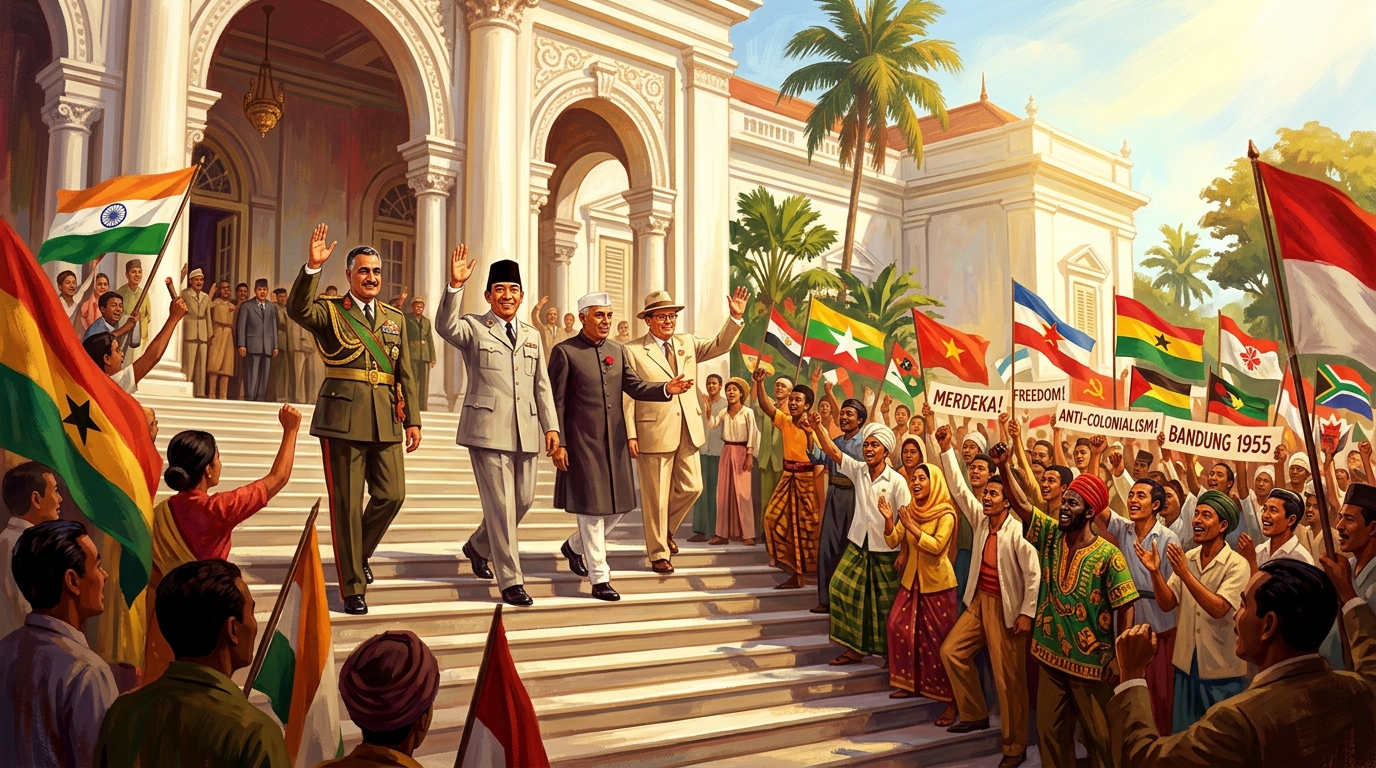
On April 18, 1955, the conference officially opened at the Gedung Merdeka (Independence Building) in Bandung, a cool hill station in West Java, Indonesia. Delegations from 29 nations, representing roughly 1.5 billion people—more than half of the world's population at the time—were in attendance.
Indonesian President Sukarno delivered the opening address, entitled "Let a New Asia and a New Africa be Born." It was a rhetorical tour de force that set the emotional and political tone for the week:
"We are often told 'Colonialism is dead.' Let us not be clamoured or deceived by that. I say to you, colonialism is not yet dead. How can we say it is dead, so long as vast areas of Asia and Africa are unfree? ... Colonialism has also its modern dress, in the form of economic control, intellectual control, actual physical control by a small but alien community within a nation. It is a skilful and determined enemy, and it appears in many guises." [[^2]]
The 29 Attending Nations (1955)
- Afghanistan
- Cambodia
- Ceylon
- China (PRC)
- Egypt
- Ethiopia
- Gold Coast (Ghana)
- India
- Indonesia
- Iran
- Iraq
- Japan
- Jordan
- Laos
- Lebanon
- Liberia
- Libya
- Nepal
- Pakistan
- Philippines
- Saudi Arabia
- Sudan
- Syria
- Thailand
- Turkey
- North Vietnam
- South Vietnam
- Yemen
- Yugoslavia (Observer)
High-Stakes Debates and Ideological Clashes
Despite the shared sentiment of anti-colonialism, the conference quickly became a forum for fierce geopolitical debate.
- The Question of "Colonialism in All Its Manifestations": Pro-Western delegates, led by Fatin Rustu Zorlu of Turkey and Carlos P. Romulo of the Philippines, argued passionately that the conference must condemn not only traditional Western imperialism but also Soviet "subversion" and the domination of Eastern Europe. This sparked heated arguments with Nehru, who feared that criticizing the Soviet Union would alienate socialist allies and drag the conference directly into Cold War polemics.
- The Diplomatic Masterclass of Zhou Enlai: The Chinese Premier navigated this hostile territory with remarkable pragmatism. Instead of delivering ideological lectures on Marxist-Leninist theory, Zhou declared that the Chinese delegation had come "to seek unity, not to quarrel." He reassured skeptical neighbors that China sought peaceful coexistence and did not intend to export revolution, a performance that defused Western efforts to paint China as an aggressive expansionist power.
- The Rise of Nasser: The conference marked the international debut of Egyptian leader Gamal Abdel Nasser. Representing a revolutionary Egypt that had recently overthrown its monarchy, Nasser used the platform to position himself as the undisputed champion of Arab nationalism, forging deep personal and political bonds with Nehru and Zhou Enlai.
The Final Accord: The Ten Principles
After days of intense closed-door negotiations, the drafting committee successfully reconciled the divergent views. On April 24, 1955, the delegates unanimously adopted the Final Communiqué, which included the historic Dasasila Bandung (Ten Principles of Bandung). These principles integrated the Indian concept of Panchsheel (Five Principles of Peaceful Coexistence) with the tenets of the United Nations Charter, emphasizing:
- Respect for fundamental human rights and the sovereignty of all nations.
- Abstention from intervention or interference in the internal affairs of another country.
- Refusal to use arrangements of collective defense to serve the particular interests of any of the big powers.
- Settlement of all international disputes by peaceful means.
Geopolitical Consequences and Aftermath
The Bandung Conference sent shockwaves through the foreign policy establishments of both Washington and Moscow. For the first time in modern diplomatic history, non-Western nations had met independently of the traditional imperial metropoles to formulate their own vision of international order.
THE BANDUNG TRANSFORMATION
- SINO-SOVIET DYNAMICS
- UNGA VOTING POWER SHIFT
The Birth of the "Third World"
Bandung effectively popularized and politicized the term "Third World" (originally coined in French as Tiers Monde by demographer Alfred Sauvy in 1952 to parallel the "Third Estate" of the French Revolution). Rather than implying economic inferiority, the term initially carried a powerful message of revolutionary hope: a third geopolitical force, distinct from both capitalist and communist systems, that would democratize global governance 3.
The Path to Belgrade (1961) and the Role of Yugoslavia
The immediate institutional successor to Bandung was the Non-Aligned Movement (NAM). While Bandung was strictly Afro-Asian, the bridge to a truly global movement was built in Europe by Josip Broz Tito.
In July 1956, just over a year after Bandung, Tito hosted Nehru and Nasser at his summer residence on the island of Brijuni, Yugoslavia. The resulting Brijuni Declaration formally linked the principles of Bandung with European non-alignment. Tito understood that for non-alignment to be a viable global strategy, it could not be racially or geographically exclusive; it had to include European, Latin American, and Mediterranean voices.
The Founding Triumvirate
- Jawaharlal Nehru (India)
- Josip Broz Tito (Yugoslavia)
- Gamal Abdel Nasser (Egypt)
When the First Summit of the Non-Aligned Movement was held in Belgrade, Yugoslavia, in September 1961, it was Tito who acted as the host, bringing together 25 nations. The Bandung spirit had officially transformed into a structured, transnational bloc that would actively challenge the hegemony of the superpowers throughout the rest of the Cold War.
Analysis of Key Actors and Decisive Actions
The success of the Bandung Conference was not a historical inevitability; it was the product of highly skilled diplomacy and personal chemistry among a handful of charismatic leaders.
| Leader | Nation | Key Strategy at Bandung | Geopolitical Legacy |
|---|---|---|---|
| Sukarno | Indonesia | High-impact anti-imperialist rhetoric; positioning Indonesia as the moral center of the global South. | Champion of "Nasakom" (Nationalism, Religion, Communism) and radical anti-colonialism. |
| Jawaharlal Nehru | India | Intellectual mediation; steering the conference away from Cold War factionalism through Panchsheel. | Architect of democratic non-alignment and champion of Sino-Indian cooperation (before 1962). |
| Gamal Abdel Nasser | Egypt | Elevating Arab nationalist concerns; bridging the Middle East with Sub-Saharan Africa and Asia. | Leader of pan-Arabism; nationalized the Suez Canal shortly after the conference (1956). |
| Josip Broz Tito | Yugoslavia | Parallel diplomacy; integrating European socialism with Afro-Asian anti-colonial struggles. | Host of the 1961 Belgrade Summit; kept Yugoslavia independent of the Soviet Warsaw Pact. |
Sukarno: The Energetic Host
For Sukarno, Bandung was a personal and national triumph. He used the conference to project Indonesia as a major regional player and to solidify his domestic grip on power by uniting disparate nationalist, communist, and Islamic political factions under a shared banner of external anti-imperialism. His emotional framing of the conference as a moral struggle between the "New Emerging Forces" (NEFOs) and the "Old Established Forces" (OLDEFOs) provided the ideological energy that sustained the delegates through difficult negotiations.
Jawaharlal Nehru: The Aristocratic Philosopher
Nehru approached Bandung with a mixture of idealistic internationalism and pragmatic statecraft. He believed that India’s safety lay in a demilitarized, peaceful Asian zone free from superpower interference. While some contemporary critics accused Nehru of being overly accommodationist toward China, his tireless work in the committee rooms was essential in keeping the ideologically fractured delegates from walking out.
Gamal Abdel Nasser: The Revolutionary Strategist
Nasser arrived in Bandung as a relatively young colonel who had taken power in a coup; he left as a statesman of global standing. The conference provided him with the international legitimacy he needed to challenge British and French influence in the Middle East. Furthermore, it was at Bandung that Nasser first discussed the possibility of purchasing Soviet bloc weapons via Czechoslovakia, a move that would fundamentally alter the balance of power in the Middle East and lead directly to the Suez Crisis of 1956.
Josip Broz Tito: The External Catalyst
Tito’s strategic calculus was profoundly vindicated by the outcomes of Bandung. By aligning Yugoslavia with the anti-colonial movements of Asia and Africa, Tito broke the diplomatic isolation imposed on him by the Kremlin. He demonstrated that a socialist state could exist outside of Moscow's control, offering a compelling model of national sovereignty that resonated deeply with newly independent states. His collaboration with Nehru and Nasser proved that non-alignment was not merely a passive refusal to take sides, but an active, positive policy aimed at restructuring the international order 4.
Trivia and Lesser-Known Facts
- The Translation of "Dasasila": The term "Dasasila" is derived from Sanskrit, where Dasa means ten and Sila means principles. This linguistic choice, heavily influenced by Indonesian and Indian cultural heritage, was a deliberate rejection of Western diplomatic jargon.
- Richard Wright’s Account: The famous African-American novelist Richard Wright, author of Native Son, attended the Bandung Conference as an independent journalist. His subsequent book, The Color Curtain: A Report on the Bandung Conference, provided a pioneering psychological and racial analysis of the gathering, framing it as the birth of a global consciousness among the non-white peoples of the world.
- The Great Wardrobe Diplomacy: The conference was a spectacular display of national attire. While Western diplomats of the era wore identical dark suits, the delegates at Bandung proudly wore traditional clothing—Nehru in his high-collared jacket (now known as the Nehru jacket), Sukarno in his songkok cap, and Saudi princes in traditional thobes. This visual assertion of cultural identity was itself a powerful statement of decolonization.
- A "Clean" Chinese Delegation: Fearing surveillance and poisoning by foreign intelligence services, the Chinese delegation brought their own drinking water, food, and security staff from Beijing. They even brought their own secure telephone lines to ensure that their communications could not be intercepted by Western powers.
References and Literature
- The Bandung Conference of 1955 on Wikipedia - A detailed overview of the participating nations, agendas, and immediate outcomes of the Asian-African Conference.
- The Non-Aligned Movement (NAM) Official History - An analytical resource tracking the evolution of the principles of Bandung into the formal structure of the Non-Aligned Movement.
- Richard Wright, The Color Curtain: A Report on the Bandung Conference - A contemporary account of the conference focusing on the intersections of race, colonialism, and international relations.
- The Belgrade Summit of 1961 on the Office of the Historian - US Department of State historical documents detailing the transition from Bandung to the formal creation of the Non-Aligned Movement under Tito.
Footnotes & Explanations
- See Tito's Non-Aligned Policy by William E. Griffith (1963), which details how Yugoslavia leveraged decolonization to preserve its own strategic independence from the Warsaw Pact. ↩
- From President Sukarno's official opening address at the Gedung Merdeka, Bandung, April 18, 1955. ↩
- Alfred Sauvy, "Trois Mondes, Une Planète," L'Observateur, August 14, 1952. ↩
- See the joint communiqué of the Brijuni Conference, signed by Tito, Nehru, and Nasser on July 19, 1956. ↩