Key Takeaways
- The Prague Spring represented a major internal attempt to reform state socialism from within, introducing civil liberties, economic decentralization, and the abolition of censorship.
- The Soviet Union, under Leonid Brezhnev, viewed these reforms as a direct threat to the cohesion of the Eastern Bloc and the geopolitical buffer zone against NATO.
- The invasion of August 20–21, 1968, crushed the reforms, codified the 'Brezhnev Doctrine' of limited sovereignty, and permanently fractured the international communist movement.
Historical Context and Origins
The geopolitical landscape of Central and Eastern Europe in the late 1960s was characterized by the rigid framework of the Cold War, wherein the Soviet Union maintained a tight grip on its satellite states through the Warsaw Pact and the Council for Mutual Economic Assistance (COMECON). However, beneath the surface of ideological conformity, deep-seated structural crises were brewing. In the Czechoslovak Socialist Republic (ČSSR), these tensions came to a head in the mid-1960s, driven by economic stagnation, political stifling, and Slovak national grievances 1.
Cold War Bloc Alignment (1968)
| Western Bloc (NATO / Capitalism) | Eastern Bloc (Warsaw Pact / State) |
|---|---|
| Relationship: Opposed | Relationship: Opposed |
| Threatened: Prague Spring ("Socialism with a Face") |
Throughout the 1950s and early 1960s, Czechoslovakia had been governed by Antonín Novotný, a hardline neo-Stalinist who served as both the First Secretary of the Communist Party of Czechoslovakia (KSČ) and the President of the Republic. Under Novotný's administration, the Czechoslovak economy—historically one of the most industrialized and prosperous in Central Europe—suffered a severe decline. The highly centralized, Soviet-style command economy failed to sustain growth, leading to widespread shortages, inefficient production, and a decline in living standards.
By 1967, intellectual and political opposition within the KSČ had crystallized. Writers, artists, and academics began openly criticizing the regime's cultural policies and censorship. At the Fourth Congress of the Czechoslovak Writers' Union in June 1967, prominent figures like Ludvík Vaculík, Milan Kundera, and Ivan Klíma delivered blistering critiques of the party's authoritarian control. Concurrently, Slovak party members, led by Alexander Dubček, expressed growing resentment toward the centralized decision-making process in Prague, which consistently marginalized Slovak regional interests and autonomy.
Recognizing Novotný’s inability to manage the escalating crisis, the KSČ Central Committee, with the tacit approval of Soviet leader Leonid Brezhnev—who initially viewed the conflict as an internal party matter—ousted Novotný from his post as First Secretary on January 5, 1968. He was replaced by the charismatic Slovak reformer, Alexander Dubček.
Dubček’s ascension marked the official beginning of the Prague Spring. He did not seek to overthrow the socialist system or align the country with the capitalist West. Instead, he proposed a radical internal restructuring:
"We must build a socialism that corresponds to the democratic traditions of our nations, a socialism that is highly humane, dynamic, and capable of satisfying the material and spiritual needs of modern man." [[^2]]
This ideological framework, famously termed "socialism with a human face" (socialismus s lidskou tváří), sought to synthesize a socialist planned economy with democratic principles, including the abolition of press censorship, the right to assembly, freedom of travel, and the federalization of the republic to grant equal status to Slovakia.
Timeline of Events and Key Moments
The transformation of Czechoslovakia progressed rapidly throughout the spring and summer of 1968, shifting from a top-down party reform program to a spontaneous, nationwide movement for democratization.
1968 Reform-to-Invasion Timeline
| Date | Event |
|---|---|
| Jan 5 | Dubček Takes Power |
| Apr 5 | Action Programme Published |
| Jun 27 | "Two Thousand Words" Manifesto |
| Jul 29-Aug 1 | Čierna nad Tisou Summit Held |
| Aug 20-21 | Operation Danube Invasion |
The Reformist Surge (January – April 1968)
- January 5, 1968: Alexander Dubček is elected First Secretary of the KSČ.
- March 1968: The de facto abolition of censorship occurs as state censors refuse to perform their duties, leading to an unprecedented explosion of free speech in newspapers, radio, and television. Novotný resigns from the presidency and is replaced by Ludvík Svoboda, a highly respected World War II hero.
- April 5, 1968: The KSČ Central Committee adopts the Action Programme (Akční program). This document outlines the blueprint for "socialism with a human face," guaranteeing freedom of speech, press, assembly, and travel, alongside economic reforms that introduced market mechanisms and worker councils.
Escalation and Soviet Anxiety (May – June 1968)
- May 1968: The Soviet leadership, increasingly alarmed by the breakdown of ideological control in Prague, conducts military exercises (codenamed "Sumava") on Czechoslovak territory to exert psychological pressure on Dubček.
- June 27, 1968: The literary journal Literární listy publishes the "Two Thousand Words" (Dva tisíce slov) manifesto, written by novelist Ludvík Vaculík and signed by over 100,000 citizens, intellectuals, and workers. The manifesto calls for rapid democratization, civilian initiatives, and defense of the reforms against external threats. Moscow interprets this document as a declaration of counter-revolution.
Diplomatic Confrontation (July – August 1968)
- July 14–15, 1968: Leaders of the Soviet Union, Poland, Hungary, Bulgaria, and East Germany meet in Warsaw. They draft the "Warsaw Letter," warning the KSČ that its domestic reforms threaten the collective security of the entire socialist camp.
- July 29 – August 1, 1968: In a tense, bilateral summit held in a railway car at Čierna nad Tisou, on the Soviet-Czechoslovak border, the entire Soviet Politburo confronts the Czechoslovak Presidium. Dubček defends the reforms, swearing loyalty to the Warsaw Pact and COMECON, while Brezhnev demands the reimposition of censorship and the suppression of non-communist organizations.
- August 3, 1968: The signing of the Bratislava Declaration. On the surface, it appears to be a compromise, but it contains a critical clause asserting that the defense of socialist gains is the "common international duty" of all fraternal socialist countries.
The Invasion: Operation Danube (August 20–21, 1968)
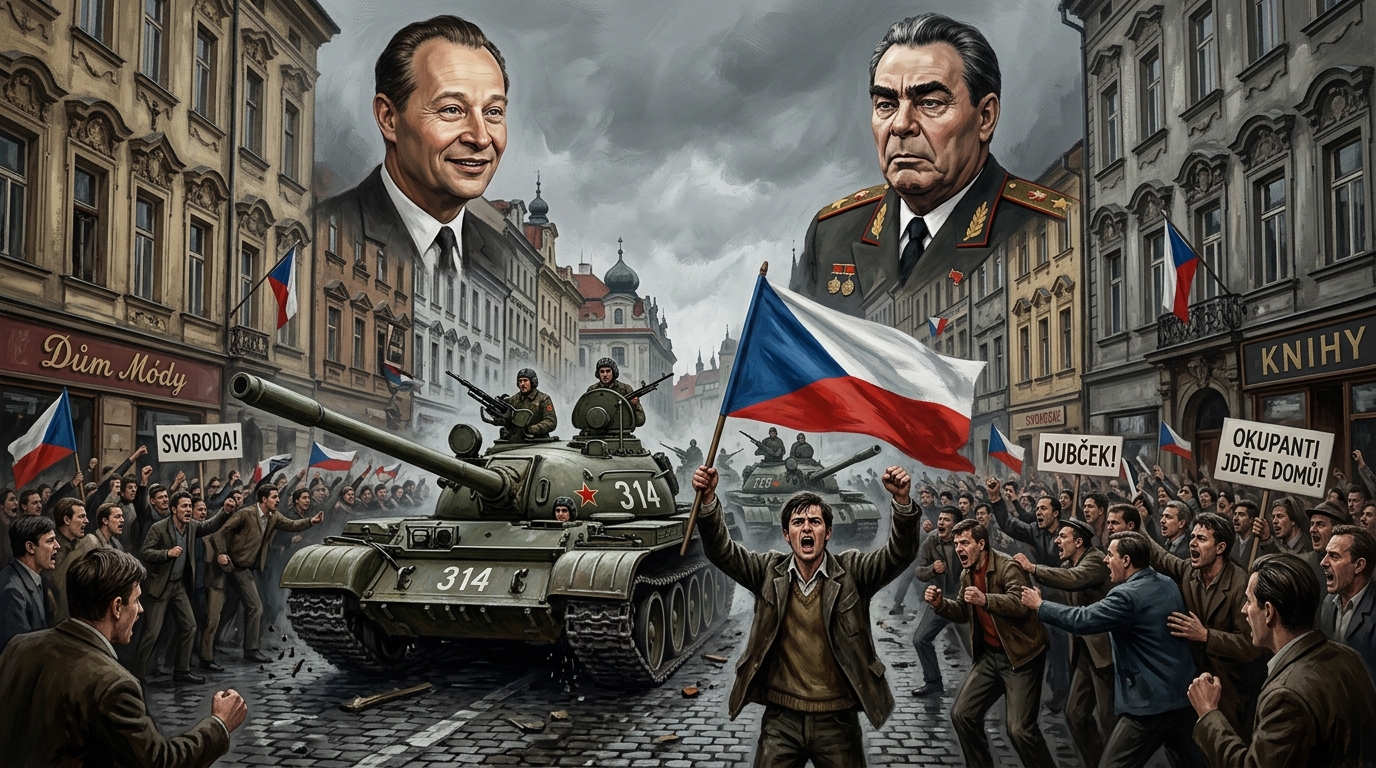
- August 20, 1968 (approx. 11:00 PM): Operation Danube (Operace Dunaj) begins. An invasion force of approximately 250,000 troops (later expanding to nearly 500,000) and 6,300 tanks from the Soviet Union, Poland, Hungary, and Bulgaria enters Czechoslovakia from multiple directions [[^3]]. East Germany provides logistical support, though its combat troops are held back at the border to avoid historical parallels with the Nazi occupation of 1938.
- August 21, 1968 (2:00 AM): Soviet airborne troops land at Prague's Ruzyně Airport and quickly seize control. The KSČ Presidium issues a historic declaration stating that the invasion occurred without the knowledge of the President, the government, or the party leadership, and calls on citizens to remain calm and offer no armed resistance to avoid a bloodbath.
- August 21–27, 1968: Dubček and other high-ranking reformers (including Oldřich Černík, Josef Smrkovský, and František Kriegel) are arrested by Soviet KGB forces and flown to Moscow in handcuffs. Meanwhile, the Czechoslovak public engages in widespread, non-violent civic resistance. Street signs are removed to disorient the invading forces, illegal free radio stations continue to broadcast truth about the invasion, and citizens confront Soviet soldiers on tanks, challenging their ideological justifications.
Invasion Routes: Operation Danube (August 1968)
| Origin | Destination |
|---|---|
| East Germany | Czechoslovakia (Prague) |
| Poland | Czechoslovakia (Prague) |
| Soviet Union | Czechoslovakia (Prague) |
| Hungary | Czechoslovakia (Prague) |
- August 27, 1968: Under immense psychological pressure and isolation in the Kremlin, the Czechoslovak delegation signs the Moscow Protocol. The agreement capitulates to Soviet demands: it invalidates the XIV Extraordinary Party Congress held secretly during the invasion, reintroduces censorship, and agrees to the permanent stationing of Soviet troops on Czechoslovak soil.
Geopolitical Consequences and Aftermath
The crushing of the Prague Spring had profound, systemic consequences for the international order, the ideological integrity of the communist movement, and the lives of millions of Czechoslovaks.
The Brezhnev Doctrine
The invasion served as the catalyst for the formal articulation of the Brezhnev Doctrine of limited sovereignty. In a speech before the Polish United Workers' Party in November 1968, Leonid Brezhnev declared:
"When forces that are hostile to socialism try to turn the development of some socialist country in the direction of capitalism, it becomes not only a problem of the country concerned, but a common problem and concern of all socialist countries." [[^4]]
This doctrine asserted that Moscow possessed the unilateral right to intervene militarily in any country within its sphere of influence to preserve the monopoly of communist rule. It institutionalized a rigid, defensive status quo in Central and Eastern Europe that lasted for two decades.
Normalization (Normalizace)
In April 1969, Alexander Dubček was officially replaced as First Secretary by Gustáv Husák, a pragmatic bureaucrat who enjoyed Moscow's confidence. Husák initiated the period of "Normalization" (normalizace), which was characterized by:
- Ideological Purges: Roughly 500,000 members were expelled from the KSČ, resulting in the loss of their jobs, academic positions, and social standing.
- Re-Stalinization of Public Life: Independent political groups were banned, censorship was strictly enforced, and travel to the West was virtually outlawed.
- A "Social Contract" of Apathy: The Husák regime offered the population a modest level of consumer stability and material well-being in exchange for public conformity and political apathy.
Normalization Era Dynamics (1969-1989)
State-Enforced Normalization
| Domestic Policies | Social Impact |
|---|---|
| • Political purges of half a million reform-minded party members. | • Destruction of civil society & free press. |
| • Restoration of rigid censorship & planning. | • Widespread apathy and conformity in exchange for economic stability. |
The psychological toll of this era was epitomized by the tragic protest of Jan Palach, a university student who set himself on fire in Wenceslas Square on January 16, 1969, to protest against public resignation and the distribution of the Soviet propaganda newspaper Zprávy.
Fissures in Global Communism
The invasion fractured the global communist movement. Western European communist parties (such as those in Italy, France, and Spain) openly condemned the Soviet action, leading to the development of Eurocommunism—a strain of communist ideology that distanced itself from Soviet authoritarianism and committed to democratic parliamentary systems.
Furthermore, several socialist states strongly condemned the invasion. Romania, under Nicolae Ceaușescu, refused to participate in the intervention, and Ceaușescu delivered a fiery speech in Bucharest denouncing the invasion as a "grave mistake" and a violation of international law 5. Albania formally withdrew from the Warsaw Pact in protest, and Yugoslavia, led by Josip Broz Tito, placed its military on high alert, fearing a potential Soviet invasion of the Balkans.
Analysis of Key Actors and Decisive Actions
| Key Actor | Role in the Crisis | Strategic Motivation | Decisive Actions |
|---|---|---|---|
| Alexander Dubček | First Secretary of the KSČ | Desired to modernize socialism to ensure its long-term survival through democratic legitimacy. | Adopted the Action Programme; resisted Soviet ultimatums; ordered non-resistance during the invasion to prevent bloodshed. |
| Leonid Brezhnev | General Secretary of the CPSU | Determined to maintain the strategic integrity of the Eastern Bloc and prevent any ideological deviation. | Coordinated the Warsaw Pact pressure campaign; ordered Operation Danube; formulated the Brezhnev Doctrine. |
| Ludvík Svoboda | President of Czechoslovakia | Sought to preserve national sovereignty and prevent bloodshed. | Refused to appoint a Soviet-backed puppet government; insisted on negotiating directly with the imprisoned reformers in Moscow. |
| Vasil Biľak & Alois Indra | Hardline KSČ Presidium Members | Alarmed by the loss of party monopoly and the rise of democratic tendencies. | Secretly signed and delivered the "Letter of Invitation" to Moscow, providing a fabricated pretext for Soviet military intervention. |
The crisis of 1968 demonstrated a profound asymmetry in political risk assessment between Prague and Moscow. Dubček was an idealist who firmly believed that because he did not intend to leave the Warsaw Pact or challenge Soviet security interests, Moscow would ultimately tolerate his internal democratization efforts. He miscalculated the extent to which the Soviet Politburo viewed ideological conformity as synonymous with security.
Brezhnev, on the other hand, was driven by a deep fear of the "domino effect." The Soviet military high command argued that a democratic, open Czechoslovakia would leave the strategic Bohemian border with West Germany undefended, potentially inviting NATO penetration into the heart of the Warsaw Pact defense line.
Trivia and Lesser-Known Facts
- The Letter of Invitation: For decades, the Soviet Union claimed they had been invited into Czechoslovakia by "healthy forces" within the country. The original "Letter of Invitation," signed by five hardline KSČ officials (Vasil Biľak, Alois Indra, Drahomír Kolder, Oldřich Švestka, and Antonín Kapek), was secretly handed to Brezhnev during the Bratislava summit in a public toilet. The document was kept in the secret archives of the Kremlin and was only officially handed over to the Czech government by Boris Yeltsin in 1992.
- The Blackout of the XIV Party Congress (Vysočany): On August 22, 1968, while Soviet troops occupied Prague, over 1,200 delegates of the KSČ secretly convened in a large industrial tractor factory in the Prague suburb of Vysočany. Operating under the noses of the occupiers, they successfully held the XIV Extraordinary Party Congress, re-electing Dubček, condemning the invasion, and calling for a general strike.
- The Red Square Demonstration: On August 25, 1968, eight Soviet citizens (including Pavel Litvinov, Larisa Bogoraz, and Natalya Gorbanevskaya) staged a daring protest in Moscow’s Red Square against the invasion of Czechoslovakia. They unfurled banners with slogans such as "For Your Freedom and Ours" (За вашу и нашу свободу). Within minutes, they were arrested, beaten by the KGB, and subsequently sentenced to years of hard labor, exile, or forced psychiatric confinement.
- The Ice Hockey Riots of 1969: Sports became a primary venue for national catharsis. During the World Ice Hockey Championships in Stockholm in March 1969, the Czechoslovak national team defeated the Soviet Union twice (2:0 and 4:3). The victories sparked massive nationwide celebrations that rapidly evolved into anti-Soviet riots. Angry crowds attacked Soviet military barracks and Aeroflot offices in Prague. This civil unrest provided the Soviet Union with the final pretext to remove Dubček from office and install Gustáv Husák.
References and Literature
- The Prague Spring and the Warsaw Pact Invasion of Czechoslovakia in 1968 - An extensive archival collection and analysis from the Wilson Center's Cold War International History Project.
- The Prague Spring 1968: A National Security Archive Documents Reader - Declassified documents, meeting transcripts, and intelligence assessments detailing the decision-making process in both Prague and Moscow.
- Williams, Kieran. (1997). The Prague Spring and its Aftermath: Czechoslovak Politics, 1968–1970. Cambridge University Press. - A definitive academic study analyzing the political dynamics, the mechanics of the invasion, and the institutionalization of the Normalization era.
- Valenta, Jiri. (1991). Soviet Intervention in Czechoslovakia, 1968: Anatomy of a Decision. Johns Hopkins University Press. - An in-depth foreign policy analysis exploring the internal bureaucratic debates within the Soviet Politburo leading up to Operation Danube.
---
Footnotes & Explanations
- Kieran Williams, The Prague Spring and its Aftermath: Czechoslovak Politics, 1968–1970 (Cambridge University Press, 1997), pp. 3-12. ↩
- Alexander Dubček, Address to the Central Committee of the KSČ, April 1968. ↩
- Jiri Valenta, Soviet Intervention in Czechoslovakia, 1968: Anatomy of a Decision (Johns Hopkins University Press, 1991), pp. 132-135. ↩
- Leonid Brezhnev, Speech at the Fifth Congress of the Polish United Workers' Party, November 12, 1968. ↩
- Nicolae Ceaușescu, Speech in Palace Square, Bucharest, August 21, 1968. ↩