Key Takeaways
- The British Mandate for Palestine ended on May 14, 1948, leading directly to the declaration of the State of Israel by David Ben-Gurion.
- A coalition of Arab states, including Egypt, Jordan, Syria, and Iraq, immediately intervened, transforming a localized civil conflict into an international war.
- The war concluded with the 1949 Armistice Agreements, establishing the 'Green Line' borders and resulting in major refugee crises for both Palestinians and Jewish communities in the Arab world.
Historical Context and Origins
The geopolitical landscape of the modern Middle East was fundamentally reshaped during the late 1940s, a decade characterized by the collapse of European colonial empires and the rise of nationalist movements. At the center of this transformation was the dissolution of the British Mandate for Palestine and the outbreak of the 1948 Arab-Israeli War. To understand the dimensions of this conflict, one must examine the competing nationalist aspirations, colonial policies, and international shifts that preceded the outbreak of hostilities.
The Rise of Competing Nationalisms
The origins of the conflict lie in the late 19th and early 20th centuries, with the concurrent rise of two major nationalist movements in the Southern Levant:
- Zionism: Emerging in late 19th-century Europe under the leadership of Theodor Herzl, Zionism sought to establish a sovereign national homeland for the Jewish people in their ancestral land, driven by persistent European antisemitism.
- Arab Nationalism: Concurrently, Arab nationalism grew within the Ottoman Empire, seeking self-determination and sovereign independence for the Arab populations of the Middle East.
Following the defeat of the Ottoman Empire in World War I, the League of Nations formally granted Great Britain the Mandate for Palestine in 1922. The mandate incorporated the text of the Balfour Declaration of 1917, in which the British government committed to supporting the "establishment in Palestine of a national home for the Jewish people," provided that the civil and religious rights of the existing non-Jewish communities were not prejudiced. 1
The Interwar Crises and British Policy Shifts
Throughout the 1920s and 1930s, Jewish immigration (Aliyah) to Palestine accelerated, particularly after the rise of the Nazi regime in Germany. This demographic shift heightened anxieties among the indigenous Arab population, who feared political displacement and land dispossession. The resulting tensions erupted into localized violence, most notably the 1929 riots and the Great Arab Revolt of 1936–1939.
In response to the Arab Revolt, the British government sought to stabilize the region by limiting Jewish immigration and land purchases. The White Paper of 1939 marked a dramatic shift in British policy, effectively abandoning the idea of partitioning Palestine into separate states and proposing instead an independent, unitary state with an Arab majority within ten years, while strictly capping Jewish immigration. This policy deeply alienated the Zionist leadership, who viewed it as a betrayal, particularly on the eve of the Holocaust.
Post-World War II Realities and the UN Partition Plan
The aftermath of World War II and the revelation of the Holocaust intensified international pressure to find a permanent solution for hundreds of thousands of Jewish displaced persons in Europe. At the same time, militant Jewish groups in Palestine, such as the Irgun and Lehi, waged an armed insurgency against British administrative and military infrastructure, while the mainstream Haganah organized large-scale clandestine immigration operations.
Exhausted by the economic strain of World War II and unable to find a policy acceptable to both Arab and Jewish populations, Great Britain announced in February 1947 that it would hand over the problem of Palestine to the newly formed United Nations.
The UN established the United Nations Special Committee on Palestine (UNSCOP) to investigate the situation. On November 29, 1947, the UN General Assembly adopted Resolution 181, which recommended the partition of the Mandate territory into an independent Jewish state, an independent Arab state, and an internationalized zone (corpus separatum) for Jerusalem and its surrounding holy sites. 2
| Proposed Entity | Demographics (Approximate) | Proposed Land Allocation |
|---|---|---|
| Jewish State | 498,000 Jews / 407,000 Arabs | ~56% of Mandate Palestine |
| Arab State | 725,000 Arabs / 10,000 Jews | ~43% of Mandate Palestine |
| International Zone | 100,000 Jews / 105,000 Arabs | ~1% (Jerusalem & Bethlehem) |
The Zionist leadership accepted the Partition Plan, viewing it as a historic recognition of Jewish sovereignty, despite reservations regarding the non-contiguous borders and the exclusion of Jerusalem. Conversely, the Arab Higher Committee and the states of the Arab League rejected the plan entirely, arguing that it violated the principles of self-determination by granting the minority population the majority of the fertile agricultural land.
The passage of Resolution 181 immediately triggered the 1947–1948 Civil War in Mandatory Palestine, a localized conflict characterized by guerrilla warfare, urban bombings, and blocks on vital communication and supply routes. During this phase, local Palestinian Arab militias, aided by the volunteer-based Arab Liberation Army, clashed with the Haganah and other Jewish forces for control of strategic transport corridors and demographic hubs.
Timeline of Events and Key Moments
The conflict transitioned from a localized civil war into an interstate military campaign on May 14, 1948, as the British Mandate officially terminated. The events that followed can be categorized into distinct phases of military offensive, diplomatic intervention, and territorial consolidation.
| Date | Event |
|---|---|
| Nov 29, 1947 | UN Resolution 181 (Partition Plan Passed) |
| Nov 30, 1947 - May 14, 1948 | Civil War Phase in Mandate Palestine |
| May 14, 1948 | Israeli Declaration of Independence (Ben-Gurion) |
| May 15, 1948 | Invasion by Arab Coalition (Egypt, Jordan, Syria, Iraq) |
| June 11 - July 9, 1948 | First UN Truce (Reorganization & Arms Deals) |
| July 9 - July 19, 1948 | Ten Days' Campaign (Israeli Offensive) |
| Oct 1948 - March 1949 | Israeli Campaigns (Yoav, Hiram, Horev, Uvda) |
| Jan - July 1949 | Armistice Agreements signed at Rhodes |
May 14, 1948: The Declaration of Independence
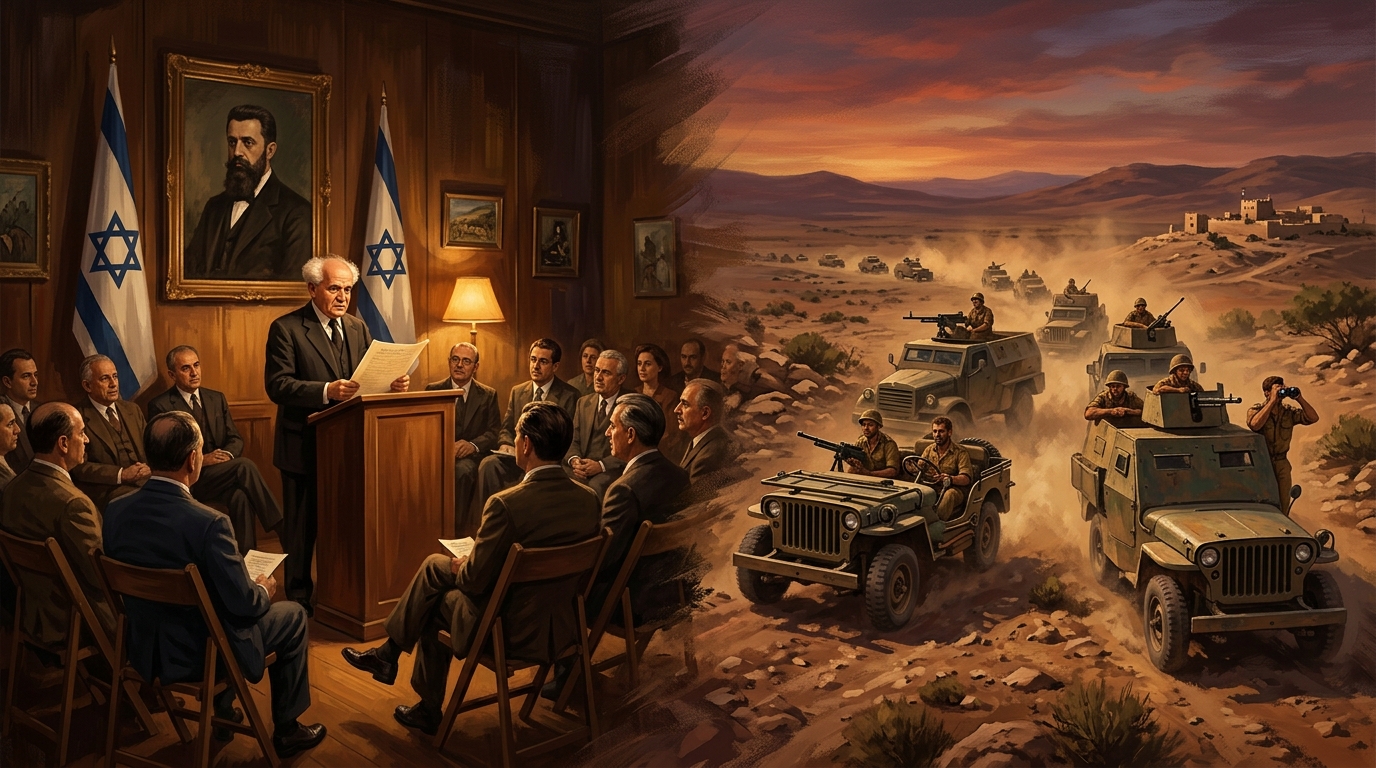
On the afternoon of May 14, 1948, hours before the British high commissioner left Palestine, David Ben-Gurion, Chairman of the Jewish Agency, read the Declaration of Independence of the State of Israel at the Tel Aviv Museum.
"By virtue of our natural and historic right and on the strength of the resolution of the United Nations General Assembly, we hereby declare the establishment of a Jewish state in Eretz-Israel, to be known as the State of Israel." — David Ben-Gurion, May 14, 1948 [[^3]]
The United States issued de facto recognition of the new state almost immediately, followed shortly by de jure recognition from the Soviet Union.
May 15, 1948: The Arab Coalition Intervention
On May 15, the armies of five sovereign Arab nations—Egypt, Transjordan, Syria, Iraq, and Lebanon—crossed the borders of the former Mandate. Their stated objective was to protect the Arab population and establish a unified, independent state of Palestine.
The initial phase of the intervention saw significant Arab advances:
- The Southern Front: Egyptian forces advanced along the coastal road toward Tel Aviv, but were halted at the Yad Mordechai kibbutz and later at the Ibrahim al-Khalil bridge (rebuilt as the Ad Halom bridge near Ashdod). Another Egyptian column moved eastward toward Beersheba and Jerusalem.
- The Central Front: The Transjordanian Arab Legion, commanded by British officer Sir John Bagot Glubb (Glubb Pasha), crossed the Jordan River and engaged in fierce combat with Jewish forces in Jerusalem. The Legion successfully captured the Old City of Jerusalem, forcing the surrender of the Jewish Quarter, and established a block on the strategic Latrun junction, cutting off West Jerusalem's supply lines.
- The Northern Front: Syrian forces struck from the Golan Heights, attacking settlements near the Sea of Galilee, while Lebanese and Iraqi units made limited incursions in the Upper Galilee and Samaria, respectively.
The First Truce (June 11 – July 9, 1948)
Acknowledging the heavy casualties and logistical exhaustion on both sides, the United Nations Security Council brokered a four-week truce, administered by UN Mediator Count Folke Bernadotte of Sweden.
This period proved to be a decisive turning point for Israel. While the arms embargo imposed by the UN was technically active, Israel successfully secured a major, clandestine shipment of weapons, artillery, and fighter aircraft from Czechoslovakia (with the tacit approval of the Soviet Union). This influx of material, combined with rapid mobilization and the integration of combat-experienced volunteers from abroad (Mahal), transformed the military balance of power.
It was also during this period that Ben-Gurion took the politically risky step of asserting state authority over rival factions. When the Altalena, a cargo ship carrying arms for the nationalist Irgun militia, arrived in June, Ben-Gurion insisted on the unconditional surrender of the weapons to the newly formed Israel Defense Forces (IDF). The resulting armed confrontation led to the shelling of the ship by the IDF, cementing the central authority of the state.
The Ten Days' Campaign (July 9 – 19, 1948)
When the truce expired, the IDF launched a series of offensive operations designed to break the siege of Jerusalem and secure strategic territory:
- Operation Dani: The IDF captured the strategic towns of Lydda (Lod) and Ramle, securing a vital transport corridor and neutralizing the threat to Tel Aviv. This operation resulted in the forced displacement of tens of thousands of local Arab residents.
- Operation Dekel: In the north, Israeli forces captured Nazareth and established control over the Western Galilee.
- Jerusalem Corridor: To bypass the Arab Legion’s blockade at Latrun, Israeli engineers constructed the "Burma Road," a makeshift bypass route through the Judean Hills that allowed vital food, water, and fuel supplies to reach the besieged Jewish population of West Jerusalem.
Final Offensives and the 1949 Armistice Agreements
Following a second, uneasy truce, Israel launched several concentrated offensives to secure its borders:
- Operation Yoav (October 1948): Targeted the southern front, driving the Egyptian army back into the northern Sinai and isolating their forces in the Faluja Pocket.
- Operation Hiram (October 1948): Successfully cleared the remaining Arab Liberation Army units from the Upper Galilee, securing the northern border.
- Operation Horev (December 1948 – January 1949): An offensive designed to expel all Egyptian forces from the Negev and advance into the Sinai Peninsula. British diplomatic intervention and US pressure eventually compelled Israeli forces to withdraw from Sinai.
- Operation Uvda (March 1949): The final military movement of the war, in which Israeli forces advanced through the southern Negev desert to reach the Red Sea coast, establishing the outpost of Umm al-Rashrash (modern-day Eilat) without armed conflict.
Between February and July 1949, UN-mediated negotiations on the island of Rhodes led to the signing of bilateral Armistice Agreements between Israel and Egypt, Lebanon, Jordan, and Syria. Iraq refused to sign any agreement, withdrawing its forces and leaving Jordan to administer its positions in Samaria.
Geopolitical Consequences and Aftermath
The 1948 Arab-Israeli War concluded with profound demographic, territorial, and political transformations that set the stage for decades of regional instability.
Territorial Reconfiguration
The armistice lines, collectively referred to as the Green Line, differed significantly from the borders proposed under UN Resolution 181.
- Israel: Emerged from the conflict in control of roughly 78% of the former British Mandate for Palestine, including the Galilee, the entire Negev desert, and a land corridor linking the coastal plain to West Jerusalem.
- Transjordan: Occupied and subsequently annexed the mountainous central region of Samaria and Judea (renamed the West Bank) and East Jerusalem, including the Old City. This annexation was recognized internationally only by the United Kingdom and Pakistan.
- Egypt: Retained control of the Gaza Strip, a narrow coastal pocket of land populated largely by displaced refugees, which remained under Egyptian military administration.
| UN Partition Plan 1947 | Post-Armistice Borders 1949 |
|---|---|
| Proposed Arab & Jewish States (Contiguous zones) | Under Jordanian Control (West Bank) & Israeli Control |
The Palestinian Refugee Crisis (Al-Nakba)
The war resulted in the displacement of approximately 700,000 Palestinian Arabs from their ancestral towns and villages in what became the State of Israel. Known in Arab historiography as the Nakba ("Catastrophe"), this displacement remains a core grievance of the Israeli-Palestinian conflict.
Historians continue to debate the relative weight of the factors that drove this displacement. They point to a combination of:
- Direct military expulsions by Jewish forces (such as in Lydda and Ramle).
- Panic and psychological pressure generated by military engagements and civilian massacres (such as the Deir Yassin massacre carried out by Irgun and Lehi fighters in April 1948). [[^4]]
- Encouragement from local Arab leaders and neighboring states to evacuate temporarily until military victory was secured.
- The collapse of local Palestinian Arab leadership, social cohesion, and administrative services.
The UN General Assembly passed Resolution 194 in December 1948, which resolved that refugees wishing to return to their homes and live at peace with their neighbors should be permitted to do so, or be compensated for their property. Israel, citing security concerns and the need to preserve its Jewish demographic majority, refused to allow a large-scale return, absorbing instead hundreds of thousands of Jewish immigrants into the vacated properties.
The Jewish Exodus from Arab Countries
Concurrently, the outbreak of the war and the rise of nationalist sentiment in the Arab world triggered a wave of anti-Jewish riots, state-sponsored discrimination, and confiscation of property across the Middle East and North Africa. Over the subsequent decade, more than 800,000 Jews fled or were expelled from countries such as Iraq, Yemen, Egypt, Syria, Morocco, and Libya. Approximately 600,000 of these refugees resettled in Israel, where they were integrated into the state, fundamentally altering Israel's demographic and cultural landscape.
Regional Political Upheaval
The defeat of the Arab armies, which became known in the Arab world as the Nakba, shook the legitimacy of the ruling elites and monarchies in the region:
- Egypt: Public anger over the army's poor performance and allegations of government corruption during the war paved the way for the Egyptian Revolution of 1952, led by Gamal Abdel Nasser's Free Officers Movement, which overthrew King Farouk.
- Jordan: King Abdullah I was assassinated in Jerusalem in July 1951 by a Palestinian nationalist who feared the monarch was planning to sign a separate peace treaty with Israel.
- Syria: The government experienced three military coups in 1949 alone, initiated by officers disillusioned by the political leadership's conduct during the campaign.
Analysis of Key Actors and Decisive Actions
The outcome of the 1948 war—which defied contemporary expectations of an easy Arab victory over a fledgling state—can be attributed to several critical strategic, logistical, and political factors.
David Ben-Gurion and the Unification of Jewish Forces
David Ben-Gurion's leadership was central to Israel's wartime strategy. His most critical and controversial decision was the dismantling of the pre-state militias and their consolidation into a single, disciplined state military:
- Order Number 4: Issued on May 26, 1948, this order established the Israel Defense Forces (IDF) and prohibited the maintenance of any other armed forces.
- The Dissolution of the Palmach: Ben-Gurion systematically dissolved the elite strike units of the Palmach, which were politically aligned with the left-wing Mapam party, ensuring that the military remained subservient to the civilian government rather than partisan interests.
Ben-Gurion also prioritized a "Jerusalem-first" strategy. Despite intense opposition from his field commanders, who argued that wasting troops on the Latrun corridor was strategically unsound, Ben-Gurion understood that the loss of Jerusalem would deal a devastating psychological and political blow to the newly proclaimed state.
Division and Divergent Goals of the Arab Coalition
The Arab coalition suffered from deep political divisions, a lack of central coordination, and mutually conflicting war aims:
- King Abdullah's Ambitions: Transjordan's King Abdullah I had secret negotiations with Jewish leaders prior to the war. His primary goal was not the destruction of the Jewish state, but rather the annexation of the Arab portion of Palestine (the West Bank) to expand his Hashemite Kingdom.
- Inter-Arab Rivalry: Egypt, Syria, and Saudi Arabia viewed Abdullah's expansionist goals with deep suspicion. The establishment of the "All-Palestine Government" in Gaza by Egypt was a direct political maneuver designed to counter Jordan's influence, rather than a genuine attempt at building an independent Palestinian state.
- Logistical Failures: The Arab forces fought as separate national contingents with no unified high command. Communication was poor, and logistics lines were overextended. Despite a nominal population advantage of tens of millions, the actual number of Arab troops deployed in Palestine during the first phase of the war was relatively small, often matching or even falling below the mobilization levels achieved by the IDF.
Mobilization and Human Capital
The Zionist leadership was highly successful at mobilizing its population. Under the direction of the provisional government, almost all sectors of society were integrated into the war effort.
Total Forces Engaged (Estimates for Mid-1948)
| Force | Estimated Strength |
|---|---|
| IDF Forces | 60,000 - 80,000 (Fully mobilized) |
| Combined Arab Coalition Forces | 40,000 - 55,000 |
While the Arab armies relied on professional expeditionary forces operating far from home, Israel mobilized its entire civilian population, including World War II veterans with modern tactical and engineering skills. This operational flexibility allowed the IDF to field more combat units during the crucial second half of the war.
Trivia and Lesser-Known Facts
- The First Fighter Squadron's Irony: The newly formed Israeli Air Force’s first operational fighter squadron (101 Squadron) flew Avia S-199s, which were Czechoslovak-built versions of the German Luftwaffe’s Messerschmitt Bf 109. This meant that Jewish pilots, many of whom had lost families in the Holocaust, were flying planes designed by Nazi Germany to defend the Jewish state against British-designed Spitfires flown by the Egyptian Air Force.
- The Secret "Burma Road": The construction of the Burma Road was inspired by the Allied supply route of the same name in Burma during WWII. The route was scouted by Mickey Marcus, a West Point graduate and former US Army colonel who volunteered to help the Jewish forces. Marcus was accidentally shot and killed by an Israeli sentry just hours before the second ceasefire took effect, because he spoke English and did not understand the Hebrew password.
- The French Cannon of Degania: During the defense of Kibbutz Degania in May 1948 against a Syrian armored advance, Jewish defenders used pre-WWI French 65mm mountain guns (nicknamed "Napoleonchiks"). These obsolete pieces of artillery, which lacked proper sights, were rushed to the front line and successfully halted the Syrian tanks, marking a major psychological victory.
- The Role of Mahal Volunteers: Approximately 4,000 foreign volunteers, mostly World War II veterans from the US, UK, Canada, and South Africa, served in the IDF during the war. Their specialized skills were critical in establishing the Israeli Air Force, Navy, and medical corps.
References and Literature
- The Birth of the Palestinian Refugee Problem Revisited - Benny Morris's detailed archival study analyzing the origins and development of the 1948 Palestinian refugee crisis.
- The 1948 Arab-Israeli War (Office of the Historian) - An official historical summary of the conflict provided by the United States Department of State.
- Israel's Border Wars, 1949–1956 - Historical analysis of the armistice regime, border conflicts, and political fallout following the 1948 war.
- A History of Israel: From the Rise of Zionism to Our Time - Howard M. Sachar's comprehensive volume outlining the geopolitical movements, military engagements, and political shifts of the era.
Footnotes & Explanations
- The Balfour Declaration was a letter written on November 2, 1917, by British Foreign Secretary Arthur Balfour to Lord Rothschild, a leader of the British Jewish community, for transmission to the Zionist Federation of Great Britain and Ireland. ↩
- United Nations General Assembly Resolution 181 (II) was adopted on November 29, 1947, by a vote of 33 to 13, with 10 abstentions. ↩
- Excerpted from the Declaration of the Establishment of the State of Israel, published in the Official Gazette, No. 1, Tel Aviv, May 14, 1948. ↩
- The events at Deir Yassin on April 9, 1948, where over 100 Arab villagers were killed by Irgun and Lehi forces, became a powerful psychological symbol that accelerated the flight of Arab communities throughout the Mandate territory. ↩