Key Takeaways
- The crisis originated in Thailand on July 2, 1997, when the government was forced to unpeg the Thai Baht from the US Dollar, sparking a massive regional currency sell-off.
- In Indonesia, the economic devastation triggered deep social unrest, culminating in the resignation of President Suharto after 32 years of autocratic rule.
- The International Monetary Fund (IMF) intervened with controversial structural adjustment packages, permanently altering the economic sovereignty of South Korea, Thailand, and Indonesia, while paving the way for the rise of China as a stabilizing regional power.
Historical Context and Origins
In the early to mid-1990s, East Asia was celebrated globally as an economic miracle. Nations like Thailand, Indonesia, Malaysia, Singapore, and South Korea experienced unprecedented GDP growth rates, often averaging between 8% and 10% annually. This phenomenon, famously dubbed the "East Asian Miracle" by the World Bank, attracted vast inflows of foreign capital. International investors, eager to capitalize on these high-yielding markets, poured billions of dollars into the region1.
Underlying this spectacular growth, however, were deep structural vulnerabilities. Many East Asian economies maintained fixed or tightly managed exchange rate regimes, pegging their national currencies to the US Dollar. This arrangement offered a false sense of security to domestic banks and corporations, encouraging them to borrow heavily in US Dollars—which featured lower interest rates—without hedging against currency risks.
Much of this imported capital was not channeled into productive, export-oriented industries. Instead, it was funneled into speculative real estate projects, inflated stock markets, and overly ambitious infrastructure schemes. This misallocation of capital was exacerbated by what critics termed "crony capitalism": a system wherein credit allocation was determined by political connections and nepotism rather than robust risk assessment.
The Cycle of Vulnerability (1990-1997)
- Fixed Exchange Rate (Pegged to USD)
By 1995, external macroeconomic shifts began to apply immense pressure on the region. The United States Federal Reserve, under Chairman Alan Greenspan, began raising interest rates to curb domestic inflation. Consequently, the US Dollar appreciated sharply against other major currencies, including the Japanese Yen. Because East Asian currencies were pegged to the dollar, they appreciated in tandem. This made East Asian exports significantly more expensive and less competitive on the global market, leading to widening current account deficits across the region, particularly in Thailand.
By late 1996, the economic cracks could no longer be hidden. In Thailand, property prices began to decline, and major financial institutions started defaulting on their foreign debt obligations. The collapse of Finance One, Thailand's largest finance company, in early 1997 signaled to international currency speculators that the Thai Baht was severely overvalued and ripe for attack.
Timeline of Events and Key Moments
The Spark: Thailand’s Capitulation
Throughout the spring of 1997, the Bank of Thailand fought a desperate, covert battle to defend the Baht against aggressive speculative attacks, primarily led by global hedge funds. The central bank spent billions of dollars in foreign currency reserves and entered into complex forward contracts to maintain the peg. By late June, however, the country’s usable foreign reserves were virtually exhausted.
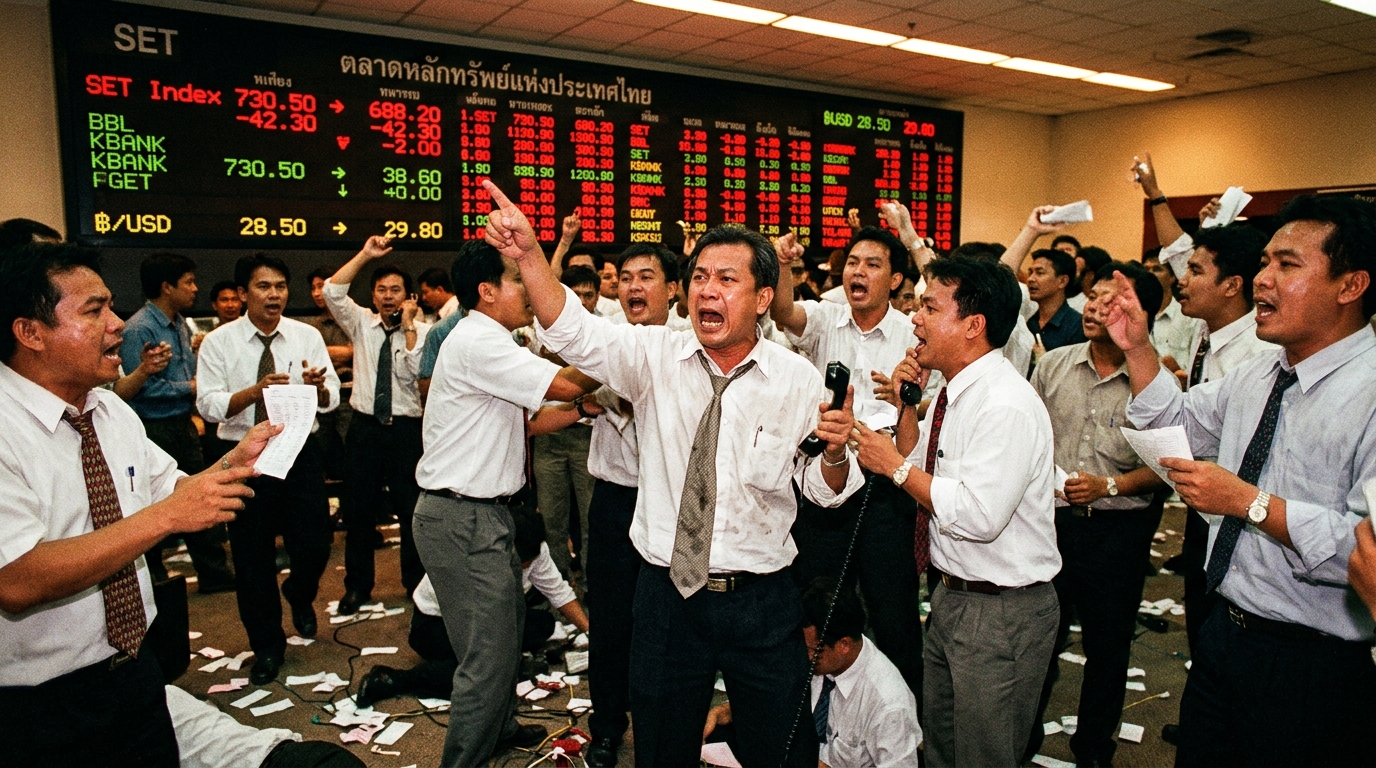
On July 2, 1997, the Thai government officially announced the floating of the Baht. The currency immediately depreciated by nearly 20%, triggering a wave of panic across regional financial markets. This event, later referred to in Thailand as the Tom Yum Goong crisis (named after the famous local spicy soup), marked the official beginning of the Asian Financial Crisis2.
The Contagion Spreads
The devaluation of the Baht shattered investor confidence, leading to a phenomenon known as "contagion." Global investors, recognizing that neighboring countries possessed similar macroeconomic weaknesses, rushed to liquidate their regional assets and convert their local currencies into US Dollars.
- July 11, 1997: The Philippines was forced to let the Peso float.
- August 14, 1997: Indonesia abandoned its managed exchange rate corridor, allowing the Rupiah to float. The Rupiah immediately began a catastrophic downward spiral.
- August 1997: Thailand formally requested assistance from the International Monetary Fund (IMF), securing a $17.2 billion rescue package conditioned on painful economic reforms.
The Indonesian Collapse and Suharto's Fall
By the autumn of 1997, Indonesia had become the epicenter of the crisis. President Suharto, who had ruled the country with an iron fist since 1967 under his "New Order" regime, initially attempted to resist the stringent conditions imposed by the IMF. The Indonesian Rupiah, which had traded at around 2,500 to the US Dollar before the crisis, plummeted to over 15,000 to the dollar by January 1998.
This astronomical depreciation destroyed the balance sheets of Indonesian corporates, which held massive dollar-denominated debts. Inflation soared, food shortages became widespread, and the domestic banking sector collapsed. In January 1998, Suharto signed a second, highly publicized agreement with IMF Managing Director Michel Camdessus.
The image of Camdessus standing over the seated, aging president with crossed arms as Suharto signed away control of Indonesia's economic policy became a potent symbol of national humiliation across Southeast Asia.
| Date | Event |
|---|---|
| July 1997 | Thai Baht floats; regional panic begins. |
| Aug 1997 | Indonesia floats the Rupiah; currency plummets. |
| Jan 1998 | Suharto signs humiliating IMF agreement amid hyperinflation. |
| May 1998 | Trisakti University shootings trigger mass riots in Jakarta. |
| May 21, 1998 | Suharto resigns, ending 32 years of New Order rule. |
The social fabric of Indonesia unraveled rapidly. In May 1998, massive student-led protests demanding democratic reforms erupted in Jakarta and other major cities. On May 12, security forces shot and killed four students at Trisakti University, igniting nationwide riots. The violence quickly turned systemic, targeting state infrastructure and the wealthy ethnic Chinese minority, who were scapegoated for the country's economic woes.
With his military backing dissolving and his closest political allies deserting him, Suharto resigned on May 21, 1998, handing power to his Vice President, B.J. Habibie.
South Korea’s "National Humiliation"
While Southeast Asia burned, the crisis moved northward to South Korea, the world’s 11th largest economy. South Korea’s industrial conglomerates, known as chaebols, had fueled the country's rapid development through highly leveraged expansions. When the crisis hit, foreign banks refused to roll over short-term loans to South Korean banks and chaebols.
Facing an imminent default on its sovereign debt, South Korea turned to the IMF. On December 3, 1997, Seoul signed a historic $58 billion bailout package—the largest in the IMF's history at the time. The South Korean public viewed the day as one of national shame, colloquially referring to the period as the "IMF Era."
Geopolitical Consequences and Aftermath
The 1997 Asian Financial Crisis was far more than a financial disruption; it fundamentally reshaped the geopolitical landscape of East Asia, shifting power balances and rewriting the rules of global governance.
The Rise of China as a Regional Anchor
One of the most significant geopolitical outcomes of the crisis was the dramatic elevation of China’s prestige and influence. While its neighbors fell like dominoes, Beijing chose to resist the temptation to devalue its currency, the Renminbi (RMB), to boost its own exports.
Had China devalued the RMB, it would have triggered another devastating round of competitive devaluations across Southeast Asia. By maintaining the RMB's peg to the US Dollar, China acted as a vital stabilizer for the regional economy. This responsible stakeholder behavior earned Beijing immense goodwill and diplomatic leverage across Southeast Asia, marking the beginning of a shift away from exclusive reliance on US hegemony3.
"In this crisis, China has shown itself to be a responsible partner. By maintaining the stability of the Renminbi, China has made a major contribution to the stability of the region." — Goh Chok Tong, Prime Minister of Singapore (1998)
Democratic Transitions and Institutional Reforms
The crisis acted as a powerful catalyst for political transformation:
- Indonesia: The fall of Suharto inaugurated the Reformasi era, transforming Indonesia from a military-backed autocracy into the world's third-largest democracy. It also paved the way for East Timor to secure its independence through a UN-sponsored referendum in 1999, as the weakened central government in Jakarta could no longer sustain its costly military occupation.
- South Korea: The crisis facilitated the election of longtime dissident and opposition leader Kim Dae-jung to the presidency. Kim used the crisis to push through sweeping structural reforms of the chaebols, increase labor market flexibility, and champion his famous "Sunshine Policy" of engagement with North Korea.
Rejection of the Washington Consensus and the Rise of Regionalism
The aggressive, austerity-heavy prescriptions of the IMF—which reflected the market-fundamentalist doctrine of the "Washington Consensus"—faced fierce criticism. Leaders like Malaysia's Prime Minister Mahathir Mohamad openly accused Western financial institutions and speculators of economic imperialism. Mahathir famously rejected IMF assistance, instead imposing strict capital controls and pegging the Malaysian Ringgit directly to the US Dollar—a move that was initially condemned by economists but later acknowledged as highly effective.
The deep resentment toward the IMF fostered a collective determination among East Asian nations to build defensive financial mechanisms that did not rely on Western institutions. This led to the creation of the Chiang Mai Initiative (CMI) in May 2000. Established by the ASEAN+3 group (the Association of Southeast Asian Nations plus China, Japan, and South Korea), the CMI created a network of bilateral currency swap arrangements designed to provide emergency liquidity support, bypassing the IMF entirely4.
Evolution of Regional Autonomy
- 1997 Crisis Depletes Reserves
Analysis of Key Actors and Decisive Actions
The trajectory of the crisis was heavily dictated by the strategic calculations and missteps of several key leaders and institutions:
| Actor | Decisive Actions | Strategic Outcome |
|---|---|---|
| Suharto (President of Indonesia) | Resisted IMF structural reforms; prioritized protecting his family's business monopolies; attempted to establish a currency board. | Lost the confidence of both international markets and the domestic military; forced to resign after 32 years in power. |
| Mahathir Mohamad (Prime Minister of Malaysia) | Rejected IMF involvement; implemented capital controls; pegged the Malaysian Ringgit to the USD; engaged in fierce rhetoric against currency speculators. | Successfully insulated Malaysia from the worst of the contagion; demonstrated that heterodox economic policies could succeed. |
| Michel Camdessus (IMF Managing Director) | Mandated high interest rates and fiscal austerity as conditions for bailout packages across Thailand, Indonesia, and South Korea. | Stabilized foreign exchange reserves but caused widespread domestic recessions; severely damaged the IMF's reputation in Asia. |
| Kim Dae-jung (President of South Korea) | Fully embraced IMF reforms; dismantled failing chaebols; mobilized the South Korean public to participate in economic recovery. | Rebuilt South Korea's foreign reserves rapidly; restructured the economy into an agile, tech-focused global powerhouse. |
The IMF's "One-Size-Fits-All" Dogma
The role of the IMF during the 1997 crisis remains one of the most controversial chapters in modern economic history. Critics, including Nobel laureate Joseph Stiglitz, argued that the IMF treated a domestic liquidity panic as if it were a classic sovereign debt crisis caused by government profligacy5. By forcing countries to raise interest rates to defend their currencies and slash public spending, the IMF inadvertently starved otherwise healthy businesses of credit, driving them into bankruptcy and turning a localized currency correction into a systemic regional depression.
Trivia and Lesser-Known Facts
- The Gold Collection Campaign: In early 1998, South Korea launched a nationwide campaign to help pay off its $58 billion IMF loan. Nearly 3.5 million citizens—amounting to roughly a quarter of the country’s households—voluntarily donated their personal gold, including wedding rings, family heirlooms, and baby formula spoons. Within months, the campaign collected 226 tons of gold worth over $2.2 billion, demonstrating an extraordinary level of civic solidarity that deeply impressed global creditors. South Korea paid back its IMF loan in full by August 2001, three years ahead of schedule.
- The "George Soros" Feud: Malaysian Prime Minister Mahathir Mohamad engaged in a highly public, bitter war of words with billionaire investor George Soros, whom he branded a "villain" and a "moron" who had systematically destroyed years of Southeast Asian economic progress for personal gain. Soros countered that Mahathir was a "menace to his own country" who was using foreign speculators as a scapegoat to mask his own economic mismanagement.
- The "Baht-Bus" Exodus: During the height of the crisis in Bangkok, newly bankrupt investment bankers and elite businessmen were reduced to selling their luxury belongings, such as Rolex watches and designer clothing, on the streets. Some even converted their luxury Mercedes-Benz sedans into makeshift street-food stalls, a phenomenon that locals dubbed the "ex-millionaires' markets."
References and Literature
- The Asian Financial Crisis: Origins, Implications, and Solutions - An academic compilation dissecting the macroeconomic factors and policy failures that led to the crisis.
- Globalization and Its Discontents by Joseph E. Stiglitz - A critical analysis by the former World Bank Chief Economist on the IMF's flawed response to the 1997 crisis.
- The Rise of the Chiang Mai Initiative - A detailed exploration of how the 1997 crisis catalyzed monetary regionalism and financial independence in East Asia.
- Ten Years After: The Legacy of the Asian Financial Crisis - A retrospective analysis of the long-term political and economic shifts across Southeast Asia published by Foreign Affairs.
---
Footnotes & Explanations
- World Bank. (1993). The East Asian Miracle: Economic Growth and Public Policy. Oxford University Press. ↩
- Phongpaichit, P., & Baker, C. (1998). East Asia in Crisis: From Being a Miracle to Needing One. Routledge. ↩
- Shambaugh, D. (2005). China Engages Asia: Reshaping the Regional Order. International Security, 29(3), 64-99. ↩
- Grimes, W. W. (2009). Currency and Contest in East Asia: The Great Power Politics of Financial Regionalism. Cornell University Press. ↩
- Stiglitz, J. E. (2002). Globalization and Its Discontents. W. W. Norton & Company. ↩