Key Takeaways
- The war transformed from a rapid invasion into a brutal, World War I-style stalemate characterized by trench warfare, human wave attacks, and the widespread use of chemical weapons.
- International powers, particularly the United States, played a pivotal role by strategically 'tilting' toward Iraq to prevent the regional export of Iran's Islamic Revolution.
- The economic devastation of the conflict left Iraq deeply indebted, directly paving the geopolitical pathway to its 1990 invasion of Kuwait.
Historical Context and Origins
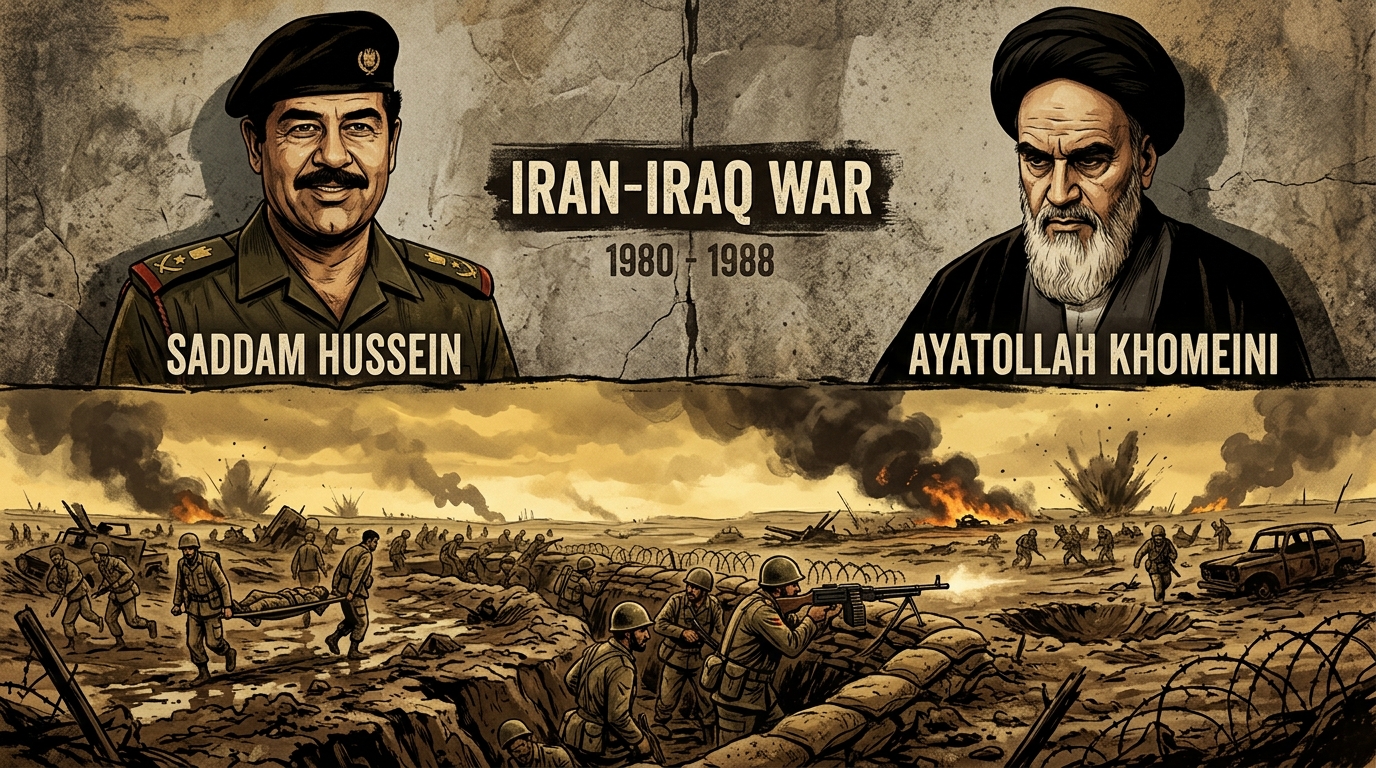
The Iran-Iraq War, which raged from September 1980 to August 1988, represents one of the most destructive conventional conflicts of the late twentieth century. To understand its outbreak, one must dissect a complex tapestry of territorial disputes, ideological clashes, and shifting regional balances of power that culminated in Saddam Hussein’s decision to invade his eastern neighbor.
Historically, the primary territorial flashpoint was the Shatt al-Arab (known in Iran as the Arvand Rud), a strategic river formed by the confluence of the Tigris and Euphrates rivers that empties into the Persian Gulf. This waterway served as the sole maritime outlet for Iraq’s oil exports, making its control a matter of existential economic survival for Baghdad. In 1975, under the mediation of the Shah of Iran and international diplomats, the two nations signed the Algiers Agreement.1 This treaty established the border along the thalweg—the deepest continuous channel of the river—representing a major diplomatic concession by a militarily weaker Iraq to a Western-backed Imperial Iran. Saddam Hussein, then Vice President of Iraq but already its de facto ruler, viewed the Algiers Agreement as a humiliating compromise forced upon Iraq under duress.
The geopolitical landscape underwent a tectonic shift in 1979. The Iranian Revolution ousted the pro-Western Shah, Mohammad Reza Pahlavi, and established a fundamentalist Islamic Republic led by the charismatic and uncompromising Ayatollah Ruhollah Khomeini. Khomeini’s revolutionary doctrine, Velayat-e Faqih (Guardianship of the Islamic Jurist), was explicitly expansionist. He openly called for the export of the Islamic Revolution across the Middle East, targeting secular, Arab nationalist regimes.
Saddam Hussein, who formally assumed the Iraqi presidency in July 1979, viewed Khomeini’s rhetoric as a direct threat to his secular Ba'athist regime. Iraq’s demographic composition—a Sunni-dominated ruling elite governing a Shia majority—made it highly vulnerable to Iranian religious propaganda. Border skirmishes escalated throughout early 1980, accompanied by state-sponsored subversion, including an assassination attempt on Iraqi Deputy Prime Minister Tariq Aziz by an Iranian-backed Shia militant group, Al-Da'wa.2
Saddam Hussein perceived Iran’s post-revolutionary chaos as a strategic window of opportunity. The Iranian military had been decimated by purges of the Shah’s officer corps, international embargoes had cut off spare parts for their American-made hardware, and the country was diplomatically isolated due to the ongoing Tehran hostage crisis. Saddam calculated that a swift military campaign would achieve several key objectives:
- Reassert absolute Iraqi sovereignty over the entire Shatt al-Arab waterway.
- Annex the oil-rich southwestern Iranian province of Khuzestan (referred to by Baghdad as Arabistan due to its significant ethnic Arab population).
- Preemptively crush any Iranian attempt to export its Shia revolution into Iraq, thereby establishing Baghdad as the undisputed preeminent power in the Persian Gulf.
On September 17, 1980, Saddam Hussein formally tore up the 1975 Algiers Agreement on live television. Five days later, on September 22, the Iraqi Air Force launched preemptive airstrikes against ten Iranian airfields, initiating an eight-year war of attrition.
Timeline of Events and Key Moments
Timeline of the War
| Date | Event |
|---|---|
| Sep 1980 | Iraq invades Khuzestan (Strategic surprise) |
| May 1982 | Iran liberates Khorramshahr; Iraqi forces retreat |
| Jul 1982 | Iran invades Iraq (Operation Ramadan); Trench stalemate begins |
| 1984-1988 | "War of the Cities" (Missile exchanges) & "Tanker War" (Gulf) |
| Mar 1988 | Halabja chemical attack (Genocide of Kurdish civilians) |
| Aug 1988 | Ceasefire accepted (UN Resolution 598) |
The Initial Iraqi Invasion (1980–1981)
The war began with a massive ground assault along a three-pronged front. Iraqi armored divisions crossed the border into Khuzestan, catching the disorganized Iranian armed forces by surprise. However, the Iraqi advance soon bogged down. Despite capturing the strategic port city of Khorramshahr after a brutal, month-long house-to-house urban battle, the Iraqis failed to capture the vital oil refining center of Abadan.
Saddam's hope for an ethnic Arab uprising in Khuzestan to support his forces proved to be a profound miscalculation; the local Arab population largely remained loyal to Iran. By late 1980, the Iraqi advance had ground to a halt, and the conflict transitioned into a static war of positions.
The Iranian Counter-Offensives and Mobilization (1981–1982)
Faced with existential ruin, Iran mobilized its vast demographic superiority. Ayatollah Khomeini mobilized the Basij (a volunteer paramilitary force composed of young boys and elderly men) alongside the newly formed Islamic Revolutionary Guard Corps (IRGC) to bolster the regular army (Artesh).
Utilizing zealous, high-density human wave attacks, Iranian forces overwhelmed fortified Iraqi positions. In late 1981, Iran launched Operation Way to Jerusalem, breaking the siege of Abadan.
The turning point of this phase occurred in May 1982 with Operation Beit ol-Moqaddas, which culminated in the liberation of Khorramshahr. Over 19,000 Iraqi soldiers were captured, and Saddam’s forces were pushed back to the internationally recognized borders. Recognizing his strategic vulnerability, Saddam offered a ceasefire and a return to the status quo ante bellum.
The Stalemate and Trench Warfare (1982–1987)
Khomeini rejected the Iraqi ceasefire offer, demanding the removal of Saddam Hussein from power and the payment of massive war reparations. In July 1982, Iranian forces crossed into Iraq, launching Operation Ramadan near Basra.
This marked the beginning of a grueling, static phase of the war that closely mirrored the Western Front of World War I. Both sides constructed extensive networks of trenches, barbed wire entanglements, bunkers, and machine-gun nests.
[Iranian Human Wave Assaults] ===> [Minefields / Barbed Wire] ===> [Iraqi Heavy Artillery & Chemical Gas]
Iran relied on its manpower advantage, launching massive infantry assaults often preceded by minimal artillery preparation. Iraq countered with superior firepower, heavy artillery, and, increasingly, the systemic use of chemical weapons (specifically mustard gas and nerve agents like tabun and sarin) to blunt Iranian breakthroughs.3
Despite major Iranian offensives in the southern marshlands—such as the Valfajr (Dawn) operations and the capture of the oil-rich Majnoon Islands—neither side could achieve a decisive strategic breakthrough.
The War of the Cities and the Tanker War (1984–1988)
To break the military deadlock on the ground, both nations expanded the conflict into new domains:
- The War of the Cities: Beginning in 1984, both capitals and major urban centers were subjected to strategic bombardment. Iraq utilized Scud-B ballistic missiles (often modified for longer range as Al-Hussein missiles) and Tupolev bombers to strike Tehran, Tabriz, and Isfahan. Iran retaliated with its own stock of Soviet-made Scuds acquired from Libya and Syria.
- The Tanker War: This phase involved systematic maritime attacks on commercial shipping in the Persian Gulf. Iraq targeted Iranian oil terminals at Kharg Island to strangle Iran's economy. Iran retaliated by attacking commercial tankers belonging to Iraq's financial backers, notably Kuwait and Saudi Arabia. This disruption of the global oil supply chain forced the United States and other Western nations to intervene. Under Operation Earnest Will (1987), the US Navy reflagged and escorted Kuwaiti tankers, leading to direct military clashes between American and Iranian naval forces.
THE TANKER WAR ESCALATION
- Iraq attacks Iranian oil terminals (Kharg Island)
- Iran retaliates against Kuwaiti & Saudi tankers
- US launches Operation Earnest Will (Reflagging tankers)
- Direct US-Iran naval clashes (e.g., Operation Praying Mantis)
The End of the War (1988)
By 1988, Iran was militarily and economically exhausted. The US Navy had destroyed a significant portion of Iran's navy during Operation Praying Mantis in April 1988, a retaliation for the mining of the USS Samuel B. Roberts.
On July 3, 1988, the tragedy of Iran Air Flight 655—a civilian airliner shot down by the cruiser USS Vincennes, killing all 290 on board—convinced Tehran that the United States was prepared to enter the war directly on Iraq's side.
Concurrently, a re-armed and financially supported Iraqi military launched a series of successful counter-offensives (the Tawakalna ala Allah operations), recapturing the Fao Peninsula and clearing Iranian forces from Iraqi territory. Realizing the impossibility of victory, Ayatollah Khomeini reluctantly accepted UN Security Council Resolution 598.4 On August 20, 1988, a formal ceasefire took effect.
Geopolitical Consequences and Aftermath
The geopolitical ripples of the Iran-Iraq War fundamentally restructured the security architecture of the Middle East, with ramifications that persist to this day.
Eight Years of War
- Economic Devastation
- Regional Realignment
Invasion of Kuwait (1990)
The Economic Toll and the Road to the Gulf War
The economic consequences were catastrophic. The total cost of the conflict was estimated at over $1 trillion in 1980s currency.5 Both countries saw their vital oil extraction and refining infrastructures heavily damaged.
Iraq, which entered the war with approximately $37 billion in foreign reserves, emerged from the conflict with over $80 billion in foreign debt, primarily owed to Western nations, the Soviet Union, and its Arab neighbors in the Gulf Cooperation Council (GCC)—specifically Kuwait and Saudi Arabia.
Saddam Hussein expected his Gulf neighbors to forgive these debts, arguing that Iraq had acted as a shield protecting them from the export of Khomeonist fundamentalism. When Kuwait refused to forgive Iraq's $14 billion debt and instead increased oil production (which depressed global crude prices and further damaged Iraq's revenue), Saddam was pushed toward desperation. This unresolved economic crisis was the direct catalyst for Iraq's invasion of Kuwait in August 1990, triggering the first Gulf War.
The Role of International Powers
The conflict was characterized by a cynical convergence of interests among international powers, who sought to ensure that neither side emerged as a dominant regional hegemon.
- The United States: Nominally neutral at the outset, the US executed a strategic "tilt" toward Baghdad in 1982 to prevent an Iranian victory. The US removed Iraq from its list of State Sponsors of Terrorism, restored diplomatic relations, and provided critical satellite intelligence, agricultural credits, and dual-use technologies. Under the dual-track foreign policy of the Reagan administration, the US also engaged in clandestine arms sales to Iran in exchange for the release of hostages in Lebanon—a scandal that became known as the Iran-Contra Affair.
- The Soviet Union: As Iraq's primary arms supplier, Moscow initially suspended deliveries in 1980 to court Iran. However, after Iran suppressed the local Tudeh Communist Party, the Soviets resumed massive arms shipments to Baghdad, including modern T-72 tanks, MiG-29 fighter jets, and Scud missiles.
- European Powers: France became Iraq's second-largest military supplier, providing state-of-the-art Mirage F1 fighter jets and Super Étendard aircraft equipped with radar-guided Exocet anti-ship missiles, which were heavily utilized in the Tanker War. West German firms played a key role in building Iraq's domestic chemical weapons facilities.
Human Toll and Regional Sectarianism
The human cost was staggering, with casualty estimates ranging from 500,000 to over 1 million total deaths.
Furthermore, the war codified the sectarian Sunni-Shia divide as a primary geopolitical axis of conflict in the Middle East. It solidified Iran’s siege mentality, reinforcing its determination to achieve military self-sufficiency and establish a "network of resistance" through regional proxies (such as Hezbollah in Lebanon).
For Iraq, the war institutionalized state violence and left a highly militarized society accustomed to total war, setting the stage for decades of future instability.
Analysis of Key Actors and Decisive Actions
| ACTOR | STRATEGIC VISION | DECISIVE ACTION / LEGACY |
|---|---|---|
| Saddam Hussein | Secular Arab Hegemony (Ba'athism) | Use of chemical weapons; invasion of Kuwait (aftermath) |
| Ruhollah Khomeini | Pan-Islamic Revolution (Theocratic rule) | Ideological mobilization; Reluctant acceptance of UNSCR598 |
| United States | Containment of Iran; Free flow of oil | Operation Earnest Will; Dual-track weapons deals |
Saddam Hussein: The Aggressor’s Miscalculation
Saddam Hussein's decision-making throughout the war was characterized by tactical opportunism marred by strategic shortsightedness. His initial invasion was based on flawed intelligence regarding the instability of the post-revolutionary Iranian state.
When the war shifted to a defensive campaign, Saddam relied on brutal, cost-effective methods to maintain power. He authorized the widespread use of chemical weapons, not only against Iranian military formations but also against his own civilian population.
The most notorious example occurred in March 1988 during the Halabja chemical attack, where the Iraqi military used mustard gas and nerve agents against the Kurdish city of Halabja, killing between 3,200 and 5,000 civilians.6 This action aimed to punish the Kurds for their perceived collaboration with Iranian forces.
Saddam's reliance on external financial backing from Gulf monarchies and technical support from Western nations created a false sense of security, leading him to believe the international community would tolerate his aggressive expansionist policies post-1988.
Ayatollah Ruhollah Khomeini: Revolutionary Zealotry
Ayatollah Khomeini framed the war not as a conventional geopolitical conflict, but as an apocalyptic struggle between Islam (Islam-e Nab-e Mohammadi) and "blasphemy" represented by Saddam's secular regime.
"This is not a war between two countries... It is a war between Islam and blasphemy. We must fight until the corrupt regime in Baghdad is overthrown." — Ayatollah Ruhollah Khomeini, public address, 1982
This ideological framing enabled Khomeini to demand immense sacrifices from the Iranian population. The IRGC and the Basij were utilized as ideological instruments to bypass the traditional military hierarchy, leading to tactical innovations like the human wave attacks.
While these tactics succeeded in driving Iraqi forces out of Iran, they resulted in catastrophic casualty rates. Khomeini’s refusal to accept a ceasefire in 1982 prolonged the war by six years, magnifying the destruction of Iran's economy and civil society.
His eventual decision to accept UN Resolution 598 was described by Khomeini himself in a radio broadcast as more painful than "drinking a chalice of poison," demonstrating how deeply his personal identity was tied to the total overthrow of Saddam Hussein.7
Khomeini's Strategic Dilemma (1988)
- Continue Total War
- Accept UNSCR 598
The United States: Realpolitik and the Balance of Power
The United States’ actions during the Iran-Iraq War are a prime study in regional realpolitik. Under the Carter Doctrine, the US declared that any attempt by an outside force to gain control of the Persian Gulf region would be regarded as an assault on its vital interests.
The Reagan administration sought to prevent either an outright Iranian victory, which would threaten Western oil security and the stability of allied Gulf states, or a complete collapse of Iraq, which would disrupt the balance of power. This policy led to highly contradictory actions:
- Providing Iraq with tactical intelligence from AWACS aircraft.
- Concurrently selling TOW anti-tank missiles and HAWK anti-aircraft missiles to Iran during the Iran-Contra affair.
- Enforcing Operation Staunch, a global diplomatic campaign led by the US to block the sale of weapons to Iran.
The intervention of the US Navy in the Gulf during the late 1980s directly degraded Iran’s military capabilities and ultimately forced Tehran to realize that it could not win a war of attrition against an adversary backed by the world's preeminent superpower.
Trivia and Lesser-Known Facts
- The "Keys to Heaven": During the human wave attacks, young Basij volunteers (some as young as twelve) were reportedly given small plastic keys imported from East Asia. These keys symbolized their guaranteed entry into Paradise if they were martyred while clearing minefields with their bodies. While some historians argue the literal keys were symbolic plastic badges, the psychological indoctrination of these child soldiers remains a well-documented tragedy of the conflict.
- The F-14 Tomcat Legacy: At the start of the war, Iran was the only country outside the United States that operated the highly sophisticated F-14 Tomcat fighter jet, acquired during the Shah's regime. Despite a severe shortage of spare parts due to US embargoes, Iranian pilots achieved astonishing success. Ace pilot Jalil Zandi is credited with shooting down 11 Iraqi aircraft, making him the most successful F-14 pilot in aviation history.
- North Korea's Secret Role: Needing military hardware, Iran turned to various non-aligned nations. One of its most reliable suppliers was North Korea. Pyongyang not only supplied Soviet-designed conventional weapons but also provided Iran with its first batch of Scud-B missiles, establishing a ballistic missile partnership that exists to this day.
- The Trench Warfare Swamp Battles: To cross the water-logged marshlands of southern Iraq during the Valfajr operations, Iranian engineers constructed a massive, 13-kilometer-long floating bridge across the Huweizah Marshes. This structure, known as the Kheybar Bridge, was a major engineering feat of the war, allowing light vehicles and troops to cross terrain previously deemed impassable.
- The US Navy's Worst Friendly Fire Incident: In May 1987, an Iraqi Mirage F1 fighter jet fired two Exocet missiles at the American guided-missile frigate USS Stark. The attack killed 37 US sailors. Although Saddam Hussein apologized, claiming the pilot mistook the frigate for an Iranian vessel, the incident highlighted the chaotic and highly dangerous nature of the maritime operations in the Persian Gulf.
References and Literature
- Lessons of Modern War: The Iran-Iraq War - A comprehensive analysis by Anthony H. Cordesman and Abraham R. Wagner under the Center for Strategic and International Studies (CSIS), highlighting the tactical and strategic lessons of the conflict.
- The Iran-Iraq War - Pierre Razoux's definitive work (Harvard University Press), providing a detailed, balanced military history based on newly available archives and personal accounts from both sides.
- The Iran-Iraq War: Chaos in a Vacuum - A contemporary article from Foreign Affairs (Winter 1980/81 edition) exploring the immediate geopolitical implications of the outbreak of the war.
- The United States and the Iran-Iraq War: A History of Tilting - Research documents from the Woodrow Wilson International Center for Scholars, detailing declassified US intelligence documents regarding relations with Saddam Hussein's regime during the 1980s.
Footnotes & Explanations
- The 1975 Algiers Agreement was signed on March 6, 1975, between Iran and Iraq, mediated by Algerian President Houari Boumédiène. ↩
- The Al-Da'wa party, a Shia Islamist political movement, carried out several insurgent operations inside Ba'athist Iraq, directly supported by the newly formed Islamic Republic of Iran. ↩
- According to UN investigations conducted in 1984, 1986, and 1987, Iraq repeatedly violated the 1925 Geneva Protocol prohibiting the use of chemical agents in war. ↩
- UN Security Council Resolution 598 was adopted unanimously on July 20, 1987, calling for an immediate ceasefire, but was not accepted by Iran until July 1988. ↩
- Economic historians estimate that the total direct and indirect economic costs of the war amounted to approximately $627 billion for Iran and $561 billion for Iraq (in adjusted 1988 USD). ↩
- The attack on Halabja occurred between March 15 and March 19, 1988, during the closing stages of the war. It remains the largest chemical weapons attack directed against a civilian-populated area in history. ↩
- Ruhollah Khomeini's address on accepting the ceasefire was broadcast on Tehran Radio on July 20, 1988. ↩