Key Takeaways
- The Truman Doctrine signaled the formal end of traditional American isolationism, committing the United States to global anti-communist containment.
- Triggered by the British Empire's financial exhaustion and inability to support Greece and Turkey, the doctrine authorized $400 million in economic and military aid.
- The policy established a precedent for global interventionism, directly paving the way for the Marshall Plan, the National Security Act of 1947, and the creation of NATO.
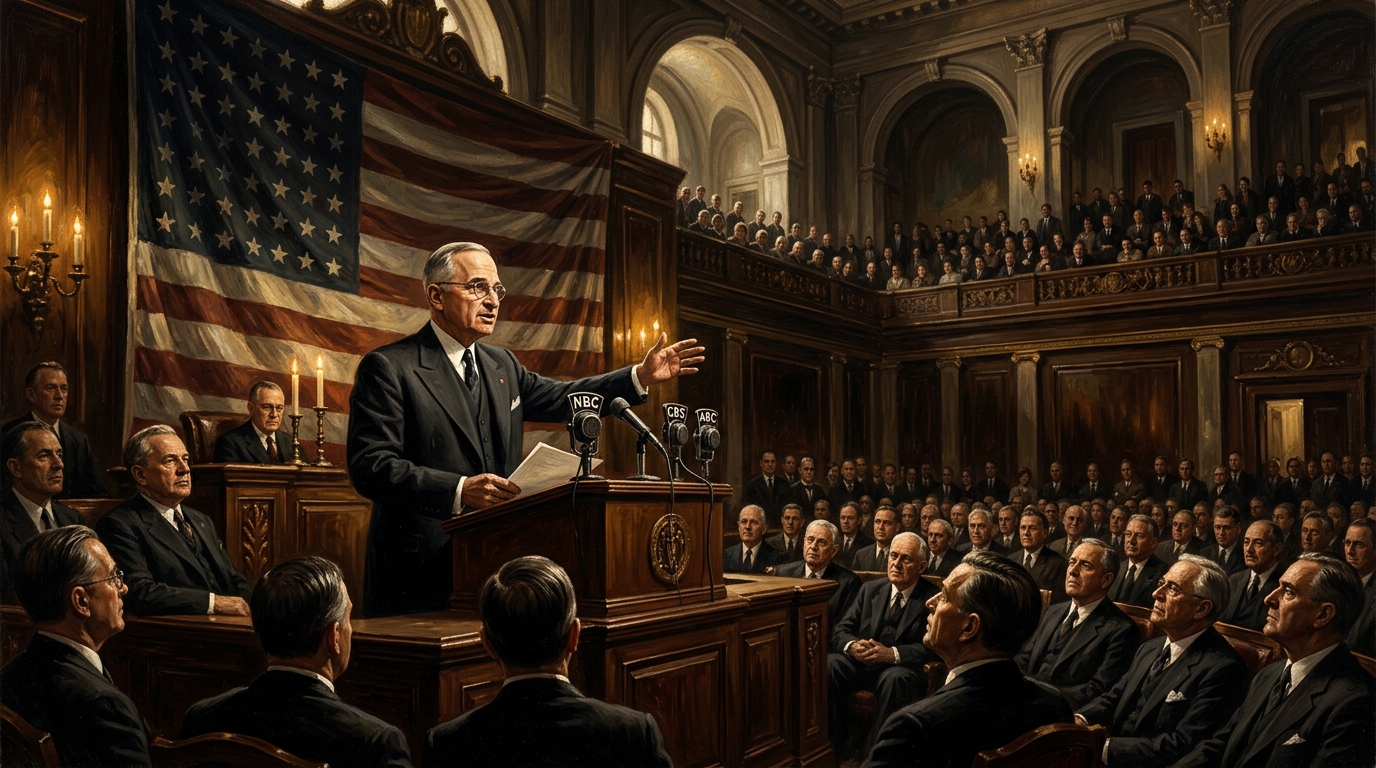
On March 12, 1947, President Harry S. Truman stood before a joint session of the United States Congress to deliver an address that would fundamentally reorder global geopolitics. At a time when the dust of the Second World War had barely settled, the United States was forced to confront a rapidly deteriorating security environment in Europe and the Near East. Truman requested $400 million in military and economic assistance for Greece and Turkey, but his speech did far more than solicit financial aid.
By declaring that "it must be the policy of the United States to support free peoples who are resisting attempted subjugation by armed minorities or by outside pressures," Truman established the core intellectual and strategic framework of the Cold War1. This policy, which became known as the Truman Doctrine, effectively launched the global strategy of containment, drawing a permanent geopolitical line between the Western democratic powers and the Soviet-aligned Eastern Bloc.
Historical Context and Origins
To understand the sudden shift in American policy in 1947, one must examine the profound geopolitical vacuum left in the wake of Axis defeats. The Second World War shattered the traditional European balance of power. Great Britain, France, and Germany were economically devastated and militarily exhausted. The British Empire, which had spent more than a century acting as the primary geopolitical arbiter and stabilizer in the Mediterranean, was on the verge of financial bankruptcy.
The Greek Civil War
In Greece, the withdrawal of Nazi occupying forces in 1944 did not bring peace, but rather a brutal, multi-phased civil war. The conflict pitted the British-backed royalist Greek government against the National Liberation Front (EAM) and its military wing, the Greek People's Liberation Army (ELAS), which were dominated by the Greek Communist Party (KKE)2.
While the Western allies feared the Greek communists were acting as direct agents of Moscow, the reality was more complex. Soviet Premier Joseph Stalin had adhered to the wartime "Percentages Agreement" made with Winston Churchill in 1944, which conceded Greece to the British sphere of influence. Consequently, Stalin offered little direct support to the Greek communists. Instead, the primary external support, arms, and sanctuary for the Greek insurgents came from Yugoslavia’s Josip Broz Tito, who operated independently of Moscow’s directives3. Nevertheless, to policymakers in Washington, any communist victory was viewed through a monolithic lens as an expansion of Soviet totalitarian control.
Post-WWII Geopolitical Vacuum
- Great Britain: Economically bankrupt, withdrawing from overseas commitments
- Greece: Engulfed in Civil War (Communist Insurgents vs. Royalists)
- Turkey: Facing Soviet demands for control over the Turkish Straits
The Turkish Straits Crisis
Simultaneously, Turkey was facing intense diplomatic and military intimidation from the Soviet Union. Throughout 1945 and 1946, Moscow pressured Ankara to revise the 1936 Montreux Convention, which governed transit through the Bosporus and the Dardanelles. Stalin demanded joint Soviet-Turkish military control of the Straits and the establishment of Soviet naval and military bases on Turkish territory. Turkey, historically suspicious of Russian imperial ambitions, resisted these demands but remained economically fragile and ill-equipped to withstand sustained Soviet coercion without external backing.
The Intellectual Shift in Washington
Within the United States, the optimism of wartime cooperation with the Soviet Union was rapidly evaporating. This transition was accelerated by several key intellectual developments:
- The Long Telegram (February 1946): Written by George F. Kennan, the Chargé d'Affaires at the US Embassy in Moscow, this 8,000-word analysis argued that the Soviet leadership was inherently expansionist, driven by a combination of traditional Russian insecurity and Marxist-Leninist ideology. Kennan suggested that the only way to counter this threat was a "long-term, patient but firm and vigilant containment of Russian expansive tendencies"[^4].
- The Clifford-Elsey Report (September 1946): Prepared for President Truman, this top-secret report cataloged Soviet violations of wartime agreements and concluded that the USSR was actively seeking global hegemony, recommending that the US prepare to use military force to contain Soviet expansion.
- The Iron Curtain Speech (March 1946): Delivered by Winston Churchill in Fulton, Missouri, this address popularized the concept of a divided Europe and called for an Anglo-American alliance to counter Soviet expansionism.
Timeline of Events and Key Moments
The transformation of these intellectual concepts into official American state policy occurred with remarkable speed during the early months of 1947.
| Date | Event |
|---|---|
| February 21 | British Note Delivered to US |
| February 27 | White House Meeting (JCS) |
| March 12 | Truman's Speech to Congress |
| May 22 | Aid Bill Signed into Law |
The Critical Week: February 1947
- February 21, 1947: The British Embassy in Washington delivered two formal diplomatic notes ("blue notes") to the Department of State. The notes declared that Great Britain could no longer provide financial or military assistance to Greece and Turkey beyond March 31, 1947. The British government was facing an acute winter energy crisis, domestic rationing, and a balance-of-payments deficit, forcing it to liquidate its overseas security commitments.
- February 24, 1947: Undersecretary of State Dean Acheson analyzed the British notes and immediately recognized the gravity of the situation. He briefed the newly appointed Secretary of State, George C. Marshall, arguing that if the United States did not step into the vacuum, the entire Eastern Mediterranean and Middle East would fall under Soviet domination.
- February 27, 1947: President Truman hosted a pivotal meeting in the Oval Office with congressional leaders, including the influential Republican Senator Arthur Vandenberg, Chairman of the Senate Foreign Relations Committee. When Secretary Marshall presented a dry, strategic overview of the crisis, the congressional delegation appeared indifferent. Acheson intervened, delivering a passionate, apocalyptic warning that compared the spread of communism to a "rotten apple in a barrel." He argued that a communist victory in Greece would destabilize Italy, France, and the Middle East. Deeply impressed, Senator Vandenberg told Truman that if he wanted congressional approval for aid, he would have to "scare hell out of the American people."
The March 12 Address
With the administration aligned, a team of speechwriters and diplomats set out to draft the president's address. Under Acheson’s direction, the language was deliberately framed in sweeping, ideological terms, moving beyond a simple request for regional aid to articulate a global struggle between freedom and tyranny.
On March 12, 1947, Truman stood before a joint session of Congress. In his twenty-one-minute address, he laid out the stark choice facing the post-war world:
"At the present moment in world history nearly every nation must choose between alternative ways of life. The choice is too often not a free one. One way of life is based upon the will of the majority, and is distinguished by free institutions, representative government, free elections, guarantees of individual liberty, freedom of speech and religion, and freedom from political oppression. The second way of life is based upon the will of a minority forcibly imposed upon the majority. It relies upon terror and oppression, a controlled press and radio, fixed elections, and the suppression of personal freedoms." [^5]
Truman argued that the security of the United States was directly linked to the survival of democratic institutions abroad. He requested $300 million in aid for Greece and $100 million for Turkey, along with the authority to dispatch American civilian and military personnel to oversee the administration of the aid and train local forces.
Legislative Passage
Despite reservations from both the isolationist wing of the Republican Party and the progressive wing of the Democratic Party—who feared the policy bypassed the newly formed United Nations—the administration successfully built a bipartisan coalition. Senator Vandenberg championed the bill in the Senate, introducing an amendment that allowed the United Nations to terminate the US aid program if it deemed UN action rendered American assistance unnecessary. This maneuver neutralized much of the domestic opposition.
On May 22, 1947, President Truman signed the Greek-Turkish Aid Act into law, marking the formal initiation of the policy of containment.
Geopolitical Consequences and Aftermath
The Truman Doctrine was not a temporary crisis-management measure; it was the opening salvo of a new era in international relations. Its implementation set off a chain reaction that fundamentally restructured global geopolitics.
Stabilizing Greece and Turkey
The immediate tactical objectives of the Truman Doctrine were achieved. The injection of American military hardware, economic aid, and tactical advice turned the tide of the Greek Civil War. American military advisors, led by General James Van Fleet, helped reorganize the Greek National Army.
Furthermore, the geopolitical landscape shifted in 1948 when Yugoslavia's Josip Broz Tito split with Joseph Stalin. Tito closed his borders to the Greek insurgents, cutting off their primary source of supply and sanctuary. By October 1949, the Greek communist forces were defeated, and the royalist government secured control of the country.
In Turkey, American financial assistance facilitated the modernization of the Turkish armed forces and infrastructure. This integration solidified Turkey's alignment with the West, enabling Ankara to successfully resist Soviet territorial demands. The strategic outcome was fully realized in 1952, when both Greece and Turkey were formally admitted to the North Atlantic Treaty Organization (NATO), anchoring the southern flank of the Western alliance.
| Country | Direct US Aid Authorized (1947) | Key Strategic Outcome | Long-term Security Integration |
|---|---|---|---|
| Greece | $300 Million | Defeat of communist insurgency (DSE); stabilization of royalist government | Admitted to NATO in 1952; Western alignment secured |
| Turkey | $100 Million | Modernization of armed forces; resistance to Soviet pressure over the Straits | Admitted to NATO in 1952; secured Western control of the Bosporus |
The Institutionalization of Containment
The intellectual framework of the Truman Doctrine paved the way for a series of landmark initiatives that structured the Western bloc throughout the Cold War:
- The Marshall Plan (June 1947): Formally known as the European Recovery Program, this massive economic assistance package aimed to rebuild Western European economies, neutralizing the political appeal of domestic communist parties in nations like France and Italy.
- The National Security Act of 1947 (July 1947): This legislation reshaped the American national security apparatus to meet the demands of a permanent global struggle. It created the Department of Defense, the Central Intelligence Agency (CIA), and the National Security Council (NSC), centralizing foreign policy execution within the executive branch.
- The North Atlantic Treaty (April 1949): The establishment of NATO represented the military crystallization of containment, committing the United States to a peacetime military alliance to defend Western Europe from potential Soviet aggression.
Analysis of Key Actors and Decisive Actions
The formulation of the Truman Doctrine was the product of a unique convergence of personalities, each playing a distinct role in translating geopolitical realities into a cohesive grand strategy.
Harry S. Truman: The Decisive President
When Harry S. Truman assumed the presidency following the death of Franklin D. Roosevelt in April 1945, he was widely regarded as a foreign policy novice. Unlike Roosevelt, who believed he could personally manage and negotiate with Joseph Stalin, Truman possessed a more direct, black-and-white view of international relations.
Truman's willingness to make quick, definitive decisions—such as the authorization of atomic weapons in 1945—was central to the adoption of the doctrine that bore his name. Faced with the British withdrawal from the Mediterranean, Truman did not hesitate. He recognized that the United States was the only power capable of filling the global vacuum and successfully staked his political future on a radical departure from traditional American foreign policy.
Dean Acheson: The Strategic Architect
While Truman was the public face of the policy, Undersecretary of State Dean Acheson was its primary intellectual and tactical architect. Acheson possessed a clear vision of the post-war world order, recognizing that economic stability was inseparable from military security.
Acheson was the figure who realized that to secure funding from a domestic-focused, tax-conscious Congress, the administration had to frame the local crises in Greece and Turkey as a universal struggle between liberty and totalitarianism. His "rotten apple" metaphor laid the foundation for the "Domino Theory," which would dominate American foreign policy thinking for the next three decades.
| Acheson's Strategic Metaphor | The Domino Theory |
|---|---|
| "If Greece should fall, Turkey would follow... the infection would spread to Iran, Italy, France, and the Middle East." | This quote serves as the foundational justification for the Domino Theory. |
George F. Kennan: The Ambivalent Theorist
George F. Kennan, whose "Long Telegram" and subsequent "X Article" in Foreign Affairs gave birth to the term "containment," viewed the implementation of the Truman Doctrine with deep ambivalence6. Kennan was a realist diplomat who favored a nuanced, localized, and primarily economic approach to countering Soviet influence.
He was privately critical of Truman's March 12 speech, arguing that the ideological and universalist tone of the address was dangerous. Kennan warned that by promising to aid "free peoples" everywhere, the United States was committing itself to defending unstable, corrupt, or peripheral regimes that had little strategic value to American security. Kennan's fears would prove prophetic in the decades that followed, as the doctrine was utilized to justify military interventions in East Asia and Latin America.
Trivia and Lesser-Known Facts
- The "Scare Hell" Advice: The famous phrase advising Truman to "scare hell out of the American people" is widely attributed to Republican Senator Arthur Vandenberg. However, historical accounts suggest that this was a synthesis of the general consensus among the bipartisan leadership during the February 27 meeting, rather than a recorded verbatim quote.
- The Ghostwriter: The initial draft of Truman's historic speech was written by Joseph M. Jones, a mid-level public relations officer in the State Department. Jones was selected because of his ability to write clear, persuasive prose that could appeal to the average American citizen.
- Stalin's Real position on Greece: Stalin was actually furious with Tito for supporting the Greek communists. In a 1948 meeting in Moscow, Stalin yelled at Yugoslav representatives, demanding that the Greek uprising be wrapped up immediately, arguing that the United States and Great Britain would never allow their communications lines in the Mediterranean to be severed[^7].
- The "Two Ways of Life" Paradox: In his speech, Truman praised Greece as a bastion of democracy. In reality, the Greek royalist government of the time was highly authoritarian, corrupt, and guilty of widespread human rights abuses, including the execution and exile of political dissidents. The US administration knowingly overlooked these flaws to maintain the anti-communist front.
- The Navy's Show of Force: Before the speech was delivered, the US Navy had already begun practicing "gunboat diplomacy." In April 1946, the battleship USS Missouri was sent to Istanbul, ostensibly to return the body of the deceased Turkish ambassador to Washington, but realistically to signal to the Soviet Union that the US Navy was prepared to operate in the Eastern Mediterranean.
References and Literature
- The Truman Doctrine Document at the National Archives - The official transcript of President Harry S. Truman's address to Congress on March 12, 1947.
- Gaddis, John Lewis. (2005). The Cold War: A New History. Penguin Press. - A comprehensive analysis of the evolution of the Cold War, detailing the implementation of the policy of containment.
- The Long Telegram by George F. Kennan - The historical background of the containment policy from the Office of the Historian, US Department of State.
- Kuniholm, Bruce R. (1980). The Origins of the Cold War in the Near East. Princeton University Press. - A detailed study focusing on the geopolitical rivalry over Greece and Turkey.
Footnotes & Explanations
- Truman, Harry S. "Address to Joint Session of Congress," March 12, 1947. President's Secretary's Files, Truman Presidential Library. ↩
- Frazier, Robert. Anglo-American Relations with Greece: The Coming of the Cold War 1942-1947. Macmillan, 1991. ↩
- Westad, Odd Arne. The Global Cold War: Third World Interventions and the Making of Our Times. Cambridge University Press, 2005. ↩
- Kennan, George F. "The Long Telegram," February 22, 1946. Foreign Relations of the United States, 1946, Volume VI, Eastern Europe; The Soviet Union. ↩
- Truman Presidential Library, official speech transcript, March 12, 1947. ↩
- Kennan, George F. (under the pseudonym "X"). "The Sources of Soviet Conduct," Foreign Affairs, July 1947. ↩
- Djilas, Milovan. Conversations with Stalin. Harcourt, Brace & World, 1962. ↩