Key Takeaways
- The Tunisian revolution dramatically demonstrated the potential for grassroots, digitally-enabled social mobilization to dismantle entrenched authoritarian regimes, inspiring similar uprisings across the MENA region.
- Economic marginalization, rampant state-sponsored corruption, and pervasive systemic humiliation (hogra) were the fundamental drivers of popular dissent, transcending mere political grievances and exposing the fragility of a seemingly stable autocracy.
- The rapid and relatively bloodless departure of President Zine El Abidine Ben Ali, facilitated by the military's refusal to fire on civilians, created an unprecedented regional domino effect, profoundly destabilizing long-standing autocracies across North Africa and the Middle East.
- Tunisia's post-revolutionary trajectory, though fraught with political polarization and economic challenges, stands out as a unique case of successful, if incomplete, democratic transition, distinguished by a robust civil society and a commitment to constitutional reform.
Historical Context and Origins
To understand the uprising that ignited the Arab Spring, one must look beyond the immediate spark of December 2010 and analyze the structural foundations of the Tunisian state under Zine El Abidine Ben Ali, a regime that, for over two decades, skillfully balanced a façade of modernization and stability with a brutal reality of authoritarian control and systemic corruption.
Ben Ali’s ascent to power in 1987, through a bloodless coup known as the "constitutional coup" against the ailing President-for-Life Habib Bourguiba, initially promised an era of greater democracy and respect for human rights. He branded his new order the "New Era," attempting to distance himself from Bourguiba's late-stage autocracy and cult of personality. However, these promises quickly evaporated. While he did dismantle some of Bourguiba's more anachronistic institutions, he swiftly consolidated power, building an even more sophisticated and pervasive security state. The ruling Democratic Constitutional Rally (RCD) party, once Bourguiba's Neo Destour, became an all-encompassing apparatus of control, penetrating every aspect of public life, from professional associations to local municipalities. Dissent was ruthlessly suppressed, critical voices silenced through imprisonment, torture, or exile, and opposition parties rendered largely ineffectual or co-opted.
Tunisia was often lauded by Western observers and international financial institutions for its stable macroeconomic indicators, its secularist credentials, and its apparent "success" in terms of educational attainment and women's rights compared to other Arab nations. This narrative of a "model Arab state" often overshadowed a deep-seated and corrosive rot within the system. The regime’s crony capitalism was not merely incidental; it was central to its modus operandi. Power and wealth became inextricably linked, concentrated in the hands of the presidential family, especially Ben Ali’s second wife, Leila Trabelsi, and her sprawling clan. The Trabelsi family, often referred to as the "mafia" by ordinary Tunisians, systematically monopolized the most lucrative sectors of the economy, including banking, real estate, tourism, telecommunications, and even the automotive industry. They used their political connections to secure lucrative contracts, bypass regulations, and stifle competition, effectively transforming the state into a personal enrichment vehicle.
By 2010, the divide between the coastal, relatively affluent regions like Tunis and Sfax, which benefited from tourism and export-oriented industries, and the neglected, impoverished interior regions like Sidi Bouzid, Kasserine, and Gafsa, had reached a breaking point. These interior regions suffered from chronic underdevelopment, lack of investment, high unemployment, and inadequate public services. The government’s development policies exacerbated these disparities, favoring politically connected elites and geographically advantaged areas.
Youth unemployment, particularly among university graduates, had soared to over 30% in some regions, exacerbated by an educational system that continued to produce more qualified workers than the stagnant, nepotistic labor market could absorb. These educated but jobless young people, often fluent in French and digitally savvy, found themselves trapped in a system that offered no avenues for upward mobility or dignified work. This alienation was not merely financial; it was existential. The pervasive sense of hogra—a Tunisian dialect term denoting systematic humiliation, state-sponsored indignity, and the arbitrary exercise of power by corrupt officials—served as the primary psychological fuel for the protests that would soon consume the country. It was the daily experience of petty corruption, bureaucratic arrogance, and the blatant injustice of a two-tiered system that ignited the spark, transforming economic grievance into a demand for human dignity and respect.
Historical Precedents and the Ben Ali Regime's Architecture
While the Jasmine Revolution appeared sudden to external observers, its roots lay in decades of simmering discontent and the particular architecture of Ben Ali’s authoritarian rule. The seeds of popular protest had been sown long before 2010, indicating a gradual erosion of the regime's legitimacy.
Ben Ali meticulously crafted a system designed for self-preservation. He learned from Bourguiba's mistakes, avoiding the overt cult of personality while establishing a formidable police state. The Ministry of Interior, rather than the military, became the primary pillar of his power, expanded and equipped to monitor and suppress any form of dissent. Its intelligence agencies infiltrated every sector of society, creating an atmosphere of pervasive fear and self-censorship. The ruling RCD party functioned not just as a political party, but as a vast patronage network, extending its tentacles into local communities and professional organizations, ensuring loyalty through benefits and controlling public discourse.
However, beneath this veneer of control, discontent occasionally surfaced. A significant precursor to the Jasmine Revolution was the Gafsa Mining Basin Uprising of 2008. This protest, sparked by allegations of corruption and nepotism in hiring practices at the state-owned phosphate company, involved thousands of unemployed youth and workers in the country's phosphate-rich but impoverished interior. The regime responded with brutal force, arrests, and trials, but the protests lingered for months, demonstrating the potential for sustained, localized resistance against economic grievances. Crucially, these protests received limited national and international media attention due to the regime's strict control over information. Yet, for many Tunisians, Gafsa was a clear sign that the social contract—economic stability in exchange for political silence—was breaking down, particularly for the youth in marginalized regions.
Furthermore, a small but persistent network of human rights activists, lawyers, and independent journalists, often operating in exile or on the fringes of society, continued to document abuses and advocate for reform. Bloggers and online activists, utilizing nascent internet technologies, attempted to circumvent state censorship and share information, laying some of the groundwork for the digital mobilization seen in 2010. These groups, though marginalized, kept alive a flicker of opposition and a memory of independent thought that would prove crucial when the larger movement began. The Ben Ali regime, despite its apparent strength, was thus a brittle edifice, built on fear and corruption, and increasingly disconnected from the aspirations of its own people, especially the growing demographic of educated but disenfranchised youth.
Timeline of Events and Key Moments
The trajectory of the revolution was characterized by a rapid and organic escalation from localized despair to a nationwide existential threat to the regime. It transformed from isolated acts of defiance into a mass movement that ultimately brought down a seemingly unshakeable autocracy.
| Date | Event | Significance |
|---|---|---|
| Dec 17, 2010 | Self-immolation of Mohamed Bouazizi | A municipal inspector confiscates his cart; Bouazizi sets himself on fire in Sidi Bouzid, sparking initial, localized protests over hogra and economic despair. |
| Dec 18-23, 2010 | Initial Protests and State Repression | Protests in Sidi Bouzid intensify; police violently disperse demonstrators, using tear gas and batons. Local authorities attempt to suppress news, but videos circulate online. |
| Dec 24, 2010 | Escalation in the Interior | Demonstrations spread to neighboring towns like Menzel Bouzaiane, Meknassy, and Thala. Security forces open fire on protesters, resulting in the first deaths (e.g., Mohamed Ammari), intensifying outrage. |
| Dec 27-28, 2010 | Spread to Tunis and Lawyers' Protest | Smaller solidarity protests occur in Tunis. Lawyers organize a rare public demonstration in the capital, challenging the regime's authority. |
| Jan 3, 2011 | Clashes in Kasserine and Thala | Security forces fire live ammunition into crowds in the impoverished interior cities of Kasserine and Thala, leading to dozens of casualties and further inflaming public anger. |
| Jan 4, 2011 | Bouazizi dies | Mohamed Bouazizi succumbs to his burns in a Tunis hospital. His death, after 18 days, intensifies national anger and transforms him into a potent martyr for the uprising. |
| Jan 6-10, 2011 | Intensified Crackdown and Internet Censorship | The regime intensifies its crackdown, deploying police and plainclothes agents. It also attempts to control information by blocking websites and conducting phishing attacks against Tunisian activists' social media accounts. |
| Jan 12, 2011 | Military withdrawal/neutrality | Protests spread to the capital, Tunis. Crucially, the army, under General Rachid Ammar, reportedly refuses to fire on protesters, signaling the loss of regime control over its key security apparatus. Ben Ali declares a state of emergency. |
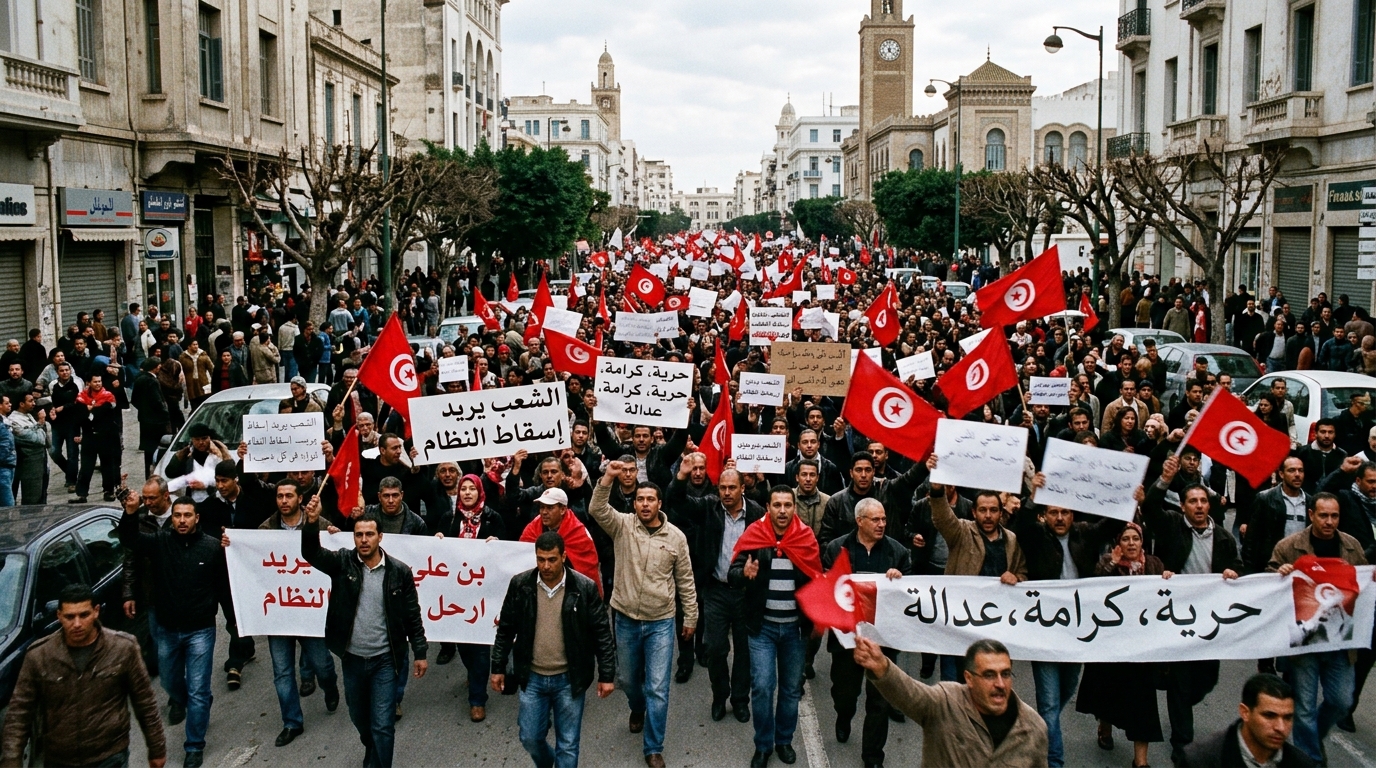
| Jan 13, 2011 | Nationwide General Strike | The powerful UGTT labor union calls for a nationwide general strike, paralyzing the country and bringing masses onto the streets of Tunis and other major cities. |
| Jan 14, 2011 | Flight of Ben Ali | Faced with massive, uncontrollable protests in Tunis and the military's effective defection, Ben Ali dissolves the government, calls for early elections, and finally flees the country with his family to Saudi Arabia, ending his 23-year rule. |
The Catalyst: Mohamed Bouazizi
The self-immolation of Mohamed Bouazizi was the singular, tragic event that converted latent resentment into collective action on an unprecedented scale. On December 17, 2010, Bouazizi, a 26-year-old university graduate reduced to selling fruits and vegetables from a cart to support his family, was publicly harassed and humiliated by a municipal inspector in his hometown of Sidi Bouzid. His cart and scales, his only means of livelihood, were confiscated, and his appeals to local authorities for redress were met with indifference and disdain. In a desperate act of protest against hogra and economic despair, Bouazizi set himself on fire in front of the municipal building. His act became a visceral, widely understood metaphor for the hopelessness, frustration, and systemic indignity felt by millions of Tunisians, particularly the youth. The subsequent protests were not initially fueled by grand ideological manifestos or pre-organized political movements, but by an organic, deeply emotional demand for karama (dignity), social justice, and basic socio-economic rights. His death 18 days later, on January 4, 2011, transformed him from a local victim into a national martyr, deepening public outrage and galvanizing support for the nascent uprising.
The Turning Point: The Army's Refusal and Erosion of Regime Control
A series of defining moments accelerated the revolution towards its climax. The regime’s brutal response, initially attempting to crush protests with live ammunition and mass arrests, paradoxically fueled the uprising. Each death and injury served to deepen public resolve and broaden the geographic scope of the demonstrations. Crucially, the regime's control over information, once absolute, was effectively circumvented by the internet and mobile phone cameras. Videos of police brutality, shared rapidly on Facebook and YouTube, became powerful tools for mobilization and international awareness, exposing the regime's true nature.
However, the most pivotal turning point occurred when Ben Ali’s regime lost the loyalty of its most critical security pillar: the military. As protests escalated and spread to Tunis in early January, Ben Ali reportedly requested that the military intervene decisively to crush the protesters. General Rachid Ammar, the Chief of Staff of the Armed Forces, famously refused to deploy the military to suppress the civilian uprising, ordering his troops to protect the people rather than fire on them. This decision was monumental. Unlike the highly politicized and corrupt police force, the Tunisian army generally maintained a professional, non-political stance and was perceived as an institution of national rather than regime loyalty. Without the unwavering backing of the security forces, particularly the military's willingness to use lethal force against its own citizens, Ben Ali’s regime collapsed within hours. This demonstrated that even the most entrenched authoritarian power is ultimately fragile once the monopoly on violence is surrendered or fractured, and when the military chooses the nation over the dictator.
Geopolitical Consequences and Aftermath
The fall of Zine El Abidine Ben Ali sent shockwaves throughout the region, challenging the "Arab Exception"—the long-standing political science theory that the Arab world was uniquely immune to democratic transition due to its cultural specificities, tribal structures, and the strength of its autocratic rulers. The Tunisian experience proved this notion fundamentally flawed, igniting a wave of popular uprisings that reshaped the geopolitical landscape of the Middle East and North Africa.
Regional Contagion: The Arab Spring's Genesis
Tunisia served as the unexpected laboratory for the Arab Spring. The "success" of the Tunisian model—or at least the perceived ease with which a deeply entrenched dictator could be deposed—inspired activists, dissidents, and frustrated citizens in an unprecedented wave across the region. The visual evidence of Tunisians defying their oppressors, broadcast live via satellite news and social media, dismantled the psychological barrier of fear that had long paralyzed populations under authoritarian rule.
The "Tunisian contagion" spread rapidly:
- Egypt (January 2011): Inspired by Tunisia, millions took to the streets, primarily in Cairo's Tahrir Square, leading to the swift overthrow of Hosni Mubarak after 30 years in power.
- Libya (February 2011): Protests against Muammar Gaddafi escalated into an armed rebellion and eventually a civil war, leading to international military intervention and Gaddafi's brutal demise.
- Yemen (January 2011): Mass protests forced President Ali Abdullah Saleh to step down, though the country soon descended into civil conflict.
- Syria (March 2011): Initially peaceful protests against Bashar al-Assad were met with extreme violence, spiraling into a devastating civil war with international involvement that continues to this day.
- Bahrain, Jordan, Morocco, Algeria, Saudi Arabia: These nations also experienced varying degrees of protests, demanding reforms, economic justice, or political change, though most regimes managed to contain or suppress them through a mix of concessions and repression.
The Tunisian precedent fundamentally altered the calculus of both rulers and the ruled across the MENA region. For rulers, it introduced the terrifying possibility of popular uprising as a legitimate threat. For the ruled, it demonstrated that change was possible, empowering millions to overcome their fear and demand a better future.
The Transition Challenges: A Difficult Path to Democracy
While the departure of the autocrat was swift, the transition to democracy in Tunisia was fraught with immense complexity and multiple crises. Unlike many of its neighbors, Tunisia navigated these challenges without succumbing to full-scale civil war, a testament to its unique characteristics.
- Political Polarization: The immediate post-revolutionary period was dominated by intense struggles between disparate political forces. The rise of the moderate Islamist Ennahda movement, which won the first free elections to the Constituent Assembly in October 2011, sparked deep anxieties among secularists who feared an erosion of Tunisia's modern, secular identity. This polarization led to recurring political crises, government collapses, and even political assassinations (e.g., Chokri Belaïd in February 2013 and Mohamed Brahmi in July 2013), pushing the country to the brink of collapse.
- Economic Fragility: The revolution did not immediately fix the structural failures of the economy; indeed, it exacerbated some. The decline in tourism (a critical sector), hesitancy of foreign investment, and persistent high youth unemployment continued to fuel social unrest and regional disparities. Successive governments struggled to implement meaningful economic reforms, often constrained by IMF-imposed austerity measures and the resistance of powerful vested interests.
- Security Threats: The vacuum of power and weakened state institutions post-2011 provided fertile ground for extremist groups. Tunisia faced significant security threats, including the rise of Salafist jihadi groups and major terrorist attacks (e.g., Bardo Museum attack in March 2015, Sousse resort attack in June 2015). The porous border with Libya, which descended into chaos, further complicated security efforts.
- Constitutional Innovation and Civil Society: Despite these formidable challenges, Tunisia achieved remarkable progress in constitutional reform. The 2014 Constitution, widely regarded as one of the most progressive in the region, emerged as the revolution’s most enduring legacy. It formalized democratic protections, enshrined a wide array of human rights, guaranteed gender equality, and established independent institutions. Crucially, the robust and organized civil society, particularly the National Dialogue Quartet (comprising the UGTT, UTICA, Tunisian Human Rights League, and the Order of Tunisian Lawyers), played an indispensable role in mediating political crises and steering the constitutional process, earning them the Nobel Peace Prize in 2015.
Analysis of Key Actors and Decisive Actions
The Tunisian revolution stands out not only for its impact but also for the unique confluence of actors and actions that shaped its trajectory, particularly its relatively leaderless nature and the crucial role of civil society.
The revolution was initially a decentralized, largely leaderless movement, which, ironically, proved to be one of its greatest strengths. By avoiding a singular charismatic leader or a centralized command structure, the regime was unable to decapitate the protest movement through arrests or assassination. Instead, thousands of localized grievances converged, amplified by social media, creating a resilient, hydra-headed challenge that the security forces struggled to contain. The cries for "dignity" and "freedom" resonated universally, bypassing the need for a specific political program or a designated figurehead.
"I want to be free. I want to work to feed my family. How can you look at yourself in the mirror if you don't fight for your rights?" — Anonymous protester, January 2011. This quote encapsulates the raw, fundamental demands that transcended mere political slogans.
The General Union of Tunisian Workers (UGTT) played an indispensable and arguably decisive role in transforming the disparate regional protests into a cohesive, national revolution. As one of the oldest and most powerful civil society organizations in Tunisia, the UGTT had deep roots in society, an established organizational capacity, and a legitimate voice that the regime had never fully crushed. Initially cautious, the UGTT leadership, pressured by its grassroots members, gradually threw its weight behind the uprising. Its call for a nationwide general strike on January 13, 2011, effectively paralyzed the state apparatus, demonstrating the regime’s complete loss of control. The UGTT’s intervention was crucial in:
- Mobilization: Providing a structured network for organizing demonstrations and strikes across the country.
- Legitimacy: Lending credibility and a broad national character to the protests, moving them beyond mere "riots."
- Coordination: Bridging the gap between various protest groups and regional activists.
- Mediation (post-Ben Ali): Its continued role, particularly as part of the National Dialogue Quartet, was vital in navigating the treacherous post-revolutionary political landscape and forging consensus for the new constitution.
Conversely, Ben Ali’s regime, despite its apparent strength, suffered from critical miscalculations and internal fractures. His reliance on the police state—specifically the heavily armed and notoriously corrupt Ministry of Interior’s police and intelligence forces—at the expense of the military proved to be his undoing. For decades, Ben Ali had systematically built up the police to be the primary instrument of repression, showering them with resources and privileges, while keeping the professional military relatively weaker and depoliticized. This created a profound institutional distrust between the two security organs. When the popular uprising reached Tunis, and Ben Ali desperately needed the full force of the state to quell it, the military, under General Rachid Ammar, refused to fire on civilians. This decision was informed by the military's institutional culture, which valued national unity over loyalty to a single leader, and perhaps also by a desire to avoid being tainted by the same corruption and brutality as the police. By alienating the military in favor of a despised police force, Ben Ali stripped himself of his most reliable pillar of support, ultimately leaving his security apparatus unable to quell the sheer scale of the human tide that flooded the streets of Tunis on January 14, 2011. Key figures like Ali Seriati, the head of presidential security, were reportedly involved in a last-ditch effort to organize a violent crackdown or even a military coup to keep Ben Ali in power, but these efforts failed due to the military's stance.
Other key actors included:
- The Internet and Bloggers: Tunisian bloggers and online activists, such as Slim Amamou and Lina Ben Mhenni, played a critical role in circumventing state censorship, documenting abuses, and mobilizing support. Their use of VPNs and proxy servers to bypass government blocks helped maintain a vital flow of information.
- Students and Youth: The young, educated, and unemployed segment of the population formed the demographic backbone of the protests, their frustration directly stemming from the socio-economic conditions.
- Lawyers and Human Rights Defenders: These groups provided crucial legal support to detained protesters and helped articulate the demands for justice and rule of law.
The International Response and Tunisia's Unique Trajectory
The international community's response to the Tunisian uprising evolved significantly from initial cautious neutrality to eventual support for the transitional process. For years, Western governments, particularly the United States and European powers, had publicly praised Tunisia as a stable, secular ally in the fight against extremism, largely overlooking or downplaying the pervasive human rights abuses and corruption under Ben Ali. This was a classic case of prioritizing stability over democracy in the region.
However, as the protests escalated and the regime's brutality became undeniable through citizen journalism and social media, international condemnation grew. The European Union and the United States, while initially hesitant to openly challenge a long-standing partner, began to issue statements urging restraint and respect for human rights. When Ben Ali finally fled, the swiftness of his departure caught many international observers by surprise, forcing a rapid recalibration of foreign policy towards Tunisia and the wider Arab world.
Post-revolution, Tunisia's unique trajectory distinguished it from the often tragic outcomes in other Arab Spring nations:
- Homogenous Society: Tunisia possesses a relatively homogenous population with a strong national identity, largely devoid of the deep sectarian or tribal divisions that plagued countries like Syria, Libya, or Yemen. This homogeneity contributed to a sense of shared national purpose and facilitated compromise during difficult political transitions.
- Strong Civil Society: As highlighted by the UGTT's role, Tunisia boasted a more developed and institutionalized civil society than many of its neighbors. Organizations like the Tunisian Human Rights League, professional associations, and women's rights groups provided crucial platforms for dialogue, advocacy, and moderation, particularly during periods of intense political polarization.
- Military Neutrality: The Tunisian military's decision to remain largely neutral and refuse to fire on protesters was paramount. Unlike Egypt, where the military eventually assumed a dominant political role, or Syria, where it brutally crushed dissent, the Tunisian military saw itself as the guardian of the nation, not the regime, earning it public trust and allowing political negotiations to proceed without military interference.
- Culture of Compromise: Despite severe polarization between secularists and Islamists, Tunisian political actors eventually demonstrated a remarkable capacity for compromise and negotiation. The formation of the National Dialogue Quartet in 2013, which successfully mediated between warring political factions and steered the country towards adopting a progressive constitution, is a prime example of this. This pragmatic approach helped avoid the descent into civil conflict or protracted authoritarian relapse.
- External Support and Diplomatic Engagement: International donors and organizations, recognizing Tunisia's unique potential for democratic success, offered significant financial aid and technical assistance during the transition. Diplomatic efforts, particularly from European nations, also played a role in encouraging dialogue and supporting the constitutional process.
Despite these advantages, Tunisia's democratic experiment remains fragile, constantly battling economic stagnation, ongoing security threats, and the complexities of building robust democratic institutions in a region hostile to such transitions. Yet, its story stands as a beacon of hope, demonstrating that a peaceful, albeit arduous, path to democracy is indeed possible in the Arab world.
Trivia and Lesser-Known Facts
- The Role of the "WikiLeaks" Effect: In late 2010, just weeks before Bouazizi's self-immolation, WikiLeaks began releasing U.S. diplomatic cables that contained vivid and damning descriptions of the corruption of the Trabelsi family and the inner workings of Ben Ali's regime. These documents, rapidly circulated online by Tunisian activists, provided undeniable, "official" confirmation of the population's worst suspicions, further shattering the regime’s legitimacy and fueling public anger. They served as a form of intellectual ammunition for the protests.
- The "Jasmine" Misnomer and the "Dignity Revolution": While international media widely adopted the romanticized "Jasmine Revolution" moniker, many Tunisians were initially irritated by the label. They felt it sanitized and minimized the violence, the visceral struggle, and the often-bloody nature of the uprising, which saw over 300 citizens killed by state forces. They preferred "Thawrat al-Karama" (The Dignity Revolution) to emphasize the struggle against hogra and for fundamental human respect.
- The Internet and the "Tunisian" Tweet: The Tunisian uprising is frequently cited as the first true "Twitter revolution" or "Facebook revolution," where hashtag activism directly correlated with physical protest patterns on the ground. Activists used platforms to organize, disseminate information, document abuses, and bypass state media control. The term "Tunisian tweet" became shorthand for the power of digital communication in political mobilization.
- Exile in Jeddah: Ben Ali’s flight to Jeddah, Saudi Arabia, marked a significant diplomatic precedent. It was one of the first times a host country in the Arab world provided sanctuary to a deposed Arab leader without the immediate threat of extradition or international prosecution. This act highlighted the conservative interests of the Gulf monarchies in protecting the stability of ruling families, even those ousted by popular revolts. Ben Ali lived in Jeddah until his death in 2019.
- The Missing Gold: Immediately after Ben Ali's flight, there were widespread rumors and official investigations into the alleged flight of his wife, Leila Trabelsi, with a significant amount of gold from the Central Bank of Tunisia. While the exact scale was debated, the narrative of the Trabelsi family literally absconding with the nation's wealth became a powerful symbol of the regime's greed and corruption.
- The National Dialogue Quartet's Nobel Peace Prize: In 2015, the Tunisian National Dialogue Quartet – comprising the UGTT, the Tunisian Union of Industry, Trade and Handicrafts (UTICA), the Tunisian Human Rights League, and the Tunisian Order of Lawyers – was awarded the Nobel Peace Prize for its decisive contribution to building a pluralistic democracy in Tunisia in the wake of the Jasmine Revolution. This was a rare international recognition of the power of civil society in fostering peace and political transition.
References and Literature
- The Arab Uprising: The Unfinished Revolutions of the New Middle East - A comprehensive analysis by Marc Lynch on how the Tunisian spark ignited regional transitions and the complexities that followed.
- Tunisia's Struggle for Democracy: The Rise and Fall of the Arab Spring - A scholarly exploration of the post-2010 political landscape in Tunisia, examining the challenges and successes of its democratic transition.
- The Jasmine Revolution: A Digital History - An academic perspective detailing how social media dynamics influenced the Tunisian protest architecture and the role of digital activism.
- The Tunisian Revolution: A Historic Turning Point - Archival reporting and analysis from Al Jazeera on the immediate aftermath of the January 14th collapse of the Ben Ali government.
- Why Tunisia? The Roots of the Jasmine Revolution - A detailed analysis from the Carnegie Endowment for International Peace exploring the underlying socio-economic and political causes of the uprising.
- The Nobel Peace Prize 2015 - Official statement from the Nobel Committee recognizing the Tunisian National Dialogue Quartet.
Footnotes & Explanations
- Hogra is defined in sociological literature as a systematic state-inflicted humiliation, lack of respect, and marginalization, often at the hands of authorities. ↩
- General Rachid Ammar’s refusal is widely documented in testimonies by former members of the Tunisian transitional government and by journalists who covered the events extensively. ↩