Key Takeaways
- The 2011 intervention transformed a localized civil uprising into a complex regime-change operation under the banner of 'Responsibility to Protect' (R2P), setting a contentious precedent for future humanitarian interventions.
- The death of Muammar Gaddafi in October 2011 created a profound power vacuum, dismantling Libya's unique Jamahiriya structure and facilitating systemic state collapse, the fragmentation of territory, and the proliferation of armed groups.
- The conflict remains a highly contentious case study in international relations, highlighting critical debates regarding the limits of humanitarian intervention, the challenges of post-conflict stabilization, and the unintended consequences of regime change in ethnically and tribally diverse states.
- The aftermath saw Libya descend into prolonged civil strife, economic volatility, and a deep-seated humanitarian crisis, which continues to impact regional stability and global migration patterns.
Historical Context and Origins
To comprehensively understand the 2011 Libyan Civil War, one must first meticulously analyze the unique and often enigmatic political architecture established by Muammar Gaddafi following his 1969 coup d'état. Gaddafi, then a 27-year-old army officer, overthrew King Idris I and swiftly dismantled the existing monarchy, ushering in an era of revolutionary republicanism that would eventually transform into the Jamahiriya, or "state of the masses."
The Jamahiriya, theoretically outlined in Gaddafi's idiosyncratic Green Book (published in three parts between 1975 and 1979), was touted as a direct democracy, a "government of the people by the people without any representation." In practice, this meant the abolition of traditional state institutions—parliament, political parties, a codified legal system—and their replacement with a labyrinthine network of Basic People's Congresses, revolutionary committees, and people's committees. While ostensibly empowering citizens through local direct participation, ultimate power remained highly centralized in Gaddafi's hands, often through his trusted family members, loyal tribal factions (particularly from his Qadhadhfa tribe), a formidable internal security apparatus, and elite paramilitary battalions like the Khamis Brigade. This system effectively suppressed dissent, marginalized traditional centers of power (especially in the eastern region of Cyrenaica), and distributed oil wealth unevenly, creating simmering resentments beneath a facade of stability.
Libya's economic foundation, almost entirely reliant on its vast oil and natural gas reserves—the largest in Africa—was both a blessing and a curse. While it allowed Gaddafi to provide generous subsidies, free education, and healthcare, fostering a relatively high standard of living for many Libyans, it also enabled pervasive corruption and a lack of economic diversification. This rentier state model, coupled with Gaddafi's unpredictable foreign policy, which oscillated from supporting international terrorism to renouncing WMDs and seeking rapprochement with the West in the 2000s, meant Libya was a state perpetually on the brink, held together primarily by the cult of personality and coercion. Gaddafi had, by the early 2000s, dismantled his unconventional weapons programs and settled compensation claims for the Lockerbie bombing, leading to a period of diplomatic rehabilitation and increased Western economic engagement. However, beneath the surface, the grievances of a population denied political participation and economic equity festered.
By late 2010 and early 2011, the "Arab Spring" uprisings had begun to dismantle long-entrenched autocracies in neighboring Tunisia and Egypt, sending seismic waves across North Africa and the Middle East. The sheer speed and success of these revolutions—culminating in the ousting of Zine El Abidine Ben Ali and Hosni Mubarak—provided immense inspiration and a potent psychological catalyst for marginalized and disenfranchised populations across the region. In Libya, this emboldened nascent opposition movements, particularly among the youth and in the country’s eastern heartland, specifically Benghazi.
Benghazi, historically the capital of Cyrenaica and a hotbed of anti-Gaddafi sentiment due to decades of perceived marginalization and underdevelopment compared to Tripoli, became the epicenter of the initial protests. The immediate spark for the uprising occurred on February 15, 2011, following the arrest of Fathi Terbil, a prominent human rights lawyer representing families of prisoners killed in the infamous 1996 Abu Salim prison massacre. What began as peaceful demonstrations, driven by grievances over corruption, lack of political freedoms, and economic stagnation, rapidly escalated when Gaddafi’s security forces responded with disproportionate and lethal force. Live ammunition was used against unarmed protestors, leading to a swift and brutal cycle of violence. Gaddafi's defiant and inflammatory rhetoric, famously labeling the protestors as "rats" and "cockroaches" and vowing to "cleanse" Libya "house by house, room by room," resonated with chilling echoes of past genocides and triggered an immediate, profound alarm within the international community, particularly the fear that a Srebrenica-style massacre was imminent in Benghazi.
Historical Precedents & the Responsibility to Protect (R2P) Doctrine
The international response to the Libyan crisis in 2011 was largely framed by the burgeoning, yet controversial, doctrine of the "Responsibility to Protect" (R2P). Born out of the international community's profound failures to intervene during the Rwandan genocide in 1994 and the Srebrenica massacre in 1995, R2P was formally adopted by all UN member states at the 2005 World Summit. It posits that state sovereignty is not an absolute right but entails a responsibility to protect one's own population from four mass atrocity crimes: genocide, war crimes, ethnic cleansing, and crimes against humanity. If a state manifestly fails to protect its population, or is itself the perpetrator, then the international community has a collective responsibility to intervene, using diplomatic, humanitarian, and, as a last resort, coercive measures, including military force, authorized by the UN Security Council.
Libya presented the first major test case for R2P in a situation where the UN Security Council (UNSC) could rapidly achieve consensus for military action. Previous interventions, such as NATO's campaign in Kosovo in 1999, had occurred without explicit UNSC authorization, leading to significant debates about legality and legitimacy. The specter of Gaddafi's rhetoric and the real-time reports of his forces advancing on Benghazi, a city of over a million people, created a strong moral imperative and a perception of imminent mass atrocities that galvanized international action. The urgency was palpable; human rights organizations and defecting Libyan officials provided harrowing accounts of atrocities and expressed grave fears for the population of Benghazi, often referring to a 'river of blood' if Gaddafi's forces entered the city.
However, the application of R2P in Libya immediately raised critical questions and criticisms. Advocates saw it as a legitimate and necessary intervention to prevent genocide. Critics, however, pointed to its selective application, noting the absence of similar interventions in other conflict zones with severe human rights abuses (e.g., Bahrain, Yemen, or later Syria, where the UNSC was deadlocked). They argued that R2P was being selectively invoked by powerful states to pursue geopolitical interests beyond pure humanitarian concerns, transforming a doctrine of civilian protection into a pretext for regime change. This debate became central to the long-term legacy of the Libyan intervention, casting a significant shadow over the future utility and credibility of the R2P doctrine, particularly its potential for abuse in future international crises. The scope creep from protecting civilians to actively assisting rebels in regime change became a deeply contentious point that continues to fuel skepticism about humanitarian interventions.
Timeline of Events and Key Moments
The transition from a localized domestic insurrection to a comprehensive internationalized conflict moved with unprecedented velocity, largely driven by Gaddafi’s escalating violence and the international community’s urgent humanitarian concerns.
| Date | Key Event | Description |
|---|---|---|
| Feb 15, 2011 | Protests erupt in Benghazi | Following the arrest of human rights lawyer Fathi Terbil, initial demonstrations against Gaddafi's regime begin, quickly spreading across eastern Libya, leading to clashes with security forces. |
| Feb 21, 2011 | Libyan diplomats resign | Several Libyan ambassadors and senior diplomats, including to the UN and Arab League, denounce Gaddafi's crackdown and resign, signaling internal cracks in the regime's international facade and lending credibility to opposition claims. |
| Feb 26, 2011 | UN Security Council Resolution 1970 | UNSC unanimously passes Resolution 1970, imposing an arms embargo, asset freeze, and travel ban on Gaddafi and his inner circle. It also refers the situation to the International Criminal Court (ICC) for investigation of alleged crimes against humanity. |
| Mar 5, 2011 | National Transitional Council (NTC) formed | Anti-Gaddafi forces formally establish the NTC in Benghazi as the interim governing authority, led by former Justice Minister Mustafa Abdel Jalil. It quickly sought international recognition and support. |
| Mar 10, 2011 | France recognizes NTC | France becomes the first country to formally recognize the NTC as the legitimate representative of the Libyan people, providing a significant diplomatic boost to the opposition and signaling a shift in international policy. |
| Mar 17, 2011 | UN Security Council Resolution 1973 | UNSC adopts Resolution 1973, authorizing a no-fly zone over Libya and 'all necessary measures' (excluding foreign occupation) to protect civilians. Russia and China abstain, allowing passage while expressing reservations about military action. |
| Mar 19, 2011 | Operation Odyssey Dawn begins | French fighter jets conduct the first airstrikes against Gaddafi's forces near Benghazi, destroying tanks and armored vehicles advancing on the city. U.S. and UK forces soon join the multinational operation. |
| Mar 27, 2011 | NATO agrees to enforce no-fly zone | NATO expands its role from implementing the arms embargo to enforcing the no-fly zone, gradually assuming broader operational control and coordination of military assets. |
| Mar 31, 2011 | NATO assumes full command | NATO officially takes full command of all military operations in Libya under the name Operation Unified Protector, centralizing multinational efforts and coordinating airstrikes and naval embargoes. |
| Jun 27, 2011 | ICC issues arrest warrants | The International Criminal Court issues arrest warrants for Muammar Gaddafi, his son Saif al-Islam, and intelligence chief Abdullah al-Senussi for crimes against humanity, further isolating the regime. |
| Aug 20, 2011 | Battle of Tripoli begins | Rebel forces, with significant NATO air support, launch a coordinated offensive on the capital, Tripoli, swiftly overwhelming Gaddafi's remaining loyalists and entering the city. |
| Aug 23, 2011 | Fall of Bab al-Azizia | Gaddafi's heavily fortified compound in Tripoli, Bab al-Azizia, falls to rebel fighters, signifying the collapse of his regime's authority in the capital and forcing Gaddafi into hiding. |
| Sep 16, 2011 | UN recognizes NTC | The United Nations General Assembly formally recognizes the National Transitional Council as Libya's legitimate government, completing its diplomatic ascent. |
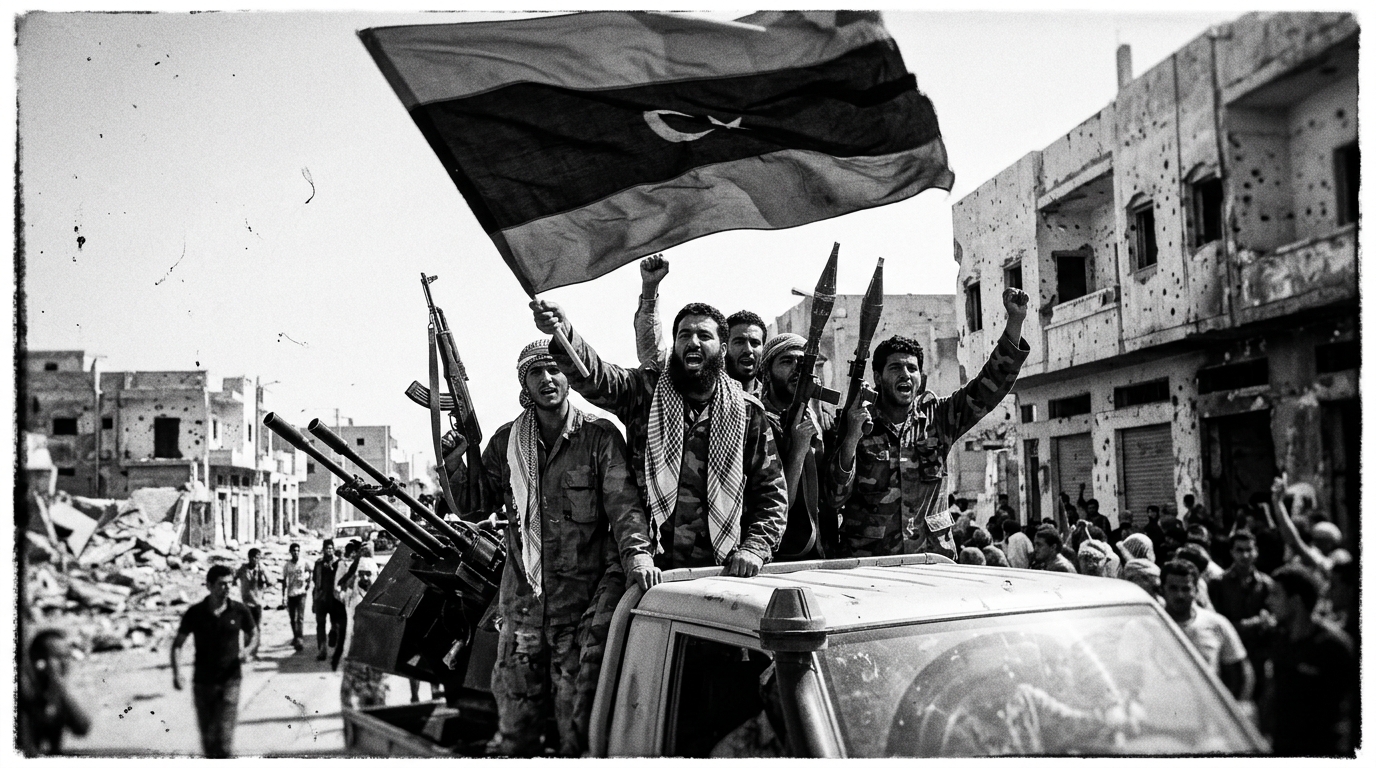
| Oct 20, 2011 | Muammar Gaddafi killed | Gaddafi is captured near Sirte after a NATO airstrike hit his convoy, and subsequently killed by rebel forces. His death marks the undisputed end of his rule and the armed phase of the civil war. |
| Oct 31, 2011 | NATO concludes Operation Unified Protector | NATO officially ends its seven-month military mission in Libya, declaring success in protecting civilians and enabling the overthrow of Gaddafi's regime. |
The intervention, initially dubbed Operation Odyssey Dawn by the United States before transitioning to NATO's Operation Unified Protector, was characterized by a distinct "lead from behind" strategy orchestrated by the Obama administration. This approach, outlined by then-Secretary of State Hillary Clinton and National Security Advisor Susan Rice, aimed to allow European and Arab nations to assume the visible mantle of diplomatic and tactical leadership, while the U.S. provided crucial enabling capabilities like intelligence, surveillance, reconnaissance (ISR), refueling, and electronic warfare. This was a deliberate departure from the unilateralism that had defined the 2003 Iraq War, reflecting the Obama administration's desire to build broad, multilateral coalitions, share burdens, and minimize American exposure to direct ground combat and post-conflict nation-building responsibilities. While successful in forming a coalition and avoiding a "boots on the ground" quagmire for the U.S., it would later face criticism for its implications on post-intervention stability, as the reduced American footprint also translated into a less engaged post-conflict stabilization effort.
Analysis of Key Actors and Decisive Actions
The Libyan intervention was a complex ballet of international diplomacy and military coercion, driven by a convergence of humanitarian concerns, political ambitions, and strategic calculations.
The French Initiative: Nicolas Sarkozy
President Nicolas Sarkozy of France emerged as the most vocal and politically aggressive advocate for intervention. Facing flagging domestic approval ratings and a looming reelection campaign in 2012, Sarkozy saw the Libyan crisis as an opportunity to project French power on the international stage, reassert France's influence in the Mediterranean, and restore its moral standing after perceived inaction in Rwanda. His administration, particularly through figures like philosopher Bernard-Henri Lévy, maintained close and public contact with the nascent National Transitional Council (NTC), offering them political recognition and material support. France was instrumental in pushing for Resolution 1973 at the UN Security Council, leveraging its permanent seat and diplomatic network to rally support, including from key Arab League states.
Militarily, France was among the first to act, with its Rafale fighter jets launching the initial airstrikes on March 19, 2011, targeting Gaddafi's advancing armor column near Benghazi. French Special Forces were also reportedly active on the ground, providing intelligence, guidance, and training to rebel forces, a detail often downplayed officially. Sarkozy’s rapid recognition of the NTC on March 10, 2011, legitimized the opposition, gave it a significant diplomatic boost, and put immense pressure on other European nations to follow suit. His vision for a post-Gaddafi Libya was vague, focusing more on the immediate removal of the dictator than on a robust plan for the subsequent transition, an oversight that would later draw considerable criticism.
The American Position: Barack Obama
The Obama administration’s role was marked by initial skepticism, particularly from then-Secretary of Defense Robert Gates, who warned against the dangers of another military engagement in the Middle East. However, powerful voices within the administration, including Secretary of State Hillary Clinton and UN Ambassador Susan Rice, championed the R2P doctrine and argued forcefully for intervention to prevent a humanitarian catastrophe. President Obama ultimately adopted a strategy he termed "lead from behind," which sought to enable European and Arab partners to take primary responsibility for the military mission while the U.S. provided unique logistical, intelligence, and targeting capabilities.
This strategy allowed Obama to commit U.S. military assets—such as stealth bombers for initial air defense suppression, advanced surveillance drones, and aerial refueling tankers—without deploying ground troops, thus avoiding the "boots on the ground" quagmire that had plagued the Bush administration in Iraq. The legal justification for military action without a formal Congressional declaration of war was predicated on the argument that the operation was limited in scope (no-fly zone, civilian protection) and duration, thus not constituting "war" in the constitutional sense. This remains a point of intense legal and political debate, especially regarding the War Powers Resolution. While preventing a massacre, the "lead from behind" approach also meant that the U.S. played a lesser role in post-conflict planning, which many critics argue contributed to the subsequent destabilization.
The British Role: David Cameron
The United Kingdom, under Prime Minister David Cameron, was another crucial European partner in the intervention. Cameron and Sarkozy formed a strong Anglo-French axis, advocating together for military action and deploying significant air and naval assets. The UK's involvement was partly driven by historical ties to Libya, a desire to align with the U.S., and a moral commitment to R2P. British Typhoon and Tornado jets participated extensively in airstrikes, and special forces were also reportedly involved in advising rebel groups. The UK’s commitment to Resolution 1973 was steadfast, reflecting a broader foreign policy stance that prioritized human rights and international law, while also acknowledging potential economic interests in a post-Gaddafi Libya.
The Dictator’s End: Muammar Gaddafi
Muammar Gaddafi's steadfast refusal to negotiate with the rebels, embrace genuine reforms, or seek exile ultimately sealed his fate. He profoundly miscalculated the international community’s resolve, believing that the Western coalition would eventually fracture under the political and financial weight of sustained operations, as had happened in previous limited interventions. His strategy relied heavily on loyalist forces, primarily drawn from his Qadhadhfa tribe and led by his sons, most notably the Khamis Brigade. However, NATO’s sustained precision airstrikes systematically degraded his command-and-control capabilities, decapitated his military leadership, and destroyed his heavy weaponry, leaving his ground forces increasingly isolated and unable to coordinate effective resistance.
Throughout the conflict, Gaddafi maintained an unwavering public defiance, projecting an image of revolutionary steadfastness even as his regime crumbled around him. He rejected African Union mediation efforts, seeing them as attempts to legitimize the "rebel rats." By August 2011, as rebel forces, aided by NATO air support, advanced on Tripoli, Gaddafi went into hiding, issuing audio messages urging his supporters to fight to the death. His final stronghold was his hometown of Sirte, a symbolic and strategic location. On October 20, 2011, as rebel forces overran Sirte, Gaddafi was captured alive after a NATO airstrike hit his convoy. He was subsequently brutally killed by militiamen, an event that, while celebrated by many Libyans and intervention proponents, immediately raised questions about accountability and the rule of law, setting a dangerous precedent for future conflicts. His death marked the undisputed end of the Jamahiriya but also removed the singular, albeit brutal, force that had suppressed the country’s deep-seated tribal and regional divisions for over four decades.
"We will find you in your homes, in your streets, in your wardrobes, in your cupboards." — Muammar Gaddafi, speaking on television, February 2011. This infamous threat against the protestors underscored his brutal resolve and catalyzed international action.
Intelligence & Strategic Miscalculations
A critical component of understanding the Libyan intervention and its tumultuous aftermath lies in an examination of intelligence gathering and strategic miscalculations made by both the Gaddafi regime and the intervening coalition.
Gaddafi's Miscalculations: Gaddafi himself made several profound errors. Firstly, he fundamentally misjudged the international community's willingness to intervene, particularly under the R2P doctrine. He likely believed that his past rapprochement with the West in the 2000s (giving up WMDs, compensating Lockerbie victims) would shield him from direct military action. Secondly, he underestimated the resolve of the nascent rebel forces and overestimated the loyalty and capabilities of his own military, which, despite its elite brigades, suffered from pervasive corruption, poor morale, and a lack of modern training and equipment. His inflammatory rhetoric, far from intimidating the international community, instead served to justify and accelerate the intervention. His belief in his own revolutionary mystique and the unwavering loyalty of his core supporters blinded him to the depth of popular discontent and the potency of coordinated external pressure.
Coalition Intelligence Failures & Oversight:
- Underestimation of Post-Intervention Chaos: Perhaps the most significant miscalculation by the international coalition was a profound underestimation of the inherent fragility of the Libyan state and the depth of its societal cleavages. Western intelligence largely focused on Gaddafi's military capabilities and the immediate threat to civilians, but paid insufficient attention to the country's complex tribal dynamics, the lack of robust civil society institutions, and the absence of a unified, credible alternative government. There was a failure to foresee the immediate collapse of state authority and the resulting power vacuum, assuming that once Gaddafi was removed, a more stable, democratic order would naturally emerge.
- Lack of a "Day After" Plan: The "lead from behind" strategy, while effective in achieving the immediate military objective of removing Gaddafi and preventing a massacre, severely hampered the development and implementation of a comprehensive post-conflict stabilization and nation-building plan. There was no concerted effort to disarm militias, demobilize fighters, establish effective governance, or integrate various factions into a new security architecture. This oversight was partly intentional, reflecting the desire to avoid another Iraq-style occupation, but it proved catastrophic for Libya's long-term stability. The absence of a clear mandate or resources for stabilization meant a critical window for peacebuilding was missed.
- Militia Fragmentation and Proliferation: Intelligence assessments largely failed to grasp the extent to which the anti-Gaddafi forces were a heterogeneous collection of regional, tribal, and ideological militias with differing agendas, rather than a cohesive military force. The reliance on these militias to overthrow Gaddafi, coupled with the lack of post-intervention disarmament, directly led to the proliferation of armed groups that would plunge Libya into subsequent civil wars. The belief that these groups would naturally unify under a civilian government was a fundamental misjudgment.
- Influence of External Actors: While some intelligence might have existed, the coalition arguably underestimated the potential for regional powers (e.g., UAE, Egypt, Turkey, Qatar) to fund and arm competing factions in a post-Gaddafi Libya, further exacerbating internal divisions and undermining efforts towards national unity. The intervention created a vacuum that invited a new geopolitical proxy battleground.
In essence, while the intervention achieved its immediate objective of preventing mass atrocities and overthrowing Gaddafi, it did so without a clear and well-resourced strategic vision for the aftermath. The intelligence community's focus on tactical military objectives overshadowed the broader geopolitical and socio-economic complexities, contributing significantly to Libya's subsequent state collapse.
Geopolitical Consequences and Aftermath
The fall of the Jamahiriya in October 2011 did not, as many proponents of the intervention had hoped, usher in an era of liberal democracy and stability. Instead, the lack of a comprehensive, well-resourced post-conflict "day-after" plan by the international coalition created a catastrophic power vacuum that rapidly metastasized into prolonged civil war, state fragmentation, and regional destabilization.
Internal Fragmentation and Militia Proliferation: The immediate consequence was the complete dissolution of the Libyan state’s monopoly on violence. Thousands of heavy weapons—including anti-aircraft missiles, artillery, and vast caches of small arms—looted from Gaddafi’s extensive stockpiles flooded across Libya and into the broader Sahel region. The thuwar, or revolutionary militias, who had been instrumental in overthrowing Gaddafi, refused to disarm. These groups, often organized along regional, tribal, or ideological lines, became the de facto power brokers, vying for control over territory, resources (especially oil facilities), and political influence. Each militia represented local interests, seeking to secure their gains from the revolution rather than cede power to a weak central authority.
Libya effectively splintered into competing governments. Initially, the National Transitional Council struggled to assert authority beyond Tripoli. This was followed by the General National Congress (GNC) in 2012, which itself became deeply divided. By 2014, the country was plunged into a second civil war, resulting in two primary competing governments: the internationally recognized Government of National Accord (GNA) based in Tripoli, and the House of Representatives (HoR) based in Tobruk and backed by the Libyan National Army (LNA) under General Khalifa Haftar. Each government was a fragile coalition of militias and political factions, heavily reliant on external patronage. The emergence of figures like Khalifa Haftar, a former Gaddafi general who had defected to the U.S., further complicated the landscape, as he sought to establish a military-dominated state.
Regional Destabilization and Terrorism: The impact reverberated across the Sahara and Sahel. The uncontrolled flow of arms and returning Libyan Tuareg mercenaries, who had fought for Gaddafi, exacerbated existing tensions in Mali, fueling the 2012 Tuareg rebellion and creating fertile ground for Islamist militant groups like Ansar Dine and Al-Qaeda in the Islamic Maghreb (AQIM). This triggered a French military intervention in Mali (Operation Serval) in 2013, illustrating the direct blowback from Libya's collapse. The porous borders and collapsed state authority also transformed Libya into a major transit hub for human trafficking and irregular migration across the Mediterranean to Europe, creating a profound humanitarian crisis and significant political pressure on European nations.
Furthermore, the power vacuum facilitated the rise of extremist groups. The Islamic State of Iraq and Syria (ISIS) established a significant presence in Libya by 2014, seizing control of Sirte and other territories, leveraging the chaos to recruit and launch attacks, including high-profile executions. This necessitated further localized interventions, notably by the U.S. and Italy, to counter the ISIS threat, demonstrating how the initial intervention had inadvertently created new security challenges.
External Interference and Geopolitical Realignment: The Libyan conflict became a proxy battleground for various regional and international powers. The GNA in Tripoli received significant military and financial support from Turkey and Qatar, which saw an opportunity to expand their influence in North Africa and support Islamist-leaning factions. Conversely, the LNA under Khalifa Haftar was backed by Egypt, the United Arab Emirates, Saudi Arabia, France, and, controversially, Russia, all of whom sought to counter Islamist influence and promote a secular strongman. This external interference intensified the conflict, prolonged the civil war, and undermined numerous UN-led peace efforts, turning Libya into a geopolitical chessboard where each actor pursued its own strategic interests, from access to oil and gas to regional hegemony. The UN's attempts at brokering ceasefires and political transitions were frequently thwarted by these external patrons, perpetuating the conflict.
Socio-Economic Aftermath and Human Toll
The immediate and long-term socio-economic consequences of the 2011 Libyan Civil War have been nothing short of catastrophic, transforming a once relatively prosperous North African nation into a fractured state plagued by poverty, instability, and a severe humanitarian crisis.
Economic Devastation and Resource Control: Libya, with Africa's largest proven oil reserves, saw its economy plummet post-2011. Oil production, which had been around 1.6 million barrels per day before the conflict, frequently dropped to a fraction of that, sometimes as low as 100,000 bpd, due to blockades of oil terminals, attacks on pipelines, and internal conflicts over control of oil fields. This collapse in hydrocarbon revenue deprived the state of its primary income source, leading to massive budget deficits, a liquidity crisis, and the inability to pay public sector salaries regularly. The National Oil Corporation (NOC), ostensibly a neutral entity, frequently found itself caught in the political crossfire, with rival factions attempting to control its revenues. This struggle over oil has been a primary driver of the ongoing conflict, turning valuable natural resources into a curse. The illicit trade of fuel and other commodities became widespread, further undermining legitimate economic activity.
Breakdown of Public Services and Infrastructure: Gaddafi’s Jamahiriya, for all its autocratic flaws, had invested heavily in social welfare programs, offering free education, healthcare, and subsidized food and housing. Post-2011, these services disintegrated. Hospitals and clinics, already understaffed, faced critical shortages of medicine and equipment, frequently becoming targets in urban warfare. Educational institutions suffered from teacher shortages, damage, and disruptions, impacting an entire generation of Libyan youth. Essential infrastructure, including electricity grids, water supply networks, and roads, sustained severe damage from protracted fighting and suffered from a chronic lack of maintenance and investment. The breakdown of law and order also facilitated rampant corruption and illicit economies, further eroding the legitimate economic fabric and creating vast opportunities for warlords and criminal gangs.
Displacement, Migration, and Human Trafficking: The violence and instability led to massive internal displacement, with hundreds of thousands of Libyans forced to flee their homes. Many sought refuge in safer cities within Libya or in neighboring countries, placing immense strain on host communities. Beyond internal displacement, Libya became the primary transit point for irregular migration from sub-Saharan Africa and the Middle East towards Europe. The collapse of border controls and the emergence of powerful militias engaged in lucrative smuggling operations turned Libya into a hub for human trafficking. Migrants and refugees, often fleeing war and poverty, faced horrific abuses in Libya, including arbitrary detention, torture, forced labor, and sexual violence, with reports of modern-day slave markets emerging. This crisis presented a significant humanitarian challenge for international organizations and exacerbated political tensions between Libya and European nations. The humanitarian catastrophe drew widespread condemnation but proved difficult to address given the pervasive insecurity.
Social Fragmentation and Trauma: The conflict deepened existing tribal, regional, and ideological divisions within Libyan society. The glorification of militias and the erosion of state authority normalized violence, leading to a rise in vigilantism, crime, and a generalized breakdown of social cohesion. The psychological trauma of protracted warfare, particularly for children, is immense and will have long-lasting societal repercussions, manifesting in increased aggression, anxiety, and a sense of hopelessness. The post-Gaddafi era also saw a rise in identity politics and grievances, with marginalized groups seeking greater autonomy or control, further complicating efforts at national reconciliation. The promise of a democratic, prosperous Libya quickly devolved into a struggle for survival, leaving deep scars on the nation's social and economic landscape, impacting family structures, education, and the very fabric of community life.
Trivia and Lesser-Known Facts
- The "Lockerbie" Shadow: The 2011 intervention was heavily influenced by the historical baggage of the 1988 Pan Am Flight 103 bombing over Lockerbie, Scotland, for which Gaddafi's regime eventually accepted responsibility. Many Western leaders, particularly in the UK and U.S., viewed the opportunity to remove Gaddafi as a long-delayed settling of scores, contributing to a sense of moral rectitude in the intervention, often overshadowing pragmatic considerations for the aftermath.
- The Gaddafi Tent Diplomacy: A symbol of his defiance, eccentricity, and Bedouin roots, Gaddafi famously traveled with an ornate Bedouin tent for international diplomatic visits and even set it up in New York during UN General Assembly meetings. Its perceived destruction or looting during the fall of his compound served as a symbolic end to his nomadic, erratic form of statecraft and persona, signaling the finality of his overthrow.
- The Oil Factor: While humanitarian protection was the stated rationale, Libya held the largest proven oil reserves in Africa and was a major supplier to Europe. Analysts noted that the rapid and robust Western intervention stood in stark contrast to the relative inaction regarding simultaneous, arguably equally severe, protests and crackdowns in Bahrain, Yemen, or later Syria. This led many critics, particularly from the Global South, to argue that energy security and economic interests remained a covert, if not primary, motivation for the coalition's swift action, even if not explicitly acknowledged.
- Intelligence Cooperation: Despite decades of animosity and Libya's designation as a state sponsor of terrorism, it was revealed post-2011 (through seized documents) that Western intelligence agencies, notably the CIA and MI6, had maintained a working, if tense, relationship with Libyan intelligence regarding counter-terrorism operations against Al-Qaeda affiliates in the decade preceding the war, particularly after Gaddafi renounced WMDs in 2003. This complex relationship complicated some policymakers' views on his removal, highlighting the transactional nature of international security cooperation.
- African Union's Unheeded Plan: The African Union (AU) proposed a roadmap for peace in March 2011, which included a ceasefire, humanitarian aid, and a transitional period. Gaddafi tentatively accepted this plan. However, the plan was rejected by the rebels and largely ignored by NATO powers, who by then had committed to his removal. Many critics argue that bypassing the AU’s efforts undermined regional solutions and contributed to the subsequent power vacuum, setting a precedent of external actors overriding African initiatives.
- The Gold Dinar Theory: A controversial but persistent theory, particularly popular in conspiracy circles, posits that Gaddafi's real 'crime' was his ambition to establish a pan-African gold-backed currency, the gold Dinar, which would challenge the dominance of the U.S. dollar and French franc in African trade. Proponents of this theory suggest that this economic threat, rather than humanitarian concerns, was the true impetus for Western intervention. While largely unsubstantiated by mainstream analysis, it highlights deeper suspicions about Western motivations and economic imperialism in Africa.
References and Literature
- Official Reports & Resolutions:
- Academic & Policy Analysis:
- Journalism & Investigative Reports:
Footnotes & Explanations
- The Responsibility to Protect (R2P) is a global political commitment endorsed by all UN member states to prevent genocide, war crimes, ethnic cleansing, and crimes against humanity. It asserts that state sovereignty is not a shield for mass atrocities. ↩
- The NTC (National Transitional Council) was established in February 2011 by anti-Gaddafi factions to serve as the interim authority and political face of the opposition. ↩
- The thuwar is an Arabic term meaning "revolutionaries" or "rebels," commonly used to refer to the various armed militias that fought against Gaddafi’s regime. ↩