Key Takeaways
- The Potsdam Conference marked the final summit of the 'Big Three' Allied powers, transitioning from wartime cooperation to Cold War rivalry.
- Key agreements established the 'Four Ds' for occupied Germany and finalized the Oder-Neisse line as Poland's western border.
- The revelation of the atomic bomb to Stalin shifted the geopolitical dynamic, accelerating the nuclear arms race and the division of Europe.
Historical Context and Origins
In July 1945, the global landscape stood at a historic crossroads. Nazi Germany had unconditionally surrendered on May 8, bringing an end to the devastating conflict in the European theater. However, the Pacific War still raged, and the task of reconstructing a shattered Europe loomed large. The Grand Alliance—composed of the United States, the Soviet Union, and Great Britain—had successfully cooperated to defeat fascism, but the underlying ideological contradictions between Western democratic capitalism and Soviet totalitarian communism could no longer be masked by the necessity of a shared military objective 1.
The previous major summit, the Yalta Conference in February 1945, had left several critical issues unresolved or subject to ambiguous compromises. While Yalta had established the framework for the United Nations and secured a Soviet commitment to enter the war against Japan, it had also exposed deep fissures regarding the future of Eastern Europe, particularly Poland. President Franklin D. Roosevelt’s death in April 1945 elevated Vice President Harry S. Truman to the presidency. Unlike Roosevelt, who believed he could personally manage and cajole Joseph Stalin, Truman harbored deep suspicions of Soviet expansionist intentions and was determined to adopt a firmer diplomatic stance.
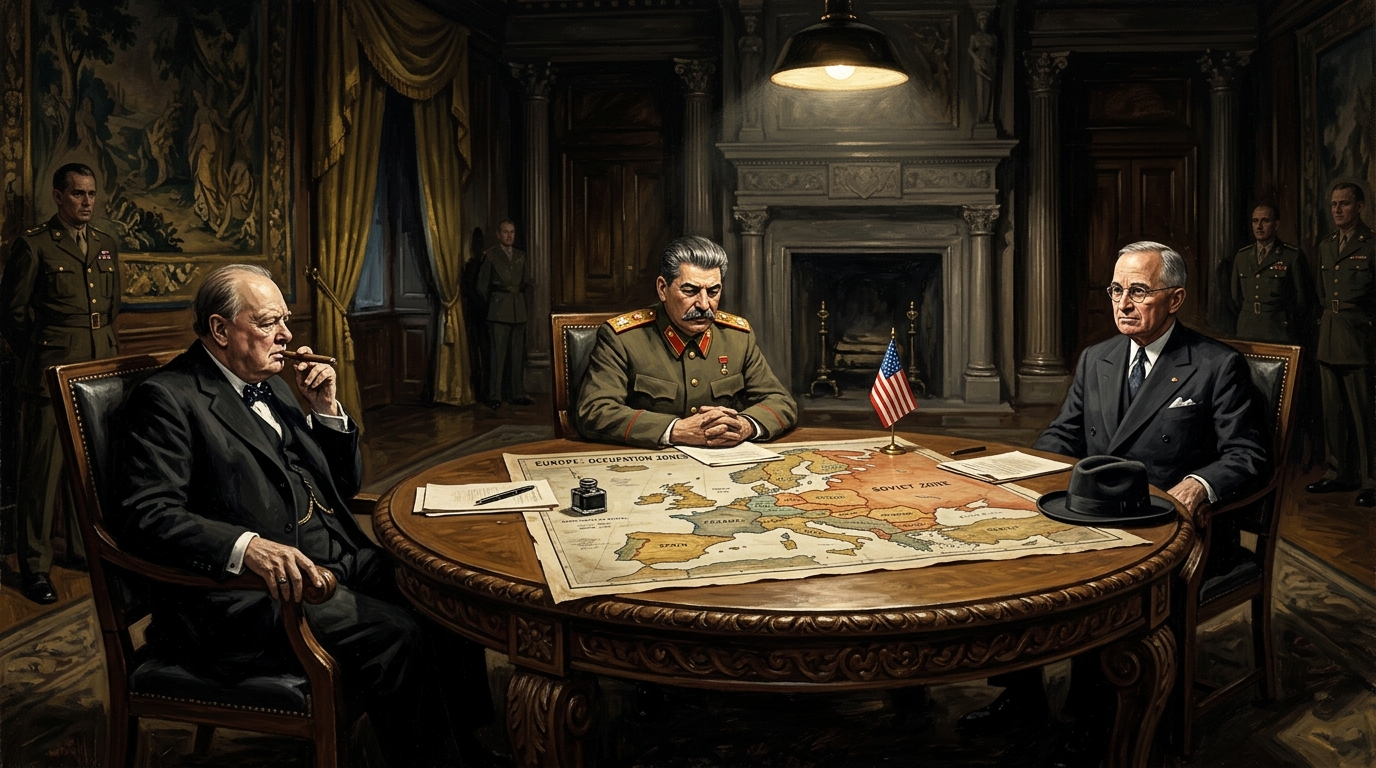
By the time the leaders gathered in Potsdam, a suburb of Berlin, the military reality on the ground heavily favored the Soviet Union. The Red Army occupied Poland, Hungary, Romania, Bulgaria, Czechoslovakia, and eastern Germany. The Western Allies had withdrawn their forces to their designated occupation zones, leaving Stalin in de facto control of Central and Eastern Europe.
"We must stand up to the Russians at this point and not easy or gentle with them. They only understand one language—'how many divisions have you?'" — Harry S. Truman, writing in his diary shortly before the conference [[^2]].
Thus, the Potsdam Conference (codenamed Terminal) was convened not just to draft the terms of peace, but to navigate a precarious transition from global conflict to an uncertain post-war order.
Timeline of Events and Key Moments
The Potsdam Conference took place from July 17 to August 2, 1945, at the Cecilienhof Palace, the former residence of Crown Prince Wilhelm of Prussia. Over the course of seventeen days, the delegations engaged in intense, often acrimonious negotiations.
POTSDAM CONFERENCE TIMELINE
| Date | Event |
|---|---|
| July 16 | Successful Trinity atomic test in New Mexico, USA. |
| July 17 | Conference opens; Truman, Stalin, and Churchill meet. |
| July 24 | Truman casually informs Stalin of a "new weapon." |
| July 25 | Churchill departs for election results in London. |
| July 26 | Potsdam Declaration issued to Japan. |
| July 28 | Attlee returns to Potsdam as the new British PM. |
| August 1 | Final agreements reached on reparations and Poland. |
| August 2 | Signing of the Potsdam Agreement; conference closes. |
The Opening Phase and the Atomic Revelation
On July 16, 1945, the day before the conference officially opened, the United States successfully detonated the world's first atomic bomb at the Trinity test site in Alamogordo, New Mexico. Truman received the coded notification of the successful test on July 21. This monumental scientific achievement fundamentally altered Truman’s diplomatic leverage.
On July 24, during a casual conversation at the end of a plenary session, Truman approached Stalin and mentioned that the United States now possessed "a new weapon of unusual destructive force" 3. Stalin, to Truman's surprise, reacted with remarkable calmness, merely expressing hope that the United States would make "good use of it against the Japanese." In truth, Soviet intelligence had thoroughly penetrated the Manhattan Project; Stalin was already well aware of the bomb's development and immediately ordered his own nuclear program accelerated.
The British Leadership Transition
One of the most dramatic occurrences of the conference was the sudden change in British leadership. Following the plenary sessions on July 25, Prime Minister Winston Churchill returned to London to await the results of the British general election. In a stunning landslide, the Labour Party defeated the Conservatives.
On July 28, Clement Attlee returned to Potsdam as the newly elected Prime Minister, accompanied by his new Foreign Secretary, Ernest Bevin. While Attlee maintained British solidarity with the United States, the sudden departure of Churchill—a master of wartime diplomacy—disrupted the continuity of the Western delegations and left Stalin as the sole remaining member of the original "Big Three."
Geopolitical Consequences and Aftermath
The decisions reached at Potsdam laid the structural foundation for the division of Europe and the onset of the Cold War. Rather than producing a comprehensive peace treaty, the conference resulted in a protocol of proceedings that formalized spheres of influence.
The Division of Germany
The conference solidified the division of Germany into four occupation zones (American, British, French, and Soviet), a system also applied to the capital city of Berlin, which sat deep within the Soviet zone. The Allies established the Allied Control Council to coordinate joint administration, though in practice, each occupying power governed its zone according to its own political and economic philosophies.
The Allies agreed on the fundamental principles of occupation, commonly referred to as the "Four Ds":
- Demilitarization: The complete disarmament and dissolution of all German armed forces and military infrastructure.
- Denazification: The removal of National Socialist influence from German public life, politics, and the judiciary, alongside the prosecution of war criminals.
- Decentralization: The deconcentration of the German economy, particularly the break-up of massive industrial cartels like IG Farben.
- Democratization: The gradual restoration of local self-government and civil liberties.
| Region | Zone |
|---|---|
| North | British Zone |
| East | Soviet Zone (including Berlin) |
| Southwest | French Zone |
| South | American Zone |
The Reparations Compromise
Reparations proved to be the most contentious issue. The Soviet Union, having suffered immense physical destruction and the loss of over 27 million citizens during the war, demanded $10 billion in reparations from Germany. The United States and Great Britain, remembering the economic chaos caused by the Treaty of Versailles after World War I, feared that excessive reparations would permanently cripple the German economy, forcing Western taxpayers to subsidize German survival.
A compromise engineered by US Secretary of State James F. Byrnes dictated that each occupying power would extract reparations primarily from its own zone. Because the Soviet zone was largely agricultural and the Western zones contained the industrial heartland of the Ruhr Valley, it was agreed that the Soviets would receive 10% of the industrial capital equipment from the Western zones for free, and another 15% in exchange for agricultural products and raw materials from the East 4. This economic decoupling of the zones set the stage for the formal partition of Germany in 1949 into the Federal Republic of Germany (West) and the German Democratic Republic (East).
Territorial Realignments and Population Expulsions
The conference confirmed the provisional transfer of German territory east of the Oder-Neisse Line to Poland and the Soviet Union (specifically the northern half of East Prussia, which became the Kaliningrad Oblast). This massive territorial shift was designed to compensate Poland for the eastern lands annexed by the Soviet Union under the terms of the Molotov-Ribbentrop Pact, which Stalin refused to relinquish.
To accommodate these new borders, the Allies sanctioned the "orderly and humane" transfer of ethnic German populations from Poland, Czechoslovakia, and Hungary. In reality, this resulted in the forced expulsion of over 12 million Germans—the largest single mass migration in modern European history—characterized by widespread violence, deprivation, and an estimated death toll ranging from 500,000 to two million civilians 5.
Analysis of Key Actors and Decisive Actions
The dynamics at Potsdam were heavily dictated by the personalities, domestic political pressures, and strategic objectives of the leaders involved.
| LEADER | COUNTRY | PRIMARY STRATEGIC OBJECTIVE |
|---|---|---|
| Harry S. Truman | United States | Contain Soviet expansion; secure prompt Japanese surrender; limit reparations. |
| Joseph Stalin | Soviet Union | Establish a secure East European buffer; extract maximum reparations; gain territory. |
| Winston Churchill | United Kingdom | Preserve British imperial interests; prevent total Soviet dominance of Europe. |
| Clement Attlee | United Kingdom | Smooth post-war domestic transition; maintain Anglo-American security alliance. |
Harry S. Truman: The Practitioner of "Atomic Diplomacy"
President Truman arrived in Europe feeling inexperienced but determined not to be outmaneuvered by Stalin. The successful Trinity test gave him a psychological boost. Historians have argued that Truman began to practice "atomic diplomacy," believing that the possession of the atomic bomb would make the Soviet Union more manageable in Eastern Europe 6. However, this strategy largely backfired; rather than intimidating Stalin, it reinforced his paranoia and hardened his resolve to establish a buffer zone of satellite states in Eastern Europe to protect the Soviet heartland from future Western aggression.
Joseph Stalin: The Patient Strategist
Stalin operated with a clear, singular vision: securing the western borders of the USSR. Having survived two German invasions in thirty years, Stalin viewed the establishment of friendly (meaning Soviet-controlled) regimes in Warsaw, Bucharest, and Sofia as a non-negotiable security requirement. He was a master of exploiting the war-weariness of the Western democracies. He knew that the American public was anxious for a rapid demobilization of troops and that the British Empire was financially bankrupt. Stalin patiently accepted minor Western concessions while securing his primary objective: the permanent redrawing of Poland’s borders and the establishment of a Soviet sphere of influence.
Churchill and Attlee: The Changing Face of Britain
Winston Churchill viewed the Soviet advance into Central Europe with growing alarm. He was deeply concerned that the "Red Army tide" would sweep across the continent. However, Churchill’s ability to influence events was limited by Britain's declining economic power. When Clement Attlee assumed the premiership, he brought a more bureaucratic and less confrontational style to the table. Attlee was intensely focused on Britain's dire economic situation and the domestic implementation of the welfare state. While his Foreign Secretary, Ernest Bevin, was a staunch anti-communist who vigorously opposed Soviet demands, the British delegation was ultimately forced to play a supporting role to the United States.
Trivia and Lesser-Known Facts
- The Golden Tablecloth: The large round table used in the main conference room at the Cecilienhof Palace was custom-made by a Moscow furniture factory and transported to Potsdam by train on Stalin's direct orders to ensure the Soviet delegation held symbolic center stage.
- Stalin's Train Journey: Due to his fear of flying, Stalin traveled to Potsdam via a heavily armored train. The journey required laying thousands of miles of security personnel along the railway tracks passing through Poland and occupied Germany.
- A "Casual" Walk: The moment Truman informed Stalin about the atomic bomb occurred during a short walk in the garden outside the conference room, away from the official stenographers. Consequently, there is no official transcript of their exact words, only the memoirs of those present, such as British diplomat Alexander Cadogan and Soviet interpreter Vladimir Pavlov [[^7]].
- The French Exclusion: Despite being granted an occupation zone in Germany and a seat on the Allied Control Council, France, under General Charles de Gaulle, was not invited to the Potsdam Conference. De Gaulle took this as a severe insult, and the French delegation subsequently used its veto power in the Allied Control Council to obstruct many of the Potsdam decisions, particularly regarding centralized German administrative agencies.
References and Literature
- The Potsdam Conference, 1945 - Office of the Historian - The official historical record and archival overview provided by the United States Department of State.
- Mee, Charles L. (1975). Meeting at Potsdam. M. Evans & Company - A highly detailed, narrative-driven history of the personalities and negotiations that shaped the conference.
- Trachtenberg, Marc (1999). A Constructed Peace: The Making of the European Settlement 1945–1963. Princeton University Press - An academic analysis of the post-war settlements and the transition to the Cold War.
- The Potsdam Agreement (August 2, 1945) - Full text of the official protocol and final declarations of the Potsdam Conference.
---
Footnotes & Explanations
- Yergin, Daniel (1977). Shattered Peace: The Origins of the Cold War and the National Security State. Houghton Mifflin. ↩
- Truman, Harry S. (1945). Personal Diary, July 1945. Harry S. Truman Presidential Library and Museum. ↩
- Alperovitz, Gar (1995). The Decision to Use the Atomic Bomb. Alfred A. Knopf. ↩
- Gimbel, John (1976). The Origins of the Marshall Plan. Stanford University Press. ↩
- Douglas, R.M. (2012). Orderly and Humane: The Expulsion of the Germans after the Second World War. Yale University Press. ↩
- Sherwin, Martin J. (1975). A World Destroyed: The Atomic Bomb and the Grand Alliance. Alfred A. Knopf. ↩
- Mastny, Vojtech (1996). The Cold War and Soviet Insecurity: The Stalin Years. Oxford University Press. ↩