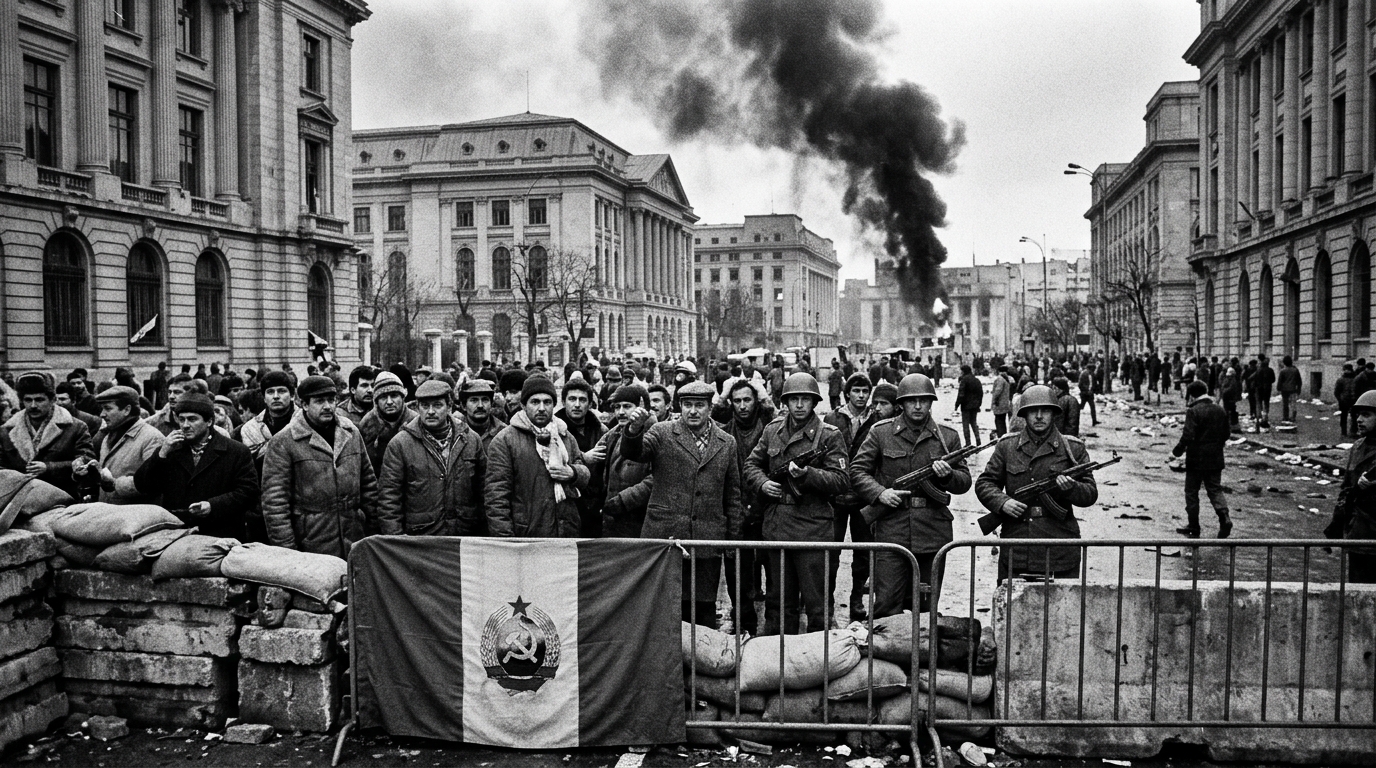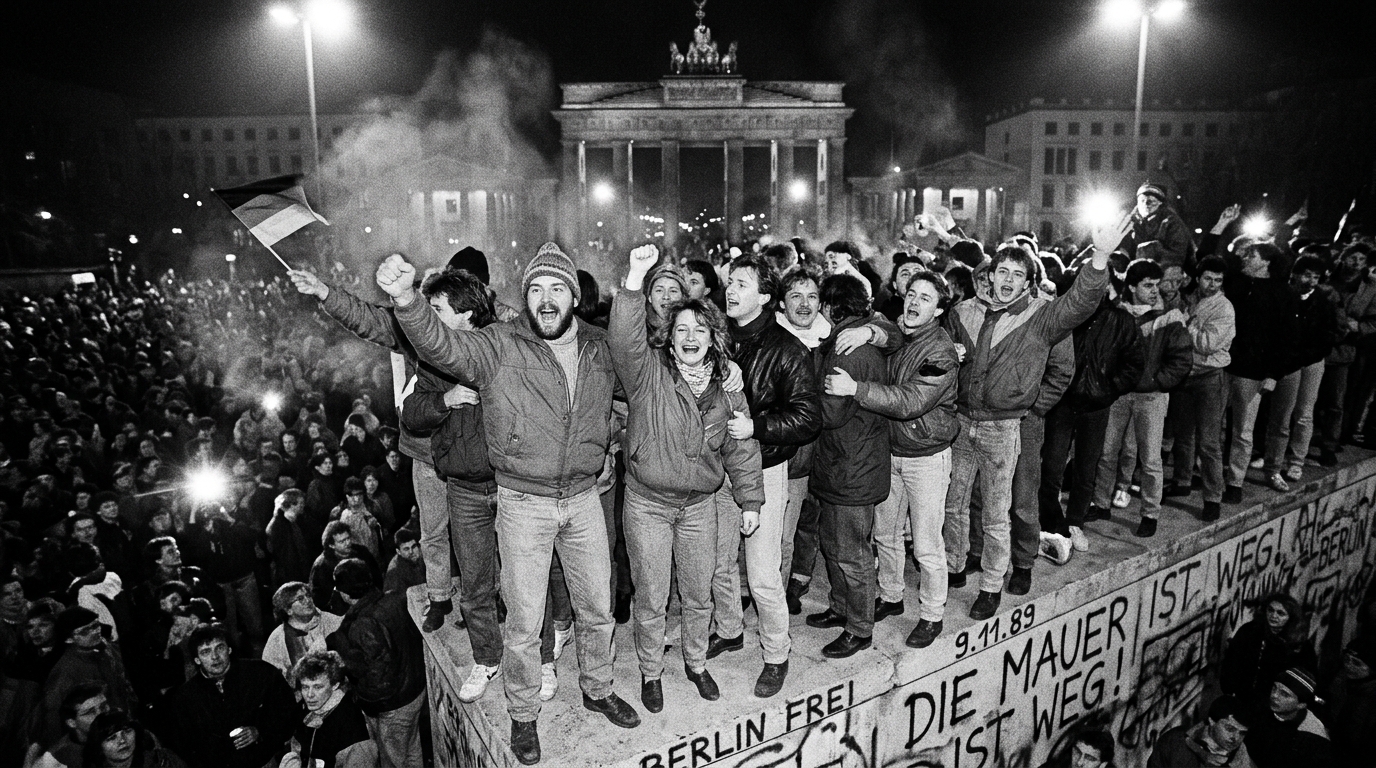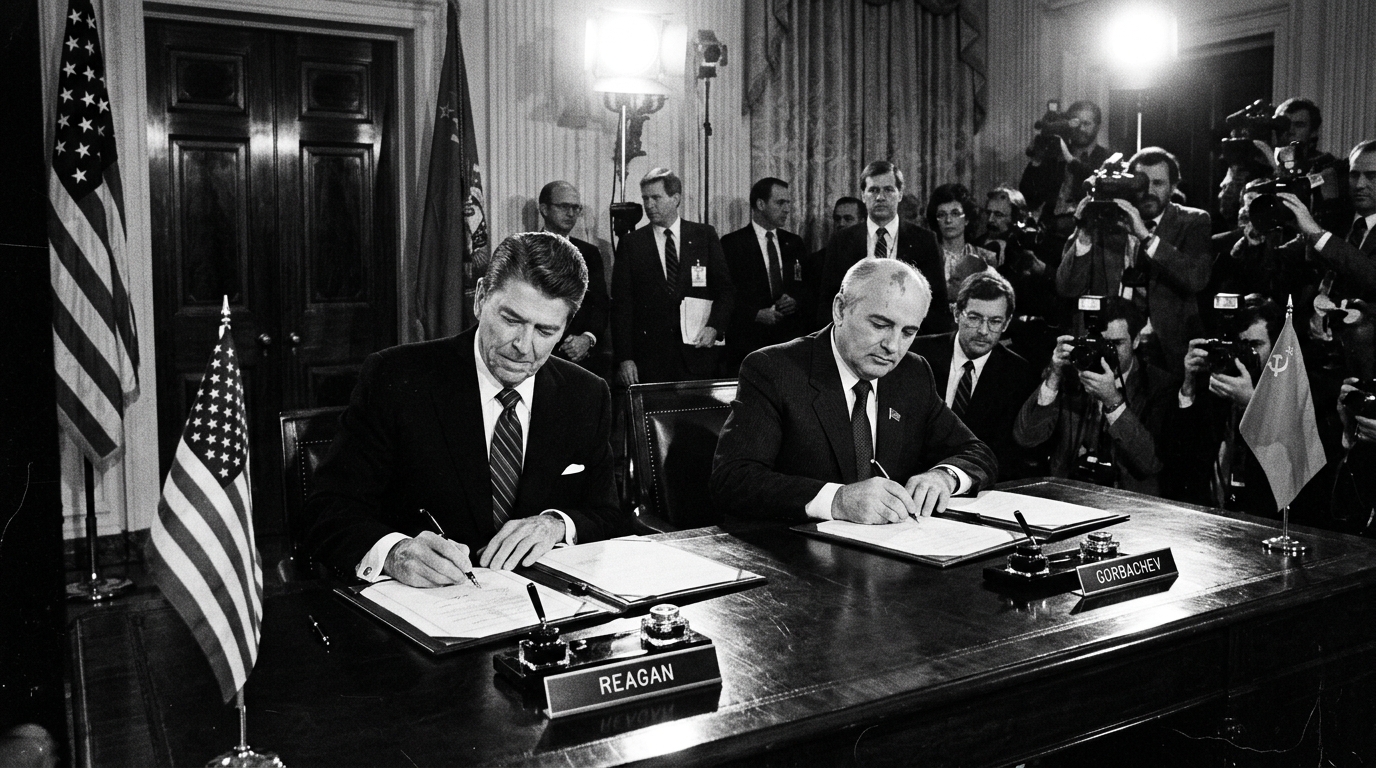
Key Takeaways
- The death of reformist leader Hu Yaobang catalyzed student protests demanding free speech, democratic reforms, and an end to corruption.
- A profound ideological rift emerged within the CCP leadership between moderate dialogue advocates like Zhao Ziyang and hardliners backed by Deng Xiaoping.
- The military intervention on June 3–4, 1989, resulted in significant civilian casualties, led to international condemnation, and solidified the CCP's political monopoly.
Historical Context and Origins
The Tiananmen Square protests of 1989 were not a sudden, isolated eruption of popular discontent, but rather the culmination of a decade of profound socioeconomic transition, ideological tension, and institutional friction within the People’s Republic of China (PRC). To understand the events of Beijing's Spring, one must analyze the dual-track reform program initiated by Deng Xiaoping in late 1978, the cultural shifts of the 1980s, and the mounting structural contradictions of the early reform era.
The Decalogue of Reform and Opening Up
Following the death of Mao Zedong in 1976 and the subsequent sidelining of the "Gang of Four," Deng Xiaoping emerged as the paramount leader of the Chinese Communist Party (CCP). At the historic Third Plenary Session of the 11th Central Committee in December 1978, Deng officially steered the nation away from class struggle toward economic modernization, launching the policy of "Reform and Opening Up" (Gaige Kaifang).
This economic restructuring proceeded along two primary tracks:
- Agricultural De-collectivization: The introduction of the Household Responsibility System, which allowed peasants to lease land and sell surplus crops on the open market.
- Urban and Industrial Restructuring: The gradual introduction of private enterprise, foreign direct investment via Special Economic Zones (SEZs) like Shenzhen, and a "dual-track" price system where goods were sold at both state-mandated and market prices.
While these reforms unleashed unprecedented productive forces and lifted millions out of poverty, they also introduced destabilizing socioeconomic phenomena. The dual-track price system invited rampant corruption, as well-connected cadres (guandao) bought goods at low state prices and resold them at high market prices 1. Furthermore, by 1988, overheating economic growth led to hyperinflation, with the consumer price index in urban areas soaring to nearly 30 percent, eroding the purchasing power of workers and intellectuals alike.
Intellectual Ferment and the "Beijing Spring" of the 1980s
Parallel to economic liberalization was a period of intellectual pluralism. Throughout the 1980s, Chinese universities became hotbeds for Western political philosophy, sociology, and economics. This period, often characterized as a cultural Renaissance or the "New Enlightenment," saw the rise of prominent dissident intellectuals like astrophysicist Fang Lizhi, who openly questioned the CCP’s monopoly on power and advocated for human rights, democratic governance, and academic freedom.
The intellectual climate was further stimulated by media liberalizations under Hu Yaobang (General Secretary of the CCP from 1982 to 1987) and his successor, Zhao Ziyang. Television programs like the controversial 1988 documentary series River Elegy (Heshang) criticized traditional Chinese inward-looking culture and argued that China’s survival depended on embracing maritime civilization, trade, and democratic ideals.
| Economic Grievances | Political/Social Ideals |
|---|---|
| High inflation (~30% in 1988) | Democratic reforms |
| Official corruption (Guandao) | Freedom of the press |
| Lack of career placement choice | Freedom of association |
| Housing and wage insecurity | Academic liberty |
The Purge of Hu Yaobang
The limits of political tolerance were, however, strictly defined by Deng Xiaoping’s "Four Cardinal Principles," established in 1979:
- Keeping to the socialist road;
- Upholding the dictatorship of the proletariat;
- Upholding the leadership of the Communist Party;
- Upholding Marxist-Leninist-Mao Zedong Thought.
When nationwide student demonstrations broke out in late 1986 demanding democratic reforms, Deng and party conservatives blamed the unrest on "bourgeois liberalization." Hu Yaobang, who was seen as sympathetic to the students and reluctant to execute harsh crackdowns, was forced to resign as General Secretary in January 1987 2. Hu’s forced ouster deeply angered liberal intellectuals and university students, who viewed him as an honest reformer. His sudden death from a heart attack on April 15, 1989, served as the immediate catalyst that ignited the pent-up frustrations of a generation.
Timeline of Events and Key Moments
The protest movement in Beijing progressed through distinct phases, transforming from a student-led memorial for Hu Yaobang into a broad-based, nationwide movement for systemic political reform, before ending in a militarized crackdown.
Phase 1: Mourning and Mobilization (April 15 – April 25)
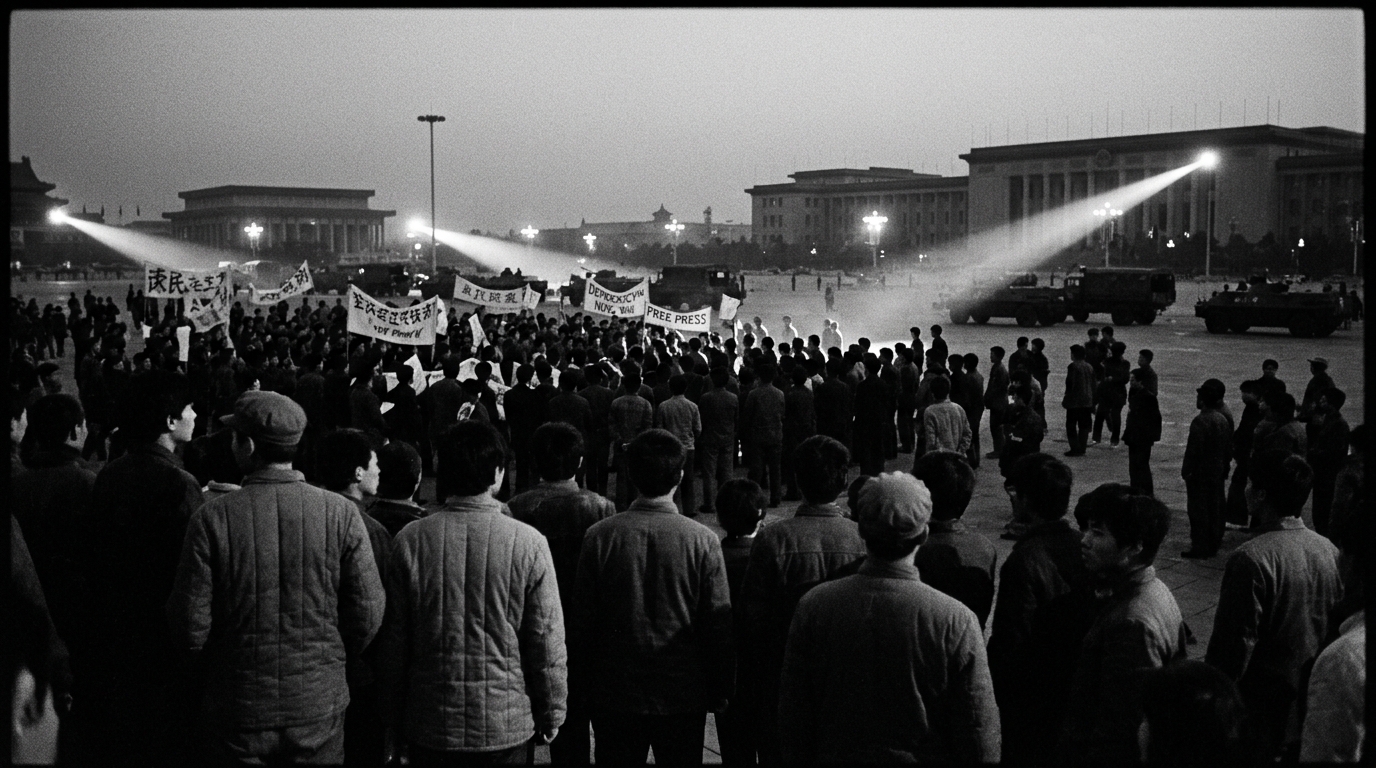
Immediately following the announcement of Hu Yaobang's death on April 15, students from Beijing University (Beida), Tsinghua University, and People's University (Renmin) began gathering at Tiananmen Square to lay wreaths at the Monument to the People's Heroes. The mourning quickly evolved into political action. On April 17, students formulated the "Seven Demands," which included:
- Affirming Hu Yaobang’s views on democracy and freedom;
- Repudiating the campaigns against "bourgeois liberalization";
- Publishing the assets of government officials and their family members;
- Guaranteeing freedom of the press and speech;
- Increasing funding for education and raising intellectual salaries;
- Lifting restrictions on public demonstrations.
On April 22, the day of Hu’s state funeral, tens of thousands of students defied police orders and occupied Tiananmen Square. Three student representatives knelt on the steps of the Great Hall of the People, holding a petition and demanding to speak with Premier Li Peng. The refusal of the leadership to receive them deeply alienated the student body, leading to the creation of the Beijing Students' Autonomous Federation, the first major independent student organization in communist China.
Phase 2: The April 26 Editorial and Escalation (April 26 – May 12)
While General Secretary Zhao Ziyang was on a state visit to North Korea, hardline elements within the party, led by Premier Li Peng and Beijing Party Secretary Chen Xitong, presented Deng Xiaoping with an alarmist brief on the protests. Influenced by this report, Deng declared that the protests were an organized anti-party, anti-socialist conspiracy aimed at overthrowing the socialist system.
On April 26, the party's official mouthpiece, the People's Daily (Renmin Ribao), published an editorial titled "It is Necessary to Take a Clear-Cut Stand Against Turmoil" (Bixu qishi xianming di fandui dongluan). The editorial branded the student movement as an illegitimate conspiracy:
"This is a planned conspiracy and a disturbance. Its essence is to fundamentally negate the leadership of the Chinese Communist Party and the socialist system."
Rather than intimidating the students, the editorial backfired. On April 27, outraged by the accusation of treason, over 100,000 students broke through police blockades to march to Tiananmen Square, supported by hundreds of thousands of Beijing citizens cheering from the streets.
Upon his return from Pyongyang on April 30, Zhao Ziyang attempted to defuse the situation. In speeches delivered during the Asian Development Bank meeting on May 3–4, Zhao praised the students' patriotism, acknowledged that their concerns about corruption were legitimate, and argued that the crisis should be resolved "along the track of democracy and the law."
Phase 3: The Hunger Strike and Gorbachev's Visit (May 13 – May 19)
As the movement appeared to lose momentum due to exam schedules and government stonewalling, a group of radical student leaders, including Chai Ling, Wang Dan, and Wuerkaixi, decided to escalate the protest. On May 13, two days before the arrival of Soviet leader Mikhail Gorbachev for a historic Sino-Soviet summit, several hundred students went on a hunger strike in Tiananmen Square.
Chronology of Escalation: May 1989
| Date | Event |
|---|---|
| May 13 | Hunger strike begins in Tiananmen Square |
| May 15 | Gorbachev arrives; global media descends on Beijing |
| May 17 | 1 million+ protest in Beijing; worker unions join |
| May 19 | Zhao Ziyang's final appeal; martial law announced |
| May 20 | Martial law officially takes effect |
The hunger strike galvanized Chinese society. The spectacle of young students starving for democratic ideals generated widespread public sympathy. By May 17, over one million people, including factory workers, civil servants, military personnel, and journalists from state media, took to the streets of Beijing in solidarity.
The hunger strike also thoroughly disrupted the diplomatic itinerary of Mikhail Gorbachev’s visit, which was meant to mark the normalization of Sino-Soviet relations. Because the square was occupied, the welcoming ceremony could not be held there, forcing the state to hold it at the airport. Hundreds of foreign journalists, already in Beijing to cover the historic summit, redirected their cameras toward the protests, broadcasting the civil unrest live to a global audience.
Phase 4: Martial Law and the Internal Coup (May 19 – June 2)
The political split within the CCP leadership reached a breaking point on May 17 during an extraordinary meeting at Deng Xiaoping’s residence. Zhao Ziyang argued for conciliation and a formal retraction of the April 26 Editorial. He was opposed by Li Peng, Yao Yilin, and Deng himself, who argued that further concessions would lead to complete state collapse. Deng decided to declare martial law, a decision Zhao refused to implement, subsequently submitting his resignation.
In the early morning hours of May 19, a visibly emotional Zhao Ziyang made a final, unannounced visit to the hunger-striking students in the square. Accompanied by a young Wen Jiabao (who would later become Premier), Zhao spoke through a megaphone:
"Students, we came too late. We are sorry... We have already grown old, it does not matter to us anymore. But you are still young, you must live to see the day of China’s modernization." [[^3]]
It was Zhao’s last public appearance; he was stripped of his official duties and placed under house arrest for the remaining 16 years of his life.
On May 20, Premier Li Peng officially declared martial law. Troops from the People's Liberation Army (PLA) were ordered to advance on Beijing. However, tens of thousands of Beijing citizens blocked the incoming military convoys in the suburbs, erecting barricades, pleading with the soldiers, and offering them food and water. The military stood down temporarily, retreating to outskirts bases to regroup.
On May 30, art students from the Central Academy of Fine Arts erected the Goddess of Democracy (Minzhu nvshen) in the center of Tiananmen Square. Built in just four days out of papier-mâché and plaster over a wire frame, the 10-meter-tall statue, bearing a striking resemblance to the Statue of Liberty, became an international symbol of the movement, drawing fresh crowds to the square.
Phase 5: The Crackdown (June 3 – June 4)
By early June, the CCP leadership had finalized their plans to clear the square. Deng Xiaoping, along with party elders, authorized the use of "any means necessary" to enforce martial law. Troops from the 38th, 27th, and 15th Airborne Group Armies—totaling over 150,000 soldiers—were mobilized from various military regions. Unlike the initial deployment, these troops were heavily armed, accompanied by tanks and armored personnel carriers (APCs).
The offensive began on the night of Saturday, June 3. Army divisions advanced on the city center from several directions:
- The Western Approach (Muxidi): Some of the heaviest fighting and highest civilian casualties occurred at Muxidi, where citizens attempted to block the advance of the 38th Group Army. Troops fired live ammunition directly into the crowds, killing demonstrators, bystanders, and residents in nearby apartment complexes.
- The Southern and Eastern Approaches: PLA units met similar resistance, responding with lethal force. Barricades were systematically crushed by tanks.
By 1:00 AM on June 4, military units had reached the perimeter of Tiananmen Square. Around 4:00 AM, the lights in the square were turned off. Student leaders, including Liu Xiaobo (the future Nobel Peace Prize laureate) and Hou Dejian, negotiated a peaceful withdrawal with military commanders to prevent further bloodshed. At 4:30 AM, the remaining students began to exit the square through the southeastern corner. Despite this, some skirmishes continued on the fringes of the square, and fleeing students were chased down and run over by tanks near the Rokko (Liubukou) intersection.
By midday on June 4, the PLA was in complete military control of the capital. The cost in human lives remains a subject of intense controversy:
- The Chinese government claimed that approximately 200 civilians and several dozen security personnel died.
- Student groups, foreign intelligence services, and international Red Cross organizations estimated the death toll to range from several hundred to several thousand [[^4]].
Geopolitical Consequences and Aftermath
The military suppression of the protests triggered an immediate global backlash, reshaped China’s internal political structure, and fundamentally altered the trajectory of its foreign relations during the final years of the Cold War.
Western Isolation and Sanctions
The visual broadcast of tanks rolling down Chang'an Avenue shocked the international community. In the United States, Europe, and Japan, public outrage put intense pressure on governments to act.
The response of the Western alliance was swift, though varied:
- Sanctions: The United States and the European Economic Community (EEC) suspended high-level military contacts, halted loans from the World Bank, and imposed a comprehensive arms embargo on the PRC. This arms embargo remains in place to this day, severely restricting China’s access to advanced Western military technology.
- Diplomatic Quarantine: High-level diplomatic visits between China and Western capitals were frozen. The G7 summit in Paris in July 1989 formally condemned China’s human rights record, threatening further economic isolation.
- Protection of Dissidents: Several Western countries offered protection to Chinese students studying abroad. US President George H.W. Bush signed an executive order allowing Chinese nationals in the US to remain indefinitely, a policy later codified in the Chinese Student Protection Act of 1992.
Despite these measures, President Bush sought to maintain a backchannel to Beijing. In July 1989, he dispatched National Security Advisor Brent Scowcroft on a secret mission to meet with Deng Xiaoping, ensuring that the US did not permanently sever relations, recognizing China's strategic importance as a counterweight to a declining Soviet Union 5.
Domestic Consolidation and the Ideological Freeze
Domestically, the CCP underwent a major political purge. Reformers associated with Zhao Ziyang were ousted from the government, academic institutions, and media organizations.
| Feature | Pre-June 1989 | Post-June 1989 |
|---|---|---|
| General Secretary | Zhao Ziyang | Jiang Zemin |
| Status | (Purged / House Arrest) | (New Leadership) |
| Policy Orientation | Liberal Reformist | Technocratic / Conservative Pivot |
Jiang Zemin, then the Party Secretary of Shanghai, was elevated to the position of General Secretary of the CCP. Jiang had won the favor of Deng Xiaoping and party elders by defusing the protests in Shanghai peacefully without resorting to military force, while maintaining strict party control over local media.
To prevent future ideological challenges, the CCP launched several internal initiatives:
- Patriotic Education Campaign: Initiated in the early 1990s, this campaign restructured the educational curriculum to emphasize China's "Century of Humiliation" (Bainian Guochi) under foreign powers, casting the CCP as the sole defender of Chinese national sovereignty and stability.
- Expansion of the State Security Apparatus: The People’s Armed Police (PAP) was expanded and specialized in riot control, ensuring that future domestic unrest could be handled without deploying active-duty military units.
- The "Stability Maintenance" (Weiwen) Regime: A vast bureaucratic and technological system dedicated to preemptively monitoring, censoring, and dismantling any organized opposition.
Reinvigorating Economic Reform: The Southern Tour
In the immediate aftermath of 1989, conservative elements within the CCP, led by Chen Yun, tried to roll back market reforms and return to a more planned economy. However, Deng Xiaoping realized that economic stagnation posed an even greater threat to the party’s legitimacy than demands for political reform.
In early 1992, at the age of 88, Deng made his famous Southern Tour (Nanxun) to Shenzhen, Zhuhai, and Guangzhou. By bypassing the conservative leadership in Beijing and directly appealing to local cadres and the public, Deng declared that "whoever does not reform must step down."
His tour successfully broke the ideological deadlock, paving the way for the 14th National Congress of the CCP in late 1992, which formally adopted the goal of building a "Socialist Market Economy." The implicit social contract of the post-1989 era was established: the Chinese population would accept the political monopoly of the CCP in exchange for rapid economic growth, material prosperity, and personal (though non-political) freedoms.
Analysis of Key Actors and Decisive Actions
The tragedy of Beijing's Spring can be analyzed as a complex interaction between distinct historical figures, whose decisions under extreme pressure shaped the final outcome.
Deng Xiaoping: The Pragmatist's Red Line
Deng Xiaoping’s role was paramount. As the de facto leader of China, he was simultaneously the architect of its economic liberalization and the defender of its authoritarian political system. Deng's actions in 1989 were governed by two fundamental beliefs:
- The Fear of "Luan" (Chaos): Having lived through the chaos of the Cultural Revolution, Deng believed that political stability was the absolute prerequisite for economic development. He viewed any threat to CCP authority as a precursor to civil war.
- The Solidarity Lesson: Deng closely watched the unfolding developments in Eastern Europe, particularly Poland, where the Solidarity movement was challenging the ruling communist party. He was determined that the CCP would not yield its monopoly on power through negotiations.
By choosing military force, Deng preserved the ruling party's power but severely damaged his international legacy. He successfully defended his red line: economic reform could continue, but political reform was permanently off the table.
Zhao Ziyang: The Tragic Reformer
Zhao Ziyang represented the liberal-reformist wing of the party. His approach to the crisis was structural rather than purely tactical; he believed that the student protests were an opportunity to accelerate political reforms, such as increasing government transparency, separating the party from state administration, and legalizing independent social groups 6.
His decisive failure lay in his inability to build a coalition among the party elders and his miscalculation of Deng Xiaoping's tolerance limit. By publicly revealing the split within the party during his meeting with Mikhail Gorbachev—where he noted that Deng was still the ultimate decision-maker in China—Zhao crossed an unwritten line of party discipline, allowing hardliners to frame him as a factional splitter.
The Student Leadership: Radicalization and Division
The student movement was not a monolith. It was marked by continuous internal power struggles, ideological splits, and coordination failures:
- The Moderates: Advocated for a tactical approach, suggesting that students should return to classes after key demonstrations (like those on April 27 or May 4) to consolidate their gains and engage in structured dialogue with the government.
- The Radicals: Gained control of the movement through the hunger strike. Leaders like Chai Ling believed that compromise with the government was impossible and that only a dramatic confrontation would expose the true nature of the regime.
This radicalization created a tragic feedback loop: the students' refusal to vacate the square, even when offered compromises, reinforced the hardliners' narrative that the movement was an irreconcilable threat, ultimately making a violent resolution more likely.
Trivia and Lesser-Known Facts
- The Mystery of Tank Man: On June 5, 1989, a lone man carrying two shopping bags stood directly in front of a column of Type 59 tanks leaving Tiananmen Square. Captured on film by Western journalists from the Beijing Hotel, the image became one of the most famous symbols of peaceful resistance in history. Despite numerous investigations, his identity and fate remain unconfirmed. Some sources identify him as "Wang Weilin," but successive CCP leaders, including Jiang Zemin, have claimed they have no record of his arrest or existence.
- Xu Qinxian’s Refusal: Major General Xu Qinxian, commander of the elite 38th Group Army, refused to execute the martial law order to use force against civilians. He argued that the order was unconstitutional because it had not been signed by the Chairman of the Central Military Commission (at the time, Deng Xiaoping) and the Premier simultaneously. Xu was court-martialed, expelled from the CCP, and sentenced to five years in prison [[^7]].
- Operation Yellowbird: In the wake of the crackdown, an underground network of Hong Kong activists, triad members, and Western diplomats organized "Operation Yellowbird" (Huangque Xingdong). The operation successfully smuggled over 400 prominent student leaders and intellectuals, including Wuerkaixi and Yan Jiaqi, out of mainland China to Hong Kong (then a British colony) and on to safety in Western countries.
- The Disappearing "May 19" Recording: The audio recording of Zhao Ziyang's final speech in Tiananmen Square was captured by a student with a portable tape recorder. The tape was smuggled out of the square and copied thousands of times, becoming a prized historical artifact of the movement before state authorities could confiscate the original.
References and Literature
- The Tiananmen Papers - Compiled by Zhang Liang, edited by Andrew J. Nathan and Perry Link. PublicAffairs, 2001. A compilation of leaked internal CCP documents detailing the leadership's decision-making process during the 1989 crisis.
- Prisoner of the State: The Secret Journal of Premier Zhao Ziyang - Zhao Ziyang, translated and edited by Pu Pu and Sherman Chao. Simon & Schuster, 2009. The secretly recorded memoirs of the purged General Secretary of the CCP, providing an insider's view of the internal party struggles.
- The People's Republic of Amnesia: Tiananmen Revisited - Louisa Lim. Oxford University Press, 2014. An exploration of the memory and systemic censorship of the 1989 protests in contemporary China.
- The Gate of Heavenly Peace - Long Bow Group, 1995. A highly acclaimed, comprehensive documentary film and archive detailing the history, ideology, and factional struggles of the student movement.
Footnotes
Footnotes & Explanations
- Naughton, Barry. Growing Out of the Plan: Chinese Economic Reform, 1978-1993. Cambridge University Press, 1995, pp. 245–248. ↩
- Baum, Richard. Burying Mao: Chinese Politics in the Age of Deng Xiaoping. Princeton University Press, 1994, pp. 203–207. ↩
- Zhao Ziyang. Prisoner of the State: The Secret Journal of Premier Zhao Ziyang. Simon & Schuster, 2009, p. 32. ↩
- Link, Perry, and Nathan, Andrew J. The Tiananmen Papers. PublicAffairs, 2001, pp. 435–439. ↩
- Bush, George H.W., and Scowcroft, Brent. A World Transformed. Alfred A. Knopf, 1998, pp. 98–101. ↩
- Fewsmith, Joseph. Dilemmas of Reform in China: Political Conflict and Economic Debate. M.E. Sharpe, 1994, pp. 112–115. ↩
- "The Commander Who Said No to the Massacre." The New York Times, June 2, 2014. ↩