Key Takeaways
- The historic 1972 visit ended over two decades of diplomatic isolation between the United States and the People's Republic of China.
- By exploiting the deep ideological and military fissures of the Sino-Soviet split, Nixon and Kissinger established 'triangular diplomacy' to gain leverage over the USSR.
- The signing of the Shanghai Communiqué established a framework of strategic ambiguity regarding Taiwan, which remains the cornerstone of US-China relations today.
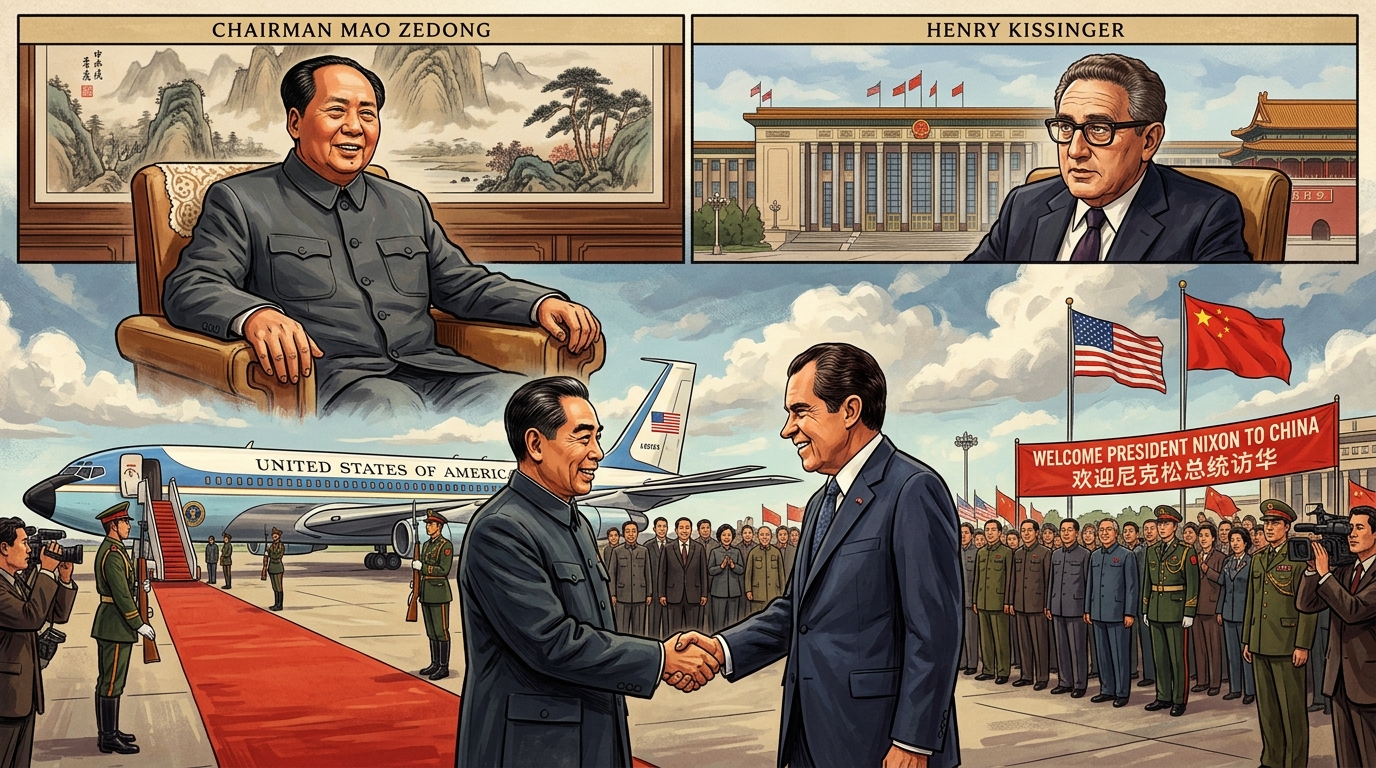
On February 21, 1972, Air Force One touched down at Beijing Capital Airport, carrying President Richard M. Nixon on a mission he famously characterized as "the week that changed the world." 1 For more than two decades, the United States and the People’s Republic of China (PRC) had existed in a state of bitter mutual isolation, frozen in ideological hostility since the Chinese Communist Party's victory in 1949 and the bloody clash of their armies on the Korean Peninsula.
Nixon’s descent down the passenger stairs to clasp the hand of Chinese Premier Zhou Enlai did more than break a twenty-three-year diplomatic freeze. It shattered the binary structure of the Cold War, introducing a sophisticated tri-polar dynamic known as Triangular Diplomacy. By engaging with a revolutionary Beijing, Washington successfully exploited the deep fissures of the Sino-Soviet split, isolated the Soviet Union, altered the trajectory of the Vietnam War, and laid the structural foundation for the modern globalized economic order.
Historical Context and Origins
To understand the audacity of Nixon's opening to China, one must examine the geopolitical paralysis of the late 1960s. For years, Western foreign policy had operated under the assumption of a "monolithic communist bloc" directed from Moscow. However, beneath the surface of shared Marxist-Leninist rhetoric, relations between the Union of Soviet Socialist Republics (USSR) and the PRC had deteriorated into existential hostility.
The Sino-Soviet Split
The ideological schism between Moscow and Beijing began to widen in the late 1950s, driven by Nikita Khrushchev's denunciation of Stalin, his policy of "peaceful coexistence" with the West, and Mao Zedong’s belief that the Soviet Union had succumbed to "revisionism." 2 Mao positioned himself as the true champion of global anti-imperialist revolution, accusing Moscow of betrayal.
By 1969, ideological disputes transformed into territorial conflict. Armed clashes erupted along the disputed Ussuri River border, particularly over Zhenbao (Damansky) Island. For several months, the prospect of a full-scale, potentially nuclear war between the two communist giants was a distinct possibility. Realizing their vulnerability to a preemptive Soviet strike, Chinese leaders began to reconsider their strategic isolation.
The American Quagmire in Vietnam
Simultaneously, the United States was facing its own strategic crisis. The Vietnam War had dragged on for years, draining American military resources, polarizing domestic society, and damaging Washington's international prestige.
Upon taking office in 1969, Richard Nixon and his National Security Advisor, Henry Kissinger, sought a way out of Southeast Asia through "Peace with Honor." 3 They believed that if Washington could build a constructive relationship with Beijing—North Vietnam’s primary supplier of food and political backing—it could isolate Hanoi and pressure the North Vietnamese to negotiate a peace settlement.
Nixon’s Vision of a Multipolar World
Contrary to his reputation as a fierce anti-communist dogmatist during his early political career, Nixon was a pragmatic realist. As early as October 1967, he penned an article in Foreign Affairs arguing that Washington could not leave China forever outside the international community:
"Taking the long view, we simply cannot afford to leave China forever outside the family of nations, there to nurture its fantasies, cherish its hates and threaten its neighbors. The world cannot be safe until China changes." [[^4]]
Nixon envisioned a multipolar international system in which five great power centers—the United States, Europe, the Soviet Union, China, and Japan—balanced one another, replacing the volatile, zero-sum bipolarity of the early Cold War.
[United States] / \ / \ / \ [Soviet Union] ---- [PRC] (Deep Border Conflict, 1969)
Timeline of Events and Key Moments
The road to Beijing was paved with highly sensitive, secret backchannel communications, unconventional diplomacy, and high-stakes intelligence operations.
1969–1970: The Backchannel Operations
Direct communication between Washington and Beijing was non-existent. To signal a desire for dialogue, the Nixon administration utilized foreign intermediaries.
- The Pakistani Channel: President Yahya Khan of Pakistan served as a vital bridge, hand-delivering messages between Washington and Beijing.
- The Romanian Channel: President Nicolae Ceaușescu also conveyed messages, signaling Nixon's willingness to ease trade restrictions and travel bans.
- The Warsaw Talks: Low-level diplomatic meetings in Poland, which had occurred sporadically for years, were upgraded to convey serious intent.
April 1971: Ping-Pong Diplomacy
The public breakthrough occurred in an unexpected venue: the 31st World Table Tennis Championships in Nagoya, Japan. On April 4, 1971, Glenn Cowan, an American table tennis player, missed his team bus and was invited onto the Chinese team bus by Zhuang Zedong, China's triple world champion. The two players chatted through an interpreter and exchanged gifts.
Mao Zedong seized on this spontaneous moment of goodwill. Overriding his foreign ministry's cautious advice, Mao personally authorized an invitation for the US Table Tennis team to visit China.
"This Zhuang Zedong," Mao remarked, "is not only a good ping-pong player, but he’s also a good diplomat." [[^5]]
On April 10, 1971, nine American players, along with accompanying journalists, stepped across the bridge from Hong Kong into mainland China, marking the first group of Americans officially permitted to enter the PRC since 1949.
July 1971: Operation Polo – Kissinger’s Secret Mission
With the ice broken, the diplomatic machinery moved rapidly. In July 1971, Henry Kissinger embarked on a trip to Asia. While in Islamabad, Pakistan, Kissinger feigned a stomach illness, requiring him to retreat to a hill station to "recover."
In reality, under the cover of darkness, Kissinger boarded a Pakistani Boeing 707 and flew to Beijing. Code-named Operation Polo, this secret trip lasted 48 hours. Kissinger met with Premier Zhou Enlai, negotiating the groundwork for a presidential visit. On July 15, 1971, Nixon stunned the world by delivering a live television address announcing that he had been invited to visit the People's Republic of China before May 1972.
KEY MILESTONES TO THE 1972 SUMMIT
| Date | Milestone |
|---|---|
| Oct 1967 | Nixon publishes "Asia After Viet Nam" |
| Mar 1969 | Sino-Soviet border clashes along Ussuri River |
| Apr 1971 | U.S. Table Tennis Team visits Beijing |
| Jul 1971 | Kissinger's secret trip (Operation Polo) |
| Oct 1971 | UN General Assembly passes Resolution 2758 |
| Feb 1972 | Nixon lands in Beijing; meets Mao & Zhou |
February 21–28, 1972: The Historic Visit
Nixon’s visit was structured to maximize global symbolic impact while hammering out complex diplomatic frameworks behind closed doors.
- February 21 – The Arrival and the Unscheduled Audience: Shortly after Nixon's plane landed, Premier Zhou Enlai escorted him to the Great Hall of the People. Almost immediately, Chairman Mao requested a meeting at his private residence in Zhongnanhai. Though Mao was physically frail and suffering from congestive heart failure, he remained mentally sharp. The conversation avoided granular policy details, focusing instead on philosophical questions and global balance-of-power dynamics.
- February 22–26 – Detailed Negotiations: While Nixon and Zhou Enlai conducted high-level geopolitical discussions, Kissinger and Vice Foreign Minister Qiao Guanhua debated the wording of a joint communiqué.
- February 28 – The Shanghai Communiqué: Released on the final day of the trip, this document was a masterpiece of diplomatic craftsmanship. Rather than masking their disagreements, both nations explicitly listed their opposing views on issues like Vietnam, Korea, and social systems, before establishing common ground on the exclusion of hegemony in the Asia-Pacific region.
Geopolitical Consequences and Aftermath
Nixon's visit acted as a geopolitical catalyst, fundamentally realigning international alliances and ushering in a new phase of the Cold War.
The Realignment of the Cold War: Moscow’s Reaction
The immediate target of Triangular Diplomacy was the Soviet Union. Prior to Nixon's announcement, Moscow had stalled arms control negotiations with the United States. The prospect of a strategic partnership between Washington and Beijing threatened Soviet leader Leonid Brezhnev with his ultimate strategic nightmare: a two-front confrontation with a hostile Western alliance and a nuclear-armed China.
The response from the Kremlin was swift. Anxious to prevent a US-China axis, Brezhnev immediately invited Nixon to Moscow. In May 1972—just three months after his trip to China—Nixon became the first US president to visit Moscow. This summit resulted in the signing of the Strategic Arms Limitation Treaty (SALT I) and the Anti-Ballistic Missile (ABM) Treaty, initiating the era of détente. 6
[UNITED STATES] / \ / \ Détente / \ Rapprochement (SALT I) / \ (Shanghai Communiqué) / \ / \ [SOVIET UNION] <=============> [PRC] Deep Hostility
The Taiwan Dilemma and Strategic Ambiguity
The most delicate issue during the negotiations was the status of Taiwan (the Republic of China). For over two decades, the US had recognized the Nationalist government in Taipei as the sole legitimate representative of all of China.
In the Shanghai Communiqué, the parties resolved this through Strategic Ambiguity:
"The United States acknowledges that all Chinese on either side of the Taiwan Strait maintain there is but one China and that Taiwan is a part of China. The United States Government does not challenge that position." [[^7]]
This carefully balanced phrasing allowed Washington to maintain a security relationship with Taiwan while simultaneously acknowledging Beijing's "One China" principle. However, this shift dealt a severe blow to Taipei. Just months prior to Nixon's trip, in October 1971, United Nations General Assembly Resolution 2758 expelled representatives of Chiang Kai-shek and recognized the PRC as the sole legitimate representative of China to the UN.
Vietnam and Regional Security
By establishing relations with Beijing, the Nixon administration successfully limited Hanoi's diplomatic options. While China continued to send material aid to North Vietnam, it pressured the North Vietnamese leadership to accept a negotiated settlement. This strategic leverage ultimately facilitated the signing of the Paris Peace Accords in January 1973, allowing the withdrawal of US combat troops from Vietnam.
Analysis of Key Actors and Decisive Actions
The success of the 1972 opening depended heavily on the unique characters, calculations, and political capital of the four key leaders involved.
| Leader | Strategic Motivation | Key Decisive Action | Domestic Risk |
|---|---|---|---|
| Richard Nixon | Establish a multipolar balance of power; secure an exit from the Vietnam War; pressure the Soviet Union. | Traveled to an unrecognized revolutionary state; personally signed the Shanghai Communiqué. | Extremely high risk of backlash from the conservative, anti-communist wing of the Republican Party. |
| Mao Zedong | Protect China from Soviet military aggression; secure international legitimacy and the UN Security Council seat. | Overrode radical ideologues within the CPC to invite the "capitalist" US president; prioritized national security over ideological purity. | Risk of ideological fragmentation inside the party following the Cultural Revolution. |
| Zhou Enlai | Re-establish Chinese professional diplomacy; rebuild administrative governance after the chaos of the Cultural Revolution. | Managed the intense diplomatic protocols; negotiated the strategic compromises of the Shanghai Communiqué. | Susceptibility to accusations of "rightist surrender" by domestic radicals. |
| Henry Kissinger | Implement realist geopolitical balance; construct the intellectual framework of Triangular Diplomacy. | Conducted highly sensitive, secret negotiations in Islamabad and Beijing, keeping the US State Department in the dark. | Risk of diplomatic embarrassment if the secret mission was leaked. |
"Only Nixon Could Go to China"
This political phrase captures a core tenet of modern political science: the concept of credibility under pressure. Throughout the 1940s and 1950s, Nixon had built his career on aggressive anti-communism, notably during the Alger Hiss case and his attacks on the Truman administration for "losing China." 8
Because his conservative credentials were unquestionable, Nixon possessed the domestic political capital to initiate relations with the PRC without being accused of weakness or appeasement. Had a liberal Democratic president attempted a similar initiative, they would have likely faced devastating political attacks from conservative forces.
Trivia and Lesser-Known Facts
- The Handshake Protocol: During the 1954 Geneva Conference, US Secretary of State John Foster Dulles had reportedly refused to shake hands with Zhou Enlai, a snub that the Chinese leadership found deeply insulting. Realizing this, Nixon made a point of extending his hand first as he stepped off the plane in Beijing, resolving the long-standing grievance.
- The Islamabad Deception: Kissinger's fake illness during his July 1971 visit to Pakistan was so convincing that foreign intelligence agencies scrambled to verify his health status, unaware that he was actually meeting Zhou Enlai in Beijing.
- The Gift of Pandas: Following the visit, China gifted two giant pandas, Ling-Ling and Hsing-Hsing, to the National Zoo in Washington, D.C. In return, the United States sent a pair of musk oxen, Milton and Matilda, to the Beijing Zoo. This "Panda Diplomacy" became a lasting symbol of the new era of relations.
- Pat Nixon’s Red Coat: First Lady Pat Nixon chose to wear a bright red coat during her public appearances in Beijing. While some advisers worried the color carried communist connotations, Mrs. Nixon wore it because red represents good fortune, joy, and prosperity in Chinese culture, which was highly appreciated by her hosts.
References and Literature
- Foreign Affairs: Asia After Viet Nam - Richard Nixon's seminal 1967 article outlining his strategic vision for Asia and the need to bring China back into the international system.
- The National Security Archive: The Beijing Summit - Declassified transcripts of the secret meetings between Nixon, Kissinger, Mao Zedong, and Zhou Enlai.
- On China by Henry Kissinger - An in-depth, insider account of the diplomatic negotiations and historical context surrounding the 1972 opening.
- The Shanghai Communiqué (February 28, 1972) - The official text of the Joint Communiqué of the United States of America and the People's Republic of China.
---
Footnotes & Explanations
- Richard Nixon, The Memoirs of Richard Nixon (New York: Grosset & Dunlap, 1978), 580. ↩
- Lorenz M. Lüthi, The Sino-Soviet Split: Cold War in the Communist World (Princeton University Press, 2008), 46-52. ↩
- Henry Kissinger, White House Years (Boston: Little, Brown and Company, 1979), 223. ↩
- Richard M. Nixon, "Asia After Viet Nam," Foreign Affairs 46, no. 1 (October 1967): 121. ↩
- Nicholas Griffin, Ping-Pong Diplomacy: The Secret History Behind the Game That Changed the World (New York: Scribner, 2014), 184. ↩
- John Lewis Gaddis, The Cold War: A New History (New York: Penguin Books, 2005), 158-161. ↩
- "Joint Communiqué of the United States of America and the People's Republic of China," February 28, 1972, Department of State Bulletin LXVI, no. 1708. ↩
- Margaret MacMillan, Nixon and Mao: The Week That Changed the World (New York: Random House, 2007), 35-39. ↩