Key Takeaways
- The Romanian Revolution was unique in the Eastern Bloc for its extreme violence, resulting in over 1,100 deaths during the transition from totalitarian rule.
- The crisis was sparked by the forced eviction of dissident pastor László Tőkés in Timișoara, quickly snowballing into a national anti-communist uprising.
- Following the flight of Nicolae Ceaușescu, power was seized by the National Salvation Front (FSN) led by Ion Iliescu, a former high-ranking communist official, raising long-standing questions about whether the revolution was partially a palace coup.
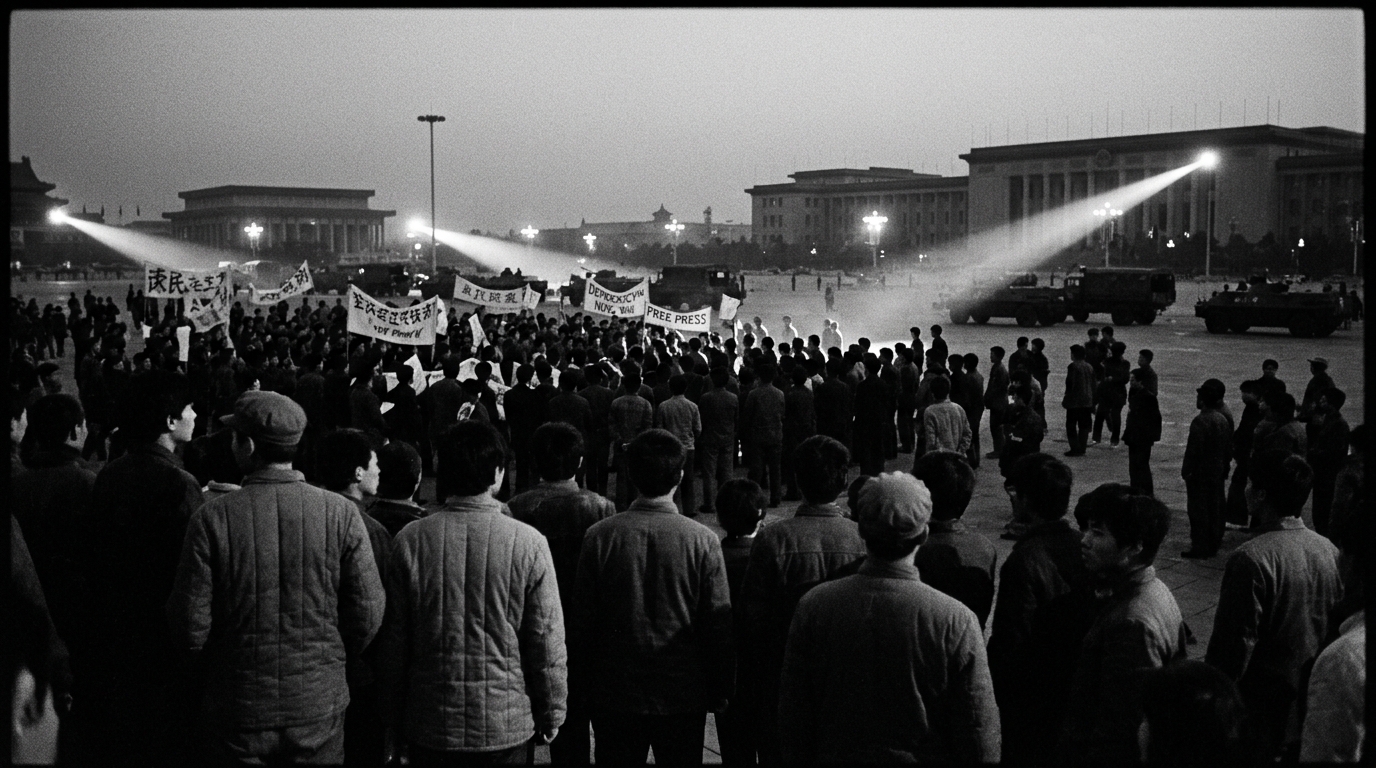
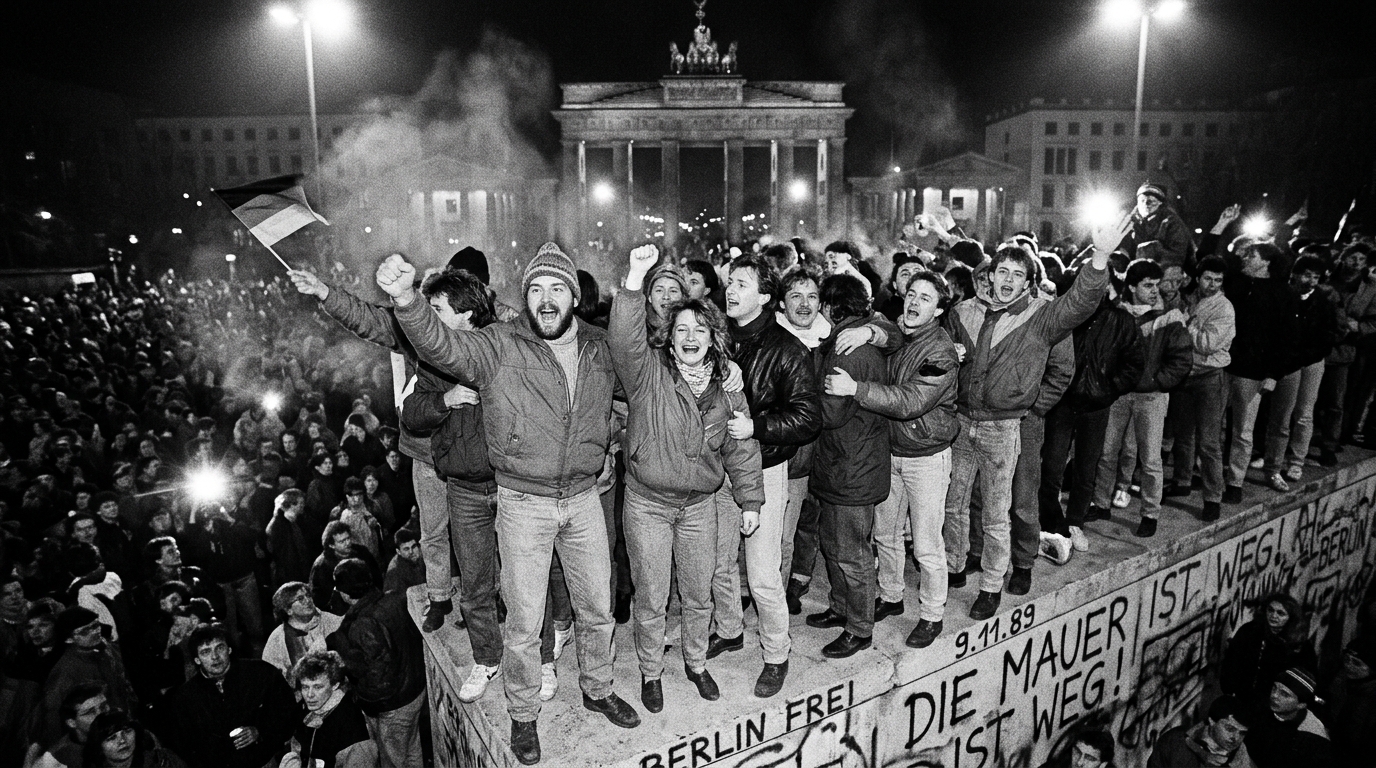
The collapse of communist regimes across Central and Eastern Europe in the autumn of 1989 was characterized by remarkably peaceful transitions. From the roundtable talks in Poland to the peaceful dismantling of the Berlin Wall and the Velvet Revolution in Czechoslovakia, the structural retreat of Soviet hegemony under Mikhail Gorbachev allowed for relatively bloodless regime changes.
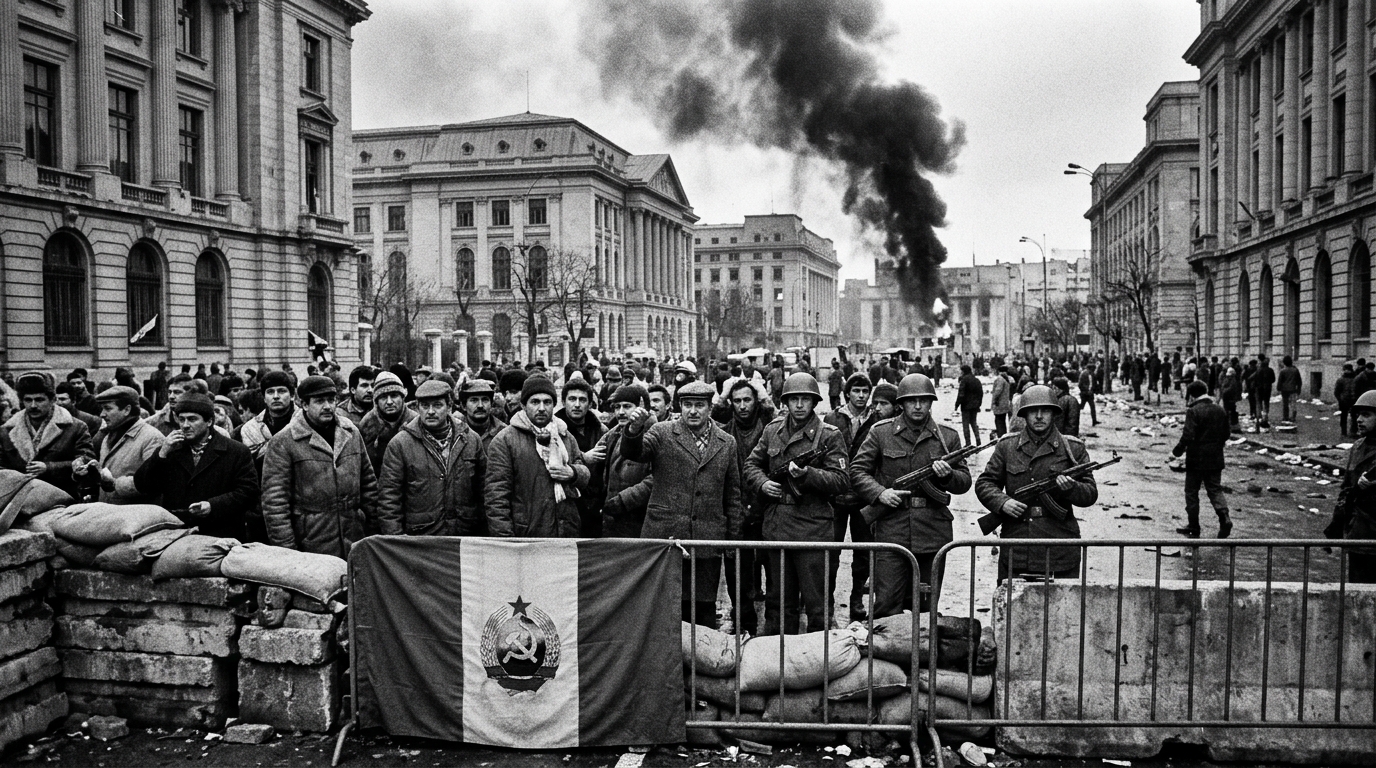
Romania was the singular, violent exception. Under the highly personalized, neo-Stalinist dictatorship of Nicolae Ceaușescu, the country had spent the 1980s isolated not only from the West but also from its Warsaw Pact allies. When the end came in December 1989, it did not arrive through negotiated compromises or constitutional reforms. Instead, it unfolded through a bloody popular uprising, street combat, military defection, a hurried show trial, and the televised execution of the head of state.
Historical Context and Origins
To understand the sudden and explosive violence of December 1989, one must examine the extreme degradation of Romanian daily life during the 1980s. When Nicolae Ceaușescu assumed the leadership of the Romanian Communist Party (PCR) in 1965, he initially enjoyed genuine domestic popularity and Western respect. He had pursued a foreign policy independent of Moscow, famously refusing to participate in the 1968 Warsaw Pact invasion of Czechoslovakia.1 This independent stance earned Romania favorable trade terms, Western loans, and state visits from U.S. Presidents Richard Nixon and Gerald Ford.
The Road to Revolution (1980s)
- External Debt of $10+ Billion
By the late 1970s, however, Ceaușescu's massive industrial projects—such as petro-chemical plants dependent on imported oil—proved to be economically disastrous. Confronted with a foreign debt exceeding $10 billion, Ceaușescu made a fateful decision in 1981: Romania would repay its entire external debt by the end of the decade, regardless of the domestic human cost.2
The resulting austerity program was draconian:
- Severe Food Rationing: Basic necessities like bread, flour, sugar, cooking oil, and meat were strictly rationed. Long queues (popularly known as cozi) became a permanent feature of Romanian life.
- Energy Deprivation: To conserve electricity and fuel for export, domestic heating was reduced to near-freezing levels, street lighting was turned off, and television broadcasts were limited to two hours of sycophantic praise for Ceaușescu and his wife, Elena.
- Demographic Mandates: Abortion and contraception remained strictly banned under Decree 770, aiming to artificially inflate the population, which led to high maternal mortality rates and an explosion of overcrowded, underfunded orphanages.
- Systematization: An ambitious urban planning policy saw historical quarters in Bucharest and entire rural villages bulldozed to make way for monolithic apartment blocks and the megalomaniacal Palace of the Parliament (then called the House of the People).
While neighboring Poland and Hungary experimented with economic liberalization and tolerated growing opposition movements, Ceaușescu rejected Gorbachev’s initiatives of Glasnost (openness) and Perestroika (restructuring) as "counter-revolutionary." The Securitate—one of the most pervasive secret police forces in the Soviet bloc—ruthlessly crushed any sign of dissent. Under these pressure-cooker conditions, a popular explosion was not a matter of if, but when.
Timeline of Events and Key Moments
The Spark in Timișoara (December 15–17, 1989)
The catalyst for the revolution was not an organized political plot, but a local protest in the multi-ethnic western city of Timișoara. László Tőkés, an ethnic Hungarian Reformed Church assistant pastor, had been speaking out against the regime's systematization policies and human rights abuses. When the authorities ordered his eviction and transfer to a remote parish, his parishioners gathered around his home on December 15 to prevent his removal.
| Date | Event |
|---|---|
| December 15–16 | Timișoara Human Shield |
| December 17 | Securitate Fires |
| December 21 | Bucharest Speech |
| December 22 | Ceaușescu Flees |
| December 25 | Târgoviște Execution |
By December 16, the protest had transformed from an ethnic Hungarian demonstration into a broad anti-communist rally, drawing in Romanian factory workers, students, and citizens. Demands for religious freedom quickly evolved into chants of "Down with Ceaușescu!" (Jos Ceaușescu!) and "Down with Communism!"
On December 17, Ceaușescu held a teleconference with his top generals and Securitate chiefs, berating them for their lack of resolve and ordering them to use live ammunition.
"You should have fired on them! You should have shot to kill! Fire at their legs, and if they don't stop, shoot them down!"[^3]
The military, militia, and Securitate opened fire on protesters in Timișoara that evening. Dozens were killed, and hundreds were wounded. To conceal the regime's crimes, the Securitate launched "Operation Rose" (Operațiunea Trandafirul), secretly transporting 40 bodies from the Timișoara county hospital to Bucharest, where they were cremated and their ashes dumped in a sewer.
The Turning Point in the West (December 18–20)
Believing that the brutal crackdown had successfully stabilized Timișoara, Ceaușescu departed on a scheduled state visit to Iran on December 18. This proved to be a critical tactical error. In his absence, the protests in Timișoara did not subside; instead, they intensified.
On December 20, tens of thousands of workers from Timișoara's massive industrial plants walked out and marched into the city center. Facing an overwhelming, peaceful mass of humanity, army units stationed in the city refused to fire any longer and withdrew to their barracks. Timișoara was declared the first free city of Romania.
The Speech that Backfired (December 21)
Ceaușescu returned to Bucharest on the evening of December 20 and immediately addressed the nation on television, denouncing the demonstrators in Timișoara as "fascist hooligans" instigated by foreign intelligence agencies.
Confident in his ability to command obedience, he ordered a mass rally to be held the following morning, December 21, in Palace Square (Piața Palatului) outside the Central Committee building in Bucharest. Tens of thousands of workers were bussed in, carrying portraits of the dictator and banners of the Communist Party, expecting a standard ritual of state-mandated adoration.
THE BUCHAREST RALLY
Date: December 21, 1989
Event: Ceaușescu on the Balcony (Starts at 12:00 PM)
- Shouts and explosions (firecrackers) heard from the crowd
- Live state television feed cuts to a technical card
- Ceaușescu waves his hand: "Allo! Allo!" (Visibly shaken)
- The crowd begins to chant: "Ti-mi-șoa-ra! Ti-mi-șoa-ra!"
Shortly after Ceaușescu began speaking from the balcony, a loud explosion—likely a firecracker detonated to provoke panic—shook the back of the crowd. The assembled workers began to flee, and the panic quickly turned into anger. For the first time in twenty-four years of rule, Ceaușescu was booed and heckled during a live national broadcast.
The television feed cut to a blue card, but not before millions of Romanians saw the expression of sheer, paralyzed terror on the dictator's face. The myth of his absolute control was shattered in an instant.
As night fell on December 21, students and workers occupied the area around University Square and the InterContinental Hotel, erecting makeshift barricades. Under the command of Minister of National Defense Vasile Milea, the army, Securitate, and USLA (anti-terrorist units) deployed tanks and armored personnel carriers, crushing the barricades and killing dozens of demonstrators.
The Flight of the Dictator (December 22)
On the morning of December 22, the protests swelled to hundreds of thousands of people, marching from all corners of Bucharest toward the city center. The regime’s grip on power dissolved rapidly.
At approximately 9:30 AM, Defense Minister Vasile Milea was found dead of a gunshot wound in his office. While state media claimed he had committed suicide after betraying the country, many military officers suspected he had been executed for refusing to order troops to shoot at the advancing crowds.
- Death of Vasile Milea (Defense Minister)
General Victor Atanasie Stănculescu took temporary command of the military. Recognizing that the situation was unsalvageable, Stănculescu ordered all military units to return to their barracks and halt all firing. He then pressured Nicolae and Elena Ceaușescu to flee the Central Committee building.
At 12:09 PM, as protesters breached the doors of the Central Committee building, a white Dauphin helicopter carrying the Ceaușescus, two security guards, and two PCR officials lifted off from the roof of the building. The flight marked the official collapse of the communist administration.
The Rise of the FSN and Urban Warfare (December 22–25)
The escape of the dictator left a dangerous power vacuum. By the afternoon of December 22, a heterogeneous group of reform-minded communists, military commanders, and civil dissidents gathered at the Central Committee building and the state television station (RTV) to form the National Salvation Front (FSN - Frontul Salvării Naționale). The leadership of this new entity quickly consolidated around Ion Iliescu, a prominent, Western-educated former PCR propaganda secretary who had been marginalized by Ceaușescu in the 1970s.
| Timeline | Event |
|---|---|
| December 22 (12:09 PM) | Ceaușescu Flees CC Building |
| December 22 (Late Afternoon) | FSN Formed, Led by Ion Iliescu |
| Subsequent Events | Outbreak of Urban Warfare (The "Terrorist" Phase) |
| December 25 (Târgoviște) | Trial & Execution of Ceaușescu |
As Iliescu and his associates declared the dissolution of the old state apparatus on live television, a mysterious wave of violence erupted across Bucharest and other major cities. Unidentified snipers, designated by the new authorities as "terrorist elements loyal to Ceaușescu," opened fire on military units, television centers, and civilian crowds from the rooftops of government buildings.
A chaotic, three-day urban war ensued. The vast majority of the casualties of the Romanian Revolution—nearly 900 of the 1,116 total deaths—occurred after Ceaușescu had already fled on December 22.4 The army, now aligned with the FSN, engaged in frantic exchanges of gunfire with these invisible enemies, often accidentally shooting other military units or civilians in the confusion.
Geopolitical Consequences and Aftermath
The Târgoviște Trial and Execution
While urban combat raged, the helicopter carrying the Ceaușescus had landed near Snagov, and then near Târgoviște, after the pilot was ordered to land by military air defense. The couple was detained by local police and subsequently handed over to the military garrison at Târgoviște.
On December 25, 1989, a hastily convened, secret military tribunal put Nicolae and Elena Ceaușescu on trial. The charges included:
- Genocide (the deaths of over 60,000 people during their entire rule—a figure later proven to be highly exaggerated for political purposes).
- Destruction of state property and national economy.
- Attempting to flee the country with over $1 billion in foreign banks (a claim that was never verified).
The trial was brief, lasting just under two hours. The defense attorneys appointed by the court acted as co-prosecutors, arguing that their clients were guilty of heinous crimes. The Ceaușescus refused to recognize the legitimacy of the court, with Nicolae repeatedly demanding to speak to the Grand National Assembly.
The tribunal sentenced both to death. They were led into the courtyard of the military base with their hands tied behind their backs. According to witnesses, Nicolae Ceaușescu sang "The Internationale" as he was led to the wall. Before the execution squad could formalize their positions, three paratroopers opened fire with automatic rifles, killing the couple instantly. The execution was filmed and broadcast to a relieved but shocked Romanian public and international audience hours later.
The Execution at Târgoviște
- Date: December 25, 1989
- Location: Military Garrison, Târgoviște
- Method: Firing Squad (3 Paratroopers)
- Key Figures Involved:
The Transition Under Ion Iliescu
With the dictator dead, the "terrorist" attacks ceased almost overnight, reinforcing suspicions that the threat had been manufactured or exaggerated to legitimize the FSN's seizure of power. Ion Iliescu assumed the office of interim president. Under his leadership, the FSN quickly transformed from an ad-hoc revolutionary council into a highly organized political party.
May 1990 Elections
- Ion Iliescu Wins Presidency
- Dissident Disillusionment
In the country’s first free elections in May 1990, Iliescu won the presidency with 85% of the vote, largely supported by rural populations and industrial workers who feared rapid market reforms. However, student activists and intellectual elites felt betrayed, arguing that the revolution had been "stolen" by second-tier communist apparatchiks who replaced the Ceaușescu clan while preserving much of the old administrative and secret police infrastructure under new names (such as the Romanian Intelligence Service, SRI).5
This political polarization culminated in the Mineriads (Mineriade) of 1990 and 1991, during which President Iliescu summoned coal miners from the Jiu Valley to Bucharest to violently crush peaceful student demonstrations in University Square. These events damaged Romania's international reputation and delayed its integration into Western structures.
Euro-Atlantic Integration
Despite its rocky transition, the ultimate trajectory of post-revolutionary Romania aligned with the rest of Eastern Europe. Romania formally applied for European Union membership in 1995, joined NATO in 2004, and became a member of the European Union on January 1, 2007. The transition marked the definitive end of the country's decades-long isolation, opening its economy to foreign investment and its citizens to free movement within Europe.
Analysis of Key Actors and Decisive Actions
Nicolae Ceaușescu: The Isolated Autocrat
Ceaușescu’s actions in December 1989 reveal an autocrat completely insulated from the reality of his own country. Decades of a pervasive cult of personality, coupled with the sycophancy of his immediate circle—particularly his wife Elena, who held the post of First Deputy Prime Minister—had convinced him of his own popularity.
His decision to hold the public rally on December 21 is the ultimate monument to this delusion. Rather than addressing the systemic economic grievances of the population, he offered a marginal increase in minimum wage and child allowances (100 lei), a gesture that was seen as an insult by a population suffering from basic malnutrition.
Ion Iliescu: The Pragmatic Successor
Ion Iliescu remains one of the most polarizing figures in modern Romanian history. To his supporters, he was a stabilizing force who prevented Romania from descending into a full-scale civil war along ethnic or regional lines. To his critics, he was a neo-communist opportunist who hijacked a genuine, spontaneous popular revolution to preserve the privileges of the nomenclature.
ION ILIESCU: DUAL PERSPECTIVES
| The Stabilizer (Supporters) | The Opportunist (Critics) |
|---|---|
| Prevented post-regime civil war. | Staged a palace coup under the guise of a popular revolt. |
| Organized first democratic elections. | Used miners to brutally crush student protests in 1990. |
| Navigated difficult initial transition without state collapse. |
Historical investigations have scrutinized Iliescu’s role in the "terrorist" phase of the revolution. In 2019, Romanian military prosecutors officially indicted Iliescu for crimes against humanity, alleging that he and other FSN leaders deliberately spread misinformation through state television to create a state of psychosis, thereby justifying military actions that led to hundreds of deaths.6
The Romanian Military: Shifting Allegiances
The role of the military (Armata) was highly complex. Initially, under Defense Minister Milea, the army complied with Ceaușescu's orders to suppress protests in Timișoara and Bucharest. However, the military was deeply uncomfortable with acting as an internal police force.
When General Stănculescu assumed command on December 22, his decision to order troops back to their barracks and align the military with the FSN was the decisive structural blow to the Ceaușescu regime. Without the backing of the armed forces, the Securitate, despite its advanced weaponry, could not maintain control.
Trivia and Lesser-Known Facts
- The Plaster Cast Deception: On the morning of December 22, General Victor Stănculescu attempted to avoid being appointed Defense Minister by Ceaușescu by showing up at the Ministry with his leg in a fake plaster cast, claiming he had broken it in an accident. Ceaușescu ignored the cast and appointed him anyway.
- The "Radio Free Europe" Factor: Throughout the revolution, millions of Romanians gathered around shortwave radios to listen to Radio Free Europe broadcasts. These broadcasts, anchored by journalists like Emil Hurezeanu and Vlad Georgescu, provided the only accurate news about the scale of the uprisings, bypasses of state censorship, and messages from global leaders.
- The Flight from the Roof: The Dauphin helicopter that evacuated the Ceaușescus from the roof of the Central Committee building was so overloaded with passengers (the Ceaușescus, two bodyguards, and two PCR officials) that the pilot, Vasile Maluțan, had difficulty lifting off, barely clearing the building’s heavy radio antennas.
- The Mystery of the Missing Dollars: For decades, rumors persisted that Ceaușescu had stashed a secret fortune of over $1 billion in Swiss bank accounts. Extensive international investigations conducted after 1989 by forensic accountants failed to find any trace of these accounts, concluding that the dictator had no personal foreign bank deposits; his wealth was entirely tied to his control over the Romanian state.
- The Burning of the National Library: During the chaotic shootout in Palace Square on December 22–23, the historic Central University Library of Bucharest was set on fire. Over 500,000 rare books, manuscripts, and incunabula, including invaluable documents of Romanian history, were completely destroyed. The exact source of the fire remains a subject of dispute between those who blame Securitate snipers and those who blame army tank fire.
References and Literature
- The Romanian Revolution of December 1989 - An extensive archival resource and analysis by the Woodrow Wilson International Center for Scholars, detailing declassified documents from the Warsaw Pact.
- Ceaușescu and the Securitate: Coercion and Dissent in Romania, 1965-1989 - Dennis Deletant's definitive scholarly work on the inner workings of the Romanian secret police and its role in sustaining the dictatorship.
- The 1989 Romanian Revolution on Trial - An academic examination of the post-1989 judicial proceedings against Ion Iliescu and military commanders, published in East European Politics and Societies.
- The Collapse of the Ceaușescu Regime - A contemporary analysis published by Foreign Affairs in the spring of 1990, reflecting on the immediate geopolitical implications of the violent transition.
---
Footnotes & Explanations
- Dennis Deletant, Ceaușescu and the Securitate: Coercion and Dissent in Romania, 1965-1989 (London: Hurst & Co., 1995), p. 182. ↩
- Vlad Georgescu, The Romanians: A History (Columbus: Ohio State University Press, 1991), p. 271. ↩
- Transcripts of the Executive Political Committee (CPEx) meeting, December 17, 1989. Romanian National Archives. ↩
- Statistics from the Romanian State Secretariat for Revolutionary Problems (SSPR), official register of victims of the December 1989 Revolution. ↩
- Peter Siani-Davies, The Romanian Revolution of December 1989 (Ithaca: Cornell University Press, 2005), p. 195. ↩
- Prosecutor's Office attached to the High Court of Cassation and Justice, Military Prosecution Department, Case No. 11/P/2014 (Indictment of Ion Iliescu, Gelu Voican Voiculescu, and Iosif Rus), issued April 2019. ↩