Key Takeaways
- The Battle of Dien Bien Phu (March–May 1954) was the decisive engagement of the First Indochina War, resulting in a crushing victory for the Viet Minh over the French Far East Expeditionary Corps.
- General Vo Nguyen Giap's brilliant logistical feat of transporting heavy artillery through mountainous jungle dismantled the French military assumption of technological superiority.
- The defeat led directly to the 1954 Geneva Accords, ending French colonial rule, partitioning Vietnam at the 17th parallel, and setting the stage for direct United States military intervention.
Historical Context and Origins
The Battle of Dien Bien Phu was not an isolated military clash, but the violent culmination of nearly a century of French colonial dominance in Southeast Asia and eight years of grueling asymmetric warfare. To understand why the French military chose to make its stand in a remote valley in northwestern Vietnam, one must trace the convergence of late 19th-century imperialism, the geopolitical convulsions of World War II, and the polarizing dynamics of the early Cold War.
The Rise of Colonialism and the Viet Minh
France established its grip over Indochina (comprising Vietnam, Cambodia, and Laos) in the late 19th century, exploiting the region’s rich resources of rubber, coal, and rice while suppressing indigenous nationalist movements 1. This colonial apparatus collapsed abruptly during World War II when the Imperial Japanese Army occupied the region. Although the French Vichy administration remained as puppet administrators, the power vacuum allowed the emergence of the Viet Nam Doc Lap Dong Minh Hoi (League for the Independence of Vietnam), commonly known as the Viet Minh.
Founded in 1941 by the charismatic Marxist-nationalist Ho Chi Minh, the Viet Minh organized a highly effective guerrilla resistance against both the Japanese occupiers and the French. When Japan surrendered in August 1945, Ho Chi Minh quickly seized the initiative, declaring the independence of the Democratic Republic of Vietnam (DRV) in Hanoi on September 2, 1945.
"We hold these truths to be self-evident, that all men are created equal... The French have fled, the Japanese have capitulated, Emperor Bao Dai has abdicated. Our people have broken the chains which for nearly a century have fettered them and have won independence for the Fatherland." — Ho Chi Minh, Declaration of Independence of the Democratic Republic of Vietnam [^2]
This declaration of independence was short-lived. France, determined to restore its national prestige after the humiliation of wartime occupation in Europe, dispatched the French Far East Expeditionary Corps (Corps Expéditionnaire Français en Extrême-Orient, CEFEO) to reclaim its lost territories. By late 1946, negotiations between the DRV and France broke down, and the First Indochina War officially commenced.
Evolution of the Conflict (1945-1954)
| Year | Event |
|---|---|
| 1945 | Ho Chi Minh declares DRV Independence |
| 1946 | Outbreak of First Indochina War |
| 1949 | Chinese Communist Victory (PRC supplies Viet Minh) |
| 1950 | US begins financing French war effort (Cold War) |
| 1953 | General Navarre initiates "Navarre Plan" |
| 1954 | Battle of Dien Bien Phu & Geneva Accords |
The Cold War Crucible and the Navarre Plan
Initially, the conflict was a localized colonial war. However, by 1949, the geopolitics of the region shifted dramatically. The victory of Mao Zedong’s Chinese Communist Party in the Chinese Civil War gave the Viet Minh a friendly, ideologically aligned neighbor. From 1950 onward, the Soviet Union and the newly formed People's Republic of China recognized the DRV and began supplying Vo Nguyen Giap’s forces with modern military hardware, including artillery, anti-aircraft guns, and radar systems 3.
In response, the United States, gripped by the fear of communist expansionism—a doctrine later codified by President Dwight D. Eisenhower as the "Domino Theory"—began heavily subsidizing the French war effort. By 1953, the United States was funding nearly 80% of the French military expenditures in Indochina.
Despite massive American financial aid, the French military was caught in a strategic quagmire. The Viet Minh avoided large-scale conventional battles, preferring guerrilla tactics: hit-and-run ambushes, sabotage, and night raids that bled the CEFEO dry.
In May 1953, General Henri Navarre was appointed Commander-in-Chief of French forces in Indochina. Tasked with finding an honorable exit strategy for France, Navarre formulated the "Navarre Plan." The core of this strategy was to establish a powerful "mooring point" or air-land base (hérisson—hedgehog) deep within enemy-controlled territory. Navarre hoped this base would block Viet Minh infiltration routes into northern Laos (a key French ally) and lure General Giap’s division-sized units into an open, conventional battle. Navarre believed that French superiority in artillery, armor, and air power would decimate the assault forces.
The site selected for this trap was Dien Bien Phu, a heart-shaped valley twelve miles long and six miles wide, surrounded by high, heavily forested hills.
Timeline of Events and Key Moments
The battle unfolded over several distinct phases, starting with a daring airborne drop, continuing through a tense logistical race, and culminating in a brutal, trench-warfare siege that lasted fifty-five days.
Phase 1: Operation Castor and the Occupation of the Valley (November 1953)
On November 20, 1953, the French launched Operation Castor. Over several days, thousands of elite French paratroopers (parachutistes) dropped into the Dien Bien Phu valley. They quickly cleared the small Viet Minh garrison, took control of the local airstrip, and began constructing a fortified camp.
Under the tactical command of the aristocratic cavalry officer Colonel Christian de Castries, the French built nine fortified strongpoints, famously given female names:
- Beatrice, Gabrielle, and Anne-Marie: Guarding the northern approaches of the valley.
- Dominique, Eliane, Claudine, and Huguette: Surrounding the central headquarters and the vital airstrip.
- Isabelle: Positioned isolatedly four miles to the south to protect an auxiliary airstrip.
The French military leadership was highly confident. They believed the surrounding mountains were too steep and the jungle too dense for the Viet Minh to bring in heavy artillery. Colonel Charles Piroth, the one-armed French artillery commander, assured his superiors that his batteries could silence any Viet Minh guns the moment they fired 4.
Phase 2: The Siege Begins (March 13–15, 1954)
For four months, the valley remained deceptively quiet. However, on the afternoon of March 13, 1954, the French illusions of safety were shattered.
At 17:00, Viet Minh artillery opened a massive, coordinated bombardment on strongpoint Beatrice. The sheer volume of fire was unprecedented in the war. The French trenches, built primarily of soil and weak timber, collapsed. Within hours, Beatrice fell, and its commander was killed.
Two days later, on March 15, strongpoint Gabrielle was overwhelmed after its defense force was decimated by targeted artillery fire. Recognizing his catastrophic failure to protect the base from enemy bombardment, Colonel Charles Piroth retreated to his bunker, held a hand grenade against his chest, and pulled the pin.
| Date | Key Moment |
|---|---|
| Nov 20, 1953 | Operation Castor: French paratroopers drop |
| Mar 13, 1954 | Viet Minh artillery barrage; Beatrice falls |
| Mar 15, 1954 | Gabrielle falls; suicide of Colonel Piroth |
| Mar 30, 1954 | "Battle of the Five Hills" begins |
| Apr 1-30, 1954 | Trench warfare suffocates French perimeter |
| May 7, 1954 | Central command collapses; French surrender |
Phase 3: The Battle of the Hills and Airfield Choking (Late March–April 1954)
Following the fall of the northern strongpoints, the Viet Minh turned their attention to the eastern hills (Dominique and Eliane). Giap shifted his tactics to avoid high casualties, employing a slow, suffocating siege method inspired by the Battle of Verdun.
Viet Minh soldiers dug hundreds of miles of trenches that snaked across the valley floor, gradually enveloping the remaining French strongpoints. These trenches allowed the Viet Minh to advance unseen, protected from French napalm and machine-gun fire, and launch sudden, close-quarters assaults.
By late March, Viet Minh anti-aircraft artillery (supplied by China) had established virtual control over the airspace. Landing planes on the shell-cratered runway became impossible. The French garrison became entirely dependent on parachute drops for food, ammunition, and medical supplies. However, as the French perimeter shrank, much of the air-dropped material fell directly into Viet Minh hands.
Phase 4: The Final Assault (May 1–7, 1954)
By May, the situation for the defenders had become catastrophic. The monsoon rains had turned the French trenches into rivers of mud, filled with decaying corpses and wounded men whom the field hospitals could no longer treat.
On May 1, Giap launched his final, general offensive. Wave after wave of Viet Minh soldiers, motivated by nationalistic fervor and the promise of land reform, surged forward. One by one, the remaining French bastions—Huguette, Dominique, and finally Eliane—were overrun.
On the afternoon of May 7, 1954, General de Castries (who had been promoted to Brigadier General during the siege) received orders from Hanoi to cease fire. At 17:30, Viet Minh soldiers raised their red flag with a yellow star over the French command bunker. The battle was over.
Geopolitical Consequences and Aftermath
The fall of Dien Bien Phu was a watershed moment in 20th-century history, acting as a catalyst for the end of old-world European imperialism and the acceleration of the Cold War block division.
The Geneva Conference and Partition
The day after the French surrender, on May 8, 1954, delegations met in Geneva, Switzerland, to discuss the future of Indochina. The French military defeat stripped their diplomats of all leverage.
The resulting Geneva Accords of 1954 brought about:
- The cessation of hostilities in Vietnam, Laos, and Cambodia.
- The temporary partition of Vietnam along the 17th parallel, creating the communist-led Democratic Republic of Vietnam in the north (under Ho Chi Minh) and the Western-backed State of Vietnam in the south (later the Republic of Vietnam).
- A mandate for nationwide, free democratic elections to be held in July 1956 to unify the country.
These elections were never held. The United States and the South Vietnamese regime, led by Ngo Dinh Diem, feared that Ho Chi Minh would win a landslide victory. Consequently, the temporary division of the country solidified, laying the groundwork for the next stage of the conflict: the Vietnam War (Second Indochina War) 5.
| Feature / Metric | French Expeditionary Corps (CEFEO) | Viet Minh (People's Army of Vietnam) |
|---|---|---|
| Troop Strength | ~15,000–20,000 (at peak) | ~50,000 combat troops; ~100,000 porters |
| Commanders | Gen. Henri Navarre, Brig. Gen. Christian de Castries | Gen. Vo Nguyen Giap |
| Casualties (Killed/Missing) | ~2,293 dead; over 10,000 captured | ~4,800–8,000 dead; ~15,000 wounded |
| Geopolitical Goal | Retain colonial empire; block Communist expansion | National liberation; unification; land reform |
The Collapse of the French Colonial Empire
The defeat at Dien Bien Phu shattered the prestige of the French military and marked the beginning of the rapid dissolution of the French colonial empire. Within months of the surrender, nationalist movements in French North Africa took note of the Viet Minh's success.
In November 1954, the National Liberation Front (FLN) of Algeria launched an armed insurrection, initiating the Algerian War of Independence. Many of the French officers who fought at Dien Bien Phu were immediately dispatched to Algeria, carrying with them the psychological trauma of their defeat and a desperate determination to prevent another colonial loss.
The Entry of the United States
As France withdrew its forces from Southeast Asia, the United States rapidly moved to fill the power vacuum. Under the Eisenhower administration, Washington viewed South Vietnam as a crucial bulwark against the spread of communism in Asia.
To formalize this containment policy, the US sponsored the creation of the Southeast Asia Treaty Organization (SEATO) in September 1954. Over the next decade, American involvement escalated from financial subsidies and military advisors under Kennedy to direct, large-scale combat intervention under Johnson, dragging the United States into its own long and divisive conflict in Vietnam.
Analysis of Key Actors and Decisive Actions
The outcome of the Battle of Dien Bien Phu was not determined by luck, but by contrasting leadership styles, strategic adaptations, and massive differences in logistical mobilization.
THE LOGISTICAL CONTRAST
| FRENCH ASSUMPTIONS | VIET MINH REALITY |
|---|---|
| Jungle impassable for heavy artillery. | 100,000 porters carve mountain roads. |
| Supply lines fully secured by aircraft. | Steel-reinforced bicycles carry 200kg. |
| Artillery camouflaged in deep bunkers. |
Vo Nguyen Giap: The Logistics of Genius
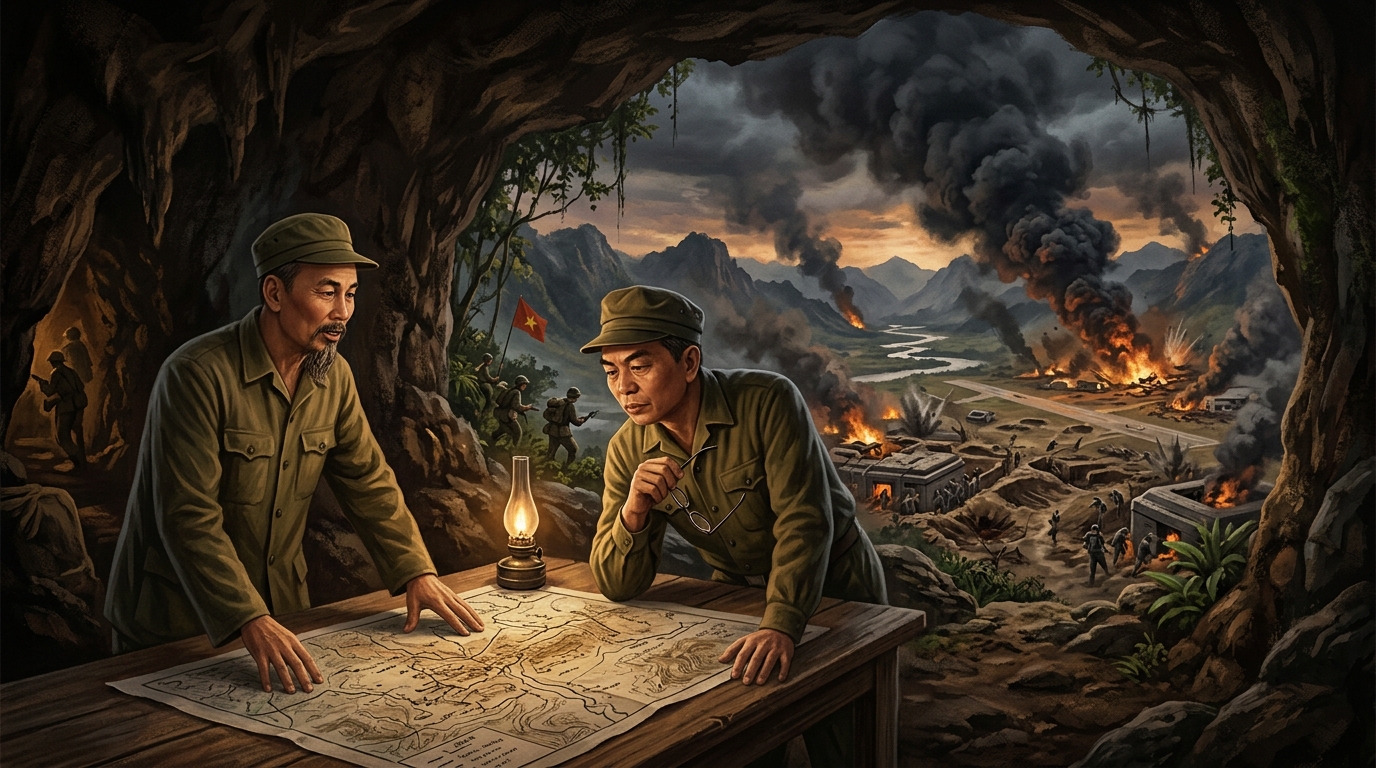
General Vo Nguyen Giap's leadership during the campaign is widely studied in military academies worldwide. Giap's primary victory was not tactical, but logistical.
The French command had calculated that the Viet Minh could not supply more than a single division in such rugged terrain, and certainly could not transport heavy artillery. Giap proved them catastrophically wrong by mobilizing the dan cong (peasant logistics corps) 6.
- Peasant Mobilization: Over 100,000 civilians were mobilized to hack roads through the jungle and transport supplies.
- The "Steel Horse": Peasants utilized French-made Peugeot bicycles, reinforced with wood and steel bars, to carry up to 200 kilograms (440 lbs) of supplies each over mountainous trails.
- Artillery Dispersal: Giap dismantled 105mm and 75mm guns, dragging them up the steep hills surrounding the valley. Instead of clustering them in open fields, Giap had his men dig deep, horizontal caves into the reverse slopes facing the French. This rendered the artillery completely invisible from the air and invulnerable to French counter-battery fire.
Initially, Giap planned a quick, decisive strike ("Fast Strike, Fast Victory"). However, recognizing the strength of the French fortifications, he made the difficult, decisive decision to delay the attack and switch to "Steady Strike, Steady Advance." This tactical patience allowed his forces to construct the encircling trenches that ultimately strangled the French garrison.
Ho Chi Minh: The Diplomatic Chessboard
While Giap managed the military campaign, Ho Chi Minh handled the political and diplomatic fronts. Ho realized that military victories were useless without political will. He utilized the military campaign at Dien Bien Phu to directly influence the negotiations occurring simultaneously in Geneva.
By timing the final assault to coincide exactly with the opening of the Geneva Conference, Ho Chi Minh ensured that the news of the French surrender would break just as international diplomats sat down at the negotiating table, completely undermining the French diplomatic position.
Henri Navarre and Christian de Castries: The Arrogance of Empire
The defeat of the French military stemmed from a series of systemic underestimations of their opponent, combined with operational rigidity.
- The "Chamber Pot" Selection: Navarre placed his forces in a low valley surrounded by high ground, effectively handing the high ground to the enemy. This tactical mistake earned the valley the nickname "the chamber pot" among French soldiers.
- Underestimation of the Enemy: The French officer corps suffered from a deep-seated colonial bias, believing that the "peasant army" of the Viet Minh lacked the technical competence to operate advanced artillery, coordinate anti-aircraft defenses, or execute complex logistical maneuvers.
- The Air Force Fallacy: Navarre assumed that the French Air Force could easily destroy Viet Minh supply lines and keep the base supplied indefinitely. He failed to account for the dense jungle canopy that hid Viet Minh movements, the frequent monsoon weather that grounded flights, and the effectiveness of Chinese-supplied anti-aircraft guns.
Trivia and Lesser-Known Facts
- The Mistress Myth: A persistent legend claims that Colonel Christian de Castries named the strongpoints (Beatrice, Gabrielle, Anne-Marie, etc.) after his various aristocratic mistresses. While highly romanticized, military historians note that the naming convention was likely selected alphabetically (A, B, C, D, E, G, H, I) to simplify radio communications.
- German Soldiers in the French Foreign Legion: A significant percentage of the French Foreign Legion troops who fought and died at Dien Bien Phu were German nationals. Many of these men were veterans of World War II, including former soldiers of the Wehrmacht and even the Waffen-SS, who had enlisted in the Legion after 1945 to escape devastated postwar Europe.
- The Secret "Operation Vulture": The United States came remarkably close to launching a direct military intervention to save the French garrison. Under the code name Operation Vulture (Opération Vautour), the US Joint Chiefs of Staff drafted a plan to use B-29 bombers from US bases in the Pacific to conduct high-altitude strikes against Viet Minh positions. Some options even considered the tactical use of atomic weapons. However, President Eisenhower refused to authorize the strikes without British support and congressional approval, neither of which materialized.
- The Surgical Pioneer: Dr. Paul-Henri Grauwin, the chief French military surgeon during the siege, performed over 1,000 operations in a dark, underground mud bunker with limited anesthetic and sterilized water. His memoirs, Seulement Médecin, detailed the horrific conditions of the wounded under constant artillery bombardment.
- The "White" Viet Minh: A small group of European deserters, mostly foreign legionnaires of German, Italian, or Spanish origin, fought on the side of the Viet Minh. Known as the Viet Minh Blancs, they assisted Giap's forces with artillery maintenance, logistics, and translation duties.
References and Literature
- Hell in a Very Small Place: The Siege of Dien Bien Phu - Bernard B. Fall's classic, definitive military history of the siege, combining deep strategic analysis with harrowing first-hand accounts.
- Embers of War: The Fall of an Empire and the Making of America's Vietnam - Fredrik Logevall's Pulitzer Prize-winning history detailing the transition of imperial power from France to the United States in Southeast Asia.
- The Battle of Dien Bien Phu: History and Legacy - Foreign Affairs analysis of Vo Nguyen Giap's tactical genius and the broader regional implications of the French defeat.
- The First Indochina War: 1946–1954 - Encyclopaedia Britannica's comprehensive overview of the conflict and its geopolitical origins.
---
Footnotes & Explanations
- Fall, Bernard B. Street Without Joy. Harrisburg: Stackpole Company, 1961. ↩
- Ho Chi Minh. "Declaration of Independence of the Democratic Republic of Vietnam." Hanoi, September 2, 1945. ↩
- Logevall, Fredrik. Embers of War: The Fall of an Empire and the Making of America's Vietnam. New York: Random House, 2012. ↩
- Windrow, Martin. The Last Valley: Dien Bien Phu and the French Defeat in Vietnam. London: Weidenfeld & Nicolson, 2004. ↩
- Herring, George C. America's Longest War: The United States and Vietnam, 1950-1975. New York: McGraw-Hill, 2001. ↩
- Vo Nguyen Giap. People's War, People's Army. Hanoi: Foreign Languages Publishing House, 1961. ↩