Key Takeaways
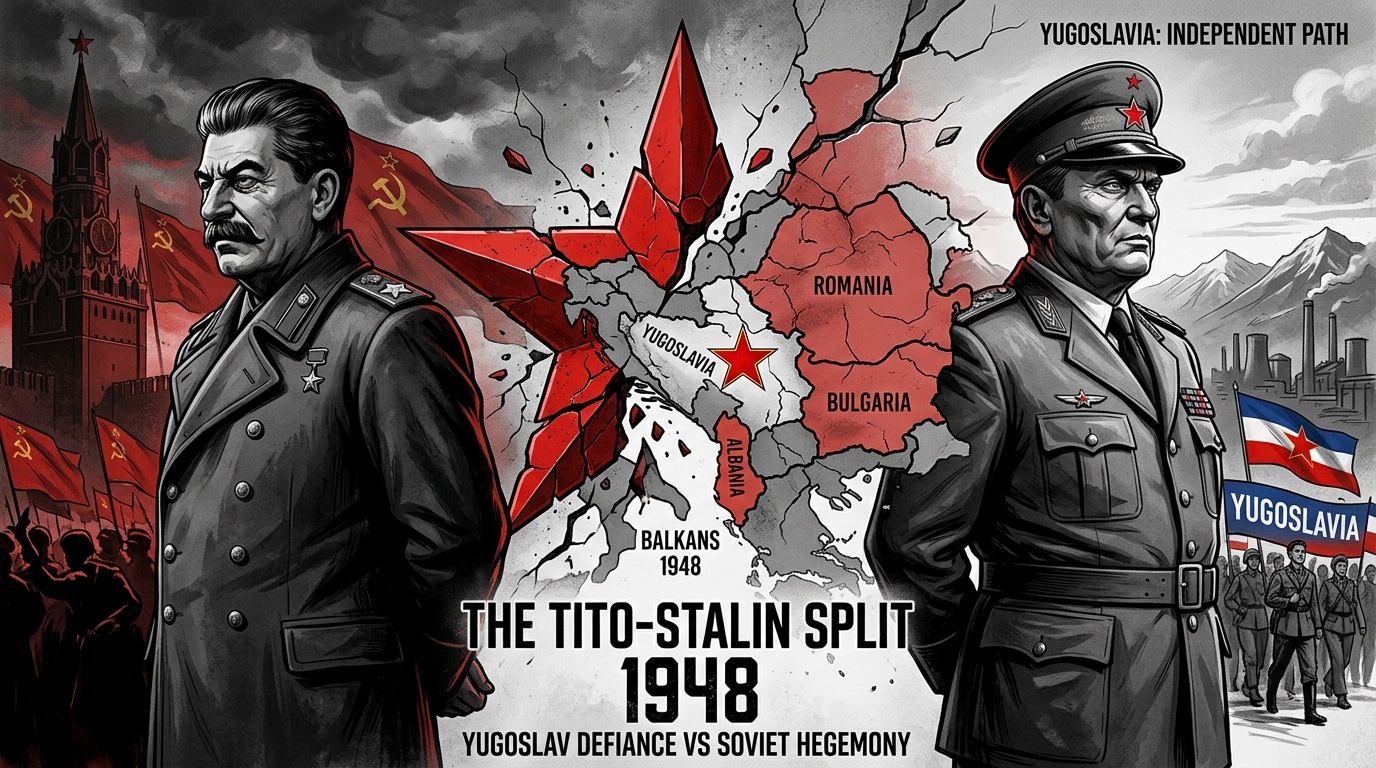
- The Soviet-Yugoslav split of 1948 was the first major schism within the Eastern Bloc, shattering the illusion of a monolithic communist world under Moscow's absolute control.
- Unlike other Eastern European nations, Yugoslavia's communists under Josip Broz Tito had liberated their own country from Axis occupation, giving them an independent power base and military legitimacy.
- By defying Joseph Stalin's demands for economic integration and political subordination, Yugoslavia paved the way for 'national communism' and eventually co-founded the Non-Aligned Movement.
Historical Context and Origins
The geopolitical landscape of post-World War II Europe was defined by the rapid division of the continent into Western and Eastern spheres of influence. Within the emerging Eastern Bloc, the Union of Soviet Socialist Republics (USSR) sought to establish absolute ideological, economic, and military hegemony. However, Yugoslavia presented a unique case. Unlike Poland, Hungary, Romania, or Bulgaria, where the Soviet Red Army played the decisive role in liberation and subsequent political transformation, the Communist Party of Yugoslavia (CPY) had forged its own path to power.1
Led by the charismatic and pragmatic Josip Broz Tito, the Yugoslav Partisans ran the most effective anti-Axis resistance movement in occupied Europe. By the time the Red Army entered the Balkans in late 1944, Tito’s forces already controlled vast swaths of territory, possessed a seasoned army of hundreds of thousands of fighters, and had established functioning administrative organs. This indigenous victory gave the Yugoslav leadership an unparalleled degree of legitimacy and self-confidence. They viewed themselves not as subordinates to Moscow, but as equal allies who had spilled their own blood to achieve socialist revolution.
This foundational difference in how power was acquired sowed the seeds of friction. While Joseph Stalin expected absolute obedience from satellite states, Tito and his close associates—such as Edvard Kardelj, Milovan Đilas, and Aleksandar Ranković—envisioned a sovereign socialist state that could pursue its own regional and domestic policies.
Several early flashpoints escalated tensions between 1945 and 1947:
- The Trieste Crisis: Yugoslavia’s aggressive push to annex the strategic Adriatic port of Trieste threatened to spark a direct military confrontation with the Western Allies (the United States and Great Britain). Stalin, cautious of provoking a war before the USSR had secured its own post-war borders and developed atomic weapons, urged restraint. Tito publicly complained that Yugoslavia’s national interests were being sacrificed for Moscow's broader geopolitical bargaining.
- The Greek Civil War: Tito actively supported the Greek communist guerrillas (the Democratic Army of Greece) by providing weapons, logistics, and sanctuary. Stalin, who had signed the "Percentages Agreement" with Winston Churchill in 1944 conceding Greece to the British sphere of influence, viewed Tito's intervention as a dangerous provocation that risked bringing the United States directly into European conflicts under the newly minted Truman Doctrine.[^2]
- The Balkan Federation: Tito, along with Bulgarian communist leader Georgi Dimitrov, envisioned the creation of a massive Balkan Federation that would unite Yugoslavia, Bulgaria, Albania, and eventually Greece into a single powerhouse. While Stalin initially entertained the idea of regional federations to streamline administrative control, he grew deeply alarmed when Tito began negotiating treaties and planning military integration with Albania and Bulgaria without consulting the Kremlin.
Stalin recognized that Tito was building an independent power center in Southern Europe. To the Soviet dictator, a communist leader who did not take orders from Moscow was more dangerous than a capitalist adversary, as it threatened the ideological unity and absolute obedience required to wage the Cold War against the West.
Timeline of Events and Key Moments
The escalation from covert diplomatic friction to an open, public rupture occurred rapidly over the first half of 1948.
- Late 1947: Cominform Established
- Feb 1948: Secret Moscow Meetings (Stalin censures Yugoslav/Bulgarian plans)
- Mar 1948: Soviet advisors withdrawn; accusatory letters exchanged
- June 28, 1948: Cominform Resolution expels Yugoslavia; public split
- July 1948: Fifth Congress of the CPY rallies behind Tito; purges of Stalinists
The Secret Correspondence (March – May 1948)
The opening salvo of the split was fired in the shadows of diplomatic correspondence. On March 18, 1948, the Soviet government abruptly announced the immediate withdrawal of all military advisors and civilian specialists from Yugoslavia, claiming they were surrounded by an "unfriendly atmosphere."
On March 27, Stalin and his Foreign Minister, Vyacheslav Molotov, sent a highly critical letter to the Central Committee of the CPY. The letter accused the Yugoslav leadership of ideological deviations, alleging that they were failing to wage a class war in the countryside, leaning toward capitalism, and harboring anti-Soviet sentiments. Crucially, the Soviet letter compared Tito and his associates to Trotskyites and accused Yugoslav security forces of spying on Soviet citizens:
"We cannot reconcile ourselves to a situation where the Soviet Ambassador in Belgrade is treated as an ordinary tourist, and where Soviet specialists are placed under the surveillance of state security organs." [^3]
Tito and Kardelj replied on April 13 with a firm, dignified rebuttal. They rejected the Soviet accusations, asserted that the CPY's devotion to socialism was unquestionable, and pointedly declared:
"No matter how much each of us loves the land of socialism, the USSR, he can, in no case, love his own country less." [^4]
Subsequent letters from Moscow grew increasingly hostile, attempting to bypass Tito and appeal directly to the "healthy forces" within the Yugoslav party to overthrow their leadership.
The Expulsion from the Cominform (June 28, 1948)
The crisis reached its boiling point in June 1948. The Communist Information Bureau (Cominform)—an organization established by Stalin in 1947 to coordinate European communist parties—met in Bucharest, Romania. The Yugoslav delegation, sensing a trap and refusing to submit to a kangaroo court, declined to attend.
On June 28, 1948—a date of profound historical significance in Serbia (Vidovdan)—the Cominform published its historic resolution: "Resolution on the State of the Communist Party of Yugoslavia."
The resolution made the split public and absolute. It condemned the CPY for pursuing an "incorrect line in domestic and foreign policy" and embarking on a path of "nationalism." The document concluded with a direct call to overthrow the Yugoslav leadership:
"It is the task of these healthy members of the CPY... to compel their present leaders to recognize their mistakes openly and honestly and to rectify them... or, if the present leaders of the CPY prove incapable of doing this, to replace them and to raise from below a new internationalist leadership." [^5]
Tito's Counter-Offensive: The Fifth Party Congress (July 1948)
Stalin had underestimated Tito's control over the party, state, and military apparatus. The Soviet leader famously boasted to his inner circle: "I will shake my little finger and there will be no more Tito." 6 He expected the Yugoslav Central Committee to fracture and depose Tito.
Instead, Tito moved decisively. In July 1948, the CPY convened its Fifth Congress in Belgrade. It was the first time the party had met openly since before the war. Rather than backing down, the Congress became a massive demonstration of loyalty to Tito. Delegates chanted his name and overwhelmingly endorsed his report, which defended Yugoslavia’s socialist credentials while firmly rejecting Soviet interference.
Geopolitical Consequences and Aftermath
The Soviet-Yugoslav split acted as a geopolitical earthquake, sending shockwaves through both the Eastern and Western blocs and fundamentally reshaping the dynamics of the Cold War.
The Ideological Purges in Eastern Europe
In the wake of the split, Stalin launched a paranoid campaign to prevent "Titoism" from infecting other Eastern European satellite states. Anyone suspected of national communist tendencies, autonomy, or insufficient loyalty to Moscow was systematically purged. Show trials, forced confessions, and executions swept the region between 1949 and 1953. High-profile victims included:
- László Rajk in Hungary
- Traicho Kostov in Bulgaria
- Rudolf Slánský in Czechoslovakia
- Władysław Gomułka in Poland (who was imprisoned but survived)
These trials solidified Soviet control over the satellite states through sheer terror, framing "Titoist-Trotskyist espionage" as the ultimate betrayal of the working class.
| Country | Key Purged Leader | Outcome |
|---|---|---|
| Hungary | László Rajk | Executed (1949) |
| Bulgaria | Traicho Kostov | Executed (1949) |
| Czechoslovakia | Rudolf Slánský | Executed (1952) |
| Poland | Władysław Gomułka | Imprisoned, later rehabilitated (1956) |
Yugoslavia's Geopolitical Pivot and Western Aid
Isolated from the communist world and facing a total economic blockade by the Council for Mutual Economic Assistance (COMECON), Yugoslavia was on the brink of collapse. Tito was forced to make a dramatic strategic pivot. He turned to the capitalist West for economic survival, but did so without sacrificing his socialist domestic system.
| Year/Event | Action/Initiative | Supporting Party / Context |
|---|---|---|
| 1948: Soviet Blockade | Economic Aid & Loans | United States (Truman Administration) |
| 1948: Soviet Blockade | Military Assistance | MDAP (Mutual Defense Assistance Act) |
| 1948: Soviet Blockade | Balkan Pact of 1953 | Defensive alliance with Greece & Turkey |
The United States, recognizing the immense strategic value of a communist state resisting Soviet expansion, launched a covert and overt program of support. Under the Truman administration, the US provided hundreds of millions of dollars in economic aid, Eximbank loans, and food shipments to stave off famine caused by severe droughts and the Eastern bloc trade embargo.
Furthermore, through the Mutual Defense Assistance Program (MDAP), Yugoslavia received modern Western military hardware, including jet aircraft (such as F-84 Thunderjets and F-86 Sabres), tanks, and artillery to deter a potential Soviet invasion. In 1953, Yugoslavia signed the Balkan Pact with Greece and Turkey (both NATO members), indirectly linking Belgrade to the Western defensive system.
The Birth of "Titoism" and the Non-Aligned Movement
To justify their independence ideologically, Yugoslav theoreticians—chiefly Edvard Kardelj and Milovan Đilas—developed an alternative model of socialism known as Socialist Self-Management (radničko samoupravljanje). They argued that the Soviet system was not true socialism, but "state capitalism" run by a privileged, parasitic bureaucracy. Under the Yugoslav model, factories and enterprises were theoretically run by workers' councils rather than central state planners, presenting a decentralized, more humane alternative to Stalinism.
In foreign policy, Tito refused to permanently join the Western capitalist camp. As post-war decolonization swept Africa and Asia, Tito found common ground with leaders of newly independent nations who wished to remain free from both superpower blocs. Along with Jawaharlal Nehru of India, Gamal Abdel Nasser of Egypt, Kwame Nkrumah of Ghana, and Sukarno of Indonesia, Tito co-founded the Non-Aligned Movement (NAM) at the Belgrade Conference in 1961.7 This position as a bridge between East and West allowed Yugoslavia to punch far above its weight in international diplomacy for decades.
Analysis of Key Actors and Decisive Actions
The split was fundamentally a clash of wills between two larger-than-life historical figures, each backed by highly capable organizations and distinct strategic cultures.
| Category | Joseph Stalin (USSR) | Josip Broz Tito (Yugoslavia) |
|---|---|---|
| Strategic Goal | Monolithic bloc | Sovereign socialism |
| Method | Subversion, terror, purges | Army loyalty, Western aid |
| Key Factor | Miscalculation: Expected easy coup | Win Condition: Domestic survival |
Joseph Stalin: The Miscalculation of Absolute Power
Stalin’s approach to Yugoslavia was shaped by his domestic success in eliminating rivals during the Great Purges of the 1930s. He assumed that ideological denunciation, economic pressure, and subversion would be sufficient to destabilize Tito’s regime.
However, Stalin committed several critical strategic errors:
- Overestimating Soviet intelligence and internal opposition: Stalin relied on reports from pro-Soviet elements within the CPY, such as Andrija Hebrang and Sreten Žujović. He believed these "comrades" could easily organize a coup. But Tito's internal security service was too efficient and neutralized them before they could act.
- Underestimating nationalist cohesion: By attacking Yugoslavia publicly, Stalin inadvertently triggered a wave of patriotic solidarity among the Yugoslav populace, who rallied around Tito to defend their hard-won independence from foreign interference—whether capitalist or Soviet.
- Hesitating on military invasion: While Stalin mobilized forces along Yugoslavia's borders and authorized numerous border skirmishes, he refrained from a full-scale invasion. He feared that a protracted guerrilla war in the mountainous terrain of Yugoslavia, combined with the risk of US military intervention, could escalate into World War III.
Josip Broz Tito: The Mastery of Survival
Tito’s response to the crisis was a masterclass in political survival and strategic flexibility. He successfully balanced ruthlessness at home with diplomatic finesse abroad.
- Securing the Home Front: Tito unleashed his secret police, the UDBA (State Security Administration), led by Aleksandar Ranković. Anyone suspected of pro-Soviet sympathies (known colloquially as Informbiro-ists) was arrested. Thousands of real and suspected Stalinists were sent to the notorious Goli Otok (Barren Island) prison camp, neutralizing any potential internal "fifth column."
- Pragmatic Foreign Policy: Tito understood that he had to sell his defiance to the West not as a betrayal of socialism, but as a defense of national sovereignty. By keeping his domestic socialist system intact while offering geopolitical concessions to the West (such as closing the Greek-Yugoslav border, which effectively ended the Greek communist insurgency), he secured crucial Western backing without becoming a Western puppet.
Trivia and Lesser-Known Facts
- The Legendary Warning Letter: After surviving multiple Soviet-backed assassination attempts, Tito reportedly sent a direct, chilling letter to Stalin. The letter, found in Stalin's personal files after his death, read:
- The Secret Gulag of Goli Otok: Located in the northern Adriatic Sea, the uninhabited island of Goli Otok was turned into a high-security, top-secret labor camp for pro-Soviet dissidents. The camp was designed to "re-educate" prisoners through psychological torture and grueling manual labor, ensuring they broke their loyalty to Stalin.
- The Hungarian "Trojan Horse": Soviet planners had drawn up detailed invasion plans for Yugoslavia, codenamed Operation Maxim. It involved coordinated thrusts by Soviet, Hungarian, Romanian, and Bulgarian forces. To prepare, the Hungarian military built extensive fortifications along the Yugoslav border, believing an outbreak of hostilities was imminent.
- The Post-Stalin Reconciliation: Following Stalin's death in 1953, the new Soviet leader, Nikita Khrushchev, traveled to Belgrade in 1955 to personally apologize to Tito. Khrushchev blamed the split entirely on Stalin and his secret police chief, Lavrentiy Beria, signing the Belgrade Declaration, which explicitly recognized "different paths to socialism."
References and Literature
- The Soviet-Yugoslav Split of 1948: A Case Study - An archived contemporary analysis by Foreign Affairs detailing the immediate geopolitical shock of the event.
- Banac, Ivo (1988). With Stalin against Tito: Cominformist Splits in Yugoslav Communism. Ithaca, NY: Cornell University Press. - A definitive academic monograph focusing on the internal struggles within the Yugoslav Communist Party during the split.
- Dedijer, Vladimir (1953). Tito. Simon and Schuster. - The official biography of Tito written by his close associate, offering unique primary source insights into the correspondence with Stalin.
- West, Richard (1994). Tito and the Rise and Fall of the Yugoslav State. London: Sinclair-Stevenson. - A comprehensive historical overview of Tito's life, his defiance of Stalin, and the creation of the Non-Aligned Movement.
---
Footnotes & Explanations
- Ivo Banac, With Stalin against Tito: Cominformist Splits in Yugoslav Communism (Ithaca, NY: Cornell University Press, 1988), pp. 12-15. ↩
- Richard West, Tito and the Rise and Fall of the Yugoslav State (London: Sinclair-Stevenson, 1994), pp. 210-212. ↩
- Soviet-Yugoslav Correspondence, Letter from Stalin and Molotov to Tito and the Central Committee of the CPY, March 27, 1948. ↩
- Letter from Tito and Kardelj to Stalin and Molotov, April 13, 1948. ↩
- "Resolution on the State of the Communist Party of Yugoslavia," Cominform Resolution, Bucharest, June 28, 1948. ↩
- Nikita Khrushchev, Special Report to the 20th Congress of the CPSU (The Secret Speech), February 25, 1956. ↩
- Vladimir Dedijer, Tito (Simon and Schuster, 1953), pp. 320-325. ↩
- Documented in the personal archives of Joseph Stalin; later verified and publicized in post-Soviet historical releases. ↩