Key Takeaways
- The invasion of Kuwait was fueled by Iraq's catastrophic post-Iran-Iraq War debts, OPEC oil production disputes, and long-standing territorial claims.
- The crisis marked a historic moment of post-Cold War diplomatic consensus, with the United Nations Security Council swiftly condemning Iraq and authorizing military intervention.
- The United States led a massive 35-nation coalition, establishing a permanent military footprint in the Gulf and setting the geopolitical blueprint for the 1990s.
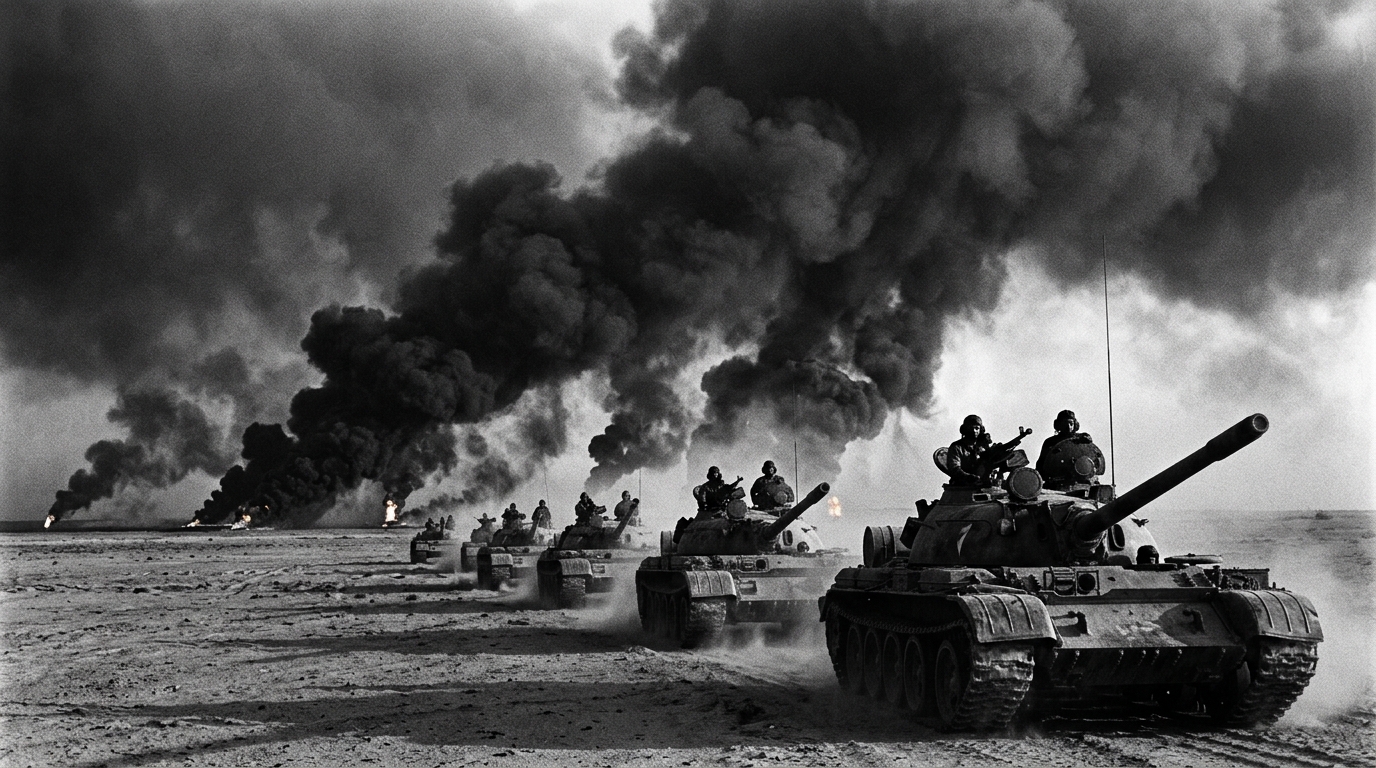
In the sweltering early hours of August 2, 1990, the geopolitical landscape of the Middle East was shattered. Over 100,000 Iraqi troops, backed by hundreds of main battle tanks, crossed the southern border into the State of Kuwait. Within hours, the small, oil-rich emirate was overwhelmed, its royal family forced into hasty exile, and its sovereign territory declared the "19th province" of the Republic of Iraq.
This swift and aggressive act of expansionism by Iraqi President Saddam Hussein did not merely spark a regional crisis; it galvanized a global response that would define the post-Cold War international order. Coming at a historical juncture when the Soviet Union was in terminal decline, the crisis presented the United States and its allies with an opportunity to establish a "New World Order" based on collective security, international law, and the preservation of national sovereignty. The subsequent diplomatic mobilization and military build-up, known as Operation Desert Shield, assembled one of the most diverse and powerful military coalitions in human history, setting the stage for the high-tech warfare of Operation Desert Storm in early 1991.
Historical Context and Origins
To understand Saddam Hussein’s decision to risk international isolation by invading Kuwait, one must examine the catastrophic economic and political fallout of the Iran-Iraq War (1980–1988).
The Economic Legacy of the Iran-Iraq War
For eight years, Iraq had acted as a bulwark for the conservative Arab monarchies of the Persian Gulf against the revolutionary Islamist fervor of Ayatollah Khomeini's Iran. While Iraq emerged from the conflict with a highly experienced, million-man military, its economy was in ruins.
- Crushing Debt: Iraq had accumulated over $80 billion in foreign debt, including approximately $14 billion owed to Kuwait and $26 billion to Saudi Arabia. Saddam argued that these loans should be forgiven, framing Iraq's war effort as a defense of the entire Arab world against Persian expansion.
- Infrastructure Collapse: The reconstruction of Iraq’s oil infrastructure, industries, and cities required tens of billions of dollars that the state treasury simply did not possess.
- Demobilization Fears: Saddam feared that demobilizing hundreds of thousands of armed, unemployed young men would spark domestic unrest or a military coup.
The Oil Dispute and the Rumaila Field
By 1990, Iraq's primary source of revenue—crude oil exports—was severely constrained. Saddam desperately needed global oil prices to rise to at least $25 per barrel to service Iraq's debts and fund reconstruction. However, several members of the Organization of the Petroleum Exporting Countries (OPEC), most notably Kuwait and the United Arab Emirates, consistently exceeded their production quotas. This flooded the global market, driving oil prices down to nearly $14 per barrel. Iraq calculated that every one-dollar drop in the price of a barrel of oil cost its treasury $1 billion annually. 1
Saddam Hussein turned his economic desperation into a series of aggressive diplomatic accusations against Kuwait:
- "Economic Warfare": Baghdad accused Kuwait of deliberately sabotaging the Iraqi economy through overproduction.
- The Rumaila Dispute: Iraq accused Kuwait of using advanced "slant-drilling" technology to steal oil worth billions of dollars from the Rumaila oil field, which straddled the ill-defined border between the two countries.
- Border Disputes: Iraq revived historical, colonial-era claims over Kuwait, arguing that the emirate was an artificial creation of British imperialism and rightfully belonged to the Iraqi province of Basra.
"The oil policy of some Arab rulers is a knife thrust into the back of Iraq... If words fail to protect Iraqis, we will have no choice but to take effective action to restore our rights." [[^2]] — Saddam Hussein, addressing the Arab League Summit in Baghdad, May 1990.
Timeline of Events and Key Moments
The transition from diplomatic posturing to active military invasion occurred with dizzying speed during the summer of 1990.
[July 1990] Iraqi troop build-up on border -> [July 25] Glaspie-Saddam Meeting -> [Aug 1] Jeddah talks collapse -> [Aug 2] Invasion of Kuwait -> [Aug 6] UNSC Res 661 / Desert Shield begins
The Diplomatic Prelude (July 1990)
Throughout July, Iraqi military units, including elite Republican Guard divisions, began massing along the Kuwaiti border. Alarmed, regional and global actors attempted to defuse the situation.
- July 25, 1990 – The Glaspie Meeting: US Ambassador to Iraq, April Glaspie, met with Saddam Hussein in Baghdad to ascertain his intentions. In a highly controversial exchange, Glaspie expressed that the United States desired friendly relations and had "no opinion on the Arab-Arab conflicts, like your border disagreement with Kuwait." [[^3]] This statement was later heavily criticized as a failure of deterrence, signaling to Saddam that Washington would not intervene militarily to protect Kuwait.
- July 31, 1990 – The Jeddah Talks: Saudi Arabia brokered bilateral talks in Jeddah between Iraqi and Kuwaiti delegations. The negotiations quickly collapsed as Kuwait refused to capitulate to Iraq's demands for territorial concessions (specifically the islands of Warbah and Bubiyan) and massive financial compensation.
The Invasion: August 2, 1990
At 2:00 AM local time on August 2, 1990, the Iraqi armed forces launched a multi-pronged assault into Kuwait.
- The Military Onslaught: Elite Republican Guard divisions spearheaded the attack, utilizing armor, mechanized infantry, and helicopter-borne special forces.
- The Flight of the Emir: Kuwait's small defense force of approximately 16,000 men fought brave but futile delaying actions. Kuwaiti Mirage fighters flew combat sorties until their airbases were overrun, after which surviving aircraft fled to Saudi Arabia. Within hours, the Emir of Kuwait, Sheikh Jaber Al-Ahmad Al-Sabah, and his cabinet fled across the southern border into Saudi Arabia, establishing a government-in-exile in the resort city of Taif.
- Saddam's Puppet State: By nightfall, Iraqi forces controlled Kuwait City. Saddam initially established a puppet regime known as the "Provisional Government of Free Kuwait" before officially annexing the country as Iraq's 19th province on August 8.
| Entity/Action | Details |
|---|---|
| Origin | Iraq |
| Action | Republican Guard Armor invades Kuwait |
| Target | Kuwait |
| Consequence 1 | Kuwaiti resistance overwhelmed |
| Consequence 2 | Emir flees to Taif, Saudi Arabia |
The Immediate Global Backlash
The international response was swift, coordinated, and virtually unprecedented in its uniformity.
- UN Security Council Resolution 660: Passed on the day of the invasion, it condemned the attack and demanded an immediate and unconditional Iraqi withdrawal.
- UN Security Council Resolution 661 (August 6, 1990): Imposed a comprehensive economic embargo and financial sanctions on Iraq, effectively cutting the country off from global trade. [[^4]]
- The US Response: President George H. W. Bush immediately froze all Iraqi and Kuwaiti assets in the United States and began rallying international support. On August 5, Bush made his famous declaration to reporters on the South Lawn of the White House:
"This will not stand. This will not stand, this aggression against Kuwait." — President George H. W. Bush, August 5, 1990.
Geopolitical Consequences and Aftermath
Saddam Hussein's gamble radically altered global alignments, initiating a series of structural shifts that defined international relations for decades to come.
The Construction of the Coalition
The most immediate consequence of the invasion was the assembly of a vast, US-led multinational coalition. This endeavor was a masterclass in diplomacy by the Bush administration, particularly Secretary of State James Baker. By utilizing personal relationships, financial incentives, and diplomatic leverage, the US secured the participation of 35 nations, including:
- Western Allies: The United Kingdom, France, Italy, and Canada.
- Arab and Muslim States: Egypt, Syria, Saudi Arabia, the United Arab Emirates, Morocco, and Pakistan. The inclusion of Arab forces was critical to neutralizing Saddam’s propaganda, which sought to frame the conflict as a Western crusade against Islam and Arab nationalism.
- Post-Soviet Cooperation: The Soviet Union, traditionally Iraq’s primary arms supplier, did not veto the UN resolutions. This marked the birth of a cooperative US-Soviet dynamic at the twilight of the Cold War.
| Country | Troops Contributed (Peak) | Key Role |
|---|---|---|
| United States | ~540,000 | Overall command, strategic air assets, heavy armor |
| Saudi Arabia | ~118,000 | Host country, ground forces, air defense |
| United Kingdom | ~43,000 | Armored warfare (Desert Rats), air interdiction |
| Egypt | ~33,000 | Heavy armored divisions, key Arab coalition legitimacy |
| Syria | ~14,000 | Armored defense, symbolic pan-Arab realignment |
The Birth of the "New World Order"
The response to the 1990 invasion was widely seen as the first test of the post-Cold War era. On September 11, 1990, President Bush addressed a joint session of Congress, outlining his vision of a "New World Order":
"A world where the rule of law supplants the rule of the jungle. A world in which nations recognize the shared responsibility for freedom and justice. A world where the strong respect the rights of the weak." [[^5]]
This doctrine asserted that the United Nations, freed from the gridlock of superpower rivalry, could finally function as its founders intended—as an instrument for collective security against rogue aggression.
The Long-Term Security Footprint in the Gulf
Prior to 1990, the United States maintained a relatively light "over-the-horizon" military presence in the Persian Gulf. Operation Desert Shield changed this permanently.
- US Troops in Saudi Arabia: King Fahd's decision to allow hundreds of thousands of non-Muslim Western soldiers onto Saudi soil—home to Islam's holiest sites of Mecca and Medina—was highly controversial. It deeply alienated conservative Islamists, most notably Osama bin Laden, who cited the permanent presence of US troops in Saudi Arabia as a primary justification for Al-Qaeda's subsequent terror campaign against the United States. [[^6]]
- Containment of Iraq: The end of the active combat phase in 1991 did not resolve the "Iraq problem." It led to a decade of strict economic sanctions, the establishment of Northern and Southern No-Fly Zones, and ongoing inspections by the United Nations Special Commission (UNSCOM) to dismantle Iraq's weapons of mass destruction (WMD) programs, laying the groundwork for the 2003 US invasion of Iraq.
Analysis of Key Actors and Decisive Actions
The trajectory of the 1990 crisis was dictated by the decisions, miscalculations, and philosophies of a few pivotal leaders.
Saddam Hussein: The Sovereign Miscalculator
Saddam Hussein’s actions in 1990 were characterized by a profound misunderstanding of contemporary international relations. Having spent the 1980s coddled by both Western and Arab powers who feared the spread of the Iranian Islamic Revolution, Saddam assumed his actions would be met with rhetorical condemnation but no physical resistance.
- Misreading the Cold War: Saddam failed to realize that the Soviet Union was no longer willing or able to shield its clients from Western pressure. Mikhail Gorbachev valued partnership with Washington over maintaining Baghdad as a client state.
- Underestimating American Resolve: Saddam believed the United States suffered from "Vietnam Syndrome"—a crippling domestic reluctance to engage in foreign military interventions. He calculated that the US would not risk high casualties for a small Gulf emirate.
- The Arab Solidarity Illusion: He erroneously believed that the Arab street would rise up in support of his populist, anti-imperialist, and pro-Palestinian rhetoric, forcing regional leaders like King Fahd of Saudi Arabia and President Hosni Mubarak of Egypt to stay out of the conflict.
George H. W. Bush: The Master of Coalition Building
In contrast to Saddam's insular thinking, President George H. W. Bush demonstrated exceptional strategic clarity and diplomatic finesse.
- The Use of Multilateralism: Bush recognized that unilateral US action would be highly destabilizing. By channeling the response through the United Nations Security Council, he gave the impending military action absolute international legitimacy.
- The Saudi Dilemma: Bush dispatched Secretary of Defense Dick Cheney to Riyadh on August 6 to show King Fahd satellite imagery of Iraqi troop concentrations, convincing the reluctant monarch that Saudi Arabia was next on Saddam's target list. This secured Saudi consent for Operation Desert Shield.
- UN Security Council Resolution 678: Passed on November 29, 1990, this resolution gave Iraq a final deadline of January 15, 1991, to withdraw from Kuwait, authorizing coalition states to use "all necessary means" to enforce Resolution 660 thereafter. This provided the legal mandate for the transition from a defensive posture (Desert Shield) to an offensive campaign (Desert Storm).
Trivia and Lesser-Known Facts
While the broad strokes of the Gulf War are well documented, several fascinating, lesser-known aspects highlight the complexity of the crisis:
- The "Human Shields" and British Airways Flight 149: On August 2, 1990, British Airways Flight 149 landed in Kuwait City for a scheduled refueling stop just hours after the Iraqi invasion had commenced. The passengers and crew were captured by Iraqi forces and used as "human shields" at strategic military sites across Iraq to deter coalition bombing. They were held for months before Saddam released them in December 1990 as a diplomatic gesture.
- The Nayirah Testimony: In October 1990, a 15-year-old Kuwaiti girl known only as "Nayirah" gave emotional testimony before the US Congressional Human Rights Caucus. She claimed to have witnessed Iraqi soldiers taking babies out of incubators in a Kuwaiti hospital and leaving them to die. The story was widely cited by President Bush and US Senators to justify military action. It was later revealed that Nayirah was the daughter of the Kuwaiti Ambassador to the US, and her testimony was organized by the public relations firm Hill & Knowlton as part of a sophisticated lobbying effort funded by "Citizens for a Free Kuwait." [[^7]]
- The "Stealth" Invasion of Saudi Border Towns: Before the major air campaign of 1991 began, Iraqi forces launched a surprise cross-border incursion into the Saudi town of Khafji on January 29, 1991. The Battle of Khafji was the first major ground engagement of the conflict, resulting in a coalition victory but highlighting Saddam's willingness to take tactical initiatives.
- The Demise of the Soviet-Iraqi Alliance: To prevent war, the Soviet Union sent special envoy Yevgeny Primakov to Baghdad multiple times in late 1990. Primakov, who had a long-standing personal relationship with Saddam, attempted to negotiate a face-saving withdrawal. Saddam refused, ignoring Primakov's warnings that the US military would completely devastate Iraq's armed forces.
References and Literature
- UN Security Council Resolutions (1990) - The official record of Resolutions 660, 661, and 678, establishing the legal framework for the international response.
- Bush, George H. W., and Brent Scowcroft. A World Transformed. New York: Knopf, 1998. - A firsthand account of the diplomatic efforts and strategic decisions made by the Bush administration during the Gulf crisis.
- Freedman, Lawrence, and Efraim Karsh. The Gulf Conflict 1990-1991: Diplomacy and War in the New World Order. Princeton University Press, 1993. - An exhaustive, scholarly analysis of the political, military, and diplomatic dimensions of the war.
- The Gulf War: An In-Depth Retrospective - Foreign Affairs article detailing the immediate geopolitical consequences of the crisis on the Middle East.
---
Footnotes & Explanations
- Lawrence Freedman and Efraim Karsh, The Gulf Conflict 1990-1991: Diplomacy and War in the New World Order (Princeton University Press, 1993), p. 45. ↩
- Saddam Hussein, Address to the Arab League Summit in Baghdad, May 28, 1990. ↩
- Cable from US Embassy Baghdad to Department of State, "Subject: Ambassador's Meeting with President Saddam Hussein," July 25, 1990 (released under FOIA). ↩
- United Nations Security Council Resolution 661, adopted on August 6, 1990. ↩
- George H.W. Bush, "Address Before a Joint Session of the Congress on the Persian Gulf Crisis," September 11, 1990. ↩
- Osama bin Laden, "Declaration of War against the Americans Occupying the Land of the Two Holy Places," published in Al-Quds Al-Arabi, August 1996. ↩
- John R. MacArthur, Second Front: Censorship and Propaganda in the Gulf War (Hill and Wang, 1992), pp. 58-64. ↩