Key Takeaways
- The coup was triggered by Prime Minister Mosaddegh's nationalization of the British-owned Anglo-Iranian Oil Company (AIOC) in 1951.
- Operation Ajax marked a watershed moment as the CIA's first successful peacetime covert operation to overthrow a foreign government.
- The intervention restored the autocratic rule of Mohammad Reza Pahlavi, laying the geopolitical groundwork for the 1979 Islamic Revolution.
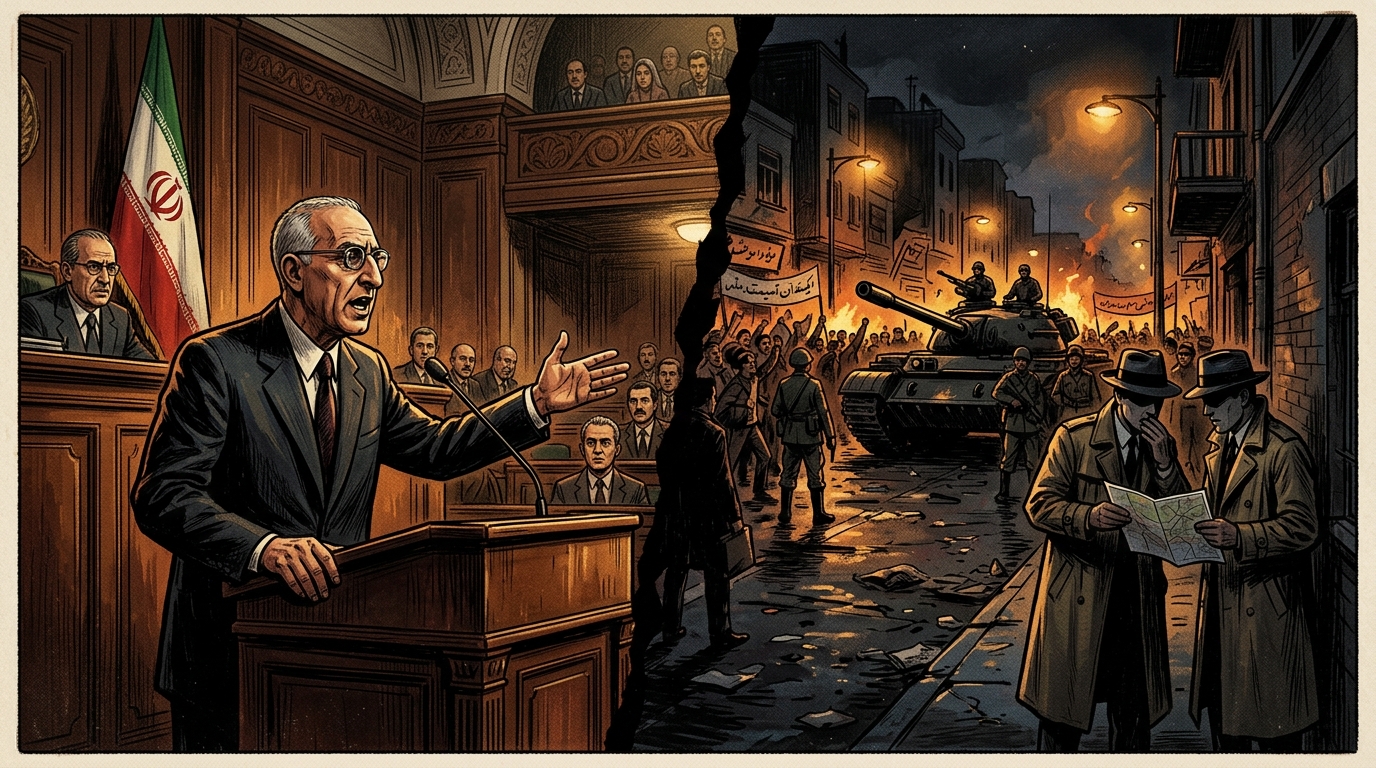
The events of August 1953 in Tehran represent a defining pivot point in twentieth-century geopolitics. Operation Ajax (officially designated TP-AJAX by the United States Central Intelligence Agency) was a joint covert operation orchestrated by the United States and the United Kingdom to overthrow the democratically elected Prime Minister of Iran, Dr. Mohammad Mosaddegh. By replacing Mosaddegh with a military government loyal to Shah Mohammad Reza Pahlavi, the Western powers secured short-term oil interests and integrated Iran into the anti-communist Western alliance.
However, this tactical success came at a catastrophic strategic cost. The coup extinguished Iran’s brief experiment with secular democracy, consolidated an autocracy that suppressed all moderate dissent, and generated a deep-seated grievance against foreign intervention. Decades later, this grievance would serve as the ideological fuel for the 1979 Islamic Revolution, transforming Iran from a key Western ally into an implacable adversary.
Historical Context and Origins
To understand the crisis of 1953, one must look back to the early twentieth century, when Iran’s most valuable natural resource became entangled with British imperial interests. In 1901, the Qajar shah granted a massive 60-year oil concession to British millionaire William Knox D'Arcy. This concession eventually evolved into the Anglo-Persian Oil Company (APOC), later renamed the Anglo-Iranian Oil Company (AIOC) (the precursor to modern-day British Petroleum, or BP).
- British Concession (1901)
- Establishment of APOC/AIOC
- Asymmetric Profit Sharing
- Iranian Nationalist Backlash (1940s-50s)
For decades, the AIOC operated as a virtual state within a state in southwestern Iran. The company controlled the massive Abadan Refinery—the largest in the world—and paid Iran meager royalties while extracting immense profits that funded the British Treasury and fueled the Royal Navy. Iranian laborers at Abadan endured substandard wages, squalid living conditions, and systemic discrimination, while British administrators enjoyed luxurious enclaves 1.
The Rise of National Sentiment
Following the Allied occupation of Iran during World War II and the subsequent withdrawal of foreign troops, the Iranian public grew increasingly resentful of foreign exploitation. In 1949, a coalition of secular, religious, and liberal-nationalist parties formed the National Front (Jebhe Melli), led by the charismatic, Swiss-educated aristocrat Dr. Mohammad Mosaddegh.
Mosaddegh’s platform centered on two core pillars:
- Strict adherence to the Iranian Constitution of 1906 to limit the power of the young Shah, Mohammad Reza Pahlavi.
- The nationalization of the AIOC to reclaim Iran's sovereign wealth.
In March 1951, the Iranian parliament (the Majlis) voted unanimously to nationalize the country's oil industry. Facing overwhelming public pressure, the Shah was forced to appoint Mosaddegh as Prime Minister in April 1951.
"Our many years of negotiations with foreign countries... have yielded no results. With the oil revenues, we could meet our entire budget and combat poverty, disease, and backwardness among our people." — Dr. Mohammad Mosaddegh, addressing the Majlis, 1951
The Abadan Crisis and International Escalation
The British government, led initially by Clement Attlee’s Labour administration and later by Winston Churchill’s Conservative government, viewed nationalization as an intolerable theft of British property. London retaliated swiftly:
- Economic Blockade: Britain instituted a worldwide embargo on Iranian oil and froze Iranian financial assets.
- Legal Warfare: The British took the dispute to the International Court of Justice (ICJ) at The Hague and the United Nations Security Council, both of which ultimately declined to rule against Iran’s sovereign right to nationalize its resources.
- Military Threats: Warships were dispatched to the Persian Gulf to intimidate the Mosaddegh government.
The embargo devastated the Iranian economy, depriving the state of virtually all foreign exchange. Despite the mounting economic hardship, Mosaddegh refused to back down, insisting on full sovereign control over Iran’s petroleum resources.
The Shift in Washington's Stance
Initially, the U.S. Truman administration acted as a mediator. President Harry S. Truman and his Secretary of State, Dean Acheson, feared that British intransigence would destabilize Iran and push the country into the orbit of the Soviet Union. However, the geopolitical landscape changed dramatically in late 1952 and early 1953 with two critical developments: the election of Republican President Dwight D. Eisenhower and the appointment of the Dulles brothers—John Foster Dulles as Secretary of State and Allen Dulles as Director of Central Intelligence (DCI).
Unlike Truman, the Eisenhower administration viewed the world through a rigid Cold War lens. The British Secret Intelligence Service (SIS/MI6), realizing they could not win American support purely on the basis of corporate oil interests, reframed the dispute. They convinced Washington that Mosaddegh was susceptible to a communist takeover by the pro-Soviet Tudeh Party 2. Facing a deteriorating economy and rising domestic political instability, Eisenhower authorized a covert regime-change operation in cooperation with the British.
Timeline of Events and Key Moments
The planning of the coup began in earnest in the spring of 1953 under the joint direction of the CIA’s Near East and Africa Division, led by Kermit Roosevelt Jr. (grandson of President Theodore Roosevelt), and British intelligence officers. The operation was codenamed TP-AJAX.
| Date | Event |
|---|---|
| June 1953 | Operation Ajax finalized in Nicosia |
| Mid-August | Shah signs royal decrees (firmans) under Western pressure |
| Aug 15-16 | First coup attempt fails; Shah flees to Baghdad/Rome |
| Aug 17-18 | CIA mobilizes street mobs and military networks in Tehran |
| Aug 19 | Pro-Shah forces storm government offices; Mosaddegh overthrown |
The Preliminary Phase (June – July 1953)
- June 1953: US and British intelligence officials meet in Nicosia, Cyprus, to finalize the operational plan. Donald Wilber, a key CIA planner and specialist on Iran, drafts the psychological warfare and propaganda strategies.
- July 1953: The CIA begins funnelling large sums of money into Iran to bribe politicians, journalists, military officers, and religious leaders. The goal is to undermine Mosaddegh's public support and paint him as an authoritarian ally of the communists.
The First Attempt and Failure (August 15–16, 1953)
The plan required the Shah to sign two imperial decrees (firmans): one dismissing Mosaddegh as Prime Minister and another appointing retired General Fazlollah Zahedi in his place.
- August 15: Colonel Nematollah Nassiri, commander of the Imperial Guard, delivers the dismissal decree to Mosaddegh's villa. However, Mosaddegh has been tipped off about the impending coup. Nassiri is promptly arrested by loyalist forces.
- August 16: As news of the failed coup spreads, the Shah panics and flees the country, flying first to Baghdad and then to Rome. Pro-Mosaddegh and leftist crowds take to the streets of Tehran, tearing down statues of the Shah and his father.
Roosevelt's Pivot and Chaos in the Streets (August 17–18, 1953)
Back in Washington, CIA headquarters sends a cable to Kermit Roosevelt ordering him to abort the operation and leave Iran immediately. Roosevelt, operating covertly from the US embassy compound in Tehran, decides to ignore the order. He recognizes that the political volatility can still be exploited.
Roosevelt deploys a network of Iranian agents, including the wealthy Rashidian brothers, to sow chaos:
- They hire athletic instigators, wrestlers, and street thugs (most notably Shaban Jafari, known as "Shaban the Brainless") to pose as Tudeh Party communists.
- These hired mobs vandalize shops, attack mosques, and chant pro-communist slogans, successfully alienating the religious establishment and conservative middle class, who fear an imminent Marxist revolution.
- Concurrently, the CIA pays rival right-wing mobs and royalist sympathizers to clash with the fake communists.
The Turning Point (August 19, 1953)
The climax of the operation unfolds with rapid, orchestrated violence.
- Morning: A massive crowd of pro-Shah demonstrators—comprising hired street elements, off-duty policemen, and military personnel mobilized by General Zahedi—marches toward the center of Tehran.
- Afternoon: Pro-Shah military units, equipped with tanks and heavy artillery, seize key strategic points, including the state radio station, the Ministry of Foreign Affairs, and army headquarters.
- The Assault on Mosaddegh's Residence: Royalist military units surround Mosaddegh's home on Kakh Street. A fierce, hours-long battle ensues between loyalist guards and rebel troops. Over 300 people are killed in the clashes [^3]. Mosaddegh is forced to flee over his garden wall.
The Aftermath (August 20, 1953)
On August 20, realizing that further resistance will only lead to greater bloodshed, Dr. Mohammad Mosaddegh surrenders to General Zahedi. Zahedi declares himself Prime Minister, and a few days later, the Shah returns to Tehran in triumph.
Geopolitical Consequences and Aftermath
The immediate aftermath of Operation Ajax was celebrated in Washington and London as a resounding triumph for the West. However, the medium- and long-term consequences fundamentally altered the trajectory of the Middle East.
Consolidation of Autocracy and the Rise of SAVAK
Upon his return, the Shah dismantled the constitutional constraints that had previously limited his power. He suspended the Majlis, outlawed the National Front, and ruthlessly suppressed the political left.
To maintain his grip on power, the Shah established SAVAK (the State Organization for Security and Intelligence) in 1957. Trained by the CIA and Israel's Mossad, SAVAK became notorious for its pervasive surveillance, systemic censorship, and brutal torture of political dissidents. By eliminating secular, democratic critics, the regime inadvertently drove the opposition underground into the only institution the Shah could not fully dismantle: the network of Shi'a mosques led by conservative clerics like Ayatollah Ruhollah Khomeini.
| Domestic Reforms vs. Political Reality under the Shah |
|---|
| Socio-Economic Modernization: The "White Revolution" introduced literacy programs, land reform, and women's suffrage. |
| Political Suppression: Opposition parties were banned; dissent was treated as treason, and SAVAK controlled public life. |
| Western Alignment: Iran became a major recipient of US military hardware and acted as the "Gendarme of the Persian Gulf." |
The Redistribution of Oil Wealth
While the British had instigated the coup to regain their monopoly, the post-coup reality reflected the shift in global hegemony from London to Washington. Under the Consortium Agreement of 1954, the Anglo-Iranian Oil Company (renamed British Petroleum) was forced to cede its monopoly. A new international consortium was created:
- British Petroleum received a 40% share.
- Five major American oil companies received a combined 40% share.
- Royal Dutch Shell and French companies split the remaining 20% [^4].
Profits were split on a 50-50 basis between the consortium and the Iranian government, providing the Shah with billions of dollars to fund his military ambitions and modernization programs.
The Path to the 1979 Revolution
The legacy of 1953 poisoned relations between the Iranian public and the United States. For generations of Iranians, the coup was a stark lesson: the United States’ rhetoric concerning democracy and self-determination was secondary to its imperialist interests in oil and strategic containment.
When economic inequality, cultural alienation, and political oppression culminated in the 1979 Islamic Revolution, the primary target of popular anger was not just the Shah, but his "puppeteer"—the United States, famously labeled the "Great Satan" by Khomeini. The storming of the US Embassy in Tehran in November 1979 and the subsequent 444-day hostage crisis were directly motivated by fears among Iranian revolutionaries that the CIA was planning a repeat of 1953 to restore the Shah to power.
| Sequence | Event |
|---|---|
| 1 | 1953 Coup |
| 2 | 26 Years of Autocracy |
| 3 | 1979 Islamic Revolution |
| 4 | US Embassy Takeover / Hostage Crisis |
Analysis of Key Actors and Decisive Actions
The success of Operation Ajax was not inevitable; rather, it was the result of a complex interplay of personal ambitions, miscalculations, and tactical maneuvers.
Dr. Mohammad Mosaddegh: The Tragic Reformer
Mosaddegh was a passionate nationalist committed to constitutional principles, but he underestimated both the ruthlessness of his foreign adversaries and the fragility of his domestic coalition.
- Strategic Strengths: He possessed immense charisma and moral authority, successfully rallying the Iranian public around the cause of nationalization.
- Tactical Failures: As the economic blockade took its toll, Mosaddegh grew increasingly authoritarian. To bypass a hostile parliament, he conducted a controversial referendum to dissolve the Majlis in August 1953. This action alienated key moderate allies, including secular liberals and influential religious leaders like Ayatollah Abol-Ghasem Kashani, leaving him isolated when the military turned against him.
Shah Mohammad Reza Pahlavi: The Reluctant Monarch
Throughout the crisis, the young Shah exhibited a profound lack of resolve. He was highly insecure, terrified of Mosaddegh's popularity, and deeply hesitant to act against him without explicit Western guarantees.
- Decisive Moment: The Shah signed the firmans only after receiving intense pressure from US and British emissaries, who made it clear that Western support for his throne was contingent on his cooperation. His flight to Rome on August 16 revealed his default impulse to flee in times of crisis, a pattern he would repeat in January 1979.
Kermit Roosevelt Jr.: The Maverick Operative
Kermit Roosevelt’s tactical improvisation was the single most decisive factor in the success of the coup.
- The Counter-Intuitive Decision: When the August 15 plot failed and Washington ordered him to abort, Roosevelt recognized that the political vacuum in Tehran could still be exploited. By utilizing local assets, manipulating public fear of a communist takeover, and flooding the streets with hired actors, he turned a failed military coup into a chaotic, successful civilian uprising.
Trivia and Lesser-Known Facts
- The BBC's Secret Code: To convince the skeptical Shah that the US and UK governments were fully behind the coup, the British government arranged for a coded message to be broadcast over the Persian service of the BBC. The announcer, who normally said, "It is now midnight in London," instead said, "It is now exactly midnight in London," a pre-arranged signal to the Shah that the operation had been officially approved.
- The "Save the Shah" Propaganda Campaign: The CIA’s psychological warfare division planted hundreds of articles in both Iranian and international newspapers. They fabricated stories claiming Mosaddegh had Jewish ancestry, was a crypto-communist, and was actively working to destroy Islam in Iran.
- The Official Declassification: For decades, the US government maintained a policy of plausible deniability regarding its role in the coup. It was not until 2000 that Secretary of State Madeleine Albright publicly acknowledged the US role, and in 2013—on the 60th anniversary of the coup—the CIA formally declassified documents explicitly admitting its planning and execution of the operation [^5].
- The "Wild Card" Shaban the Brainless: Shaban Jafari, a notorious bazaar powerhouse and giant of the traditional Iranian gym (Zurkhaneh), was actually in prison during the first days of the coup. He was released on August 19 by pro-Shah officers specifically to lead the street mobs that overwhelmed Mosaddegh’s supporters.
References and Literature
- All the Shah's Men: An American Coup and the Roots of Middle East Terror - Stephen Kinzer's definitive narrative account of the 1953 coup and its long-term geopolitical repercussions.
- The Coup: 1953, the CIA, and the Roots of Modern U.S.-Iranian Relations - Ervand Abrahamian's academic study analyzing the social, economic, and class dynamics of the nationalization crisis.
- The Foreign Policy of the Eisenhower Administration - Official historical archives of the United States Department of State detailing the declassified diplomatic cables regarding Operation TP-AJAX.
- The C.I.A. in Iran: The Secret History of the 1953 Coup - The New York Times' publication of the leaked internal CIA history written by coup planner Donald Wilber.
---
Footnotes & Explanations
- Ervand Abrahamian, The Coup: 1953, the CIA, and the Roots of Modern U.S.-Iranian Relations (New York: The New Press, 2013), 34-38. ↩
- Stephen Kinzer, All the Shah's Men: An American Coup and the Roots of Middle East Terror (Hoboken: John Wiley & Sons, 2003), 112-115. ↩
- Kinzer, All the Shah's Men, 182-186. ↩
- Abrahamian, The Coup, 196-201. ↩
- "CIA Confirms Role in 1953 Iran Coup," National Security Archive Electronic Briefing Book No. 435, August 19, 2013. ↩