Key Takeaways
- The assassination of Rafik Hariri fundamentally altered the regional balance of power, effectively ending three decades of Syrian military presence in Lebanon and setting the stage for a new era of contested sovereignty.
- The event acted as a profound catalyst for the Cedar Revolution, a powerful grassroots movement that successfully mobilized Lebanese society across sectarian lines, demonstrating unprecedented civic unity against foreign interference.
- The international response, spearheaded by the UN Special Tribunal for Lebanon, established a new precedent for international accountability in political assassinations, albeit one fraught with challenges and complex outcomes.
- The subsequent power vacuum led to increased internal political polarization, culminating in the rise of the March 8 and March 14 blocs, and fundamentally reshaped Lebanon's domestic and external alliances.
Historical Context and Origins
The assassination of Rafik Hariri on February 14, 2005, did not occur in a vacuum. It was the culmination of mounting tensions between the Lebanese political establishment, which sought greater sovereignty, and the deeply entrenched Syrian-backed security apparatus that had maintained a firm grip on the country since the end of the Lebanese Civil War in 1990. To understand the profound impact of this event, one must delve into the intricate history of Lebanon's post-war settlement and Syria's enduring influence.
Lebanon's Post-Civil War Landscape and Syrian Hegemony
The Lebanese Civil War (1975-1990), a brutal and complex conflict fueled by internal sectarian divisions and regional interventions, ended with the Taif Agreement in 1989. This accord, brokered by Saudi Arabia and with significant Syrian oversight, redistributed political power among Lebanon's confessional groups, while critically legitimizing Syria's military presence in Lebanon as a "stabilizing force" for a transitional period. What began as a peacekeeping mission in 1976 transformed into a de facto occupation, with Damascus establishing a vast intelligence and military infrastructure that permeated every aspect of Lebanese political, economic, and security life.
Syria's "guardianship" was enforced through its intelligence agencies, most notably the Mukhabarat, led by powerful figures such as Ghazi Kanaan and later Rustom Ghazaleh. These officials wielded immense power, effectively vetoing Lebanese government decisions, orchestrating political appointments, and suppressing dissent. Lebanon became a vital strategic asset for Syria, providing "strategic depth" against Israel, a diplomatic leverage point with the West, and an economic lifeline for its own struggling economy. Any challenge to this hegemony was met with swift and often brutal reprisal.
Rafik Hariri: A Vision for Independence
Rafik Hariri, a self-made billionaire businessman who amassed his fortune in Saudi Arabia, emerged as a pivotal figure in post-war Lebanon. Returning to his homeland, he served as Prime Minister from 1992-1998 and again from 2000-2004. Hariri spearheaded the ambitious post-war reconstruction of Beirut, famously known as the Solidere project, aiming to transform the war-ravaged capital into a modern financial and cultural hub. His vision for Lebanon was one of modernization, financial stability, and integration into the global economy, often placing him at odds with the entrenched Syrian intelligence apparatus and its Lebanese allies, particularly then-President Emile Lahoud, who was widely seen as a Syrian protégé.
Hariri's growing international stature and his close ties with Western leaders, especially French President Jacques Chirac, made him an increasingly independent and powerful political force. He represented a pragmatic, pro-Western faction within Lebanon that sought to incrementally reassert Lebanese sovereignty and reduce Syrian influence. This stance, while popular among a significant segment of the Lebanese population, inevitably put him on a collision course with Damascus.
The Breaking Point: UNSC Resolution 1559
By 2004, the relationship between Hariri and the Syrian leadership, particularly President Bashar al-Assad, had reached a critical breaking point. The immediate catalyst for heightened tensions was the Syrian-orchestrated amendment to the Lebanese constitution in September 2004, which extended President Lahoud's term by three years. This move was a blatant violation of democratic norms and a direct affront to Hariri, who strongly opposed it. In protest, Hariri resigned as Prime Minister, signaling his refusal to legitimise Syria's continued interference.
Simultaneously, United Nations Security Council Resolution 1559, passed in September 2004, emerged as a game-changer. Drafted by France and the United States, it explicitly called for the withdrawal of all remaining foreign forces from Lebanon (a clear reference to Syria) and the disarming of all Lebanese and non-Lebanese militias (most notably Hezbollah). This resolution, supported by Hariri—albeit cautiously and through backchannels—was perceived by Damascus as an unprecedented international challenge to its strategic interests and a direct threat to its regional influence. Hariri, with his international connections and independent political capital, was viewed by Damascus as a liability who could no longer be contained within the Syrian-Lebanese security architecture. His removal, whether through political marginalization or more extreme means, became a perceived necessity for the Syrian regime to maintain its grip on Lebanon.
Timeline of Events and Key Moments
The trajectory of the 2005 crisis is defined by a rapid sequence of events that pushed Lebanon from shock into revolutionary fervor. These moments highlight the acceleration of both domestic opposition and international pressure following Hariri's assassination.
| Date | Event | Significance |
|---|---|---|
| September 2004 | UNSC Resolution 1559 Passed | Demanded Syrian withdrawal and the disarmament of all militias in Lebanon. |
| September 2004 | Lebanese Constitutional Amendment | President Emile Lahoud's term extended under Syrian pressure, causing Rafik Hariri to resign. |
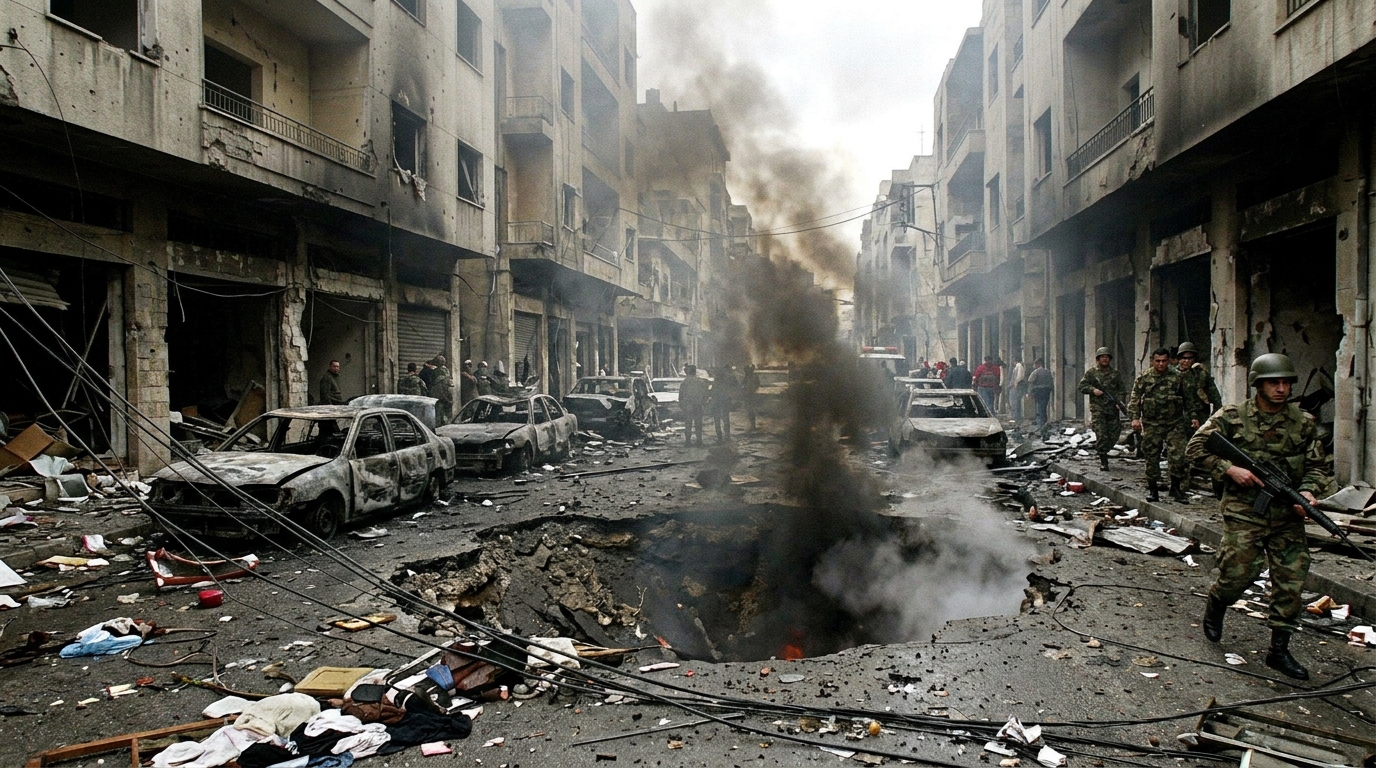
| February 14, 2005 | Assassination of Rafik Hariri | A massive explosion on the Beirut Corniche kills Hariri and 21 others, igniting national outrage. |
| February 2005 | The Cedar Revolution Begins | Mass protests erupt in Martyrs' Square, demanding truth, an international investigation, and independence from Syrian influence. |
| March 8, 2005 | Pro-Syrian Rally in Beirut | Hezbollah and its allies organize a massive counter-demonstration, showcasing their political and popular strength. |
| March 14, 2005 | The "Independence Intifada" | An estimated one million citizens protest in Beirut, representing the largest anti-Syrian demonstration in Lebanese history, solidifying the Cedar Revolution. |
| April 26, 2005 | Syrian Withdrawal | The last Syrian intelligence and military personnel leave Lebanon, marking the end of a 29-year presence. |
| May 29, 2005 | Parliamentary Elections Begin | The first post-Syrian withdrawal elections, leading to a victory for the March 14 coalition. |
| June 2007 | UN Security Council Resolution 1757 | Established the Special Tribunal for Lebanon (STL) to prosecute those responsible for the assassination. |
Geopolitical Consequences and Aftermath
The immediate fallout of the explosion was a profound shockwave that reverberated across Lebanon and throughout the international community. The assassination not only ended Hariri's life but also fundamentally altered the regional balance of power, leading to the rapid, though often turbulent, redefinition of Lebanon's sovereignty and its relationships with its neighbors.
International Isolation of Syria and the Syrian Withdrawal
The international community, particularly the United States and France, reacted with immediate condemnation. President George W. Bush and President Jacques Chirac took leading roles in demanding an international investigation, framing the assassination as a brazen assault on Lebanese democratic institutions and a challenge to international law. This unprecedented joint pressure, coupled with mounting domestic Lebanese protests, proved decisive. Under the weight of UNSC Resolution 1559 and the global outrage, Syria was forced to withdraw its forces. On April 26, 2005, the last Syrian intelligence and military personnel left Lebanon, ending a 29-year presence and marking a symbolic end to the immediate phase of the Cedar Revolution.
The Rise of Political Blocs and Deepened Polarization
The withdrawal of Syrian forces created a significant power vacuum that was quickly contested. The initial euphoria of independence soon gave way to increased internal political polarization. The "March 14" movement, representing a loose coalition of anti-Syrian and pro-Western factions (including Hariri's Future Movement, the Lebanese Forces, and the Progressive Socialist Party), initially took control of the government after the 2005 parliamentary elections. This bloc advocated for a fully sovereign and independent Lebanon, free from external influence, and for the disarmament of Hezbollah.
However, a counter-bloc quickly solidified: the "March 8" alliance, led by Hezbollah and its allies, including the Amal Movement and later the Free Patriotic Movement. This bloc maintained close ties to Syria and Iran, viewing Hezbollah's armed resistance as essential for Lebanon's defense and rejecting attempts to disarm it. The subsequent years were defined by intense political deadlock, often erupting into street violence, as these two blocs vied for control, effectively paralyzing state institutions.
Regional Instability and the 2006 Lebanon War
The shift in Lebanon's internal dynamics had immediate regional repercussions. The perceived weakening of Syria's control and the empowerment of Hezbollah, coupled with lingering border disputes, contributed to the outbreak of the 2006 Lebanon War between Hezbollah and Israel. While ostensibly a conflict between a non-state actor and a state, the war further destabilized Lebanon, exposed its fragility, and underscored Hezbollah's enduring military power and its strategic importance to Iran. The conflict severely damaged Lebanon's infrastructure and deepened internal divisions over Hezbollah's role as a state-within-a-state.
The Doha Agreement and Power-Sharing
The political fragility reached a peak in 2008 when Hezbollah, following a protracted political crisis, deployed its armed fighters across Beirut, seizing control of large parts of the capital. This display of force, which shocked the international community, led to the Doha Agreement, brokered by Qatar. The agreement sought to stabilize the country through a complex power-sharing mechanism, granting the March 8 bloc effective veto power in cabinet decisions and paving the way for the election of a consensus president, Michel Suleiman. While it averted further civil conflict, the Doha Agreement enshrined sectarian power-sharing imbalances and formally institutionalized Hezbollah's political influence, allowing it to maintain its armed wing largely unchecked.
"The blood of the martyr prime minister will not be in vain; it has paved the way for a sovereign, free, and independent Lebanon." — Common sentiment expressed by protesters in Beirut, 2005.
Economic and Social Impact
The initial optimism following the Syrian withdrawal quickly faded as political instability, security concerns, and deep-seated sectarian divisions continued to plague Lebanon. The assassination and its aftermath deterred foreign investment, exacerbated capital flight, and hindered economic recovery. The constant political paralysis prevented crucial reforms, contributing to Lebanon's long-term economic decline and increasing social grievances. The Hariri assassination, therefore, marked a turning point that promised liberation but ultimately delivered protracted political strife and economic stagnation.
Analysis of Key Actors and Decisive Actions
The assassination of Rafik Hariri and the subsequent Cedar Revolution were the product of complex interactions between domestic Lebanese factions and powerful regional and international actors. Understanding their motivations and actions is crucial to grasping the full scope of the crisis.
The Role of Syria
For Damascus, Lebanon was not merely a neighbor but a critical "strategic depth" and a linchpin in its regional foreign policy. It provided a crucial conduit to Hezbollah, a proxy against Israel, and a source of economic and political leverage. Hariri’s move toward the West, his close relationship with French President Chirac, and his increasing independent political footprint were viewed as direct threats to Syrian national security and its hegemonic control.
Syria's intelligence chiefs in Lebanon, such as Ghazi Kanaan (before 2002) and Rustom Ghazaleh, operated with impunity, effectively running the country from their headquarters in Anjar. They maintained an intricate web of informants, allies, and loyalists across the Lebanese political, military, and economic spectrum. The passage of UNSC Resolution 1559, which explicitly demanded Syrian withdrawal and militia disarmament, was seen by Damascus as an existential challenge, orchestrated by the United States and France. The assassination served to decapitate the opposition to Syrian influence and send a violent message to any political actor attempting to align with international mandates like Resolution 1559. The timing, just months after Hariri's resignation and the passing of Resolution 1559, strongly suggested a desperate attempt by Damascus to reassert control through terror.
The United States and France
The U.S. and France, the latter being the former colonial power with historical ties to Lebanon, formed an unlikely but highly effective geopolitical tandem in the aftermath of the assassination.
- The United States: Under President George W. Bush, the U.S. was deeply engaged in its "War on Terror" and pursuing a strategy of regime change or pressure on states perceived as supporting terrorism, particularly those categorized as part of an "Axis of Evil." Syria, with its support for Hezbollah and Hamas, and its perceived obstruction in Iraq, fit this mold. The Hariri assassination provided a moral and political imperative for the U.S. to intensify its pressure on Damascus, aligning with its broader regional objectives of isolating Iran and its allies, and promoting democracy in the Middle East. The U.S. played a critical role in pushing for strong UN resolutions and galvanizing international opinion against Syria.
- France: President Jacques Chirac shared a deep personal friendship with Rafik Hariri, viewing him as a key partner in stabilizing Lebanon and promoting French influence in the Levant. For France, the assassination was not just a political act but a personal affront. Paris felt a historical and cultural responsibility towards Lebanon and viewed Syrian dominance as an impediment to Lebanese sovereignty. France's diplomatic efforts, leveraging its permanent seat on the UN Security Council and its strong ties to European and Arab nations, were crucial in building the international consensus that ultimately forced Syria's withdrawal. The Franco-American diplomatic axis was instrumental in transforming the regional tragedy into a global political crisis for Syria.
Hezbollah
Caught between its loyalty to its Syrian and Iranian backers and the domestic pressure of the "Cedar Revolution," Hezbollah adopted a dual strategy. Initially, its leadership expressed condolences but refrained from directly condemning the assassination, implicitly supporting the Syrian narrative that blamed Israel. However, as the Cedar Revolution gained momentum, Hezbollah organized the massive March 8 counter-demonstration, showcasing its formidable mobilization capabilities and demonstrating that a significant portion of the Lebanese population still supported its resistance agenda and its alliance with Syria.
Hezbollah's unique position as both a powerful political party and an armed militia allowed it to navigate the post-2005 landscape with agility. While it officially opposed the "anti-Syrian" protests and the demands for its disarmament, it maintained the political flexibility to re-integrate into the state post-2005. It capitalized on the political vacuum and the fragmentation of the anti-Syrian forces, eventually turning the tables on its domestic opponents by exploiting the ongoing political fragility. Its strategic alliance with Iran grew even stronger in the years following the Syrian withdrawal, as Tehran sought to maintain its influence in Lebanon through its most reliable proxy.
Other Lebanese Factions
The assassination also fundamentally reshaped the landscape for other key Lebanese political figures and parties:
- Walid Jumblatt: The charismatic leader of the Druze community and the Progressive Socialist Party, Jumblatt made a dramatic and risky pivot from a long-standing Syrian ally to a fierce opponent of Damascus after Hariri's death. His impassioned speeches and political maneuvering were critical in mobilizing broad sectarian support for the Cedar Revolution.
- Christian Leaders: The Maronite Christian community was deeply divided. Figures like Samir Geagea, leader of the Lebanese Forces, were staunchly anti-Syrian. However, Michel Aoun, leader of the Free Patriotic Movement, initially returned from exile as an anti-Syrian figure but later formed a controversial alliance with Hezbollah, shifting the internal balance of power significantly.
- The Hariri Family and the Future Movement: Rafik Hariri’s son, Saad Hariri, inherited his father’s political mantle and led the "March 14" coalition. While lacking his father's international gravitas and experience, he became a central figure in the anti-Syrian movement, though he struggled to maintain a unified front against the increasingly powerful March 8 alliance.
Historical Precedents & Regional Geopolitics
The assassination of Rafik Hariri, while shocking in its scale and immediate impact, was not an isolated incident in the violent tapestry of Lebanese and regional politics. It must be viewed through the lens of historical precedents of political violence in Lebanon and the broader geopolitical currents shaping the Middle East in the early 2000s.
A History of Political Assassinations in Lebanon
Lebanon has a tragic history of political assassinations, often serving as a brutal tool to eliminate rivals, alter power dynamics, or send chilling messages. Key examples include:
- Kamal Jumblatt (1977): The influential Druze leader and head of the Lebanese National Movement, a left-leaning, pan-Arabist coalition, was assassinated during the Civil War. His death profoundly impacted the war's trajectory and the Druze community, with strong suspicions pointing to Syrian involvement.
- Bashir Gemayel (1982): The Maronite Christian leader and President-elect, a controversial figure allied with Israel, was assassinated before he could take office. His death triggered the Sabra and Shatila massacres and profoundly impacted the Christian political landscape.
- René Moawad (1989): A consensus-building Maronite president elected shortly after the Taif Agreement, Moawad was assassinated just 17 days into his term. This attack, also widely attributed to Syrian intelligence or its allies, underscored the fragility of Lebanese sovereignty even at the dawn of peace.
These precedents demonstrate a pattern: political assassinations in Lebanon are rarely purely internal affairs. They are often entwined with external powers seeking to shape the country's destiny, using violence to install compliant leaders or remove obstacles to their strategic agendas. Hariri's assassination, therefore, fit into a disturbing, long-standing tradition, but its timing and the scale of the international response set it apart.
The Broader Middle East Context in the Early 2000s
The Hariri assassination unfolded in a highly charged regional environment, profoundly shaped by the aftermath of the September 11, 2001, attacks and the subsequent U.S.-led "War on Terror."
- The Iraq War (2003): The U.S. invasion of Iraq and the overthrow of Saddam Hussein created a new geopolitical reality. It demonstrated American willingness to use force to reshape the region and sent a clear message to "rogue states" or members of the "Axis of Evil" (a term coined by President Bush, which included Iran, Iraq, and North Korea, with Syria often implicitly linked). This created immense pressure on Syria, which was accused by Washington of supporting insurgents in Iraq and harboring terrorist groups.
- U.S. Pressure on Syria and Iran: With Saddam gone, the Bush administration turned its attention to Syria and Iran, viewing them as key sponsors of terrorism and destabilizing forces. Resolution 1559, co-sponsored by the U.S. and France, was part of this broader strategy to isolate Damascus and curtail its influence, particularly over Lebanon.
- The Arab-Israeli Conflict: Syria remained a frontline state in the Arab-Israeli conflict, maintaining its hold on the Golan Heights and supporting various Palestinian and Lebanese resistance groups. Its presence in Lebanon was seen as crucial for its strategic leverage against Israel.
- Iran's Rising Influence: The removal of Saddam Hussein inadvertently created a power vacuum that allowed Iran to expand its influence across the Shiite crescent. Syria was Iran's vital land bridge to Hezbollah, making any threat to Syrian control in Lebanon a direct threat to Iran's regional strategy and its "axis of resistance" against the U.S. and Israel.
- The "Axis of Resistance" vs. "Moderate Arab States": The early 2000s saw the hardening of regional blocs. On one side, the "axis of resistance" (Iran, Syria, Hezbollah, and other allied groups) coalesced around opposition to U.S. and Israeli policies. On the other, "moderate" Arab states (Egypt, Saudi Arabia, Jordan, and the Gulf States) aligned more closely with the U.S. and sought regional stability. Rafik Hariri, with his vision for a Western-aligned, economically open Lebanon, was implicitly positioning Lebanon within the "moderate" camp, making him an intolerable obstacle for the "axis of resistance" and its Syrian anchor.
Thus, the assassination of Hariri was not merely a Lebanese political act; it was a violent manifestation of these broader regional struggles, where internal Lebanese dynamics became proxies for a wider contest for power and influence in the Middle East.
The Special Tribunal for Lebanon (STL) and its Legacy
The international community's response to Hariri's assassination culminated in the creation of the Special Tribunal for Lebanon (STL), a landmark legal mechanism that aimed to bring justice to the victims and set a precedent for international accountability. However, the STL's journey was long, complex, and fraught with challenges, leaving a mixed legacy.
Formation and Mandate
The establishment of the STL was a direct outcome of intense international pressure, driven by the U.S., France, and the UN. Following the initial UN investigation led by Detlev Mehlis (the Mehlis Commission), which implicated Syrian and Lebanese security officials, the UN Security Council adopted Resolution 1757 in June 2007. This resolution established the STL as an internationalized criminal court, operating under Chapter VII of the UN Charter, meaning its decisions were legally binding.
Unique in its structure, the STL was designed as a "hybrid court," applying Lebanese criminal law but operating with international judges, prosecutors, and staff, and based outside Lebanon (in Leidschendam, Netherlands) to ensure its independence from Lebanese political interference. Its initial mandate was to prosecute those responsible for the attack of February 14, 2005. Later, its jurisdiction was expanded to include "connected attacks" against other anti-Syrian politicians if a common pattern of perpetrator, purpose, and method was established.
Challenges and Controversies
From its inception, the STL faced numerous obstacles and generated considerable controversy:
- Funding: The Tribunal was funded primarily through voluntary contributions from UN member states, with Lebanon contributing 49%. This reliance on voluntary funding often led to financial uncertainty and accusations of political influence from donor countries.
- Witness Protection and Intimidation: Operating in a deeply polarized and volatile political environment, the STL faced significant challenges in protecting witnesses. There were numerous reports of witness intimidation, harassment, and even deaths, which severely hampered the investigation and trial proceedings.
- Jurisdiction and Scope: Debates frequently arose over the expansion of its mandate to "connected attacks," with critics arguing it broadened the scope too much, while proponents argued it was necessary to expose a wider pattern of political assassinations.
- Political Interference and Legitimacy: The STL was consistently targeted by the March 8 alliance, particularly Hezbollah, which denounced it as a politicized, American-Israeli tool designed to target the resistance. This narrative significantly eroded the Tribunal's legitimacy among a segment of the Lebanese population and made cooperation difficult. In 2011, Hezbollah ministers famously resigned from the Lebanese government over the STL's impending indictments, leading to a collapse of the cabinet.
- In Absentia Trials: One of the most controversial aspects was the decision to proceed with trials in absentia, as the indicted Hezbollah members were never apprehended by Lebanese authorities. This raised questions about the fairness and effectiveness of a justice system that could not secure the presence of the accused.
Key Findings and Convictions
After a decade of investigation, legal proceedings, and millions of dollars spent, the STL finally delivered its judgment in August 2020. The verdict focused on the bombing itself, specifically:
- Indictments: Four members of Hezbollah were indicted in 2011: Salim Jamil Ayyash, Hassan Habib Merhi, Hussein Hassan Oneissi, and Assad Hassan Sabra. They were charged with conspiracy to commit a terrorist act, committing a terrorist act, intentional homicide, and attempted intentional homicide.
- Conviction of Salim Ayyash: In 2020, the STL found Salim Ayyash guilty of five charges related to the assassination, based primarily on forensic analysis of mobile phone networks and call data that linked him to the planning and execution of the attack. He was sentenced to five concurrent life sentences in absentia. The other three defendants were acquitted due to insufficient evidence.
- Lack of State/Organizational Blame: Crucially, while Ayyash was identified as a member of Hezbollah, the Tribunal stated that there was insufficient evidence to directly link the assassination to the leadership of Hezbollah as an organization or to the Syrian government. The judgment clarified that while the plot was "politically motivated," the evidence presented did not meet the high threshold required to establish direct responsibility for an organization or state. This nuance was significant and often overlooked in public discourse.
Legacy and Impact
The STL's legacy is complex and multifaceted:
- International Justice and Accountability: It represented a significant step forward in the pursuit of international justice for political assassinations, demonstrating a commitment to ending impunity even in highly sensitive political contexts. It set a precedent for hybrid courts and the application of domestic law in an international setting.
- Rule of Law in Lebanon: Despite its external nature, the STL aimed to strengthen the rule of law in Lebanon by holding perpetrators accountable where the domestic judicial system was perceived as compromised. However, its ultimate failure to apprehend the convicted individual highlighted the persistent challenges to judicial independence and enforcement within Lebanon.
- Historical Record and Memory: The STL's extensive investigation and public trial contributed immensely to the historical record of the assassination, meticulously documenting evidence and expert testimonies that might otherwise have been lost or suppressed. It provided a detailed, if incomplete, account of the attack.
- Limitations and Divisions: The Tribunal’s inability to definitively link the crime to a state or organizational command structure left many unsatisfied and did not fully bridge the deep political divisions within Lebanon. For the March 14 movement, it confirmed Hezbollah's involvement, while the March 8 camp continued to dismiss it as a politically motivated witch hunt.
Ultimately, the Special Tribunal for Lebanon, much like the event it investigated, remains a symbol of Lebanon's enduring struggle for sovereignty, justice, and reconciliation amidst persistent internal divisions and profound external influence.
Trivia and Lesser-Known Facts
- The Explosive Load: Forensic investigators concluded that the blast was caused by at least 1,000 to 1,800 kilograms of military-grade explosives, specifically RDX and PETN, likely hidden in a Mitsubishi Canter truck. The sheer magnitude of the bomb created a crater 10 meters wide and 2 meters deep, shattered windows across Beirut, and registered as a small earthquake.
- The Media Catalyst: The privately-owned Future TV, owned by the Hariri family, played a vital and often understated role in organizing the protests that formed the backbone of the Cedar Revolution. It essentially transformed from a television station into a de facto headquarters and communications hub for the anti-Syrian movement, broadcasting live from Martyrs' Square and disseminating information to protesters.
- The Name "Cedar Revolution": The term was not coined by Lebanese activists but by U.S. officials, including then-Assistant Secretary of State for European and Eurasian Affairs Paula J. Dobriansky. It drew a deliberate parallel to the "Orange Revolution" in Ukraine and the "Rose Revolution" in Georgia, which had recently occurred in the former Soviet sphere, framing the Lebanese movement within a broader narrative of democratic transitions.
- The Target's Security: Hariri had survived multiple assassination attempts prior to 2005, leading to the installation of highly sophisticated jammers and elaborate security protocols, including an armored convoy and a meticulously planned route. However, the sheer magnitude and precision of the 2005 blast, likely detonated from a distance via a sophisticated remote trigger, overwhelmed all defensive measures. His armored Mercedes-Benz was vaporized.
- The "False Witnesses" Controversy: In the early stages of the STL investigation, several individuals provided testimonies that were later found to be fabricated, significantly delaying and complicating the investigation. This "false witnesses" controversy became a major political scandal in Lebanon, with accusations that Syrian intelligence and its allies had deliberately planted misinformation.
- The Satellite Phone Evidence: A cornerstone of the STL's evidence against Salim Ayyash was the meticulous analysis of transient "Red Network" and "Green Network" satellite phones. These pre-paid mobile phones were allegedly used exclusively by the plotters before, during, and after the assassination, and their movements were found to perfectly track with Hariri's movements and the bombing itself, allowing investigators to trace the conspirators' activities.
References and Literature
- UN Special Tribunal for Lebanon (Official Archive) - The primary legal repository for evidence, trial proceedings, judgments, and official documents regarding the assassination.
- Lebanon: The Cedar Revolution (Foreign Affairs) - An analytical deep dive into the political shifts post-2005 and the challenges to Lebanese sovereignty.
- Robert Fisk, "The Great War for Civilisation: The Conquest of the Middle East" - A comprehensive historical perspective on the conflicts that shaped modern Lebanon and the broader Middle East, including detailed accounts of the 2005 crisis and Syrian involvement.
- Bassam S. Khawaja, "The Cedar Revolution," Journal of Middle Eastern Studies - An academic analysis of the grassroots mobilization, its drivers, and the subsequent political fallout in Lebanon.
- Mroue, Bassem. "Rafik Hariri assassination tribunal delivers verdict after 15 years." AP News, 18 Aug. 2020. - A journalistic account of the STL's final verdict and its immediate reception.
- Traboulsi, Fawwaz. "A History of Modern Lebanon." Pluto Press, 2007. - Provides critical historical context on Lebanon's civil war, foreign interventions, and post-Taif political landscape.
- UN Security Council Resolution 1559 (2004) - The foundational resolution demanding Syrian withdrawal and militia disarmament in Lebanon.
- UN Security Council Resolution 1757 (2007) - The resolution establishing the Special Tribunal for Lebanon.
Footnotes & Explanations
- The investigation into the assassination became one of the longest and most expensive in the history of international tribunals, costing hundreds of millions of dollars over its operational lifespan. ↩
- The withdrawal of Syrian troops was colloquially referred to by many Lebanese as the "End of the Guardianship," signifying the breaking of a long-standing foreign yoke. ↩