Key Takeaways
- The Partition of British India in August 1947 created two independent dominions, India and Pakistan, ending nearly two centuries of British hegemony but triggering one of the largest and bloodiest mass migrations in human history.
- Hastily executed by the last Viceroy, Lord Louis Mountbatten, and defined by the arbitrary border drawn by British lawyer Cyril Radcliffe, the division resulted in sectarian violence that claimed between 500,000 and two million lives.
- The unresolved status of princely states, most notably Jammu and Kashmir, established a legacy of permanent geopolitical hostility, leading to multiple wars and a nuclear-armed standoff in South Asia.
The partition of the British Raj in August 1947 stands as one of the defining geopolitical cataclysms of the twentieth century. It brought about the end of the British Empire's "Jewel in the Crown" and gave birth to two independent sovereign states: the secular, Hindu-majority Dominion of India and the Islamic Republic of Pakistan. However, this historic decolonization was not a peaceful transition of power; instead, it was a chaotic, bloody rupture that triggered the forced displacement of an estimated 15 million people and the slaughter of hundreds of thousands.
The ramifications of this division continue to shape the geopolitical landscape of South Asia today. From the intractable dispute over Jammu and Kashmir to the nuclear-armed standoff between New Delhi and Islamabad, the ghosts of 1947 remain active participants in modern international relations. Understanding the Partition requires an analysis of its deep historical roots, the critical failures of its execution, and the enduring scars it left on the global order.
Historical Context and Origins
To comprehend the speed and violence of the Partition, one must analyze the complex interplay of British colonial policy, the rise of nationalist movements, and the hardening of communal identities over the preceding decades.
The British Strategy of "Divide and Rule"
For nearly two centuries, first through the East India Company and later under the direct rule of the British Crown (the Raj), Great Britain maintained control over the vast Indian subcontinent. A central pillar of imperial governance was the strategy of "divide and rule" 1. By emphasizing religious, caste, and regional differences, the colonial administration prevented the formation of a unified front against imperial authority.
This strategy became formalized in institutional structures. The introduction of separate electorates in the Morley-Minto Reforms of 1909 meant that Muslims could only vote for Muslim representatives, and Hindus for Hindus. While intended by some as a protective measure for minorities, it structurally incentivized political mobilization along strictly religious lines, laying the groundwork for communal polarization.
The Rise of the Indian National Congress and the Muslim League
The nationalist struggle was dominated by two contrasting political organizations:
- The Indian National Congress (INC): Founded in 1885, the Congress grew under the leadership of figures like Mahatma Gandhi and Jawaharlal Nehru into a massive pluralistic movement. The INC advocated for a unified, secular democratic India where all religious communities would enjoy equal rights.
- The All-India Muslim League: Founded in 1906 to protect the political rights of India's Muslim minority, the League struggled for mainstream relevance until the late 1930s. Under the leadership of Muhammad Ali Jinnah, a brilliant lawyer and former Congress member, the League began to argue that Muslims—constituting roughly 25% of the subcontinent's population—would be permanently marginalized in a Hindu-majority democratic India.
- British Indian Raj
The Two-Nation Theory and the Lahore Resolution
By 1940, Jinnah had embraced the "Two-Nation Theory," which asserted that Hindus and Muslims were not merely religious communities but two distinct nations that could not peacefully coexist within a single state. At the Muslim League’s annual session in Lahore in March 1940, the historic Lahore Resolution (often referred to as the Pakistan Resolution) was passed. It declared:
"No constitutional plan would be workable in this country or acceptable to the Muslims unless it is designed on the following basic principles, viz., that geographically contiguous units are demarcated into regions which should be so constituted, with such territorial readjustments as may be necessary, that the areas in which the Muslims are numerically in a majority, as in the North-Western and Eastern zones of India, should be grouped to constitute 'Independent States' in which the constituent units shall be autonomous and sovereign." [[^2]]
The Impact of World War II
World War II acted as a powerful catalyst for decolonization. The war severely depleted Great Britain's financial and military resources, making the continued administration of a turbulent empire unsustainable.
In 1942, the Congress launched the Quit India Movement, demanding immediate British withdrawal, which resulted in the imprisonment of almost the entire INC leadership. Conversely, Jinnah and the Muslim League chose to cooperate with the British war effort, using this period to consolidate their political influence and position themselves as the sole legitimate voice of India’s Muslims.
Timeline of Events and Key Moments
The path to Partition accelerated dramatically in the post-war years, descending into a spiral of political deadlocks, administrative failures, and communal violence.
1946: The Year of Living Dangerously
- Early 1946 – Provincial Elections: The elections proved to be a critical turning point. The Congress swept the general seats, while the Muslim League won the vast majority of seats reserved for Muslims, validating Jinnah's claim to represent Muslim India.
- May 1946 – The Cabinet Mission Plan: A high-level British delegation proposed a three-tier federal structure with a weak central government and autonomous provinces grouped by religious majorities. Though initially accepted with reservations by both sides, public disagreements between Nehru and Jinnah over its interpretation led to the plan’s collapse.
- August 16, 1946 – Direct Action Day: Frustrated by the failure of negotiations, Jinnah called for "Direct Action" to achieve Pakistan. The result was the "Great Calcutta Killings," three days of horrific communal violence in Calcutta that left over 4,000 dead and 100,000 homeless. This marked the point of no return; sectarian violence spread rapidly to Bihar, Noakhali, and the Punjab.
| Date | Event / Milestone | Major Geopolitical Consequence |
|---|---|---|
| March 1940 | Lahore Resolution passed | Formalized the demand for a separate Muslim homeland (Pakistan). |
| August 1946 | Direct Action Day / Calcutta Killings | Triggered irreversible sectarian violence across Northern India. |
| February 1947 | Clement Attlee's declaration | Set a firm deadline for British withdrawal (originally June 1948). |
| March 1947 | Arrival of Lord Mountbatten | Accelerated the timetable for decolonization and division. |
| June 3, 1947 | Announcement of the Mountbatten Plan | Officially scheduled Partition for August 15, 1947. |
| August 14-15, 1947 | Independence of Pakistan and India | End of the British Raj; power transferred to two new Dominions. |
| August 17, 1947 | Publication of the Radcliffe Line | Caused immediate, chaotic mass flight and border violence. |
1947: Haste, Panic, and the Radcliffe Boundary
In February 1947, British Prime Minister Clement Attlee announced that Britain would transfer power to Indian hands no later than June 1948. To oversee this transition, he appointed Lord Louis Mountbatten as the last Viceroy of India.
Upon his arrival in March 1947, Mountbatten concluded that the political atmosphere was too volatile to wait another year. Fearing a full-scale civil war, he made the fateful decision to advance the date of British withdrawal to August 15, 1947—giving the administration just a few months to divide an empire.
On June 3, 1947, Mountbatten announced the Partition Plan. The provinces of Punjab and Bengal, which had mixed populations but Muslim majorities overall, were to be sliced in half. To draw these lines, the British government appointed Sir Cyril Radcliffe, a London-based barrister who had never set foot in India and possessed no knowledge of its geography, culture, or demographics.
Radcliffe was given just five weeks to complete one of the most complex cartographic divisions in history 3. Working with outdated census reports and inaccurate maps, he drew borders that sliced through villages, divided families, and severed vital agricultural lands from their processing mills. Crucially, the final borders—known as the Radcliffe Line—were kept secret by Mountbatten until August 17, two days after independence, to prevent the British from being blamed for the inevitable violence during the celebrations.
Geopolitical Consequences and Aftermath
The immediate and long-term consequences of the Partition reconfigured the geopolitical balance of power and generated humanitarian crises of staggering proportions.
The Great Migration and the Carnage
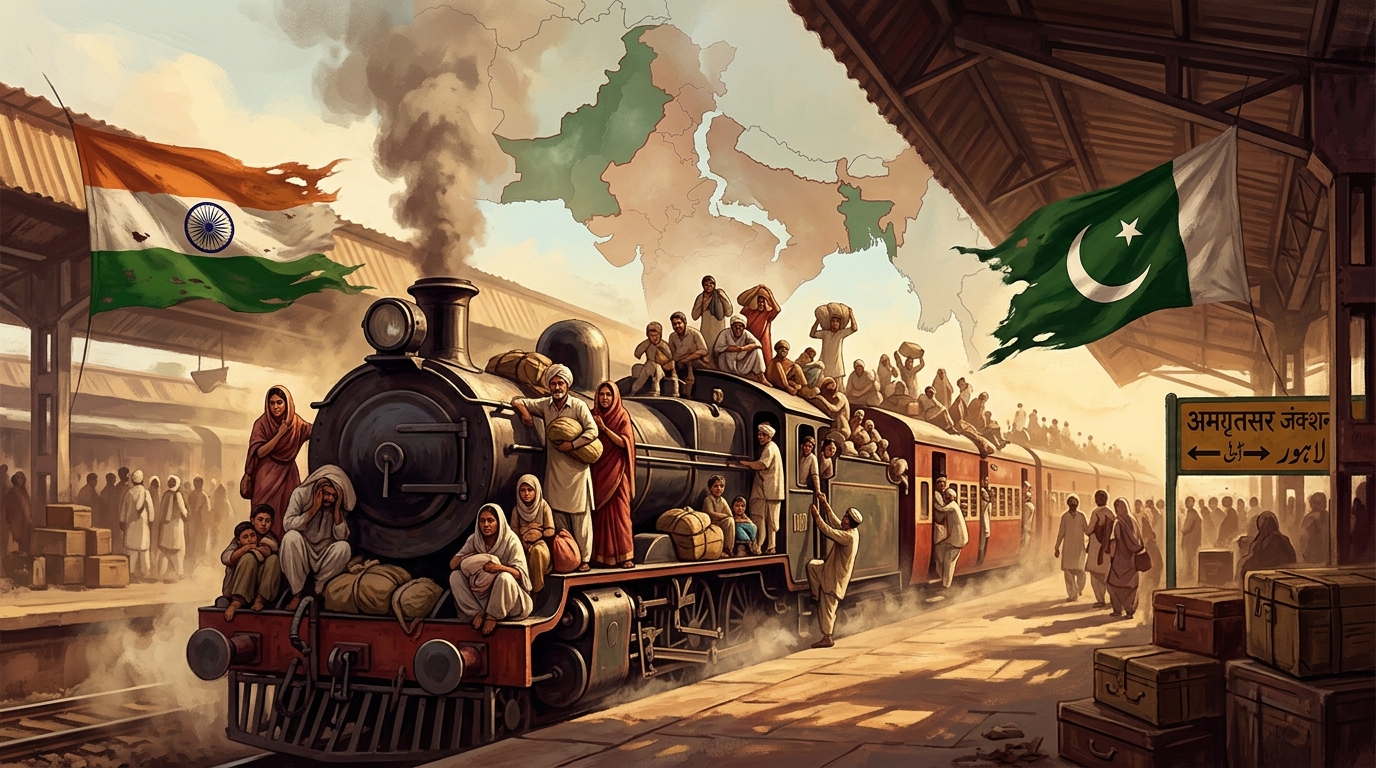
The secrecy and suddenness of the partition boundaries triggered instant panic. Millions of Hindus and Sikhs found themselves on the "wrong" side of the border in Pakistan, while millions of Muslims found themselves on the "wrong" side in India.
The Partition of India (Radcliffe Line)
- West/East Pakistan
- India
- Humanitarian Crisis
What followed was a dual exodus of unprecedented scale. Entire populations moved by foot, bullock cart, and overstuffed "refugee trains." These trains became targets for sectarian militias; many arrived at their destinations carrying only the corpses of their passengers.
Sectarian cleansing swept through the Punjab and Bengal. Neighbors turned on neighbors in a frenzy of arson, looting, and murder. Women were targeted with systematic sexual violence as a means of communal humiliation; an estimated 75,000 to 100,000 women were abducted and raped by mobs on both sides 4. Estimates of the death toll vary wildly, ranging from a conservative 200,000 to upwards of two million people.
The Integration of Princely States
The British Raj comprised two distinct political entities: British India (directly ruled provinces) and the Princely States (over 560 semi-autonomous kingdoms ruled by local monarchs under British suzerainty). With the lapse of British power, these rulers were released from their treaties and had to choose to accede to either India or Pakistan.
Most rulers made their choice based on geography and population demographics under the intense diplomatic pressure of India’s Home Minister, Sardar Vallabhbhai Patel. However, three states presented severe crises:
- Junagadh: A Hindu-majority state with a Muslim ruler who chose to accede to Pakistan. Following public protests and a military intervention by India, a plebiscite was held, resulting in an overwhelming vote to join India.
- Hyderabad: The largest and wealthiest princely state, with a Muslim ruler (the Nizam) and a majority Hindu population. The Nizam attempted to remain independent. In September 1948, the Indian Army launched Operation Polo, forcibly annexing Hyderabad into the Indian Union.
- Jammu and Kashmir: A strategically vital state with a Muslim majority but a Hindu ruler, Maharaja Hari Singh. Singh hesitated to join either nation, hoping to maintain independence.
The Kashmir Dispute and the First Indo-Pakistani War
In October 1947, armed Pashtun tribesmen from Pakistan's Northwest Frontier, backed by the Pakistani state, invaded Kashmir. In a state of panic, Maharaja Hari Singh signed the Instrument of Accession to India on October 26, 1947, in exchange for immediate military assistance.
Indian troops were airlifted into Srinagar, successfully halting the tribal advance but sparking the First Indo-Pakistani War (1947–1948). The conflict ended on January 1, 1949, with a UN-brokered ceasefire that established the Line of Control (LoC), leaving approximately two-thirds of Kashmir under Indian administration and one-third under Pakistani control. The dispute remains unresolved, serving as the primary driver of Indo-Pakistani hostility and resulting in subsequent wars in 1965, 1971, and 1999.
Analysis of Key Actors and Decisive Actions
The tragedy of Partition was not merely the result of deep historical forces; it was profoundly shaped by the personalities, calculations, and miscalculations of key leaders.
| MAHATMA GANDHI | MUHAMMAD ALI JINNAH | LOUIS MOUNTBATTEN |
|---|---|---|
| Idealized Hindu-Muslim unity and a joint state. | Championed the "Two-Nation Theory". | Advanced the withdrawal timeline by 10 months. |
| Fasted to halt sectarian riots in Bengal & Delhi. | Feared Hindu hegemony in a united democracy. | Kept the Radcliffe Line secret until after independence. |
| Disenfranchised by the speed of the partition. | Achieved Pakistan but lamented its "mutilated" territorial borders. | Prioritized a rapid and face-saving British exit. |
| Assassinated in 1948. |
Mahatma Gandhi: The Marginalized Apostle of Unity
Mahatma Gandhi spent his life campaigning for a free, pluralistic, and united India. For Gandhi, the partition of his homeland was a personal and spiritual tragedy. He famously declared:
"Let the whole world be against us, let us be cut to pieces, but we cannot agree to any such thing which is against the basic grain of our life... Partition is a spiritual tragedy." [[^5]]
As the political negotiations in New Delhi shifted toward division, Gandhi increasingly found himself marginalized by his closest disciples, including Jawaharlal Nehru and Sardar Patel, who had come to view Partition as a necessary price to pay for a strong central government.
Rather than celebrating independence in New Delhi, Gandhi spent August 15, 1947, in Calcutta, fasting and praying to halt the communal slaughter. His moral authority succeeded in temporarily calming the violence in Bengal, an achievement that Mountbatten described as the work of a "One-Man Boundary Force." Gandhi's insistence that India protect its Muslim minority and pay Pakistan its share of divided assets ultimately led to his assassination by Hindu nationalist Nathuram Godse in January 1948.
Muhammad Ali Jinnah: The Architect of Pakistan
Known as Quaid-e-Azam (Great Leader) in Pakistan, Jinnah was a highly complex political figure. In his early career, he was celebrated as the "Ambassador of Hindu-Muslim Unity." However, his political trajectory shifted radically in the late 1930s as he became convinced that the Congress's vision of secularism was a majoritarian facade.
Jinnah's strategic brilliance was his ability to leverage the British war effort and exploit Congress's tactical mistakes to turn the demand for "Pakistan" from a marginal concept into an absolute geopolitical reality. Yet, Jinnah did not get the exact state he envisioned. He lamented that the British had given him a "mutilated, moth-eaten, and truncated Pakistan" by partitioning Punjab and Bengal 6.
Jinnah’s vision for Pakistan remains a subject of intense historical debate. While he utilized religious nationalism to mobilize the masses, his famous address to the Constituent Assembly of Pakistan on August 11, 1947, suggested a secular, inclusive vision for the new nation:
"You are free; you are free to go to your temples, you are free to go to your mosques or to any other place of worship in this State of Pakistan... You may belong to any religion or caste or creed — that has nothing to do with the business of the State." [[^7]]
Jinnah died of tuberculosis in September 1948, barely a year after independence, leaving the young nation of Pakistan without its founding father during its most vulnerable formative period.
Lord Louis Mountbatten: Haste and Imperial Retrenchment
As the last Viceroy, Mountbatten was tasked with executing the British withdrawal. While praised by some for his charisma and decisiveness, modern historians heavily criticize his handling of the partition process.
Mountbatten’s decision to advance the date of independence from June 1948 to August 1947 is widely regarded as a catastrophic failure of governance. By rushing the timeline, he left no time for the proper division of administrative assets, the military, or the civil services.
Most critically, the rapid division of the joint British Indian Army meant that at the very moment sectarian violence erupted, the military units were themselves undergoing partition and reorganization along religious lines, leaving them completely ineffective as a peacekeeping force. Mountbatten prioritised a rapid, face-saving British exit over the security of the millions of people his government was leaving behind.
Trivia and Lesser-Known Facts
- Radcliffe’s Refusal of Fee: Horrified by the immense human suffering caused by the border he drew, Sir Cyril Radcliffe refused to accept his fee of 40,000 rupees (then roughly £3,000). He burned all his papers and notes before leaving India and never returned to the subcontinent.
- The Division of Assets: The partition required the division of everything from army regiments and treasury reserves to office furniture, typewriter ribbons, and library books. Officials had to divide sets of the Encyclopaedia Britannica (India took odd volumes, Pakistan took even) and even split instruments of police bands (flutes were divided, but drums were disputed).
- The Royal Navy Divide: The division of the Royal Indian Navy was so precise that ships were divided based on their crews' religious demographics. Pakistan received two sloops, two frigates, and four minesweepers, while India retained the remainder of the fleet.
- A Shared National Anthem Author: The national anthems of both India and Bangladesh (which emerged from East Pakistan in 1971) were written by the same Indian Bengali poet, Rabindranath Tagore. Additionally, Tagore's poetry also deeply influenced the author of the Sri Lankan national anthem.
References and Literature
- The Great Partition: The Making of India and Pakistan - Yasmin Khan's seminal work analyzing the social, administrative, and political dimensions of the 1947 partition.
- Indian Summer: The Secret History of the End of an Empire - Alex von Tunzelmann's detailed narrative history focusing on the relationships between Mountbatten, Nehru, Jinnah, and Gandhi.
- The Proudest Day: India's Long Road to Independence - Anthony Read and David Fisher's comprehensive account of the political maneuvers leading up to August 15, 1947.
- Foreign Affairs: The Long Shadow of 1947 - An analytical article exploring the long-term geopolitical impacts of Partition on contemporary South Asian security.
---
Footnotes & Explanations
- See Yasmin Khan, The Great Partition: The Making of India and Pakistan (Yale University Press, 2007), pp. 18-22, for a discussion on how colonial administrative practices solidified communal identities. ↩
- The Lahore Resolution, passed on March 24, 1940, at Minto Park, Lahore. ↩
- Alex von Tunzelmann, Indian Summer: The Secret History of the End of an Empire (Henry Holt and Co., 2007), pp. 203-207. ↩
- Urvashi Butalia, The Other Side of Silence: Voices from the Partition of India (Duke University Press, 2000), p. 3. ↩
- Mahatma Gandhi, speaking at a prayer meeting in New Delhi, June 1947. ↩
- Hector Bolitho, Jinnah: Creator of Pakistan (John Murray, 1954), p. 128. ↩
- Muhammad Ali Jinnah, Presidential Address to the Constituent Assembly of Pakistan, August 11, 1947. ↩