Key Takeaways
- The war was triggered by Vietnam's December 1978 invasion of Cambodia, which ousted the Chinese-backed Khmer Rouge regime.
- Chinese leader Deng Xiaoping framed the invasion as a 'punitive' strike to teach Hanoi a lesson and demonstrate the limits of Soviet security guarantees.
- Though brief, the conflict exposed severe operational weaknesses within the People's Liberation Army (PLA), accelerating China's military modernization.
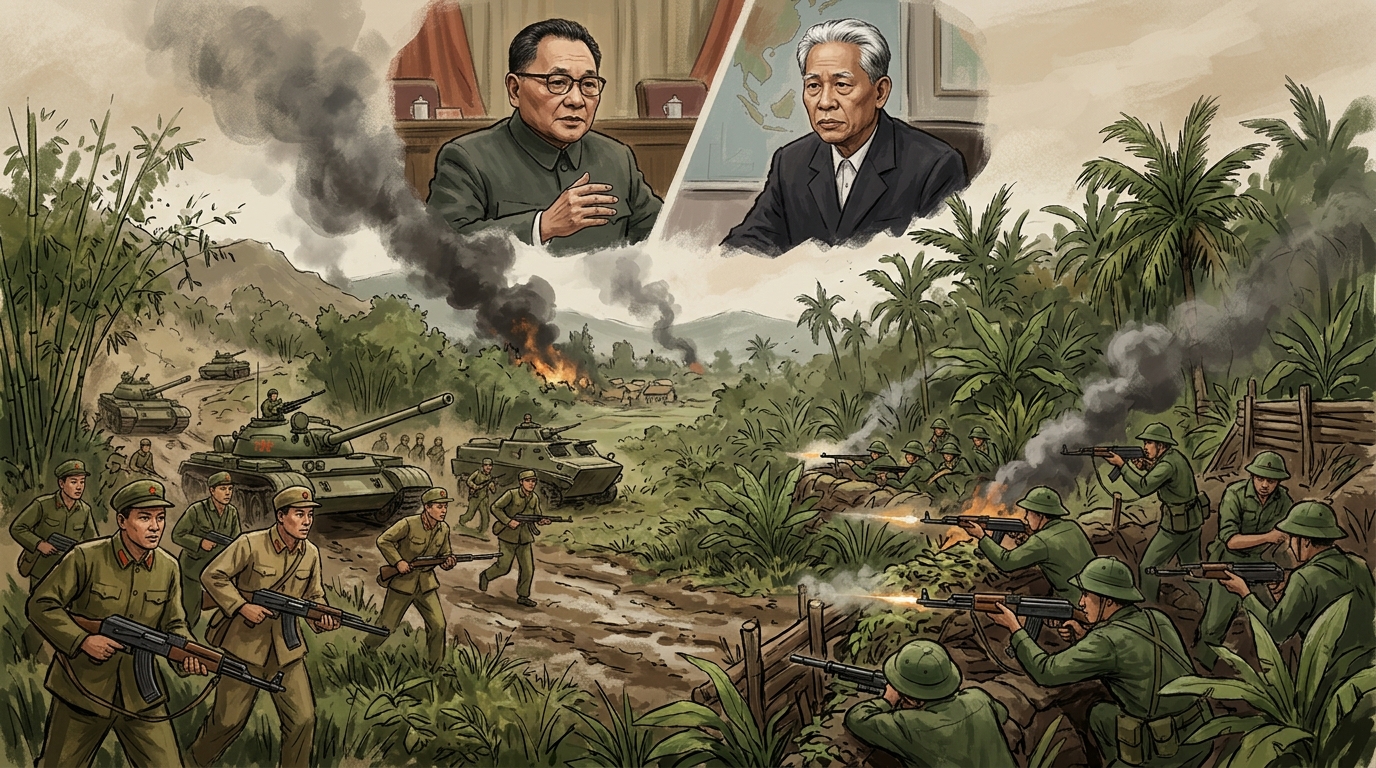
In the early morning hours of February 17, 1979, the rugged, mist-shrouded border between the People’s Republic of China (PRC) and the Socialist Republic of Vietnam (SRV) erupted in heavy artillery fire. What followed was a brief but exceptionally bloody conflict that shattered the long-held myth of monolithic communist solidarity in Asia. Often referred to by Beijing as the "Self-Defensive Counterattack against Vietnam" (zihui fanji zhan), the Sino-Vietnamese War of 1979 marked a critical geopolitical turning point of the late Cold War.
Initiated by Deng Xiaoping, China's paramount leader, the month-long war was designed as a "punitive" campaign. Its primary objective was to punish Hanoi for its recent invasion of Cambodia, which had overthrown the Beijing-aligned Khmer Rouge regime, and to expose the limits of Vietnam's alliance with the Soviet Union. By the time the last Chinese soldier withdrew across the border in mid-March, tens of thousands of soldiers and civilians lay dead, leaving a legacy of deep-seated bitterness that would dictate Southeast Asian geopolitics for the next decade.
Historical Context and Origins
To understand how two nations once described by Mao Zedong and Ho Chi Minh as being "as close as lips and teeth" 1 could go to war, one must examine the rapid realignment of global alliances in the late 1960s and 1970s. The roots of the 1979 conflict lie in the intersection of the Sino-Soviet split, the regional ambitions of a newly unified Vietnam, and the catastrophic internal dynamics of Cambodia.
The Sino-Soviet Split and Vietnam's Strategic Pivot
During the Second Indochina War (the Vietnam War), both the Soviet Union and China provided massive logistical, financial, and military aid to North Vietnam. However, beneath this veneer of socialist solidarity lay intense competition. As the ideological and geopolitical chasm between Moscow and Beijing widened after 1960, both powers vied for influence in Hanoi.
With the fall of Saigon in 1975 and the unification of Vietnam, Hanoi faced a devastated domestic economy and immediate security challenges. Vietnam's leadership, headed by General Secretary Le Duan, increasingly viewed China's historical regional ambitions with suspicion. Conversely, Beijing feared encirclement by the Soviet Union, which had massed dozens of divisions along China's northern border.
In search of reconstruction aid and security guarantees, Vietnam pivoted decisively toward Moscow. This culminated in November 1978 with the signing of the Soviet-Vietnamese Treaty of Friendship and Cooperation, a mutual defense pact that Beijing viewed as a direct threat to its national security 2.
[ Soviet Union ] / \ Treaty of Friendship Sino-Soviet & Cooperation (1978) Split / \ [ Vietnam ] <==========> [ China ] Border Clashes
The Cambodian Cauldron and the Khmer Rouge
The immediate catalyst for the war, however, lay in Cambodia (Democratic Kampuchea). In 1975, the radical and xenophobic Khmer Rouge, led by Pol Pot, seized power. Fearing Vietnamese hegemony in Indochina, Pol Pot’s regime launched brutal, cross-border raids into Vietnamese territory, massacring civilians and claiming large swaths of the Mekong Delta.
While Vietnam sought to neutralize this threat, China became the primary patron of the Khmer Rouge, providing military hardware, advisors, and economic aid. Beijing viewed Democratic Kampuchea as a vital southern bulwark against Vietnamese-Soviet expansionism.
On December 25, 1978, after years of border provocations, the People's Army of Vietnam (PAVN) launched a massive, multi-divisional invasion of Cambodia. Utilizing rapid, Soviet-style combined-arms tactics, Vietnamese forces swept through the country, capturing Phnom Penh on January 7, 1979, and driving the remnants of the Khmer Rouge into the western jungles. In their place, Hanoi established the pro-Vietnamese People's Republic of Kampuchea (PRK).
Deng Xiaoping's Diplomatic Offensive
For Deng Xiaoping, who was concurrently consolidating his power in Beijing and launching his historic "Reform and Opening Up" economic policies, Vietnam's actions were unacceptable. Hanoi had dared to dismantle a Chinese ally and solidify a pro-Soviet enclave on China's southern flank. Deng argued that if China did not respond, it would appear weak to both Moscow and its neighbors in Southeast Asia.
Before launching a military strike, Deng embarked on a brilliant diplomatic offensive to isolate Hanoi and secure international backing—or at least tacit neutrality. In late January 1979, Deng made a historic state visit to the United States, meeting with President Jimmy Carter. During his discussions in Washington, Deng candidly informed Carter of China's intentions to "teach Vietnam a lesson" 3.
While Carter warned against military action, the U.S. administration did not actively attempt to block the move, seeing a Chinese strike as a way to curb Soviet expansionism in Asia. Having secured a diplomatic understanding with the West and neutralized the threat of direct American opposition, Deng returned to Beijing to finalize the invasion plans.
Timeline of Events and Key Moments
The Sino-Vietnamese War was brief, lasting just under a month, but it was characterized by immense violence, massive artillery duels, and high casualty rates on both sides.
The Order of Battle
China assembled a massive force of roughly 200,000 to 300,000 troops along the border, primarily drawn from the Guangzhou, Chengdu, and Kunming Military Regions. The invasion force was organized under the overall command of General Xu Shiyou and General Yang Dezhi.
| People's Liberation Army (PLA) | Vietnamese Forces |
|---|---|
| ~200,000 - 300,000 Regular Troops (Outdated tactics & communications) | ~100,000 - 150,000 (Mostly Border Guards & Regional Militia) |
Vietnam, having anticipated a Chinese incursion, chose not to withdraw its elite divisions from Cambodia. Instead, Hanoi relied on a highly effective defense-in-depth strategy, deploying approximately 100,000 to 150,000 personnel in the northern border provinces. This force consisted mostly of border guards, regional militia, and a few regular army divisions, many of whom were veteran fighters equipped with modern Soviet weaponry and captured American hardware.
Phase 1: The Initial Assault (February 17 – 25, 1979)
At 05:00 on February 17, 1979, a massive artillery barrage opened the Chinese offensive. PLA infantry and armored units crossed the border at 26 points along a 500-mile front. The primary axes of advance targeted the key Vietnamese provincial capitals of Lao Cai, Cao Bang, and Lang Son.
The PLA expected a rapid advance, but they immediately encountered fierce, highly organized resistance. Utilizing the mountainous terrain, extensive tunnel networks, and hidden bunkers left over from their decades of fighting the French and Americans, Vietnamese local militia units inflicted heavy casualties on the advancing Chinese columns.
- The Battle of Lao Cai: In the western sector, PLA forces managed to capture the town of Lao Cai after several days of intense urban fighting, but the advance stalled shortly thereafter in the surrounding hills.
- The Siege of Cao Bang: In the central sector, Chinese armor was repeatedly ambushed in narrow mountain passes. The PLA was forced to rely on slow, costly infantry assaults to clear entrenched Vietnamese positions.
Phase 2: The Battle of Lang Son (February 26 – March 5, 1979)
The Eastern Axis, directed at the strategic city of Lang Son, became the climax of the conflict. Lang Son sat at the edge of the mountainous border zone; beyond it lay the flat plains leading directly to the Vietnamese capital, Hanoi.
Both sides recognized the immense political and strategic value of the city. The PLA reinforced its assault divisions, employing human-wave tactics and concentrated artillery bombardments to overwhelm the defenders.
By March 2, after days of brutal, hand-to-hand combat, Chinese forces breached the northern defense perimeter of Lang Son. By March 5, the PLA had captured the southern portion of the city and the high ground overlooking the plains. The road to Hanoi was now wide open, and panic began to spread in the capital, where the Vietnamese government began preparing for a evacuation.
"The Chinese came in waves. We killed them by the hundreds, but more kept coming. They did not seem to care about their losses." [^4] — An anonymous Vietnamese militia fighter reflecting on the defense of Lang Son.
Phase 3: The Chinese Withdrawal (March 6 – 16, 1979)
With the capture of Lang Son, Deng Xiaoping declared that China's "punitive" goals had been met. Beijing had demonstrated that it could penetrate deep into Vietnamese territory, and it had exposed the limits of the Soviet security guarantee, as Moscow did not launch a counter-offensive on China's northern border.
On March 6, 1979, Beijing announced the unilateral withdrawal of its forces. However, the retreat was far from peaceful. As the PLA withdrew, they enacted a systematic, scorched-earth policy. Chinese engineers systematically dynamited industrial infrastructure, bridges, schools, hospitals, and communication lines in northern Vietnam, ensuring that even in retreat, they inflicted long-term economic damage on Hanoi 5.
By March 16, the last PLA soldier had crossed back into Chinese territory, bringing an end to the twenty-nine-day war.
Geopolitical Consequences and Aftermath
The short-term military results of the conflict were ambiguous, allowing both Beijing and Hanoi to construct narratives of victory. However, the long-term geopolitical ripples of the war fundamentally reshaped East Asia.
GEOPOLITICAL CONSEQUENCES
| Geopolitical Consequence |
|---|
| China-US rapprochement solidifies against Soviet expansionism. |
| Accelerated modernization of the PLA under Deng Xiaoping. |
| Deepened Vietnam-Soviet alliance, but exposed Soviet limits. |
| Severe economic devastation in Northern Vietnam. |
The Assessment of Victory
Beijing claimed a resounding victory. It argued that it had successfully smashed Vietnam's defense lines, captured several provincial capitals, and exposed the hollow nature of the Soviet-Vietnamese alliance. Furthermore, China proved that it could wage a foreign war without fear of Soviet intervention.
Hanoi also claimed a historic victory, asserting that its local militias and regional forces had successfully repelled a massive invasion by a nuclear-armed superpower without having to redirect its main divisions from Cambodia. Vietnam pointed to the staggering casualty rates suffered by the PLA as evidence of China’s military failure.
While exact casualty figures remain state secrets and subject to intense propaganda, modern historical consensus suggests that both sides suffered heavily:
- PLA Losses: Estimates range from 7,000 to 26,000 killed, and up to 37,000 wounded [^6].
- PAVN and Militia Losses: Estimates range from 10,000 to 30,000 military deaths, alongside thousands of civilian casualties.
The Modernization of the People's Liberation Army
Perhaps the most significant domestic consequence of the war was its impact on the Chinese military. The conflict exposed the PLA as an outdated, poorly equipped, and tactically rigid force.
During the campaign, the PLA suffered from:
- Outdated Doctrine: Relying on the Maoist doctrine of "People's War" and infantry-heavy human-wave tactics, which were highly vulnerable to modern defensive firepower.
- Poor Communications: PLA units often lacked basic field radios, relying on bugles and runners, which led to disastrous friendly-fire incidents and a lack of coordination.
- Logistical Failures: The PLA’s logistics relied heavily on manual labor and pack animals, which proved entirely inadequate for supporting a rapid mechanized offensive.
Deng Xiaoping used these glaring deficiencies to marginalize conservative military leaders who resisted change. The war served as the ultimate justification for Deng's program to modernize the PLA under the framework of the Four Modernizations. In the decade that followed, the PLA transformed from a peasant-based defensive force into a modern, professional, combined-arms military.
The Isolation of Vietnam
For Vietnam, the war was an economic and diplomatic catastrophe. Although they maintained their occupation of Cambodia until 1989, the cost was devastating. Vietnam found itself internationally isolated, facing an economic embargo led by the United States and China, and highly dependent on dwindling Soviet aid.
The northern border remained a militarized zone. Throughout the 1980s, China and Vietnam engaged in persistent, low-intensity border skirmishes and artillery duels, most notably around the Laoshan and Zheyinshan heights. These skirmishes forced Vietnam to keep a massive standing army mobilized along its northern border, further draining its meager economic resources.
Analysis of Key Actors and Decisive Actions
The Sino-Vietnamese War was fundamentally a duel of political wills between two dominant figures of twentieth-century Asian communism: Deng Xiaoping and Le Duan.
Deng Xiaoping: The Pragmatic Strategist
Deng Xiaoping's decision to go to war was a calculated risk of the highest order. He recognized that China was militarily weak and economically fragile, yet he understood that geopolitics is governed by perceptions of strength.
By launching the war, Deng achieved several strategic goals:
- He solidified China's strategic partnership with the United States, signaling that Beijing was willing to take concrete military action to oppose Soviet hegemony.
- He secured vital Western technology and capital, which fueled China's economic boom over the next four decades.
- He successfully tested the Soviet Union's resolve and proved that Moscow would not risk a global conflict to defend its allies in Southeast Asia.
Deng's willingness to accept high casualties in exchange for long-term geopolitical positioning demonstrated a ruthless pragmatism that characterized his entire tenure as China's leader.
Le Duan: The Resolute Nationalist
As General Secretary of the Communist Party of Vietnam, Le Duan was a fierce nationalist who refused to allow Vietnam to submit to Chinese hegemony. Le Duan believed that Vietnam, having defeated both the French and the Americans, possessed the military prowess and moral authority to lead Indochina.
Le Duan's decision to maintain the occupation of Cambodia, despite massive Chinese pressure, showed immense resolve. He correctly calculated that the PLA could not sustain a long-term occupation of northern Vietnam due to logistical constraints and the threat of Soviet mobilization. However, his reliance on Soviet support ultimately left Vietnam vulnerable when the Soviet Union collapsed in the late 1980s.
Trivia and Lesser-Known Facts
- The Silent Air Forces: Despite both China and Vietnam possessing large air forces (including modern Soviet MiG-21s and MiG-23s on the Vietnamese side), neither country deployed combat aircraft for ground-attack missions during the war. Both sides feared that introducing air power would escalate the conflict into a total war, possibly drawing in the Soviet Air Force [^7].
- The "Fake" Soviet Mobilization: To deter the Soviets from intervening, China mobilized its forces along the Sino-Soviet border in Xinjiang and Inner Mongolia. China also evacuated hundreds of thousands of civilians from border areas, signaling to Moscow that Beijing was fully prepared for a two-front war.
- The Fate of the Hoa People: Prior to and during the conflict, Vietnam expelled tens of thousands of ethnic Chinese (Hoa), fearing they would act as a fifth column for Beijing. Many of these refugees became part of the tragic "boat people" crisis, fleeing across the South China Sea.
- The Silent War in the West: While the world's media was focused on the border battles, a silent war was fought in the spy networks of Southeast Asia. Chinese-backed guerrilla groups, including remnants of the Khmer Rouge and anti-communist Lao insurgents, were actively funded by Beijing to harass Vietnamese logistics lines in Laos and Cambodia.
References and Literature
- The Sino-Vietnamese War of 1979: Chi-Wang Chin - A comprehensive analysis of the military strategy and operational history of both the PLA and PAVN during the brief border war.
- Deng Xiaoping and the Sino-Vietnamese War: Cold War International History Project - Academic resource compiling declassified Chinese and Soviet documents detailing the diplomatic maneuvering behind the conflict.
- Vietnam's Border Wars: An Overview: Foreign Affairs - A contemporary 1979 analysis of the geopolitical and military dimensions of the conflict.
- The Third Indochina War: King C. Chen - A foundational book tracing the origins, execution, and regional aftermath of the 1979 Sino-Vietnamese conflict.
---
Footnotes & Explanations
- Mao Zedong famously used this metaphor in the 1950s and 1960s to describe the fraternal socialist bond between China and North Vietnam. ↩
- King C. Chen, The Third Indochina War (Westview Press, 1987), p. 78. ↩
- Ezra F. Vogel, Deng Xiaoping and the Transformation of China (Harvard University Press, 2011), p. 521. ↩
- Transcribed from oral history archives of regional militia veterans, Lang Son Provincial Museum. ↩
- Edward C. O'Dowd, Chinese Military Strategy in the Third Indochina War (Routledge, 2007), p. 115. ↩
- Xiaoming Zhang, Deng Xiaoping's Long War: The Military Conflict between China and Vietnam, 1979-1991 (University of North Carolina Press, 2015), p. 110. ↩
- Zhang, Deng Xiaoping's Long War, p. 95. ↩