Key Takeaways
- The Soviet invasion in December 1979 aimed to stabilize a collapsing communist regime in Kabul but dragged the USSR into an intractable nine-year asymmetric war.
- Operation Cyclone, orchestrated by the CIA and Pakistan's ISI, funneled billions of dollars to the Mujahideen, turning Afghanistan into a major Cold War proxy battlefield.
- The conflict severely damaged Soviet economic and military prestige, directly contributing to the collapse of international detente and domestic destabilization within the USSR.
Historical Context and Origins
To understand the fateful decision of the Soviet Union to cross the Amu Darya river in December 1979, one must analyze the complex interplay of Afghanistan’s domestic instability, regional geopolitics, and the rigid ideological framework of late-Cold War Soviet foreign policy. Afghanistan had long served as a geopolitical buffer state during the 19th-century "Great Game" between the British and Russian Empires. By the mid-20th century, Moscow had established a comfortable relationship with the kingdom of Mohammed Zahir Shah, providing substantial economic and military aid to ensure a neutral, friendly neighbor on its southern flank.
This delicate equilibrium shattered in July 1973 when King Zahir Shah was overthrown in a bloodless coup by his cousin, Prince Mohammed Daoud Khan, who declared Afghanistan a republic. Daoud’s attempt to balance Soviet influence by seeking ties with regional powers like Iran and Pakistan ultimately alienated both the leftists and the conservative Islamists within Afghan society.
The political landscape grew increasingly polarized. On the left, the People's Democratic Party of Afghanistan (PDPA), a Marxist-Leninist party founded in 1965, gained traction. However, the PDPA was deeply divided into two hostile factions:
- The Khalq (Masses): Led by Nur Muhammad Taraki and Hafizullah Amin, this faction was predominantly Pashtun, highly radical, and advocated for immediate, revolutionary transformation.
- The Parcham (Banner): Led by Babrak Karmal, this faction was more ethnically diverse, urban, and favored a gradualist approach to building socialism in a deeply traditional, religious society.
| PDPA (Marxist-Leninist) |
|---|
- Khalq (Masses)
- Parcham (Banner)
In April 1978, triggered by the assassination of a prominent Parcham leader, the PDPA launched a violent coup d'état known as the Saur Revolution (April Revolution) 1. President Daoud and his family were executed, and the PDPA established the Democratic Republic of Afghanistan (DRA) with Taraki as President and Amin as Prime Minister.
The new regime immediately embarked on a radical, uncompromising program of modernization. They implemented sweeping land reforms, abolished the traditional bride price (dowry), mandated literacy campaigns for women, and replaced religious laws with secular decrees. In a country where social life was deeply rooted in Islamic tradition and tribal honor codes, these top-down reforms were viewed as offensive and blasphemous.
By late 1978, local rebellions erupted across rural provinces. The newly formed Mujahideen (holy warriors) took up arms, framing their struggle as a jihad against an atheist communist regime. The situation deteriorated drastically in March 1979 during the Herat Uprising, where mutinous Afghan army soldiers joined local rebels, massacring hundreds of civilians, including several Soviet military advisors and their families.
The Kremlin, led by General Secretary Leonid Brezhnev, watched these developments with growing alarm. While the Soviet Union quickly signed a Treaty of Friendship and Cooperation with Kabul in December 1978, Soviet leaders were privately deeply critical of the PDPA’s reckless implementation of reforms. Behind closed doors, Taraki repeatedly begged for direct Soviet military intervention to suppress the spreading insurgency.
The Soviet leadership consistently refused. In a March 1979 Politburo meeting, Premier Alexei Kosygin remarked:
"The entry of our troops into Afghanistan would arouse the international community, and there would be immediate negative consequences... Our troops would have to fight not only against foreign aggressors, but against a significant portion of the Afghan people. And the people would never forgive us for this." [[^2]]
However, two critical events in late 1979 forced a dramatic reassessment in Moscow.
First, the internal rivalry within the PDPA reached a boiling point. In September 1979, Hafizullah Amin staged an internal coup, arresting and later smothering Taraki with a pillow. Amin’s rise to power deeply disturbed the KGB, headed by Yuri Andropov. Amin was seen as an unstable, ruthless megalomaniac whose brutal purges of political rivals and military officers further fueled the rebellion. Rumors began circulating within Soviet intelligence that Amin had secret contacts with the US Central Intelligence Agency (CIA) and might align Afghanistan with Washington to secure his own survival.
Second, the geopolitical landscape of the Middle East was undergoing a tectonic shift. The Iranian Revolution of February 1979 had deposed the pro-Western Shah, replacing him with an anti-American Islamic Republic. Fearing that the United States might seek a new base of operations in Afghanistan to replace its lost monitoring stations in Iran, and worried that the Islamic revolution could spill over into the Soviet Union's Central Asian republics (Uzbekistan, Tajikistan, and Turkmenistan), Moscow's calculus shifted from reluctance to perceived strategic necessity.
Timeline of Events and Key Moments
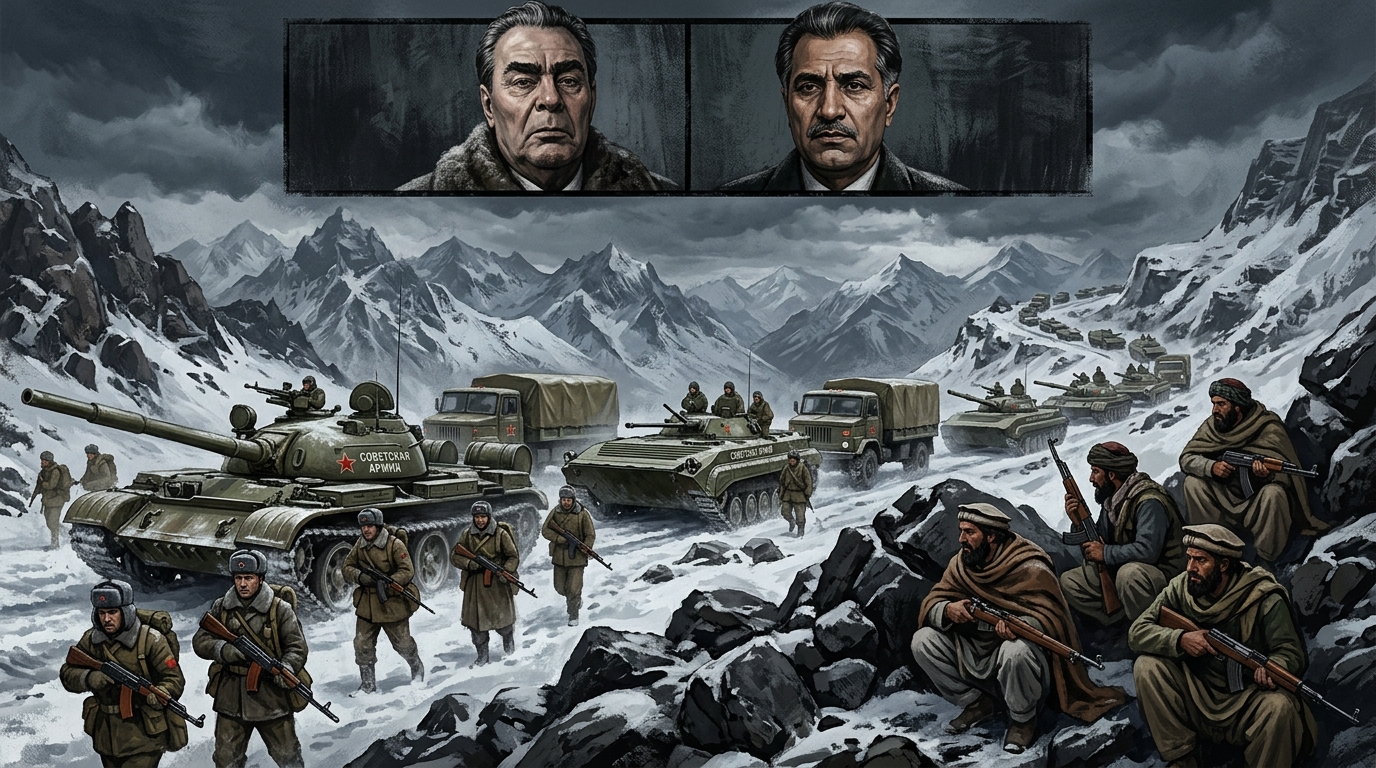
The Soviet military intervention was planned with meticulous secrecy. The decision to invade was not made by the full Politburo, but by an informal "troika" of hardline advisors: Yuri Andropov (KGB Chairman), Dmitry Ustinov (Defense Minister), and Andrei Gromyko (Foreign Minister), who then obtained the signature of an increasingly frail and ill Leonid Brezhnev.
The Soviet Troika
- Andropov (KGB)
- Ustinov (Defense)
- Gromyko (Foreign Policy)
▼
- Leonid Brezhnev (Sign)
The Decisive Move: Operation Storm-333 (December 1979)
The intervention began on December 25, 1979, with Soviet airborne units securing key airfields in Kabul and Bagram. Concurrently, mechanized columns of the Soviet 40th Army crossed the northern border.
The primary objective of the initial phase was the removal of Hafizullah Amin. On the evening of December 27, 1979, Soviet Spetsnaz (special forces) units, alongside KGB Alpha and Zenit groups disguised in Afghan military uniforms, executed Operation Storm-333 3. They launched a daring, high-risk assault on the heavily fortified Tajbeg Palace in Kabul, where Amin had relocated.
Despite fierce resistance from Amin's presidential guard, the Soviet forces overran the palace and assassinated Amin. Babrak Karmal, the leader of the moderate Parcham faction who had been living in exile in Czechoslovakia, was flown into Kabul by the Soviets and declared the new President of the Democratic Republic of Afghanistan.
| Date | Event |
|---|---|
| Dec 1979 | Operation Storm-333; Hafizullah Amin assassinated; Babrak Karmal installed. |
| 1980-82 | Soviet 40th Army secures urban centers; Mujahideen resort to guerrilla warfare. |
| 1985 | Mikhail Gorbachev becomes General Secretary; calls Afghanistan a "bleeding wound." |
| 1986 | Introduction of US FIM-92 Stinger missiles; Soviet air superiority neutralized. |
| Apr 1988 | Signing of the Geneva Accords. |
| Feb 1989 | General Boris Gromov leads the final Soviet column across the Friendship Bridge. |
Stalemate and Escalation (1980–1985)
Initially, Soviet planners expected a brief campaign, lasting perhaps a few months, to stabilize the government before handing over control to the reconstructed Afghan Army. This estimation proved to be a catastrophic miscalculation. The presence of foreign, non-Muslim troops on Afghan soil instantly united the disparate tribal, ethnic, and religious factions of the country in a national rebellion.
The Soviet 40th Army, which rarely exceeded 115,000 personnel, found itself ill-equipped for counterinsurgency operations in the rugged, mountainous terrain of the Hindu Kush. The conflict rapidly devolved into a brutal war of attrition:
- Soviet Tactics: The Red Army relied heavily on motorized infantry, heavy armor, and massive artillery bombardments. To isolate the Mujahideen, they conducted a scorched-earth campaign, destroying crops, irrigation channels (the ancient kariz system), and livestock in rural areas, forcing millions of Afghans to flee to neighboring Pakistan and Iran.
- Mujahideen Tactics: The rebels operated in small, highly mobile bands. Utilizing their intimate knowledge of the mountainous terrain, they laid ambushes along Soviet supply lines, hit military outposts, and dissolved back into the civilian population. They operated from safe havens across the porous border in Pakistan’s Federally Administered Tribal Areas (FATA).
The Proxy War and Operation Cyclone
The conflict quickly became one of the most critical proxy battlegrounds of the late Cold War. Recognizing an opportunity to inflict a costly defeat on their geopolitical rival, the United States, under President Jimmy Carter and later expanded significantly under Ronald Reagan, authorized the CIA to launch Operation Cyclone 4.
This covert program funneled billions of dollars in military aid and high-tech weaponry to the Mujahideen. The operation relied on a complex international network:
- Funding: Shared equally between the United States and Saudi Arabia, alongside private donations from wealthy Arab states.
- Logistics: Run by Pakistan’s Inter-Services Intelligence (ISI), which acted as the gatekeeper, receiving the weapons and distributing them to various Afghan insurgent factions.
- Recruitment: The ISI favored the most radical Islamist factions, such as Gulbuddin Hekmatyar’s Hezb-e Islami, fueling the rise of religious fundamentalism in the region.
The conflict also attracted thousands of volunteer fighters from across the Arab world, known as "Afghan Arabs," including a young, wealthy Saudi national named Osama bin Laden, who helped construct training camps and coordinate foreign aid.
The Turning Point: The Stinger Missile (1986)
Throughout the early 1980s, the Soviet military’s primary tactical advantage was its absolute control of the skies. The Mi-24 Hind attack helicopter, dubbed "The Devil’s Chariot" by the Mujahideen, was highly effective at flushing out rebel positions and protecting convoy movements.
This changed dramatically in September 1986, when the United States began supplying the Mujahideen with the FIM-92 Stinger missile, a shoulder-fired, heat-seeking surface-to-air missile (MANPADS). The impact was immediate and profound. The Mujahideen began shooting down Soviet helicopters and transport planes at an alarming rate, forcing Soviet pilots to fly at higher altitudes, which severely degraded their targeting accuracy and ground-support capabilities.
| Before 1986 (Soviet Air) | After 1986 (The Stinger) |
|---|---|
| Mi-24 Hind dominates skies | High altitude flight required |
| Low-altitude tactical strikes | Support capability degraded |
| Secure troop transport | Vulnerable supply lines |
The Stinger did not win the war single-handedly, but it fundamentally altered the strategic equation. It raised the human and material cost of the war to a level that the Soviet political leadership could no longer justify.
Geopolitical Consequences and Aftermath
The Soviet invasion of Afghanistan had profound, cascading effects on international relations, the stability of South Asia, and the domestic fate of the Soviet Union.
The Death of Detente and the Second Cold War
The entry of Soviet troops into Kabul abruptly ended the era of detente—the period of easing tensions between the United States and the Soviet Union that had characterized much of the 1970s. In the United States, the invasion was viewed not as a defensive, regional stabilization effort, but as an aggressive, expansionist push toward the oil-rich Persian Gulf.
In response, President Jimmy Carter took a series of decisive retaliatory measures:
- He withdrew the SALT II strategic arms limitation treaty from consideration by the Senate.
- He declared the Carter Doctrine, stating that any attempt by an outside force to gain control of the Persian Gulf region would be regarded as an assault on the vital interests of the US and repelled by any means necessary, including military force.
- He imposed an embargo on grain and high-technology shipments to the Soviet Union.
- He led a massive, multi-nation boycott of the 1980 Summer Olympic Games in Moscow, which was subsequently countered by a Soviet-led boycott of the 1984 Los Angeles Olympics.
The Human and Economic Toll
For Afghanistan, the decade of war was catastrophic. Estimates of Afghan civilian casualties range from 500,000 to over 2 million. Millions more were permanently displaced:
- Over 3 million refugees fled to Pakistan.
- Nearly 2 million refugees fled to Iran.
- Internal displacement shattered the agricultural base of the nation, leaving vast swathes of the country littered with millions of landmines, which continue to claim lives today.
For the Soviet Union, the war was an unmitigated disaster. Over 620,000 Soviet soldiers served in Afghanistan. The official death toll stood at 14,453, though modern estimates suggest the true figure, including those who died later of wounds or diseases contracted in the field, was closer to 26,000. Additionally, over 53,000 were wounded, and tens of thousands returned home suffering from severe psychological trauma and physical disabilities.
The economic cost of the war, estimated at $3 billion to $8 billion annually, severely strained an already stagnant Soviet economy.
Domestically: The "Bleeding Wound"
When Mikhail Gorbachev assumed the position of General Secretary of the Communist Party of the Soviet Union in March 1985, he recognized that the war was a strategic dead end. He famously referred to Afghanistan as a "bleeding wound" (khochushchaya rana) that was draining the country's resources and destroying its international moral standing.
Gorbachev’s policies of Glasnost (openness) and Perestroika (restructuring) allowed, for the first time, public criticism of the war. Families of conscripts began openly questioning the necessity of sacrificing their sons for an incomprehensible cause. The return of thousands of "zinc coffins" (the metal containers used to ship dead soldiers back home) fueled widespread public disillusionment with the Communist leadership.
Realizing that victory was impossible without a massive, politically unacceptable escalation of forces, Gorbachev signed the Geneva Accords in April 1988. The agreement laid out a timetable for a systematic, honorable withdrawal of Soviet troops. On February 15, 1989, General Boris Gromov, the commander of the 40th Army, walked across the Friendship Bridge connecting Afghanistan and Uzbekistan, marking the official end of the Soviet military presence.
| The Fall of the Soviet Union |
|---|
| Economic Exhaustion |
| Billions spent on a war of attrition. |
| Military Demoralization |
| Elite Red Army defeated by rebels. |
| Domestic Discontent |
| Glasnost allowed "Zinc Coffins" anger. |
The Rise of the Taliban and Global Jihadism
The withdrawal of Soviet forces did not bring peace to Afghanistan. The communist regime of President Mohammad Najibullah managed to survive for three years on continued Soviet financial and military aid. However, with the formal dissolution of the Soviet Union in December 1991, all aid ceased.
In April 1992, Mujahideen forces captured Kabul, and the DRA collapsed. Almost immediately, the victorious Mujahideen factions turned their weapons on each other, plunging the country into a devastating civil war that destroyed much of what remained of Kabul. Out of this chaotic vacuum of lawlessness and warlordism arose the Taliban, a movement of conservative, Pakistani-educated Islamic seminary students led by Mullah Omar. By 1996, the Taliban captured Kabul, enforcing a strict, fundamentalist interpretation of Islamic law.
The war also left a dangerous legacy of globalized militancy. The thousands of foreign fighters who had trained and fought in Afghanistan returned to their home countries in the Middle East, North Africa, and Southeast Asia, radicalized and possessing advanced military skills. This network of "Afghan veterans" formed the core of numerous transnational terrorist organizations, most notably Al-Qaeda, which used the Taliban-ruled state as a sanctuary to plan the September 11, 2001 attacks on the United States.
Analysis of Key Actors and Decisive Actions
The trajectory of the Soviet-Afghan War was shaped by critical decisions made by key leaders, driven by ideological blind spots, intelligence failures, and geopolitical miscalculations.
Leonid Brezhnev and the Soviet Leadership
By 1979, Leonid Brezhnev was a shadow of his former self, suffering from advanced arteriosclerosis and dependency on sleeping pills. Real power had devolved to a small inner cabinet. This bureaucratic sclerosis led to a complete lack of critical debate regarding the military intervention.
The Soviet leadership suffered from a profound ideological bias: they genuinely believed that the historical march toward socialism was irreversible. Once a country entered the socialist orbit (via the Saur Revolution), the Soviet Union had an obligation to defend it, a doctrine informally known as the Brezhnev Doctrine.
Furthermore, the Soviet military command, flushed with successful interventions in Hungary (1956) and Czechoslovakia (1968), suffered from strategic hubris. They assumed that a demonstration of overwhelming force would quickly pacify the country and stabilize the PDPA regime, failing to realize that Afghanistan’s fractured, tribal society operated under entirely different rules than urbanized Central Europe.
Babrak Karmal
Babrak Karmal was a tragic figure of the conflict. Installed by Soviet bayonets to replace the ruthless Hafizullah Amin, Karmal was intended to be a moderate, unifying figure. He immediately released political prisoners, promised a return to religious tolerance, and attempted to build a broad national coalition.
However, Karmal could never overcome the stigma of being a Soviet puppet. His survival depended entirely on the protection of foreign troops, which delegitimized his administration in the eyes of the majority of Afghans. His inability to broaden his support base or build a competent, loyal Afghan army frustrated Moscow. In 1986, as Gorbachev began seeking an exit strategy, Karmal was removed from power and replaced by the pragmatic former head of the KHAD (state security service), Mohammad Najibullah.
Comparison of Key Leaders in Kabul (1978-1992)
| Leader | Period | Faction | Fate |
|---|---|---|---|
| Nur Muhammad Taraki | 1978-1979 | Khalq | Assassinated by Hafizullah Amin. |
| Hafizullah Amin | 1979 | Khalq | Assassinated by Soviet Spetsnaz in Tajbeg Palace. |
| Babrak Karmal | 1979-1986 | Parcham | Dismissed by Moscow; died in exile in Moscow. |
| Mohammad Najibullah | 1986-1992 | Parcham | Overthrown in 1992; executed by the Taliban in 1996. |
Zbigniew Brzezinski and US Covert Action
A major point of historical debate revolves around the role of US National Security Advisor Zbigniew Brzezinski. In a famous 1998 interview with the French magazine Le Nouvel Observateur, Brzezinski claimed that the US had begun providing covert aid to the anti-communist opposition in Afghanistan six months before the Soviet invasion, with the explicit intention of drawing the Soviets into a costly, debilitating proxy war:
"We didn't push the Russians to intervene, but we knowingly increased the probability that they would... That secret operation was an excellent idea. It had the effect of drawing the Soviets into the Afghan trap." [[^5]]
While historians continue to debate whether the US actively set a "trap" or simply reacted to Soviet expansionism, it is clear that the Carter and Reagan administrations recognized that bleeding the Soviet military in Afghanistan would shift the global balance of power back in favor of the United States.
Trivia and Lesser-Known Facts
- The "Muslim Battalion": The initial assault on Tajbeg Palace during Operation Storm-333 was executed in part by the "Muslim Battalion" (the 154th Spetsnaz Detachment). This was a specialized unit of the Soviet GRU composed entirely of Central Asian soldiers (Uzbeks, Tajiks, and Turkmen) who looked identical to the local Afghan population and spoke Dari or Uzbek, allowing them to infiltrate deep into Kabul undetected.
- The Drug Epidemic: Much like the US military in Vietnam, the Soviet 40th Army in Afghanistan suffered from a severe substance abuse problem. Facing constant danger, isolation, and boredom, many Soviet conscripts traded military equipment, gasoline, and weapons to locals in exchange for hashish, heroin, and opium. This created a massive wave of drug addiction within the military that followed the soldiers back to the Soviet Union.
- Najibullah's Surprising Resilience: Although western analysts predicted that the communist government of Mohammad Najibullah would collapse within weeks of the Soviet withdrawal in 1989, it actually survived for three years. The Afghan army, fortified by massive shipments of Soviet Scud missiles and heavy artillery, successfully repelled a major Mujahideen offensive on the city of Jalalabad in March 1989, proving that the regime was far more resilient than initially believed.
- The Swiss Connection: To maintain deniability under Operation Cyclone, the CIA initially purchased old Soviet-bloc weapons from Egypt, China, and even Israel to distribute to the Mujahideen. The goal was to ensure that if any weapons were captured, they would appear to have been taken from the Afghan army, keeping the US role completely hidden.
References and Literature
- The Soviet Invasion of Afghanistan: A Retrospective Analysis - An early analysis of the geopolitical shockwaves of the invasion published in Foreign Affairs.
- The Soviet-Afghan War: How a Superpower Fought and Lost - The Russian General Staff's official assessment of the war, translated and edited by Lester W. Grau and Michael A. Gress.
- Ghost Wars: The Secret History of the CIA, Afghanistan, and Bin Laden, from the Soviet Invasion to September 10, 2001 - Steve Coll's Pulitzer Prize-winning book on the covert operations surrounding the Soviet war in Afghanistan.
- A Long Goodbye: The Soviet Withdrawal from Afghanistan - Artemy M. Kalinovsky's detailed historical account of the political and diplomatic maneuvers that led to the Soviet exit.
---
Footnotes & Explanations
- The Saur Revolution of April 27, 1978, overthrew Mohammed Daoud Khan and established the Democratic Republic of Afghanistan (DRA), setting off a chain reaction of reforms and armed rebellion. ↩
- Official minutes of the Soviet Politburo meeting on March 17-18, 1979, where Alexei Kosygin and Andrei Gromyko strongly opposed the initial Afghan requests for military intervention. ↩
- Operation Storm-333, executed on December 27, 1979, remains a classic textbook example of special forces operations, though it initiated a decade-long war of attrition. ↩
- Operation Cyclone was one of the longest and most expensive covert CIA operations ever undertaken, starting with under $1 million in 1979 and peaking at over $630 million annually by 1987. ↩
- Zbigniew Brzezinski, interview with Le Nouvel Observateur, January 15-21, 1998. While Brzezinski later moderated his claims, the interview highlighted the deliberate US strategy of utilizing the conflict to weaken the Soviet Union. ↩