Key Takeaways
- The victory of the Chinese Communist Party (CCP) over the Kuomintang (KMT) in 1949 fundamentally reshaped the global balance of power during the early Cold War.
- Economic collapse, hyperinflation, administrative corruption, and tactical overextension were critical internal factors that doomed Chiang Kai-shek's Nationalist regime.
- The retreat of the Republic of China (ROC) government to Taiwan established a permanent geopolitical flashpoint that remains a central issue in modern international relations.
Historical Context and Origins
The Chinese Civil War was not merely a localized conflict of the late 1940s, but the violent culmination of a multi-decade socio-political struggle for the sovereignty and soul of China. Following the collapse of the Qing Dynasty in 1911, China fractured into a patchwork of competing militarized fiefdoms during the Warlord Era. Two primary movements emerged to unify the country: the Nationalist Kuomintang (KMT), led by Sun Yat-sen and later Chiang Kai-shek, and the Chinese Communist Party (CCP), founded in Shanghai in 1921.
Though initially united under the First United Front to eradicate warlordism, the alliance shattered in April 1927 when Chiang Kai-shek launched the Shanghai Massacre, purging communists and trade unionists from the revolutionary ranks.1 This initiated the first phase of the civil war (1927–1937). Forced into the countryside, the CCP, under the rising influence of Mao Zedong, established rural bases, most notably the Jiangxi Soviet. Facing relentless encirclement campaigns by the Nationalist forces, the Communists undertook the grueling 6,000-mile retreat known as the Long March (1934–1935). This legendary march not only ensured the survival of the CCP cadre but also consolidated Mao Zedong’s unchallenged ideological leadership.2
- 1911: Fall of Qing
- Warlord Era
- 1927: KMT-CCP Split
- 1934-35: Long March
The expansion of the Empire of Japan into Manchuria in 1931 and the subsequent outbreak of the Second Sino-Japanese War in 1937 forced a temporary, highly fragile pause in the civil war. The Second United Front was declared, yet mutual suspicion remained deep. While Chiang Kai-shek’s conventional Nationalist armies bore the brunt of high-intensity Japanese military offenses—suffering immense casualties and losing China’s major industrial and coastal centers—Mao’s Red Army engaged primarily in low-risk guerrilla warfare behind Japanese lines.3
By the time of the Japanese surrender in August 1945, the balance of power had subtly but decisively shifted. The KMT emerged from World War II victorious but exhausted, plagued by astronomical inflation, rampant corruption, and a demoralized populace. Conversely, the CCP had expanded its territorial control, consolidated a disciplined administrative apparatus in its Yan'an stronghold, and constructed a highly motivated peasant army numbering over one million active soldiers.
Timeline of Events and Key Moments
The post-World War II period in China rapidly devolved from tense peace negotiations into full-scale military confrontation. The following timeline outlines the crucial phases of this monumental transition:
Phase 1: Post-War Maneuvers and Failed Diplomacy (1945–1946)
- August 1945: Following the Soviet entry into the war against Japan, the Red Army occupies Manchuria. This resource-rich region becomes a critical theater of competition.
- August–October 1945: The Chongqing Negotiations. Under pressure from the United States and the Soviet Union, Chiang Kai-shek and Mao Zedong meet to discuss a peaceful coalition government. While a basic agreement is signed, neither side intends to disarm.
- December 1945: U.S. General George C. Marshall arrives in China as a special presidential envoy to broker a ceasefire. The resulting Marshall Mission temporarily halts major fighting but ultimately fails due to irreconcilable differences over military integration and territorial control.[^4]
Phase 2: Nationalist Offensives and Strategic Redirection (1946–1947)
- July 1946: The civil war resumes in earnest. Chiang Kai-shek launches a massive conventional offensive, utilizing superior American-supplied weaponry and air transport to seize major urban centers and rail lines in Northern and Central China.
- March 1947: Nationalist forces capture Yan'an, the symbolic wartime capital of the CCP. While celebrated as a great victory by the KMT, Mao Zedong deliberately evacuates the city, choosing to preserve his forces rather than defend indefensible positions. Mao famously remarks:
"We will give Chiang Yan'an. He will give us China."
- Mid-1947: The Communist forces, newly renamed the People's Liberation Army (PLA), transition from defensive guerrilla actions to mobile conventional warfare. Under General Lin Biao, the PLA begins isolating Nationalist garrisons in Manchuria by systematically cutting off rail lines.
Phase 3: The Three Great Campaigns (September 1948 – January 1949)
The war reached its military climax in a series of three massive conventional campaigns that destroyed the tactical capabilities of the Nationalist army:
THE THREE GREAT CAMPAIGNS (1948-1949)
| Liaoshen Campaign (Sept - Nov 1948) | Huaihai Campaign (Nov 1948 - Jan 1949) | Pingjin Campaign (Nov 1948 - Jan 1949) |
|---|---|---|
| • Secure Manchuria | • Central-East China | • Northern China |
| • Isolation of KMT | • Decisive PLA victory | • Peaceful surrender of Beiping (Beijing) |
| • PLA gains heavy arms | • 500k KMT casualties |
- The Liaoshen Campaign (September–November 1948): Fought in Manchuria, this campaign resulted in the total collapse of the Nationalist position in the northeast. The PLA captured vast stockpiles of American military hardware and took over 470,000 Nationalist prisoners, establishing numerical parity with the KMT for the first time.
- The Huaihai Campaign (November 1948–January 1949): Centered around the strategic railway junction of Xuzhou, this was one of the largest conventional battles of the 20th century. Over one million combatants were involved. The PLA’s victory decimated the elite, American-trained divisions of Chiang’s central army, leaving the Nationalist capital of Nanjing vulnerable.
- The Pingjin Campaign (November 1948–January 1949): The PLA systematically surrounded and captured the northern cities of Tianjin and Zhangjiakou. In January 1949, Nationalist General Fu Zuoyi surrendered the historic city of Beiping (now Beijing) without a fight, preserving its ancient cultural heritage.
Phase 4: The Fall of the South and the Flight to Taiwan (1949)
- April 1949: Having rejected a final Nationalist offer to partition China along the Yangtze River, the PLA launches a massive crossing operation. Nanjing falls to Communist forces on April 23, followed by Shanghai in May.
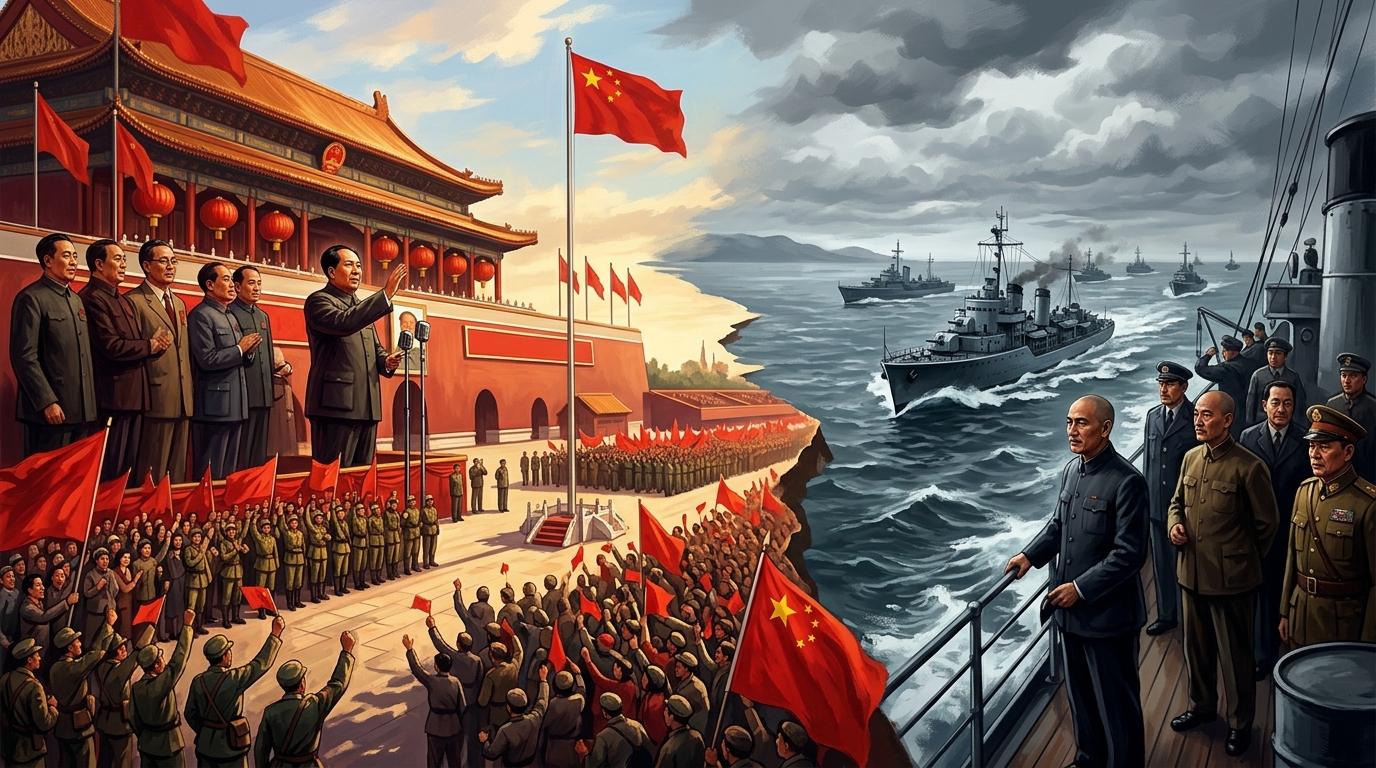
- October 1, 1949: Standing atop Tiananmen Gate in Beijing, Mao Zedong formally proclaims the establishment of the People's Republic of China (PRC).
- December 1949: With his remaining armies shattered, Chiang Kai-shek, along with approximately two million Nationalist soldiers, government officials, and civilians, evacuates to the island province of Taiwan. Taipei is declared the temporary capital of the Republic of China (ROC).
Geopolitical Consequences and Aftermath
The triumph of the CCP over the KMT fundamentally altered the geopolitical landscape of the mid-20th century, redrawing the strategic map of East Asia and defining the contours of the global Cold War.
| Communist Victory (1949) |
|---|
| Domestic Shift |
| • PRC established in Beijing |
| • Land Reform & Nationalization |
| • ROC government flees to Taiwan |
| Global Shift |
| • "Loss of China" debate in US |
| • Sino-Soviet Treaty (1950) |
| • Outbreak of Korean War (1950) |
| Taiwan Strait |
| • Locked division (7th Fleet intervention) |
| • Long-term regional flashpoint |
The "Loss of China" and the U.S. Domestic Backlash
In the United States, the fall of mainland China sparked a fierce domestic political debate known as the "Loss of China" controversy. The Truman administration faced intense criticism from the "China Lobby"—a powerful network of politicians, businessmen, and military officials who advocated for unlimited aid to Chiang Kai-shek. The State Department’s release of the China White Paper in August 1949 sought to justify U.S. policy by arguing that the Nationalist collapse was the result of internal political and military failures rather than a lack of American support.5
Nevertheless, the events of 1949 fueled the rise of McCarthyism and a virulent anti-communist red scare. It solidified a consensus in Washington that any further communist expansion in Asia had to be met with military force, directly influencing subsequent U.S. interventions in Korea and Vietnam.
The Sino-Soviet Alliance and the Asian Cold War
Initially, the PRC’s victory represented a massive strategic gain for the socialist bloc. In February 1950, Mao Zedong and Joseph Stalin signed the Sino-Soviet Treaty of Friendship, Alliance, and Mutual Assistance. This treaty created a formidable communist axis spanning from Central Europe to the Pacific Ocean, forcing Western strategists to view communism as a monolithic global threat.
However, this victory also shifted the geographical focus of the Cold War from Europe to Asia. Within a year, the continent became the site of active, hot conflicts, starting with the outbreak of the Korean War in June 1950.
The Taiwan Strait and the Legacy of Two Chinas
Prior to June 1950, the Truman administration had largely resigned itself to the eventual communist capture of Taiwan. However, the North Korean invasion of South Korea changed Washington's strategic calculus. Fearing that a communist seizure of Taiwan would threaten the security of Japan and the Philippines, President Truman ordered the U.S. Navy's Seventh Fleet to patrol the Taiwan Strait.6
This action effectively neutralized the strait, preventing the PLA from launching a planned amphibious invasion of the island and securing the survival of the Republic of China on Taiwan. This division created a unique, enduring geopolitical anomaly: two governments claiming to represent the entirety of China, a structural tension that continues to threaten regional stability in the 21st century.
Analysis of Key Actors and Decisive Actions
The outcome of the Chinese Civil War was not preordained. At the start of the post-WWII phase, the Nationalists possessed overwhelming advantages in manpower, heavy weaponry, industrial capacity, and international recognition. Understanding the rapid reversal of fortunes requires an analysis of the contrasting strategies and decisions of the key actors.
Mao Zedong: Mass Mobilization and Ideological Discipline
Mao Zedong’s victory was built on a sophisticated integration of military strategy and social revolution. Unlike traditional Marxist theory, which relied on the urban proletariat, Mao recognized the revolutionary potential of China’s vast, impoverished peasantry.
- Land Reform as a Weapon: Wherever the PLA took control, it implemented radical land reform policies, confiscating land from wealthy landlords and distributing it to landless peasants. This policy generated immense popular support, ensuring a virtually limitless supply of recruits, porters, and intelligence for the PLA.
- Military Flexibility: Mao’s military philosophy prioritized space over territory. He advocated for a highly mobile style of warfare, avoiding costly head-on battles unless local superiority was guaranteed. This approach allowed the PLA to wear down the KMT's superior forces through attrition.
- Political Integration: The CCP maintained strict political control over its armed forces through a system of political commissars, ensuring high morale and preventing the desertion of entire units, a problem that consistently plagued the Nationalist military.
Chiang Kai-shek: Tactical Rigidity and Administrative Failure
Chiang Kai-shek’s leadership during the civil war was marked by strategic miscalculations, administrative incompetence, and an inability to address domestic crises.
- Overextension in Manchuria: Against the advice of his American military advisors, Chiang insisted on deploying his best-trained and best-equipped divisions to Manchuria immediately after World War II.[[^7]] This overextended his lines of supply and communication, leaving these elite forces isolated in hostile rural territory where they were systematically cut off and destroyed by the PLA.
- Economic Mismanagement: To finance his military campaigns, Chiang’s government resorted to printing massive amounts of fiat currency, triggering hyperinflation. By 1948, the Chinese National Currency (Fabi) was practically worthless. This economic collapse wiped out the savings of the urban middle class—historically the KMT’s strongest base of support—and led to widespread strikes, protests, and a total loss of public confidence in the regime.
- Factionalism and Corruption: The Nationalist military was crippled by internal rivalries. Chiang, deeply paranoid of betrayal, routinely bypassed the chain of command to issue conflicting orders directly to field commanders, often prioritizing personal loyalty over professional competence. Corruption was rampant; officers frequently pocketed payrolls, sold military supplies on the black market, and reported inflated troop numbers.
Trivia and Lesser-Known Facts
- The Golden Flight: As the Nationalist regime prepared to evacuate to Taiwan in late 1948 and 1949, Chiang Kai-shek orchestrated the secret transfer of China’s national gold reserves. Over several months, navy ships and transport planes moved more than 4 million ounces of gold, along with hundreds of thousands of priceless imperial artifacts from the Palace Museum in Beijing. This gold reserve provided the crucial financial stability needed to secure the ROC’s economy in Taiwan during the difficult years of the early 1950s.
- Secret Communist Agents: The Nationalist military high command was heavily compromised by CCP sleeper agents. Most notable was Lieutenant General Liu Fei, the KMT’s Assistant Chief of the General Staff, who was responsible for drafting operational plans. Liu regularly leaked Chiang’s troop movements and strategic decisions directly to Mao Zedong before KMT field commanders even received their orders.[[^8]]
- The Dixie Mission: Between 1944 and 1947, the United States maintained an official military observer group in Yan'an, known informally as the "Dixie Mission." American officers and diplomats who visited the communist base were highly impressed by the CCP’s organizational efficiency, high morale, and lack of corruption, contrasting it sharply with the decay they observed in Chiang Kai-shek’s wartime capital of Chongqing. Their objective reports, however, were later suppressed during the anti-communist purges of the McCarthy era.
References and Literature
- The General Marshall Mission to China, 1945–1947 - Office of the Historian, U.S. Department of State. An official documentary history of the failed American mediation effort.
- The Tragedy of Chinese Revolution - Harold R. Isaacs (1938). A foundational historical work detailing the early ideological and violent splits between the KMT and CCP.
- China's Civil War: A Social History, 1945–1949 - Diana Lary (Cambridge University Press). An extensive academic study analyzing the social and human cost of the conflict on the civilian population.
- United States Relations with China, With Special Reference to the Period 1944-1949 - U.S. Department of State (1949). The official "White Paper" issued by the Truman administration documenting the collapse of the Nationalist regime.
---
Footnotes & Explanations
- Harold R. Isaacs, The Tragedy of Chinese Revolution (1938), details the violent events of the April 1927 purge in Shanghai and its long-term consequences. ↩
- Edgar Snow, Red Star Over China (1937), provides the classic first-hand account of the Long March and the consolidation of Mao's power. ↩
- Hans van de Ven, War and Nationalism in China: 1937–1945 (Routledge, 2003), offers an objective analysis of the military contributions of both the KMT and CCP during World War II. ↩
- Foreign Relations of the United States (FRUS), The Far East: China, Vol. XI (1946), documents the daily negotiations of the Marshall Mission. ↩
- U.S. Department of State, United States Relations with China, With Special Reference to the Period 1944-1949 (The White Paper), issued in August 1949. ↩
- Harry S. Truman, Presidential Statement on the Mission of the U.S. Seventh Fleet in the Formosa Strait, June 27, 1950. ↩
- Odd Arne Westad, Decisive Encounters: The Chinese Civil War, 1946-1950 (Stanford University Press, 2003), provides a detailed military analysis of the Manchurian campaigns. ↩
- Jung Chang and Jon Halliday, Mao: The Unknown Story (Jonathan Cape, 2005), details the extensive network of communist infiltrators within the Nationalist military. ↩