Key Takeaways
- The death of Joseph Stalin on March 5, 1953, triggered an immediate, high-stakes power struggle within the Kremlin's inner circle.
- Lavrentiy Beria initiated surprisingly radical liberalizing reforms before being arrested and executed by a coalition of his rivals led by Nikita Khrushchev.
- The Khrushchev Thaw dismantled key pillars of the Stalinist terror apparatus, rehabilitated millions of Gulag prisoners, and initiated a complex era of cultural liberalization and geopolitical 'Peaceful Coexistence'.
Historical Context and Origins
By the turn of the 1950s, the Soviet Union existed in a state of petrified consolidation. Joseph Stalin, who had ruled the country with an absolute, uncompromising grip since the late 1920s, had overseen the transformation of the USSR from an agrarian state into a nuclear-armed industrial superpower. However, this transition was achieved through unprecedented state violence, collectivization, rapid industrialization, the establishment of the vast GULAG penal labor system, and systematic purges of the Communist Party and Soviet society.
In the post-World War II era—often referred to as "Late Stalinism"—the regime's paranoia intensified 1. Despite the Soviet victory over Nazi Germany, Stalin perceived internal and external enemies everywhere. This period was marked by the launch of chauvinistic campaigns, such as the struggle against "rootless cosmopolitans," the purging of the Leningrad Party apparatus (the Leningrad Affair), and the targeting of prominent Jewish intellectuals. By 1952, the political atmosphere was further poisoned by the fabrication of the "Doctors' Plot," in which a group of predominantly Jewish Moscow doctors was accused of conspiring to assassinate top Soviet political and military leaders.
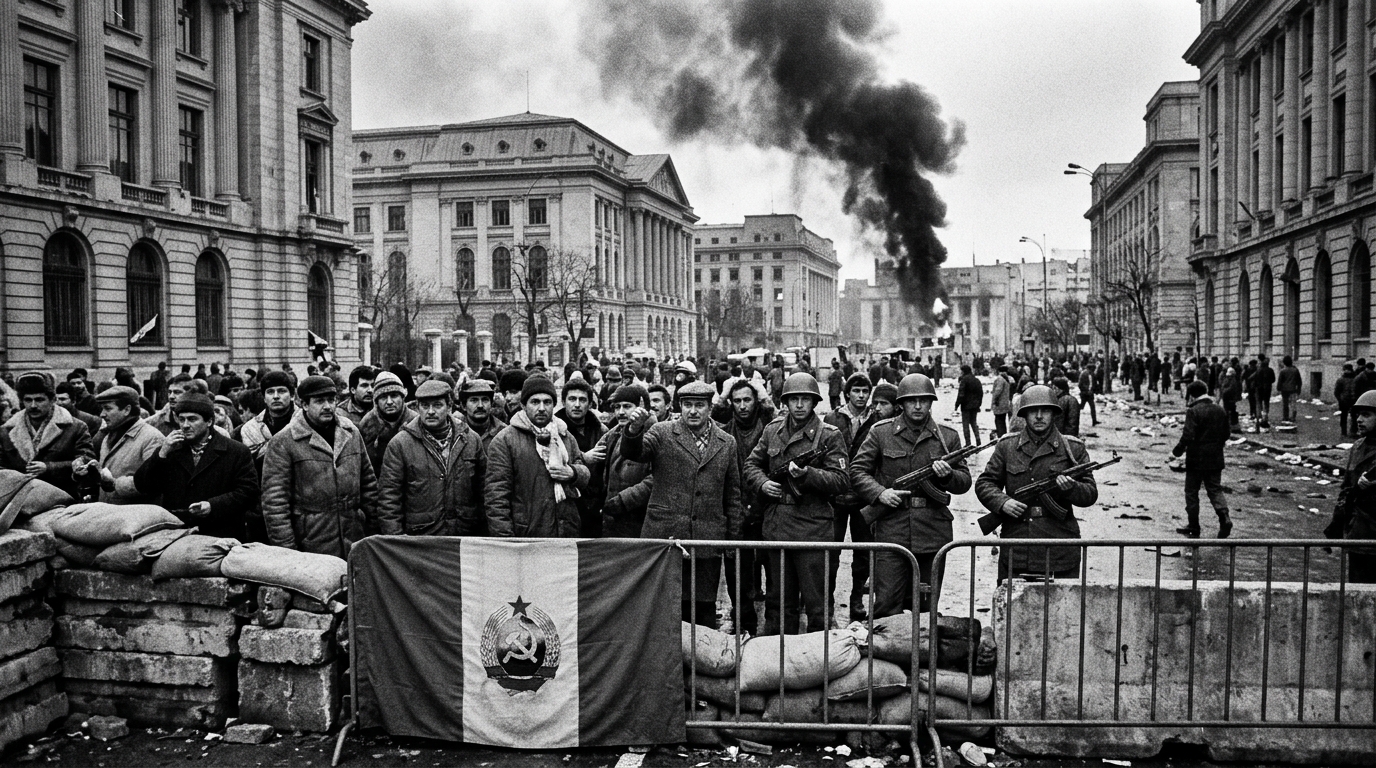
- Late Stalinist Paranoia (1945–1953)
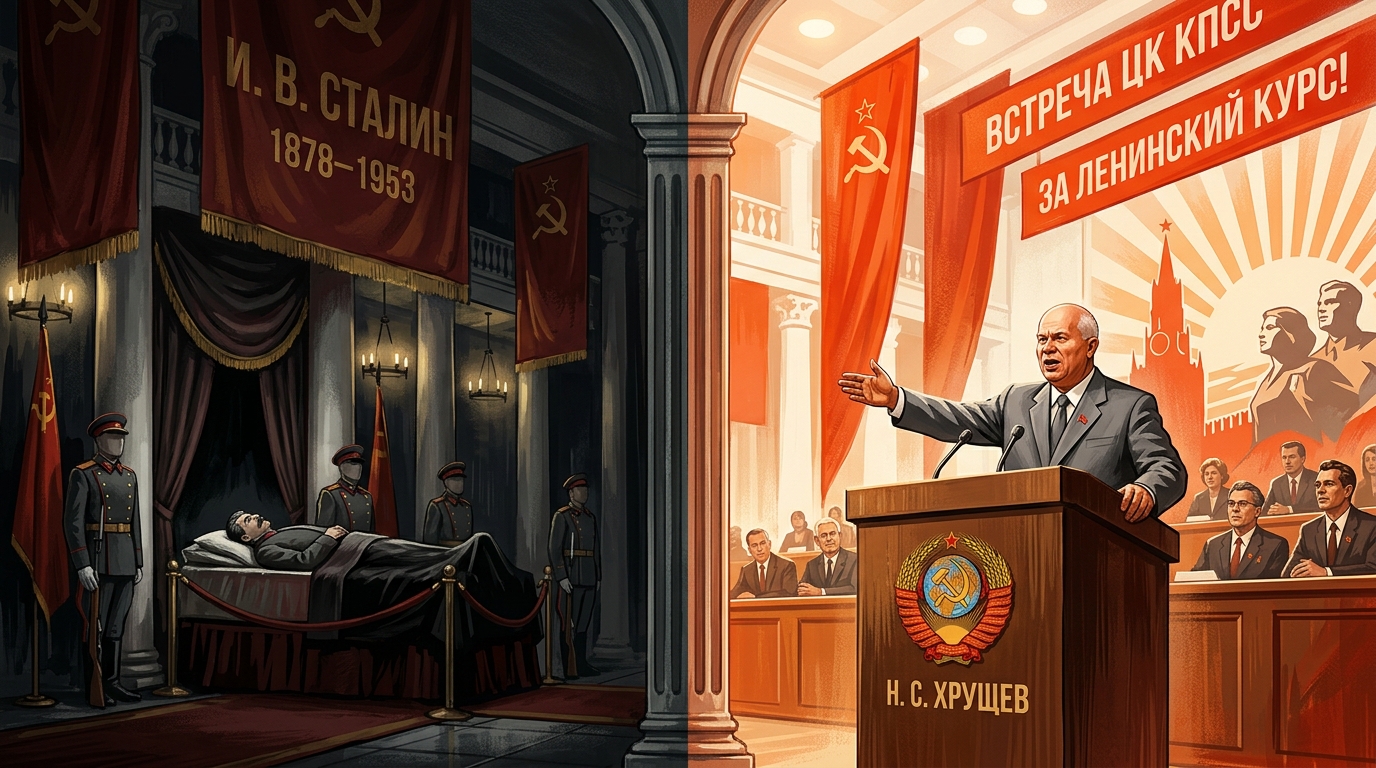
- The Death of Stalin: March 5, 1953
The economic structure of the Soviet Union was also reaching a crisis point. While heavy industry and military-technical projects, including the Soviet atomic bomb program, received massive funding, agriculture remained devastated and inefficient. The GULAG system, housing over 2.5 million prisoners, had become an economic liability. The forced labor model was highly inefficient, costly to maintain, and increasingly prone to riots and mass strikes, such as those that would soon erupt in Vorkuta and Norilsk.
Furthermore, Stalin’s aging inner circle—consisting of Georgy Malenkov, Lavrentiy Beria, Nikita Khrushchev, Nikolai Bulganin, and Vyacheslav Molotov—lived in perpetual fear for their lives. Stalin had expanded the old Politburo into a larger Presidium during the 19th Party Congress in October 1952, a move widely interpreted by his subordinates as a preliminary step toward purging the veteran leadership and replacing them with younger, more compliant cadres. Thus, the origins of the post-Stalin transition were rooted not just in ideological exhaustion, but in a desperate, shared imperative among the Kremlin elite to ensure their own survival.
Timeline of Events and Key Moments
The transformation of the Soviet state in the 1950s unfolded through a sequence of dramatic political maneuvers, sudden policy reversals, and institutional crises.
The Death of the Dictator (March 1953)
On the evening of March 1, 1953, guards at Stalin’s Kuntsevo Dacha outside Moscow discovered the 74-year-old leader lying semi-conscious on the floor of his room. He had suffered a massive hemorrhagic stroke. Due to the paralyzing fear of invoking Stalin's wrath, the guards had hesitated to enter his room for hours, and when they finally did, the senior leadership was reluctant to summon medical help immediately. Doctors were eventually brought to the dacha on the morning of March 2, but his condition was irreversible.
"He breathed heavily, his face was distorted, his hands were trembling... We stood there in silence as he slowly slipped away." — From the memoirs of Nikita Khrushchev, recalling the vigil at Stalin's deathbed.
On March 5, 1953, Stalin was pronounced dead. His passing triggered a profound public outpouring of grief, mixed with private relief and deep anxiety about the future. During his massive state funeral on March 9, panic in the packed streets of Moscow led to a crowd crush, resulting in the deaths of hundreds of citizens 2.
[March 1, 1953] --> Stalin suffers hemorrhagic stroke at Kuntsevo Dacha. [March 5, 1953] --> Stalin dies; collective leadership is formed. [June 26, 1953] --> Beria is arrested in a coordinated coup at the Kremlin. [Dec 23, 1953] --> Beria is executed; Khrushchev begins consolidating power. [Feb 25, 1956] --> Khrushchev delivers the "Secret Speech" at the 20th Party Congress. [June 1957] --> Khrushchev defeats the "Anti-Party Group."
The Rise and Fall of Lavrentiy Beria (March–December 1953)
In the immediate aftermath of Stalin’s death, power was divided among a triumvirate:
- Georgy Malenkov, who assumed the role of Chairman of the Council of Ministers (Premier).
- Lavrentiy Beria, who consolidated the Ministry of State Security (MGB) and the Ministry of Internal Affairs (MVD) into a single powerhouse under his control.
- Nikita Khrushchev, who secured control of the Party apparatus as the de facto head of the Secretariat (formally becoming First Secretary in September 1953).
To the surprise of his colleagues, it was Beria—the feared architect of the late-era terror—who launched the first wave of radical reforms. Recognizing the unsustainability of the system, Beria quickly suspended the Doctors' Plot case, initiated a mass amnesty that released over one million non-political prisoners from the GULAG, halted expensive and useless construction projects driven by forced labor, and proposed a relaxation of Soviet control over East Germany to ease relations with the West 3.
However, Beria’s rapid reforms and his control over the security forces terrified his peers. Led by Nikita Khrushchev and Georgy Malenkov, a conspiracy was formed. On June 26, 1953, during a meeting of the Party Presidium, Khrushchev initiated a blistering attack on Beria, accusing him of being a careerist, a British spy, and an anti-party element. Before Beria could react, Marshal Georgy Zhukov and a group of armed military officers entered the room and arrested him. Following a secret trial, Beria was executed by a firing squad on December 23, 1953.
The Interregnum and Khrushchev’s Consolidation (1953–1955)
With Beria eliminated, the political struggle shifted to a rivalry between Malenkov and Khrushchev. Malenkov advocated for the "New Course," which prioritized light industry and consumer goods over heavy industry, alongside a cautious approach to foreign policy. Khrushchev, leveraging his position as First Secretary of the Central Committee, cultivated the support of regional Party secretaries and military officials. He championed the "Virgin Lands Campaign" (launched in 1954 to cultivate vast areas of Kazakhstan and Siberia) and defended the traditional emphasis on heavy industry.
By February 1955, Khrushchev had successfully marginalized Malenkov, forcing him to resign as Premier due to "administrative incompetence." Malenkov was replaced by Bulganin, a Khrushchev ally, establishing Khrushchev as the dominant figure in the collective leadership.
The 20th Party Congress and the "Secret Speech" (February 1956)
The defining moment of de-Stalinization occurred on the night of February 24–25, 1956, during the 20th Congress of the Communist Party of the Soviet Union. In a closed session restricted to Soviet delegates and key foreign communist leaders, Khrushchev delivered a four-hour address titled "On the Cult of Personality and Its Consequences".
20th Congress of the CPSU
- De-Stalinization Initiated
- Ideological Shockwaves
In the speech, Khrushchev systematically demolished the myth of Stalin’s infallibility:
- He detailed Stalin's personal responsibility for the Great Purge of 1937–1938 and the torture of loyal Party members.
- He criticized Stalin’s military incompetence and his failure to prepare the USSR for the German invasion of 1941.
- He condemned the forced mass deportations of entire nationalities during World War II.
- Crucially, Khrushchev framed these crimes as aberrations of the "cult of personality," thereby preserving the perceived legitimacy of the Communist Party and Lenin's legacy.
Though initially classified, the text of the speech was read to local Party cells across the country, quickly becoming an open secret. In June 1956, the U.S. State Department obtained a copy through Polish channels and published it globally, sending shockwaves through the international communist movement.
Geopolitical Consequences and Aftermath
The transition from Stalin's autocracy to the Khrushchev Thaw fundamentally altered the geopolitical landscape of the Cold War and reshaped the internal dynamics of the Eastern Bloc.
| Aspect | Under Joseph Stalin (Pre-1953) | Under Nikita Khrushchev (Post-1956) |
|---|---|---|
| Foreign Policy Doctrine | Inevitable conflict with capitalism; aggressive isolationism. | "Peaceful Coexistence" (Mirnoye Sosushchestvovaniye); diplomatic engagement. |
| Sino-Soviet Relations | Unequal partnership; Mao deferential but resentful of Stalin's dominance. | Sino-Soviet Split; ideological hostility and competition for global leadership. |
| Eastern Bloc Control | Absolute subordination; Sovietization and frequent purges of local elites. | Warsaw Pact (1955); "polycantric" autonomy within limits (crushed Hungarian Uprising). |
| Security & Domestic Law | Pervasive terror; unchecked MVD/MGB power; massive GULAG population. | Socialist Legality; curtailment of KGB powers; dismantling of the GULAG. |
The Dissolution of the GULAG and Domestic Liberalization
Domestically, the "Thaw" (Ottepel)—a term coined from Ilya Ehrenburg’s 1954 novella of the same name—ushered in a period of unprecedented cultural and social relaxation. The security organs were reformed and subordinated to the Party, losing their autonomous empire-state status. The MVD was stripped of its economic enterprises, and the GULAG system was systematically dismantled. Between 1953 and 1956, millions of political prisoners were released, and hundreds of thousands of others were posthumously rehabilitated 4.
In the cultural sphere, censorship was eased. Literary journals, most notably Novy Mir edited by Aleksandr Tvardovsky, published works that directly addressed the hardships of Soviet life and the legacy of the purges, culminating in the authorized 1962 publication of Aleksandr Solzhenitsyn's One Day in the Life of Ivan Denisovich. Scientific inquiry, which had been crippled by ideological dogmas like Lysenkoism under Stalin, experienced a revival, facilitating the rapid development of the Soviet space program and the launch of Sputnik 1 in October 1957.
Crisis in the Eastern Bloc: Poland and Hungary (1956)
The relaxation of Soviet control and the ideological shock of the Secret Speech triggered rapid destabilization in Soviet satellite states, where populations sought greater national autonomy and democratic reforms.
- Poland: In June 1956, worker protests in Poznań escalated into a national crisis. In October, the reformist Władysław Gomułka was elevated to leader of the Polish United Workers' Party without Moscow's prior approval. Khrushchev flew to Warsaw and threatened military intervention, but ultimately backed down, accepting Gomułka’s domestic reforms in exchange for Poland's continued commitment to the Warsaw Pact.
- Hungary: Inspired by Poland, the Hungarian Revolution erupted in late October 1956. Reformist Prime Minister Imre Nagy announced plans to withdraw Hungary from the Warsaw Pact, introduce a multi-party system, and declare neutrality. This crossed Khrushchev's red line. On November 4, 1956, Soviet forces launched a massive military assault, brutally crushing the uprising. Thousands of Hungarians were killed, and Nagy was subsequently arrested and executed, demonstrating the strict limits of Khrushchev's liberalization.
Crisis of 1956 in Eastern Europe
- Polish October
- Hungarian Revolution
The Sino-Soviet Split
The ideological pivot of de-Stalinization permanently damaged the alliance between the Soviet Union and the People's Republic of China. Mao Zedong viewed Khrushchev’s Secret Speech as a betrayal of Marxist-Leninist orthodoxy and a direct threat to his own cult of personality in China. Mao argued that Khrushchev was a "revisionist" who was abandoning the revolutionary struggle against Western imperialism.
By the late 1950s, public polemics and ideological disputes escalated. The Soviet refusal to support China in its border dispute with India and Moscow's decision to withdraw nuclear advisors from China in 1959 cemented the Sino-Soviet Split, fracturing the communist world into competing factions and fundamentally altering the Cold War balance of power.
Analysis of Key Actors and Decisive Actions
Joseph Stalin: The Paralyzing Shadow
Stalin’s decisive action in his final years was his deliberate refusal to designate a successor, combined with the continuous destabilization of his subordinates. By playing his lieutenants against one another—Malenkov against Beria, Khrushchev against Malenkov—Stalin ensured his personal security but left a institutional vacuum. The immediate, collective rush to dismantle the terror apparatus upon his death reveals how unsustainable his model of absolute autocracy had become, even for those who executed his orders.
Lavrentiy Beria: The Pragmatic Executioner
Beria remains one of the most paradoxical figures of Soviet history. As the head of the security apparatus, he was directly responsible for some of the regime's worst crimes. Yet, his administrative competence made him uniquely aware of the structural failures of the Soviet state. His decisive actions after March 1953—such as ending the Doctors' Plot, proposing a market-oriented agricultural policy, and advocating for a neutral, unified Germany—were driven by a pragmatic desire to rationalize the system. However, his long-term association with Stalinist terror made him an untrustworthy partner in the eyes of his colleagues, leading to his swift elimination.
Nikita Khrushchev: The Populist Reformer
Khrushchev’s political survival and ultimate dominance rested on his mastery of the Party apparatus. Unlike his rivals, who operated within the state ministries, Khrushchev understood that the Communist Party remained the ultimate source of institutional legitimacy. His decisive actions were characterized by bold, often high-risk maneuvers:
- Arresting Beria: Securing the support of the military (via Marshal Zhukov) to execute a palace coup.
- The Secret Speech: Overcoming the resistance of the conservative Presidium majority to deliver a speech that risked destabilizing the entire communist world, believing that a managed critique of the past was the only way to modernize the Soviet state.
- Defeating the "Anti-Party Group" (1957): When Malenkov, Molotov, and Kaganovich formed a majority in the Presidium to depose him in June 1957, Khrushchev bypassed them by demanding an emergency meeting of the full Central Committee, which voted to keep him in power and demoted his opponents.
Khrushchev's Power Strategy
| Mastery of Party App | Alliance with Military | Ideological Gambles |
|---|---|---|
| Used CC Secretariat | Used Marshal Zhukov | Secret Speech (1956) |
| Appointed loyalists | Arrested Beria (1953) | Anti-Party Group (1957) |
Trivia and Lesser-Known Facts
- The Guard's Dilemma: When Stalin suffered his stroke, the duty guard on shift, Peter Lozgachev, wanted to enter Stalin's quarters earlier but was terrified to do so. The rules at Kuntsevo Dacha strictly forbade entering Stalin’s private chambers without an explicit call, and violators faced immediate arrest or execution.
- The Secret Recording: Following Beria's arrest, the Soviet leadership was so paranoid about his remaining loyalists in the MVD that they had the Kremlin's communication lines physically cut and used military tanks to surround the Lubyanka headquarters.
- The Leaked Speech: The copy of the Secret Speech that reached the West was obtained by Viktor Grayevsky, a Polish-Jewish journalist. He borrowed it from his girlfriend, who worked in the office of the First Secretary of the Polish Communist Party, and took it to the Israeli Embassy in Warsaw, where it was photographed and sent to Shin Bet, who then shared it with the CIA.
- The Mausoleum Eviction: Stalin’s body was embalmed and placed alongside Vladimir Lenin in the Red Square mausoleum in March 1953. It remained there for eight years. However, in October 1961, during the 22nd Party Congress, de-Stalinization reached a new peak, and Stalin’s body was quietly removed from the mausoleum under the cover of night and buried in the Kremlin Wall Necropolis.
References and Literature
- Taubman, William (2003). Khrushchev: The Man and His Era. W. W. Norton & Company - A definitive, Pulitzer Prize-winning biography of Khrushchev, detailing his rise, the Secret Speech, and the inner workings of the Thaw.
- Gorlizki, Yoram, and Khlevniuk, Oleg (2004). Cold Peace: Stalin and the Soviet Ruling Circle, 1945–1953. Oxford University Press - An archival study analyzing the final, paranoid years of Stalin's rule and his relationships with his successors.
- Knight, Amy (1993). Beria: Stalin's First Lieutenant. Princeton University Press - A comprehensive academic biography of Lavrentiy Beria, focusing on his reform initiatives and his sudden fall from power.
- Zubok, Vladislav M. (2007). A Failed Empire: The Soviet Union in the Cold War from Stalin to Gorbachev. University of North Carolina Press - A major diplomatic history examining how the shift from Stalin to Khrushchev reshaped international relations and Soviet foreign policy.
---
Footnotes & Explanations
- Gorlizki, Yoram, and Khlevniuk, Oleg. Cold Peace: Stalin and the Soviet Ruling Circle, 1945–1953. Oxford University Press, 2004, pp. 112-118. ↩
- Taubman, William. Khrushchev: The Man and His Era. W. W. Norton & Company, 2003, pp. 240-244. ↩
- Knight, Amy. Beria: Stalin's First Lieutenant. Princeton University Press, 1993, pp. 185-192. ↩
- Zubok, Vladislav M. A Failed Empire: The Soviet Union in the Cold War from Stalin to Gorbachev. University of North Carolina Press, 2007, pp. 98-104. ↩