Key Takeaways
- The speech marked the definitive end of Russia's post-Soviet attempt to integrate with the Western-led security architecture, signaling a profound shift in Moscow's strategic orientation.
- Putin articulated a clear and forceful challenge to the 'unipolar' model, arguing that global stability and genuine security necessitate a return to a multipolar system of international relations, based on the principles of international law and sovereign equality.
- The address served as a critical geopolitical inflection point, transforming Russia's international posture from that of a potentially cooperative partner to an openly assertive strategic competitor, willing to defend its perceived spheres of influence and national interests with greater vigor.
- It publicly outlined Russia's core grievances: NATO expansion, the US withdrawal from the ABM Treaty, US unilateralism in military interventions (e.g., Iraq), and the perceived erosion of international law.
Historical Context and Origins
The year 2007 represented a confluence of burgeoning self-confidence within the Russian state and a deepening sense of grievance against the perceived trajectory of the post-Cold War international order. For nearly two decades since the dissolution of the Soviet Union, Russia had navigated a tumultuous path, marked by economic chaos, political instability, and a dramatic reduction in its global influence. By the mid-2000s, however, a decade of soaring global energy prices, particularly oil and natural gas, had fundamentally transformed Russia's fiscal landscape. This economic resurgence not only stabilized the domestic political situation but also provided the Kremlin with the financial muscle to project a more assertive foreign policy.
When Vladimir Putin traveled to Germany to address the 43rd Munich Conference on Security Policy, he had already served seven years as President, consolidating power and re-establishing the state's authority after the turbulent Boris Yeltsin era. His initial tenure had been characterized by a complex duality: outwardly, he had been the first leader to call President George W. Bush after the 9/11 attacks, offering unprecedented intelligence cooperation and facilitating the transit of U.S. forces into Afghanistan. This period fostered a brief, fragile hope in Western capitals that Russia might eventually integrate fully into the liberal international order.
However, beneath this veneer of cooperation, deep-seated strategic disagreements were festering. By 2006-2007, the "honeymoon" period of U.S.-Russian relations had evaporated. The primary catalysts for this breakdown were multifaceted and deeply rooted in historical anxieties and perceived betrayals:
- NATO Expansion: The enlargement of the North Atlantic Treaty Organization (NATO) eastward into former Warsaw Pact countries (Poland, Hungary, Czech Republic in 1999) and later into the Baltic states and other Eastern European nations (Bulgaria, Estonia, Latvia, Lithuania, Romania, Slovakia, and Slovenia in 2004) was viewed by Moscow as an existential threat. Russian officials, including Putin, argued that these expansions violated informal understandings reached during German reunification in 1990 regarding NATO's non-expansion beyond a united Germany.
- U.S.-led Invasion of Iraq (2003): Moscow viewed this intervention, conducted without explicit UN Security Council authorization, as a flagrant breach of international law and a demonstration of U.S. unilateralism. Russia, along with France and Germany, strongly opposed the war, further highlighting a rift in global governance.
- "Color Revolutions": The Kremlin interpreted the pro-Western, non-violent uprisings in Georgia (Rose Revolution, 2003) and Ukraine (Orange Revolution, 2004), along with similar movements in Kyrgyzstan (Tulip Revolution, 2005), not as genuine expressions of democratic will but as a systematic campaign by the United States and its allies to encircle Russia, undermine its influence in its traditional "near abroad," and install compliant regimes. Moscow accused Western NGOs and governments of directly funding and orchestrating these revolutions.
- U.S. Withdrawal from the ABM Treaty (2002) and Missile Defense Plans: The U.S. decision to unilaterally withdraw from the Anti-Ballistic Missile (ABM) Treaty, a cornerstone of Cold War strategic stability, deeply alarmed Moscow. Subsequent plans to deploy missile defense components in Poland and the Czech Republic were seen by Russia not as a defense against rogue states like Iran, but as a direct strategic threat designed to negate Russia's nuclear deterrent and extend U.S. military reach closer to its borders.
These cumulative events fostered a profound sense of insecurity and indignation within the Kremlin. Putin's speech in Munich was not an impromptu outburst but rather the culmination of years of growing frustration and a carefully calibrated articulation of a new, more assertive Russian foreign policy doctrine that had been gestating for some time. It was an explicit declaration that Russia would no longer passively accept what it perceived as a unipolar world dominated by the United States.
Historical Precedents & Ideological Underpinnings
Putin's Munich address drew heavily on deep-seated historical narratives and ideological currents within Russia, reflecting a long-standing understanding of Russia's place in the world. To fully grasp the speech's significance, it is essential to consider these precedents.
The Trauma of the 1990s and the Quest for Derzhavnost
The collapse of the Soviet Union in 1991 ushered in a decade of profound national trauma for Russia. The rapid transition to a market economy led to hyperinflation, widespread corruption, and a dramatic decline in living standards. Russia's military, once a global superpower, was left in disarray, and its geopolitical influence waned considerably. This period was widely perceived within Russia as one of national humiliation and weakness, a stark contrast to its imperial and Soviet-era "great power" (derzhavnost) status. Putin, a former KGB officer, often emphasized the need to restore Russia's dignity and strength, a message that resonated deeply with a population tired of perceived Western condescension.
The concept of "derzhavnost" is crucial here. It embodies the idea of Russia as a strong, independent, and influential power, a civilization with its own unique path and interests, not merely a junior partner or a transitional state mimicking Western models. The Munich speech was a powerful articulation of this desire to reclaim Russia's rightful place on the global stage.
Eurasianism and the "Near Abroad"
While not directly referencing specific ideologues like Alexander Dugin, the speech implicitly aligned with certain tenets of Russian geopolitical thought, particularly a revised form of Eurasianism. This worldview posits that Russia is a distinct civilization, neither purely European nor Asian, destined to lead a unique geopolitical bloc. The "near abroad" – the former Soviet republics – is considered a vital sphere of influence, crucial for Russia's security and identity. Western attempts to integrate these countries into NATO or the EU were thus seen as direct encroachments on Russia's strategic space.
The speech implicitly articulated a "lessons learned" perspective from Russia's historical experiences. From the Napoleonic Wars to the two World Wars, Russia has historically viewed its vast landmass as both a strength and a vulnerability, necessitating a deep strategic buffer zone. The eastward expansion of NATO was thus interpreted as a historical echo of past invasions, exacerbating a deeply ingrained siege mentality.
Post-Westphalian Order and International Law
Putin's emphasis on international law and the UN Charter in Munich was not a sudden embrace of these principles but rather a strategic invocation. Russia consistently champions a Westphalian understanding of international relations, emphasizing state sovereignty, non-interference in internal affairs, and the preeminence of the UN Security Council as the sole legitimate arbiter of international force. This stance served as a direct counterpoint to what Russia perceived as the U.S.'s post-Westphalian tendency toward interventionism and selective application of international law, particularly regarding the interventions in Kosovo (1999) and Iraq (2003). Russia argued that a unipolar world, far from guaranteeing stability, led to chaos and violated the fundamental principles of sovereign equality established in the wake of the World Wars.
In essence, Putin's Munich speech was a carefully crafted ideological manifesto, rooted in historical grievances, national pride, and a distinct vision of international order that challenged the prevailing Western liberal hegemony. It declared that Russia was not merely reacting to specific policy choices but fundamentally rejecting the philosophical underpinnings of the post-Cold War world as defined by the West.
Timeline of Events and Key Moments
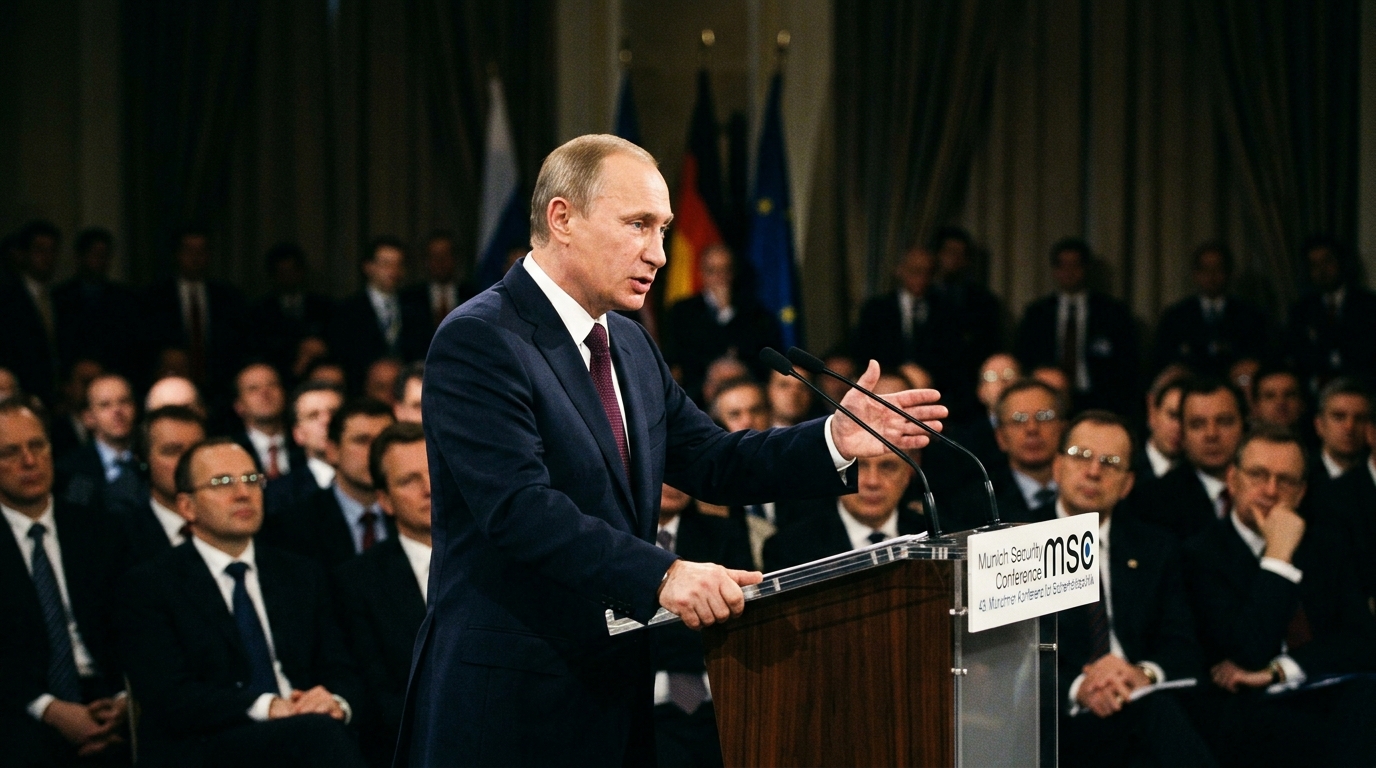
The atmosphere at the Munich Security Conference on February 10, 2007, was palpably tense, charged with a sense of anticipation following years of escalating rhetoric from Moscow. The audience, comprising a who's who of global policymakers—including U.S. Secretary of Defense Robert Gates, NATO Secretary-General Jaap de Hoop Scheffer, German Chancellor Angela Merkel, and Senator John McCain—was accustomed to diplomatic niceties. What they received from Putin was anything but.
Here's an expanded timeline leading up to and immediately following the seminal speech:
| Date | Event | Significance |
|---|---|---|
| 1990 | German Reunification | Western leaders, primarily U.S. Secretary of State James Baker, allegedly offered assurances against NATO expansion "one inch eastward" in exchange for Soviet cooperation on German unity, a claim Moscow would frequently invoke. |
| 1999 | First NATO Enlargement (Post-Cold War) | Poland, Hungary, and the Czech Republic join NATO. This was viewed by Moscow as the first major betrayal of the 1990 understandings. |
| 1999 | NATO Intervention in Kosovo | NATO's bombing campaign against Serbia without UN Security Council resolution. Russia vehemently opposed this, seeing it as a blatant violation of international law and state sovereignty. |
| 2001 | 9/11 Attacks | Putin is the first foreign leader to call President George W. Bush. Russia offers significant cooperation in the Global War on Terror, including intelligence sharing and facilitating transit to Afghanistan. |
| 2002 | U.S. Withdrawal from ABM Treaty | The U.S. unilaterally withdraws from the Anti-Ballistic Missile Treaty, a cornerstone of strategic stability, citing evolving threats. Russia condemned this as undermining global security. |
| 2003 | U.S.-led Invasion of Iraq | The U.S. and its allies launch the Iraq War without explicit UN Security Council authorization, despite strong opposition from Russia, France, and Germany. This action solidified Moscow's view of U.S. unilateralism. |
| 2003 | Georgia's Rose Revolution | A peaceful uprising leads to the resignation of Eduard Shevardnadze. Moscow views this and subsequent "Color Revolutions" as U.S.-backed attempts to undermine its influence. |
| 2004 | Second NATO Enlargement (Post-Cold War) | Bulgaria, Estonia, Latvia, Lithuania, Romania, Slovakia, and Slovenia join NATO, bringing the alliance directly to Russia's borders, especially the Baltic states. |
| 2004 | Ukraine's Orange Revolution | Mass protests invalidate a disputed election, leading to a pro-Western government. This further fueled Russian paranoia about Western interference in its "near abroad." |
| Feb 10, 2007 | The Munich Speech | Putin delivers his landmark address, directly challenging the U.S.-led unipolar world order, criticizing NATO expansion, missile defense, and U.S. unilateralism. |
| Feb 10, 2007 | Immediate Western Reaction | U.S. Secretary of Defense Robert Gates dismisses the speech as "Cold War rhetoric," stating "one Cold War was quite enough." Other Western leaders express surprise but largely downplay its significance. |
| April 2007 | Estonian "Bronze Soldier" Controversy | Relocation of a Soviet-era war memorial in Tallinn sparks riots and accusations of Russian cyberattacks against Estonian government websites, signaling a new front in hybrid warfare. |
| Late 2007 | Russia Resumes Long-Range Air Patrols | Putin announces the resumption of strategic bomber patrols, suspended since 1992, as a direct response to missile defense plans, a symbolic return to Cold War military posturing. |
| Early 2008 | Russia Threatens Missile Deployment | Moscow threatens to deploy short-range missiles in Kaliningrad in response to U.S. missile defense plans in Poland and the Czech Republic. |
| April 2008 | Bucharest NATO Summit | Despite fierce Russian opposition, NATO leaders declare that Ukraine and Georgia "will become members of NATO," further inflaming tensions and providing a critical impetus for subsequent Russian actions. |
| Aug 2008 | Russo-Georgian War | Russia responds to a Georgian offensive in South Ossetia with a full-scale invasion, swiftly defeating Georgian forces and recognizing the independence of Abkhazia and South Ossetia. This is seen as the first kinetic manifestation of the Munich doctrine. |
The speech itself was remarkably candid, bypassing the polite, diplomatic ambiguity typical of such high-level forums. Putin explicitly argued that the world had moved from a bipolar order (US-USSR) to a unipolar one that proved unsustainable, unjust, and ultimately dangerous. He directly accused the United States of overstepping its boundaries and disregarding international law in pursuit of its own interests.
"I consider that the unipolar model is not only unacceptable but also impossible in today's world... We are seeing a greater and greater disdain for the basic principles of international law. And independent legal norms are, in fact, coming closer and closer to the American legal system... This is very dangerous." — Vladimir Putin, February 10, 2007.
Geopolitical Consequences and Aftermath
The immediate reaction from many Western delegates was a mixture of shock, discomfort, and a dismissive categorization of the speech as "Cold War rhetoric" or an "outburst." However, history has unequivocally proven that the Munich Speech was not a transient expression of frustration but a meticulously crafted blueprint for the Kremlin’s future strategy and a declaration of intent that profoundly reshaped global geopolitics.
- The Definitive End of the "Reset" Era and Western Integration Hopes: The speech irrevocably signaled that the Russian leadership no longer viewed Western institutional norms, multilateral frameworks, or democratic values as universal or neutral. Instead, they were perceived as instruments of American power projection, designed to perpetuate a unipolar order detrimental to Russia's interests. The subsequent attempts by the Obama administration to pursue a "reset" in U.S.-Russia relations were fundamentally undermined by the ideological chasm that Munich had exposed.
- Multipolarity as a Central Foreign Policy Goal: Following Munich, Russia actively and strategically pursued a policy of building a multipolar world order. This involved:
- Domestic Consolidation and Nationalist Revival: Within Russia, the speech was widely broadcast and celebrated by state-controlled media. It was framed as the moment Russia "stood up from its knees" and proudly asserted its sovereignty on the world stage after years of perceived subservience. This narrative was instrumental in cementing Putin’s image as the strong leader who restored Russia's national dignity and power, bolstering his domestic political legitimacy for over a decade.
- Increased Military Spending and Modernization: The speech was followed by a significant increase in Russia's defense budget and a concerted effort to modernize its armed forces. This was not merely about capability but about projecting strength and signaling Russia's readiness to defend its interests militarily. The resumption of long-range strategic bomber patrols in late 2007 was a symbolic yet potent demonstration of this renewed military assertiveness.
- Assertive Actions in the "Near Abroad": The speech effectively drew a rhetorical "red line" around Russia's perceived spheres of influence. When subsequent events threatened to cross that line—such as the explicit declaration at the 2008 Bucharest NATO summit that Georgia and Ukraine "will become members of NATO," or Georgia's military actions in South Ossetia—Moscow’s response moved rapidly from rhetorical opposition to direct military action. The 2008 Russo-Georgian War (just 18 months after Munich) was the first major kinetic manifestation of the strategic shift articulated by Putin, demonstrating Russia's willingness to use force to prevent perceived Western encroachment in its immediate neighborhood.
- Energy Geopolitics as a Tool of Foreign Policy: Russia, as a major energy supplier to Europe, increasingly utilized its energy leverage. Disputes over gas transit with Ukraine (e.g., in 2006 and 2009) were not merely commercial but became geopolitical tools, demonstrating Russia's capacity to exert pressure and divide European states. The push for projects like Nord Stream 1, bypassing traditional transit routes, was also part of this strategy to ensure direct energy access to key European markets while enhancing Russia's geopolitical leverage.
- Sustained Confrontation over Missile Defense: The debate over the U.S. missile defense shield in Poland and the Czech Republic intensified significantly. Russia responded with threats to deploy short-range missiles in its Kaliningrad exclave, demonstrating a willingness to escalate military posturing in response to what it considered a direct threat to its strategic parity.
In sum, the Munich Speech was a premonition. It was a formal declaration of a new era of strategic competition, laying the ideological and conceptual groundwork for a more confrontational and revisionist Russian foreign policy that would unfold in the subsequent years, culminating in the annexation of Crimea (2014) and the full-scale invasion of Ukraine (2022). It marked the transition from a period of hesitant engagement with the West to one of open defiance and the active construction of an alternative, multipolar global order.
Analysis of Key Actors and Decisive Actions
The Munich Speech was a performance, but one underpinned by a deep ideological conviction and strategic calculus. Its impact stemmed from the interplay of its central orator, the broader international environment, and the reactions of other key actors.
Vladimir Putin: The Architect of a New Doctrine
The figure of Vladimir Putin stands at the epicenter of this transformation. In 2007, he was not merely reacting to events; he was proactively shaping Russia's role on the world stage. His journey from an eager, if cautious, partner post-9/11 to a vocal critic of the Western order was a product of his background, worldview, and strategic objectives.
- KGB Legacy: Putin's training in the KGB imbued him with a deep suspicion of foreign intentions, a belief in the necessity of a strong state, and an understanding of power politics. He likely viewed Western assistance and democratic promotion efforts not as benevolent aid but as forms of geopolitical maneuvering aimed at weakening Russia.
- Restorationist Agenda: His core objective was the restoration of Russia's great power status and national pride, which he believed had been severely eroded in the 1990s. The unipolar world, dominated by the U.S., was fundamentally incompatible with this vision.
- Calculated Assertiveness: The speech itself demonstrated a calculated shift from diplomatic hints to direct confrontation. It was designed to send an unmistakable message: Russia was no longer a supplicant but a sovereign power with its own interests, willing to challenge the prevailing international consensus. His delivery, intense and unyielding, underscored the gravity of his message.
The Role of U.S. Hegemony and Strategic Deafness
The United States, under the Bush administration, was largely consumed by the Global War on Terror, particularly the wars in Iraq and Afghanistan. This singular focus led Washington to largely perceive Putin’s increasingly critical rhetoric as either a distraction, an internal political play, or simply "Cold War nostalgia."
- Underestimation of Grievances: U.S. policymakers often underestimated the depth and sincerity of Russian grievances regarding NATO expansion and missile defense. These were viewed by Washington as defensive measures or necessary steps to secure new democracies, not as aggressive encirclement.
- Unilateralist Tendencies: The Bush administration's assertive unilateralism, particularly its willingness to act outside traditional multilateral frameworks (e.g., the Iraq War, withdrawal from the ABM Treaty), inadvertently validated Putin's critique of a unipolar world and provided him with powerful rhetorical ammunition.
- "Strategic Deafness": By largely dismissing the concerns articulated in Munich, the U.S. missed a critical opportunity for a genuine strategic dialogue, however difficult. This "strategic deafness" contributed to the failure of diplomatic channels in the decade that followed, fostering an environment of mutual distrust and misinterpretation. Key figures like Secretary of State Condoleezza Rice and Vice President Dick Cheney, while aware of Russian discontent, did not anticipate the complete ideological break that Munich signified.
The European Dilemma: Between Alliance and Dependence
For European leaders, the speech created a profound and uncomfortable tension. Many, particularly in Western Europe, were dependent on Russian energy resources but simultaneously committed to the NATO security framework and the values of the transatlantic alliance.
- German Chancellor Angela Merkel: Merkel, who had grown up in East Germany, understood the nuances of the post-Soviet space and Russia better than many Western leaders. While she openly disagreed with Putin's assessment immediately after the speech, she also understood the underlying concerns and subsequently became a key proponent of maintaining dialogue with Moscow, even as she upheld European unity and values.
- Divisions within Europe: The speech highlighted and exacerbated existing divisions within Europe. Newer NATO members in Eastern Europe, having experienced Soviet domination, were often more hawkish towards Russia and advocated for robust NATO expansion. Older Western European members, particularly Germany and France, preferred a more nuanced engagement, balancing security concerns with economic interests.
- EU Foreign Policy: The European Union's attempts to craft a unified foreign policy toward Russia struggled in the face of these internal divisions and Moscow's skillful exploitation of individual member states' dependencies and interests. Figures like Javier Solana, the EU's High Representative for the Common Foreign and Security Policy, faced an increasingly complex diplomatic landscape.
NATO: Justification vs. Perception
NATO's role was central to Putin's critique. The Alliance justified its expansion as bringing stability to a region emerging from Soviet control, preventing a security vacuum, and allowing sovereign nations to choose their own alliances. However, from Moscow's perspective:
- Broken Promises: The perception of broken promises regarding NATO's non-expansion after German reunification fueled a narrative of betrayal.
- Existential Threat: Regardless of NATO's stated defensive intentions, its eastward movement was interpreted by Russia as an offensive military encirclement, eroding its strategic depth and threatening its borders.
- Erosion of Trust: Each expansion round and the discussion of further enlargements (especially towards Ukraine and Georgia) systematically eroded any remaining trust that Russia might have placed in a cooperative security framework with the West.
In essence, the Munich Speech laid bare the fundamental divergence in strategic outlooks between Russia and the West. It revealed a Russian leadership that felt marginalized and betrayed, determined to reassert its influence, confronting a Western leadership that either misunderstood or dismissed the depth of Moscow's grievances, confident in the presumed universality of the liberal international order.
Intelligence & Diplomatic Failures: The Warning Signs Unheeded
The Munich Speech was not delivered in a vacuum; it was the culmination of years of escalating rhetoric and policy decisions that, in retrospect, served as clear warning signs. The failure of Western intelligence and diplomatic communities to fully grasp the fundamental shift occurring in Moscow represents a significant aspect of its aftermath.
Missing the Ideological Pivot
Prior to 2007, Western analyses of Russia often operated under the implicit assumption that Russia, despite its frustrations, was ultimately on a path towards integration with the Western liberal order. Disagreements were often framed as tactical, not existential.
- Wishful Thinking: There was a prevailing "wishful thinking" bias that interpreted Russia's economic recovery and increasing engagement with global institutions (like the G8) as signs of maturation into a responsible stakeholder. The aggressive nationalism and anti-Western sentiment brewing within Russia were often downplayed or seen as temporary political maneuvering.
- Focus on Individual Policies: Western diplomats tended to analyze Russia's actions in isolation – an energy dispute here, a critical statement there – rather than piecing together a coherent ideological framework guiding Moscow's broader strategy. The focus was on "what Russia did," not "why Russia thought the way it did."
- Ignoring Historical Grievances: The deep-seated historical grievances and narratives of humiliation, which Putin skillfully tapped into, were often not fully appreciated or were dismissed as irrelevant "Soviet nostalgia" by Western analysts, who were more focused on contemporary geopolitical shifts.
Diplomatic Interpretations: Underestimation vs. Awareness
While publicly dismissed, it is important to acknowledge that not all within Western diplomatic and intelligence circles were completely oblivious. Some individuals and agencies did issue warnings:
- Early Alarm Bells: As early as the late 1990s and early 2000s, some Russia specialists within the State Department, CIA, and European foreign ministries raised concerns about the growing resentment in Moscow over NATO expansion and U.S. unilateralism. They noted a hardening of Russian foreign policy discourse and a shift away from pro-Western elements within the Kremlin.
- The "Mirror Imaging" Problem: A persistent issue was "mirror imaging" – assuming that Russian leaders thought like their Western counterparts, prioritizing economic interdependence and democratic values. This led to a misinterpretation of Putin's genuine commitment to a different, more authoritarian and statist model for Russia.
- Dismissal by Leadership: Even when warnings were raised, they were often not fully integrated into top-level policy decisions. The preoccupation with counter-terrorism and the wars in Afghanistan and Iraq meant that Russia, while an important actor, was not always the highest priority, leading to a degree of strategic neglect. The "reset" button mentality that followed in 2009 suggests a continued belief that a tactical adjustment in U.S. policy could mend the relationship, rather than recognizing a fundamental ideological divergence.
The Contrast in Communication
Putin’s speech represented a clear and unambiguous communication of Russia's intent. The fact that it was largely dismissed as "Cold War rhetoric" by Secretary Gates (a direct quote) rather than treated as a serious strategic statement underscores the diplomatic gap.
- Cultural Differences in Communication: Western diplomatic culture often favors nuanced, indirect communication, especially in multilateral forums. Putin's direct, almost confrontational style was jarring and perhaps interpreted as less serious due to its bluntness, rather than more serious.
- Failure of Strategic Empathy: There was a critical failure to engage in strategic empathy – to truly understand the world from Moscow's perspective, even if disagreeing with it. Had Western leaders taken Putin's grievances more seriously, even if they decided not to alter policy, they might have been better prepared for the subsequent aggressive actions.
In hindsight, the Munich Speech was not just a warning; it was a clear articulation of a new doctrine. The failure to fully internalize its implications, largely due to a combination of wishful thinking, strategic overstretch, and a misreading of Putin's ideological resolve, contributed significantly to the geopolitical turbulence of the subsequent decade and beyond.
Trivia and Lesser-Known Facts
- The "Cold War" Label: Robert Gates, in his rebuttal, famously quipped that "one Cold War was quite enough." This phrase became a standard retort by Western media and politicians to dismiss Russian critiques for years afterward, arguably hindering a deeper analytical engagement with Russia's evolving posture.
- The Translation Factor: While official English transcripts of the speech were circulated, many Western delegates who understood Russian were particularly struck by the intensity and visceral aggression of Putin's delivery in his native tongue. The nuances of his tone and body language conveyed a more profound anger and determination than the printed text alone suggested.
- The Audience: The conference attendees included numerous former Soviet-bloc leaders who had recently joined NATO or the EU, making the atmosphere in the room exceptionally tense. Their presence, as beneficiaries of the very Western expansion Putin was condemning, underscored the ideological chasm. Czech Foreign Minister Karel Schwarzenberg, for instance, publicly stated that while he understood Putin's concerns, Russia's vision was "out of date."
- A Turning Point for Domestic PR: The Kremlin-aligned media hailed the speech as the moment Russia "stood up from its knees," a narrative that became a pillar of Putin’s domestic political legitimacy for the next fifteen years. It resonated deeply with a public yearning for a return to national greatness after the perceived humiliation of the 1990s.
- Pre-Speech Leaks: Some reports suggest that elements of the speech's highly critical content were intentionally leaked or hinted at in the days leading up to the conference, perhaps to gauge reactions or prepare the ground for the strong message.
- German Response: German Chancellor Angela Merkel, who was fluent in Russian and had direct experience dealing with the Soviet system, engaged Putin directly after the speech. While she publicly expressed disagreement with his assessment of NATO, her response was more nuanced than some American counterparts, emphasizing the need for continued dialogue, a stance characteristic of Germany's Ostpolitik.
- No "Surprise" to Some: While many were surprised by the bluntness, seasoned Russia watchers and those within intelligence services who had closely tracked Putin's public statements and policy shifts over the preceding years (e.g., his 2005 address to the Federal Assembly, where he called the collapse of the USSR "the greatest geopolitical catastrophe of the century") understood that the Munich speech was a culmination, not an anomaly. The surprise was more about the public, direct, and unvarnished nature of the challenge.
- The Follow-up: The speech was not a one-off. Putin continued to articulate similar themes in subsequent years, most notably during his 2012 Valdai Club speech, where he further elaborated on the breakdown of international law and the necessity of a multipolar world.
References and Literature
- Munich Security Conference Official Archives: Contains the full, verified transcript of the 2007 speech, official photos, and summaries of other proceedings from the event. https://securityconference.org/
- Sakwa, Richard, The Crisis of Russian Democracy: The Dual State, Factionalism and the End of Public Life. Cambridge University Press, 2011. Provides an academic analysis of the underlying ideological shifts within Russia and how the West failed to interpret the ideological pivot of the mid-2000s.
- Trenin, Dmitri, Russia's Journey to the West: From Inevitable Evolution to Necessary Confrontation. Carnegie Endowment for International Peace, 2017. Offers a comprehensive overview of Russia's evolving relationship with the West since the Cold War, placing the Munich Speech within a broader strategic context.
- Galeotti, Mark, A Short History of Russia: How the World's Largest Nation Has Been Shaped by Conflict, Faith, and Fates. Hanover Square Press, 2020. Provides historical context for Russia's sense of grievance and great power ambition.
- Brookings Institution: "The 2007 Munich Speech and Its Legacy." An assessment of how the speech impacted U.S.-Russia security dialogues during the Obama administration and beyond. Available on their website: https://www.brookings.edu/
- Mankoff, Jeffrey, Russian Foreign Policy: The Return of Great Power Politics. Rowman & Littlefield Publishers, 2009. An academic treatise detailing the origins and evolution of Russia's post-Cold War foreign policy, with significant attention to the 2007 speech.
- Spechler, Martin, "Putin's 'Munich' Speech: A Challenge to the World Order," Eurasian Geography and Economics, Vol. 48, No. 6, 2007. An early academic interpretation of the speech's significance.
- Foreign Affairs: "The 2007 Munich Speech: A Turning Point?" A deep-dive retrospective on the evolution of Russian strategic thinking following the address. Online archives: https://www.foreignaffairs.com/
Footnotes & Explanations
- The concept of the "unipolar moment," popularized by Charles Krauthammer in 1990, described the period of unquestioned U.S. global dominance after the Cold War. This was the exact paradigm Putin sought to dismantle, arguing it bred instability and injustice. ↩
- The expansion of NATO, perceived by Russia as a betrayal of promises made during the German reunification process by Western leaders such as James Baker, remained the core complaint throughout the speech and a central grievance in Russian foreign policy. ↩