Key Takeaways
- The Rose Revolution marked the first successful 'Color Revolution' in the post-Soviet space, setting a precedent for political change via mass mobilization and non-violent resistance.
- It signaled a definitive shift in Georgia's foreign policy orientation, moving away from Russia’s traditional sphere of influence toward Euro-Atlantic integration, including aspirations for NATO and EU membership.
- The peaceful nature of the transition served as a catalyst for future uprisings in Ukraine (Orange Revolution) and Kyrgyzstan (Tulip Revolution), fundamentally altering the Kremlin’s geopolitical strategy towards its 'near abroad'.
- The revolution exposed the deep-seated corruption and stagnation within post-Soviet authoritarian systems, galvanizing a new generation of leaders and civil society activists across the region.
- Its complex legacy includes both significant achievements in anti-corruption and economic reform, alongside criticisms regarding the concentration of power and a long-term deterioration in Russo-Georgian relations, culminating in the 2008 Russo-Georgian War.
Historical Context and Origins
By the early 2000s, Georgia was struggling with a profound systemic rot that threatened its very existence as a functional state. The heady days of independence, following the collapse of the Soviet Union in 1991, had quickly devolved into a brutal period of instability. The country had endured a civil war between supporters of the deposed President Zviad Gamsakhurdia and the new government, alongside devastating ethnic conflicts in its separatist regions of Abkhazia and South Ossetia. These conflicts, which saw significant Russian involvement and support for the separatists, resulted in large-scale displacement, economic ruin, and the effective loss of Tbilisi's control over significant portions of its sovereign territory.
Eduard Shevardnadze, the former Soviet Foreign Minister and a key architect of the Perestroika era, had returned to Georgia in 1992, initially at the invitation of the country's ruling Military Council. While he was credited with preventing total state disintegration and bringing a semblance of stability after the chaotic Gamsakhurdia era, his decade of rule (1995-2003) became synonymous with "Shevardnadzism"—a system characterized by deep-seated cronyism, rampant corruption, and the capture of state institutions by an oligarchic elite. This "state capture" manifested in virtually every sector: energy, customs, law enforcement, and even the judiciary were plagued by bribery and patronage networks. Power was decentralized among regional strongmen and influential businessmen, making governance inefficient and accountability almost non-existent.
The discontent was not merely economic; it was a profound crisis of dignity and national sovereignty. For the burgeoning generation of young Georgians, many of whom had been educated in the West through scholarships and exchange programs, Shevardnadze represented the stagnant remnants of the Soviet past. They yearned for a modern, democratic Georgia integrated into Euro-Atlantic structures, free from the pervasive influence of Moscow and the suffocating grip of corruption. The burgeoning civil society movement, bolstered by international funding and NGOs like the Open Society Georgia Foundation (Soros Foundation), began to articulate this vision. These groups focused on advocating for human rights, media freedom, and good governance, laying crucial groundwork for future protests.
The political landscape became increasingly fragmented. While Shevardnadze's Citizens' Union of Georgia (CUG) nominally held power, internal dissent grew. The arrival of Mikheil Saakashvili—a charismatic, Western-educated lawyer who had studied in the U.S. and France and served as Minister of Justice under Shevardnadze—provided a focal point for this restless demographic. Saakashvili, alongside other reform-minded figures like Zurab Zhvania (former Speaker of Parliament) and Nino Burjanadze (also a former Speaker), initially rose within Shevardnadze's party. However, their increasing frustration with the entrenched corruption led them to break away. Saakashvili famously resigned as Minister of Justice in 2001, accusing Shevardnadze and his government of being "a hotbed of corruption." His subsequent formation of the "United National Movement" (UNM) became the vanguard of a movement demanding accountability, transparency, and a decisive break from the post-Soviet status quo. Zhvania and Burjanadze formed their own opposition blocs, but the charismatic Saakashvili, leveraging his youth and anti-corruption rhetoric, quickly emerged as the most prominent figure.
Historical Precedents and Context
To fully appreciate the Rose Revolution, it's essential to understand its place within a broader historical and geopolitical trajectory. Georgia's historical identity has long been shaped by its precarious position between empires – Persian, Ottoman, and Russian. Its brief independence from 1918-1921 was brutally crushed by the Red Army, leading to seven decades of Soviet rule. This deep historical memory of lost sovereignty fuelled a potent sense of nationalism that re-emerged powerfully during the perestroika era, culminating in independence in 1991.
However, the path to stable statehood was fraught with challenges. The early post-Soviet years under Zviad Gamsakhurdia were marked by an exclusionary nationalism and civil strife. Shevardnadze's return in 1992, while initially stabilizing, was seen by many as a re-establishment of a Soviet-era political elite, albeit with a Western veneer. The challenges were compounded by Russia's persistent influence, particularly in the separatist regions of Abkhazia and South Ossetia, which Moscow effectively used as levers to maintain control over Tbilisi's foreign policy choices. The presence of Russian military bases on Georgian soil, and energy dependence on Russia, further constrained Georgia's room for maneuver.
The Rose Revolution was also a product of evolving methods of political change. While the collapse of communism saw many post-Soviet states undergo transitions, these were often either elite-driven or accompanied by significant violence. The concept of non-violent, "people power" movements, inspired by figures like Mahatma Gandhi and Martin Luther King Jr., and later codified by theorists like Gene Sharp, gained traction in the late 20th century. The Serbian Otpor! movement, which successfully ousted Slobodan Milošević in 2000 through sophisticated non-violent tactics, served as a direct inspiration and practical training ground for Georgian youth activists. This transfer of knowledge and strategy became a critical precedent, transforming theoretical models of resistance into actionable blueprints for change in the post-Soviet space. The Rose Revolution was thus not an isolated event but a culmination of Georgia's internal struggles, historical grievances, evolving geopolitical aspirations, and the adoption of modern non-violent resistance strategies.
Timeline of Events and Key Moments
The transition of power, while appearing swift, was the culmination of months of simmering discontent and strategic planning by the opposition. The decisive phase, compressed into three intense weeks of civil resistance, marked a turning point in Georgia’s history.
| Date | Event | Significance |
|---|---|---|
| Early 2003 | Opposition Coalitions Formed | Saakashvili's United National Movement (UNM) and the Burjanadze-Zhvania bloc emerge as key opposition forces, often coordinating, but also competing. Youth movement "Kmara" (Enough!) intensifies street activism, adopting Serbian Otpor! tactics. |
| October 2003 | Pre-Election Environment | Mass demonstrations against Shevardnadze's government gain momentum. Independent media, particularly Rustavi 2 TV, plays a crucial role in airing grievances and highlighting corruption. International observers express concerns over the fairness of the upcoming parliamentary elections. |
| Nov 2, 2003 | Parliamentary Elections | The pivotal moment. Immediately after polls close, independent exit polls (conducted by GORBI for Rustavi 2, with USAID funding) contradict official results, showing Saakashvili's UNM leading significantly. Widespread allegations of massive state-led ballot rigging, voter list manipulation, and intimidation surface, corroding public trust in the Central Election Commission (CEC). |
| Nov 3, 2003 | Initial Protests and Official Denials | Spontaneous demonstrations begin in Tbilisi as preliminary results favor Shevardnadze's bloc and the pro-government "Adjara" union. Shevardnadze's government and the CEC dismiss fraud allegations as politically motivated, exacerbating public anger. |
| Nov 4, 2003 | "Kmara" and Student Mobilization Intensifies | The pro-democracy youth movement "Kmara" (meaning "Enough!") begins systematic, non-violent protests, utilizing sophisticated organizational methods and drawing inspiration from Serbia's Otpor!. Students from Tbilisi State University and other institutions join, amplifying the movement's visibility and reach. |
| Nov 8-15, 2003 | Sustained Mass Rallies | Daily protests grow in size, attracting tens of thousands to the streets of Tbilisi, particularly around the Parliament building. Opposition leaders, including Saakashvili, Zhvania, and Burjanadze, address crowds, articulating demands for Shevardnadze's resignation and new elections. Regional protests also begin, though Tbilisi remains the epicenter. |
| Nov 14, 2003 | Georgian Supreme Court Upholds Results | The Supreme Court rejects opposition appeals to invalidate election results, further fueling public outrage and cementing the perception of a government unwilling to acknowledge its illegitimacy. |
| Nov 20, 2003 | Official Results Announced | The Central Election Commission formally declares the pro-Shevardnadze "For a New Georgia" coalition the winner, claiming a significant lead over opposition parties. This official announcement, widely perceived as fraudulent, acts as the final spark, galvanizing even larger, more determined mass rallies and leading to the opposition's definitive call for civil disobedience and Shevardnadze's resignation. |
| Nov 21, 2003 | Opposition Ultimatum and March on Tbilisi | Mikheil Saakashvili declares the results illegitimate and announces a "March on Tbilisi" from the western city of Kutaisi, calling for Shevardnadze's immediate resignation. The march, featuring thousands of supporters, gains symbolic momentum and adds pressure to the capital. |
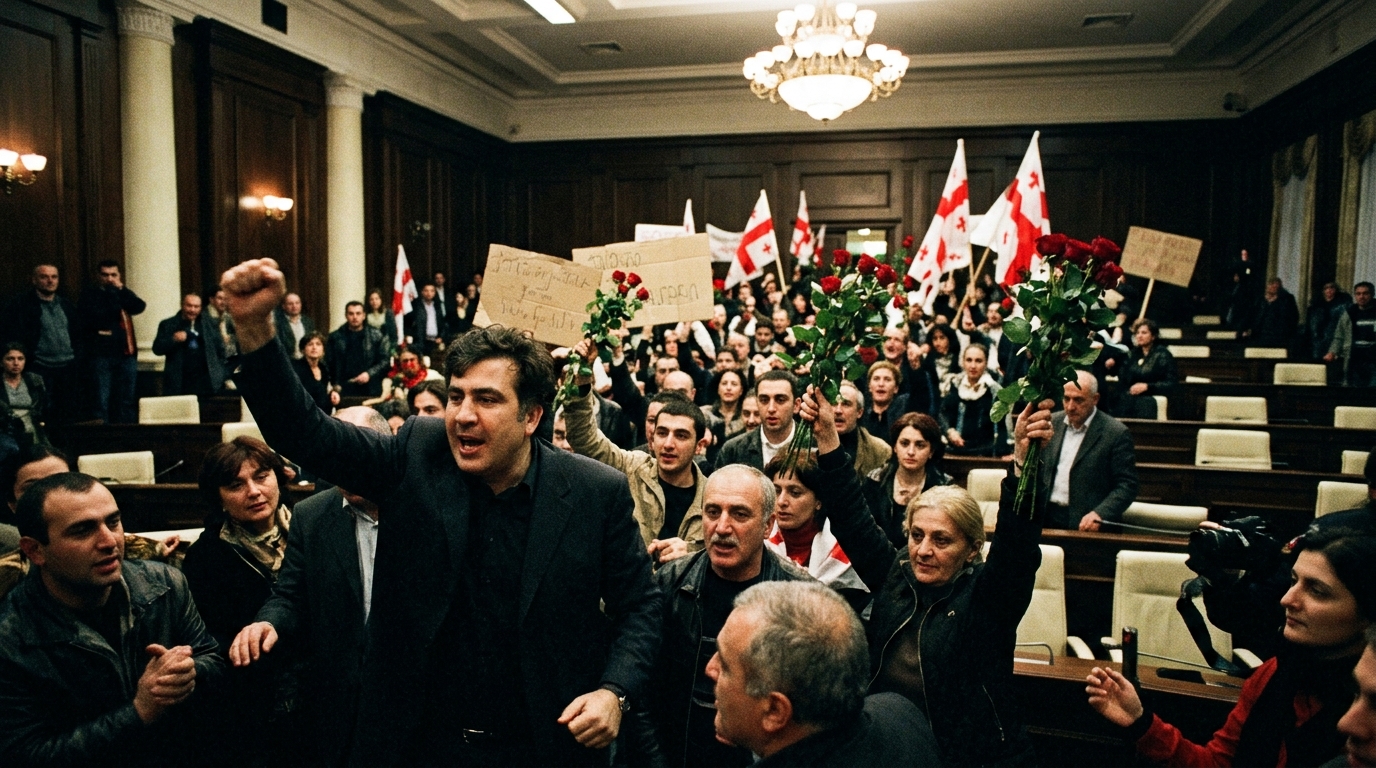
| Nov 22, 2003 | Parliamentary Storming and Shevardnadze's Flight | On the opening day of the new Parliament, as Shevardnadze addresses the chamber, protesters led by Saakashvili, carrying red roses, storm the legislature. Security forces offer minimal resistance, signaling their wavering loyalty. Shevardnadze is forced to flee mid-speech, escorted by bodyguards, thus losing his physical grip on power and symbolic authority. A state of emergency is declared by some officials, but it lacks enforcement. |
| Nov 23, 2003 | The Resignation and Power Transfer | Amid escalating tensions and the threat of civil unrest, Shevardnadze holds a meeting with opposition leaders (Saakashvili, Zhvania, Burjanadze), mediated by Russian Foreign Minister Igor Ivanov, at his presidential residence. Facing a unified opposition, a fractured security apparatus, and significant international pressure, Shevardnadze agrees to step down, stating his desire to avoid bloodshed. This paves the way for a constitutional power transfer, with Nino Burjanadze becoming acting president. |
| January 4, 2004 | Presidential Elections | Mikheil Saakashvili wins snap presidential elections with an overwhelming majority (over 96% of the vote), solidifying the transition initiated by the revolution. |
The iconography of the movement—protesters holding red roses as a symbol of peace and non-violence—gave the event its evocative name. It was a masterclass in strategic non-violent resistance, effectively utilizing humor, music, and the symbolic defiance of marching directly into the halls of power without engaging in physical violence. The sheer numbers and unwavering determination of the protesters, coupled with the erosion of state authority and the reluctance of security forces to confront their own citizens, proved insurmountable for the Shevardnadze regime.
The Role of International Support and Civil Society
The success of the Rose Revolution cannot be fully understood without acknowledging the significant, albeit often debated, role played by international actors and a robust domestic civil society. Far from being a purely spontaneous uprising, the movement benefited from years of groundwork and strategic assistance.
Western Funding and NGO Support:
Several Western governments and private foundations had been actively investing in Georgian civil society since the mid-1990s. The United States Agency for International Development (USAID), the National Democratic Institute (NDI), the International Republican Institute (IRI), and particularly George Soros's Open Society Foundations (OSF) provided substantial financial and technical support. This aid focused on:
- Democratic Institution Building: Strengthening nascent democratic institutions, supporting independent media, and funding election monitoring organizations.
- Civil Society Empowerment: Training local NGOs in advocacy, community organizing, and legal aid.
- Youth Mobilization: Providing resources and training for student groups like "Kmara" in non-violent resistance tactics, communication strategies, and digital literacy. OSF, for example, directly funded student groups and independent media outlets that became crucial conduits for opposition messaging.
This support was framed by Western donors as promoting democracy and good governance, aligning with their broader post-Cold War foreign policy objectives. Critics, particularly from Russia, often portrayed this as "foreign interference" or "color revolution technology," alleging a covert agenda to destabilize pro-Russian regimes. However, proponents argued that such funding merely enabled local actors to pursue their own legitimate aspirations for democracy and accountability, providing tools rather than dictating goals.
Training in Non-Violent Resistance:
A crucial element was the transfer of expertise in non-violent direct action. The Serbian youth movement Otpor! ("Resistance!"), which successfully overthrew Slobodan Milošević in 2000, served as a direct inspiration and mentor. Georgian activists from "Kmara" traveled to Serbia to receive training from former Otpor! members, learning practical tactics such as:
- Symbolic Communication: Using memorable symbols (like the rose), slogans ("Kmara!"), and humor to engage the public and ridicule the regime.
- Decentralized Organization: Building a network of activists with distributed leadership, making it harder for the state to decapitate the movement.
- Maintaining Non-Violence: Strict adherence to non-violence to delegitimize state repression and broaden public support.
- Strategic Escalation: Gradually increasing the intensity and visibility of protests.
These methods, derived from the theories of thinkers like Gene Sharp of the Albert Einstein Institution, proved highly effective in neutralizing potential state repression and maintaining the moral high ground.
The Role of Independent Media:
Independent media outlets, especially Rustavi 2 television, were instrumental in the Rose Revolution. At a time when state media was tightly controlled, Rustavi 2 provided a crucial platform for opposition voices, investigative journalism exposing corruption, and live coverage of protests. Its broadcast of the independent exit poll results on November 2, 2003, which starkly contrasted with the government's official figures, served as an immediate trigger for mass mobilization. This brave stance, often under threat of closure or intimidation, ensured that the public was informed and could coordinate their actions, fundamentally eroding the state's monopoly on information.
Ultimately, while the desire for change was indigenous, the Rose Revolution's success was significantly amplified by the strategic support, training, and resources provided by international partners, enabling Georgian civil society to translate widespread discontent into effective political action.
Geopolitical Consequences and Aftermath
The ousting of Shevardnadze sent profound shockwaves through the Kremlin and fundamentally reshaped the geopolitical landscape of the South Caucasus and beyond. For Moscow, Georgia was not merely a neighbor; it was a cornerstone of the regional security architecture, a historical part of its sphere of influence, and a critical transit route. The ascent of Mikheil Saakashvili, with his explicit pro-Western agenda, represented a "geopolitical defection" that Moscow viewed as both a betrayal and an existential threat—a direct encroachment by Western powers into its "near abroad."
Centralization of State Power and Domestic Reforms:
Saakashvili's new administration immediately launched aggressive and far-reaching reforms aimed at dismantling "Shevardnadzism" and establishing a modern, functional state. Key initiatives included:
- Anti-Corruption Drive: A zero-tolerance policy targeting police, customs, and other state agencies. Thousands of corrupt officials were fired or arrested. This led to a dramatic reduction in petty corruption and improved public services.
- Police Reform: The notoriously corrupt traffic police force was entirely disbanded and rebuilt from scratch, significantly enhancing public trust and state legitimacy.
- Economic Liberalization: Sweeping reforms to simplify tax codes, reduce bureaucracy, and encourage foreign investment. Georgia rapidly climbed global rankings for ease of doing business.
- Military Modernization: Significant investments were made in professionalizing and re-equipping the Georgian armed forces, often with Western assistance, a move viewed with deep suspicion by Russia.
While these reforms led to unprecedented economic growth and a visible improvement in public services, critics eventually argued that Saakashvili's approach, while effective in the short term, led to an "illiberal democracy." Concerns arose over the concentration of power in the presidency, a weakening of checks and balances, the marginalization of political opposition, and alleged human rights abuses. This criticism intensified towards the latter part of his two terms in office, suggesting that the drive for efficiency and reform sometimes came at the cost of democratic safeguards.
Russo-Georgian Antagonism:
The Rose Revolution plunged Russo-Georgian relations into a downward spiral of antagonism. Moscow perceived Saakashvili's Western orientation as an unacceptable challenge to its regional hegemony. Tensions steadily escalated through various means:
- Economic Embargoes: Russia imposed politically motivated economic sanctions, most notably banning imports of Georgian wine, mineral water (Borjomi), and agricultural products in 2006, ostensibly due to health concerns, but widely understood as a retaliatory measure.
- Energy Disputes: Russia used its leverage as Georgia's primary energy supplier, increasing gas prices and periodically disrupting supply, creating energy crises.
- Spy Scandals and Diplomatic Crises: Frequent expulsions of diplomats, allegations of espionage, and a general climate of mistrust became routine.
- Support for Separatist Regions: Russia dramatically increased its political, economic, and military support for the breakaway regions of Abkhazia and South Ossetia, issuing Russian passports to their residents, building infrastructure, and conducting military exercises, effectively integrating them into its sphere of control. This was a direct challenge to Georgia's territorial integrity and a major flashpoint.
- Military Posturing: Russia maintained its military bases in Georgia (Batumi and Akhalkalaki), despite Georgia's demands for their withdrawal, eventually withdrawing them in 2007 but increasing its military presence in the separatist regions.
This escalating tension culminated in the devastating 2008 Russo-Georgian War. The five-day conflict resulted in Russia's recognition of Abkhazia and South Ossetia as independent states, a significant portion of Georgian territory coming under effective Russian military control, and a long-term humanitarian crisis for internally displaced persons. The war fundamentally altered the regional security architecture and confirmed Moscow's willingness to use military force to prevent perceived Western encroachment in its "near abroad."
Regional Domino Effect:
The success of the Rose Revolution had an immediate and profound impact on the post-Soviet space, sparking hope among opposition movements and alarm bells in authoritarian capitals.
- Ukraine's Orange Revolution (2004): Just a year after Tbilisi, Ukraine experienced its own "Color Revolution" following a disputed presidential election. Georgian activists, including "Kmara" members, even traveled to Kyiv to assist Ukrainian counterparts. The Orange Revolution saw mass protests, a Supreme Court ruling annulling fraudulent results, and a rerun election that brought pro-Western Viktor Yushchenko to power.
- Kyrgyzstan's Tulip Revolution (2005): In Central Asia, similar dynamics led to the overthrow of President Askar Akayev amid protests against corruption and authoritarianism. While initially celebrated, the Tulip Revolution was more chaotic and ultimately led to further instability in Kyrgyzstan.
These events, fueled by similar grievances (corruption, authoritarianism, disputed elections) and often employing similar non-violent tactics, fundamentally altered the Kremlin’s geopolitical strategy. Moscow, led by Vladimir Putin, began to view these revolutions not as genuine popular uprisings but as Western-orchestrated coups, designed to encircle Russia and undermine its influence. This perception led to:
- Increased Support for "Managed Democracy": Moscow intensified its efforts to consolidate "managed democracy" at home and support friendly authoritarian regimes abroad, often providing financial aid and security assistance.
- Crackdown on NGOs: A tightening of laws on foreign-funded NGOs within Russia and its allies, branding them "foreign agents" and restricting their activities, to prevent similar movements from taking root.
- Emphasis on Sovereignty and Multipolarity: Russia increasingly emphasized state sovereignty and a multipolar world order, directly challenging the Western-led promotion of democracy and human rights as justification for intervention.
- Investment in Propaganda and Disinformation: A significant increase in state-controlled media and propaganda efforts to counter Western narratives and discredit opposition movements.
The Rose Revolution, therefore, was not merely a Georgian affair; it was a catalyst that reshaped the ideological battlefield and power dynamics across the entire post-Soviet realm, setting the stage for future confrontations.
Analysis of Key Actors and Decisive Actions
The Rose Revolution was a complex interplay of individual leadership, collective action, and external factors. Understanding the roles of key figures is crucial to grasping its swift success.
Mikheil Saakashvili: The Catalyst
Mikheil Saakashvili's role was undeniably central. His genius lay in his ability to articulate the widespread discontent into a clear political program and to galvanize diverse segments of society.
- Charisma and Communication: Saakashvili possessed exceptional charisma and rhetorical skills, honed by his Western education and political experience. He connected with the urban intelligentsia, disillusioned youth, and segments of the rural population. His use of direct, passionate language, often in televised speeches, bypassed state propaganda and resonated with a population tired of opaque Soviet-era politics.
- Anti-Corruption Platform: By adopting the rhetoric of anti-corruption and anti-clericalism (in terms of political corruption and illicit enrichment), he successfully framed the election as a binary choice: the stagnant, corrupt past (Shevardnadze) versus a modern, transparent, and pro-Western future (Georgia).
- Strategic Defiance: His refusal to accept the legitimacy of the ballot boxes, backed by independent exit polls and mass protests, was the decisive act of defiance that created a constitutional crisis and paralyzed the state’s repressive apparatus. His dramatic entrance into Parliament, rose in hand, became the iconic image of the revolution.
- Unifying Force: Despite initial rivalries with other opposition figures like Zhvania and Burjanadze, Saakashvili emerged as the undisputed leader during the critical days of the revolution, capable of uniting disparate opposition forces under a common banner.
Eduard Shevardnadze: The Reluctant Exit
Shevardnadze’s decision to step down, rather than unleash state violence, remains a subject of historical debate.
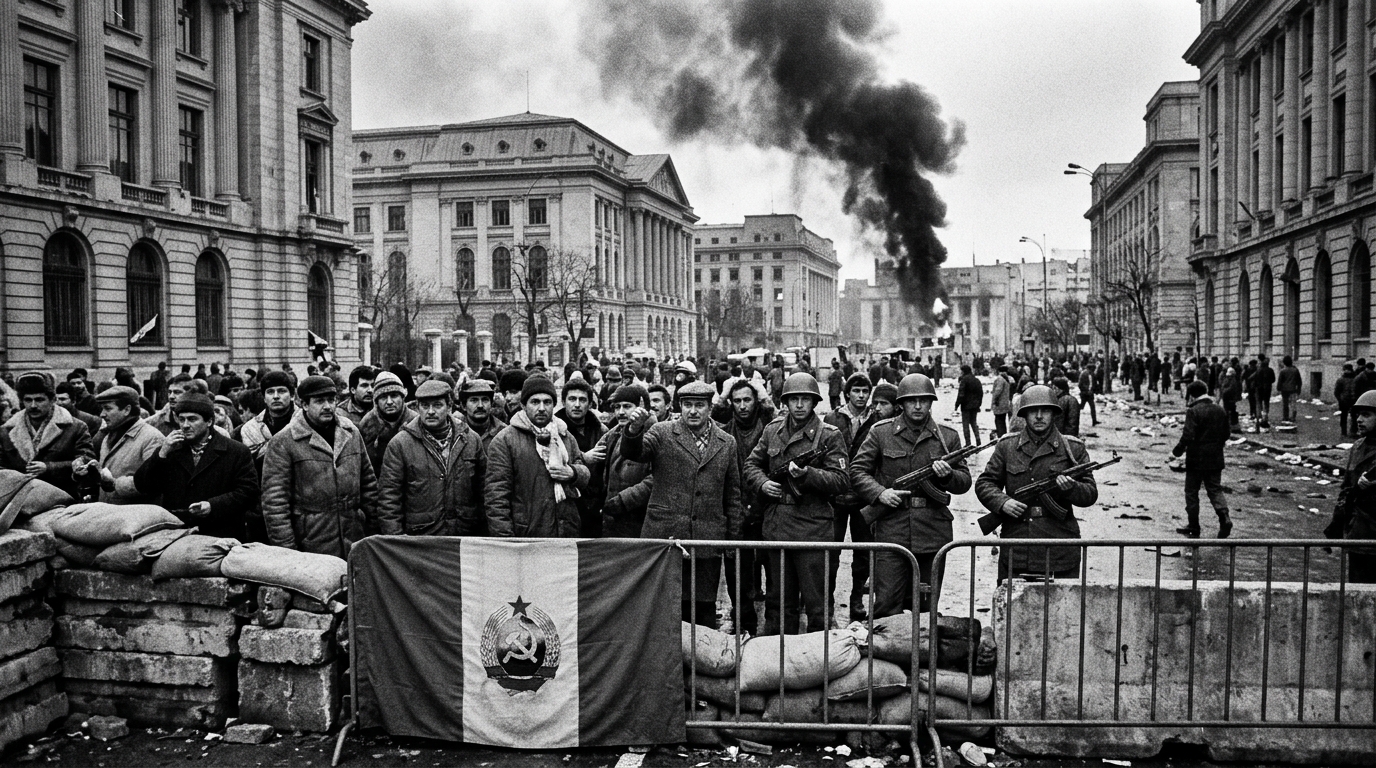
- Pragmatism vs. Weakness: While his government was characterized by corruption, Shevardnadze was also a seasoned politician, a former Soviet Foreign Minister who had navigated the complexities of superpower diplomacy. His decision to avoid the "Romanian option"—the violent end of Nicolae Ceaușescu—is often cited by historians as a pragmatic choice, reflecting a recognition of his own weakening position.
- Erosion of Authority: Despite his previous iron-fisted rule, by 2003, his security forces and military were no longer reliably loyal. Corruption had permeated even these institutions, and many officers and soldiers shared the public's grievances. The minimal resistance offered during the parliamentary storming was a clear indication that he could not count on them to suppress a mass popular movement.
- International Pressure: Significant pressure from Western capitals, alongside Russia's mediation, likely reinforced his decision to step aside. He understood the international implications of a bloody crackdown. As he famously noted during the transition:
Igor Ivanov: The Russian Broker
The role of the Russian Foreign Minister, Igor Ivanov, is crucial for understanding Moscow's initial strategy and its miscalculation.
- Preventing Chaos: Russia’s primary motivation was to prevent chaos and civil war on its southern border. A bloody uprising in Georgia could have spilled over into the volatile North Caucasus region of Russia itself, potentially destabilizing Russian internal affairs.
- Maintaining Influence (or attempting to): By mediating the transition, Moscow hoped to maintain influence over the successor government. The assumption was that by facilitating a peaceful handover, Russia could secure a friendly, or at least neutral, outcome, potentially installing a more pliable interim leader.
- Miscalculation: While Ivanov’s maneuver successfully prevented a bloody civil war, it ultimately failed to keep a pro-Russian regime in place. The new leadership under Saakashvili proved far more decisively pro-Western than Moscow had anticipated or desired. Russia's intervention, therefore, inadvertently legitimized the opposition's victory and paved the way for Georgia's westward pivot, which would eventually lead to severe geopolitical friction. Ivanov's mediation highlighted Russia's deep-seated interest in its "near abroad" but also exposed its limited ability to control the outcomes of popular uprisings.
Intelligence Failures and Security Apparatus Responses
The Rose Revolution also serves as a case study in intelligence failures and the breakdown of state security apparatuses in the face of widespread popular dissent. Shevardnadze's regime, despite its authoritarian tendencies, was caught off guard by the speed and scale of the opposition's mobilization.
Intelligence Breakdown:
- Underestimation of Opposition: Georgian intelligence services consistently underestimated the organizational capacity, popular support, and strategic sophistication of the opposition. They viewed Saakashvili, Zhvania, and Burjanadze as disparate political rivals rather than a coalescing force.
- Lack of Infiltration: Despite years of Shevardnadze's rule, the security agencies failed to effectively infiltrate or neutralize key opposition groups, particularly the youth movement "Kmara." This allowed "Kmara" to organize, train, and disseminate information largely unimpeded.
- Misreading Public Mood: The intelligence apparatus, often insulated from public sentiment and accustomed to delivering reports palatable to the regime, failed to accurately gauge the depth of public anger over corruption and election fraud. This led to a critical miscalculation of the potential for mass mobilization.
- Technological Disadvantage: While the government relied on traditional surveillance, the opposition effectively utilized emerging technologies (mobile phones, independent internet forums, satellite TV) to coordinate and disseminate information, often bypassing state controls.
Security Apparatus Response:
- Wavering Loyalty: The most critical factor was the wavering loyalty, and eventual inaction, of the police, military, and state security services. Years of corruption had hollowed out these institutions, eroding discipline, morale, and professional integrity. Many officers themselves were victims of low wages and bribery, sharing the public's frustrations.
- Refusal to Use Force: When confronted with tens of thousands of peaceful protesters, particularly those carrying roses and engaging in non-violent defiance, security forces largely refused to use force. There were no orders for a violent crackdown that were widely followed, suggesting either a deliberate decision by higher-ups to avoid bloodshed or a widespread refusal at lower levels to execute such orders.
- Internal Divisions: There were reports of internal divisions within the security establishment, with some elements potentially sympathetic to the opposition or at least unwilling to prop up a widely detested regime. This meant Shevardnadze could not rely on a cohesive, loyal force to suppress the uprising.
- Symbolic Power of Non-Violence: The opposition's commitment to non-violence proved strategically brilliant. It made any potential use of force by the state appear disproportionate and brutal, further alienating the security forces and international observers. The images of protesters handing roses to riot police effectively neutralized the psychological barrier for using force.
In essence, the intelligence failure to predict and the security apparatus's inability (or unwillingness) to suppress the revolution were as critical to its success as the opposition's organizational prowess. Shevardnadze lost control of the streets because he lost control of his own instruments of power.
Trivia and Lesser-Known Facts
- The Red Rose Symbol: While widely associated with the movement, the rose was also a symbolic nod to the "peaceful" nature of the transition, as many protesters actually handed roses to the riot police, effectively neutralizing their willingness to use force and appealing to their shared Georgian identity. The visual imagery was carefully cultivated to present the movement as civic, not violent.
- Institutional Legacy of "Kmara": The "Kmara" movement, the youth wing that led the protests, was largely inspired by and directly trained by the tactics of the Serbian "Otpor!" movement. This highlights the transnational nature of post-Soviet democratic training and the active sharing of strategies between emerging civil societies. "Kmara" itself later became an inspiration and trainer for activists in Ukraine and Kyrgyzstan.
- Constitutional Aftermath and Power Shift: The immediate aftermath of the revolution led to an ad-hoc constitutional crisis. Nino Burjanadze, as the Speaker of Parliament, constitutionally became interim President. However, the subsequent constitutional amendments, largely driven by Saakashvili, shifted Georgia to a heavily presidential-centric system. Ironically, these amendments granted Saakashvili the very expansive powers he would later be accused of abusing by critics concerned about democratic backsliding.
- The "Energy Revolution" That Wasn't: A lesser-known factor contributing to public discontent was the perennial energy crisis. Georgia suffered from chronic electricity and gas shortages, especially in winter, due to corruption in the energy sector and reliance on Russian supplies. While not the primary cause of the revolution, the promise of stable energy was a significant implicit demand from the population, though fully resolving it proved a long-term challenge for the new government.
- The Role of Arts and Culture: Georgian artists, musicians, and filmmakers also played a subtle but important role, often embedding anti-establishment messages in their work, performing at rallies, and contributing to the vibrant atmosphere of dissent. Humor and satire were potent tools used to mock the Shevardnadze regime and galvanize public support.
- Initial U.S. Skepticism: While the U.S. later became a strong supporter of the Rose Revolution, there was initial skepticism within some parts of the U.S. administration about the stability of Saakashvili's movement and concerns about potential Russian reactions to a dramatic shift in Georgia. However, as the non-violent nature of the protests became clear, U.S. support solidified.
Long-Term Legacy and Historiographical Debates
The Rose Revolution's legacy is a complex tapestry of successes, failures, and ongoing geopolitical ramifications, continuing to shape Georgia's domestic trajectory and its place in the world.
Domestic Legacy: A Mixed Record of Reform and Centralization
Within Georgia, the revolution ushered in a period of unprecedented reform and economic growth, but also raised concerns about the health of its democratic institutions:
- Anti-Corruption Successes: The initial years under Saakashvili saw remarkable achievements in combating corruption, particularly in the police force and public services. This led to a significant increase in public trust in state institutions and attracted foreign investment.
- Economic Growth: Liberal economic policies spurred economic growth, improved infrastructure, and professionalized state administration. Georgia became a regional leader in economic reform.
- Democratic Erosion: Critics argue that Saakashvili's pursuit of rapid, top-down reforms led to an authoritarian drift. Concerns emerged about the concentration of power in the executive, weakening of judicial independence, selective justice against political opponents, and media freedom. This debate often frames the Saakashvili era as a shift from "state capture" by oligarchs to "state capture" by a centralized political party.
- Political Polarization: The Rose Revolution initiated a highly polarized political landscape in Georgia, with a strong pro-Western, reformist camp often pitted against a more conservative, sometimes pro-Russian, opposition. This polarization remains a defining feature of Georgian politics.
Regional Impact: A Template and a Warning
The Rose Revolution undeniably served as a template for subsequent "Color Revolutions" in Ukraine and Kyrgyzstan, demonstrating that citizens in post-Soviet states could challenge entrenched power through non-violent means. This inspired hope among pro-democracy activists across the region.
However, it also served as a stark warning for Russia and other authoritarian regimes. For the Kremlin, the Rose Revolution was a pivotal moment that fundamentally altered its foreign policy doctrine. Russia began to view these movements as a direct threat to its national security and sphere of influence, leading to:
- Proactive Counter-Revolutionary Measures: Increased efforts to cultivate "managed democracies," support loyal regimes, and crack down on civil society organizations deemed to be promoting "foreign influence."
- Shift in Information Warfare: A significant increase in state-sponsored propaganda, disinformation campaigns, and media control to shape narratives and discredit perceived Western plots.
- Militarization of Foreign Policy: The Rose Revolution and its successors are often cited as a contributing factor to Russia's more assertive, and often militarized, foreign policy in its "near abroad," culminating in actions like the 2008 Russo-Georgian War and the 2014 annexation of Crimea.
Geopolitical Realignment and the 2008 War:
Perhaps the most enduring and tragic legacy of the Rose Revolution is its direct contribution to the long-term deterioration of Russo-Georgian relations, culminating in the 2008 Russo-Georgian War. Saakashvili's unwavering pursuit of NATO and EU membership, combined with his efforts to regain control over Abkhazia and South Ossetia, was perceived by Moscow as an intolerable provocation. The war, a direct consequence of the post-Rose Revolution geopolitical realignment, solidified Russia's military presence in the breakaway regions and permanently fractured Georgia's territorial integrity. It also served as a critical precedent for future Russian military interventions in its neighborhood.
Historiographical Debates:
Academic and public discourse surrounding the Rose Revolution continues to evolve:
- "Authentic Uprising" vs. "Western Plot": A central debate revolves around whether the revolution was an authentic, grassroots uprising of a disillusioned populace or a "Western-orchestrated coup" fueled by foreign money and expertise. Most scholarly consensus acknowledges the genuine domestic grievances but also the undeniable, and sometimes crucial, role of external support for civil society and non-violent training.
- "Democratic Breakthrough" vs. "Authoritarian Rebound": Another debate centers on whether the Rose Revolution ultimately led to a sustainable democratic breakthrough in Georgia or merely replaced one form of authoritarianism with another. While reforms were significant, concerns about the concentration of power under Saakashvili and subsequent political challenges suggest a more nuanced picture.
- The "Color Revolutions" Model: The Rose Revolution established a model for "Color Revolutions," but the varied outcomes in Ukraine (Orange Revolution) and Kyrgyzstan (Tulip Revolution, which was more violent and less stable) suggest that while the tactics could be replicated, local conditions, institutional strength, and geopolitical context profoundly influence the long-term success and democratic consolidation.
In conclusion, the Rose Revolution was a watershed moment—the first successful non-violent popular uprising in the post-Soviet space. It demonstrated the power of civil society, independent media, and strategic non-violence to challenge entrenched power. However, its legacy is complex: a blend of domestic reform, geopolitical realignment, and renewed regional instability that continues to shape the strategic landscape of Eastern Europe and the Caucasus.
References and Literature
- The Rose Revolution: The Beginning of the Color Revolutions - A comprehensive analysis of the geopolitical shifts in Eurasia following the 2003 events, emphasizing the cascading effects across the post-Soviet space.
- Mitchell, L. A. (2009). Uncertain Democracy: U.S. Foreign Policy and Georgia's Rose Revolution - A deep dive into the role of U.S. soft power, civil society support, and the complex relationship between external assistance and internal democratic transitions in Georgia.
- Shevardnadze, E. (2006). The Future Belongs to Freedom - The former President's autobiographical reflection on the fall of his administration, offering his perspective on the "Color Revolutions" and the forces that led to his resignation.
- Karatnycky, A. (2005). The Orange Revolution: A Time for Action, A Time for Change. Freedom House. - Provides broader context on the "Color Revolutions" phenomenon, drawing parallels and contrasts with the Georgian experience.
- Welt, C. (2006). "The Revolution in Georgia." Journal of Democracy, 17(1), 127-141. - An academic analysis of the causes, events, and immediate consequences of the Rose Revolution, often cited for its insights into the role of youth movements and opposition coordination.
- Cornell, S. E. (2000). Small Nations and Great Powers: A Study of Ethnopolitical Conflict in the Caucasus. Routledge. - Offers crucial historical context on Georgia's post-Soviet conflicts in Abkhazia and South Ossetia, essential for understanding the underlying geopolitical tensions that pre-dated and were exacerbated by the Rose Revolution.
Footnotes & Explanations
- Quote adapted from various archival interviews and reports, including BBC coverage on November 24, 2003, and subsequent analyses of Shevardnadze's statements regarding his decision to step down to prevent further conflict. ↩