Key Takeaways
- The catastrophic failure of Reactor No. 4 on April 26, 1986, was driven by critical RBMK design flaws and a deeply entrenched culture of bureaucratic secrecy.
- The Soviet state's initial attempts to cover up the disaster severely damaged its domestic and international credibility, forcing Mikhail Gorbachev to accelerate his policy of glasnost (openness).
- The economic burden of the cleanup, combined with rising ecological nationalism in Ukraine and Belarus, acted as a powerful catalyst for the eventual collapse of the USSR.
The catastrophe that unfolded at the Chernobyl Nuclear Power Plant on April 26, 1986, is universally recognized as the worst civilian nuclear disaster in human history. Yet, its significance extends far beyond the realms of physics, engineering, and public health. Chernobyl was a watershed political event—a systemic shock that laid bare the structural decay, pathological secrecy, and administrative incompetence of the Soviet Union under the Communist Party of the Soviet Union (CPSU) 1.
For General Secretary Mikhail Gorbachev, who had assumed power just over a year prior, the disaster served as a brutal wake-up call. It exposed the rot within the Soviet military-industrial complex and forced a radical acceleration of glasnost (openness) and perestroika (restructuring). By releasing a cascade of ecological, economic, and nationalist forces, the meltdown of Reactor No. 4 became, in Gorbachev's own retrospective assessment, perhaps the true catalyst for the collapse of the Soviet empire five years later.
Historical Context and Origins
To understand the Chernobyl disaster, one must examine the specific evolution of the Soviet nuclear program and the broader geopolitical anxieties of the Late Soviet Era. Following the Second World War, the Soviet Union raced to achieve nuclear parity with the United States. Nuclear energy was not merely a source of electricity; it was a symbol of socialist modernity, scientific triumph, and ideological supremacy.
The Cult of the Soviet Atom and Sredmash
The Soviet nuclear industry operated under the auspices of the ultra-secretive Ministry of Medium Machine Building (Sredmash). Sredmash existed as a state-within-a-state, answerable only to the highest echelons of the Politburo. It enjoyed immense funding, prestige, and a total immunity from public scrutiny or independent regulatory oversight 2. In this environment, criticism of nuclear safety was treated as a treasonous assault on the achievements of the Soviet state.
This culture of infallible technocracy bred dangerous complacency. Soviet scientists and administrators boasted that Soviet nuclear reactors were so safe they could be built in the center of Moscow, near the Kremlin.
The RBMK Reactor: A Compromise of Design
At the heart of the Chernobyl tragedy was the RBMK-1000 (Reaktor Bolshoy Moshchnosti Kanalnyy, or "High-Power Channel-Type Reactor"). The RBMK design was favored by Soviet planners for several reasons:
- Scale and Cost: It could be built rapidly without the massive, expensive steel pressure vessels required by Western pressurized water reactors (PWRs).
- Dual-Use Capability: It utilized enriched uranium fuel while simultaneously producing weapons-grade plutonium, fitting the military-industrial requirements of the Cold War.
- On-Load Refueling: It allowed individual fuel channels to be refueled without shutting down the entire reactor, maximizing electrical output.
However, the RBMK possessed critical, latent design flaws that were downplayed or outright classified by the state. The most dangerous of these was its positive void coefficient. In most Western reactors, as water turns to steam (forming "voids"), the nuclear reaction slows down because water acts as a moderator. In the RBMK, which used solid graphite blocks as a moderator and water only as a coolant, steam voids actually increased the rate of fission, creating a positive feedback loop: more heat generated more steam, which led to more power, generating yet more heat.
Furthermore, the reactor's control rods—designed to absorb neutrons and halt the reaction—were tipped with graphite. Under certain conditions, inserting these rods would briefly displace coolant water with graphite, causing a localized increase in reactivity before the absorbing boron section could enter the core. This "emergency protection" system carried a lethal trigger mechanism, a vulnerability known to the scientific elite but withheld from the operators who actually ran the plants 3.
Timeline of Events and Key Moments
The destruction of Reactor No. 4 was not the result of a single error, but a tragic convergence of a flawed machine, a poorly planned electrical experiment, and an authoritarian hierarchy that penalized dissent.
April 25, 1986: The Setup
On the afternoon of April 25, the operators of Chernobyl's Reactor No. 4 prepared to conduct a safety test during a scheduled maintenance shutdown. The test was designed to determine whether the residual rotational energy of the turbogenerators could spin out enough electricity to power the emergency cooling pumps during the critical 40-to-50-second gap between a grid failure and the startup of emergency diesel generators.
- Normal Operation
The test was supposed to be executed at a power level of 700–1000 Megawatts thermal (MWt). However, the regional power grid controller in Kyiv requested a delay in power reduction to meet peak electricity demands. This delayed the test by nine hours, pushing it into the night shift. The night shift crew was unprepared, had not been properly briefed, and was forced to operate under the pressure of completing a delayed procedure.
April 26, 1986: The Explosion
- 00:28: As power reduction resumed, an operator error caused the reactor power to plummet to near-zero (approx. 30 MWt). This triggered "reactor poisoning" by Xenon-135, a neutron-absorbing isotope that accumulates at low power levels.
- 01:00–01:20: To overcome the poisoning and boost power, operators systematically withdrew almost all of the reactor's control rods. They stabilized the reactor at 200 MWt—well below the safe threshold designated for the test. The reactor was now highly unstable, with its cooling systems working at capacity and almost no margin for safety.
- 01:23:04: The safety test officially began. The turbine valves were closed, cutting off steam to the generators. The coolant pumps slowed, reducing the flow of water through the core.
- 01:23:35: Due to reduced water flow and increased heat, steam voids rapidly formed in the fuel channels. Because of the positive void coefficient, the reactor's power began to climb exponentially.
- 01:23:40: Seeing the dangerous surge in power, the shift supervisor, Aleksandr Akimov, ordered the activation of the emergency shutdown button (AZ-5). This plunged all control rods back into the boiling core.
- 01:23:43: The graphite tips of the control rods entered the core first, displacing water and triggering a localized prompt-neutron power surge. The internal pressure deformed the fuel channels, trapping the rods mid-descent. Power skyrocketed to over 100 times the reactor's maximum design capacity.
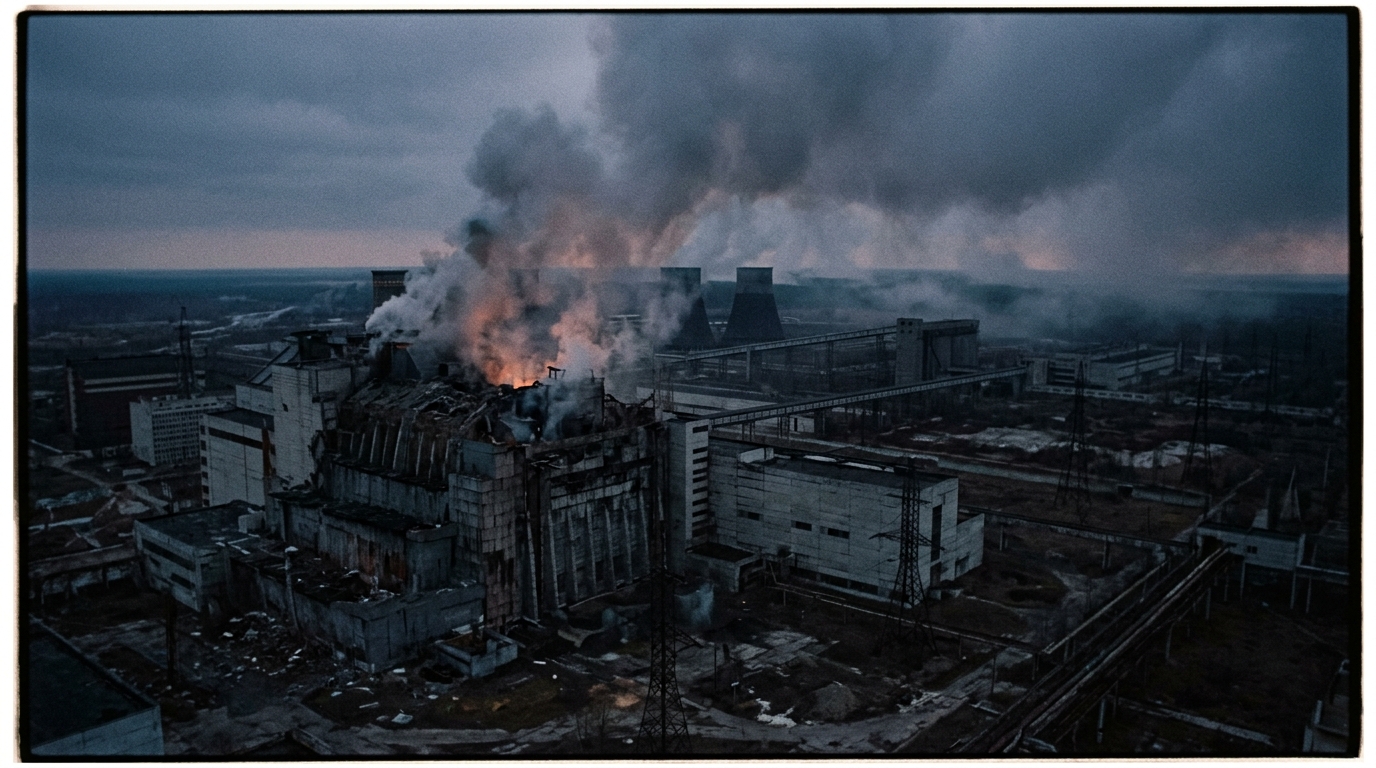
- 01:23:48: The immense thermal energy instantly vaporized the coolant water. A massive steam explosion ruptured the 2,000-ton concrete upper shield cover ("Elena") and blew through the reactor roof. Seconds later, a second explosion—likely a hydrogen-oxygen chemical explosion fueled by zirconium-steam reactions—occurred, ejecting burning graphite blocks and highly radioactive fuel into the night sky.
Chernobyl Reactor No. 4 Explosion Sequence
| Step | Event |
|---|---|
| 1 | AZ-5 Button Pressed |
| 2 | Graphite Rod Tips Enter Core |
| 3 | Localized Power Surge (Positive Void Coefficient) |
| 4 | Steam Pressure Ruptures Upper Shield ("Elena") |
| 5 | Air Ingress Triggers Secondary Hydrogen/Graphite Explosion |
| 6 | Open-Air Core Fire Releases Massive Radioactive Plume |
The Initial Cover-Up and Denial
The immediate response of the plant management and local authorities was characterized by psychological denial and bureaucratic paralysis. Plant Director Viktor Bryukhanov and Chief Engineer Nikolai Fomin refused to believe the core had been destroyed, reporting to Moscow that the reactor was intact and merely being cooled with water.
First responders—including local firefighters led by Lieutenant Volodymyr Pravyk—rushed to the scene without radiological protection, believing they were fighting a standard roof fire. Most would die of Acute Radiation Syndrome (ARS) within weeks.
For nearly 36 hours, the nearby city of Pripyat, home to 50,000 residents (mostly plant workers and their families), was not evacuated. Children played in the radioactive fallout, and residents watched the glowing blue column of ionized air rising from the ruins. It was not until the afternoon of April 27 that the military finally ordered a "temporary" evacuation, giving residents two hours to pack light luggage. They would never return.
Geopolitical Consequences and Aftermath
The radioactive plume did not respect the borders of the Soviet Union. On April 28, radiological monitoring stations at the Forsmark Nuclear Power Plant in Sweden, over 1,000 kilometers away, detected abnormally high levels of radiation 4. Sweden demanded explanations from Moscow. Confronted with irrefutable atmospheric evidence, the Soviet state news agency Tass released a terse, five-sentence statement late on April 28:
"An accident has occurred at the Chernobyl Nuclear Power Station. One of the atomic reactors has been damaged..."
This marked the beginning of a geopolitical nightmare for the Kremlin.
| Radioactive Isotope | Half-life | Primary Health & Environmental Impact |
|---|---|---|
| Iodine-131 | 8 days | Absorbed by the thyroid gland; primary cause of thyroid cancer in children. |
| Cesium-137 | 30 years | Bioaccumulates in soil, plants, and animals; long-term agricultural contamination. |
| Strontium-90 | 29 years | Behaves like calcium in the human body; deposits in bones and teeth, causing leukemia. |
The Blow to Soviet Prestige and Glasnost
The timing of the disaster was catastrophic for Mikhail Gorbachev's reform agenda. Having assumed office in March 1985, Gorbachev had preached glasnost (openness) as a tool to revitalize Soviet society. Yet, when faced with the ultimate test, the state machine defaulted to its traditional posture of absolute secrecy. Gorbachev himself remained silent on television until May 14, eighteen days after the explosion.
The international community condemned the USSR's disregard for global public health. European nations banned imports of Soviet agricultural products, and the global anti-nuclear movement gained immense momentum.
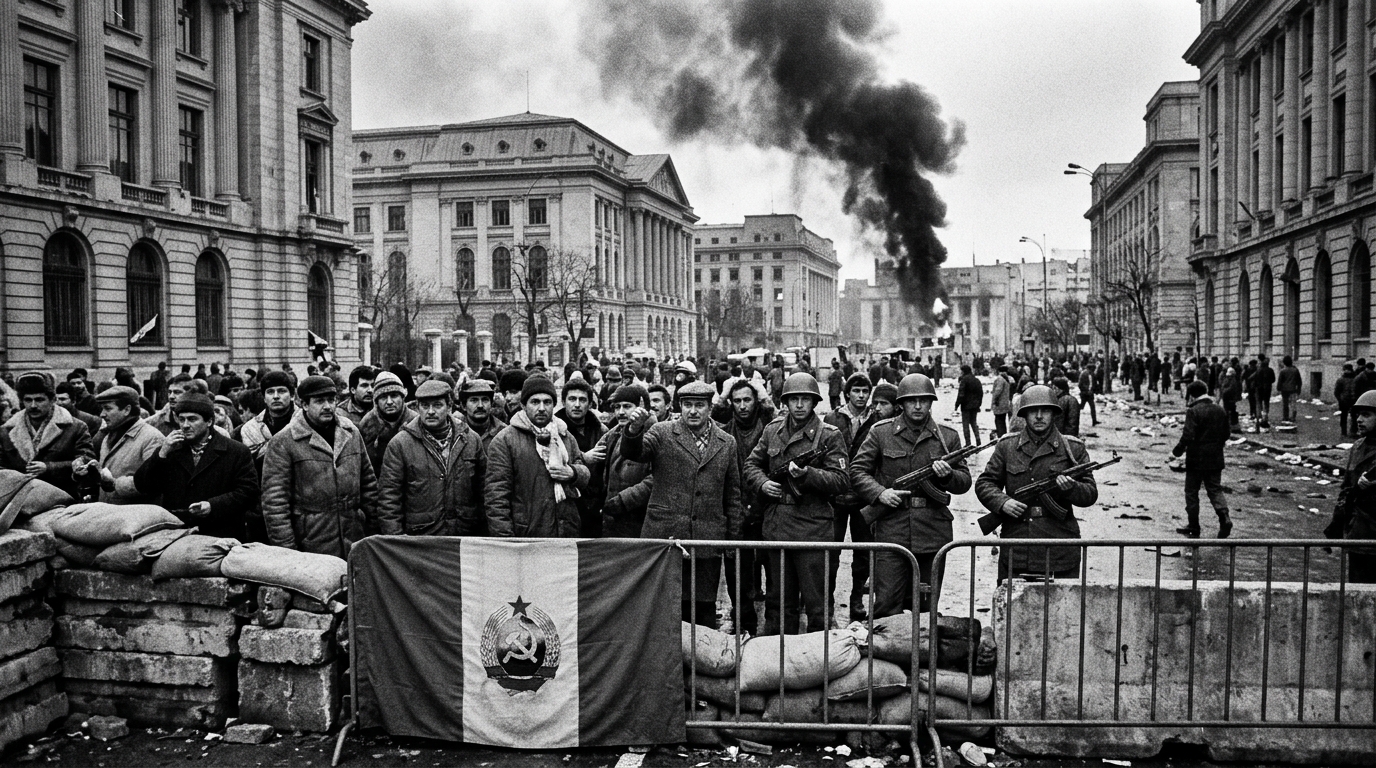
Internally, the realization that the government had actively concealed the danger—even proceeding with the annual May Day parades in Kyiv and Minsk while radioactive fallout was raining down—shattered the remaining social contract between the Soviet citizen and the Communist Party 5.
Economic Exhaustion
The economic cost of containing the disaster was staggering and occurred at a time when the Soviet economy was already reeling from collapsing global oil prices and the costly war in Afghanistan.
- The Liquidators: Over 600,000 soldiers, miners, and civilian specialists (known as "liquidators") were mobilized to clean up the site, construct the steel-and-concrete "Sarcophagus" over the ruined reactor, and bury contaminated villages.
- Direct Costs: Estimates of the direct economic damage of the disaster range from 18 billion to 100 billion rubles (equivalent to tens of billions of US dollars in the late 1980s). This financial drain effectively bankrupted the Soviet treasury, starving other critical economic sectors of desperately needed capital.
Soviet Economic Crunch (1986-1988)
- Contributing Factors
- Resulting Impact
- Final Outcome
The Rise of Eco-Nationalism
In Ukraine, Belarus, and the Baltic states, Chernobyl acted as a powerful accelerant for national liberation movements. The environmental degradation of their homelands was framed as a direct consequence of Moscow’s "colonial" and technocratic exploitation.
The Ukrainian cultural intelligentsia formed ecological associations, such as Zelenyi Svit ("Green World"), which quickly morphed into political opposition groups like Rukh (the People's Movement of Ukraine). The discourse shifted from demanding safe reactors to demanding national sovereignty, arguing that only an independent Ukraine could protect its citizens from the negligence of the Kremlin 6.
Analysis of Key Actors and Decisive Actions
The tragedy and its geopolitical fallout were shaped by several key figures whose actions, decisions, and ultimate fates mirrored the decline of the state they served.
Mikhail Gorbachev: The Reluctant Reformer
Gorbachev's handling of Chernobyl is one of the most controversial chapters of his leadership. His initial silence and acquiescence to the traditional cover-up damaged his credibility both at home and abroad.
However, the crisis ultimately transformed his worldview. Gorbachev realized that the system's structural defects could not be patched with cosmetic reforms. In his memoirs, he wrote:
"The nuclear accident at Chernobyl... was perhaps the real cause of the collapse of the Soviet Union five years later. Indeed, it was a turning point: it opened the possibility of much greater freedom of expression, to the point that the system as we knew it could no longer continue."
Following the disaster, Gorbachev gave greenlight to investigative journalism, allowed the publication of banned books, and pushed for genuine, multi-candidate elections, which ultimately led to the undoing of the CPSU’s monopoly on power.
Valery Legasov: The Voice of Conscience
First Deputy Director of the Kurchatov Institute of Atomic Energy, Academician Valery Legasov was appointed to the government commission investigating the disaster. Arriving at Chernobyl on April 26, Legasov quickly grasped the scale of the catastrophe and made crucial decisions, such as dumping tons of sand, boron, and lead from helicopters to smother the burning core.
At the International Atomic Energy Agency (IAEA) conference in Vienna in August 1986, Legasov delivered an unprecedentedly candid, five-hour report on the causes of the accident. While he defended the Soviet political system in public, he was privately devastated by the systemic negligence, the poor quality of Soviet manufacturing, and the state’s refusal to fix the remaining RBMK reactors.
Ostracized by the Soviet scientific establishment for his candor and denied the title of Hero of Socialist Labor, Legasov fell into deep depression. On April 27, 1988—exactly two years and one day after the disaster—he hung himself in his apartment, leaving behind tape recordings that detailed the systemic corruption and design flaws that made Chernobyl inevitable. His suicide sent shockwaves through the Soviet scientific community, forcing the state to finally implement safety upgrades on the remaining RBMK reactors.
Anatoly Dyatlov: The Face of Scapegoating
The assistant chief engineer of the Chernobyl plant, Anatoly Dyatlov, was the supervisor of the ill-fated test. Known for his abrasive, authoritarian management style, Dyatlov pressured the younger, inexperienced operators to continue the test despite the reactor's unstable condition.
In the aftermath, the Soviet state sought to frame the disaster entirely as the result of human error, shielding the RBMK design from public criticism. In a closed trial held in the contaminated zone of Chernobyl in 1987, Dyatlov, along with Bryukhanov and Fomin, was sentenced to ten years in a labor camp.
Though Dyatlov undoubtedly made reckless operational choices, his conviction was a classic Soviet exercise in shifting systemic blame onto individual actors. He was released early in 1990 and spent his remaining years writing articles and a book arguing that the reactor was fundamentally unlicensable and that the designers, not the operators, bore the primary responsibility 7.
Trivia and Lesser-Known Facts
- The "Suicide Squad" Divers: To prevent a massive steam explosion that could have occurred if the melting core burned through the concrete floor into the water-filled bubbler pools below, three men volunteered to wade through highly radioactive water to manually open the release valves. Contrary to urban legends that they died shortly after, Alexei Ananenko, Valeri Bezpalov, and Boris Baranov survived their mission; two are still alive today, and Baranov lived until 2005.
- The Red Forest: The pine forest surrounding the nuclear plant absorbed vast amounts of radiation, dying and turning a rusted ginger-brown color. The "Red Forest" remains one of the most active radiological zones on Earth.
- The Elephant’s Foot: In the dark basement ruins of Reactor No. 4 lies a highly radioactive mass of corium (molten fuel, concrete, and metal) known as the "Elephant's Foot." In 1986, just a few minutes of exposure to this mass was fatal. It remains radioactive and hot to this day.
- Sarcophagus Replacement: The initial concrete sarcophagus built in 1986 was designed to last only 30 years. In 2016, it was encased by the New Safe Confinement, a massive, €1.5 billion arch-shaped steel structure engineered to prevent further radioactive dust release for the next 100 years. It is the largest movable land-based structure ever built.
References and Literature
- Midnight in Chernobyl - Adam Higginbotham’s definitive, deeply researched journalistic account of the disaster and its political landscape.
- Chernobyl: History of a Tragedy - Harvard historian Serhii Plokhy’s award-winning analysis of the disaster and its role in the collapse of the Soviet Union.
- The Legacy of Chernobyl - An archived article from Foreign Affairs examining the immediate geopolitical fallout and ecological nationalism.
- INSAG-7 Report - The International Nuclear Safety Advisory Group's updated 1992 technical report, which revised the initial Soviet-dominated narrative to emphasize RBMK reactor design flaws.
Footnotes & Explanations
- Serhii Plokhy, Chernobyl: History of a Tragedy (London: Penguin Books, 2018), 32-35. ↩
- Adam Higginbotham, Midnight in Chernobyl: The Untold Story of the World's Greatest Nuclear Disaster (New York: Simon & Schuster, 2019), 45-48. ↩
- International Nuclear Safety Advisory Group, The Chernobyl Accident: Updating of INSAG-1 (INSAG-7) (Vienna: IAEA, 1992), 11-14. ↩
- "The Chernobyl Disaster: A International Timeline," Swedish Meteorological and Hydrological Institute (SMHI), archives. ↩
- Mikhail Gorbachev, Memoirs (New York: Doubleday, 1996), 432. ↩
- Jane Dawson, Eco-Nationalism: Anti-Nuclear Activism and National Identity in the Baltic Republics, Ukraine, and Belarus (Duke University Press, 1996), 87-92. ↩
- Anatoly Dyatlov, Chernobyl: How It Was (Moscow: Nauchtechlitizdat, 1995), 102. ↩