Key Takeaways
- The Second Chechen War served as the crucible for Vladimir Putin's consolidation of domestic political power and his transition from an obscure intelligence official to Russia's undisputed leader.
- A combination of radical Islamist incursions into Dagestan and the mysterious Russian apartment bombings of September 1999 shifted public sentiment, creating overwhelming support for a renewed military campaign.
- The siege and capture of Grozny redefined modern urban warfare, resulting in the near-total devastation of the Chechen capital and establishing a blueprint for Russia's subsequent military doctrines.
Historical Context and Origins
The Second Chechen War did not erupt in a vacuum; it was the direct consequence of the unresolved geopolitical, social, and economic pathologies of the post-Soviet transition. The First Chechen War (1994–1996) had ended in a humiliating de facto defeat for the Russian Federation. Under the terms of the Khasavyurt Accord, signed in August 1996 by General Alexander Lebed and Chechen Chief of Staff Aslan Maskhadov, Russian forces withdrew from the breakaway republic, leaving the question of Chechnya’s official status suspended until 2001 1.
- The Khasavyurt Accord (1996)
- Interwar Instability (1996-1999)
During this interwar period (1996–1999), the Chechen Republic of Ichkeria degenerated into a fractured state characterized by lawlessness, economic collapse, and institutional paralysis. Elected President in 1997, the moderate nationalist Aslan Maskhadov proved incapable of centralizing state authority or disarming the powerful network of warlords who had risen to prominence during the war. The Chechen economy, starved of reconstruction funds from Moscow and devastated by years of bombardment, was replaced by a criminalized economy driven by:
- Massive oil-siphoning networks
- Ransom-motivated kidnapping syndicates targeting foreign aid workers, journalists, and Russian citizens [[^2]]
- Transnational smuggling pipelines
This chaotic environment provided fertile soil for the rapid growth of radical Islamic ideology. Foreign fighters, financed by Gulf-based charities and led by the Saudi-born commander Ibn al-Khattab, introduced a militant, Salafi-Wahhabi ideology that directly challenged both traditional Chechen Sufism and Maskhadov’s nationalist agenda. This ideological rift split the Chechen leadership.
While Maskhadov sought international recognition and a negotiated settlement with Moscow, radical warlords like Shamil Basayev and Khattab envisioned a broader regional jihad aimed at liberating the entire North Caucasus from Russian rule and establishing a pan-Islamic Caliphate.
Meanwhile, across the border in Moscow, the late 1990s represented a period of profound vulnerability. The Russian Federation was reeling from the 1998 ruble crisis, which wiped out the savings of millions and undermined public confidence in the market-oriented reformers.
President Boris Yeltsin was physically frail, politically unpopular, and surrounded by a coterie of family members and oligarchs known as "The Family." This group was preoccupied with securing their own safety and fortunes ahead of the upcoming 2000 presidential elections. As the state seemed to slide toward systemic collapse, the Kremlin urgently sought a successor capable of preserving the political status quo while restoring a semblance of order and state authority.
Timeline of Events and Key Moments
The path to war and the subsequent military campaign developed rapidly in the late summer and autumn of 1999, fundamentally shifting the trajectory of Russian domestic politics and regional security.
1999
- Aug 7: Basayev & Khattab invade Dagestan
- Aug 9: Yeltsin appoints Putin as Prime Minister
- Sep: Apartment bombings kill over 300 across Russia
- Sep 30: Russian ground forces enter Chechnya
- Dec: Siege of Grozny begins
2000
- Jan: Putin becomes Acting President (Yeltsin resigns Dec 31)
- Feb 6: Grozny captured; insurgents retreat to southern mountains
The Incursion into Dagestan (August–September 1999)
On August 7, 1999, Shamil Basayev and Ibn al-Khattab led an armed force of approximately 2,000 fighters—the Islamic Peacekeeping Brigade—across the border from Chechnya into the neighboring Russian republic of Dagestan. Their objective was to support local Islamist insurgents in the Botlikh and Novolaksky regions and declare an independent Islamic state.
The invasion did not trigger the popular uprising the warlords expected. Instead, local Dagestani villagers armed themselves and, alongside the Russian military, fought back against the invaders.
On August 9, as the fighting in Dagestan intensified, Boris Yeltsin dismissed Prime Minister Sergei Stepashin and appointed Vladimir Putin, the relatively obscure head of the Federal Security Service (FSB), in his place. Yeltsin openly declared Putin his chosen successor. By mid-September, Russian forces had pushed the Islamist insurgents back across the Chechen border, but the incursion had already shattered the fragile status quo established by the Khasavyurt Accord.
The Russian Apartment Bombings (September 1999)
In September 1999, a series of devastating explosions targeted apartment buildings in the Russian cities of Buynaksk, Moscow, and Volgodonsk, killing over 300 people and injuring more than 1,000 3. The sheer terror of civilian apartment blocks being reduced to rubble in the middle of the night sent shockwaves of panic through Russian society.
The Russian government immediately blamed Chechen terrorists. Although Chechen leaders, including President Maskhadov, denied any involvement, the bombings transformed public sentiment. A population previously exhausted by military conflict now demanded decisive state action and revenge.
A highly controversial incident occurred in the city of Ryazan on September 22, 1999, when local residents spotted individuals placing bags of white powder in the basement of an apartment building. A preliminary test by local bomb disposal teams indicated the presence of hexogen (RDX).
The following day, Prime Minister Putin praised the vigilance of Ryazan's citizens, but soon after, the FSB claimed the incident was a training exercise designed to test public alertness, and that the bags contained only sugar. This incident fueled persistent conspiracy theories, championed by critics like former FSB officer Alexander Litvinenko, suggesting the FSB itself was involved in the bombings to create a pretext for war 4. However, for the vast majority of the Russian public in the autumn of 1999, the bombings were the work of Chechen terrorists, and military intervention was seen as a necessity.
| Step | Event | Details |
|---|---|---|
| 1 | Dagestan Incursions | Aug-Sept 1999 |
| 2 | Sept. Apartment Bombs | 300+ civilian deaths |
| 3 | Public Clamor for Decisive Action | |
| 4 | Ground Invasion | Sept 30, 1999 |
| 5 | Siege of Grozny | Dec 1999-Feb 2000 |
| 6 | Grozny Captured | Feb 2000 |
The Ground Invasion and the Siege of Grozny
On September 30, 1999, Russian ground forces crossed the border into Chechnya. Unlike the disorganized, ad-hoc columns of 1994, this campaign was planned with methodical caution. The Russian military, under the command of generals like Viktor Kazantsev and Anatoly Kvashnin, prioritized the heavy use of long-range artillery, airstrikes, and tactical missiles to soften opposition before infantry units advanced. By December, Russian forces had isolated the northern lowlands and surrounded the capital, Grozny.
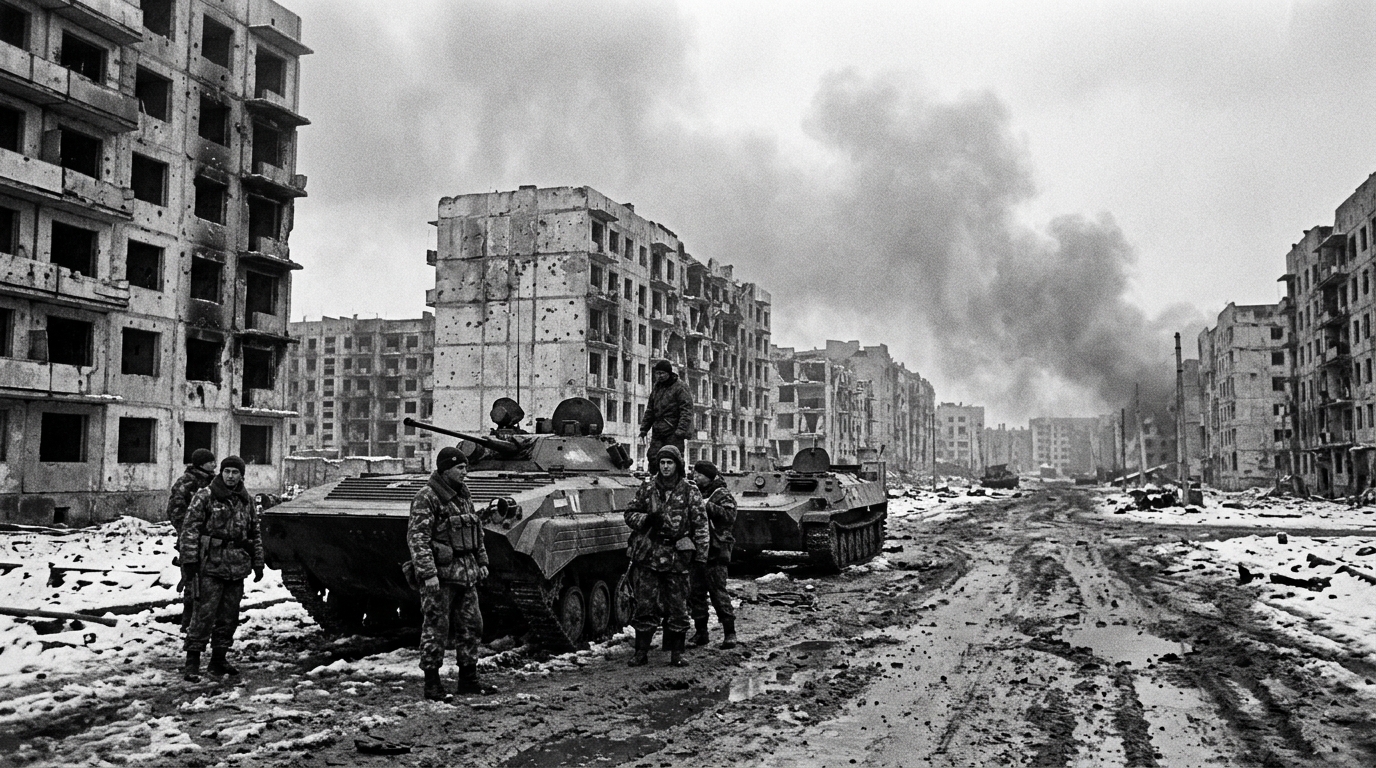
The siege of Grozny, lasting from December 1999 to February 2000, was the military climax of the war. Approximately 2,000 to 3,000 Chechen fighters entrenched themselves in the city, utilizing the urban ruins to construct a defense network of bunkers, tunnels, and sniper positions.
The Russian response was uncompromising. Utilizing heavy artillery, TOS-1 thermobaric rocket launchers, and Uragan multiple-launch rocket systems, the military systematically leveled the city district by district.
"We will pursue the terrorists everywhere. If they are in an airport, we will catch them in the airport. And if, excuse me, we catch them in the toilet, we will waste them in the outhouse." — Vladimir Putin, September 24, 1999 [[^5]]
By early February 2000, the remaining Chechen fighters attempted a breakout from the encircled city. Lured into a trap, hundreds of fighters—including Shamil Basayev, who lost a foot—were killed or maimed as they withdrew through a pre-mined corridor. On February 6, 2000, Vladimir Putin, now acting president, announced the liberation of Grozny. The city was left in total ruins, leading a UN assessment team to declare it the most destroyed city on earth.
Geopolitical Consequences and Aftermath
The Second Chechen War had profound international and domestic consequences, altering the trajectory of Russian governance and redefining its relationship with the West.
| Dimension | First Chechen War (1994-1996) | Second Chechen War (1999-2009) |
|---|---|---|
| Primary Russian Objective | Preservation of territorial integrity | Eradication of terrorism & state consolidation |
| Russian Military Tactics | Undermanned armored columns; poor coordination | Heavy artillery, thermobaric weapons, encirclement |
| Public Support in Russia | Highly unpopular; critical media coverage | Broadly popular; state-controlled media narrative |
| Chechen Governance Post-War | Fragmented de facto independence (Ichkeria) | Re-integration; rule by the pro-Moscow Kadyrov clan |
| Geopolitical Framing | Domestic constitutional crisis | Part of the Global War on Terror (post-2001) |
The Domestic Power Shift: The Rise of Putin
The primary political beneficiary of the war was Vladimir Putin. His tough, direct rhetoric and apparent competence in managing the crisis offered a stark contrast to the ailing Yeltsin. On December 31, 1999, Yeltsin unexpectedly resigned, appointing Putin as Acting President.
Riding an unprecedented wave of public support directly tied to the military's progress in Chechnya, Putin won the March 2000 presidential election in the first round with 53% of the vote. The war proved to be the ultimate catalyst for the re-establishment of the "vertical of power" in Russia, centralizing regional authority, curtailing independent media, and re-establishing the prominence of the security services (siloviki) in state administration.
Geopolitical Realignment and the War on Terror
Initially, Western nations criticized Russia's campaign in Chechnya, citing heavy civilian casualties, the displacement of over 200,000 refugees, and systematic human rights abuses 6.
However, the geopolitical landscape changed overnight after the September 11 attacks in 2001. Putin was the first foreign leader to call U.S. President George W. Bush, offering full cooperation in the struggle against Islamic extremism.
By framing the conflict in Chechnya not as an internal struggle for national self-determination, but as a crucial front in the Global War on Terror, Moscow successfully blunted Western criticism. The presence of foreign fighters like Ibn al-Khattab and Chechen ties to Al-Qaeda networks made this narrative plausible to Western policymakers, who increasingly treated the Chechen issue as an internal Russian counterterrorism matter.
| September 11 Attacks on the United States |
|---|
| Putin aligns with Bush |
| Re-framing of Chechen Conflict by Moscow |
| - From: Internal secessionist struggle |
| - To: Active front in "War on Terror" |
| Diminished Western Pressure on Russia |
| Acceptance of "Counterterrorism" Framing |
Chechenization and the Rise of the Kadyrov Clan
Recognizing that military force alone could not guarantee long-term stability, Moscow initiated a policy known as "Chechenization." This strategy involved co-opting local elites and delegating the governance and pacification of the republic to Chechen proxies. The key figure in this strategy was Akhmad Kadyrov, the Chief Mufti of Ichkeria, who had fought against Russia in the first war but became disillusioned by the rise of radical Wahhabism.
- 2000: Akhmad Kadyrov is appointed head of the transitional administration by Vladimir Putin.
- 2003: Kadyrov is elected President of the Chechen Republic under a new constitution that solidified Chechnya’s status as an autonomous republic within the Russian Federation.
- 2004: Akhmad Kadyrov is assassinated in a bomb attack in Grozny; his son, Ramzan Kadyrov, gradually assumes control of the republic's security apparatus.
- 2007: Ramzan Kadyrov is officially appointed President of Chechnya, establishing a highly personalist regime backed by a private militia known as the Kadyrovtsy.
Under the Kadyrov clan, Chechnya was pacified through a combination of ruthless counter-insurgency operations, reconstruction funded by massive federal subsidies from Moscow, and the enforcement of conservative social codes. While this brought an end to active, large-scale combat, it replaced separatist aspirations with a loyalist, autocratic enclave within the Russian Federation.
Analysis of Key Actors and Decisive Actions
Vladimir Putin: The Architect of State Restabilization
For Vladimir Putin, the Second Chechen War was the crucible in which his political identity was forged. His approach was defined by absolute pragmatism and a rejection of the compromises that characterized the Yeltsin era.
He understood that the Russian public, demoralized by the collapse of the Soviet Union and economic instability, craved a restoration of state authority (derzhavnost). By aligning himself closely with the military and presenting an unyielding front, he transformed the military campaign into a nation-building project that unified a fragmented electorate.
Aslan Maskhadov: The Tragic Figure of Moderate Nationalism
Aslan Maskhadov’s role during the crisis was defined by his structural weakness. Although he was the democratically elected president of Chechnya, he could not control the radical factions within his borders.
When Basayev and Khattab invaded Dagestan, Maskhadov publicly condemned the incursion, but he was unable to arrest or militarily neutralize them without risking a civil war. Once the Russian invasion began, Maskhadov was forced to fight alongside his radical rivals, losing any credibility as a moderate negotiating partner in the eyes of Moscow. His death in a Russian special forces raid in March 2005 marked the final end of the secular, nationalist wing of the Chechen independence movement.
- President Aslan Maskhadov
The Shift in Russian Military Doctrine
The decisive factor on the battlefield was the adaptation of the Russian Armed Forces. Under the leadership of General Anatoly Kvashnin, the military discarded the aggressive, rapid-advance tactics that had led to the disaster of New Year's Eve 1994 in Grozny. Instead, the army utilized a "firepower-first" approach:
- Isolation: Encircling urban centers and cut off supply lines.
- Bombardment: Using heavy artillery, thermobaric weapons, and tactical ballistic missiles (such as the Tochka-U) to destroy defensive positions from a distance.
- Mopping Up (Zachistka): Sending in infantry and interior ministry (MVD) troops only after target areas had been heavily bombarded.
While this doctrine significantly reduced Russian military casualties, it resulted in massive collateral damage, the near-total destruction of civilian infrastructure, and high rates of civilian displacement.
Trivia and Lesser-Known Facts
- The Ryazan Incident and "Sugar": The three FSB operatives arrested by local police in Ryazan for placing suspicious bags in an apartment basement were quickly released under orders from Moscow. The incident remains one of the most controversial events in modern Russian history, with debate still persisting over whether it was a genuine terrorist plot or a state provocation [[^4]].
- The "Black Widows": The Second Chechen War saw the emergence of female suicide bombers, known as Shahidki or "Black Widows." Many of these women were the widows, sisters, or daughters of Chechen men killed during the wars, and they were recruited by radical networks to carry out high-profile attacks in the Russian heartland.
- The TOS-1 "Buratino" debut: The conflict saw some of the first extensive uses of the TOS-1 thermobaric multiple rocket launcher, nicknamed "Buratino" (the Russian version of Pinocchio) due to its distinctively shaped launcher cabinet. Its fuel-air explosive warheads proved devastatingly effective at clearing trenches and urban ruins by consuming all oxygen in the blast area.
- The Fate of the Danish Refugee Council: During the height of the crisis, the Danish Refugee Council (DRC) became the largest NGO operating in the region, feeding hundreds of thousands of internally displaced persons. Despite threats of kidnapping and direct opposition from Russian authorities, the DRC remained active throughout the conflict.
- The Transition of Ramzan Kadyrov: Ramzan Kadyrov, who would eventually govern Chechnya with an iron fist, once bragged about killing his first Russian soldier at the age of 16 during the First Chechen War. His subsequent transition into one of Vladimir Putin’s most fiercely loyal allies remains one of the most striking political turnarounds in the region's history.
References and Literature
- Lieven, Anatol (1998). Chechnya: Tombstone of Russian Power. - A foundational analysis of the social and political dynamics that drove the first conflict and set the stage for the second war.
- Satter, David (2003). Darkness at Dawn: The Rise of the Russian State. - A detailed examination of the late-Yeltsin era, the 1999 apartment bombings, and the political rise of Vladimir Putin.
- Trenin, Dmitri, & Malashenko, Aleksei (2004). Russia’s Restless Frontier: The Chechen Factor in Post-Soviet Russia. - A comprehensive study by the Carnegie Moscow Center analyzing the geopolitical, security, and economic dimensions of the Second Chechen War.
- Human Rights Watch (2000). "No Happiness Here": War Crimes in Chechnya. - An archival report detailing the humanitarian impact, civilian casualties, and human rights violations during the military campaign.
Footnotes & Explanations
- Anatol Lieven, Chechnya: Tombstone of Russian Power (New Haven: Yale University Press, 1998), 142-145. ↩
- Dmitri Trenin and Aleksei Malashenko, Russia's Restless Frontier (Washington, D.C.: Carnegie Endowment for International Peace, 2004), 85. ↩
- David Satter, Darkness at Dawn: The Rise of the Russian State (New Haven: Yale University Press, 2003), 63-65. ↩
- Yuri Felshtinsky and Alexander Litvinenko, Blowing Up Russia: Terror from Within (London: Gibson Square Books, 2007), 112-118. ↩
- "Putin's 'Waste Them in the Outhouse' Quote Turns 15," The Moscow Times, September 24, 2014. ↩
- Human Rights Watch, "No Happiness Here: War Crimes in Chechnya," Human Rights Watch Report, February 2000, Vol. 12, No. 2. ↩