Key Takeaways
- The attacks of September 11, 2001, orchestrated by al-Qaeda, resulted in nearly 3,000 deaths and prompted the United States to launch the 'Global War on Terror'.
- The crisis led to the immediate US invasion of Afghanistan, the dismantling of the Taliban regime, and the eventual expansion of preemptive military doctrines.
- Global security architecture was profoundly restructured through sweeping domestic laws like the USA PATRIOT Act and international intelligence-sharing frameworks.
The terrorist attacks of September 11, 2001, represent a historical inflection point that shattered the post-Cold War geopolitical consensus. In the span of a single morning, the illusion of absolute security enjoyed by the world's sole remaining superpower evaporated. Orchestrated by the transnational jihadist network al-Qaeda, the hijackings of four commercial airliners and their subsequent transformation into guided missiles targeted the financial, military, and political nerve centers of the United States.
The consequences of that day extended far beyond the devastating immediate loss of life and physical destruction in New York, Arlington, and Shanksville. The attacks ushered in an era of global counter-terrorism, fundamentally rewrote the rules of international engagement, initiated two major wars, and restructured the domestic security apparatus of states worldwide. By examining the origins, timeline, and far-reaching geopolitical aftermath of 9/11, this article provides a comprehensive analysis of the crisis that defined the opening decades of the twenty-first century.
Historical Context and Origins
The roots of the September 11 attacks are deeply intertwined with the shifting geopolitical dynamics of the late twentieth century, particularly the Soviet-Afghan War (1979–1989). Following the Soviet invasion of Afghanistan, the United States, alongside Saudi Arabia and Pakistan, covertly funded and armed the Afghan mujahideen through the CIA's Operation Cyclone 1. This campaign successfully repelled the Soviet forces but also acted as a magnet for radicalized foreign fighters, collectively known as "Afghan Arabs."
Among these foreign volunteers was Osama bin Laden, the son of a wealthy Saudi construction magnate. Working alongside the Palestinian ideologue Abdullah Azzam, bin Laden co-founded the Maktab al-Khidamat (Services Office) to funnel funds, arms, and recruits to the Afghan resistance. As the war drew to a close in late 1988, bin Laden and several senior associates envisioned a more expansive, global vanguard for jihad, leading to the formal creation of al-Qaeda ("The Base").
- Soviet-Afghan War (1979-1989)
The pivotal turn in al-Qaeda’s ideological trajectory occurred in 1990. Following Iraq's invasion of Kuwait, Saudi Arabia declined bin Laden’s offer to defend the kingdom with his veteran mujahideen force, choosing instead to host hundreds of thousands of United States military personnel on Saudi soil. For bin Laden, the presence of non-Muslim troops in the land of the two holy mosques—Mecca and Medina—constituted a profound desecration and an unforgivable betrayal by the House of Saud.
Al-Qaeda's focus shifted decisively from local secular regimes to the "far enemy": the United States. Bin Laden argued that local "apostate" regimes in the Middle East could not be overthrown as long as they were subsidized and protected by American military and economic power. In 1996, bin Laden issued his first major fatwa, declaring war on the United States 2. This was followed in 1998 by a joint declaration under the banner of the "World Islamic Front for Jihad Against Jews and Crusaders," which asserted:
"The ruling to kill the Americans and their allies — civilians and military — is an individual duty for every Muslim who can do it in any country in which it is possible to do it..." [[^3]]
Throughout the 1990s, al-Qaeda systematically built its operational capacity, executing a series of precursor attacks that tested the resolve of Western intelligence agencies:
- The 1993 World Trade Center Bombing: A truck bomb detonated in the North Tower's underground garage, killing six and injuring over a thousand. Though not directly commanded by bin Laden, it was orchestrated by Ramzi Yousef, the nephew of future 9/11 mastermind Khalid Sheikh Mohammed (KSM).
- The 1998 East Africa Embassy Bombings: Near-simultaneous truck bombs struck US embassies in Nairobi, Kenya, and Dar es Salaam, Tanzania, killing 224 people and firmly placing al-Qaeda at the top of the FBI's counter-terrorism priorities.
- The 2000 USS Cole Bombing: An explosive-laden skiff rammed the guided-missile destroyer in the port of Aden, Yemen, killing 17 US sailors and proving al-Qaeda's capacity for complex maritime operations.
By the late 1990s, Khalid Sheikh Mohammed presented bin Laden with the blueprint for what would be termed the "Planes Operation." This ambitious plan involved hijacking commercial airliners within the United States and piloting them directly into highly symbolic targets. Bin Laden approved the plot, provided financial backing, and selected the operatives, utilizing Afghanistan—then under the control of the fundamentalist Taliban movement—as a safe haven to plan, train, and coordinate the operation.
Timeline of Events and Key Moments
The execution of the September 11 attacks relied on nineteen hijackers, organized into four teams, who successfully exploited vulnerabilities in US domestic civil aviation security. The chronological sequence of that morning unfolded with terrifying speed and precision:
07:59 – 08:42: The Departures and Hijackings
- 07:59 AM: American Airlines Flight 11, a Boeing 767 carrying 81 passengers and 11 crew members, departs Boston Logan International Airport for Los Angeles.
- 08:14 AM: United Airlines Flight 175, another Boeing 767 with 56 passengers and 9 crew members, departs Boston for Los Angeles. At approximately this time, hijackers on Flight 11 seize control of the aircraft using box cutters and chemical sprays, disabling the plane's transponder.
- 08:20 AM: American Airlines Flight 77, a Boeing 757 with 53 passengers and 6 crew members, departs Washington Dulles International Airport for Los Angeles.
- 08:42 AM: United Airlines Flight 93, a Boeing 757 with 37 passengers and 7 crew members, departs Newark International Airport for San Francisco after a 42-minute runway delay.
08:46 – 09:03: The World Trade Center Strikes
- 08:46:40 AM: American Airlines Flight 11 crashes into the northern facade of the World Trade Center's North Tower (1 WTC) between floors 93 and 99. The impact severs all three emergency stairwells, trapping hundreds above the collision zone. Initially, public officials and media speculate that the crash is a tragic accident involving a small private plane.
- 09:03:02 AM: United Airlines Flight 175 penetrates the south facade of the South Tower (2 WTC) between floors 77 and 85, live on global television. The second crash removes any doubt: the United States is under a coordinated, highly organized terrorist attack.
- 08:46 AM: AA Flight 11 hits North Tower (WTC 1)
09:05 – 09:45: The Federal Response and the Pentagon Attack
- 09:05 AM: White House Chief of Staff Andrew Card whispers into the ear of President George W. Bush, who is attending a reading demonstration at Emma E. Booker Elementary School in Sarasota, Florida: "A second plane has hit the second tower. America is under attack."
- 09:37:46 AM: American Airlines Flight 77 crashes into the western facade of the Pentagon in Arlington, Virginia, killing all 64 people on board and 125 personnel inside the military headquarters.
- 09:45 AM: The Federal Aviation Administration (FAA) orders SCATANA (Security Control of Air Traffic and Air Navigation Aids), grounding all civilian aircraft within the United States and diverting incoming international flights to Canada and Mexico (an operation dubbed Operation Yellow Ribbon).
09:59 – 10:28: The Collapses and Flight 93
- 09:59:00 AM: The South Tower of the World Trade Center collapses in just nine seconds after burning for 56 minutes. The structural steel, weakened by the intense heat of burning jet fuel, fails catastrophically under the weight of the upper floors.
- 10:03:11 AM: United Airlines Flight 93 crashes into an empty field near Shanksville, Pennsylvania. After learning of the other attacks via airphones, the passengers had voted to storm the cockpit. Led by Todd Beamer's famous rallying cry, "Let's roll," the passengers fought back, forcing the hijackers to crash the plane short of its intended target, widely believed to have been the US Capitol or the White House.
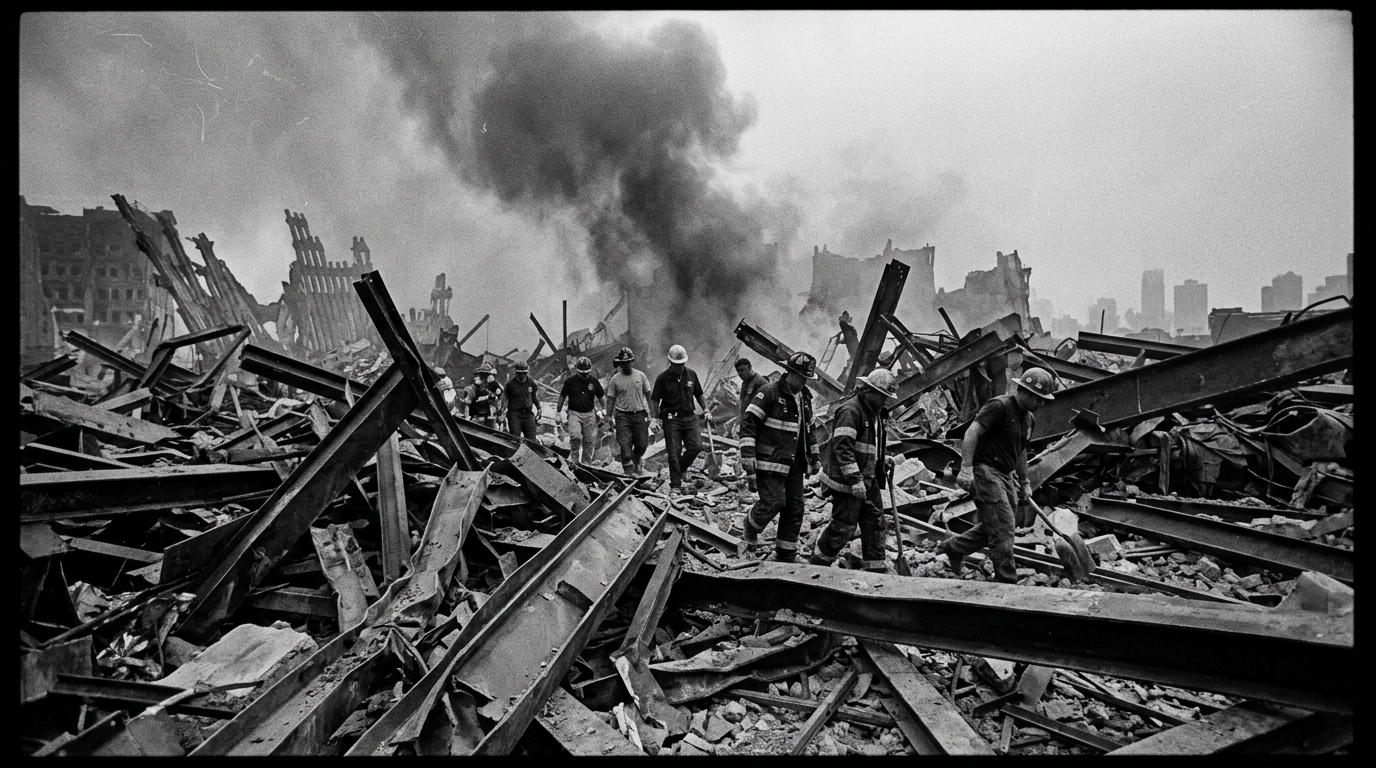
- 10:28:19 AM: The World Trade Center’s North Tower collapses. The entire World Trade Center complex is reduced to a smoldering landscape of debris, subsequently referred to as "Ground Zero."
At 8:30 PM that evening, President George W. Bush addressed the nation from the Oval Office, articulating a doctrine that would guide American foreign policy for the foreseeable future:
"We will make no distinction between the terrorists who committed these acts and those who harbor them." [[^4]]
Geopolitical Consequences and Aftermath
The geopolitical landscape of the early twenty-first century was fundamentally reshaped by the events of September 11. The post-Cold War era of undisputed, relatively peaceful Western hegemony gave way to a security-centric global paradigm marked by military intervention, international law restructuring, and deep-seated changes to state sovereignty.
| Geopolitical Dimension | Pre-9/11 Status Quo | Post-9/11 Transformation |
|---|---|---|
| US Foreign Policy | Multilateralism; focus on great-power competition and regional stability. | "War on Terror"; unilateralism; preemptive warfare doctrine; regime change. |
| Alliances & Treaties | NATO as a regional defense pact with no Article 5 invocations. | NATO Article 5 invoked; global coalitions of the willing; intelligence integration. |
| State Power & Liberty | High civil liberty protections; decentralized domestic security agencies. | Passage of USA PATRIOT Act; massive electronic surveillance; creation of DHS and ODNI. |
| Aviation & Borders | Permeable physical border security; basic airport security screening. | Highly securitized borders; creation of TSA; global passenger screening data sharing. |
1. The Invasion of Afghanistan and NATO's Mobilization
On September 12, 2001, NATO invoked Article 5 of the North Atlantic Treaty—which states that an attack on one ally is an attack on all—for the first and only time in the history of the alliance 5. This collective defense declaration laid the groundwork for Operation Enduring Freedom, launched on October 7, 2001.
A coalition led by the United States and Great Britain, in alliance with the Afghan Northern Alliance, initiated a campaign of airstrikes and special forces operations targeting al-Qaeda training camps and the ruling Taliban regime that harbored them. By December 2001, the Taliban had been ousted from power, and their leader, Mullah Omar, fled along with bin Laden into the rugged, tribal areas of Pakistan.
The war, however, was far from over. It evolved into a prolonged, twenty-year counter-insurgency operation that concluded only with the highly chaotic and controversial withdrawal of US forces in August 2021, which saw the Taliban return to power.
2. The Bush Doctrine and the War in Iraq
The strategic response to 9/11 quickly expanded beyond Afghanistan. In his January 2002 State of the Union address, President Bush introduced the concept of the "Axis of Evil," comprising Iraq, Iran, and North Korea, which he accused of harboring terrorists and pursuing weapons of mass destruction (WMDs).
The policy shift was formalized in the 2002 National Security Strategy, outlining the Bush Doctrine. The core tenet of this doctrine was the assertion that deterrence was obsolete in an era of asymmetric warfare and suicide terrorism. Consequently, the United States claimed the right to wage preemptive wars of self-defense:
- Preemption: Striking adversaries before they could execute attacks against the homeland.
- Unilateralism: The willingness to act without consensus from international bodies like the United Nations Security Council if national security dictated.
- Regime Change: Deposing hostile dictatorships to foster democratic institutions in the Middle East.
This doctrine found its most controversial application in the March 2003 invasion of Iraq. Although intelligence asserting that Saddam Hussein's regime possessed WMDs and maintained ties to al-Qaeda was later proven false, the geopolitical outcome was a profound destabilization of the Middle East, leading to a sectarian civil war and the eventual rise of the Islamic State of Iraq and the Levant (ISIL).
3. Domestic Legal and Surveillance Frameworks
The attacks prompted a massive expansion of state power in Western nations. In October 2001, the US Congress passed the USA PATRIOT Act (Uniting and Strengthening America by Providing Appropriate Tools Required to Intercept and Obstruct Terrorism Act) with broad bipartisan support 6. The law dramatically lowered barriers between law enforcement and intelligence agencies, allowing for:
- Roving wiretaps and warrantless searches.
- National Security Letters (NSLs), enabling the FBI to collect telecommunications and financial records without judicial oversight.
- Bulk data collection, which would later be exposed by whistleblower Edward Snowden in 2013 as a key mechanism of global NSA surveillance.
Furthermore, the Department of Homeland Security (DHS) was created in 2002, consolidating 22 disparate federal agencies into a singular department tasked with defending the interior of the nation.
4. International Law, Black Sites, and Guantanamo Bay
The War on Terror challenged established norms of international law, particularly regarding the treatment of prisoners of war. The Bush administration classified captured al-Qaeda and Taliban operatives not as traditional combatants or criminals, but as "unlawful enemy combatants." This distinction was used to justify their detention outside the jurisdiction of US courts and the Geneva Conventions.
The establishment of the detention camp at Guantanamo Bay Naval Base in Cuba in January 2002, along with the CIA's program of "extraordinary rendition" to "black sites" around the globe, created deep diplomatic rifts between the United States and its European allies. Methods classified by critics as torture, termed "enhanced interrogation techniques" by the administration, severely compromised the moral authority of the Western coalition and served as highly effective recruiting tools for extremist groups.
Analysis of Key Actors and Decisive Actions
The trajectory of the post-9/11 era was heavily shaped by the personal calculations and strategic decisions of key political and military figures.
George W. Bush: The Wartime President
Prior to September 11, the foreign policy platform of George W. Bush was relatively modest, focusing on "humble" international engagement and a skepticism toward nation-building. The crisis transformed his presidency. Guided by neoconservative advisers like Vice President Dick Cheney and Secretary of Defense Donald Rumsfeld, Bush embraced a highly moralistic framework that divided the international community into two camps:
"Every nation, in every region, now has a decision to make. Either you are with us, or you are with the terrorists." [[^7]]
His decision to link the threat of transnational terrorism to the proliferation of WMDs led directly to the overextension of US military power in Iraq. While his early leadership consolidated domestic resolve, his administration's disregard for international bodies like the United Nations created long-term diplomatic friction with traditional European allies like France and Germany, permanently fracturing the transatlantic unity that had immediately followed 9/11.
Bush Administration Neoconservative Strategy
- Operation Enduring Freedom
- Operation Iraqi Freedom
Osama bin Laden: The Asymmetric Strategist
Osama bin Laden's strategic calculus in launching the 9/11 attacks was designed to exploit what he perceived as the core vulnerability of the United States: its reluctance to sustain high casualties in prolonged overseas conflicts, a theory he based on the US withdrawals from Lebanon in 1983 and Somalia in 1993.
Bin Laden did not believe he could defeat the United States militarily. Instead, his goal was to provoke the superpower into launching massive, direct military interventions in the Muslim world. He calculated that these interventions would:
- Deplete the economic resources of the United States, driving it into bankrupting military quagmires.
- Expose the "brutality" of American military power, thereby radicalizing millions of Muslims and driving them to join the jihadist cause.
- Destabilize and overthrow corrupt local Arab regimes that relied on US security guarantees.
While bin Laden's core target list was executed on 9/11, his strategic long-term goals yielded mixed results. Although the United States spent trillions of dollars on the wars in Iraq and Afghanistan 8, the expected global uprising of the Muslim world against the West did not materialize on the scale he envisioned, and his personal isolation in Pakistan ultimately culminated in his death during a US Navy SEAL raid in Abbottabad on May 2, 2011.
Trivia and Lesser-Known Facts
- Failure of Imagination: The official 9/11 Commission Report concluded that the primary failure of the US intelligence community was a "failure of imagination." Despite several warnings of an impending, spectacular attack from al-Qaeda throughout the summer of 2001, the agencies failed to connect the dots due to institutional "stovepiping" (the refusal of the CIA and FBI to share intelligence seamlessly).
- The Prophet of 9/11: John O'Neill, the FBI's chief al-Qaeda expert who had warned of the threat for years, resigned from the bureau in August 2001 due to bureaucratic infighting. He took a job as the head of security at the World Trade Center and died on his first day on the job during the attacks.
- The White House Target: Intelligence gathered from interrogations of Khalid Sheikh Mohammed later revealed that the four hijackers on Flight 93 had intended to crash the plane directly into the dome of the US Capitol Building or the White House. The passenger rebellion saved hundreds of lives, including those of congressmen and senators.
- Operation Yellow Ribbon: When the US airspace was closed, Canada accepted over 200 diverted international commercial flights. The town of Gander, Newfoundland, with a population of just over 9,000, hosted over 6,600 stranded passengers for nearly a week, a historical act of hospitality that later became the subject of the Broadway musical Come from Away.
- The "Able Danger" Project: A highly classified military data-mining project named Able Danger had reportedly identified four of the 9/11 hijackers, including ringleader Mohamed Atta, as members of an al-Qaeda cell in 2000. However, the information was not shared with civilian law enforcement agencies due to legal concerns regarding the surveillance of green card holders.
References and Literature
- The 9/11 Commission Report - The official, comprehensive governmental investigation detailing the planning, execution, and systemic intelligence failures surrounding the September 11 attacks.
- Foreign Affairs: The War on Terror at 20 - An academic analysis by leading foreign policy scholars tracking the long-term strategic costs and shifts in global power dynamics post-9/11.
- The Looming Tower: Al-Qaeda and the Road to 9/11 - Lawrence Wright's Pulitzer Prize-winning book tracing the histories of al-Qaeda, the FBI, and the CIA, explaining how the agencies failed to stop the plot.
- NATO's Official Archive on Article 5 - The historical records detailing the North Atlantic Council's invocation of collective defense on September 12, 2001.
---
Footnotes & Explanations
- Coll, Steve. Ghost Wars: The Secret History of the CIA, Afghanistan, and Bin Laden, from the Soviet Invasion to September 10, 2001. Penguin Books, 2004. ↩
- Bin Laden, Osama. "Declaration of War against the Americans Occupying the Land of the Two Holy Places." Published in Al-Quds Al-Arabi, August 1996. ↩
- World Islamic Front. "Jihad Against Jews and Crusaders." Statement published in Al-Quds Al-Arabi, February 23, 1998. ↩
- Bush, George W. "Address to the Nation on the Terrorist Attacks." White House Archives, September 11, 2001. ↩
- North Atlantic Treaty Organization. "Statement by the North Atlantic Council." NATO Press Release, September 12, 2001. ↩
- Congressional Research Service. "The USA PATRIOT Act: A Legal Analysis." Library of Congress, 2002. ↩
- Bush, George W. "Address to a Joint Session of Congress and the American People." September 20, 2001. ↩
- Watson Institute for International and Public Affairs. "Costs of War Project." Brown University, 2021. ↩