Key Takeaways
- The military campaign was the first time NATO launched a combat operation against a sovereign state without explicit UN Security Council authorization.
- The conflict accelerated the shift toward the doctrine of 'Responsibility to Protect' (R2P), redefining the balance between state sovereignty and international human rights.
- The 78-day bombardment severely damaged Yugoslavia's infrastructure, triggered a major diplomatic crisis with China, and concluded with the establishment of a UN-administered Kosovo under Resolution 1244.
Historical Context and Origins
The path to the 1999 North Atlantic Treaty Organization (NATO) bombing of the Federal Republic of Yugoslavia (FRY) was paved by the violent dissolution of the Socialist Federal Republic of Yugoslavia throughout the 1990s. While wars raged in Croatia and Bosnia and Herzegovina, the southern province of Kosovo remained a quiet but volatile fault line. Under the 1974 Constitution of socialist Yugoslavia, Kosovo had enjoyed extensive autonomy within the Republic of Serbia. This status was stripped away in 1989 by the ascendant Serbian nationalist administration led by Slobodan Milošević, who consolidated power by mobilizing Serbian public sentiment around the historical and cultural significance of Kosovo 1.
| Time Period | Event Description |
|---|---|
| 1989 | Milošević revokes Kosovo's autonomy status |
| 1991–1995 | Wars in Croatia and Bosnia; Kosovo remains quiet |
| 1996–1998 | Emergence of the KLA; guerilla warfare escalates |
| Jan 1999 | Račak Incident; failure of Rambouillet Accords |
| March 1999 | NATO launches Operation Allied Force |
Throughout the early 1990s, Kosovo Albanians, led by Ibrahim Rugova, pursued a strategy of non-violent resistance, establishing parallel civic, educational, and healthcare institutions. However, the exclusion of the Kosovo issue from the 1995 Dayton Accords—which ended the Bosnian War—convinced many younger, more radical Albanians that peaceful resistance would not yield international support or independence. By 1996, the Kosovo Liberation Army (KLA, or UÇK) emerged as an armed guerrilla force targeting Serbian police, administrative offices, and civilians 2.
By 1998, the low-intensity insurgency had escalated into a full-scale civil war. Belgrade responded to the KLA’s guerrilla tactics with a heavy-handed counter-insurgency campaign, deploying both the Yugoslav Army (VJ) and special police units (MUP). Entire villages were shelled, displacing tens of thousands of civilians and drawing the scrutiny of Western capitals.
The turning point occurred on January 15, 1999, with the Račak incident, where 45 Kosovo Albanians were killed. While Belgrade claimed those killed were KLA combatants, the head of the Organization for Security and Co-operation in Europe (OSCE) verification mission, William Walker, declared the event a massacre of civilians 3. The tragedy galvanized international resolve.
In February 1999, the international community convened the Rambouillet Peace Talks in France. The Western-drafted Rambouillet Accords proposed substantial autonomy for Kosovo, backed by a peacekeeping force of 30,000 NATO troops. Crucially, the draft included "Appendix B," which granted NATO personnel unimpeded transit, access, and immunity throughout the entire territory of the FRY, not just Kosovo 4. Milošević's delegation rejected these terms, viewing them as an effective occupation of Yugoslavia. The talks collapsed on March 18, setting the stage for military action.
Timeline of Events and Key Moments
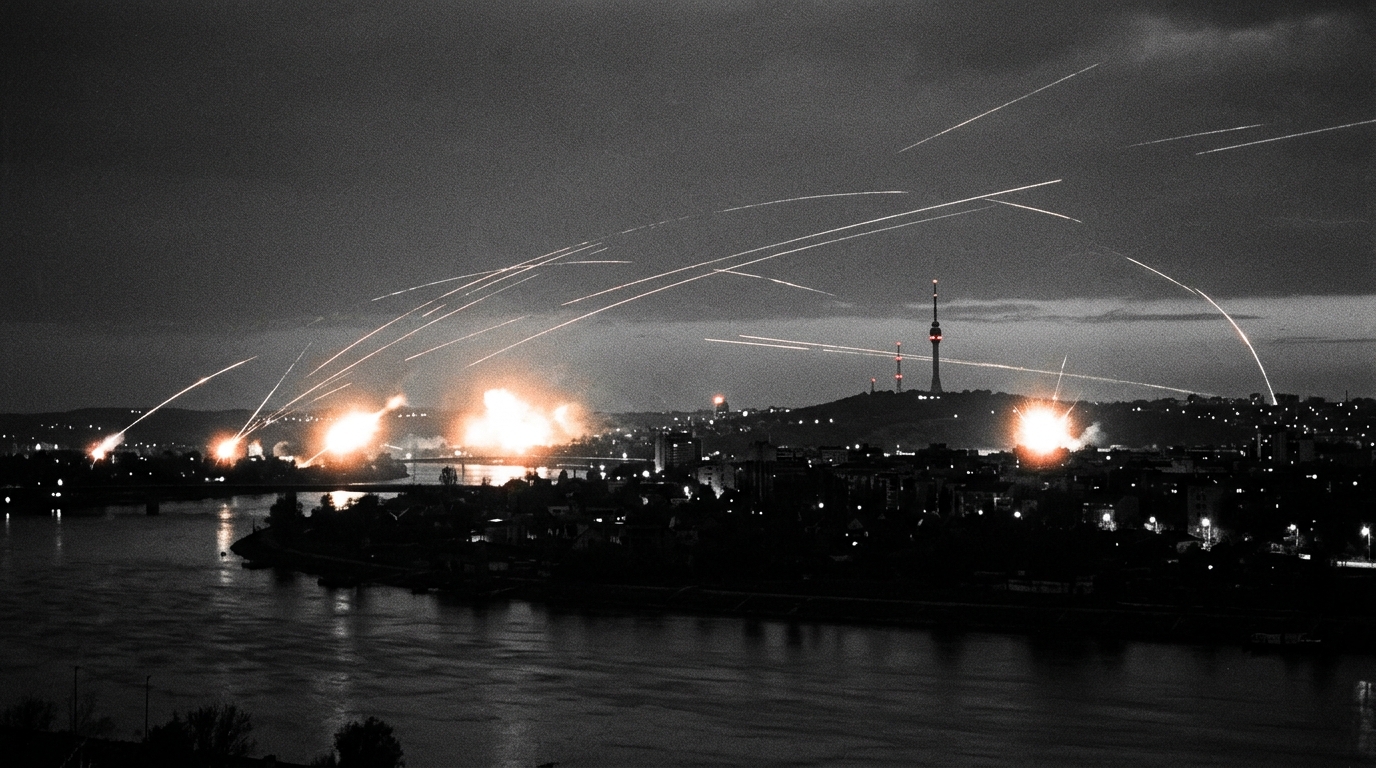
On March 24, 1999, NATO launched Operation Allied Force (Operation Noble Anvil in the United States military nomenclature). It marked the first time the alliance launched a major offensive against a sovereign state without the explicit authorization of the United Nations Security Council, where Russia and China held veto power.
Phase One: Suppression of Air Defenses (Late March)
The campaign began with targeted strikes from standoff cruise missiles and high-altitude bombers. NATO Secretary General Javier Solana ordered SACEUR (Supreme Allied Commander Europe) General Wesley Clark to initiate air strikes targeting Yugoslavia's air defense network, command infrastructure, and military installations.
Despite NATO's overwhelming technological superiority, the Yugoslav military utilized decoy tactics and mobile, integrated air-defense networks to limit their losses. On March 27, Yugoslav forces achieved a major propaganda victory: using an aging Soviet-made S-125 Neva missile system, they shot down an American F-117A Nighthawk stealth fighter near the village of Buđanovci 5.
Phase Two: Strategic Expansion and the Refugee Crisis (April)
As Belgrade refused to yield, NATO expanded its target list to include dual-use infrastructure: bridges, oil refineries, power grids, and government buildings.
Simultaneously, the situation on the ground in Kosovo worsened. Yugoslav forces launched Operation Horseshoe, a systematic campaign aimed at driving the ethnic Albanian population out of the province. Hundreds of thousands of refugees flooded across the borders into neighboring Albania, Macedonia, and Montenegro, overwhelming humanitarian agencies and creating a televised humanitarian emergency that Western leaders used to justify the continuation of the bombing.
NATO Bombing Targets: Dual-Use Infrastructure
| Category | Targets |
|---|---|
| Transport | Grdelica Bridge, Danube Bridges (Novi Sad) |
| Communications | RTS Belgrade HQ, Telecommunication towers |
| Energy | Obrenovac Power Plant, Oil Refineries (Pančevo) |
| Military | Batajnica Air Base, VJ Garrisons in Kosovo |
This phase was marked by several high-profile civilian casualty incidents, which NATO categorized as "collateral damage":
- April 12, 1999: A NATO F-15E strike eagle bombed a railway bridge in the Grdelica Gorge, striking a passenger train and killing at least 14 civilians.
- April 23, 1999: NATO targeted the headquarters of the Radio Television of Serbia (RTS) in Belgrade, killing 16 media workers. NATO argued the station was a propaganda instrument vital to the war effort; critics labeled it a war crime.
Phase Three: Diplomatic Crises and Resolution (May–June)
By May, the diplomatic fallout of the campaign reached its peak. On May 7, a US B-2 stealth bomber struck the Chinese Embassy in Belgrade, killing three Chinese journalists. The United States claimed the targeting was a mistake resulting from outdated maps, but the incident sparked furious protests in Beijing and severely damaged Sino-American relations 6.
The military pressure, combined with economic devastation and shifting diplomatic backchannels, eventually forced Belgrade to reconsider. With Russia—Yugoslavia's traditional ally—acting as a mediator through special envoy Viktor Chernomyrdin, Milošević was presented with a joint European Union-Russian peace proposal. Realizing that Moscow would not militarily intervene on Yugoslavia's behalf, Milošević capitulated.
On June 9, 1999, the military representatives of NATO and the FRY signed the Kumanovo Technical-Military Agreement in Macedonia. The agreement mandated the complete withdrawal of all Yugoslav military, police, and paramilitary forces from Kosovo. The following day, June 10, NATO suspended its air operations, and the UN Security Council passed Resolution 1244, establishing the United Nations Interim Administration Mission in Kosovo (UNMIK) and authorizing a NATO-led peacekeeping force (KFOR) 7.
Geopolitical Consequences and Aftermath
The 1999 bombing left a deep imprint on the international legal order, European security architectures, and regional demographics.
| International Law | Geopolitics of the Balkans |
|---|---|
| • Precedent of Humanitarian Intervention without UNSC | • UNMIK administration of Kosovo under UNSCR 1244 |
| • Evolution of the R2P doctrine (Responsibility to Protect) | • Outflow of 200,000 Serbs and non-Albanian minorities |
| • Severed ties with RU & CN | • Unilateral independence (2008) |
The Legal Precedent: Humanitarian Intervention vs. Sovereignty
Operation Allied Force sparked a debate on the legality of military action for humanitarian purposes. Under the UN Charter, military force is only permissible in self-defense or with the authorization of the Security Council. By bypassing the Security Council, NATO prioritized humanitarian concern and the prevention of ethnic cleansing over the traditional principles of state sovereignty.
This intervention became the cornerstone of the Responsibility to Protect (R2P) doctrine, formally adopted by the UN in 2005. R2P asserts that when a sovereign state fails to protect its own citizens from mass atrocities, the international community has a responsibility to intervene, using force if necessary. However, critics argue this precedent has been exploited by major powers to justify unilateral interventions in places like Iraq, Libya, and Ukraine 8.
Political and Demographical Shifts
The cessation of hostilities allowed for the rapid return of over 800,000 displaced Kosovo Albanians. However, the entry of KFOR and the withdrawal of Yugoslav forces triggered a reverse migration. Fearing retaliatory violence from the returning population and the KLA, approximately 200,000 Serbs, Romani, and other non-Albanian minorities fled or were expelled from Kosovo 9.
Politically, the war was the beginning of the end for Slobodan Milošević. Although he survived the immediate aftermath, the loss of Kosovo, coupled with hyperinflation and the physical destruction of the country's industrial infrastructure, eroded his support base. In October 2000, he was ousted in the peaceful "Bulldozer Revolution." He was subsequently arrested and transferred to the ICTY in The Hague, where he died in his cell in 2006 before his trial on charges of genocide and crimes against humanity concluded.
In February 2008, Kosovo unilaterally declared its independence from Serbia. Belgrade, backed by Russia, China, and several EU states, continues to reject Kosovo’s statehood, maintaining that it remains an integral part of its sovereign territory.
Analysis of Key Actors and Decisive Actions
The course and outcome of the conflict were heavily shaped by the political and military decisions of a few key leaders:
| Key Actor | Role in the Conflict | Decisive Actions & Strategic Focus |
|---|---|---|
| Slobodan Milošević | President of the Federal Republic of Yugoslavia | Stood firm against NATO demands during Rambouillet, miscalculating the Alliance's unity; leveraged a domestic war footing but ultimately conceded when Russia withdrew diplomatic support. |
| Bill Clinton | President of the United States | Directed the leading contributor of airpower and diplomatic weight; prioritized avoiding US ground troop casualties, which restricted the initial air campaign to high-altitude strikes. |
| Javier Solana | NATO Secretary General | Managed the political consensus of all 19 NATO member nations; framing the conflict as a moral imperative rather than a geopolitical one to preserve alliance unity. |
| Wesley Clark | NATO Supreme Allied Commander Europe (SACEUR) | Oversaw the daily execution of Operation Allied Force; advocated for a broader target list and ground force contingency planning despite pushback from Washington and European allies. |
Slobodan Milošević: The Calculated Risk
Milošević's strategy was built on the assumption that NATO's heterogeneous coalition of 19 democratic nations would not endure a protracted campaign. He believed that civilian casualties, domestic anti-war protests, and opposition from Russia would fracture NATO's unity before Yugoslavia's air defense capabilities were exhausted.
By initiating forced expulsions in Kosovo after the bombing began, Milošević hoped to create a fait accompli on the ground. However, this strategy backfired by providing NATO with a continuous flow of media coverage that consolidated Western public opinion in favor of the intervention.
Bill Clinton: The Post-Cold War Presidency
For US President Bill Clinton, the Kosovo crisis was an opportunity to define the role of the United States in the post-Cold War era. Having been criticized for his administration's hesitation during the Bosnian War and inaction during the 1994 Rwandan Genocide, Clinton sought to position American power as a force for global stability and human rights.
However, Clinton faced significant domestic constraints. Still recovering from the political fallout of his impeachment trial and facing a skeptical Congress, he took the controversial step of publicly ruling out the deployment of US ground forces at the start of the campaign. This decision eased domestic concerns but gave Milošević a tactical advantage, as it removed the immediate threat of a ground invasion.
Javier Solana: Consolidating Alliance Unity
As Secretary General, Javier Solana had to navigate the divergent political interests of NATO's 19 member states. Countries like the United States and the United Kingdom favored a rapid, aggressive bombing campaign, while others, such as Greece and Italy, faced massive public opposition to the war and urged restraint.
| Actor | Position / Stance |
|---|---|
| USA & United Kingdom | Favored rapid, aggressive campaign |
| NATO Secretary General Javier Solana | Maintained political consensus among 19 nations; balanced aggressive strikes with diplomatic caution |
| Italy & Greece | Faced anti-war public; urged restraint |
Italy's position was particularly delicate. Led by Prime Minister Massimo D’Alema, Italy served as the primary operational base for the campaign, with Aviano Air Base hosting hundreds of NATO aircraft. Despite strong domestic anti-war sentiment and political pressure from within his own left-wing coalition, D'Alema kept Italian bases open and Italian aircraft participated in the strikes, illustrating the political tightrope walked by European leaders to maintain transatlantic cohesion 10.
Wesley Clark: Military Strategy and Internal Friction
General Wesley Clark had the task of executing an air campaign directed by a political committee. Every target category had to be approved by NATO political authorities, a process Clark found frustrating.
He clashed repeatedly with US Secretary of Defense William Cohen and Chairman of the Joint Chiefs of Staff General Henry Shelton, who favored a more cautious approach to avoid escalating tensions with Russia. These tensions peaked in the final days of the war during the Pristina Airport incident (see below), where Clark’s directives were openly challenged by his European subordinate officers.
Trivia and Lesser-Known Facts
- The Friendship of Former Foes: Lieutenant Colonel Dale Zelko, the pilot of the F-117A stealth fighter shot down on March 27, 1999, and Zoltán Dani, the Yugoslav air defense commander who directed the missile launch, eventually met under peaceful circumstances years later. Dani had retired and opened a bakery in Serbia. The two became close friends, a reconciliation that became the subject of a documentary film titled The Second Meeting.
- "I'm Not Going to Start World War Three": On June 12, 1999, a contingent of 200 Russian paratroopers performed a surprise dash from Bosnia and took control of the Slatina Airfield in Pristina before NATO forces could arrive. General Wesley Clark ordered British Lieutenant General Mike Jackson to block the runway to prevent Russian reinforcements from landing. Jackson famously refused the order, telling Clark, "I'm not going to start World War Three for you" [[^11]].
- The Graphite Bomb Blackout: To minimize permanent structural damage to Yugoslavia's civilian infrastructure, NATO deployed highly specialized CBU-94 "blackout bombs." These weapons did not detonate with explosive force; instead, they dispersed clouds of highly conductive, sub-millimeter carbon-fiber filaments over Yugoslav electrical substations. The filaments caused massive short circuits, temporarily disabling up to 70% of the country's power grid without destroying the physical generation plants.
- Operation Allied Force in Pop Culture: In Serbia, the F-117A shootdown remains a point of national pride. During the bombing, citizens printed posters with the image of the downed stealth jet and the slogan: "Sorry, we didn't know it was invisible!" Parts of the actual aircraft are still on display at the Museum of Aviation in Belgrade.
References and Literature
- The Kosovo Conflict and International Law: An Analytical Documentation - A comprehensive legal and historical compilation detailing the collapse of the Rambouillet talks, NATO's military campaign, and the resulting UN Resolution 1244.
- Waging Modern War: Bosnia, Kosovo, and the Future of Combat - General Wesley K. Clark's personal memoir detailing the strategic decisions, coalition challenges, and geopolitical pressure during the 1999 air campaign.
- Winning Ugly: NATO's War to Save Kosovo - Ivo H. Daalder and Michael E. O'Hanlon's deep dive into the diplomacy, military strategies, and consequences of Operation Allied Force, published by the Brookings Institution.
- Human Rights Watch: Civilian Deaths in the NATO Air Campaign - A detailed, objective investigation assessing individual strikes, civilian casualties, and the legality of target selections during the 78-day bombardment.
---
Footnotes & Explanations
- Tim Judah, Kosovo: War and Revenge (Yale University Press, 2000), pp. 34–38. ↩
- International Crisis Group, "Kosovo's Long Hot Summer," ICG Balkans Report No. 41 (September 1998). ↩
- William Walker’s public statement in Račak on January 16, 1999, recorded in the OSCE Kosovo Verification Mission archives. ↩
- Marc Weller, "The Rambouillet Conference on Kosovo," International Affairs 75, no. 2 (1999): pp. 211–251. ↩
- "How a Belgrade museum preserves the memory of shooting down the 'invisible' F-117," Associated Press, March 24, 2009. ↩
- "Chinese Embassy Bombing: US offers explanation to Beijing," The Washington Post, May 10, 1999. ↩
- United Nations Security Council, "Resolution 1244 (1999)," adopted at its 4011th meeting on June 10, 1999. ↩
- Nicholas J. Wheeler, Saving Strangers: Humanitarian Intervention in International Society (Oxford University Press, 2000), pp. 242–284. ↩
- Human Rights Watch, Under Orders: War Crimes in Kosovo (New York: Human Rights Watch, 2001), pp. 451–462. ↩
- Massimo D'Alema, Kosovo: Gli italiani e la guerra (Mondadori, 1999), pp. 12–25. ↩
- "General Sir Mike Jackson: 'I'm not starting World War Three for you,'" The Guardian, March 9, 2000. ↩