Key Takeaways
- The dissolution of Czechoslovakia on January 1, 1993, known as the Velvet Divorce, stands as a rare historical example of a peaceful, negotiated bilateral termination of a sovereign federal state.
- The split was driven by diverging political and economic visions between Czech leader Václav Klaus, who favored rapid free-market reforms, and Slovak leader Vladimír Mečiar, who advocated for a more gradual transition and greater national autonomy.
- Despite public opinion polls indicating that a majority of citizens preferred maintaining a unified state, the political elites bypassed a national referendum, opting for a constitutional legislative separation to avoid political paralysis.
Historical Context and Origins
The dissolution of the Czech and Slovak Federal Republic on January 1, 1993, did not occur in a historical vacuum. To understand the "Velvet Divorce," one must examine the complex, often asymmetrical relationship between the two nations since the foundation of their joint state in 1918.
The Birth of Czechoslovakia and the Interwar Asymmetry
Czechoslovakia was established in the ashes of the Austro-Hungarian Empire following World War I. Promoted by figures such as Tomáš Garrigue Masaryk, Edvard Beneš, and the Slovak diplomat Milan Rastislav Štefánik, the concept of a single "Czechoslovak nation" was initially constructed to justify the creation of a viable nation-state to the victorious Entente powers 1. However, this concept masked deep-seated differences.
The Czech lands (Bohemia, Moravia, and Austrian Silesia) were highly industrialized, secular, and historically influenced by direct Austrian administration. In contrast, Slovakia had been subjected to intense "Magyarization" under Hungarian rule, resulting in a primarily agrarian, deeply religious (predominantly Roman Catholic), and less economically developed society. Throughout the interwar First Republic, many Slovaks felt that Prague treated their homeland more like a colony than an equal partner, fueling early autonomy movements led by figures like Andrej Hlinka.
World War II, Communism, and the 1968 Federalization
The fragile union fractured during World War II. Following the Munich Agreement of 1938 and the subsequent German occupation of the Czech lands, a clerical-fascist Slovak State was established under Jozef Tiso. Although this wartime republic was a Nazi puppet state, it gave Slovakia its first taste of formal, independent statehood—an experience that left a complex legacy after the joint state was reconstituted in 1945.
Following the communist coup d'état of 1948, the totalitarian regime enforced rigid centralism from Prague. The only major structural reform to survive the crushing of the 1968 Prague Spring was the formal federalization of the state. On October 27, 1968, the Constitutional Act on the Czechoslovak Federation was passed, dividing the country into the Czech Socialist Republic and the Slovak Socialist Republic 2.
| Czechoslovak State (1918–1992) |
|---|
| Czech Republic |
| - Industrialized |
| - Secular |
| - Rapid Transition |
| Slovak Republic |
| - Agrarian/Heavy Ind. |
| - Catholic/Nationalist |
| - Gradualist Reform |
While federalization existed primarily on paper under the watchful eye of the Communist Party of Czechoslovakia (KSČ), it established the institutional framework—including dual parliaments and a bicameral Federal Assembly—that would later facilitate the legal partition of the state in 1992.
The Velvet Revolution and the Resurgence of National Identity
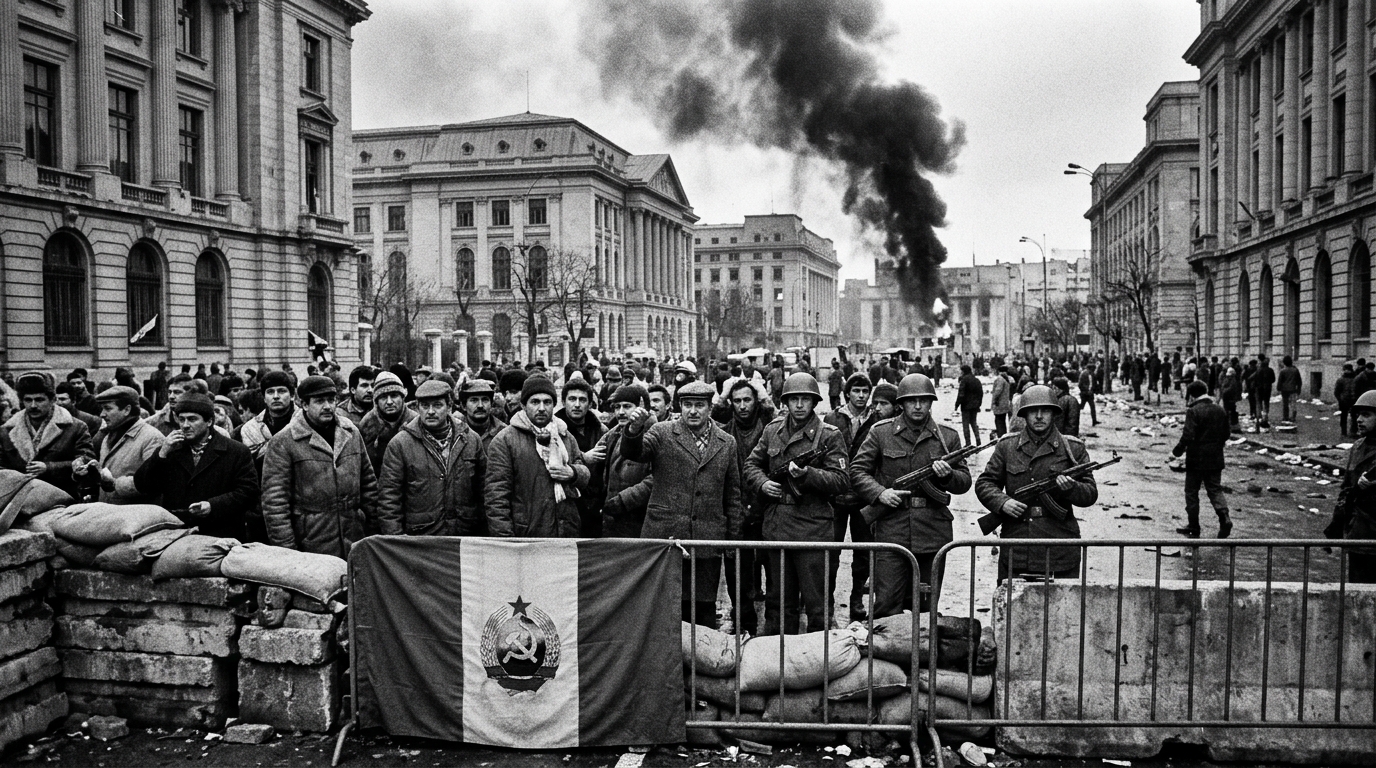
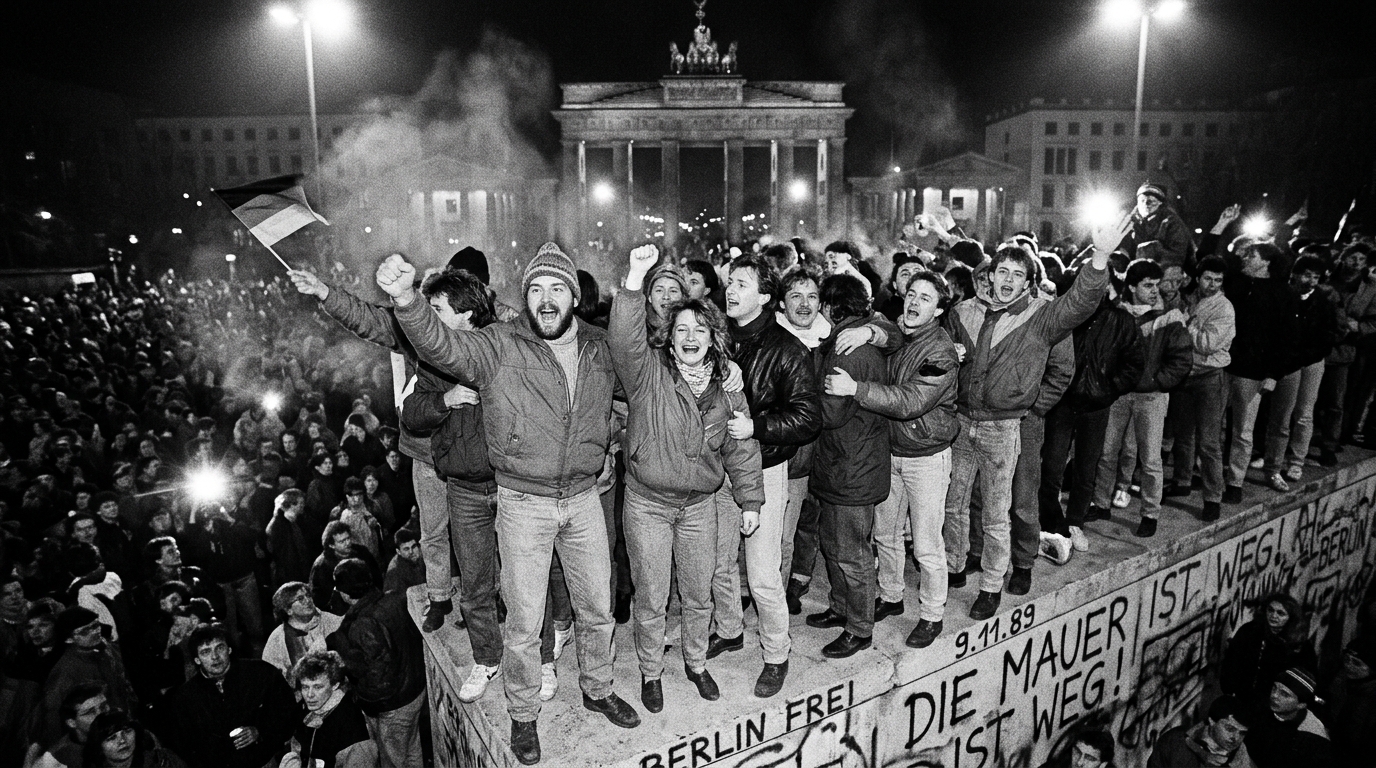
The fall of the communist regime during the Velvet Revolution of November 1989 quickly exposed the unresolved national questions that had been suppressed for forty years. With the removal of totalitarian coercion, the diverging interests of Prague and Bratislava immediately re-emerged.
The first public sign of friction was the so-called "Hyphen War" (pomlčková válka) in the spring of 1990. A fierce legislative dispute erupted over the official name of the post-communist state. Slovak politicians demanded the inclusion of a hyphen (Czecho-Slovakia) to symbolize the equal partnership of two distinct nations, while Czech politicians viewed the hyphen as grammatically incorrect and historically reminiscent of the post-Munich Second Republic. The compromise title—the Czech and Slovak Federal Republic (CSFR)—satisfied neither side and signaled that the union's symbolic foundation was deeply fractured.
Timeline of Events and Key Moments
The transition from a newly liberated democratic federation to two independent states took just under three years. This period was marked by intense constitutional debates, polarizing national elections, and strategic political maneuvering.
| Date | Event |
|---|---|
| 1990 (Spring) | Hyphen War exposes deep national rifts. |
| 1992 (June) | Elections: Klaus & Mečiar take power. |
| 1992 (July) | Havel resigns; Slovak sovereignty declared. |
| 1992 (Nov) | Federal Assembly passes Act 542 to dissolve state. |
| 1993 (Jan 1) | Official split; sovereignty of Czech & Slovak Reps. |
1990–1991: Constitutional Deadlock
Throughout 1990 and 1991, delegations from the Czech National Council and the Slovak National Council met repeatedly (at castles such as Kroměříž and Milovy) to draft a new federal constitution. The negotiations repeatedly stalled on the distribution of power between the federal government and the national republics:
- The Czech perspective favored a strong, streamlined federal center capable of executing rapid macroeconomic reforms and securing swift integration into Western institutions (the European Community and NATO).
- The Slovak perspective insisted on a "bottom-up" federation, where the republics would hold primary sovereignty and delegate only limited powers (such as defense and foreign policy) to the federal center.
As economic reforms designed by federal Finance Minister Václav Klaus began to take effect, the rift widened. The closure of inefficient, state-subsidized heavy industries and armaments factories—which had been disproportionately concentrated in Slovakia by communist planners—led to skyrocketing unemployment in Slovakia (reaching over 12%), while the Czech Republic maintained an unemployment rate below 4% 3. This economic disparity supercharged Slovak nationalism and populist political movements.
June 1992: The Decisive Democratic Elections
The parliamentary elections of June 5–6, 1992, served as the catalyst for the dissolution. The political landscape fractured along national lines:
- In the Czech Republic, the right-wing Civic Democratic Party (ODS), led by the pragmatic economist Václav Klaus, won a decisive victory on a platform of rapid privatization and market reform.
- In Slovakia, the populist-nationalist Movement for a Democratic Slovakia (HZDS), led by the charismatic lawyer Vladimír Mečiar, emerged dominant, campaigning on a platform of Slovak sovereignty, economic protectionism, and a slower transition to a market economy.
The election results made a functioning federal government virtually impossible. Klaus and Mečiar, representing diametrically opposed economic philosophies and visions for the state, became the prime ministers of their respective republics and took control of the constitutional negotiations.
Summer 1992: Negotiations at Villa Tugendhat
Between June and October 1992, Klaus and Mečiar led several rounds of intensive, often closed-door negotiations. The most famous of these meetings occurred on August 26, 1992, at the functionalist Villa Tugendhat in Brno.
Klaus & Mečiar Meet (Villa Tugendhat)
- Czech Position
- Slovak Position
- Mutual Agreement
Klaus presented Mečiar with a stark choice: either a tightly integrated, functional federation with centralized economic management, or an outright, clean separation into two independent states. Mečiar, who had envisioned a loose confederation where Slovakia would have its own currency, central bank, and international recognition while remaining subsidized by Prague, realized that Klaus would not compromise. Both leaders agreed that a peaceful, planned partition was preferable to a prolonged constitutional crisis or a dysfunctional, paralyzed federation.
Autumn 1992: The Legislative Path to Dissolution
On July 17, 1992, the Slovak National Council adopted the Declaration of Independence of the Slovak Nation. Three days later, federal President Václav Havel, a staunch defender of Czechoslovak unity who refused to preside over the liquidation of the state, resigned his office, leaving the presidency vacant.
The final hurdle was legalizing the split. The Czechoslovak Constitution of 1968 did not contain provisions for a unilateral secession or a negotiated dissolution by the regional parliaments. To prevent an unconstitutional collapse, the federal government drafted the Constitutional Act on the Dissolution of Czechoslovakia (Act No. 542/1992 Coll.).
The bill initially faced fierce resistance in the federal parliament, as opposition parties demanded a national referendum. However, through intense political bargaining, the bill was finally passed by the Federal Assembly on November 25, 1992, by a narrow margin. This law provided the legal framework for the formal termination of the 74-year-old joint state at midnight on December 31, 1992.
Geopolitical Consequences and Aftermath
The peaceful dissolution of Czechoslovakia stood in stark contrast to the violent, bloody disintegration of neighboring Yugoslavia and the chaotic collapse of the Soviet Union. It demonstrated that state borders in Europe could be redrawn through diplomatic and legislative means.
The Division of National Assets and the Currency Split
The division of state assets was executed with remarkable administrative efficiency. Public property, military assets, and federal infrastructure were divided based on a 2:1 ratio, corresponding to the relative populations of the Czech Republic (approx. 10 million) and Slovakia (approx. 5 million).
- The Armed Forces: The Czechoslovak Army was split into the Czech Land and Air Forces and the Armed Forces of the Slovak Republic. Military equipment—including fighter jets, tanks, and artillery—was physically divided and relocated to their respective national territories without incident.
- The Currency: Although both states initially agreed to maintain a temporary monetary union using the Czechoslovak koruna (CSK), speculative capital flight and diverging economic policies forced an end to this arrangement. On February 8, 1993, just over a month after the split, both countries successfully launched their own currencies: the Czech koruna (CZK) and the Slovak koruna (SKK).
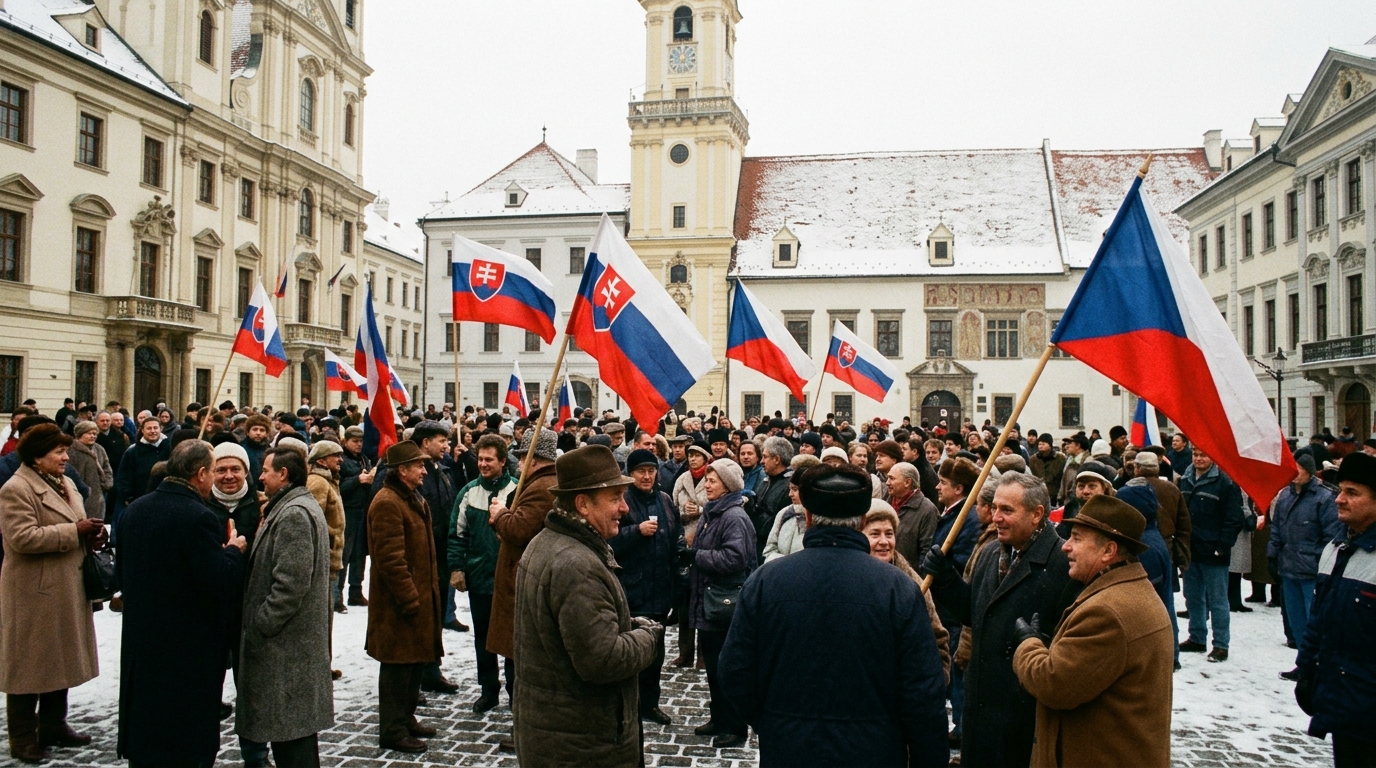
- The Flag: A minor diplomatic dispute arose regarding national symbols. The Czech Republic adopted the original blue-wedge tricolor flag of Czechoslovakia, violating a joint legislative clause stating that neither successor state would use the historic federal symbols. Slovakia, meanwhile, adopted a new flag featuring the traditional double cross on three hills, superimposed on white, blue, and red horizontal stripes.
Division of Federal Assets (2:1 Ratio)
- Military Assets
- Infrastructure
- Gold & Reserves
Divergent Trajectories in the 1990s
Following the split, the two new republics embarked on highly distinct domestic and geopolitical paths during the remainder of the 1990s:
The Czech Republic experienced rapid integration into Western institutions. Under Václav Klaus's premiership and Václav Havel's moral guidance as the new Czech President, the country positioned itself as the poster child of post-communist economic transformation. The Czech Republic was admitted to the OECD in 1995 and joined NATO in 1999, alongside Poland and Hungary.
Slovakia, by contrast, entered a period of democratic backsliding and international isolation under the authoritarian-leaning leadership of Vladimír Mečiar. His tenure (1993–1998) was marred by privatization scandals, the kidnapping of the president's son, and political intimidation. During this era, U.S. Secretary of State Madeleine Albright famously labeled Slovakia "the black hole of Europe" 4. Consequently, Slovakia was excluded from the first wave of NATO expansion in 1999 and saw its EU accession talks temporarily stalled.
Reconvergence and Integration in the European Union
The geopolitical divergence proved temporary. In 1998, a coalition of democratic reformist parties led by Mikuláš Dzurinda defeated Mečiar in national elections. The new government launched deep economic and institutional reforms, enabling Slovakia to rapidly catch up with its Western neighbors.
On May 1, 2004, both the Czech Republic and the Slovak Republic entered the European Union in a major enlargement wave. Three years later, in December 2007, both nations joined the Schengen Area, effectively removing the border controls that had been erected in 1993. Slovakia went on to adopt the Euro (€) as its official currency in 2009, while the Czech Republic chose to retain the Czech koruna.
Analysis of Key Actors and Decisive Actions
The peaceful outcome of the partition of Czechoslovakia was heavily influenced by the personalities, ambitions, and tactical maneuvers of three key political figures.
| Leader | Key Political Role | Ideological Stance | Strategic Objectives during the Split |
|---|---|---|---|
| Václav Havel | President of CSFR (1989–1992) | Liberal Humanist / Dissident | To preserve a democratic, unified federal state based on civil society; resigned when dissolution became inevitable. |
| Václav Klaus | Prime Minister of the Czech Republic | Neoliberal Conservative | To execute rapid market-oriented economic reforms; preferred a clean break over a dysfunctional, subsidized federation. |
| Vladimír Mečiar | Prime Minister of the Slovak Republic | National-Populist | To secure Slovak sovereignty and economic autonomy while retaining a loose, subsidized union with Prague. |
Václav Havel: The Moral Conscience
As a globally respected former dissident and the leader of the Velvet Revolution, Václav Havel fought passionately to preserve the common state. He believed that a unified Czechoslovakia was a vital symbol of multinational harmony in post-cold war Europe.
"My personal position is clear: I am for a common state. I believe that our two nations, which have lived together for seventy-four years, have a moral obligation to try to make their coexistence work under democratic conditions." [^5] — Václav Havel, address to the nation, 1991
However, Havel's moral and philosophical approach was increasingly sidelined by the pragmatic, party-political machinery controlled by Klaus and Mečiar. When the Slovak parliament declared sovereignty in July 1992, Havel resigned, stating he could not fulfill his oath of loyalty to a federation that was legally winding down. His resignation removed the last major moral barrier to partition.
Václav Klaus: The Pragmatic Architect of Partition
Václav Klaus approached the state's future with cold, technocratic precision. As a committed free-market economist, Klaus viewed the Slovak leadership's demands for a slow transition to capitalism as an unacceptable drag on the Czech economy. He calculated that a clean, rapid separation would allow the Czech Republic to modernize its economy, attract foreign direct investment, and join Western institutions much faster than a combined state burdened by Slovakia's economic difficulties.
Klaus's decisive action during the negotiations at Villa Tugendhat was to reject any form of "confederation" or "hybrid state." He understood that a state must be either fully integrated or fully sovereign, avoiding the structural traps that had paralyzed other multi-ethnic federations in the region.
Vladimír Mečiar: The Populist Catalyst
Vladimír Mečiar was a master of political rhetoric who successfully harnessed the growing sense of Slovak national pride and economic anxiety. While he did not initially seek an outright, complete break from Prague, his insistence on Slovak sovereignty, a separate central bank, and an independent international identity made a shared state untenable.
Mečiar underestimated Klaus’s willingness to let Slovakia go. When presented with Klaus's ultimatum of either a tight federation or a total split, Mečiar chose separation, transforming himself into the founding father of the modern Slovak Republic. His nationalist policies shaped the early years of Slovak statehood, leaving a controversial legacy that remains a subject of intense debate.
Trivia and Lesser-Known Facts
- The Missing Referendum: Despite the historic magnitude of the decision, the citizens of Czechoslovakia were never given a vote on the dissolution of their country. Contemporary opinion polls consistently showed that only about 36% of Czechs and 37% of Slovaks supported a complete split, with the majority favoring some form of reformed federal arrangement [^6].
- The "Hyphen War" Linguistic Complexity: During the dispute over the state's name, a bizarre linguistic compromise was reached. The country was officially named Československá federativní republika (without a hyphen) in Czech, but Česko-slovenská federatívna republika (with a hyphen) in Slovak. This dual spelling highlighted the deep division between the two republics.
- Architectural Symbolism of the Split: The historic decision to dissolve the nation was finalized under a large plane tree in the garden of Villa Tugendhat in Brno. This modernist masterpiece, designed by Ludwig Mies van der Rohe, was chosen for its central geographical location between Prague and Bratislava, offering a neutral setting for the two delegations.
- The Border in a Single House: The demarcation of the new international border on January 1, 1993, occasionally split local communities. In the village of Sidonie (Brumov-Bylnice), the border ran directly through a local glassworks factory and split several residential houses in half. It required subsequent land swaps and diplomatic adjustments in the late 1990s to resolve these micro-border anomalies.
- A Unique Separation of the Church: Despite the political split of the state, many civic, academic, and cultural organizations took years to formally separate. Some entities, such as certain scientific academies and religious bodies, maintained unified federal structures well into the late 1990s, demonstrating that social ties persisted long after political ties were severed.
References and Literature
- Leff, Carol Skalnik (1997). The Czech and Slovak Republics: Nation Versus State - A comprehensive academic study of the domestic political dynamics, economic factors, and cultural divisions that led to the dissolution of Czechoslovakia.
- Kirschbaum, Stanislav J. (2005). A History of Slovakia: The Struggle for Survival - An in-depth exploration of Slovak history, focusing on the country's national identity development and its journey to independence in 1993.
- Innes, Abby (2001). Czechoslovakia: The Short Goodbye - A detailed analysis of the political party systems, the role of elites, and the economic reforms under Klaus and Mečiar that catalyzed the Velvet Divorce.
- The Constitutional Act on the Dissolution of Czechoslovakia (Act No. 542/1992 Coll.) - The original legislative document passed by the Federal Assembly of the Czech and Slovak Federal Republic, establishing the legal framework for the peaceful split.
Footnotes & Explanations
- Leff, Carol Skalnik. The Czech and Slovak Republics: Nation Versus State. Westview Press, 1997, p. 22. ↩
- Constitutional Act No. 143/1968 Coll. on the Czechoslovak Federation. ↩
- Innes, Abby. Czechoslovakia: The Short Goodbye. Yale University Press, 2001, pp. 84-86. ↩
- Albright, Madeleine. Public address during diplomatic visit to Bratislava, Slovakia, 1997. ↩
- Havel, Václav. Address to the Federal Assembly of the CSFR, Prague, November 1991. ↩
- Center for Social Analysis (Bratislava) & Institute for Public Opinion Research (Prague). Joint Poll Data, October 1992. ↩