Key Takeaways
- The death of Josip Broz Tito on May 4, 1980, removed the singular, authoritative arbiter of Yugoslavia's complex multi-ethnic political structure, exposing deep institutional vulnerabilities.
- Tito's demise triggered the rapid unraveling of the 1974 Constitution's decentralized governance framework, leading to systemic economic paralysis and the rise of nationalist demagoguery.
- The event marked a geopolitical shift, as both the United States and the Soviet Union lost their strategic incentives to financially and politically sustain a unified, non-aligned Yugoslav state.
Historical Context and Origins
The Socialist Federal Republic of Yugoslavia (SFRY) was a unique geopolitical construct of the post-World War II era. Its cohesion relied almost exclusively on three foundational pillars: the charisma and authoritarian arbitration of Marshal Josip Broz Tito, the ideological myth of "Brotherhood and Unity" (Bratstvo i jedinstvo), and a strategically lucrative position between the Western Alliance and the Warsaw Pact 1.
Following the historic 1948 Tito-Stalin split, Yugoslavia carved out an independent path to socialism, rejecting the Soviet model of highly centralized state planning in favor of "socialist self-management" (samoupravljanje). This domestic compromise was paired with an ambitious foreign policy. By co-founding the Non-Aligned Movement (NAM) in 1961 alongside India's Jawaharlal Nehru and Egypt's Gamal Abdel Nasser, Tito elevated a medium-sized Balkan nation to the status of a global diplomatic heavyweight.
The Three Pillars of SFRY Unity
- Josip Broz Tito
- Brotherhood & Unity Myth
- Geopolitical Non-Alignment
However, beneath the veneer of prosperous "goulash communism" lay deep-seated ethnic animosities, historical grievances, and profound developmental disparities between the industrialized north (Slovenia and Croatia) and the agrarian south (Kosovo, Macedonia, and Bosnia-Herzegovina). To appease growing nationalist sentiments—most notably demonstrated during the 1971 "Croatian Spring"—Tito instituted the 1974 Constitution 2.
This document was a double-edged sword:
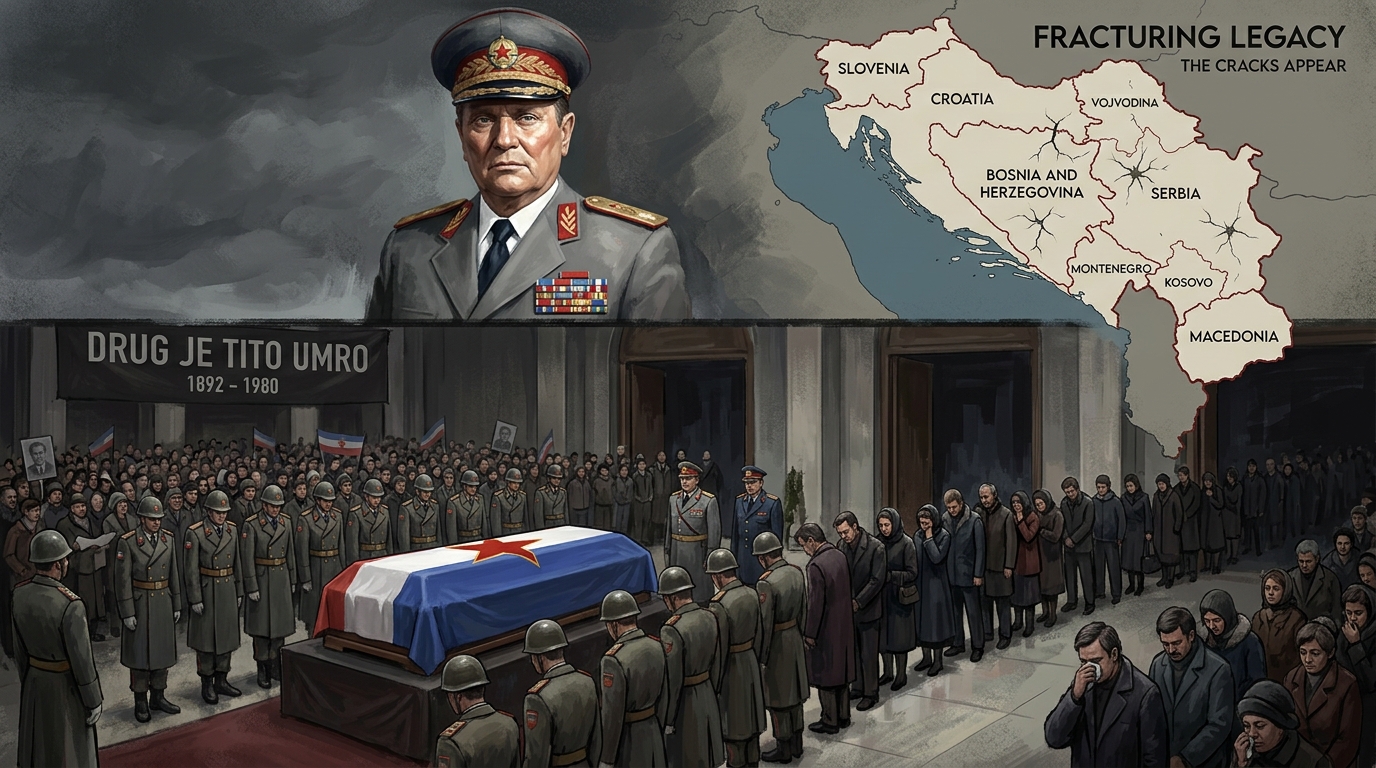
- It highly decentralized the state, effectively transforming the federation into a de facto confederation of six republics and two autonomous provinces (Vojvodina and Kosovo).
- It granted veto power to all federal units over key economic and legislative decisions.
- It established a highly complex, rotating collective presidency to govern after Tito's death.
While Tito lived, his word remained the ultimate constitutional arbiter. He was designated President for Life, and his personal authority was absolute. If a republic opposed federal policy, Tito could purge its leadership, as he did in Croatia and Serbia in the early 1970s. However, this constitutional framework essentially institutionalized the eventual fragmentation of the state, ensuring that once the central authority of Tito vanished, the federal center would find itself structurally paralyzed.
Timeline of Events and Key Moments
The physical decline of Josip Broz Tito began to accelerate in late 1979. At 87 years old, the Yugoslav leader suffered from severe circulatory problems in his left leg, exacerbated by decades of heavy smoking and diabetes.
The Medical Crisis (January – May 1980)
- January 3, 1980: Tito was admitted to the University Medical Centre in Ljubljana, Slovenia. His physicians diagnosed arterial blockages in his left leg.
- January 12, 1980: Doctors attempted a bypass surgery to restore blood flow. The procedure failed.
- January 20, 1980: Faced with the threat of fatal gangrene, Tito reluctantly consented to the amputation of his left leg.
- February – April 1980: While Tito briefly showed signs of recovery, his internal organs began to fail. He suffered from pneumonia, heart failure, kidney failure, and internal bleeding. He was kept alive via mechanical life-support systems, transforming the Ljubljana clinic into the focal point of global geopolitical anxiety.
During these months, both Washington and Moscow watched Belgrade with intense scrutiny. The Soviet invasion of Afghanistan in December 1979 had reignited Cold War tensions, and Western intelligence agencies feared that the Soviet Union might use the post-Tito power vacuum to militarily intervene in Yugoslavia and secure a warm-water port on the Adriatic Sea 3.
May 4, 1980: The Announcement
At 15:05 CET on May 4, 1980, Josip Broz Tito was officially pronounced dead. At 18:50, the Presidency of the Central Committee of the League of Communists of Yugoslavia (LCY) and the Presidency of the SFRY issued a joint proclamation to the citizens of Yugoslavia:
"To the working class, all working people and citizens, and all nations and nationalities of the Socialist Federal Republic of Yugoslavia: Comrade Tito has died."
The news was first broadcast on television by Miodrag Zdravković, a presenter on Radio Television Belgrade, who struggled to contain his tears.
Perhaps the most culturally resonant moment of the announcement occurred during a Yugoslav First League football match in Split between NK Hajduk Split and Red Star Belgrade. When the news of Tito's death was broadcast over the stadium's public address system, players from both teams collapsed to the pitch in tears, and the crowd of 50,000 spontaneously began singing the patriotic anthem "Druže Tito, mi ti se kunemo" ("Comrade Tito, We Swear to You").
The State Funeral (May 8, 1980)
Tito's funeral in Belgrade remains one of the largest diplomatic gatherings in modern history, reflecting Yugoslavia's unique global standing during the Cold War.
Representation at Tito's Funeral (May 8, 1980)
| Category | Count | Category | Count |
|---|---|---|---|
| Four Kings | 4 | 31 Presidents | 31 |
| 6 Princes | 6 | 22 Prime Ministers | 22 |
| Foreign Ministers | 47 | Delegations | 128 |
| Nations | 119 | Alignment | Both Blocs & NAM |
The attendees included:
- Western Leaders: British Prime Minister Margaret Thatcher, West German Chancellor Helmut Schmidt, French President Valéry Giscard d'Estaing, and Italian President Sandro Pertini.
- Eastern Bloc Leaders: Soviet Premier Leonid Brezhnev, East German leader Erich Honecker, and Polish leader Edward Gierek.
- Non-Aligned and Third World Leaders: Indian Prime Minister Indira Gandhi, Iraqi President Saddam Hussein, and North Korean leader Kim Il-sung.
Tito was buried in the Kuća Cveća ("House of Flowers") mausoleum, located on the grounds of his residence in Belgrade. His coffin was carried on the shoulders of workers, soldiers, and representatives of all the Yugoslav nations, projecting a final, deceptive image of unity.
- Tito's Passing (1980)
Geopolitical Consequences and Aftermath
The death of Tito removed the master domestic balancer and exposed the structural cracks of the Yugoslav state. The immediate geopolitical consequence was the gradual loss of Yugoslavia's strategic utility to both the West and the East.
Economic Collapse and IMF Austerity
Throughout the 1970s, Yugoslavia had artificially maintained its high standard of living through massive borrowing from Western banks and multilateral institutions. By 1980, the national debt hovered around $20 billion 4.
With the second oil shock of 1979 and the subsequent rise of global interest rates initiated by US Federal Reserve Chairman Paul Volcker, Yugoslavia's debt-servicing costs became unsustainable.
- The International Monetary Fund (IMF) conditioned emergency loans on strict stabilization programs, demanding structural reforms, wage freezes, and currency devaluations.
- The domestic result was a decade of hyperinflation, severe shortages of basic consumer goods (such as coffee, detergent, and fuel), and power reductions.
- The economic crisis immediately polarized the federation along regional lines. The wealthy northern republics (Slovenia and Croatia) resented sending their hard-currency revenues to federal funds intended to develop the impoverished south, viewing it as a drain on their own European integration prospects.
The Rise of Nationalism and the 1981 Kosovo Protests
In the spring of 1981, less than a year after Tito's death, ethnic Albanian students at the University of Priština in Kosovo organized protests. What began as a demonstration over poor campus conditions quickly escalated into nationwide political demands for Kosovo to be granted full republic status within Yugoslavia, independent of Serbia.
The federal presidency responded by declaring a state of emergency, deploying the Yugoslav People’s Army (JNA), and violently suppressing the protests. The 1981 riots in Kosovo shattered the illusion of "Brotherhood and Unity" and catalyzed Serbian nationalist anxiety, setting the stage for the ascent of Slobodan Milošević in the late 1980s.
The Loss of Geopolitical Leverage
During the Cold War, the United States viewed a stable, independent Yugoslavia as a vital buffer against Soviet expansion in Southern Europe. This policy was codified in US National Security Decision Directive 133 (NSDD 133) in 1984, which affirmed that US policy toward Yugoslavia was to support its "independence, territorial integrity, and national unity" 5.
However, as Mikhail Gorbachev initiated glasnost and perestroika in the mid-1980s, the Cold War began to wind down. With the fall of the Berlin Wall in 1989 and the collapse of the Warsaw Pact, Yugoslavia lost its strategic position as a bridge between East and West. To Western policymakers, Belgrade was no longer a vital security buffer, but an economically failing socialist state of secondary geopolitical importance.
Analysis of Key Actors and Decisive Actions
| Actor | Strategic Position / Motivation | Action Taken | Historical Impact |
|---|---|---|---|
| Josip Broz Tito | To maintain his absolute power and the integrity of the multi-ethnic Yugoslav state. | Implemented the highly decentralized 1974 Constitution, suppressing nationalist movements while institutionalizing regional vetoes. | Created a fragile system that depended entirely on his personal authority, ensuring post-mortem political gridlock. |
| The Collective Presidency | To preserve the federal status quo while protecting regional and republican interests. | Failed to reform the economy or curb regional self-interests; relied heavily on JNA military crackdowns during regional crises. | Paralyzed federal decision-making, allowing local populist and nationalist leaders to capture the political narrative. |
| United States | To prevent Soviet encroachment in the Balkans and ensure Yugoslav stability via financial assistance. | Provided IMF loans and political support under the Reagan administration (NSDD 133), but eventually withdrew support as the Cold War ended. | Kept the Yugoslav state on financial life support during the early 1980s, but left it vulnerable to rapid collapse when geopolitical priorities shifted. |
| Soviet Union | To bring Yugoslavia back into the socialist fold or, failing that, prevent its complete integration into Western security architectures. | Maintained diplomatic and economic ties (importing Yugoslav goods), while monitoring Belgrade for signs of political collapse or Western alignment. | Contributed to the strategic ambiguity that kept Yugoslavia on high military alert, but lost its own leverage as the USSR collapsed. |
The Systemic Failure of the Rotating Presidency
The primary institutional mechanism designed to prevent any single nationality from dominating Yugoslavia was the rotating State Presidency. This council consisted of eight members: one representing each of the six republics and the two autonomous provinces. Every year, the presidency was supposed to rotate to a new head of state.
This system proved to be an absolute failure. Without Tito's authority, decisions required unanimous consensus, which was impossible to achieve as economic resources dwindled. Republican politicians quickly realized that their political survival depended not on federal loyalty, but on appealing to the nationalistic sentiments of their local electorates.
By the late 1980s, leaders like Slobodan Milošević in Serbia utilized the systemic paralysis of the collective presidency to bypass federal structures entirely. Through his "Anti-Bureaucratic Revolution," Milošević orchestrated mass rallies to replace the leadership of Vojvodina, Kosovo, and Montenegro with his loyalists, effectively seizing control of four out of the eight votes in the federal presidency. This move destroyed the delicate balance of power established by the 1974 Constitution, prompting Slovenia and Croatia to conclude that remaining within the federation was no longer viable.
Trivia and Lesser-Known Facts
- The Mystery of the Death Date: Rumors persisted in Yugoslavia that Tito actually died several days or even weeks prior to May 4, 1980. Some historians argue that his death was kept secret by the state leadership to coordinate security measures, arrange the funeral logistics, and prevent immediate domestic panic.
- The Blue Train (Plavi Voz): Following his death in Ljubljana, Tito’s coffin was transported back to Belgrade aboard his famous luxury train, the Plavi Voz. Hundreds of thousands of citizens lined the railway tracks across the country, kneeling, crying, and throwing flowers as the train passed.
- The Fake Coffin Theory: Rumors have persisted that due to the rapid decomposition of Tito's body (exacerbated by gangrene and his extensive medical treatment), his actual remains were not in the wooden coffin displayed during the state funeral. According to some accounts, the coffin was filled with sand to prevent any odor during the long outdoor ceremony, and he was buried under the concrete slab of the House of Flowers hours before the public service.
- The Last Gathering of the Old World: Tito’s funeral was one of the very few occasions where leaders of deeply adversarial states stood in close physical proximity. In a remarkable display of diplomatic pragmatism, Chinese Premier Hua Guofeng, Soviet leader Leonid Brezhnev, and various Western leaders stood just feet apart, paying respects to a man who had successfully navigated the dangerous waters of Cold War division.
References and Literature
- The Yugoslav Constitution of 1974 - Official text and analysis of the legislative framework that decentralized the Yugoslav federation.
- National Security Decision Directive 133 (NSDD 133) - Declassified United States national security document outlining US policy toward Yugoslavia in 1984.
- The Death of Tito and the Rise of Slobodan Milosevic - Foreign Affairs analysis of the transition from Tito's authoritarian regime to the rise of ethnic nationalism.
- Yugoslavia's Debt Crisis and the IMF - Detailed IMF historical analysis of the macroeconomic imbalances and debt negotiations of post-Tito Yugoslavia in the 1980s.
Footnotes & Explanations
- See The Death of Tito and the Rise of Slobodan Milosevic, Foreign Affairs (1999). ↩
- Refer to The Yugoslav Constitution of 1974, Section II, on the division of federal and republican authority. ↩
- See US National Security Council reports from late 1979 detailing fears of Soviet movements in the Balkans post-Afghanistan. ↩
- Detailed in Yugoslavia's Debt Crisis and the IMF, Chapter 13 of the IMF Historical Archives. ↩
- Documented in National Security Decision Directive 133 (NSDD 133), signed by President Ronald Reagan on March 14, 1984. ↩