Key Takeaways
- The March 30, 1981, assassination attempt by John Hinckley Jr. transformed Ronald Reagan from a politically vulnerable newly-elected president into a highly revered national figure, securing him vast political capital.
- Reagan's survival was interpreted by the President himself and his inner circle as a providential mandate, accelerating the transition from Richard Nixon's détente to an assertive, neoconservative-influenced foreign policy.
- The consolidated domestic authority post-recovery enabled the administration to bypass moderate opposition, fund a massive peacetime military buildup, and lay the groundwork for the 'Evil Empire' speech and the rollback of Soviet influence.
Historical Context and Origins
The transition of power from the Carter administration to the Reagan presidency in January 1981 occurred during a period of profound geopolitical crisis and domestic malaise. The United States was reeling from a decade characterized by the economic burdens of stagflation, the humiliating conclusion of the Vietnam War, the ongoing fallout of the Watergate scandal, and the geopolitical setbacks of the late 1970s. Chief among these setbacks were the Soviet invasion of Afghanistan in December 1979 and the 444-day Iran hostage crisis, which symbolized a perceived paralysis of American global power 1.
During the 1970s, United States foreign policy had been dominated by the doctrine of détente—a strategy of relaxed tensions, arms control treaties (such as SALT I and SALT II), and pragmatic coexistence championed by Richard Nixon, Henry Kissinger, and, initially, Jimmy Carter. However, a growing intellectual and political movement argued that détente was a policy of appeasement that allowed the Soviet Union to expand its sphere of influence in the Global South while achieving strategic nuclear parity with the United States.
- Domestic Malaise of the 1970s
This opposition coalesced around a diverse coalition of traditional conservatives and a highly influential group of disillusioned liberals who migrated rightward—the neoconservatives. Organized under pressure groups like the Committee on the Present Danger (CPD), these intellectuals, policy analysts, and politicians argued for a robust moral clarity in foreign relations, a substantial increase in military spending, and an active global rollback of communist expansionism 2.
When Ronald Reagan assumed office, his victory was viewed as a mandate to restore American strength. However, during his first seventy days in office, Reagan faced severe institutional resistance. His proposed radical economic restructuring (later dubbed "Reaganomics") stalled in a divided Congress, and his hawkish foreign policy rhetoric was dismissed by critics as dangerous warmongering. The administration lacked the absolute political leverage required to execute its dual program of domestic tax cuts and massive peacetime defense expansion. The catalyst that broke this political deadlock, and cemented the ideological dominance of the neoconservative vision, came on a rainy Monday afternoon in Washington, D.C.
Timeline of Events and Key Moments
March 30, 1981: The Shooting at the Washington Hilton
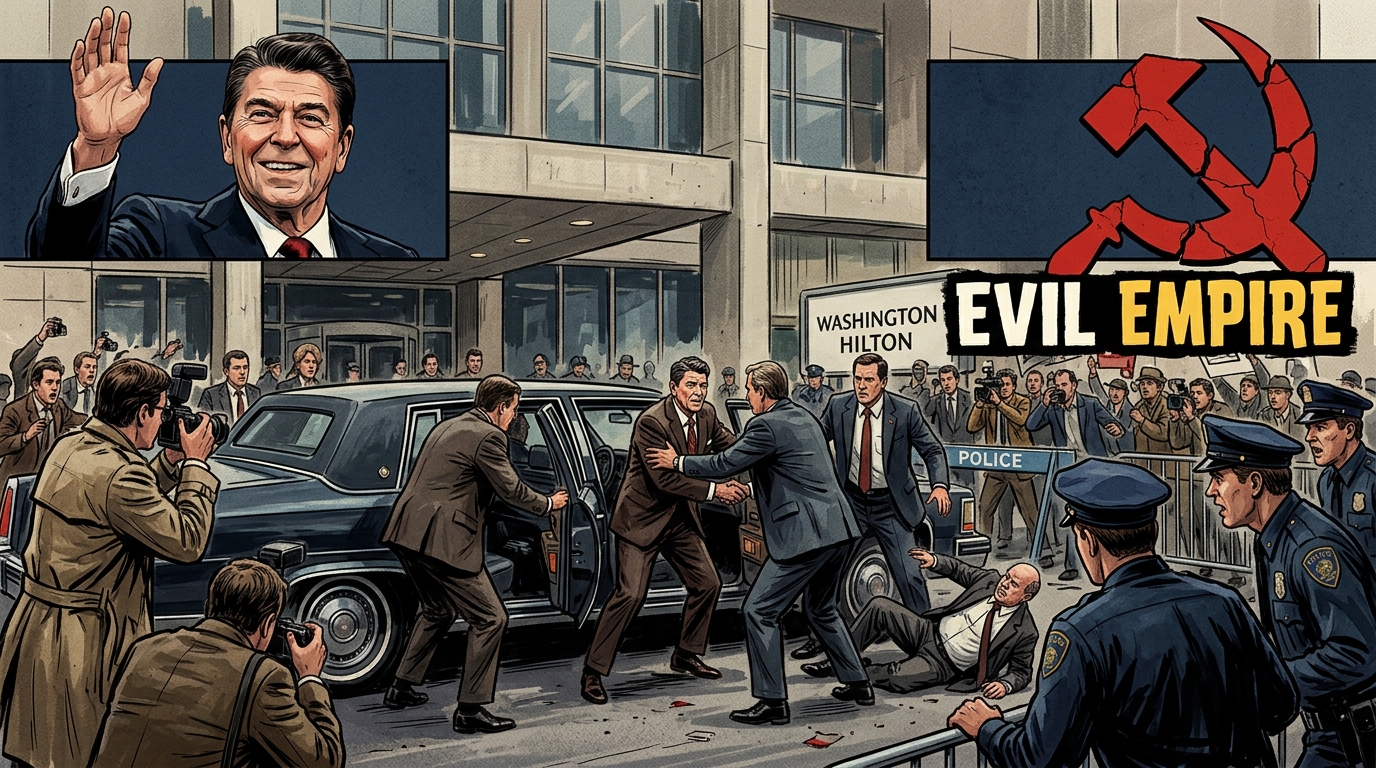
At 2:27 PM EST, President Ronald Reagan emerged from the T Street NW exit of the Washington Hilton Hotel, where he had just delivered an address to approximately 3,500 members of the AFL-CIO building trades national conference. As Reagan walked toward his waiting presidential limousine, accompanied by his White House staff and a Secret Service detail, John Hinckley Jr. stepped forward from a crowd of reporters and onlookers.
Using a Rohm RG-14 .22 caliber revolver loaded with "Devastator" explosive-tip bullets, Hinckley fired six shots in rapid succession over the span of 1.7 seconds 3:
- The first shot struck White House Press Secretary James Brady in the forehead, causing severe, permanent brain damage.
- The second shot struck District of Columbia police officer Thomas Delahanty in the back of the neck as he turned to shield the President.
- The third shot overshot the President and hit a window across the street.
- The fourth shot struck Secret Service Agent Timothy McCarthy in the abdomen as he deliberately spread his body to protect Reagan.
- The fifth shot struck the bullet-resistant glass of the open limousine door.
- The sixth shot ricocheted off the armored side of the limousine, entered Reagan’s left underarm, fractured a rib, punctured his lung, and lodged less than an inch from his heart.
- Crowd / Press Line
The Immediate Response and Medical Emergency
Secret Service Special Agent in Charge Jerry Parr instantly shoved Reagan into the back of the limousine, screaming "Take off!" as driver Drew Ehrenbichler accelerated away from the scene. Initially, Parr assessed that the President had escaped injury, believing the moisture on Reagan's lips was merely split-lip blood caused by being thrown into the vehicle. However, as Reagan began coughing up bright red, frothy blood—a classic symptom of a punctured lung—and complaining of severe difficulty breathing, Parr overrode standard protocols to return to the secure White House. Instead, he ordered the limousine to divert to George Washington University Hospital 4.
This decision saved Reagan’s life. Upon arrival, Reagan's blood pressure had plummeted to dangerously low levels (60 systolic), and he was in thoracic shock due to internal bleeding. Despite his critical condition, Reagan maintained an extraordinary composure that would soon become central to his political mythology. Walking into the emergency room under his own power before collapsing, he famously quipped to the surgeons:
"I hope you are all Republicans." [[^5]]
To which the lead trauma surgeon, Joseph Giordano—a registered Democrat—replied:
"Today, Mr. President, we are all Republicans."
Reagan underwent a three-hour emergency thoracotomy to retrieve the bullet and stem the internal bleeding, losing over half of his blood volume in the process.
Crisis in the Situation Room
While Reagan was in surgery, a constitutional and bureaucratic crisis unfolded in the White House Situation Room. Vice President George H.W. Bush was in mid-air flying from Texas to Washington. Secretary of State Alexander Haig, a former four-star general, clashed with Defense Secretary Caspar Weinberger over the chain of command and control of the National Command Authority (the nuclear football).
In a televised press briefing from the White House briefing room, a visibly agitated Haig attempted to reassure the nation but instead generated widespread alarm by asserting:
"As of now, I am in control here, in the White House, pending the return of the Vice President..." [[^6]]
Haig’s statement, which bypassed the constitutional order of presidential succession (wherein the Speaker of the House and the President pro tempore of the Senate precede the Secretary of State), created an impression of administrative chaos that contrasted sharply with the calm, disciplined image subsequently projected by Reagan’s inner staff.
| Time (EST) | Event / Development | Key Figure(s) Involved |
|---|---|---|
| 2:27 PM | John Hinckley Jr. fires six shots outside the Washington Hilton Hotel. | Ronald Reagan, James Brady, Timothy McCarthy |
| 2:35 PM | Secret Service Agent Jerry Parr diverts the presidential limousine to George Washington University Hospital. | Jerry Parr, Drew Ehrenbichler |
| 3:24 PM | Secretary of State Alexander Haig makes his controversial "I am in control here" broadcast. | Alexander Haig |
| 6:30 PM | Surgeons successfully retrieve the bullet; Reagan is declared in stable condition in the ICU. | Dr. Joseph Giordano, Dr. Benjamin Aaron |
| 7:00 PM | Vice President George H.W. Bush arrives at the White House to assume temporary operational leadership. | George H.W. Bush |
Geopolitical Consequences and Aftermath
The Consolidation of Domestic Authority
The political landscape of the United States shifted overnight. Prior to March 30, Reagan’s legislative agenda was facing stiff opposition. Upon his discharge from the hospital on April 11, 1981, Reagan was greeted by a wave of public admiration that transformed his political standing. His grace, humor, and rapid recovery at age 70 earned him the moniker of the "Teflon President"—a leader whose personal popularity shielded him from political damage.
- Surviving the Assassination Attempt
- Consolidating Congressional Support
- Implementation of Peacetime Buildup
- Global Rollback of Soviet Influence
This newly minted political capital was immediately deployed to pass his economic program. By August 1981, Congress approved the Economic Recovery Tax Act (ERTA) and the Omnibus Budget Reconciliation Act, implementing the largest tax cuts in American history up to that point alongside significant cuts to domestic social programs. Crucially, the surge in Reagan's political standing silenced moderate Republicans and Southern Democrats who had previously questioned his massive defense budget requests. The administration successfully secured funding for an unprecedented peacetime military modernization program, including the reactivation of Iowa-class battleships, the deployment of Pershing II missiles in Western Europe, and the development of the B-1 Lancer bomber.
The Providential Mandate and the "Evil Empire"
Reagan’s survival profoundly altered his personal psychology and, by extension, the trajectory of US foreign policy. A deeply religious man, Reagan became convinced that God had spared his life for a specific, divine purpose: the eradication of Soviet communism. In his private diary, Reagan recorded his belief that his survival was part of a grander plan 7.
This conviction catalyzed a shift in foreign policy toward an uncompromising, morally absolute posture. Neoconservative thinkers within the administration—such as UN Ambassador Jeane Kirkpatrick, Assistant Secretary of Defense Richard Perle, and Director of Net Assessment Andrew Marshall—found their influence greatly augmented. The intellectual framework of neoconservatism, which rejected the moral equivalence of the Cold War and advocated for the active promotion of democracy and human rights abroad, became the operational template for the administration.
This moral clarity culminated in two of the most significant foreign policy speeches of the late Cold War:
- The Westminster Address (June 8, 1982): Speaking before the British Parliament, Reagan predicted that Marxism-Leninism would be left on the "ash heap of history."
- The "Evil Empire" Speech (March 8, 1983): Addressing the National Association of Evangelicals, Reagan explicitly framed the Cold War as a moral struggle between freedom and totalitarianism, urging his audience not to ignore "the facts of history and the aggressive impulses of an evil empire" [[^8]].
The Reagan Doctrine and Military Escalation
Armed with domestic support and driven by neoconservative ideologues, the Reagan administration abandoned containment in favor of rollback. This operationalized into the Reagan Doctrine, which mandated active American support—covert and overt—for anti-communist insurgencies worldwide.
The Reagan Doctrine
(Rollback of global Soviet influence)
- Central America / Contras
- Afghanistan / Mujahidin
- Europe / Deployment of Pershing II missiles
The administration began funding and training the Contra rebels fighting the Marxist Sandinista government in Nicaragua, escalated support to the Mujahidin in Afghanistan through the CIA (Operation Cyclone), and backed anti-communist elements in Angola and Cambodia.
Furthermore, in March 1983, Reagan announced the Strategic Defense Initiative (SDI), a space-based missile defense system dubbed "Star Wars" by critics. SDI directly challenged the cornerstone of Soviet-American strategic stability—Mutually Assured Destruction (MAD). The neoconservative assumption underlying SDI was that the Soviet economy was structurally weak and could be forced into collapse if forced to compete in a high-tech arms race. This assumption proved correct, as the Soviet Union, led by Mikhail Gorbachev after 1985, realized it could not match American technological and financial mobilization, ultimately forcing Moscow to negotiate arms reductions on American terms.
Analysis of Key Actors and Decisive Actions
The structural shifts in US foreign policy during the early 1980s were driven by a unique interplay of institutional structures, ideological movements, and key personalities.
Ronald Reagan
Reagan's leadership style was characterized by a focus on broad, strategic visions coupled with a relative indifference to the details of policy execution. This allowed his staff—particularly the "Troika" consisting of Chief of Staff James Baker, Counselor to the President Edwin Meese, and Deputy Chief of Staff Michael Deaver—to manage the presidency with high efficiency. Reagan's primary contribution was his communication skills. By framing complex geopolitical conflicts as binary struggles between good and evil, he successfully mobilized public opinion behind a massive, costly military buildup and controversial covert operations.
The Neoconservative Vanguard
The intellectual architecture of the administration’s foreign policy was managed by several key figures who occupied critical mid-level and high-level posts:
- Jeane Kirkpatrick: Appointed as United States Ambassador to the United Nations, Kirkpatrick formulated the "Kirkpatrick Doctrine," which argued that traditional authoritarian regimes friendly to the West were more stable and more susceptible to democratic transition than totalitarian communist regimes, justifying US support for right-wing autocracies in Latin America.
- Richard Perle: Serving as Assistant Secretary of Defense for International Security Policy, Perle earned the nickname "The Prince of Darkness" for his uncompromising stance on arms control, arguing that any treaty that did not involve asymmetric Soviet dismantling of weapons was a threat to US national security.
- Paul Wolfowitz: As Director of Policy Planning in the State Department, Wolfowitz worked to integrate human rights promotion with an assertive military posture, laying the conceptual groundwork for post-Cold War neoconservative interventions.
The Soviet Response and Miscalculation
The Kremlin, under the aging leadership of Leonid Brezhnev, Yuri Andropov, and Konstantin Chernenko, misread the political consolidation occurring in Washington. The Soviet leadership interpreted the rise of neoconservatism and the transition from détente as evidence of an impending American first-strike nuclear attack.
This paranoia culminated in Operation RYAN (a massive intelligence mobilization designed to detect Western preparations for a nuclear strike) and the near-catastrophe of the Able Archer 83 military exercise in November 1983, during which the Soviet military went on high alert, believing the NATO exercise was a cover for a real attack 9. The consolidation of Reagan’s authority post-1981 removed any incentive for Washington to compromise, forcing the Soviet leadership to confront its own terminal systemic crisis.
Trivia and Lesser-Known Facts
- The Nuclear Football Chaos: In the immediate aftermath of the shooting, Reagan's clothing was cut off by emergency room staff. His personal belongings, including the "Gold Codes" needed to authorize a nuclear strike, were placed in a plastic bag and temporarily discarded on the hospital floor. Secret Service agents subsequently retrieved them from police custody.
- The Unexploded Bullet: The "Devastator" bullet that entered Reagan’s lung was designed to explode upon impact. Had it done so, the blast would have shredded his pulmonary artery, resulting in near-instantaneous death. The bullet did not explode because it struck the armored side of the limousine first, which absorbed enough kinetic energy to prevent the nose-fuse from detonating.
- The "Secret" Letter to Brezhnev: While recovering in the hospital, Reagan handwrote a personal letter to Soviet leader Leonid Brezhnev. In it, he bypassed State Department channels to appeal directly to Brezhnev on a human level, arguing that the peoples of both nations desired peace. The State Department, horrified by the informal tone, attempted to block the letter, but Reagan insisted on sending it, marking the first quiet step toward his eventual personal diplomacy with Mikhail Gorbachev.
- The Hinckley Motivation: John Hinckley Jr.’s motivation had no political or geopolitical basis. He was pathologically obsessed with actress Jodie Foster and believed that assassinating a president would win her admiration, inspired by the film Taxi Driver (1976), in which the protagonist attempts to assassinate a presidential candidate.
References and Literature
- The Reagan Presidency and the Cold War - An analytical overview of the initial shifts in the Reagan administration's foreign policy published during the early years of his term.
- Rawhide: The Secret Service, the President, and the March 30, 1981 Assassination Attempt - Official documentation, audio files, and Secret Service reports preserved at the Ronald Reagan Presidential Library.
- The Rise of Neoconservatism and the Cold War's End - Academic analysis of how neoconservative intellectuals shaped US security strategies in the 1980s.
- The Dead Hand: The Untold Story of the Cold War Arms Race - David E. Hoffman's Pulitzer Prize-winning history of the late Cold War arms buildup, including the paranoia surrounding Operation RYAN and Able Archer 83.
Footnotes & Explanations
- For a detailed analysis of the impact of the Iran hostage crisis and the Soviet invasion of Afghanistan on American public consciousness, see the historical reviews in the Foreign Affairs archives of 1980–1981. ↩
- The Committee on the Present Danger was instrumental in drafting the policy papers that eventually became the blueprint for Reagan’s defense policy. Many of its key members were appointed directly to the National Security Council and Department of Defense. ↩
- Detailed ballistics and timeline reports from the FBI Investigation of the shooting (Code Name: REGIN). ↩
- Jerry Parr's decision is widely analyzed in Secret Service training protocols as a textbook example of tactical flexibility overriding rigid procedure. ↩
- These quotes were documented by presidential adviser Edwin Meese III in his memoirs and verified by hospital records released by George Washington University Hospital. ↩
- Haig's statement is famously preserved in television archives and became a source of significant criticism, contributing to his eventual resignation in July 1982. ↩
- See The Reagan Diaries, entry for April 11, 1981: "Whatever happens now I owe my life to God and will try to serve him in every way I can." ↩
- Address to the National Association of Evangelicals, Orlando, Florida, March 8, 1983. ↩
- For deep-dive declassified intelligence documents regarding Able Archer 83 and Operation RYAN, see the National Security Archive at George Washington University. ↩