Key Takeaways
- The 1990 elections across Yugoslavia's six republics dismantled the monopoly of the League of Communists, replacing it with fragmented, republic-centric leaderships.
- The asymmetry of the elections—held at different times and under different electoral laws in each republic—prevented the formation of a unified federal democratic consensus.
- The victory of nationalist parties in Croatia, Bosnia, and Slovenia, alongside the consolidation of Slobodan Milošević's power in Serbia, made the peaceful preservation of the federation impossible.
Historical Context and Origins
The year 1990 marked the definitive collapse of the political order that had sustained the Socialist Federal Republic of Yugoslavia (SFRY) for nearly half a century. Following the death of lifelong President Josip Broz Tito in 1980, the structural vulnerabilities of the Yugoslav state began to surface with increasing intensity. The country was governed under the highly decentralized 1974 Constitution, which had transformed the federation into a de facto confederation of eight constituent units—six republics (Slovenia, Croatia, Bosnia and Herzegovina, Serbia, Montenegro, and Macedonia) and two autonomous provinces within Serbia (Kosovo and Vojvodina).1 While designed to prevent the dominance of any single ethnic group, particularly the Serbs, this system relied on consensus-based decision-making that proved paralyzed in the face of post-Tito challenges.
| Federal Presidency (8 Members) | ||
|---|---|---|
| Slovenia | Croatia | Serbia (and 3 other republics) |
| DEMOS Victory | HDZ Victory | SPS Victory |
| Secession (Dec 1990) | Secession (June 1991) | Centralist Reaction |
Compounding this constitutional deadlock was a devastating economic crisis. Throughout the 1980s, Yugoslavia grappled with a massive foreign debt, hyperinflation that peaked at over 2,500% in late 1989, and rising unemployment. The economic misery eroded the legitimacy of the ruling League of Communists of Yugoslavia (SKJ) and fostered deep grievances between the wealthier northern republics (Slovenia and Croatia), which felt their resources were being siphoned off to subsidize the underdeveloped south, and the southern regions, which felt marginalized and economically exploited.
By the late 1980s, these economic anxieties were successfully channeled into ethnic nationalism. In Serbia, Slobodan Milošević ascended to the presidency of the Serbian League of Communists in 1987. Utilizing populist rhetoric and orchestrating the "Anti-Bureaucratic Revolution," Milošević mobilized mass protests to strip Kosovo and Vojvodina of their autonomy, effectively consolidating four of the eight votes in the Federal Presidency under Serbian control.2 This aggressive centralization alarmed the other republics, particularly Slovenia and Croatia, who feared a return to a Serb-dominated, centralized state.
The breaking point arrived in January 1990 at the 14th Extraordinary Congress of the SKJ in Belgrade. The Slovenian delegation, advocating for a transition to a multi-party system and a loose confederation, found all of their reform proposals systematically voted down by the Serbian-dominated majority. In protest, the Slovenian delegates walked out of the congress on January 22, followed shortly after by the Croatian delegation. This walkout signaled the de facto death of the League of Communists of Yugoslavia as a unified political force.
With the federal party dissolved, the locus of political legitimacy shifted entirely to the individual republics. Lacking a federal constitutional framework to govern a transition to democracy, each republic proceeded to organize its own multi-party elections throughout 1990. This asymmetric transition ensured that democracy would not be built on a pan-Yugoslav basis, but rather on localized, competing nationalisms.
Timeline of Events and Key Moments
The transition to multi-party democracy in Yugoslavia did not occur simultaneously; it was a fragmented, staggered process that took place republic by republic over the course of nine months. This staggered timeline allowed developments in one republic to directly polarize and radicalize the campaigns in the others.
| Date | Event |
|---|---|
| Apr 1990 | Slovenia: DEMOS Coalition wins; Milan Kučan elected President |
| Apr-May 1990 | Croatia: Franjo Tuđman's HDZ wins a parliamentary majority |
| Aug 1990 | "Log Revolution" begins in Knin, mobilizing Serb opposition in Croatia |
| Nov-Dec 1990 | Elections in Bosnia, Macedonia, Montenegro, and Serbia |
| Dec 1990 | Slovenian Independence Plebiscite (88.5% vote "Yes") |
Spring 1990: The Northern Republics Lead the Way
Slovenia was the first to hold elections, on April 8 and 22, 1990. The election was contested by the reformed League of Communists—renamed the Party of Democratic Reform (ZKS-SDP)—and the Democratic Opposition of Slovenia (DEMOS), a coalition of newly formed center-right and nationalist opposition parties. DEMOS won a clear victory, securing 54.8% of the vote for the socio-political chamber of the parliament. However, the presidency of the republic went to Milan Kučan, the leader of the reformed communists, who was widely respected for his pragmatic defense of Slovenian sovereignty against Milošević's pressure.
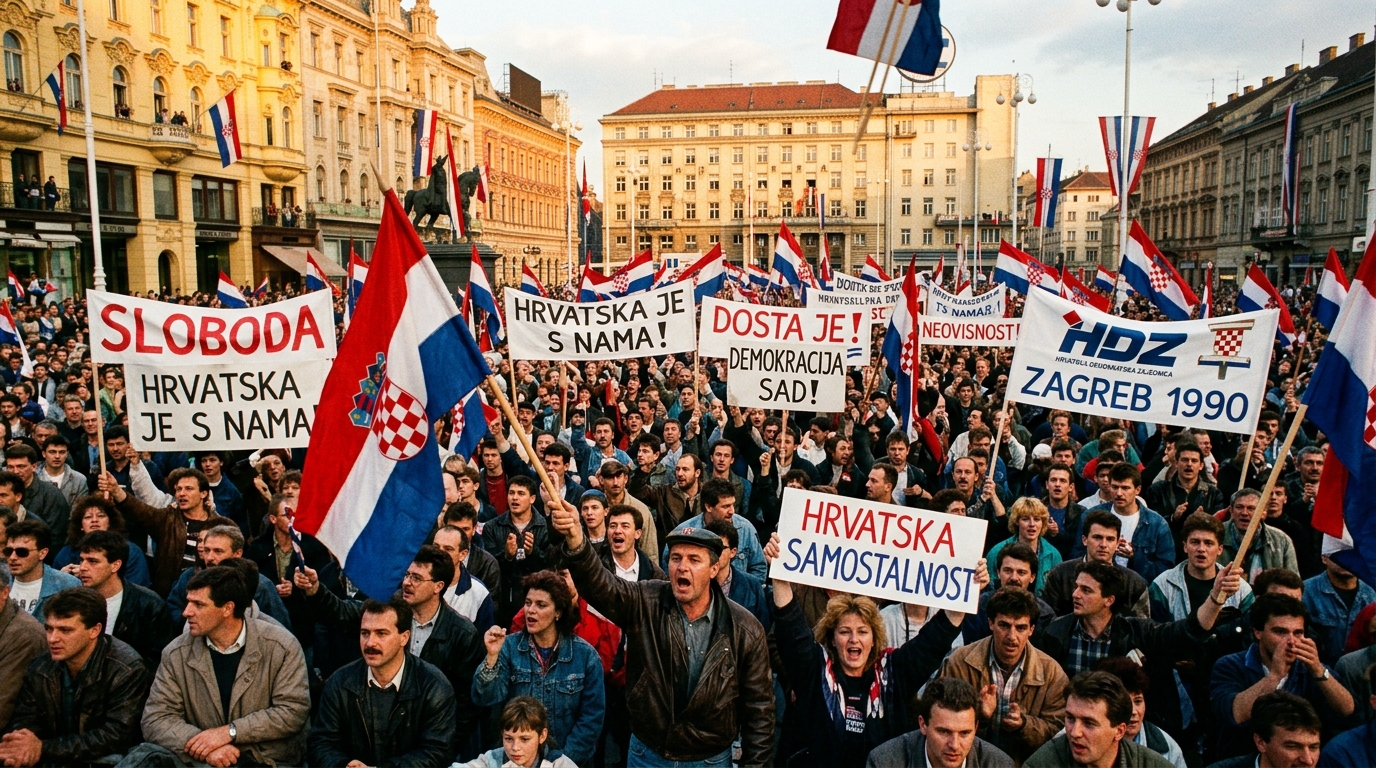
Croatia followed immediately after, with elections held on April 22 and May 6, 1990. The political landscape was dominated by the Croatian Democratic Union (HDZ), led by Franjo Tuđman, a former Yugoslav army general and dissident historian. Tuđman ran a highly nationalist campaign, promising to restore Croatian sovereignty and utilizing historic national symbols that triggered deep anxiety among the republic’s Serb minority (roughly 12% of the population). The reformed communists, led by Ivica Račan, underestimated the nationalist appeal.
Using a majoritarian, two-round voting system designed by the outgoing communists in a failed bid to protect their own power, the HDZ won a landslide in terms of seats:
- HDZ: 41.9% of the popular vote translated into 58% of the seats in the Tri-Chamber Sabor (Parliament).
- League of Communists of Croatia (SDP): Won 35% of the vote but secured only 26% of the seats.
- Serb Democratic Party (SDS): Led by Jovan Rašković, captured the majority of votes in Serb-majority areas.
On May 30, 1990, the new multi-party Sabor convened, electing Franjo Tuđman as President of Croatia.
Summer 1990: The Rising Heat of the "Log Revolution"
The victory of Tuđman in Croatia immediately exacerbated ethnic tensions. In August 1990, local Serbs in the Knin Krajina region, fearing discrimination and a revival of Ustaše-era policies, organized armed roadblocks using felled logs—an event known as the "Log Revolution" (Balvan revolucija). Supported clandestinely by Milošević's regime and elements of the Yugoslav People's Army (JNA), the Knin Serbs declared the creation of the Serbian Autonomous Oblast of Krajina, effectively carving out territory from the newly elected Croatian government's control.
Autumn-Winter 1990: The Southern and Central Republics Vote
By late autumn, elections moved to the rest of the federation, culminating in a series of votes that sealed the fate of the country:
- North Macedonia (November 11 and 25): The nationalist Internal Macedonian Revolutionary Organization – Democratic Party for Macedonian National Unity (VMRO-DPMNE) won the largest plurality of seats (38 out of 120), followed closely by the reformed communists (31 seats). A fragile coalition government was formed, and Kiro Gligorov, a veteran communist reformer, was elected President in early 1991.
- Bosnia and Herzegovina (November 18 and December 2): Bosnia's election was a census-like polarization along ethnic lines. Three ethnically exclusive parties dominated the field:
- Serbia (December 9 and 23): Slobodan Milošević consolidated his absolute control over Serbia. His party, the League of Communists of Serbia, rebranded itself as the Socialist Party of Serbia (SPS). Milošević controlled the state media, used state funds to secure voter loyalty, and positioned himself as both a defender of Serbian national interests and a guardian of social stability against "chaos."
- Montenegro (December 9 and 23): The League of Communists of Montenegro, closely aligned with Milošević and led by Momir Bulatović, won a landslide victory, securing 83 of the 125 parliamentary seats.
Geopolitical Consequences and Aftermath
The 1990 elections did not resolve the Yugoslav crisis; instead, they democratically legitimized the forces of dissolution. By empowering leaderships with mutually exclusive mandates, the elections made the peaceful renegotiation of the federal structure impossible.
"A historic agreement between our peoples is only possible if we are sovereign states first." — Franjo Tuđman, speaking in Zagreb following his electoral victory, June 1990.
The Death of the Federal Option
The primary victim of the elections was the federal government led by Prime Minister Ante Marković. Marković had launched a highly successful economic stabilization program in late 1989, pegging the Yugoslav dinar to the German mark, slashing inflation, and gaining strong backing from the West. Hoping to translate this economic success into political capital, Marković formed the Alliance of Reform Forces of Yugoslavia (SRSJ) to contest the elections on a pan-Yugoslav, pro-European integration platform.
However, because the elections were organized at the republic level and staggered, Marković's party was systematically crushed by localized nationalist machines. The newly elected republican governments refused to cooperate with the federal center, starved the federal treasury of tax revenues, and engaged in protectionist economic warfare. The most flagrant violation occurred in December 1990, when the Serbian parliament secretly authorized the Serbian National Bank to issue $1.4 billion in new money, effectively robbing the federal monetary system to pay for Serbian state pensions and state-owned enterprises.3
The Path to Secession and Armed Conflict
Armed with democratic mandates, the leaderships of Slovenia and Croatia moved rapidly toward independence. On December 23, 1990, Slovenia held a plebiscite in which 88.5% of all voters chose independence. Croatia adopted a new constitution in December 1990 that downgraded Serbs from a "constituent nation" to a "national minority," further fueling the armed rebellion in the Krajina region.
The geopolitical landscape of Europe, rapidly shifting with the fall of the Berlin Wall and the collapse of the Soviet bloc, viewed the Yugoslav elections with a mixture of hope and alarm. Western powers, particularly the United States and the European Community (EC), initially insisted on the preservation of Yugoslavia’s territorial integrity while urging democratic reforms. This policy proved contradictory, as the democratic elections had brought to power secessionists in the west and an aggressive centralist in Belgrade:
| Republic | Winning Party / Coalition | Primary Political Objective | Geopolitical Alignment |
|---|---|---|---|
| Slovenia | DEMOS (Coalition) | Independence / Confederation | Pro-Western Europe / Austria-Germany |
| Croatia | HDZ | Sovereign Nation-State / Confederation | Pro-Western / European Integration |
| Serbia | SPS | Centralized Federation / "All Serbs in one state" | Pan-Slavic / Neutralist-Orthodox |
| Bosnia | SDA / SDS / HDZ (Coalition) | Fragile Sovereignty vs. Division | Non-Aligned / Divided |
By mid-1991, the deadlock was absolute. When Slovenia and Croatia officially declared independence on June 25, 1991, the Yugoslav People's Army (JNA) intervened, marking the start of the Yugoslav Wars. The brief Ten-Day War in Slovenia was followed by the devastating, protracted war in Croatia, which eventually spilled over into the catastrophic Bosnian War in 1992.
Analysis of Key Actors and Decisive Actions
The trajectory of the 1990 elections was profoundly shaped by the strategies and personalities of four key leaders who dominated their respective republics.
- Slobodan Milošević (SPS – Belgrade)
Slobodan Milošević: The Autocratic Strategist
Milošević's strategy during 1990 was to utilize the facade of multi-party democracy to consolidate a highly centralized regime in Serbia. Unlike the communists in Slovenia and Croatia, Milošević did not surrender his party's assets or power; he simply rebranded the League of Communists as the Socialist Party of Serbia (SPS) and merged it with the state apparatus.
His decisive action was the restructuring of the Serbian constitution before holding the elections. In September 1990, Serbia adopted a new constitution that granted immense power to the presidency and practically severed Serbia's legal obligations to the federal constitution, while retaining Serbia's veto power within the federal presidency. By doing so, Milošević insured himself against any unfavorable electoral outcome at the federal level and signaled that he would only accept a Yugoslavia completely dominated by Belgrade.
Franjo Tuđman: The National Mobilizer
Franjo Tuđman understood the power of historical grievance. He constructed the HDZ not as a traditional political party, but as a broad national movement. Tuđman successfully mobilized the financial and political support of the wealthy Croatian diaspora in North America and Western Europe, which poured millions of dollars into his campaign coffers.
His decisive action was the calculated use of polarizing rhetoric. While presenting himself to Western diplomats as a pro-European democrat, his domestic rallies featured exclusionary national imagery, historical revisionism regarding the World War II-era Ustaše regime, and aggressive assertions of Croatian state right. This deliberate polarization served two purposes: it completely marginalized the moderate, civic-minded opposition within Croatia, and it provoked a defensive, radicalized response from the Serb minority, which Tuđman then used to justify the rapid militarization of the Croatian police forces.
Alija Izetbegović: The Reluctant Sovereign
In Bosnia and Herzegovina, Alija Izetbegović faced the most precarious situation of any Yugoslav leader. As the leader of the SDA, he represented the Bosnian Muslims (Bosniaks), who made up about 43% of the population but were sandwiched between Serbs (31%) and Croats (17%). Izetbegović was a former political prisoner under the communist regime, jailed for his religious and political writings.
Izetbegović’s decisive action was his attempt to maintain a tactical coalition with the Serbian and Croatian nationalist parties (SDS and HDZ) to defeat the reformed communists. However, this power-sharing agreement was hollow. Once in power, the three parties divided the state apparatus along strictly ethnic lines, creating parallel networks of loyalty. Izetbegović sought a middle ground, proposing a "symmetrical federation" to keep Yugoslavia together, but when Slovenia and Croatia moved to secede, he was forced into a tragic choice: remain in a rump Yugoslavia dominated by Milošević, or vote for independence and face an inevitable war with the armed Serbian minority.
Milan Kučan: The Pragmatic Reformer
Milan Kučan was the master of orderly transition. As the head of the Slovenian communists, he recognized early on that the survival of his political career and the safety of his republic depended on riding the wave of Slovenian national self-determination rather than opposing it. He managed a smooth transition to a multi-party system, ensuring that the Slovenian territorial defense forces were quietly armed and prepared for potential JNA intervention.
Kučan's decisive action was his willingness to cooperate with the non-communist DEMOS coalition after they won the parliamentary majority. Instead of engaging in ideological warfare, Kučan used his moral authority as president to build a unified national front. This domestic consensus, combined with Slovenia's high level of ethnic homogeneity, allowed Kučan to navigate the transition with minimal bloodshed compared to the rest of the federation.
Trivia and Lesser-Known Facts
- The Diaspora Cash Pipeline: Franjo Tuđman’s electoral campaign in 1990 was heavily funded by Croatian emigrants, particularly from Canada and Australia. It is estimated that millions of dollars in cash were carried into Croatia in suitcases, bypassing all banking regulations, to fund the HDZ's sophisticated media campaign and purchase military equipment.[[^4]]
- The Football Match Warning: On May 13, 1990, just one week after the second round of the Croatian elections, a massive riot broke out at Zagreb's Maksimir Stadium during a match between Dinamo Zagreb and Red Star Belgrade. The violence between the Croatian "Bad Blue Boys" and the Serbian "Delije" (led by the notorious Željko Ražnatović, also known as Arkan) is widely regarded by cultural historians as the symbolic opening skirmish of the Yugoslav Wars.
- The Boycott in Kosovo: In the December 1990 Serbian elections, the ethnic Albanian majority in Kosovo (making up over 80% of the province's population) executed a total boycott of the vote. Organized by Ibrahim Rugova's Democratic League of Kosovo (LDK), the boycott allowed Milošević's SPS to win almost all of Kosovo's parliamentary seats with only a tiny fraction of the total electorate voting, further delegitimizing the parliament's composition.
- The Tragic Defeat of the "Yugonostalgics": Despite the overwhelming nationalist tide, there were areas of strong resistance. In the industrial city of Tuzla, Bosnia and Herzegovina, the Reformists of Ante Marković and the local Social Democrats defeated all three nationalist parties, maintaining a multi-ethnic, civic local government that successfully prevented ethnic cleansing within the city during the subsequent war.
References and Literature
- Woodward, Susan L. (1995). Balkan Tragedy: Chaos and Dissolution after the Cold War. Brookings Institution Press. - A definitive economic and structural analysis of the collapse of Yugoslavia.
- Silber, Laura, and Little, Allan (1997). Yugoslavia: Death of a Nation. Penguin Books. - The companion book to the acclaimed BBC documentary series, providing detailed eyewitness accounts of the 1990 campaigns.
- Ramet, Sabrina P. (2006). The Three Yugoslavias: State-Building and Legitimation, 1918–2005. Indiana University Press. - An exhaustive historical study detailing the political and cultural developments in each republic during the 1990 transition.
- The 1990 Elections in Bosnia and Herzegovina: Electoral Studies Database - International Institute for Democracy and Electoral Assistance data on the transition in the Western Balkans.
Footnotes & Explanations
- Woodward, Susan L. Balkan Tragedy: Chaos and Dissolution after the Cold War. Brookings Institution Press, 1995, pp. 57-61. ↩
- Silber, Laura, and Allan Little. Yugoslavia: Death of a Nation. TV Books, 1996, pp. 60-64. ↩
- Ramet, Sabrina P. The Three Yugoslavias: State-Building and Legitimation, 1918–2005. Indiana University Press, 2006, pp. 352-355. ↩
- Glenny, Misha. The Fall of Yugoslavia: The Third Balkan War. Penguin Books, 1996, pp. 41-43. ↩