Key Takeaways
- The 1982 Falklands War was sparked by the Argentine military junta's sudden invasion of the British-administered islands to distract from domestic economic collapse.
- Prime Minister Margaret Thatcher's decisive mobilization of a Royal Navy task force demonstrated extraordinary logistical capability and political resolve, defying international skepticism.
- The British military victory led to the swift collapse of the Argentine dictatorship and consolidated Thatcher's political legacy, securing her domestic hegemony for the rest of the 1980s.
Historical Context and Origins
The Falklands War of 1982 was a brief but intensely violent undeclared war between the United Kingdom and Argentina over two British dependent territories in the South Atlantic: the Falkland Islands, and its dependencies, South Georgia and the South Sandwich Islands. To understand the sudden outbreak of hostilities in April 1982, one must analyze the deep-seated sovereignty claims of both nations, coupled with the volatile domestic political landscapes of London and Buenos Aires in the early 1980s.
Argentina had claimed sovereignty over the islands—which they refer to as Las Malvinas—since the early 19th century. The Argentine narrative maintained that Spain had bequeathed the islands to the newly independent United Provinces of the River Plate, from whom the British had "usurped" the territory by force in 18331. For generations, Argentine schoolchildren were taught that the islands were an integral, stolen piece of the fatherland. Conversely, the United Kingdom pointed to its continuous administration and open settlement of the islands since 1833, emphasizing the principle of self-determination. The islanders themselves were of British descent and consistently expressed an overwhelming desire to remain under British sovereignty.
By late 1981, the geopolitical calculus of both nations reached a critical juncture:
- The Argentine Junta's Desperation: Argentina was ruled by a repressive military junta led by General Leopoldo Galtieri, Admiral Jorge Anaya, and Brigadier Basilio Lami Dozo. The regime was heavily compromised by its "Dirty War"—a campaign of state-sponsored terror against political dissidents—and was facing a catastrophic economic crisis. Hyperinflation, soaring unemployment, and mounting civil unrest threatened the junta's survival. Galtieri calculated that reclaiming Las Malvinas would ignite a wave of patriotic fervor, uniting the fractured populace behind his government[^2].
- British Defense Policy and Mixed Signals: In London, Prime Minister Margaret Thatcher was presiding over a highly controversial economic program of monetarism, deregulation, and privatization. Her popularity ratings were the lowest of any post-war prime minister, and the country was plagued by industrial unrest and riots. Crucially, the British government sent several inadvertent signals that Buenos Aires interpreted as a lack of interest in defending the Falklands. The 1981 Defence White Paper, orchestrated by Defence Secretary John Nott, proposed deep cuts to the Royal Navy, including the planned disposal of the ice patrol ship HMS Endurance and the sale of the aircraft carrier HMS Invincible to Australia[^3].
Believing that Britain would not—and indeed, could not—mount a military response to a fait accompli 8,000 miles from home, the junta set in motion plans for a sudden amphibious invasion.
| Step | Event |
|---|---|
| 1 | Argentine Economic Crisis & Public Unrest |
| 2 | Junta Seeks Nationalist Distraction |
| 3 | Operation Rosario: Invasion of Falklands (Apr 2) |
| 4 | Thatcher Dispatches Royal Navy Task Force (Op Corporate) |
Timeline of Events and Key Moments
The conflict unfolded over a intense seventy-four-day period, characterized by high-stakes naval encounters, fierce air-to-sea battles, and grueling infantry engagements across frozen terrain.
The Prelude and the Invasion (March – April 1982)
The immediate catalyst occurred on March 19, 1982, when a group of Argentine scrap-metal merchants landed at Leith Harbour on South Georgia and raised the Argentine flag. On April 2, 1982, the main invasion began. Under Operation Rosario, elite Argentine amphibious forces landed at Mullet Creek, bypassed the small detachment of Royal Marines (NP 8901), and advanced on the capital, Port Stanley.
The Governor of the Falkland Islands, Sir Rex Hunt, realized the futility of prolonged resistance against overwhelming numbers and ordered his marines to lay down their arms to prevent civilian casualties.
"I have had to surrender the islands to the Argentine forces. They have occupied the town and we are now under their control." — Sir Rex Hunt, April 2, 1982
In London, the news was received with shock and humiliation. Margaret Thatcher rejected the advice of several senior ministers who urged a diplomatic compromise. Instead, following the decisive counsel of the First Sea Lord, Admiral Sir Henry Leach, she ordered the immediate assembly of a naval task force to retake the islands by force. On April 5, the first elements of the task force, spearheaded by the aircraft carriers HMS Hermes and HMS Invincible, departed from Portsmouth under the command of Rear Admiral John "Sandy" Woodward.
The War at Sea: Torpedoes and Exocets (May 1982)
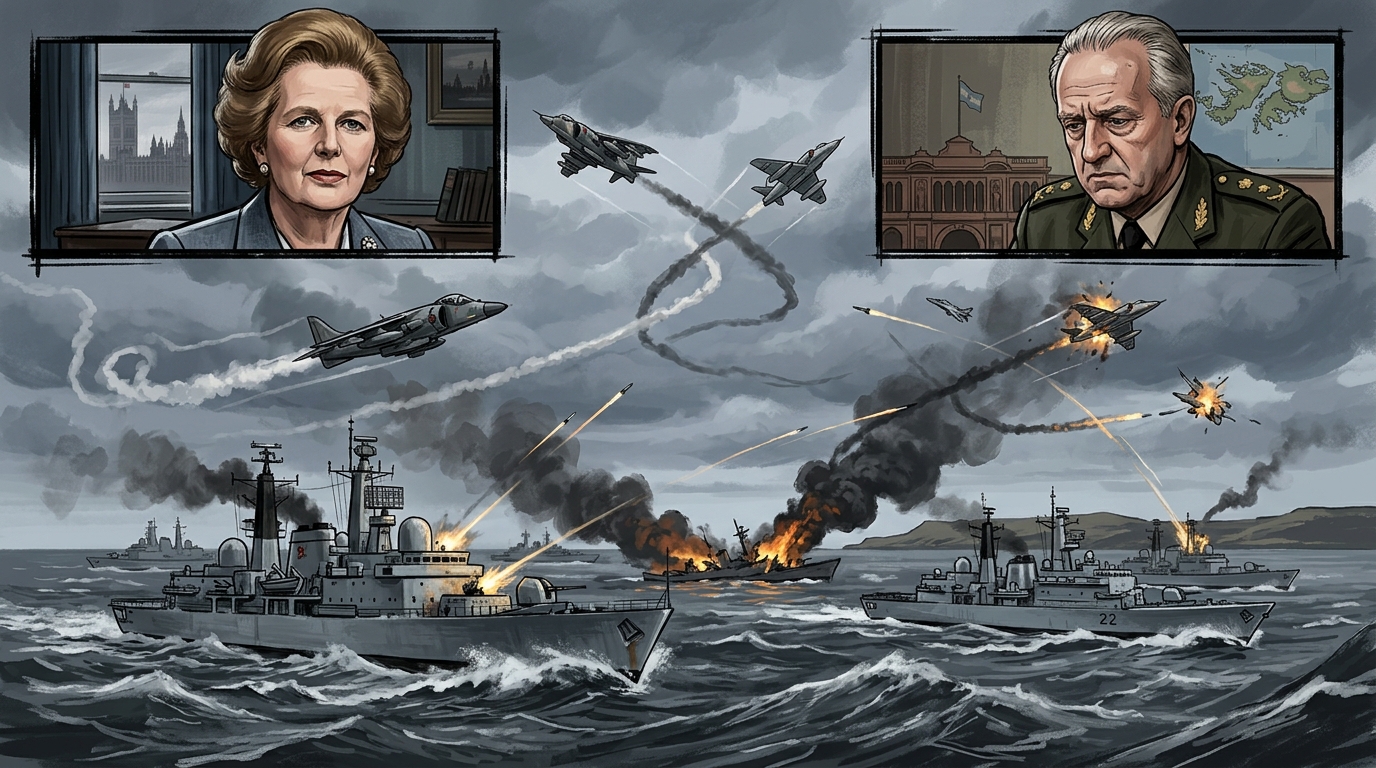
By late April, British forces had established a 200-nautical-mile Total Exclusion Zone (TEZ) around the islands. On May 2, the conflict escalated dramatically. The British nuclear-powered submarine HMS Conqueror detected the Argentine cruiser ARA General Belgrano sailing just outside the exclusion zone, accompanied by two destroyers. Acting on direct authorization from Thatcher's War Cabinet at Chequers, the Conqueror fired three Mark 8 torpedoes, sinking the cruiser4. Over 320 Argentine sailors perished. The sinking was tactically decisive; the entire Argentine surface fleet retreated to its territorial waters, effectively neutralizing Argentina's naval threat for the remainder of the war.
- HMS Conqueror (Submarine)
Two days later, on May 4, the Argentine Air Force retaliated. Flying French-built Super Étendard aircraft equipped with highly advanced Exocet AM39 anti-ship missiles, they struck the modern British destroyer HMS Sheffield. The missile did not detonate, but its residual rocket motor ignited a catastrophic fire that gutted the ship, killing 20 crewmen. This strike underscored the lethal vulnerability of the Royal Navy's surface vessels to modern precision-guided munitions.
The Land Campaign: San Carlos to Stanley (May – June 1982)
To reclaim the islands, British land forces had to establish a beachhead. On the night of May 21, the British 3 Commando Brigade executed a daring amphibious landing at San Carlos Water on the western coast of East Falkland. The landing area, nicknamed "Bomb Alley," subjected the Royal Navy to relentless, low-level air attacks by brave Argentine pilots flying Skyhawks and Daggers. Despite losing several ships—including HMS Ardent, HMS Antelope, and the container ship Atlantic Conveyor—the British successfully landed their troops and supplies.
Once ashore, British forces began a grueling march ("yomping") across the roadless, peat-bog terrain toward Port Stanley:
- The Battle of Goose Green (May 27–28): In the first major land battle, the 2nd Battalion, Parachute Regiment (2 Para), commanded by Lieutenant Colonel H. Jones (who was posthumously awarded the Victoria Cross), defeated a numerically superior, entrenched Argentine force. The victory proved the psychological and tactical superiority of the professional British infantry over Argentine conscripts.
- The Battle of Fitzroy (June 8): A disaster struck the British when the landing ships Sir Galahad and Sir Tristram were bombed by Argentine aircraft at Fitzroy, resulting in heavy casualties, particularly among the Welsh Guards.
- The Final Assault (June 11–14): Under the overall command of Major General Jeremy Moore, British forces launched a series of coordinated night attacks on the strategic high ground surrounding Port Stanley. Battles raged at Mount Longdon, Two Sisters, Mount Harriet, and Wireless Ridge. Using night-vision equipment, superior artillery coordination, and aggressive bayonet charges, the British overcame fierce resistance.
On June 14, 1982, realizing his forces were encircled and out of ammunition, the Argentine commander, Brigadier General Mario Menéndez, signed an instrument of unconditional surrender to Major General Jeremy Moore, restoring British administration to the islands5.
Geopolitical Consequences and Aftermath
The Falklands War, though lasting only ten weeks, had profound, cascading geopolitical consequences that reshaped domestic politics in both the UK and Argentina, reconfigured Latin American relations, and altered Cold War dynamics.
| Aspect | United Kingdom | Argentina |
|---|---|---|
| Political Leadership | Margaret Thatcher secured a massive parliamentary majority in 1983; the "Falklands Factor" consolidated her political dominance. | The military junta collapsed; General Leopoldo Galtieri was forced to resign within days of the surrender. |
| System of Government | Sustained parliamentary democracy; revitalization of defense spending and naval programs. | Swift transition to democracy; civilian rule restored under President Raúl Alfonsín in 1983. |
| International Standing | Reasserted as a major global power capable of projecting force unilaterally; reinforced the "Special Relationship" with the US. | Severely isolated internationally; marked a shift toward regional diplomatic integration to pursue sovereignty claims. |
The Collapse of the Junta and Democratic Transition
The immediate victim of the war was the Argentine military dictatorship. The humiliating defeat exposed the structural incompetence, systemic corruption, and strategic naivety of the military leadership. Riots broke out in Buenos Aires upon the news of the surrender. Within three days, Galtieri was ousted from power. The collapse of the junta led to the historic democratic elections of October 1983, which brought Raúl Alfonsín to the presidency6. The military's political influence in Argentina was permanently broken, and subsequent civilian governments systematically reduced the armed forces' budget and political power.
The Consolidation of Thatcherism
In Great Britain, the victory was met with a surge of national pride and euphoria. Margaret Thatcher's political gamble had paid off handsomely. The victory dismantled the post-empire narrative of British decline.
"We have ceased to be a nation in retreat. We have indeed some of the most wonderful people in the world. We have proved ourselves." — Margaret Thatcher, July 3, 1982
The "Falklands Factor" swept Thatcher to a landslide victory in the 1983 General Election, crushing a fractured Labour Opposition. This political capital allowed her to accelerate her sweeping domestic reforms, including privatizations and confrontation with powerful trade unions, shaping the economic landscape of Britain for decades.
Global Geopolitical Realignment
The war occurred at a critical juncture of the Cold War. The United States, initially torn between its North Atlantic treaty commitments (NATO) and its anti-communist alliances in Latin America (via the Rio Treaty), eventually chose to back Britain. President Ronald Reagan authorized the transfer of cutting-edge Sidewinder AIM-9L missiles, intelligence, and logistical support via Ascension Island, which proved crucial to British air superiority.
In Latin America, the war strained relations with Washington, as many nations felt betrayed by the United States' support for a European power over a regional neighbor. It also demonstrated the limitations of post-WWII security arrangements like the Inter-American Treaty of Reciprocal Assistance (Rio Treaty), which was exposed as ineffective.
Analysis of Key Actors and Decisive Actions
The outcome of the Falklands War was determined by critical strategic decisions, logistical triumphs, and catastrophic miscalculations by the key leaders of both nations.
Margaret Thatcher: The Iron Will
Thatcher's leadership throughout the crisis epitomized her nickname, the "Iron Lady." Facing severe economic headwinds at home and advice from international allies to seek a negotiated settlement, she remained resolute.
- Risk Management: Sending a fleet across 8,000 miles of ocean with virtually no air cover other than carrier-borne Sea Harriers was an immense military gamble. If either HMS Hermes or HMS Invincible had been sunk, the campaign would have failed. Thatcher accepted this strategic risk.
- Political Determination: She established a small, agile War Cabinet to bypass bureaucratic delays and ensure rapid decision-making. Her decision to order the sinking of the Belgrano—while highly controversial and heavily scrutinized by critics—effectively protected the task force from a pincer movement and demonstrated her absolute resolve to win the conflict.
Leopoldo Galtieri: Strategic Miscalculations
General Galtieri's operational planning was crippled by several fundamental misjudgments regarding the geopolitical landscape:
- The British Response: Galtieri genuinely believed that the United Kingdom, burdened by economic woes and a shrinking navy, would not launch a military response to regain a small, sparsely populated archipelago.
- American Neutrality: He assumed that because Argentina had assisted the CIA in training anti-communist Contra forces in Central America, the Reagan administration would remain neutral or support Buenos Aires.
- Military Unpreparedness: The junta failed to prepare the islands for a protracted siege. Most of the 10,000 Argentine troops deployed to the islands were poorly trained, ill-equipped conscripts who lacked cold-weather gear, adequate rations, and effective leadership. The junta's high command did not expect to fight a professional, highly trained adversary and was tactically outclassed on the battlefield.
Trivia and Lesser-Known Facts
- The Black Buck Raids: The Royal Air Force executed a series of seven extremely complex, long-range bombing missions named Operation Black Buck. Operating from Ascension Island, single Vulcan bombers flew 3,900 miles to bomb the Port Stanley airfield. Each mission required a massive, coordinated "daisy-chain" of eleven Handley Page Victor refueling tankers to keep the Vulcan and each other aloft[^7]. At the time, they were the longest-range bombing raids in military history.
- A Historic Sinking: When HMS Conqueror sank the ARA General Belgrano, it became the first and remains the only nuclear-powered submarine to sink an enemy warship during combat operations. Ironically, the torpedoes used were not modern, computerized Tigerfish models, but rather standard World War II-era Mark 8 torpedoes, chosen for their absolute mechanical reliability.
- Royalty in Combat: Prince Andrew, Queen Elizabeth II's second son, served as a Sea King helicopter pilot during the war aboard HMS Invincible. He flew multiple missions, including acting as a high-altitude decoy to draw Exocet missiles away from British carriers.
- The Gurkhas' Reputation: The deployment of the legendary 1st Battalion, 7th Duke of Edinburgh's Own Gurkha Rifles struck terror into the Argentine conscripts. Rumors of the Gurkhas' fearsome fighting reputation and their use of the Kukri knife led to widespread panic and early surrenders among several Argentine units in the hills around Stanley.
References and Literature
- The Battle for the Falklands - Max Hastings and Simon Jenkins' definitive contemporary account of the military and political aspects of the war.
- The Falklands War 1982 - Osprey Publishing's comprehensive campaign analysis detailing forces, strategies, and key engagements.
- Margaret Thatcher: The Autobiography - Details the personal accounts and critical decision-making processes of the Prime Minister during the 1982 crisis.
- The Official History of the Falklands Campaign - Sir Lawrence Freedman's exhaustive, government-commissioned academic study of the conflict.
Footnotes & Explanations
- Freedman, Lawrence. The Official History of the Falklands Campaign, Volume I. Routledge, 2005. ↩
- Cardozo, Oscar Raul, et al. Falklands: The Secret Plot. Preston Publishers, 1987. ↩
- Nott, John. Here Today, Gone Tomorrow: Recollections of an Undistinguished Life. Politico's, 2002. ↩
- Ponting, Clive. The Right to Know: The Inside Story of the Belgrano Affair. Sphere Books, 1985. ↩
- Woodward, Sandy. One Hundred Days: The Memoirs of the Falklands Battle Group Commander. HarperCollins, 1992. ↩
- Rock, David. Argentina, 1516–1987: From Spanish Colonization to Alfonsín. University of California Press, 1987. ↩
- Ward, Sharkey. Sea Harrier Over the Falklands: A Maverick at War. Leo Cooper, 1992. ↩