Key Takeaways
- The war shattered Israel's myth of military invincibility, leading to profound internal political restructuring and the resignation of Prime Minister Golda Meir.
- The conflict became a dangerous proxy arena for the US and USSR, culminating in a nuclear alert (DEFCON 3) and testing the boundaries of Cold War détente.
- The weaponization of oil by OAPEC triggered the first global energy crisis, permanently altering Western economic policies and geopolitical alignments.
On October 6, 1973, as the citizens of Israel observed Yom Kippur—the holiest day of the Jewish calendar—the sirens that shattered the afternoon silence marked more than just a localized military conflict. They heralded a geopolitical earthquake that would reshape the Middle East, push the United States and the Soviet Union to the brink of a nuclear confrontation, and unleash an economic crisis that paralyzed Western economies. The Yom Kippur War (also known as the October War or the Ramadan War) was a watershed moment in twentieth-century history, demonstrating that local regional rivalries could instantly disrupt global security and transform international financial structures.
Historical Context and Origins
The roots of the 1973 conflict lay in the unresolved grievances of the 1967 Six-Day War. In that swift, pre-emptive campaign, Israel had captured the Sinai Peninsula and the Gaza Strip from Egypt, the West Bank and East Jerusalem from Jordan, and the Golan Heights from Syria. For Israel, these newly acquired territories provided a geographical buffer zone, a defense in depth that the country had previously lacked 1. For the Arab world, the loss of these lands was a deep, intolerable humiliation that shattered the regional balance of power.
Following the 1967 defeat, the Arab League convened in Khartoum, Sudan, and issued its famous "Three Nos": no peace with Israel, no recognition of Israel, and no negotiations with Israel. The subsequent War of Attrition (1967–1970) along the Suez Canal consisted of artillery duels, aerial dogfights, and commando raids, but failed to alter the status quo.
When Egyptian President Gamal Abdel Nasser died in September 1970, he was succeeded by his relatively unheralded Vice President, Anwar Sadat. Many contemporary analysts dismissed Sadat as a transitional figure. However, Sadat possessed a clear, radical strategic vision. He recognized that Egypt’s stagnant economy could not sustain permanent mobilization, and that a total military victory to destroy Israel was an impossibility. Instead, Sadat conceived a "limited war"—a strategic offensive designed not to conquer territory, but to break the diplomatic stalemate, shatter Israel's sense of security, and force the United States and the Soviet Union to intervene and pressure Israel into returning the Sinai Peninsula 2.
To achieve this, Sadat forged a close alliance with Syrian President Hafez al-Assad, who sought to reclaim the Golan Heights. Throughout 1972 and 1973, Sadat engaged in a masterclass of political deception. He expelled thousands of Soviet military advisors from Egypt in July 1972, a move interpreted by Western and Israeli intelligence as a sign of weakness and a breakdown of Egypt's military capabilities. In reality, it freed Sadat from Soviet veto power over his military plans and served to lull Israel into a false sense of security.
This complacency was crystallized in Israeli military thinking as the conceptzia (the "conception"). Formulated by Military Intelligence (Aman), the conceptzia held that Egypt would not attack until it possessed advanced Soviet fighter-bombers capable of striking deep into Israel and neutralization of Israel's air force, and that Syria would only attack in tandem with Egypt. Because Israeli intelligence believed these conditions had not been met, they repeatedly dismissed warnings of troop movements along the Suez Canal and the Golan Heights as mere maneuvers.
Timeline of Events and Key Moments
The Surprise Offensive (October 6–9, 1973)
At 14:00 on October 6, 1973, the Egyptian and Syrian militaries launched a highly coordinated, simultaneous assault. On the southern front, Egypt initiated Operation Badr. Under the cover of a massive artillery barrage, Egyptian forces crossed the Suez Canal using high-pressure water pumps purchased from West Germany to blast breaches through the Bar Lev Line—the heavily fortified sand wall built by Israel along the canal’s eastern bank.
Within hours, tens of thousands of Egyptian soldiers had crossed the canal, establishing secure bridgeheads. Crucially, the Egyptians did not advance deep into the Sinai desert. Instead, they remained under the protective umbrella of their Soviet-supplied Surface-to-Air Missile (SAM) systems (such as the SA-6 Gainful), which neutralized Israel's dominant air force 3. At the same time, Egyptian infantry equipped with man-portable AT-3 Sagger anti-tank guided missiles inflicted heavy casualties on Israeli armored counter-attacks.
| West Bank (Egyptian Side) | East Bank (Sinai/Israeli Side) |
|---|---|
| Artillery | Bar Lev Line (Breached by water cannons) |
| SAM Umbrella | Infantry / Saggers |
| Tank Units | Israeli Armored Counter-attacks |
On the northern front, Syrian forces unleashed three infantry divisions and hundreds of tanks across the ceasefire line (the Purple Line) in the Golan Heights. The outnumbered Israeli defenders—primarily the 7th and 188th Armored Brigades—fought a desperate, holding action. In the northern sector of the Golan, a location later dubbed the "Valley of Tears," a handful of Israeli tanks held off vast waves of Syrian armor, preventing a breakthrough into the Jordan Valley and the Galilee.
The Superpower Intervention and the Tide Turns (October 10–18, 1973)
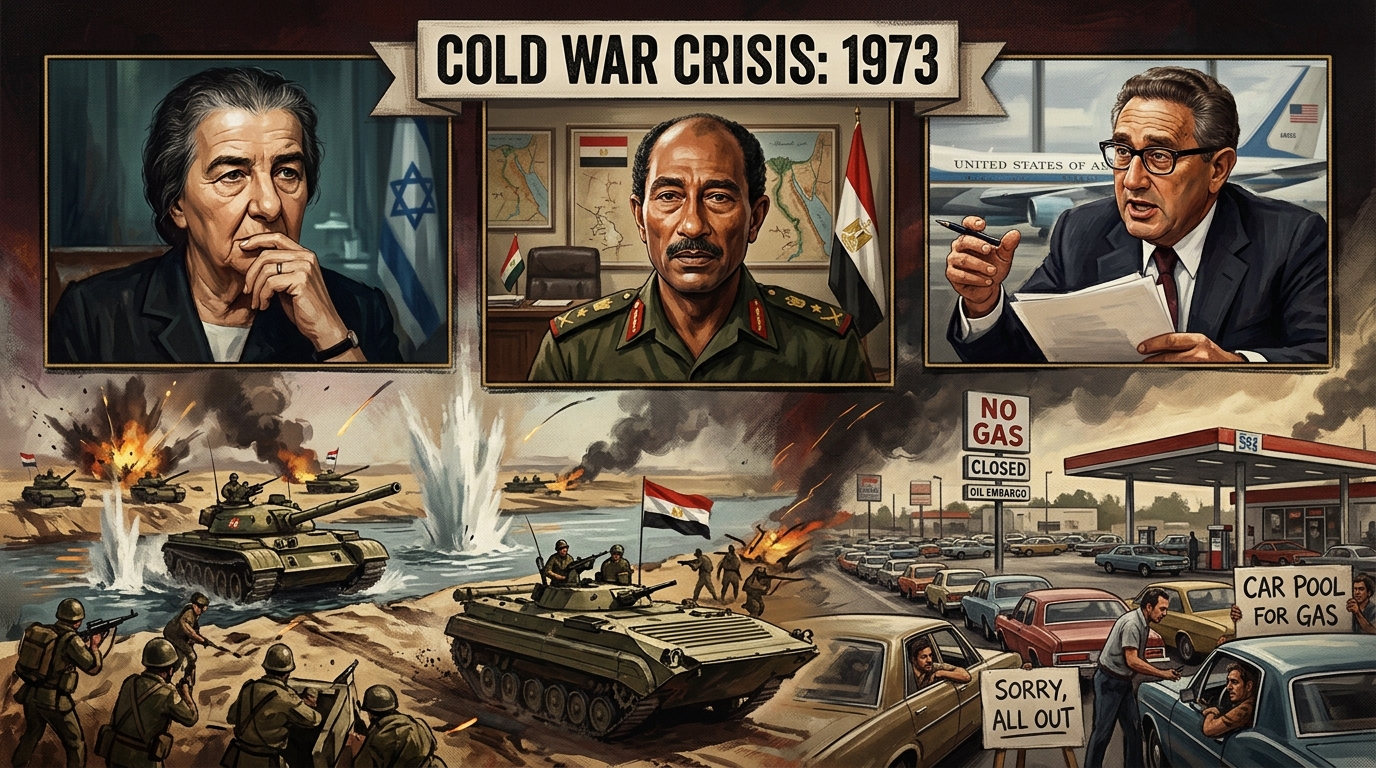
By October 8, the situation was critical for Israel. Prime Minister Golda Meir and Defense Minister Moshe Dayan faced the prospect of national collapse. Dayan, visibly shaken, spoke of the "destruction of the Third Temple." The Israeli military had lost over 500 tanks and dozens of fighter jets in just forty-eight hours.
Understanding the gravity of the situation, U.S. President Richard Nixon and Secretary of State Henry Kissinger hesitated initially, hoping for a ceasefire that would leave Egypt with minor gains, thereby facilitating future negotiations. However, once the Soviet Union began its own massive military airlift to Cairo and Damascus on October 9, the United States responded. On October 12, Nixon ordered the launch of Operation Nickel Grass, an emergency airlift that sent over 22,000 tons of tanks, artillery, ammunition, and electronic warfare equipment directly to Israel via C-5 Galaxy and C-141 Starlifter transport planes.
"Send everything that can fly." [[^4]] — U.S. President Richard Nixon, ordering the mobilization of Operation Nickel Grass
With fresh supplies arriving and the mobilization of reserves completed, Israel launched its counter-offensives. On the Golan front, Israeli forces pushed the Syrian army back past the Purple Line and advanced into Syria proper, bringing Damascus within range of heavy artillery.
On October 14, the Egyptian military, pressured by Syria to relieve the strain on the northern front, committed its armored reserves to an ill-fated offensive deep into the Sinai, moving outside the protection of their SAM umbrella. The resulting battle was one of the largest tank clashes in history. The Israelis, prepared and utilizing superior tank tactics, destroyed over 250 Egyptian tanks.
Exploiting this tactical blunder, a division led by Major General Ariel Sharon identified a gap between the Egyptian Second and Third Armies. On the night of October 15–16, Sharon’s forces crossed the Suez Canal at Deversoir, establishing a bridgehead on the west bank. Israeli forces systematically destroyed Egyptian SAM sites on the western side, allowing the Israeli Air Force to regain control of the skies.
The Encirclement of the Third Army
West Bank (Egypt)
- Israeli Sharon Division
East Bank (Sinai)
- Egyptian 2nd Army
- Egyptian 3rd Army
- Israeli Southern Command
The Brink of Superpower Confrontation (October 19–25, 1973)
By October 22, Israeli troops had advanced deep into Egyptian territory, reaching the outskirts of Suez City and completely encircling the Egyptian Third Army on the east bank of the canal. Some 20,000 Egyptian soldiers were trapped without food or water.
The Soviet Union, watching its primary Arab ally face total annihilation, reacted with alarm. Soviet General Secretary Leonid Brezhnev sent a direct message to President Nixon on October 24, suggesting a joint U.S.-Soviet peacekeeping deployment to enforce the UN ceasefire (Resolution 338, which had been passed on October 22 but ignored on the ground). Brezhnev warned that if the U.S. refused, the Soviet Union would consider taking "unilateral steps."
To emphasize this threat, the Soviet Union put seven airborne divisions on high alert and increased its naval presence in the Mediterranean. With Nixon distracted by the rapidly escalating Watergate scandal (specifically the "Saturday Night Massacre" of October 20), Kissinger and the National Security Council acted decisively. To signal American resolve and deter a unilateral Soviet deployment, they raised the U.S. military alert status to DEFCON 3—the highest readiness level since the 1962 Cuban Missile Crisis 5.
The gamble worked. Faced with the prospect of direct military confrontation with a nuclear-armed United States, Brezhnev backed down. Under intense diplomatic pressure from Kissinger, Israel agreed to halt its offensive operations and allowed humanitarian aid to reach the encircled Egyptian Third Army, ending the active military phase of the conflict.
Geopolitical Consequences and Aftermath
The Weaponization of Oil
While the military conflict was fought in the Sinai and the Golan, the most far-reaching weapon of the war was deployed in the boardrooms of the Middle East. On October 17, 1973, the Organization of Arab Petroleum Exporting Countries (OAPEC), led by Saudi Arabia’s King Faisal, announced a strategy of progressive production cuts: five percent each month until Israel withdrew from all occupied territories.
Following the formal announcement of Operation Nickel Grass by the United States, OAPEC escalated its measures. It declared a total embargo on oil shipments to the United States, the Netherlands (which had allowed its airfields to be used for the U.S. airlift), Portugal, and South Africa.
The effects of the 1973 Arab Oil Embargo were immediate and catastrophic for Western economies:
- Price Explosion: The price of crude oil quadrupled, rising from approximately $3 per barrel to nearly $12 per barrel by early 1974.
- Inflation and Recession: The sudden spike in energy costs triggered a toxic combination of high inflation and stagnant economic growth—a phenomenon known as "stagflation."
- Structural Adjustments: In the United States, the embargo led to gas rationing, long lines at service stations, the implementation of a national 55 mph speed limit, and the creation of the Strategic Petroleum Reserve. It also catalyzed the shift toward smaller, fuel-efficient Japanese automobiles, permanently altering the global automotive industry.
OAPEC Embargo Flowchart
- U.S. Airlift to Israel
The Shift in Diplomatic Alliances
The Yom Kippur War broke the diplomatic deadlock that Anwar Sadat had targeted. Under the auspices of Henry Kissinger's "shuttle diplomacy"—which saw the Secretary of State flying continuously between Jerusalem, Cairo, and Damascus—a series of disengagement agreements were signed.
The most profound long-term consequence of the war was the realignment of Egypt. Recognizing that the Soviet Union could supply weapons but only the United States could deliver territory, Sadat decisively pivoted Egypt out of the Soviet sphere of influence and into the American orbit. This diplomatic realignment culminated in the 1978 Camp David Accords and the 1979 Egypt-Israel Peace Treaty 6. Under the terms of the treaty, Israel returned the entire Sinai Peninsula to Egypt in exchange for formal recognition and peace—marking the first time an Arab nation officially recognized the State of Israel.
COGNITIVE REALIGNMENT IN CAIRO
| 1972 (Soviet Influence) | 1979 (U.S. Alliance) |
|---|---|
| Dependent on Soviet arms | Pivot to Washington |
| Frozen diplomatic posture | Peace with Israel |
| Economic isolation | Sinai returned to Egypt |
Domestic Turmoil in Israel and Arab Nations
Despite their ultimate tactical victory, the war left a legacy of trauma and disillusionment in Israel. The country had suffered over 2,600 military deaths—a devastating toll for a small nation. The public felt betrayed by the political and military leadership's complacency.
In December 1973, the Israeli government established the Agranat Commission to investigate the intelligence failures and lack of preparation. Although the commission cleared Prime Minister Golda Meir and Defense Minister Moshe Dayan of direct responsibility, focusing its blame instead on Aman Chief Eli Zeira and Chief of Staff David Elazar, public anger remained unresolved. Meir and Dayan were forced to resign in 1974, bringing an end to the dominance of the Labor Party that had ruled Israel since its founding, and setting the stage for the rise of Menachem Begin’s right-wing Likud party in 1977.
In contrast, the war was celebrated in the Arab world as a great triumph. Although Egypt and Syria had suffered severe military setbacks toward the end of the conflict, the initial successes of the canal crossing and the capture of the Hermon outpost in the Golan restored Arab honor and demonstrated that Israel’s defense forces were not invincible. Anwar Sadat solidified his position as the "Hero of the Crossing," gaining the domestic and regional prestige necessary to pursue peace with Israel.
Analysis of Key Actors and Decisive Actions
| Historical Figure | Role / Country | Strategic Objectives | Key Decisions & Actions | Historical Assessment |
|---|---|---|---|---|
| Anwar Sadat | President of Egypt | Break the status quo; reclaim the Sinai; pivot toward the West. | Expelled Soviet advisors; coordinated with Syria; launched the surprise canal crossing; limited initial gains to stay under SAM cover. | A brilliant political strategist who accepted tactical military risks to achieve his ultimate diplomatic and geopolitical goals. |
| Golda Meir | Prime Minister of Israel | Maintain Israel's borders and security; avoid international isolation. | Refused to launch a pre-emptive strike on October 6; managed the domestic crisis; leveraged the U.S. relationship for resupply. | Recognized for her iron resolve during the crisis, but her reputation was permanently damaged by her administration’s intelligence complacency. |
| Henry Kissinger | U.S. Secretary of State / National Security Advisor | Prevent Soviet dominance; ensure Israel’s survival; lay groundwork for U.S.-led peace process. | Orchestrated Operation Nickel Grass; initiated DEFCON 3; pioneered "shuttle diplomacy" to freeze out Soviet influence. | The consummate practitioner of realpolitik, he successfully utilized the crisis to reshape the Middle East to American strategic advantage. |
Anwar Sadat's Realpolitik
Sadat’s conduct of the war represents one of the purest examples of political realism in modern history. Unlike his predecessor Nasser, who was driven by pan-Arab ideology and revolutionary rhetoric, Sadat viewed conflict strictly as an instrument of statecraft.
By defining his military objectives as limited, Sadat avoided the trap of overextending his forces initially. Even when the military situation turned against Egypt with Sharon’s crossing of the canal, Sadat maintained his focus on the geopolitical endstate. He recognized that by forcing the United States to intervene to save the Third Army, he was making Washington an indispensable broker in Middle Eastern diplomacy, thereby eroding the uncritical U.S. alignment with Israel 7.
Golda Meir's Dilemma
On the morning of October 6, hours before the joint attack, Golda Meir was presented with definitive intelligence that war was imminent. IDF Chief of Staff David Elazar requested permission to launch a pre-emptive strike against Syrian forces—a tactic that had brought Israel victory in 1967.
Meir faced an agonizing choice. If she approved the strike, Israel might reduce its immediate military casualties but would face accusation as the aggressor, which would alienate the United States and jeopardize future diplomatic and military support. Meir chose to absorb the first blow.
"If we strike first, we won’t get help from anybody." [[^8]] — Golda Meir, explaining her refusal to launch a pre-emptive strike on October 6, 1973
This decision, though costly in terms of early casualties, was crucial in securing the U.S. airlift (Operation Nickel Grass) and preserving the vital alliance with Washington, which ultimately proved decisive for Israel’s survival.
Trivia and Lesser-Known Facts
- The Double Agent: "The Angel": One of Israel’s most valuable intelligence assets during the war was Ashraf Marwan, the son-in-law of former Egyptian President Gamal Abdel Nasser. Codenamed "The Angel" by the Mossad, Marwan met his Israeli handler in London on the night of October 5 and warned that war would break out the following day. Although Israeli intelligence doubted his warnings because of prior false alarms, Marwan’s tip-off prompted Israel to begin mobilizing its reserves hours before the first shots were fired, saving the Golan Heights from falling completely to Syrian forces [[^9]].
- North Korean Involvement: The skies over Egypt featured combatants from beyond the Middle East. Kim Il-sung, the leader of North Korea, sent a squadron of MiG-21 pilots to assist Egypt. These pilots engaged in direct aerial combat with Israeli F-4 Phantoms in the final days of the war.
- The "Water Cannons" of the Nile: To breach the immense sand walls of the Bar Lev Line, Egyptian engineers spent months testing various methods. They discovered that high-pressure water pumps, manufactured by the German firm Deutz and originally designed for firefighting, could quickly liquefy the sand. During the crossing, thirty-two water pump systems washed away thousands of cubic meters of sand, opening eighty-one gaps in the line within hours.
- The "Black Saturday" Massacre: On October 20, 1973, in the midst of the crisis, President Richard Nixon ordered the firing of Watergate Special Prosecutor Archibald Cox. This event, which led to the resignations of Attorney General Elliot Richardson and Deputy Attorney General William Ruckelshaus, was dubbed the "Saturday Night Massacre." The domestic political chaos left Henry Kissinger in virtual control of U.S. foreign policy, allowing him to manage the DEFCON 3 nuclear alert and the subsequent ceasefire negotiations with minimal presidential oversight.
References and Literature
- The Yom Kippur War: The Epic Encounter That Transformed the Middle East - Abraham Rabinovich's definitive, highly detailed narrative account of the military maneuvers and political decisions of the 1973 war.
- A World Restored: Metternich, Castlereagh and the Problems of Peace 1812-22 - Though about the 19th century, Henry Kissinger's personal writings on balance-of-power diplomacy are critical to understanding his strategy of "shuttle diplomacy" during the 1973 crisis.
- The Crossing of the Suez - General Saad el-Shazly's firsthand account of the planning and execution of Operation Badr, offering a valuable Egyptian military perspective.
- The Agranat Commission Report - Official state archives detailing the findings of the Israeli judicial commission that investigated the country's intelligence and military failures during the opening days of the war.
Footnotes & Explanations
- Rabinovich, Abraham. The Yom Kippur War: The Epic Encounter That Transformed the Middle East. Schocken Books, 2004, p. 14. ↩
- Sadat, Anwar. In Search of Identity: An Autobiography. Harper & Row, 1978, p. 244. ↩
- Shazly, Saad el-. The Crossing of the Suez. American Mideast Research, 1980, p. 223. ↩
- Kissinger, Henry. Years of Upheaval. Little, Brown and Company, 1982, p. 496. ↩
- Garthoff, Raymond L. Détente and Confrontation: American-Soviet Relations from Nixon to Reagan. The Brookings Institution, 1994, pp. 426–431. ↩
- Quandt, William B. Camp David: Peacemaking and Politics. The Brookings Institution, 1986, pp. 37–41. ↩
- Kissinger, Henry. Diplomacy. Simon & Schuster, 1994, pp. 739–742. ↩
- Meir, Golda. My Life. G.P. Putnam's Sons, 1975, p. 426. ↩
- Bar-Joseph, Uri. The Angel: The Egyptian Spy Who Saved Israel. HarperCollins, 2016, pp. 189–192. ↩