Key Takeaways
- The Korean War (1950-1953) was the first major hot conflict of the Cold War, solidifying the global paradigm of containment.
- The intervention of the United States under UN auspices and the subsequent entry of Chinese volunteer forces transformed a regional civil dispute into a global proxy battle.
- The signing of the 1953 Armistice established a heavily fortified Demilitarized Zone (DMZ) along the 38th parallel, leaving the peninsula in a technical state of war.
Historical Context and Origins
The Korean War was not merely a localized civil conflict; it was the crucible in which the global dynamics of the Cold War were forged. For nearly four decades, the Korean peninsula had suffered under the repressive colonial rule of the Empire of Japan. When Tokyo capitulated in August 1945, the victorious Allied powers faced the immediate challenge of disarming Japanese forces stationed in Korea.
Under the terms of General Order No. 1, the United States and the Soviet Union agreed to partition the peninsula along the 38th parallel1. The Red Army occupied the region north of this arbitrary line, while American forces took control of the south. This division, intended as a temporary administrative convenience, rapidly hardened into a geopolitical fault line as the initial cooperation between Washington and Moscow dissolved into mutual suspicion.
The 38th Parallel Division (1945–1950)
| Zone | Capital | Leader |
|---|---|---|
| Soviet Zone / DPRK | Pyongyang | Kim Il-sung |
| American Zone / ROK | Seoul | Syngman Rhee |
In the North, the Soviet Civil Administration facilitated the rise of Kim Il-sung, a former anti-Japanese guerrilla fighter, who consolidated power under the banner of the Democratic People's Republic of Korea (DPRK) in September 1948. Conversely, in the South, the United States supported the establishment of the Republic of Korea (ROK) under the staunchly anti-communist, authoritarian leadership of Syngman Rhee in August 1948. Both leaders claimed sole legitimacy over the entire peninsula and actively sought to reunify the nation by force.
By 1949, both occupying superpowers had withdrawn the bulk of their combat troops, leaving behind ill-prepared and poorly equipped local forces, particularly in the South. The geopolitical landscape shifted dramatically in late 1949 with the communist victory in the Chinese Civil War and the Soviet Union's successful detonation of its first atomic bomb.
Kim Il-sung spent months lobbying Soviet Premier Joseph Stalin for permission to launch an invasion of the South. Stalin initially demurred, fearing a direct conflict with the United States. However, by early 1950, several factors altered Stalin's calculus:
- The communist triumph in China, which freed up seasoned ethnic Korean veterans of the Chinese Civil War to return home and bolster the Korean People's Army (KPA).
- US Secretary of State Dean Acheson's "Defense Perimeter Speech" in January 1950, which conspicuously excluded Korea from the vital US security sphere in the Pacific.
- Stalin's belief that a rapid, decisive strike would present the West with a fait accompli before Washington could coordinate a military response.
With Soviet tactical approval and substantial shipments of modern military hardware—including T-34/85 tanks and heavy artillery—and Mao Zedong's cautious endorsement, Kim Il-sung prepared his forces for war.
Timeline of Events and Key Moments
The conflict progressed through four distinct military phases, transforming from a war of rapid maneuver to a grinding war of attrition.
| Phase 1 (Jun - Sep 1950) | Phase 2 (Sep - Nov 1950) | Phase 3 (Nov 1950 - Jan 1951) | Phase 4 (Jan 1951 - Jul 1953) |
|---|---|---|---|
| DPRK invades South | UN forces land at Inchon | Chinese intervention | Front stabilizes near 38th |
| ROK/US pushed to Pusan | Seoul recaptured | UN forces retreat | War of attrition |
| Perimeter held | UN crosses 38th Parallel | Stalemate established | Armistice signed |
Phase I: The Onslaught and the Pusan Perimeter (June – September 1950)
At dawn on June 25, 1950, the KPA launched a massive, coordinated surprise offensive across the 38th parallel. The ROK Army, lacking anti-tank weaponry and heavy artillery, crumbled under the onslaught. Seoul fell within three days.
The international response was swift. Capitalizing on a Soviet boycott of the United Nations Security Council (protesting the refusal to seat the newly declared People's Republic of China), President Harry Truman secured UN Resolutions 82 and 83. These resolutions condemned the invasion and called upon member states to render military assistance to the ROK. Truman appointed General Douglas MacArthur as the Commander-in-Chief of the United Nations Command (UNC).
Despite the rapid deployment of American units from occupational duty in Japan, the allied forces were pushed back into a small pocket in the southeast corner of the peninsula, which became known as the Pusan Perimeter. Throughout August and early September, UN and ROK forces, under the command of Lieutenant General Walton Walker, fought a desperate holding action against relentless KPA assaults.
Phase II: The Inchon Landing and Advance to the Yalu (September – November 1950)
With the KPA overextended and their supply lines vulnerable, General MacArthur executed one of the most daring amphibious operations in military history: Operation Chromite. On September 15, 1950, US Marines landed at the port of Inchon, deep behind enemy lines. The maneuver caught the KPA completely by surprise.
Simultaneously, UN forces launched a breakout from the Pusan Perimeter. Caught in a colossal pincer movement, the KPA disintegrated. Seoul was liberated on September 25. Emboldened by this stunning success, Truman authorized MacArthur to cross the 38th parallel to destroy the remaining enemy forces and reunify the country, provided there was no intervention by Soviet or Chinese forces.
By October, UN forces had captured Pyongyang and were racing toward the Yalu River, the border between North Korea and China. MacArthur brushed aside warnings transmitted through diplomatic channels that Beijing would not tolerate an American military presence on its border.
Phase III: The Chinese Intervention (November 1950 – January 1951)
In mid-October 1950, under the command of General Peng Dehuai, over 300,000 soldiers of the Chinese People's Volunteer Army (PVA) began secretly crossing the Yalu River. On November 25, the PVA launched a massive counteroffensive. Utilizing night attacks, infiltration tactics, and overwhelming numerical superiority, they shattered the UN flanks.
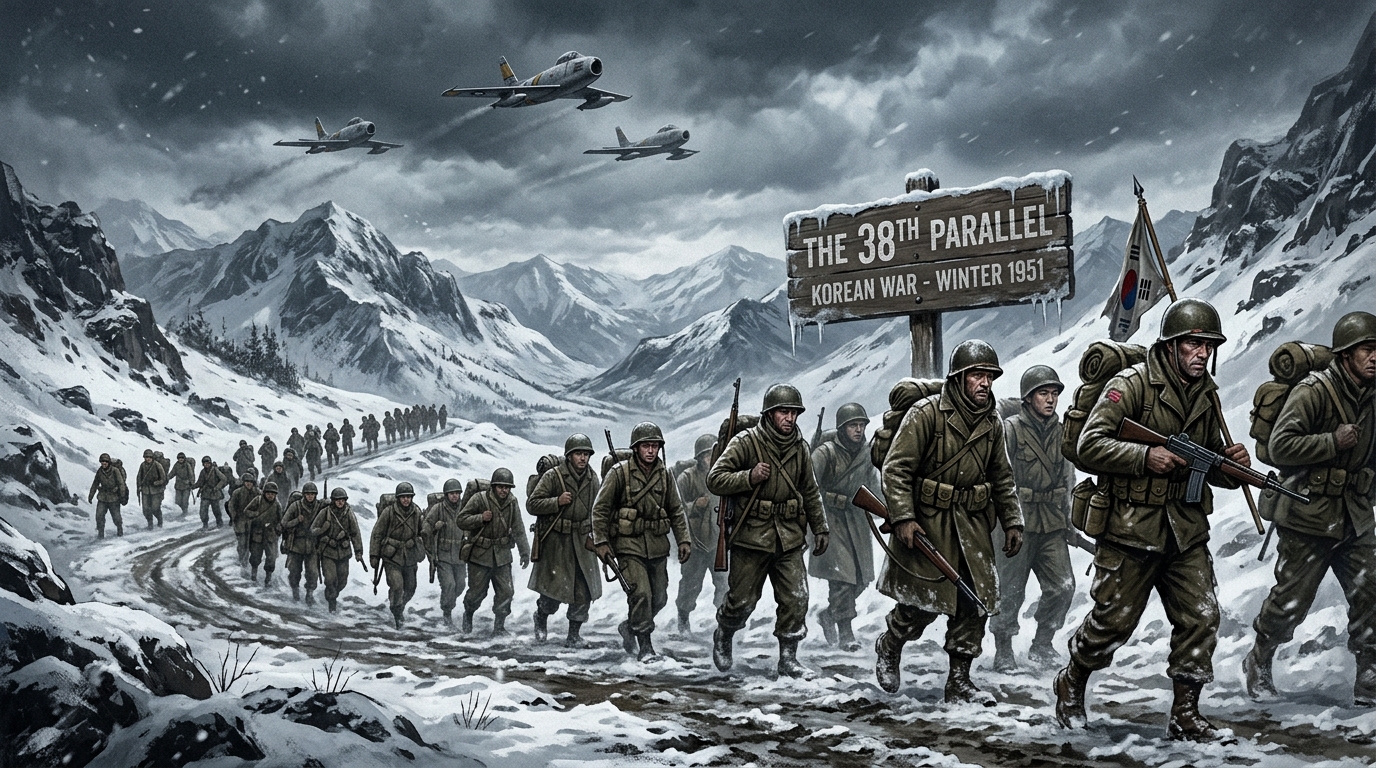
At the Battle of Chosin Reservoir, fought in sub-zero temperatures, the 1st US Marine Division and elements of the US Army's 7th Infantry Division fought their way out of a encirclement, executing a tactical retreat to the port of Hungnam, where they were evacuated by sea2.
The UN forces retreated in disarray, abandoning Pyongyang and, in January 1951, losing Seoul for a second time.
"We face an entirely new war." — General Douglas MacArthur, telegram to the Joint Chiefs of Staff, November 28, 1950.
Phase IV: Stalemate and Armistice (1951 – 1953)
The UN retreat was halted by Lieutenant General Matthew Ridgway, who assumed command of the US Eighth Army. Ridgway restored morale, utilized superior UN firepower to counter Chinese mass-infantry tactics, and launched a series of methodical counteroffensives (Operations Killer and Ripper). By March 1951, Seoul was liberated for the final time, and the front line stabilized near the 38th parallel.
From July 1951 until the summer of 1953, the war transformed into a static, brutal war of attrition reminiscent of the Western Front of World War I. Battles were fought over heavily fortified hills with names like Pork Chop Hill, Heartbreak Ridge, and the Punchbowl.
The main obstacle to peace negotiations, which began in Kaesong and later moved to Panmunjom, was the issue of prisoner of war (POW) repatriation. The UN insisted on voluntary repatriation, while the communists demanded the forced return of all POWs, many of whom did not wish to return to China or North Korea.
Finally, following the death of Joseph Stalin in March 1953 and the inauguration of Dwight D. Eisenhower as US President, a compromise was reached. On July 27, 1953, the Korean Armistice Agreement was signed.
Geopolitical Consequences and Aftermath
The Korean War fundamentally reordered global geopolitics and set the structural parameters of the Cold War for the next four decades.
The Institutionalization of Containment
Prior to June 1950, the United States' strategy of containment, as outlined by George Kennan, was primarily economic and political, exemplified by the Marshall Plan. The Korean War militarized this policy. It prompted the immediate implementation of NSC-68, a top-secret national security policy paper that advocated for a massive expansion of the US military budget.
US defense spending tripled during the conflict, setting a precedent for a permanent, global military footprint. Furthermore, the war catalyzed:
- The strengthening of NATO and the integration of West Germany into the Western defense architecture.
- The signing of the ANZUS Treaty between the US, Australia, and New Zealand.
- The transformation of Japan from a defeated, occupied nation into a vital, industrialized anti-communist ally and logistics hub in East Asia.
The Sino-Soviet Split and Chinese Prestige
While the war solidified the Western alliance, it also sowed the seeds of the future Sino-Soviet split. Mao Zedong felt that Stalin had manipulated China into fighting the West while withholding direct Soviet air support and charging Beijing for military supplies.
However, the conflict enormously elevated the international prestige of the young People's Republic of China. Having fought the world's premier superpower to a standstill, China established itself as a formidable military power and a leader in the revolutionary post-colonial world.
| Country | Estimated Military Dead | Estimated Civilian Dead/Missing |
|---|---|---|
| South Korea (ROK) | ~137,000 | ~1,000,000+ |
| United States | 36,574 | N/A |
| Other UN Nations | ~4,000 | N/A |
| North Korea (DPRK) | ~215,000 - 350,000 | ~1,000,000+ |
| China (PVA) | ~180,000 - 400,000 | N/A |
The Human Toll and Lasting Division
The human cost of the three-year war was catastrophic. Estimates suggest that between 2 and 3 million civilians lost their lives, alongside more than 1 million military casualties3. The intensive Allied bombing campaign left virtually every major city and industrial center in North Korea in ruins.
The Armistice established the Military Demarcation Line (MDL) surrounded by a 4-kilometer-wide, 250-kilometer-long Demilitarized Zone (DMZ). This zone remains one of the most heavily fortified borders on Earth.
The division produced two radically divergent societies: the democratic, technologically advanced economic powerhouse of the Republic of Korea, and the isolated, dynastic, nuclear-armed garrison state of the Democratic People's Republic of Korea. Because a formal peace treaty was never signed, the two nations remain technically at war to this day.
Analysis of Key Actors and Decisive Actions
The trajectory of the Korean War was shaped by the strategic decisions, miscalculations, and personality clashes of four key figures.
` KEY LEADERS AND THEIR STRATEGIC ROLES
Harry S. Truman Douglas MacArthur [The Containment Strategist] [The Flamboyant Commander] - Believed in collective security - Executed the Inchon Landing - Aimed to limit the war's scope - Disregarded Chinese warnings - Asserted civilian control - Relieved of command in 1951
Mao Zedong Kim Il-sung [The Revolutionary Hegemon] [The Nationalist Aggressor] - Defended Chinese borders - Instigated the war - Accepted high human costs - Miscalculated US resolve - Elevated PRC prestige - Created a dynastic regime `
Harry S. Truman: The Custodian of Limited War
President Harry Truman's primary objective was to prevent the Korean conflict from escalating into a third world war involving Soviet nuclear weapons. He viewed the North Korean invasion through the lens of the 1930s, believing that a failure to resist aggression would repeat the mistakes of Munich.
Truman's most controversial and decisive action was his insistence on a limited war. When General MacArthur publicly challenged this policy and advocated for expanding the war into China—including the use of atomic weapons—Truman took the politically risky step of relieving the legendary general of his command on April 11, 1951. This move reasserted the constitutional principle of civilian control over the military, but it damaged Truman's domestic popularity.
Douglas MacArthur: Brilliance and Hubris
General Douglas MacArthur's military career reached both its zenith and its nadir during the Korean War. His orchestrating of the Inchon landing demonstrated operational genius that saved South Korea from imminent collapse.
However, his subsequent advance to the Yalu River was characterized by a dangerous disregard for intelligence reports indicating Chinese troop movements. MacArthur's conviction that the Chinese would not dare intervene, and his public insubordination toward President Truman's diplomatic strategies, ultimately led to his dismissal, ending a half-century of distinguished military service.
Mao Zedong: The Cold War Ideologue
For Mao Zedong, the decision to enter the Korean War was deeply calculated. Despite China being exhausted by decades of civil and anti-Japanese warfare, Mao believed that a US-dominated, unified Korea would pose an unacceptable security threat to industrial Manchuria.
Under the slogan "Resist America, Aid Korea," Mao mobilized the Chinese population, solidifying his domestic control and eliminating political opponents under the cover of wartime mobilization. The loss of his eldest son, Mao Anying, in an Allied airstrike in Korea underscored his personal sacrifice for the conflict.
Kim Il-sung: The Ideologue of Reunification
Kim Il-sung was the prime instigator of the war. He calculated that the southern population would rise up in support of his forces, and that the United States would not intervene in time. Both assumptions proved false.
While his attempt to reunify Korea ended in failure, Kim successfully utilized the wartime emergency to purge political rivals within the Workers' Party of Korea, laying the groundwork for the dynastic totalitarian state that his descendants rule to this day.
Trivia and Lesser-Known Facts
- The Air War and "MiG Alley": The Korean War witnessed the world's first large-scale jet-versus-jet aerial combat. In the skies over northwestern North Korea, known as "MiG Alley," Soviet-built MiG-15s battled American F-86 Sabres. Although the Kremlin officially denied direct involvement, many of the MiG-15s were piloted by highly decorated Soviet World War II veterans wearing Chinese uniforms and speaking Russian over tactical radio frequencies. The US military intercepted these communications but chose to keep the information secret to avoid a direct public confrontation that could trigger World War II[^4].
- The "Forgotten War" moniker: In the United States, the Korean War was never officially declared a war by Congress. Instead, President Truman designated it a "police action" under the auspices of the United Nations. This bureaucratic euphemism, combined with its position in history between World War II and the Vietnam War, contributed to its status as the "Forgotten War."
- The Integration of the US Military: The Korean War was the first conflict in which the United States military fought in integrated units. President Truman had signed Executive Order 9981 in 1948 abolishing racial discrimination in the armed forces, but it was the high casualty rates and manpower shortages in the early stages of the Korean War that forced the rapid and highly successful integration of African American soldiers into front-line combat units.
- The Turkish Brigade's Valor: While the United States provided the majority of the UN forces, fifteen other nations sent combat troops. Among them, the Turkish Brigade earned a legendary reputation for bravery. At the Battle of Kunuri in November 1950, the Turkish troops held a critical flank against overwhelming Chinese forces, securing the retreat of the US 2nd Infantry Division and saving thousands of lives.
References and Literature
- The Korean War by Bruce Cumings - A seminal, revisionist history providing deep socio-political context regarding the origins of the division and the internal dynamics of the Korean peninsula.
- The Cold War: A New History by John Lewis Gaddis - Offers a broader perspective on how the Korean War fits into the global ideological struggle between the United States and the Soviet Union.
- This Kind of War: The Classic Korean War History by T.R. Fehrenbach - A detailed military history of the conflict, focusing on tactical execution, preparedness, and the harsh realities faced by ground troops.
- The United States Army in the Korean War Series - Official comprehensive military records of the operational and strategic decisions made by the United States Command during the war.
---
Footnotes & Explanations
- This temporary administrative boundary was proposed on August 10, 1945, by two young US officers, Dean Rusk and Charles Bonesteel, who were given only 30 minutes to select a division line that would keep Seoul in the American sector while utilizing a map of the peninsula that lacked detailed topographical information. ↩
- The evacuation of Hungnam in December 1950 is considered one of the largest military seaborne evacuations in history, rescuing over 100,000 UN soldiers and approximately 100,000 Korean civilian refugees. ↩
- The precise casualty figures remain a subject of historical debate due to the lack of accurate records in the North and the massive displacement of populations during the chaotic retreats and advances of both sides. ↩
- This silent agreement between Washington and Moscow to keep Soviet involvement hidden is one of the most intriguing diplomatic subplots of the early Cold War era, showing that both superpowers were acutely aware of the dangers of uncontrolled escalation. ↩