Key Takeaways
- Israel launched Operation Focus on June 5, 1967, neutralizing the Egyptian, Syrian, and Jordanian air forces on the ground in a preemptive strike.
- The war resulted in Israel capturing the Sinai Peninsula, the Gaza Strip, the West Bank, East Jerusalem, and the Golan Heights, tripling its territorial size.
- The conflict fundamentally altered Middle Eastern geopolitics, leading to UN Resolution 242, the decline of Pan-Arabism, and the rise of the Palestinian national movement.
In June 1967, a swift and devastating military conflict reshaped the political landscape of the Middle East, establishing a new status quo that continues to dominate international relations and regional security today. The Six-Day War—pitting Israel against a coalition of Arab states led by Egypt, Syria, and Jordan—lasted a mere 132 hours but transformed Israel from an insecure state fighting for recognition into a dominant regional military power. By the time the ceasefires were signed, Israel had captured territories three times its original size, bringing over one million Arabs under its direct military occupation and permanently altering the strategic calculus of the Cold War superpowers.
Historical Context and Origins
To understand the sudden outbreak of hostilities in June 1967, one must examine the unresolved grievances of the 1948 Arab-Israeli War and the subsequent 1956 Suez Crisis. The armistice agreements of 1949 had failed to produce formal peace treaties, leaving Israel’s borders highly contested and deemed indefensible by its military leadership.
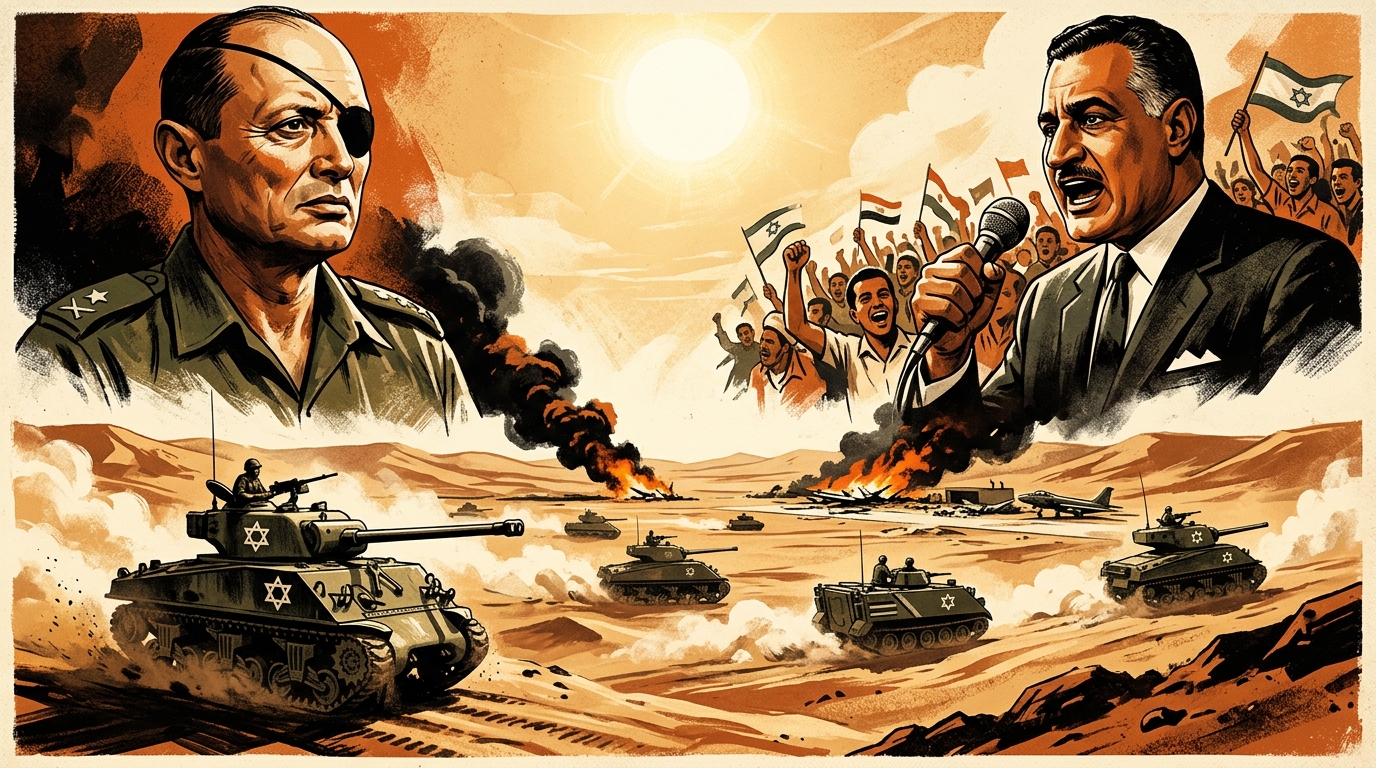
Throughout the late 1950s and 1960s, the rise of Pan-Arabism—championed by Egyptian President Gamal Abdel Nasser—created a volatile political environment. Nasser sought to unify the Arab world under his leadership, utilizing anti-Zionist rhetoric as a powerful tool to galvanize regional support and assert dominance over rival conservative Arab regimes.
- 1956 Suez Crisis
- Rising Tensions & Border Skirmishes
- Soviet Misinformation & Egyptian Mobilization (May 1967)
- Closure of the Straits of Tiran
Several critical factors converged in the spring of 1967 to ignite the fuse of war:
- The Syrian-Israeli Border Tensions: Throughout 1966 and early 1967, clashes erupted along the Israeli-Syrian border. Disputes over farming rights in the Demilitarized Zones (DMZs) and Syria’s support for Palestinian guerilla incursions (led primarily by the nascent Fatah faction) kept tensions high. This culminated in a major air battle on April 7, 1967, in which Israeli Mirage jets shot down six Syrian Soviet-built MiG-21s, flying directly over Damascus in a show of force [^1].
- Soviet Misinformation: On May 13, 1967, the Soviet Union passed a highly inaccurate intelligence report to Egypt, claiming that Israel was massing up to twelve brigades on the Syrian border, preparing for an imminent invasion. Although Israeli authorities denied this and invited the Soviet ambassador to inspect the border, the false report triggered a chain reaction.
- Nasser's Brinkmanship: Driven by a desire to preserve his prestige and protect his Syrian ally, Nasser took three decisive steps that made war virtually inevitable:
"Our basic objective will be the destruction of Israel. The Arab people want to fight." — Egyptian President Gamal Abdel Nasser, speech to Arab trade unionists, May 26, 1967 [^2]
As Arab rhetoric grew increasingly bellicose and military mobilizations accelerated, Israel entered what became known as the Hamtana ("waiting period"). Public anxiety within Israel was acute, with civilian parks earmarked for use as temporary cemeteries. Behind the scenes, Israeli military planners, led by Chief of Staff Yitzhak Rabin and newly appointed Defense Minister Moshe Dayan, argued that waiting for an Arab attack would be catastrophic. They advocated for a preemptive strike to neutralize the overwhelming numerical superiority of the surrounding Arab armies.
Timeline of Events and Key Moments
The war was characterized by an extraordinary display of military speed, coordination, and technological execution. It was decided in the opening hours of the conflict, though intense fighting continued on multiple fronts for six days.
Day 1: June 5, 1967 – Operation Focus (Moked)
At 7:45 AM (Egyptian time), the Israeli Air Force (IAF) launched Operation Focus. Nearly the entire Israeli fleet of combat aircraft took off, flying low over the Mediterranean Sea to evade Egyptian radar networks. This calculated gamble caught the Egyptian military entirely by surprise while their pilots were eating breakfast and their commanders were stuck in morning traffic.
Within three hours, the IAF decimated the Egyptian Air Force on the ground, destroying nearly 300 combat aircraft and rendering runways useless. Later that afternoon, similar preemptive strikes were launched against the air forces of Jordan, Syria, and Iraq after they entered the fray. By nightfall, Israel had established absolute air supremacy over the Middle East, ensuring the success of its ground operations.
On the southern front, Israeli armored divisions under Generals Israel Tal, Avraham Yoffe, and Ariel Sharon crossed the Sinai border, slicing through Egyptian defensive lines at Rafah and Abu Ageila.
Day 2: June 6, 1967 – The Fight for the Sinai and Jerusalem
While Israeli armor pushed deep into the Sinai desert toward the strategic mountain passes (Mitla and Gidi), the Jordanian front intensified. King Hussein, misled by false broadcasts from Cairo claiming spectacular Egyptian victories, ordered artillery bombardments of Israeli cities, including West Jerusalem and the suburbs of Tel Aviv.
Israeli paratroopers, led by Colonel Motta Gur, engaged in fierce hand-to-hand combat against Jordan's elite Arab Legion. The battle for Ammunition Hill in East Jerusalem became one of the bloodiest and most iconic engagements of the war, as Israeli forces fought to secure the northern approach to the Old City.
Day 3: June 7, 1967 – The Fall of Jerusalem and the West Bank
On the third day, Israeli forces breached the walls of the Old City of Jerusalem. Paratroopers reached the Western Wall and the Temple Mount, marking the first time Jewish forces had controlled the historical heart of Jerusalem since the fall of the Roman Empire.
| Quote | Attribution | Event |
|---|---|---|
| "The Temple Mount is in our hands!" | Col. Motta Gur, June 7, 1967 | Israeli Paratroopers secure the Old City & Western Wall |
Simultaneously, Israeli troops swept through the West Bank, capturing the historic cities of Bethlehem, Hebron, Jericho, Nablus, and Ramallah. Under heavy assault and lacking air cover, the Jordanian army began a full retreat across the Jordan River.
Day 4: June 8, 1967 – Reaching the Suez Canal
In the Sinai, retreating Egyptian forces fell into disarray. The IAF bombed choke points like the Mitla Pass, trapping retreating Egyptian armor in a devastating bottleneck. By the end of the day, Israeli tanks reached the eastern bank of the Suez Canal, completing the occupation of the entire Sinai Peninsula.
On this day, a highly controversial event took place in international waters: the Israeli attack on the USS Liberty, an American electronic intelligence vessel. The attack left 34 Americans dead and 171 wounded. Both Israel and the United States subsequently declared the incident to be a tragic case of mistaken identity, though debate over the event persists.
Day 5: June 9, 1967 – Escalation on the Syrian Front
With the southern and eastern fronts secure, Prime Minister Levi Eshkol and Defense Minister Moshe Dayan turned their attention north. The Syrian army had spent years shelling Israeli agricultural communities in the Galilee from their heavily fortified concrete bunkers on the Golan Heights.
Israeli armored and infantry units launched an uphill assault against these steep, fortified positions. Under intense artillery fire, Israeli engineers cleared minefields, allowing tanks to climb the rugged slopes.
In Cairo, a devastated Gamal Abdel Nasser announced his resignation in a televised address, taking full responsibility for the "grave setback." However, massive public demonstrations across Egypt demanding his return prompted him to rescind his resignation the following day.
Day 6: June 10, 1967 – The Fall of the Golan Heights and Ceasefire
Israeli forces broke through Syrian lines, capturing the key town of Kuneitra and threatening the road to Damascus. Fearing a total collapse of the Syrian regime and a direct confrontation with the Soviet Union—which had threatened military intervention—Israel agreed to a UN-brokered ceasefire.
At 6:30 PM on June 10, 1967, the guns fell silent. The war was over.
Geopolitical Consequences and Aftermath
The geopolitical map of the Middle East was permanently redrawn in six short days. Israel emerged as a regional superpower, controlling territories that dramatically increased its strategic depth.
| Territory | Captured From | Strategic Significance |
|---|---|---|
| Sinai Peninsula | Egypt | Provided a massive defensive buffer zone and oil resources. |
| Gaza Strip | Egypt (Administered) | Brought a large Palestinian refugee population under Israeli control. |
| West Bank | Jordan | Included biblical Judea and Samaria; shifted Israel's eastern border to the Jordan River. |
| East Jerusalem | Jordan | Reunified the city; placed historic religious sites under Jewish sovereignty. |
| Golan Heights | Syria | Ended the threat of artillery shelling on Galilee communities; secured freshwater resources. |
| Territory | Area |
|---|---|
| Pre-1967 Israel | Approximately 20,770 km² |
| Post-1967 Israel (including occupied territories) | Approximately 89,000 km² (Nearly a 300% increase) |
The Birth of UN Resolution 242 and "Land for Peace"
In November 1967, the United Nations Security Council adopted Resolution 242. Formulated as a framework for future peace agreements, the resolution introduced the concept of "Land for Peace." It called for:
- The "withdrawal of Israel armed forces from territories occupied in the recent conflict."
- The "termination of all claims or states of belligerency and respect for and acknowledgment of the sovereignty, territorial integrity, and political independence of every State in the area."
The deliberate omission of the definite article "the" before "territories" in the English version of the text became a major diplomatic battleground, with Israel arguing it was not required to withdraw from all captured lands, while Arab states and their allies insisted on a complete return to pre-war lines 3.
The Decline of Pan-Arabism and Rise of Palestinian Nationalism
The defeat of 1967 shattered the ideology of Pan-Arabism. Gamal Abdel Nasser’s dream of a secular, unified Arab state capable of dismantling Israel lay in ruins, and he died three years later, a broken leader. This ideological vacuum was rapidly filled by two forces:
- Independent Palestinian Nationalism: Palestinian leaders realized that Arab state sponsors could not deliver liberation. The Palestine Liberation Organization (PLO), under the leadership of Yasser Arafat, rose to prominence, launching independent guerrilla and diplomatic campaigns to assert Palestinian self-determination.
- Political Islam: The failure of secular Arab nationalism led to a resurgence of Islamic fundamentalism. Many in the region viewed the secular defeat as divine punishment, rallying behind the slogan "Islam is the answer" [[^4]].
Cold War Dynamics
The Six-Day War deepened the proxy nature of the Cold War in the Middle East. The Soviet Union broke off diplomatic relations with Israel and rapidly rearmed Egypt and Syria with advanced military technology. Conversely, the United States, impressed by Israel's military efficiency, transitioned from a cautious supporter into Israel’s primary strategic ally and arms supplier, laying the foundation for the modern U.S.-Israel special relationship.
Analysis of Key Actors and Decisive Actions
The dramatic outcome of the conflict was not merely the result of military hardware, but of human leadership, tactical calculations, and stark intelligence discrepancies.
Gamal Abdel Nasser: The Trap of Rhetoric
Nasser’s primary error lay in his reliance on brinkmanship without a corresponding military capability. He walked into a strategic trap of his own making: his hostile rhetoric forced him to take actions (expelling UNEF, closing the Straits) that Israel could not ignore, while his military remained poorly prepared, overstretched in the ongoing civil war in Yemen, and command-crippled by political appointments.
Moshe Dayan: The Icon of Israeli Resolve
Appointed Defense Minister just days before the outbreak of hostilities, Moshe Dayan became the global face of Israeli military prowess. His iconic eye patch, charismatic demeanor, and decisive leadership galvanized the Israeli public. Dayan’s strategic vision was critical; he understood the importance of speed and psychological shock, but also demonstrated caution, initially opposing the capture of the Old City of Jerusalem and the Golan Heights due to fears of international intervention, before ultimately authorizing both as conditions became favorable.
"We have returned to our holiest places, never to depart from them again." — Moshe Dayan at the Western Wall, June 7, 1967 [^5]
King Hussein of Jordan: The Tragic Miscalculation
King Hussein faced an impossible dilemma. If he remained out of the war, he risked a domestic revolution by his large Palestinian population and the wrath of neighboring Arab regimes. If he entered, he risked losing his kingdom. Misinformed by Egyptian commanders who claimed they had destroyed Israel's air force and were marching on Tel Aviv, Hussein made the fatal decision to honor his defense pact with Egypt, costing him control over East Jerusalem and the fertile West Bank.
Intelligence Failures vs. Planning Success
The war demonstrated the stark contrast between Israeli and Arab intelligence networks. Israel's military intelligence (Aman) and foreign intelligence (Mossad) had spent years compiling meticulous dossiers on Egyptian airfields, pilot schedules, and Syrian fortifications on the Golan Heights. They knew the exact layouts of enemy bases, the names of commanders, and even the frequencies of their communications.
In contrast, Arab intelligence was severely hampered by bureaucratic rivalries, political sycophancy, and a reluctance to deliver bad news to leadership, leaving their forces vulnerable to strategic surprise.
Trivia and Lesser-Known Facts
- The "Yellow Fleet" in the Suez Canal: When the war broke out, fifteen cargo ships from various nations (including the UK, West Germany, Sweden, and Poland) were transiting through the Suez Canal. They were trapped there for eight years after Egypt blocked both ends of the canal with scuttled ships and sea mines. The crews formed an international community known as the "Great Bitter Lake Association," even creating their own postage stamps and hosting a miniature "Bitter Lake Olympic Games" in 1968.
- The Silent Air Defense: During Operation Focus on the morning of June 5, Egyptian air defense units did not fire on the incoming Israeli jets. This was because Egypt’s Field Marshal Abdel Hakim Amer and his senior staff were in transit to a military base in Sinai in an Antonov transport aircraft. Fearing that rebel Egyptian officers might shoot down the commander's plane, the military issued a strict order to turn off all air defense radar and anti-aircraft artillery across the country during the exact window of the Israeli attack.
- The Syrian Secret Agent: Israel's rapid conquest of the Golan Heights was significantly aided by the espionage of Eli Cohen, a legendary Mossad agent who infiltrated the highest levels of the Syrian government in the early 1960s. Cohen famously advised Syrian military officers to plant eucalyptus trees around their concrete bunkers on the Golan Heights to keep the soldiers cool. During the 1967 war, these mature trees served as perfect targeting markers for Israeli artillery and aircraft. Cohen had been discovered and executed in Damascus in 1965, but his intelligence bore fruit years after his death.
References and Literature
- The Six-Day War (Official Website) - A comprehensive historical archive containing primary source documents, declassified cables, and detailed timelines of the 1967 conflict.
- Oren, Michael B. (2002). "Six Days of War: June 1967 and the Making of the Modern Middle East." Oxford University Press. - Widely considered the definitive, balanced scholarly work on the military, political, and diplomatic aspects of the war.
- The United Nations Security Council Resolution 242 (1967) - The official UN document establishing the "Land for Peace" principle for Middle Eastern diplomacy.
- Foreign Affairs: "The Legacy of 1967" (May/June 2017 Issue) - A collection of analytical essays examining the fifty-year geopolitical impact of the Six-Day War on international relations.
---
Footnotes & Explanations
- Michael B. Oren, Six Days of War: June 1967 and the Making of the Modern Middle East (Oxford University Press, 2002), pp. 48-52. ↩
- Address by President Nasser to the General Council of the International Confederation of Arab Trade Unions, Cairo, May 26, 1967. ↩
- Arthur Lall, The UN and the Middle East Crisis, 1967 (Columbia University Press, 1968), pp. 250-264. ↩
- Fouad Ajami, The Arab Predicament: Arab Political Thought and Practice Since 1967 (Cambridge University Press, 1981), pp. 19-28. ↩
- Public statement by Israeli Defense Minister Moshe Dayan upon reaching the Western Wall, Jerusalem, June 7, 1967. ↩