Key Takeaways
- The 2005 disengagement marked the first time Israel dismantled settlements in territory captured during the 1967 Six-Day War.
- Ariel Sharon’s unilateral pivot signaled a departure from the failed Oslo peace process toward a 'self-reliance' security doctrine.
- The power vacuum left by the IDF’s withdrawal ultimately catalyzed the internal Palestinian schism between Fatah and Hamas.
Historical Context and Origins
The Gaza Disengagement Plan, initiated by Prime Minister Ariel Sharon in 2003 and implemented in August 2005, represents a watershed moment in the modern history of the Middle East. To understand the genesis of this policy, one must look at the exhaustion of the "peace process" paradigm that had dominated Israeli-Palestinian relations for over a decade. By the early 2000s, the Second Intifada (also known as the Al-Aqsa Intifada), which erupted in September 2000, had decimated the optimism and fragile hopes fostered by the 1990s Oslo Accords. The Oslo process, intended to lead to a two-state solution through phased negotiations, had foundered. The dramatic failure of the 2000 Camp David Summit, where Israeli Prime Minister Ehud Barak and Palestinian leader Yasser Arafat, mediated by U.S. President Bill Clinton, failed to reach a final status agreement, was a critical turning point. This failure, coupled with the ensuing wave of violence, suicide bombings, and Israeli military responses, led many within the Israeli security establishment and the political leadership to conclude that a negotiated settlement with the Palestinian leadership—then embodied by Yasser Arafat, and subsequently, the nascent leadership of Mahmoud Abbas—was unattainable in the immediate term.
Ariel Sharon, a towering and often controversial figure in Israeli politics and a lifelong hawk with a distinguished military career, underwent a remarkable political transformation that informed the Disengagement Plan. Known affectionately by supporters and reviled by detractors as the "father of the settlements" for his role in their expansion in the West Bank and Gaza Strip during his time as Minister of Agriculture and later as Defense Minister, Sharon began to articulate a new strategic calculus. He came to argue that maintaining the Gush Katif bloc, a large cluster of Israeli settlements in the southern Gaza Strip, and other Israeli outposts within the densely populated Palestinian territory was no longer a strategic asset but a significant liability. His reasoning was multifaceted. Firstly, the enormous military resources—personnel, equipment, and financial investment—required to secure these isolated enclaves, surrounded by a hostile Palestinian population, were seen as unsustainable and disproportionate to their strategic value. Sharon famously articulated this concern, suggesting that "the fate of Netzarim is the fate of Tel Aviv," implying that the military commitment to defend even a single, remote settlement necessitated a level of national security engagement that impacted the entire country's defense posture.
Beyond the immediate security burden, the "demographic threat" loomed large in Sharon's calculations and in the broader Israeli security discourse. The demographic projections indicated that if Israel were to maintain control over the ever-growing Palestinian population in the West Bank and Gaza Strip, it would eventually face a stark choice: either annex these territories and absorb millions of Palestinians, thereby jeopardizing its Jewish majority and democratic character, or continue to rule over them in a manner that would be increasingly unsustainable and morally problematic, potentially leading to a perpetual state of occupation and internal unrest. The Disengagement Plan was thus presented, in part, as a means to extricate Israel from this demographic dilemma, by relinquishing direct control over Gaza's Palestinian population.
"I have reached the conclusion that we will not be able to hold onto the Gaza Strip for long... I have decided to remove the settlements from the Gaza Strip." — Ariel Sharon, 2003
This statement, delivered in 2003, signaled a profound shift in Israeli policy and demonstrated Sharon's willingness to take bold, even contradictory, steps to advance what he perceived as Israel's core security interests. The decision was not solely a security one; it was also a diplomatic maneuver. By initiating a unilateral withdrawal, Sharon aimed to preempt international pressure to engage in a protracted peace negotiation process that he believed was stalled and unproductive. He sought to present Israel with a fait accompli, thereby forcing the international community to deal with a new reality on the ground and potentially isolating those Palestinian factions perceived as unwilling to compromise.
Historical Precedents & Context
While the 2005 Disengagement was unprecedented in its scope and the dismantling of established settlements in territory captured during the Six-Day War, it did not occur in a vacuum. The history of Israeli settlement policy and the evolving security doctrines of the state provided a crucial backdrop. Following the Six-Day War in 1967, Israel established settlements in the West Bank, Gaza Strip, East Jerusalem, and the Golan Heights. These settlements were often driven by a combination of ideological motivations (religious and nationalistic claims to the land), security considerations (establishing strategic outposts), and demographic policies.
Over the decades, the settlements grew into significant communities, becoming deeply embedded in the Israeli political and social fabric. The Gush Katif bloc in Gaza, established in the 1970s, became a particularly large and ideologically charged settlement complex. The viability and strategic justification of these settlements were debated within Israel for years, with various security assessments highlighting their vulnerability and the immense cost of their protection.
Moreover, the concept of "unilateralism" in Israeli security policy, while controversial, had precedents. The 1978 Camp David Accords, which led to the peace treaty with Egypt, involved the dismantling of Israeli settlements in the Sinai Peninsula, though this was part of a comprehensive peace agreement with a recognized sovereign state. The Disengagement Plan, however, was explicitly unilateral, meaning it was not contingent on a reciprocal agreement with the Palestinian leadership. This approach reflected a growing frustration with the impasse in the peace process and a belief that Israel needed to take matters into its own hands to ensure its security and demographic future. Sharon's "convergence plan," as it was sometimes called, was designed to create Israeli "facts on the ground" in the West Bank (by consolidating major settlement blocs and building the separation barrier) while simultaneously disengaging from Gaza, thereby reshaping the demographic and territorial contours of the conflict in Israel's favor, or at least in a way that preserved its Jewish character.
Timeline of Events and Key Moments
The logistical and political execution of the disengagement was a complex, high-stakes operation that unfolded over several years, involving intense internal debate, legal challenges, and significant public mobilization. The Israeli Defense Forces (IDF) and the police were tasked with the emotionally charged responsibility of removing thousands of Israeli citizens from their homes, many of whom were ideologically aligned with the nationalist and religious right-wing movements that had championed settlement expansion. The process was fraught with tension, given the settlers' deep connection to the land and their perception of betrayal by their own government.
| Date | Key Event |
|---|---|
| 2003 | Prime Minister Ariel Sharon first publicly discusses the "Disengagement Plan" concept, indicating a shift in Israeli policy towards unilateral withdrawal from Gaza. |
| October 2003 | The "Disengagement Plan" is formally presented to the Israeli Cabinet and later debated in the Knesset, sparking significant opposition from within Sharon's Likud party. |
| May 17, 2004 | The Israeli Cabinet narrowly approves the Disengagement Plan in a 14-7 vote, but it faces immediate political backlash. |
| June 2004 | A national referendum is held within the Likud party, where members vote against the Disengagement Plan, leading to significant political turmoil for Sharon. |
| July 2004 | Sharon withdraws the plan from a Knesset vote after facing overwhelming opposition. He then orchestrates a political realignment, forming the new centrist Kadima party. |
| October 26, 2004 | The Knesset approves the Disengagement Plan in principle by a vote of 67-45, allowing the government to proceed with its implementation. |
| August 2005 | The Gaza Disengagement formally begins with the evacuation of settlements. The process is characterized by military operations and civil resistance from settlers. |
| August 15, 2005 | The first settlers are evacuated from the Gaza Strip. Israeli security forces enforce closure of the area to external access and begin systematic evacuations. |
| August 22, 2005 | The last Israeli civilians are removed from their homes in the Gaza settlements, marking the end of civilian presence. |
| September 12, 2005 | The final IDF soldiers withdraw from the Gaza Strip, and the military government that had overseen the territory since 1967 officially ends. |
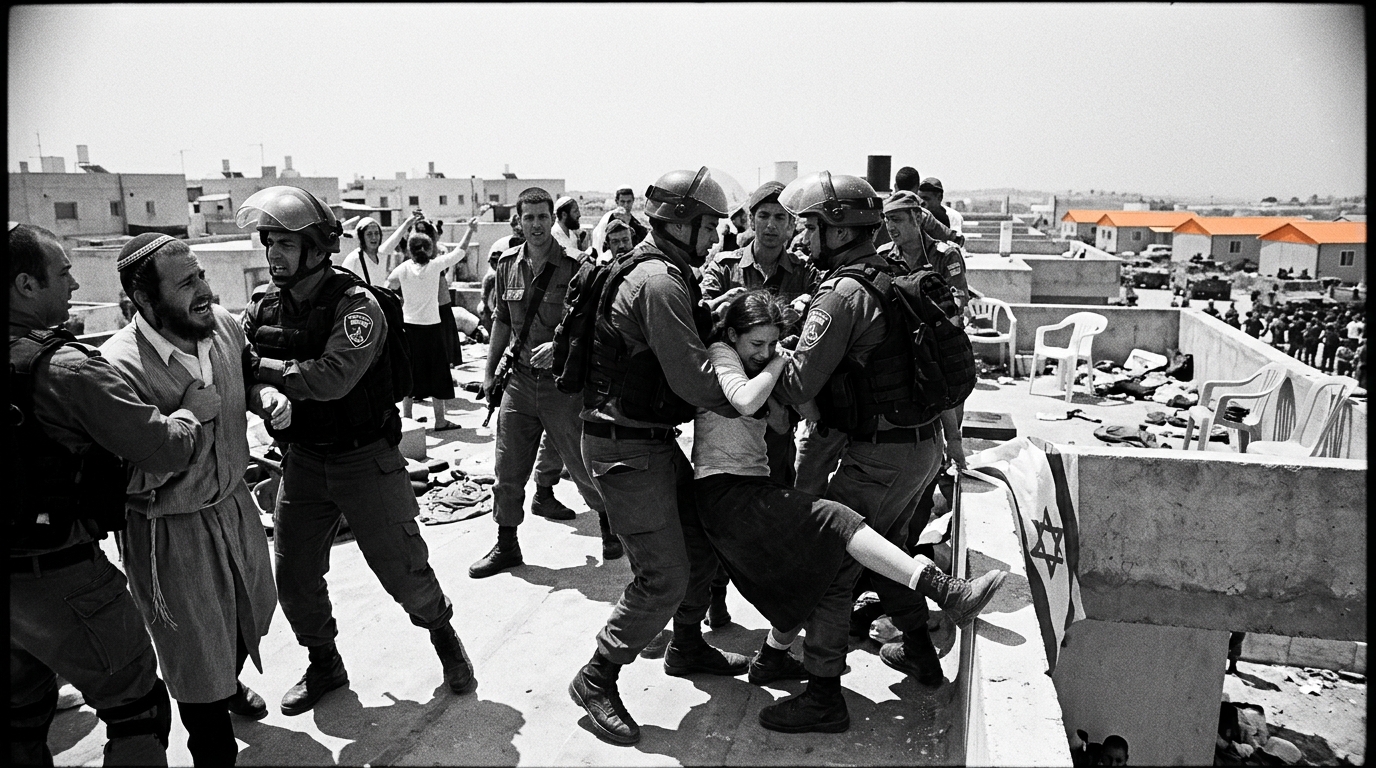
The process of evacuation was meticulously planned but emotionally wrenching. Thousands of Israeli security forces were deployed. While the government instructed soldiers and police to use a "soft touch" to minimize violence and trauma, there were inevitable confrontations. Many settlers refused to leave peacefully, barricading themselves in their homes and synagogues, leading to scenes of protesters being physically carried out by soldiers. The psychological impact on the approximately 8,500 settlers who were displaced was profound and long-lasting. Many lost their homes, livelihoods, and sense of belonging, feeling abandoned by the state they had served.
Geopolitical Consequences and Aftermath
The immediate aftermath of the disengagement was a complex tapestry of perceived victories and escalating instability. For Israel, the removal of its citizens and military presence from Gaza was hailed by supporters as a strategic success that would enhance security and alleviate demographic pressures. It freed up significant military resources and removed Israel from direct administration of a densely populated Palestinian territory, thereby lessening its obligations under international law regarding civilian protection. For the first time since its occupation in 1967, the Gaza Strip was under de facto Palestinian control. However, this withdrawal was not absolute. Israel retained control over Gaza's airspace, maritime access, and external borders, allowing it to impose significant restrictions on the movement of people and goods, a policy that continues to define the blockade of Gaza. This continued control led to ongoing debates about whether Gaza remained "occupied territory" under international law.
The power vacuum left by the IDF’s departure was not filled by a cohesive and effective Palestinian authority. Mahmoud Abbas, who had succeeded Yasser Arafat as President of the Palestinian Authority (PA) in January 2005, found himself leading an organization that was already grappling with internal divisions and a crisis of legitimacy. The PA struggled to consolidate its security forces and assert control over the Strip. The narrative that dominated Palestinian street politics was that the withdrawal was a direct result of the "armed resistance" spearheaded by Hamas and other militant factions, rather than a concession made by Israel due to external pressure or internal calculations. This narrative severely undermined the credibility of the Fatah-led PA, which was perceived by many Palestinians as having failed to achieve liberation through negotiations.
This escalating internal friction between Fatah and Hamas, exacerbated by the disengagement's aftermath, would soon erupt into open conflict. The Palestinian legislative elections of January 2006 saw Hamas win a majority of seats, a result that was largely interpreted as a rejection of Fatah's long-standing governance. Israel, supported by much of the international community, refused to work with a Hamas-led government. This political stalemate intensified the internal struggle for power. By June 2007, the tensions culminated in a violent showdown, with Hamas forces decisively defeating Fatah militias and taking full control of the Gaza Strip. This marked a profound and enduring schism in the Palestinian national movement, effectively dividing the Palestinian territories into two distinct entities: the Fatah-controlled West Bank and the Hamas-controlled Gaza Strip, a division that continues to this day and has had devastating consequences for the Palestinian people.
The disengagement also had significant implications for Israel's internal political landscape. Sharon's decision led to a deep rift within his own Likud party, a party historically associated with the settlement movement. This internal opposition was so strong that it forced Sharon to abandon the Likud and form a new centrist party, Kadima, in late 2005. Tragically, Sharon suffered a severe stroke in January 2006, just months after the disengagement, falling into a coma from which he never recovered. His successor, Ehud Olmert, continued to grapple with the fallout of the disengagement and the escalating security challenges.
Analysis of Key Actors and Decisive Actions
Ariel Sharon: The Calculated Realist
Sharon’s decision to disengage from Gaza was arguably the most significant policy shift of his long and often contentious career. It represented a pragmatic, if controversial, departure from his previous staunch support for settlement expansion. By initiating a unilateral move, he effectively neutered much of the international pressure that had been mounting on Israel to dismantle settlements or negotiate their status. He understood that such a bold, albeit unilateral, action would likely earn Israel some goodwill and a degree of international understanding, particularly from the United States. The Bush administration, while initially skeptical, largely supported Sharon's initiative, seeing it as a step that could potentially break the stalemate in the peace process.
However, the move was also a shrewd political gambit. Sharon recognized that the Oslo process was dead and that a willing and capable Palestinian partner for negotiations was absent. The disengagement allowed him to unilaterally redefine Israel's security perimeter and strategic posture, withdrawing from a volatile area that was increasingly difficult to manage. His actions redefined the Israeli Right, forcing a confrontation between the pragmatic security concerns of the state and the ideological claims of Greater Israel. By breaking with the Likud, he demonstrated his willingness to sacrifice his party loyalty for what he believed to be the long-term national interest. The plan was an attempt to secure Israel's Jewish character and its security in a rapidly changing regional landscape, prioritizing a manageable and demographically viable Israel over territorial maximalism in Gaza.
Mahmoud Abbas: The Reluctant Inheritor
Mahmoud Abbas, often viewed as a moderate and a potential partner for peace, inherited a difficult situation. His presidency began with the symbolic victory of the Israeli withdrawal from Gaza, a long-held Palestinian aspiration. However, he struggled mightily to translate this into tangible progress toward statehood or to consolidate his authority. The PA, weakened by corruption, factionalism, and the legacy of Yasser Arafat, lacked the capacity and the political will to effectively manage Gaza post-disengagement.
Abbas's inability to disarm militant groups or establish a unified security force meant that the withdrawal resulted in a surge of lawlessness and intensified internal conflict. The international community's expectation that the PA would demilitarize Gaza and prevent rocket attacks into Israel proved unrealistic. The subsequent rocket fire from Gaza bolstered the arguments of Israeli hardliners who had opposed the disengagement, portraying it as a naive and dangerous capitulation. Abbas found himself caught between the demands of the international community, the aspirations of his own people, and the growing power of Hamas. His leadership during this period highlighted the deep structural weaknesses of the PA and the profound challenges of nation-building in a conflict zone, especially when faced with internal divisions and external pressures.
Socio-Economic Aftermath
The disengagement had profound and often devastating socio-economic consequences for both the displaced Israeli settlers and the Palestinian population of Gaza. For the thousands of Israeli settlers who were uprooted, the experience was one of immense loss. They lost their homes, their businesses, and the communities they had built over decades. Many faced significant financial hardship as they struggled to find new places to live and new employment opportunities, often in overcrowded urban areas or newly established caravan sites. The psychological toll was equally severe, with many experiencing depression, trauma, and a deep sense of alienation. The government provided compensation packages, but these were often criticized as inadequate, failing to fully account for the emotional and economic losses incurred. The dismantling of Gush Katif, once a vibrant agricultural and economic hub, represented a significant symbolic and material loss for the settlement movement.
For the Palestinian population of Gaza, the disengagement was a complex mix of hope and despair. On the one hand, it represented a historic moment of freedom from direct Israeli civilian occupation. The withdrawal of thousands of settlers was seen by many as a victory for Palestinian resistance. However, the Israeli-imposed blockade that followed severely hampered economic recovery and development. The destruction of former Israeli infrastructure, including greenhouses that were intended to be a boon for the Palestinian economy, was not fully capitalized upon due to logistical challenges, Israeli restrictions, and internal Palestinian political rivalries. Unemployment remained staggeringly high, poverty rates soared, and the humanitarian situation deteriorated. The blockade, tightened significantly after Hamas took control in 2007, has had a crippling effect on Gaza's economy, leading to dependence on international aid and creating a cycle of poverty and conflict that persists to this day. The dream of a viable, self-sustaining Palestinian economy in Gaza remained elusive, overshadowed by security concerns and the persistent reality of external control.
Geopolitical Realignment and Regional Implications
The 2005 Disengagement irrevocably altered the geopolitical landscape of the Israeli-Palestinian conflict and the broader Middle East. For Israel, it marked a strategic pivot, an attempt to redefine its security boundaries and shed what it perceived as an unsustainable burden. While it did not end the conflict, it shifted the focus of Israeli security policy towards a strategy of containment and border defense, exemplified by the construction of the separation barrier in the West Bank and the ongoing blockade of Gaza. This unilateral approach, while initially welcomed by some international actors, also created new dynamics of instability.
The rise of Hamas to power in Gaza, directly following the disengagement, had profound regional implications. It bolstered the influence of Islamist movements across the region and created a new, more radicalized front against Israel. The ensuing years witnessed a series of Israeli military operations in Gaza in response to rocket fire and incursions, further entrenching the cycle of violence and deepening the humanitarian crisis. The division between Fatah in the West Bank and Hamas in Gaza also weakened the Palestinian negotiating position and complicated any future prospects for a unified peace initiative.
Moreover, the disengagement contributed to a growing perception among some regional actors that direct confrontation might yield greater results than protracted peace negotiations. The success of Hamas in leveraging the disengagement narrative provided a template for other militant groups seeking to challenge established authorities. The subsequent years saw a more assertive posture from Iran and its proxies, partly fueled by the perceived vulnerabilities exposed by Israel's unilateral withdrawal and the ensuing internal Palestinian strife. The disengagement thus inadvertently contributed to a more fragmented and volatile regional security environment.
Modern Historiographical Debates
The 2005 Israeli Disengagement from Gaza remains a subject of intense debate among historians and political scientists, with differing interpretations of its motivations, consequences, and overall legacy. One prominent debate centers on Ariel Sharon's motivations. Was he a pragmatic realist seeking to preserve Israel's long-term security and Jewish character, as some argue, by shedding the demographic and military burden of Gaza? Or was he a master strategist who manipulated the situation to achieve his own political goals, including consolidating power and deflecting international criticism, while leaving Israel with a new set of intractable security challenges?
Another critical area of debate concerns the "unilateral" nature of the plan. Critics argue that Sharon's refusal to coordinate the disengagement with the Palestinian Authority and his subsequent insistence on retaining significant control over Gaza's borders and airspace demonstrated a lack of genuine commitment to peace. They contend that a negotiated withdrawal, even one based on difficult compromises, would have had a greater chance of fostering stability and building trust. Conversely, proponents of the unilateral approach argue that the absence of a reliable Palestinian partner at the time made such a coordinated effort impossible and that Israel had no alternative but to act decisively to protect its own interests.
The consequences for the Palestinian territories are also subject to divergent analyses. Some scholars emphasize the empowerment of Hamas and the resultant internal Palestinian schism as the primary, devastating legacy of the disengagement, arguing that it extinguished hopes for a unified Palestinian state. Others highlight the enduring Israeli blockade and military interventions as the core reason for Gaza's subsequent crisis, suggesting that the disengagement merely changed the form of occupation rather than ending it. The long-term impact on the prospects for a two-state solution also remains a central question, with some arguing that the disengagement, by removing a significant portion of Israeli settlers, moved closer to a territorial basis for such a solution, while others contend that it ultimately entrenched the conflict by creating a more volatile and unmanageable situation. The historiography continues to evolve as new archival material becomes available and as the long-term impacts of this pivotal event continue to unfold.
Trivia and Lesser-Known Facts
- The Synagogue Dilemma: After a long legal and moral debate, the Israeli government decided to leave the structures of the synagogues in the Gaza settlements standing, rather than demolishing them. The intention was to preserve them as religious sites. However, within hours of the IDF's departure and the formal end of Israeli presence, Palestinian crowds entered these areas, looting and setting fire to many of these buildings, turning them into symbols of destruction.
- The Greenhouse Industry: A significant number of the sophisticated agricultural greenhouses in the Gush Katif settlements were left intact for the Palestinian economy to utilize, thanks to an initiative funded by international donors, including the United States and the European Union. The idea was to provide a swift economic boost to the Gazan economy. However, supply chain disruptions, political mismanagement, internal Palestinian disputes over ownership, and Israeli security restrictions on inputs and exports rendered most of these valuable assets unproductive within a year of the withdrawal.
- The "Orange" Resistance: The color orange became the defining visual symbol of the opposition to the Disengagement Plan and the settler movement. It was adopted by the "Yesha" (Judea and Samaria) Council, the umbrella organization for settlements in the West Bank and Gaza. The color was chosen because it was associated with the citrus fruits grown in the fertile Gush Katif region, which was a key economic driver for many of the settlers. Protesters wore orange ribbons, painted their cars orange, and even hoisted giant orange balloons, transforming the color into a potent emblem of defiance and attachment to the land.
- The Security Buffer: In the wake of the disengagement, the IDF established a substantial "no-go zone" or buffer area along the Gaza perimeter, extending several hundred meters into Gaza territory from the fence. This buffer zone was intended to prevent infiltration and rocket attacks. However, it has been a constant source of contention, leading to numerous confrontations, civilian casualties among Palestinians who strayed too close, and significant humanitarian concerns regarding access to agricultural land and fishing areas near the border.
- The Settlement's Future: Following their evacuation, many of the Gaza settlers were resettled in new communities within Israel, most notably in the Halutza Sands region in the western Negev desert. These new communities faced immense challenges in establishing themselves, both economically and socially, as they grappled with the trauma of displacement and the loss of their former way of life.
References and Literature
- The Gaza Disengagement Plan (Israeli Ministry of Foreign Affairs): Official archival documents detailing the policy, legal framework, Cabinet decisions, and governmental rationale behind the 2005 withdrawal. These materials offer insight into the official Israeli perspective and administrative processes.
- The Palestinian Authority and the Aftermath of Disengagement (Journal of Palestine Studies): This academic journal provides in-depth analyses of the governance challenges faced by the Palestinian Authority in the wake of the 2005 withdrawal, exploring the emergence of internal political friction, the rise of Hamas, and the impact on Palestinian state-building efforts.
- Sharon's Life and Legacy (New York Times Archive): Extensive biographical and analytical reporting on the political motivations and actions of Ariel Sharon during his final years in office, particularly focusing on the strategic thinking behind the Disengagement Plan and its immediate repercussions.
- The Price of Withdrawal: A History of the Gaza Evacuation (Haaretz): An investigative and analytical piece focusing on the socioeconomic impacts of the evacuation on the settler population, the human cost of the displacement, and the broader implications for the Israeli-Palestinian conflict and Israeli society.
- "The Gaza Blockade: Crisis in the Occupied Palestinian Territories" (International Crisis Group): Reports and analyses detailing the ongoing blockade of Gaza post-disengagement, its humanitarian consequences, and its impact on regional security dynamics.
- "My Promised Land: The Triumph and Tragedy of Israel" by Ari Shavit: While not solely focused on the disengagement, Shavit's work provides significant context on Israeli society, its historical narratives, and the internal debates surrounding territorial compromises and security.
Footnotes & Explanations
- This refers to the security doctrine shift from territorial occupation to border-based defense and strategic disengagement. ↩
- Refers to the internal schism between Fatah and Hamas, which became irreconcilable after the legislative elections of 2006 and the subsequent conflict in 2007. ↩
- The separation barrier, or "security fence," is a physical barrier constructed by Israel to separate it from the West Bank. It is distinct from the Gaza blockade. ↩
- The term "occupation" is contested in the context of Gaza post-2005, with Israel arguing it is no longer an occupying power due to the withdrawal of its citizens and administration, while many international bodies and critics maintain that its control over borders and airspace constitutes continued occupation. ↩