Key Takeaways
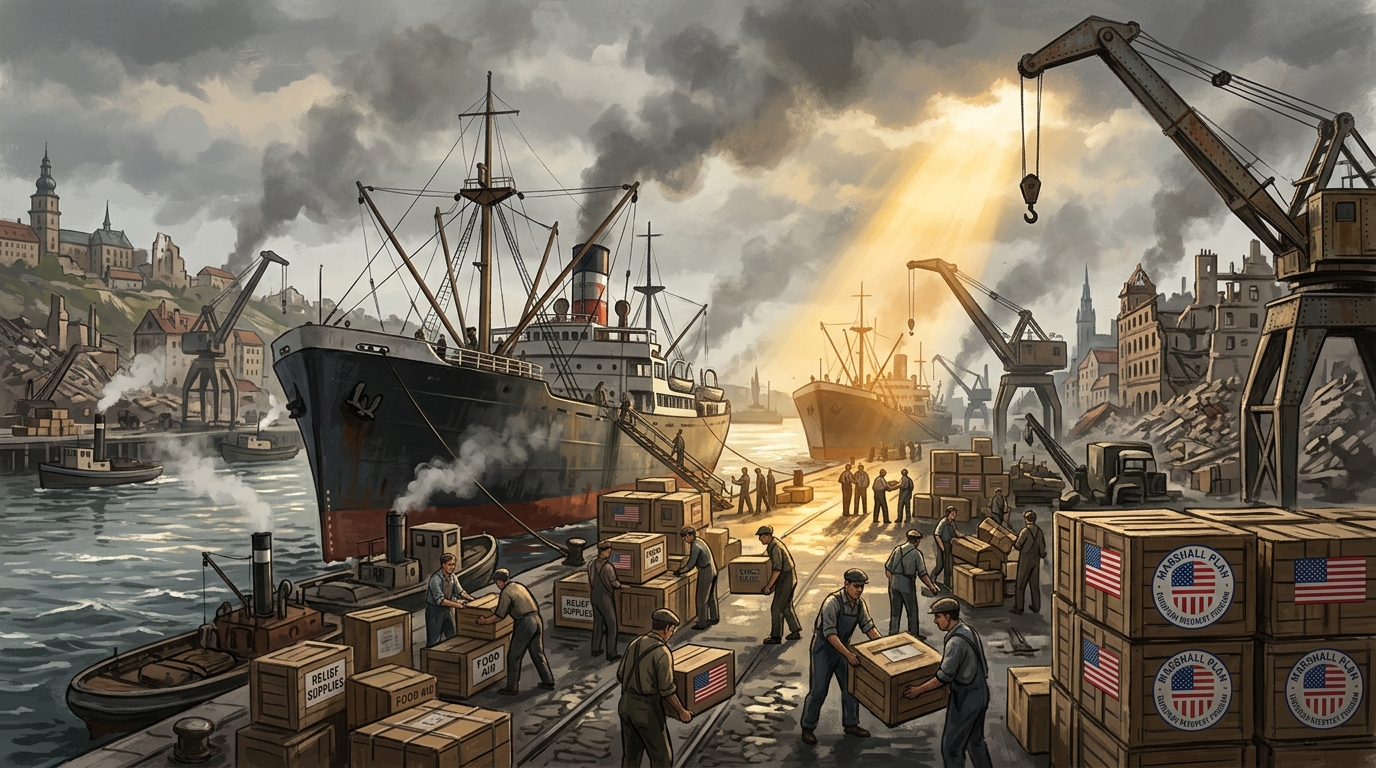
- The European Recovery Program (ERP), known as the Marshall Plan, provided over $13 billion in economic aid to rebuild war-torn Europe.
- It served as a cornerstone of the US containment policy, checking Soviet expansionism by stabilizing democratic governments in Western Europe.
- The plan laid the institutional groundwork for European integration, transforming the economic relationship between former adversaries.
Historical Context and Origins
In the immediate aftermath of World War II, Europe lay in ruins. The conflict had decimated the continent's industrial infrastructure, shattered agricultural production networks, and disrupted traditional commercial trade routes. By the harsh winter of 1946–1947, the initial optimism of liberation had dissolved into a grim struggle for survival. Millions of displaced persons lived in makeshift shelters, coal shortages paralyzed power grids, and food rationing in the United Kingdom and Germany was more severe than it had been during the war years.
This economic paralysis gave rise to what historians term the "dollar shortage." 1 European nations lacked the hard currency reserves required to import essential raw materials, machinery, and food from the United States—the only major industrial power whose economy had emerged from the war expanded rather than destroyed. Without these imports, industrial recovery ground to a halt, creating a vicious cycle of deflation, poverty, and despair.
For American policymakers in Washington, this humanitarian crisis presented a profound geopolitical threat. In France and Italy, communist parties (the Parti Communiste Français and the Partito Comunista Italiano) had leveraged their heroic wartime resistance records to secure substantial electoral victories, commanding up to 30 percent of the popular vote. In the United States' view, a desperate, impoverished Western Europe was highly vulnerable to internal subversion and Soviet alignment.
The geopolitical doctrine of containment, formulated by diplomat George F. Kennan in his famous "Long Telegram" of 1946 and his subsequent "X Article" in Foreign Affairs, posited that the Soviet Union would seek to exploit the vulnerabilities of the capitalist world without necessarily resorting to military conflict. 2 Therefore, the primary defense against Soviet expansionism had to be political and economic stabilization.
| Stage | Cause / Effect |
|---|---|
| Initial Condition | Post-War Devastation |
| Economic Consequence | Economic Paralysis / Dollar Shortage |
| Social/Political Consequence | Social and Political Instability |
| Political Result | Communist Electoral Gains |
| Strategic Outcome | Need for Containment Policy |
This strategic framework was formalized on March 12, 1947, when President Harry S. Truman announced the Truman Doctrine, pledging military and economic assistance to Greece and Turkey to resist communist insurgencies. However, Truman and his advisors soon realized that isolated interventions were insufficient. A comprehensive, continent-wide initiative was required to address the systemic collapse of Western Europe's industrial core.
Following the failure of the Moscow Conference of Foreign Ministers in April 1947—where Secretary of State George C. Marshall observed firsthand the Soviet Union's reluctance to cooperate on German economic recovery—the State Department's Policy Planning Staff, under Kennan, was tasked with designing a massive aid package. Marshall concluded that the European economy was "a patient sinking while the doctors deliberate." He recognized that saving the patient required a radical, coordinated injection of American capital.
Timeline of Events and Key Moments
The implementation of the European Recovery Program (ERP) progressed through several critical diplomatic, legislative, and operational phases between 1947 and 1951.
The Harvard Address (June 5, 1947)
Speaking at the commencement ceremony of Harvard University, Secretary of State George C. Marshall delivered the speech that would define postwar history. Carefully drafted by his aides, including Charles Bohlen and Dean Acheson, the address laid out the conceptual framework of the recovery plan:
"Our policy is directed not against any country or doctrine but against hunger, poverty, desperation, and chaos. Its purpose should be the revival of a working economy in the world so as to permit the emergence of political and social conditions in which free institutions can exist."
Marshall deliberately avoided direct attacks on the Soviet Union and explicitly invited all European nations, including the USSR and its Eastern European satellites, to participate. However, he attached a crucial condition: the European nations themselves had to jointly draft the recovery program and agree on its implementation. The United States would not merely hand out unilateral aid; it would fund a collaborative, multilateral European plan.
| Date | Event |
|---|---|
| June 5, 1947 | Marshall's Harvard Commencement Address |
| July-Sept 1947 | Paris Conference / Soviet Rejection |
| Feb 25, 1948 | Communist Coup in Czechoslovakia |
| April 3, 1948 | Truman signs Foreign Assistance Act |
| June 1948 | German Currency Reform / Berlin Block |
| Dec 1951 | ERP concludes; transition to MSA |
The Paris Conference and Soviet Rejection (July–September 1947)
The British Foreign Secretary, Ernest Bevin, and the French Foreign Minister, Georges Bidault, immediately grasped the significance of Marshall’s offer. Bevin later recalled that the speech was "a lifeline to sinking men." 3 They invited Soviet Foreign Minister Vyacheslav Molotov to a preliminary meeting in Paris in late June to discuss a unified European response.
The tripartite negotiations quickly broke down. Molotov rejected the American insistence on a coordinated European plan, arguing that joint economic planning and the disclosure of national economic data would violate national sovereignty and allow American capital to dominate Europe. He proposed instead that European countries should submit individual lists of their import needs to the United States.
When the British and French stood firm on multilateralism, Molotov walked out. The Soviet Union subsequently blocked Poland, Hungary, Yugoslavia, and Czechoslovakia—which had initially expressed strong interest—from attending the broader Paris Conference of European Economic Co-operation (CEEC) in July 1947. This decision solidified the economic division of the continent.
In response, the Soviet Union established the Molotov Plan (later formalized as the Council for Mutual Economic Assistance, or Comecon) to bind Eastern Europe's economies to Moscow.
The Prague Coup and US Legislative Passage (February–April 1948)
While the sixteen participating Western European nations formed the CEEC and drafted a detailed plan requesting $19 billion in aid, the proposal faced steep opposition in the United States Congress. Fiscal conservatives, led by Senator Robert A. Taft, feared the massive expenditure would trigger domestic inflation, increase the national debt, and turn the US into a social-welfare state.
The political logjam was broken on February 25, 1948, when a Soviet-backed communist coup in Czechoslovakia ousted the democratically elected government. The sudden death of the pro-Western Foreign Minister Jan Masaryk under suspicious circumstances shocked Western public opinion and galvanized the US Congress.
[Prague Coup (Feb 1948)] ---> [Congress Drops Opposition] ---> [ERP Signed into Law (April 1948)]
Led by the Republican Chairman of the Senate Foreign Relations Committee, Senator Arthur Vandenberg, who championed a bipartisan foreign policy, Congress swiftly moved to approve the aid package. On April 3, 1948, President Truman signed the Foreign Assistance Act, officially establishing the Economic Cooperation Administration (ECA) to manage the European Recovery Program. Congress appropriated an initial installment of $5 billion, with the total eventually reaching approximately $13.3 billion over the next four years (equivalent to over $150 billion in today's currency).
Geopolitical Consequences and Aftermath
The Marshall Plan acted as a powerful catalyst, reshaping the geopolitical landscape of Europe and accelerating the crystallization of the Cold War. Its consequences can be observed across several key areas:
Economic Revitalization and Structural Modernization
The economic impact of the Marshall Plan was profound, though historians debate whether it was the primary cause or a crucial accelerant of Western Europe’s postwar boom. Between 1948 and 1951, industrial production in the recipient countries rose by 36.2 percent, and agricultural output surpassed pre-war levels by 11 percent. 4
Crucially, the program helped resolve the "dollar shortage" by allowing European nations to import vital capital goods, modern agricultural machinery, and raw materials. It also promoted American-style industrial efficiency and managerial practices. Teams of European engineers, managers, and trade unionists traveled to the United States on study tours to learn assembly-line production, labor relations, and marketing techniques.
| Country | Marshall Plan Aid Allocation |
|---|---|
| United Kingdom | $3.297 billion (25.0%) |
| France | $2.296 billion (17.4%) |
| Italy | $1.204 billion (9.1%) |
| West Germany | $1.448 billion (11.0%) |
| Netherlands | $1.083 billion (8.2%) |
| Other Recipients | $3.834 billion (29.3%) |
The Institutional Genesis of European Integration
To receive the US funds, European nations had to cooperate in ways they never had before. The CEEC was transformed into a permanent body, the Organization for European Economic Cooperation (OEEC), which was tasked with allocating the aid and lowering trade barriers among members.
This cooperative framework directly paved the way for future European integration. The habits of supranational consultation developed in the OEEC made possible the creation of the European Coal and Steel Community (ECSC) in 1951, envisioned by French policymakers Jean Monnet and Robert Schuman. The ECSC, in turn, served as the direct precursor to the European Economic Community (EEC) and, ultimately, the European Union.
The Division and Reconstruction of Germany
The Marshall Plan made the integration of West Germany into the Western economic sphere inevitable. Recognizing that Europe could not fully recover without its traditional industrial locomotive, the Ruhr Valley, the Western allies decided to merge their occupation zones into a single economic unit (the Trizone) and include it in the ERP.
To make this economic unit functional, the Western Allies introduced a new currency, the Deutsche Mark, on June 20, 1948, replacing the hyper-inflated Reichsmark. This unilateral move, combined with the extension of Marshall Plan aid to the Western zones, provoked Joseph Stalin to initiate the Berlin Blockade on June 24, 1948.
The ensuing eleven-month Berlin Airlift demonstrated the Western commitment to defending their sectors. By the time the blockade was lifted in May 1949, the political division of Germany had been formalized with the establishment of the Federal Republic of Germany (FRG) in the West and the German Democratic Republic (GDR) in the East.
[Deutsche Mark Introduced] ---> [Soviet Berlin Blockade] ---> [Western Berlin Airlift] ---> [Division of Germany]
Security Transition: The Birth of NATO
As the economic recovery progressed, it became clear to policymakers that economic security was inextricably linked to military security. Western European nations, fearing Soviet military retaliation or domestic subversion, demanded security guarantees from the United States.
The economic cooperation fostered by the Marshall Plan thus prepared the political ground for a military alliance. In April 1949, the United States, Canada, and ten Western European nations signed the North Atlantic Treaty, establishing NATO. By 1951, as the Korean War raged in Asia, the Marshall Plan was officially wound down, and its remaining funds were redirected toward military assistance under the Mutual Security Agency (MSA).
Analysis of Key Actors and Decisive Actions
The success of the Marshall Plan depended on the strategic alignment of several key international actors, each driven by distinct national interests, domestic pressures, and geopolitical visions.
- United States (George C. Marshall / Harry S. Truman)
George C. Marshall and the United States
George C. Marshall, serving as Secretary of State, brought immense moral authority and prestige to the initiative. As the former Army Chief of Staff who had led the American military effort during World War II, Marshall was highly respected across both political parties.
His decisive action was to present the plan as a technical, humanitarian necessity rather than an ideological crusade. This strategic framing made it difficult for domestic isolationists to oppose it on purely political grounds, while simultaneously forcing the Soviet Union into a defensive diplomatic position. Under his leadership, the Economic Cooperation Administration (ECA) was run by business executives—most notably its first administrator, Paul G. Hoffman, the former president of the Studebaker automobile corporation. This business-centric, technocratic approach ensured that the aid was allocated efficiently, maximizing its economic impact and domestic political popularity.
Ernest Bevin and the United Kingdom
British Foreign Secretary Ernest Bevin played a pivotal role in operationalizing the plan. Upon hearing Marshall’s Harvard address, Bevin did not wait for formal diplomatic invitations; he immediately contacted French Foreign Minister Georges Bidault to initiate joint European action.
Bevin's decisive leadership ensured that Britain took the initiative in organizing the CEEC, making sure that Europe met Marshall's condition of self-organization. He successfully navigated Britain's complex relationship with the Commonwealth while committing the UK to the economic stabilization of the continent. Through his efforts, the United Kingdom received the largest single share of Marshall Plan aid—approximately $3.3 billion—which helped sustain the British economy during its post-war transition and the implementation of the welfare state.
Georges Bidault, Robert Schuman, and France
For France, the Marshall Plan presented a profound dilemma. French foreign policy, dominated by the Monnet Plan, had originally sought to keep Germany economically weak, dismantle its heavy industries, and annex or internationalize the coal-rich Saarland and Ruhr regions to fuel French reconstruction.
However, the United States made it clear that Marshall Plan aid was contingent on the economic rehabilitation of West Germany. French Foreign Minister Georges Bidault, and later his successor Robert Schuman, made the courageous decision to pivot French policy. Rather than trying to suppress German industrial capacity, France decided to integrate it. This shift led directly to the Schuman Declaration of May 1950, which proposed placing French and German coal and steel production under a single, supranational authority.
Without the economic security umbrella provided by the Marshall Plan, France would likely have remained locked in its traditional, adversarial stance toward Germany, preventing the post-war reconciliation that stabilized Western Europe.
Trivia and Lesser-Known Facts
- The Exclusion of Franco’s Spain: Despite its fierce anti-communist stance, Spain under dictator Francisco Franco was excluded from the Marshall Plan. President Truman harbored a deep personal dislike for Franco due to his fascist associations during World War II, and European nations, particularly France and Britain, feared that including Spain would undermine the democratic legitimacy of the program. Spain had to wait until the Pact of Madrid in 1953 to receive substantial American economic and military aid.
- The Marshall Plan Movie Propaganda: The Economic Cooperation Administration operated a massive public relations and propaganda campaign in Europe. It funded the production of over 300 documentary films, which were shown in cinemas across the continent. These films, such as The Island of Faith and The Marshall Plan at Work, depicted the benefits of modern industrial technology and showcased the theme of European cooperation under the slogan: "Whatever the weather, we must move together." [[^5]]
- The Counterpart Funds Mechanism: One of the most innovative and least understood aspects of the Marshall Plan was the use of counterpart funds. The United States did not simply give money to European governments. Instead, it shipped commodities (such as grain, oil, and machinery) to European nations, which then sold these goods to their citizens for local currency. The local currency proceeds were deposited into a special account called the "counterpart fund." These funds were then reinvested into local infrastructure projects, such as rebuilding the French national railway network (SNCF) or constructing hydroelectric dams in Austria. However, the host country could only spend these funds with the explicit approval of the American ECA administrator, giving the US significant leverage over European domestic economic policies.
- The "Marshall Plan Train": In 1950, a specially designed exhibition train traveled through Western Europe, visiting cities in France, Germany, and Italy. The train contained interactive exhibits, dioramas, and displays demonstrating how American aid was helping to rebuild European industry and agriculture. It was visited by millions of Europeans and served as a highly effective tool in countering Soviet counter-propaganda, which characterized the Marshall Plan as an instrument of American economic imperialism.
References and Literature
- The Marshall Plan: Dawn of the Cold War - Benn Steil's comprehensive 2018 study on the economic, political, and strategic dimensions of the European Recovery Program.
- The Marshall Plan: Fifty Years After - A collection of scholarly essays edited by Martin Schain, analyzing the long-term impact of the plan on European integration and Transatlantic relations.
- The Reconstruction of Western Europe 1945–51 - Alan S. Milward's classic economic history text, offering a revisionist view of the Marshall Plan's quantitative impact on European growth.
- George C. Marshall: Statesman 1945-1959 - Forrest C. Pogue's definitive biography of George C. Marshall, detailing his tenure as Secretary of State and the creation of the ERP.
---
Footnotes & Explanations
- For a detailed analysis of the postwar balance of payments crisis and the structural nature of the "dollar shortage," see Alan S. Milward, The Reconstruction of Western Europe 1945–51 (Routledge, 1984), pp. 12-45. ↩
- George F. Kennan, writing under the pseudonym "X," outlined the intellectual basis of containment in "The Sources of Soviet Conduct," Foreign Affairs, Vol. 25, No. 4 (July 1947), pp. 566-582. ↩
- Cited in Alan Bullock, Ernest Bevin: Foreign Secretary 1945-1951 (Oxford University Press, 1983), p. 405. ↩
- Statistics on postwar industrial and agricultural growth indexes are sourced from the Economic Cooperation Administration, Ninth Report to Congress (Washington, D.C.: Government Printing Office, 1950). ↩
- For an exploration of the cultural and cinematic propaganda campaigns of the ECA, see Albert Hemsing, "The Marshall Plan's European Film Campaign," Historical Journal of Film, Radio and Television, Vol. 4, No. 2 (1984), pp. 135-142. ↩