Key Takeaways
- The 2016 referendum represented a profound rejection of the post-Cold War consensus on European integration, driven by complex historical, economic, and social factors.
- David Cameron’s decision to call the referendum, aimed at unifying his party, inadvertently ignited a nationwide debate that ultimately fractured the UK's political landscape and ended his premiership.
- The vote exposed deep-seated socioeconomic fissures between urban cosmopolitan centers and deindustrialized regions, alongside significant generational and educational divides.
- The immediate aftermath plunged the UK into unprecedented political instability, forcing a fundamental re-evaluation of its constitutional framework and international alliances.
- Brexit's legacy continues to shape British domestic policy, economic performance, and its relationship with its closest European neighbors, prompting ongoing historiographical debates.
Historical Context and Origins
The relationship between the United Kingdom and the European project was characterized by profound ambivalence and a pragmatic, often transactional, approach from its very inception. Unlike the six founding members of the European Coal and Steel Community (ECSC)—France, West Germany, Italy, Belgium, Luxembourg, and the Netherlands—who viewed integration as an existential mechanism to prevent the recurrence of devastating continental war and build a lasting peace, the UK approached the European Economic Community (EEC) primarily through the lens of economic pragmatism and strategic calculation.
Britain, still grappling with the legacy of empire and its "special relationship" with the United States, initially chose to stand apart from the nascent European project in the 1950s, believing its global Commonwealth ties and transatlantic alliance offered sufficient prosperity and influence. This initial reticence, however, soon gave way to a recognition of the EEC's burgeoning economic success. Britain’s subsequent attempts to join in the early 1960s were famously vetoed by French President Charles de Gaulle, first in 1963 and again in 1967. De Gaulle, suspicious of Britain's close ties to the US and its perceived lack of European commitment, cited his fear that the UK would act as a "Trojan horse" for American influence, dilute the Community's political cohesion, and undermine France's leadership within the bloc.
By the time Britain officially joined the EEC in 1973 under the Conservative Prime Minister Edward Heath, the political climate was already shifting, and the seeds of Euroskepticism were being sown. Heath, a committed European, had to navigate a nation divided, with significant portions of both the Labour and Conservative parties harboring doubts. The first major test of public opinion on continued membership occurred in 1975, when Harold Wilson’s Labour government, itself deeply split on the issue, held a referendum on the UK's place in the EEC. The result was a resounding 67% in favor of staying, often interpreted as a pragmatic endorsement of the economic benefits rather than an embrace of deeper political integration.
However, the ensuing decades saw the rise of a distinct and increasingly vocal brand of British Euroskepticism. This sentiment was galvanized in the late 1980s by Prime Minister Margaret Thatcher, who, despite initially supporting the Single European Act, grew increasingly wary of what she perceived as an encroaching "European super-state." Her seminal 1988 Bruges Speech explicitly rejected the idea of a federal Europe, emphasizing national sovereignty and the right of nation-states to self-determination. The subsequent debates around the Maastricht Treaty (1992), which laid the groundwork for the European Union and the single currency, further entrenched Euroskepticism within the Conservative Party and a segment of the wider public, despite the UK opting out of the Euro and the Schengen Area. The 'Black Wednesday' currency crisis in 1992, which saw Britain forced out of the European Exchange Rate Mechanism (ERM), solidified many Britons' distrust of European economic institutions.
The 2010s marked a tipping point. Following the 2008 global financial crisis and the subsequent Eurozone debt crisis, public perception of the EU as an unalloyed source of stability and prosperity began to erode. Bailouts, austerity measures, and concerns over the democratic accountability of Brussels institutions fueled resentment. Domestically, politics in the UK were simultaneously reshaped by the meteoric surge in support for the UK Independence Party (UKIP), led by the charismatic Nigel Farage. UKIP's relentless focus on immigration control, national sovereignty, and the perceived costs of EU membership resonated with a growing segment of the electorate, particularly among traditional working-class voters feeling marginalized by globalization. The threat of losing significant numbers of Conservative voters to UKIP in the run-up to the 2015 General Election compelled then-Prime Minister David Cameron to promise an in-out referendum on EU membership in his party's manifesto. This was a strategic gamble, intended to neutralize the UKIP threat, unify his fractured party, and, in his estimation, settle the "Europe question" once and for all. Instead, it arguably set the nation on an irreversible trajectory toward a profound constitutional crisis and a fundamental re-evaluation of its place in the world.
Timeline of Events and Key Moments
The road to the 2016 referendum was paved with intense domestic campaigning, high-stakes diplomatic maneuvering, and ultimately, a historic vote that reshaped British politics.
| Date | Event | Significance |
|---|---|---|
| January 2013 | Bloomberg Speech | David Cameron, seeking to manage growing Euroskepticism within his party and counter the rise of UKIP, pledges an in-out referendum on EU membership if the Conservative Party wins a majority in the 2015 general election. This is widely considered the "point of no return." |
| May 2015 | General Election Victory | Against most predictions, the Conservative Party wins an outright majority, securing the mandate for the promised referendum. Cameron immediately confirms his commitment to holding the vote by the end of 2017. |
| November 2015 - February 2016 | EU Renegotiation Efforts | Cameron embarks on a series of intensive negotiations with other EU leaders, seeking a "new settlement" for the UK. Key demands include controls on welfare benefits for EU migrants, protection for the City of London, and an opt-out from "ever closer union." |
| February 2016 | "New Settlement" Reached | Cameron announces a deal, which includes a "brake" on in-work benefits for EU migrants and an exemption from "ever closer union." He declares the deal good enough for Britain to remain in a reformed EU and sets the referendum date. Many critics, including leading Euroskeptics, dismiss the settlement as largely cosmetic. |
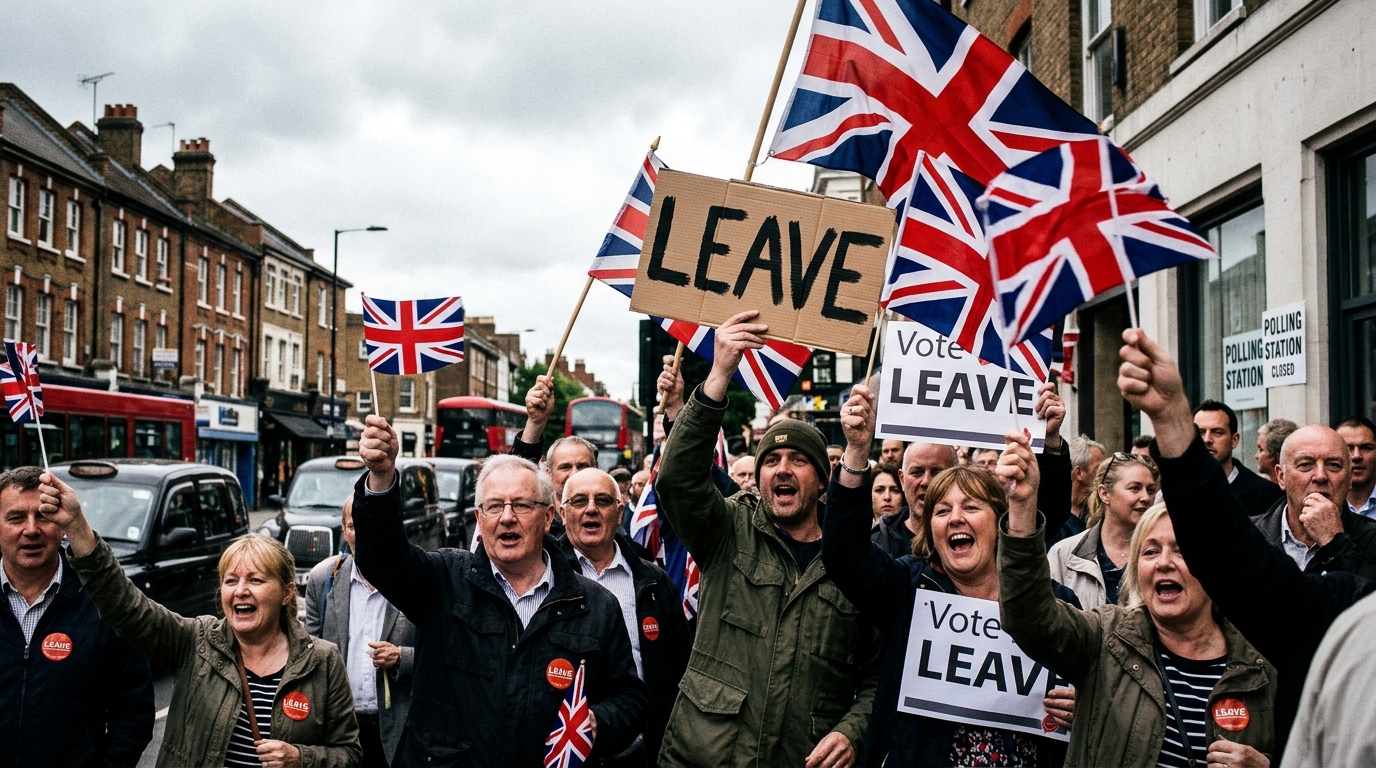
| February - June 2016 | Referendum Campaign Period | The "Vote Leave" and "Britain Stronger in Europe" campaigns officially launch. The debate intensifies, focusing on sovereignty, immigration, economic forecasts, and Britain's future global role. High-profile politicians, including Boris Johnson, declare for Leave. |
| June 16, 2016 | Jo Cox Murder | Labour MP Jo Cox, a strong Remain campaigner, is tragically murdered by a far-right extremist. The campaigning is temporarily suspended, and there are calls for a more civil and less divisive discourse. |
| June 23, 2016 | Referendum Day | The United Kingdom votes 51.9% to Leave (17,410,742 votes) versus 48.1% to Remain (16,141,241 votes). The turnout is 72.2%. |
| June 24, 2016 | Cameron Resigns; Global Market Reaction | In a televised address, Prime Minister David Cameron announces his resignation, stating the country requires new leadership to navigate the post-referendum landscape. Global financial markets react sharply, with the pound sterling plummeting to a 31-year low. |
| July 13, 2016 | Theresa May Becomes Prime Minister | Following a brief Conservative Party leadership contest, Theresa May, who had nominally supported Remain but was known as a reluctant Euroskeptic, assumes the premiership with the mandate to deliver Brexit. |
The campaign period, while technically beginning in early 2016, saw the formal designation of "Vote Leave" and "Britain Stronger in Europe" as the official entities responsible for campaigning. The rhetoric grew increasingly polarized and often acrimonious, moving from complex economic projections (the "Project Fear" narrative, as labelled by Leave campaigners) to existential debates regarding sovereignty, national identity, and the freedom of movement. The tragic assassination of MP Jo Cox during the final week underscored the intensity and potential dangers of the deeply emotional public discourse surrounding the vote.
Socio-Economic Undercurrents and Campaign Dynamics
The 2016 Brexit referendum was not merely a vote on EU membership; it was a deeply cathartic expression of underlying socio-economic grievances and cultural divides that had simmered for decades within British society. The campaign narratives, while seemingly focused on the EU, expertly tapped into these pre-existing tensions.
The Geography of Discontent
The voting patterns revealed a stark and enduring geography of discontent. Areas that voted most strongly to Leave were predominantly those that had experienced significant deindustrialization since the 1970s and 1980s: former coal mining communities, steel towns, and manufacturing hubs across the Midlands, the North of England, and parts of Wales. These regions often suffered from higher unemployment, lower educational attainment, and a sense of being "left behind" by globalization and successive governments. For many in these areas, the EU, with its free movement of labor and complex regulations, became a convenient scapegoat for local economic woes and a symbol of a distant, unaccountable elite.
Conversely, metropolitan centers like London, Edinburgh, Manchester, and Bristol, along with university towns and areas in the South East, voted overwhelmingly to Remain. These regions typically benefited from a globalized, service-based economy, attracting skilled workers and investment, and fostering more diverse, cosmopolitan populations. The divide was also heavily generational and educational: younger, university-educated voters were overwhelmingly in favor of Remain, while older, less formally educated voters predominantly backed Leave. This demographic split highlighted fundamental differences in outlook, opportunity, and identity.
Immigration as a Fulcrum
While economic arguments were central to both campaigns, the issue of immigration proved to be a decisive factor, particularly for the Leave side. The free movement of people, a core tenet of EU membership, had led to significant immigration to the UK, especially from Eastern European member states since 2004. While economists largely pointed to the net economic benefits of immigration, public concern about strain on public services, housing, and wages, alongside cultural anxieties, was widespread. The Leave campaign, spearheaded by UKIP and figures like Nigel Farage, capitalized on these fears with potent slogans like "Take Back Control" of borders, directly linking EU membership to uncontrolled immigration and a perceived loss of national sovereignty. This messaging resonated far more powerfully with segments of the electorate than the Remain campaign's often dry, data-driven arguments about GDP growth and market access.
Campaign Strategies: "Project Fear" vs. "Take Back Control"
The "Britain Stronger in Europe" (Remain) campaign, backed by the government, the Treasury, and numerous international organizations (IMF, OECD), focused heavily on the economic risks of leaving. They warned of immediate financial instability, recession, job losses, and damage to trade relationships—a strategy that Leave campaigners derided as "Project Fear." While factually robust, this approach struggled to connect emotionally with voters who felt disengaged from abstract economic statistics or were willing to accept short-term pain for long-term gains in sovereignty.
The "Vote Leave" campaign, despite internal divisions and fewer establishment endorsements, proved highly effective. It masterfully leveraged populist sentiment, tapping into a desire for national self-determination and a rejection of perceived bureaucratic overreach from Brussels. Beyond immigration, it also promised to redirect the UK's financial contributions to the EU (famously £350 million a week, a figure heavily disputed) towards the National Health Service (NHS). By framing the decision as one of democracy, sovereignty, and identity rather than purely economics, the Leave campaign bypassed rational calculations and appealed directly to a powerful sense of national pride and grievance, convincing many that leaving the EU was an opportunity to restore Britain's global standing and control its own destiny. The simplicity and emotional resonance of "Take Back Control" ultimately proved more compelling than the complex, often technical arguments for remaining.
Geopolitical Consequences and Aftermath
The result of the 2016 referendum did not immediately result in the UK's departure from the EU; rather, it triggered a protracted period of unprecedented domestic political paralysis, constitutional crisis, and diplomatic uncertainty. The necessity of invoking Article 50 of the Treaty on European Union meant that the government had to initiate a formal two-year negotiation process, the complexity of which was severely underestimated by the cabinet, parliament, and indeed, many of the Leave campaigners themselves. The subsequent three and a half years were dominated by tortuous negotiations with Brussels, deep divisions within parliament, and two general elections largely fought over the terms of Brexit.
The geopolitical consequences were immediate and far-reaching:
- Internal UK Fragmentation and Constitutional Strain: The referendum brought the divergent interests and national identities of the four constituent nations of the UK to the forefront, placing severe strain on the Union. Scotland, which voted decisively (62%) to remain in the EU, saw the Scottish National Party’s (SNP) argument for a second independence referendum gain significant momentum, citing a "democratic deficit" where Scotland was being taken out of the EU against its will. This re-energized Scottish nationalism and continues to be a major constitutional challenge. Similarly, the long-standing peace settlement in Northern Ireland, underpinned by the Good Friday Agreement, was thrown into jeopardy.
- The Northern Ireland Protocol and Border Friction: The status of the Irish border became the central, most intractable point of contention in negotiations. Both the UK and the EU were committed to avoiding a "hard border" on the island of Ireland to preserve peace and the cross-border economy. The eventual Withdrawal Agreement, negotiated under Boris Johnson, included the Northern Ireland Protocol, which effectively kept Northern Ireland aligned with the EU Single Market and Customs Union for goods. This created a de facto customs border in the Irish Sea, causing significant political friction with Unionist parties who felt it undermined Northern Ireland's place within the United Kingdom. It continues to be a source of tension and instability.
- Reconfiguration of Alliances and "Global Britain": Post-Brexit, the UK embarked on a foreign policy pivot, attempting to define itself as "Global Britain." This strategy aimed to cultivate stronger bilateral trade links and diplomatic relationships with countries in the Indo-Pacific region, the Commonwealth, and the United States, while simultaneously navigating a more difficult and often transactional diplomatic relationship with Brussels. The aspiration was to become a nimble, free-trading nation unburdened by EU regulations. However, the practical implementation has been challenging, with the benefits of new trade deals often overshadowed by the increased friction in trade with the EU, its largest and closest trading partner. The UK's global influence, particularly within European security and diplomatic structures, was undoubtedly altered, requiring a re-evaluation of its role on the world stage.
- Impact on the European Union: Brexit represented a significant blow to the European Union's project of ever-closer union, removing one of its largest economies and most militarily capable members. While it did not trigger a domino effect of other departures, it forced the EU to reconsider its internal cohesion, strengthen its remaining members' commitment, and demonstrate its resilience. The EU's negotiating stance throughout the Brexit process was largely driven by a desire to uphold the integrity of the Single Market and to deter further fragmentation.
International Reactions and the European Union's Response
The outcome of the Brexit referendum sent shockwaves across the globe, prompting immediate reactions from international partners and a firm, unified response from the European Union.
Global Reactions
United States: The US government, under President Barack Obama, had publicly advocated for the UK to remain in the EU, emphasizing the benefits of a strong UK within a unified Europe for transatlantic security and economic stability. Obama famously warned that a post-Brexit UK would be "at the back of the queue" for a trade deal. The Leave vote was therefore met with dismay in Washington, seen as a weakening of Western alliances at a time of growing geopolitical instability. Later, under President Donald Trump, the rhetoric shifted, with Trump praising Brexit as a sovereign act and offering enthusiastic support for a bilateral US-UK trade deal, though practical progress on such a deal proved elusive.
Other Major Powers: China, Russia, and other global powers observed the process with keen interest. China, a major trading partner, saw both potential new avenues for bilateral engagement with the UK and concerns about potential economic instability in Europe. Russia, often keen to exploit divisions within Western alliances, viewed Brexit as a potential weakening of NATO and the EU, aligning with its strategic objectives to fragment Western influence. Commonwealth nations, while offering expressions of solidarity, also recognized the complexities of forging new trade relationships that could genuinely offset the loss of EU market access.
Global Markets: Financial markets reacted with immediate volatility. The British pound sterling suffered one of its steepest daily falls in decades against the dollar and euro, plunging by over 10% in the immediate aftermath of the vote. Stock markets globally experienced significant dips, reflecting investor uncertainty about the future of the UK economy and the stability of the European project. While markets eventually stabilized, the sterling's devaluation had long-term implications for UK trade and purchasing power.
The European Union's Unified Front
The European Union's response to the Leave vote was characterized by a rapid consolidation of its 27 remaining members and a firm, consistent negotiating stance designed to protect the integrity of the Single Market and the foundational principles of the EU.
Principle of Indivisibility: From the outset, the EU leaders, notably Council President Donald Tusk, Commission President Jean-Claude Juncker, and Chief Negotiator Michel Barnier, emphasized that the four freedoms of the Single Market (free movement of goods, services, capital, and people) were indivisible. This meant the UK could not "cherry-pick" access to parts of the Single Market (e.g., for goods and services) while rejecting others (e.g., free movement of people), which was a key demand of the Leave campaign. This firm stance immediately challenged the UK's vision of a "bespoke" deal.
Orderly Withdrawal and Future Relationship: The EU prioritized an orderly withdrawal, focusing first on the "divorce bill" (financial settlement), citizens' rights (both EU citizens in the UK and UK citizens in the EU), and the Irish border. Only once sufficient progress was made on these withdrawal issues would negotiations on the future relationship (trade, security, etc.) commence. This structured approach, outlined in Article 50, put the onus on the UK to articulate its desired future relationship while adhering to EU principles.
Maintaining Unity: Despite initial fears that Brexit might encourage other member states to consider their own departures, the EU managed to maintain a remarkable degree of unity throughout the negotiations. Member states recognized the imperative to present a united front to avoid setting precedents that could undermine the Union. This unity often contrasted sharply with the deep divisions within the UK government and Parliament, giving the EU a significant advantage at the negotiating table. The experience of Brexit ultimately strengthened the resolve of the remaining 27 members to address internal challenges and reinforce the benefits of their collective membership.
Analysis of Key Actors and Decisive Actions
The 2016 referendum was shaped by the decisions and actions of a limited number of powerful figures, each driven by distinct motivations and political calculations. Their roles were pivotal in both precipitating the vote and influencing its outcome.
David Cameron: The Architect of the Gambit
David Cameron’s decision to hold the referendum is widely viewed by historians and political analysts as one of the most consequential strategic miscalculations in modern British political history. His intent was multifaceted: to manage and ultimately silence the "banging of the drums" from the increasingly powerful Euroskeptic right wing of his Conservative Party, to stem the flow of voters to Nigel Farage’s UKIP, and, crucially, to secure a majority in the 2015 general election. He genuinely believed he could win a Remain vote, as his predecessor Harold Wilson had in 1975, and thereby resolve the divisive "Europe question" for a generation.
Cameron campaigned for Remain with the full machinery of the state behind him, supported by figures like Chancellor George Osborne and warnings from international bodies. However, his failure to effectively counter the sovereignty-focused, anti-establishment narrative of the opposition meant that he lost control of the national discourse. His renegotiation with the EU in early 2016, designed to show Britain could secure a better deal, was largely perceived as underwhelming and "cosmetic" by the public, further weakening his position. His subsequent resignation on the morning after the vote, reflecting his deep personal conviction and responsibility for the outcome, plunged the country into immediate leadership uncertainty.
Boris Johnson: The Catalyst for Leave
Boris Johnson’s decision to endorse the Leave campaign provided a vital and arguably indispensable boost to the cause. As a popular, charismatic, and often unconventional former Mayor of London, his endorsement lent institutional credibility and mainstream appeal to an otherwise anti-establishment movement. His announcement, coming just days after Cameron's EU renegotiation deal, significantly weakened the Remain campaign's narrative of a "reformed" EU.
Johnson, often seen as a political opportunist, positioned himself as a figurehead for a revitalized, independent United Kingdom. By consciously pivoting away from the standard economic arguments of the Treasury, which largely favored Remain, he focused instead on emotive themes of sovereignty, democracy, and a romanticized vision of Britain freed from Brussels bureaucracy. His enthusiastic and often theatrical campaigning style, coupled with his ability to connect with voters outside traditional Conservative strongholds, was instrumental in swaying undecided voters and mobilizing the Leave base. His role cemented his position as a frontrunner for future leadership, a path he would eventually take.
Nigel Farage: The Outsider Influence and Ideological Driver
While not part of the official Conservative government or directly leading the "Vote Leave" campaign, Nigel Farage was undeniably the ideological driver and a relentless public face of the referendum movement for decades. As leader of the UK Independence Party (UKIP), he relentlessly kept the issues of mass migration, EU bureaucracy, and the erosion of national sovereignty on the front pages and at the forefront of public debate.
Farage transformed what was once a fringe concern into a mainstream political imperative. His populist rhetoric, often delivered with a pint in hand, resonated with many voters who felt ignored by the political establishment. By continuously pushing the boundaries of political discourse on immigration and "taking back control," he created the political environment in which Cameron felt compelled to call a referendum. His distinct, often provocative, communication style and ability to mobilize a dedicated base of supporters made him a powerful force, effectively setting the agenda for much of the Leave campaign's core messaging. His influence, more than any other, highlights the long-term impact of sustained populist pressure on mainstream politics.
Other Significant Figures:
- George Osborne: As Chancellor of the Exchequer, Osborne was a leading voice for the Remain campaign, spearheading "Project Fear" with dire warnings about the economic consequences of leaving. His highly technical arguments, though often statistically robust, failed to resonate with a public increasingly wary of expert consensus.
- Michael Gove: A senior Conservative minister and prominent intellectual voice within the Leave campaign, Gove articulated a philosophical case for leaving, arguing that "people in this country have had enough of experts" and that Britain could thrive independently. His participation gave the Leave campaign significant credibility within establishment circles.
- Theresa May: As Home Secretary, May cautiously backed Remain but kept a low profile during the campaign. Her subsequent elevation to Prime Minister after Cameron’s resignation underscored her reputation for stability and duty, but her premiership would be entirely consumed by the intractable challenge of delivering Brexit.
"The Brexit vote was the moment the British people decided to take back control, to be masters of their own destiny, and to end the political status quo." — Nigel Farage, June 2016. This statement encapsulates the core emotional appeal that ultimately carried the Leave campaign to victory.
Modern Historiographical Debates
Years after the vote and the UK's formal departure from the European Union, the Brexit referendum remains a fertile ground for intense historiographical debate. Scholars, economists, and political scientists continue to grapple with its causes, consequences, and long-term implications, often re-evaluating initial assumptions and predictions.
The Inevitability vs. Contingency Debate
One central debate revolves around whether Brexit was an inevitable outcome of long-standing British Euroskepticism or a contingent event driven by specific political choices and campaign dynamics. Some historians argue that the UK's ambivalent relationship with Europe, rooted in its imperial past, unique legal system, and pragmatic approach to the EEC, made a rupture almost preordained. They point to the consistent strain within the Conservative Party, the 1975 referendum, Thatcher's Bruges speech, and the rise of UKIP as evidence of a deep-seated national identity crisis relative to Europe.
Conversely, others emphasize the contingency of the 2016 vote. They highlight David Cameron's strategic miscalculation in calling the referendum, the tactical brilliance (or ruthlessness) of the Leave campaign, the timing amidst austerity and the refugee crisis, and the failure of the Remain campaign to mobilize its base. They argue that a different leader, a different campaign, or even a slightly different economic climate could have produced a different result, suggesting that the outcome was not a historical inevitability but rather a critical juncture shaped by specific political agency and chance.
The Role of Economic Grievances vs. Cultural Identity
Another key area of contention is the relative importance of economic grievances versus issues of cultural identity, sovereignty, and immigration. Early analyses often emphasized the socio-economic divisions, linking the Leave vote to areas of deindustrialization and economic hardship. Scholars continue to examine how the perceived failures of globalization, regional inequalities, and austerity policies created a fertile ground for anti-establishment sentiment, which Brexit tapped into.
However, a growing body of work underscores the powerful role of identity politics. Many argue that concerns about national sovereignty, democratic control, and cultural change (particularly related to immigration) were more potent motivators than purely economic calculations. For many Leave voters, the economic costs were acceptable if it meant "taking back control" of borders and laws, and reasserting a particular vision of British nationhood. This debate is crucial for understanding the enduring appeal of populist movements beyond the UK.
Long-Term Economic and Social Impact
Academics continue to scrutinize the long-term economic and social consequences of Brexit. While the initial economic shocks were less severe than some "Project Fear" warnings, the persistent drag on UK productivity, trade, and investment is a subject of ongoing research. Debates focus on whether Brexit has exacerbated regional inequalities, impacted specific sectors more severely, or genuinely opened up new global opportunities. Socially, the referendum exposed and arguably deepened existing divisions within British society, leaving a legacy of polarization that continues to manifest in political discourse and cultural identity. The impact on Northern Ireland, the future of the Union, and the UK's international standing remain dynamic areas of study, with no consensus yet reached on Brexit's ultimate success or failure.
Trivia and Lesser-Known Facts
- Turnout and Engagement: The 72.2% turnout was not only the highest for any UK-wide vote since the 1992 General Election but also surpassed the 1975 EEC referendum turnout (64.6%). This demonstrated the sheer depth of public engagement and passion the debate ignited across the country.
- The £350 Million Bus: The "Vote Leave" campaign's most recognizable symbol was arguably the red bus emblazoned with the claim that the UK sent £350 million a week to the EU, which could instead be spent on the NHS. This figure became a symbolic lightning rod for debates regarding the veracity of claims made during the campaign and the role of misinformation in modern political discourse. It was widely debunked as misleading, as it did not account for the UK’s rebate or the money the UK received back from the EU.
- Economic Forecasts vs. Reality: While the Treasury and numerous international bodies predicted an immediate and severe recession following a Leave vote, the UK economy initially proved more resilient than forecasted in the immediate aftermath. However, the long-term impact on productivity, foreign direct investment, and trade remained a subject of intense academic and economic scrutiny, with many studies later pointing to a persistent drag on economic growth.
- Generational and Educational Divide: The voting patterns revealed a striking age-related split; younger voters (18–24) voted overwhelmingly (around 75%) for Remain, while those over 65 provided the bedrock of support for the Leave campaign (around 60%). Similarly, a clear correlation existed between higher levels of education and a Remain vote, versus lower levels of formal education and a Leave vote.
- The "Leave" Vote Was Not Always Expected: Polls leading up to the referendum were notoriously close, with a slight lean towards Remain in the final days. The outcome on June 23rd, particularly the margin of victory for Leave, surprised many commentators, political analysts, and financial markets, highlighting the limitations of polling in capturing the nuances of public sentiment in highly emotional elections.
- A Referendum Without a Plan: One of the most significant criticisms leveled against the Leave campaign and the government was the lack of a detailed plan for what leaving the EU would entail. There was no agreed-upon blueprint for trade relations, border arrangements, or the legal ramifications, plunging the UK into a prolonged period of uncertainty and complex negotiations.
The 2016 Brexit referendum remains a landmark study in political communication, systemic rupture, and the intricate interplay of historical legacies, socio-economic grievances, and national identity. It profoundly challenged the assumption that European integration was an irreversible process and undeniably proved that democratic legitimacy in the 21st century remains deeply tied to concepts of national sovereignty and regional identity, often overriding purely economic considerations. Its reverberations continue to shape the UK and the wider geopolitical landscape.
References and Literature
- The British Politics of Brexit (Oxford University Press) - A comprehensive analysis of the political processes, cabinet dynamics, and underlying historical currents that led to the 2016 referendum and its aftermath.
- UK Parliament Archives: European Union Referendum - Official record of the legislation, debates, and public documents related to the 2016 vote and its parliamentary implications.
- The LSE Brexit Blog - An academic repository of analytical papers, commentaries, and research regarding the social, economic, and political impact of the 2016 referendum outcome.
- The European Council - Brexit Timeline - The institutional view of the negotiations and the constitutional requirements for withdrawal from the European Union.
- Goodwin, M., & Heath, O. (2016). The Referendum: Why did Britain Vote to Leave the European Union? London: Biteback Publishing. - An early and influential analysis of the voting demographics and motivations behind the Leave vote.
- Denham, S., & Garnett, M. (2018). The British General Election of 2017. London: Palgrave Macmillan. - While focused on the 2017 election, this book provides crucial context on the immediate political fallout and leadership changes post-referendum.
Footnotes & Explanations
- The Bloomberg Speech of 2013 is widely considered the "point of no return" for the Conservative Party regarding EU membership, as it formally committed the party to a referendum pledge. ↩
- The term "Project Fear" was a pejorative label used by the Leave campaign to dismiss economic warnings from international organizations like the IMF, the Bank of England, and the UK Treasury, framing them as attempts to scare voters rather than present objective analysis. ↩