Key Takeaways
- The 1961 Belgrade Conference formally established the Non-Aligned Movement (NAM), offering a diplomatic third path for nations refusing to join NATO or the Warsaw Pact.
- The conference was driven by the collaborative efforts of Josip Broz Tito, Gamal Abdel Nasser, Jawaharlal Nehru, Sukarno, and Kwame Nkrumah.
- The summit took place during a period of intense Cold War anxiety, marked by the Berlin Crisis and the resumption of Soviet nuclear testing, which shifted the conference's focus toward global peace and disarmament.
Historical Context and Origins
The geopolitical landscape of the late 1950s and early 1960s was characterized by a rigid, bipolar international order. The United States and the Soviet Union had divided the world into competing spheres of influence, enforced by powerful military alliances: the North Atlantic Treaty Organization (NATO) and the Warsaw Pact. For newly independent nations emerging from the collapse of European colonial empires in Asia and Africa, this polarization posed a profound dilemma. Acceptance of military patronage from either superpower often meant sacrificing hard-won sovereignty, while complete isolation left them vulnerable to economic pressure and covert intervention.
The ideological foundation of a "third way" began to take shape at the Bandung Conference of 1955 in Indonesia 1. Organized by the leaders of Burma, Ceylon (Sri Lanka), India, Indonesia, and Pakistan, Bandung gathered 29 Asian and African countries to discuss anti-colonialism, economic development, and cultural cooperation. However, Bandung was a regional gathering rather than a cohesive ideological bloc. It included countries that were openly aligned with the West (such as Turkey and the Philippines) as well as communist China.
To transform the spirit of Bandung into a global diplomatic instrument, a narrower, more defined concept of "non-alignment" was required. The catalyst for this transformation came from an unlikely source: socialist Yugoslavia. Following the Tito-Stalin split of 1948, Yugoslavia found itself expelled from the Soviet bloc and facing intense pressure from Moscow. Unwilling to join NATO, Yugoslav President Josip Broz Tito sought alternative diplomatic alliances outside of Europe.
In July 1956, Tito hosted Indian Prime Minister Jawaharlal Nehru and Egyptian President Gamal Abdel Nasser on the Adriatic island of Brijuni. The resulting Brioni Declaration asserted that the division of the world into antagonistic military blocs was a major obstacle to international peace and security. This meeting cemented the triumvirate of Tito, Nehru, and Nasser as the intellectual and political architects of non-alignment 2.
| Date / Event | Significance |
|---|---|
| 1955 Bandung Conference | Afro-Asian Solidarity |
| 1956 Brioni Declaration | Tito, Nehru, and Nasser |
| June 1961 Cairo Prep-Meeting | Strict criteria defined |
| Sept 1961 Belgrade Conference | Formal creation of the NAM |
By 1960, the international situation had grown increasingly precarious. The decolonization of Africa reached its peak, with 17 nations gaining independence in 1960 alone (the "Year of Africa"). Concurrently, the Cold War intensified with the U-2 spy plane incident, the collapse of the Paris Summit, and the erupting crisis in the Congo.
In September 1960, during the 15th Session of the United Nations General Assembly in New York, Tito, Nasser, Nehru, Sukarno (President of Indonesia), and Kwame Nkrumah (President of Ghana) met to draft a joint resolution calling on the US and Soviet leaders to resume negotiations. Though the resolution failed to pass due to superpower maneuvering, it demonstrated the potential of a unified, non-aligned bloc. The stage was set for a formal gathering of these nations, which was finalized at a preparatory meeting in Cairo in June 1961.
Timeline of Events and Key Moments
The Belgrade Conference of September 1961 did not occur in a vacuum; it was preceded by meticulous diplomatic groundwork and took place amidst one of the most dangerous periods of the Cold War.
The Preparatory Phase: Cairo (June 5–12, 1961)
Sponsored jointly by Yugoslavia, India, and the United Arab Republic (Egypt), a preparatory meeting was convened in Cairo to establish the criteria for invitation to the Belgrade summit. The delegates wrestled with the definition of "non-alignment." Some argued for a broad inclusion of all developing nations, while others insisted on strict anti-imperialist and anti-alliance standards. Ultimately, they settled on five core criteria that disqualified any country participating in Cold War military alliances (such as SEATO, CENTO, or the Rio Treaty) or hosting superpower military bases.
August 1961: The Berlin Crisis Escalates
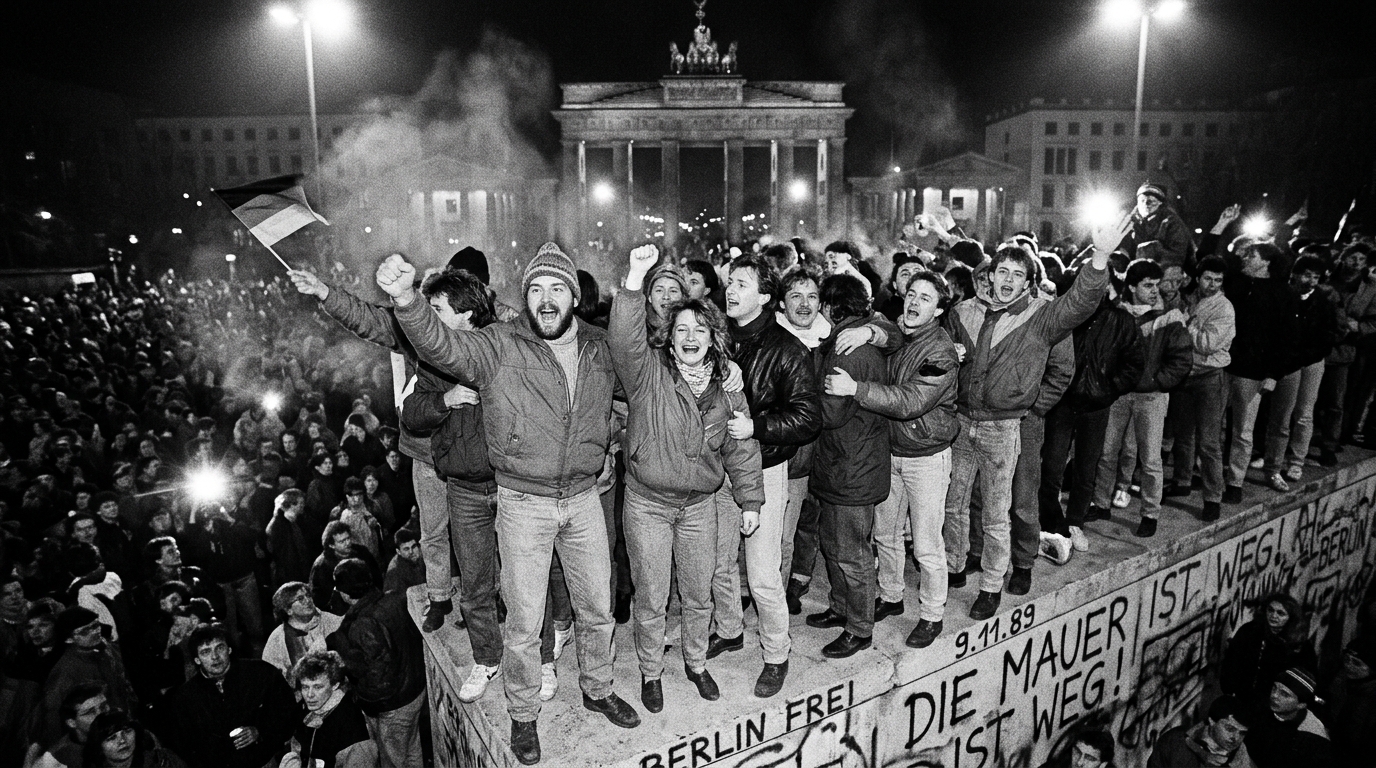
On August 13, 1961, just weeks before the Belgrade Conference was scheduled to begin, East German authorities began constructing the Berlin Wall. The crisis pushed East-West tensions to a fever pitch. On August 31—the eve of the conference—the Soviet Union announced it would end its unilateral moratorium on nuclear testing, planning a series of atmospheric nuclear detonations. This confrontational backdrop profoundly altered the tone of the Belgrade gathering, shifting the primary focus from regional anti-colonial struggles to the prevention of global thermonuclear war.
September 1, 1961: The Opening Ceremony
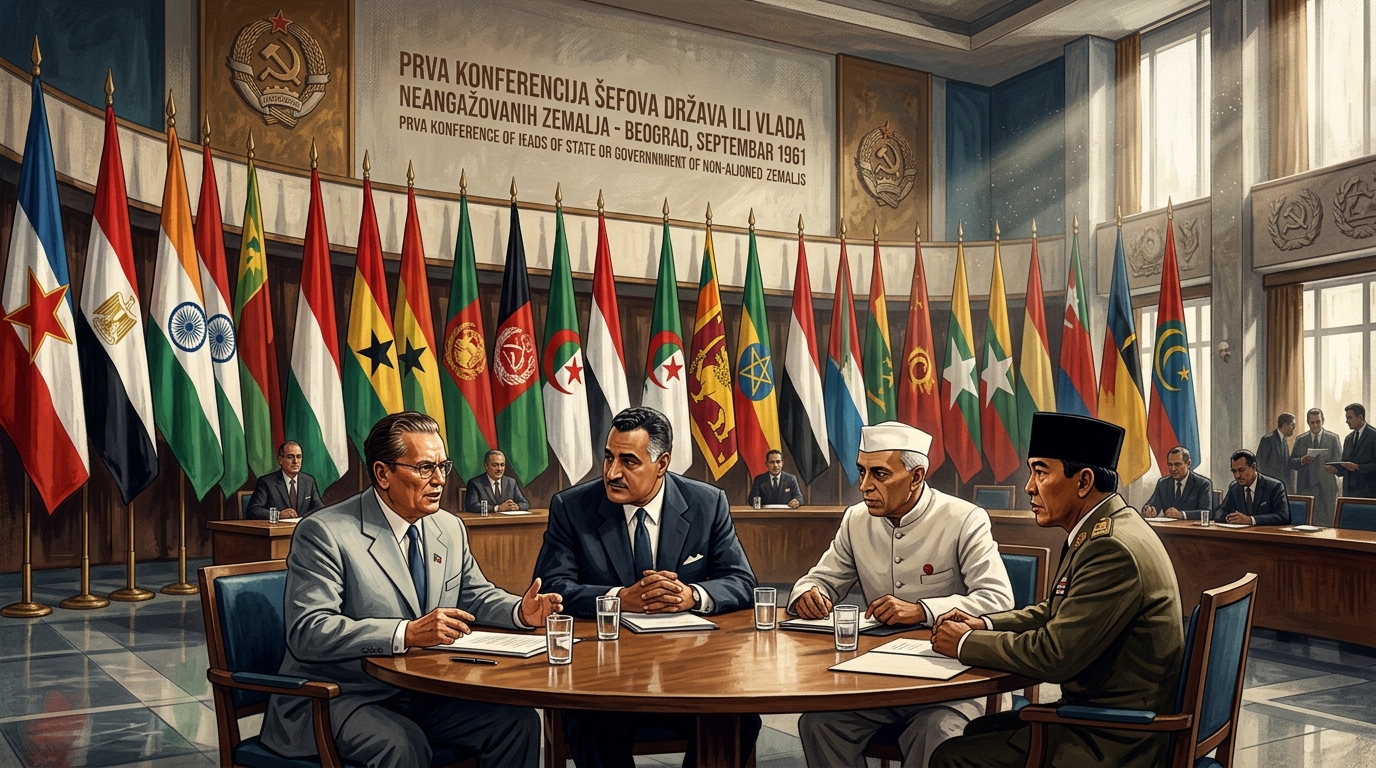
The First Conference of Heads of State or Government of Non-Aligned Countries opened in the main chamber of the Federal Assembly building in Belgrade. Representatives from 25 sovereign states attended as full participants, alongside observers from three Latin American countries (Bolivia, Brazil, and Ecuador) and various national liberation movements.
President Tito delivered the welcoming address, emphasizing that the non-aligned nations did not seek to form a "third bloc" but rather to dismantle the very logic of bloc politics.
"The concept that coexistence in the international field affects only the relations between the Great Powers is incorrect... The non-aligned countries do not wish to form a new bloc. They wish to be a factor of peace, to be a bridge between the existing blocs." [^3] — Josip Broz Tito, September 1, 1961
September 2–4, 1961: Ideological Debates and Polarization
Behind the scenes, the conference faced significant ideological divisions regarding the prioritization of global issues:
- The Anti-Colonialist Faction: Led by Sukarno of Indonesia and Kwame Nkrumah of Ghana, this group argued that imperialism and colonialism were the root causes of global instability. They pushed for aggressive, immediate timelines for the eradication of colonial rule in Africa and Asia. Sukarno famously declared that "peace is impossible as long as colonialism exists in any form."
- The Globalist Faction: Led by Jawaharlal Nehru of India, this faction argued that the threat of nuclear war overshadowed all other issues, including colonialism. Nehru contended that if the superpowers went to war, all local gains in independence would be obliterated. He urged the conference to focus its diplomatic weight on de-escalating the US-Soviet standoff.
| Anti-Colonialist Priority (Sukarno, Nkrumah, Touré) | Globalist Priority (Nehru, Nasser) |
|---|---|
| Focus: Eradication of imperialism | Focus: Nuclear disarmament |
| Belief: Colonialism is the primary source of global instability | Belief: Superpower war threatens all of humanity |
| Solution: Support armed struggle and immediate decolonization | Solution: Immediate dialogue and diplomatic mediation |
- The Middle Ground: Gamal Abdel Nasser of Egypt and Tito of Yugoslavia worked to bridge these positions, integrating the struggle against neo-colonialism with the broader campaign for peaceful coexistence and disarmament.
September 5, 1961: The Appeal for Peace
Recognizing the urgency of the Berlin Crisis, the conference adopted a special document titled "An Appeal for Peace." This document was sent directly to US President John F. Kennedy and Soviet Premier Nikita Khrushchev. The appeal urged both leaders to immediately suspend military preparations and engage in direct negotiations to avert a global catastrophe.
To ensure the message was received with due gravity, the conference dispatched high-level diplomatic missions: Nehru and Nkrumah traveled to Moscow to meet with Khrushchev, while Sukarno and President Modibo Keïta of Mali traveled to Washington to meet with Kennedy.
September 6, 1961: Adoption of the Belgrade Declaration
On the final day of the conference, the delegates unanimously adopted the Belgrade Declaration, a 27-point manifesto that laid down the foundational principles of the Non-Aligned Movement. The declaration demanded:
- The immediate and unconditional eradication of colonialism, neo-colonialism, and imperialism.
- The prohibition of nuclear weapons testing and the initiation of general and complete disarmament.
- The right of all nations to self-determination and to choose their own social and political systems without foreign interference.
- The restructuring of international economic relations to address the widening gap between developed and developing nations.
- The expansion and democratization of the United Nations Security Council and General Assembly to reflect the growing number of African and Asian members.
Geopolitical Consequences and Aftermath
The Belgrade Conference represented a structural shift in the architecture of international relations. For the first time, a large coalition of sovereign states from Europe, Asia, Africa, and Latin America had formally rejected the binary logic of the Cold War, establishing what became known as the Non-Aligned Movement (NAM) 4.
Short-Term Superpower Reactions
The immediate reactions of the United States and the Soviet Union to the Belgrade Conference were mixed, characterized by public skepticism and private concern:
- The United States: The Kennedy administration was initially highly suspicious of the conference, viewing non-alignment as a form of moral relativism that favored the Soviet Union. Washington was particularly disappointed that the Belgrade Declaration did not forcefully condemn the Soviet resumption of nuclear testing. However, Kennedy's administration soon recognized that pushing these nations too hard would only drive them closer to Moscow, leading to a more nuanced, aid-based engagement strategy.
- The Soviet Union: Nikita Khrushchev publicly welcomed the conference's anti-colonialist declarations, hoping to harness the movement as a vehicle for anti-Western sentiment. However, the Kremlin was deeply irritated by the conference's insistence on treating the US and USSR as equally responsible for global tensions, as well as Yugoslavia's leadership role in the movement, which challenged Moscow's ideological monopoly on the socialist world.
Institutionalization and Expansion
Although the founders of NAM initially resisted building a rigid bureaucratic apparatus—fearing it might devolve into a third military or political bloc—the movement gradually institutionalized. The Belgrade Conference established a pattern of periodic summits of Heads of State or Government, which would be hosted by different member states:
- Cairo (1964): Expanded the membership to 47 nations, focusing heavily on economic development and the trade imbalances of the developing world.
- Lusaka (1970): Formalized the organizational structure of NAM, establishing a coordinating bureau and defining the role of the host nation's leader as the "Chairperson-in-Office" of the movement.
- Algiers (1973): Marked the height of NAM's radical economic phase, leading directly to the United Nations adopting the declaration on the New International Economic Order (NIEO), which aimed to restructure global trade, finance, and technology transfer systems.
| Conference | Member States | Key Focus / Characteristics |
|---|---|---|
| Belgrade (1961) | 25 | Foundational Declaration |
| Cairo (1964) | 47 | Economic focus; Anti-colonialism |
| Lusaka (1970) | 53 | Institutionalized structure established |
| Algiers (1973) | 75 | Demanded the NIEO |
Challenges, Internal Divisions, and the Legacy of the Movement
As NAM grew, maintaining ideological cohesion became increasingly difficult. The movement was highly diverse, encompassing communist states (Yugoslavia, Cuba), pro-Western monarchies (Ethiopia, Saudi Arabia), parliamentary democracies (India), and military dictatorships.
Internal conflicts frequently tested the movement's principles:
- The Sino-Indian War of 1962 shattered Nehru's vision of Asian solidarity and forced India to seek military assistance from both the US and the USSR, undermining its non-aligned stance.
- The Soviet invasion of Afghanistan in 1979 caused a deep rift within the movement. Cuba, which chaired NAM at the time, attempted to portray the Soviet Union as the "natural ally" of the non-aligned countries, a position fiercely resisted by Yugoslavia, Singapore, and Pakistan.
Despite these challenges, NAM provided a crucial diplomatic shield for developing nations. It successfully shifted the agenda of the United Nations toward decolonization, disarmament, and global economic justice, establishing the Group of 77 (G77) in 1964 to coordinate the negotiating capacity of developing nations in UN forums 5.
Analysis of Key Actors and Decisive Actions
The success of the Belgrade Conference depended heavily on the political capital, personal chemistry, and distinct strategic calculations of its core leaders. Each of the "Big Four" brought unique domestic and regional imperatives to Belgrade, shaping the character of the emerging movement.
Josip Broz Tito: The Strategic Host
For Josip Broz Tito, the Belgrade Conference was a triumph of survival and prestige. Having broken with Stalin in 1948 and rejected Western political integration, Tito needed an international platform to guarantee Yugoslavia's security. By positioning Belgrade as the capital of the non-aligned world, Tito achieved several critical goals:
- He elevated Yugoslavia from a vulnerable, isolated Balkan state to a global diplomatic player.
- He demonstrated that socialism could exist outside of Soviet control, creating an alternative model of "independent" socialism.
- He fostered extensive economic ties with Asian and African nations, providing lucrative markets for Yugoslav construction and manufacturing firms.
Gamal Abdel Nasser: The Voice of Arab Nationalism
Gamal Abdel Nasser utilized non-alignment to advance his vision of Pan-Arabism and to protect Egypt from the fallout of Cold War rivalries. Having successfully navigated the Suez Crisis of 1956, Nasser understood how to play the superpowers against each other to secure development aid, such as Soviet funding for the Aswan High Dam. For Nasser, Belgrade was an opportunity to assert leadership over the Middle East and Africa, framing non-alignment as a weapon against Zionist influence, British/French neo-colonialism, and regional conservative monarchies.
Jawaharlal Nehru: The Philosophical Architect
Unlike the pragmatic Tito and the fiery Nasser, Jawaharlal Nehru approached non-alignment through a philosophical lens. Influenced by Mahatma Gandhi’s philosophy of non-violence and his own intellectual formation, Nehru conceived non-alignment as a moral imperative rather than a tactical alliance. He argued that the newly independent nations possessed a unique "moral force" that could heal the divisions of the Cold War.
At Belgrade, Nehru acted as a stabilizing force, persistently steering the conference away from aggressive, confrontational rhetoric and toward constructive diplomatic engagement with the United States and the Soviet Union. His contribution, the Panchsheel (Five Principles of Peaceful Coexistence), served as the intellectual blueprint for the Belgrade Declaration 6.
Sukarno: The Anti-Imperialist Orator
President Sukarno of Indonesia viewed the Belgrade Conference as a global stage to prosecute his revolutionary struggle against imperialism, which he termed the "Old Established Forces" (OLDEFOS). Sukarno argued that the primary division in the world was not between capitalism and communism, but between the colonizers and the colonized.
His fiery rhetoric at Belgrade polarized the conference, but it resonated deeply with nations still fighting for liberation, such as Algeria, Angola, and Mozambique. Sukarno's focus on anti-colonial agitation contrasted with Nehru’s emphasis on global peace, creating a productive tension that ultimately yielded a more comprehensive final declaration.
| Leader | Core Contribution & Ideological Drive |
|---|---|
| Josip Broz Tito | Provided the European bridge, physical venue, and strategic organization; sought security post-1948. |
| Gamal Abdel Nasser | Leveraged Arab nationalism and Middle Eastern regional influence; integrated anti-colonialism with aid. |
| Jawaharlal Nehru | Intellectual architect of peaceful coexistence and disarmament; focused on preventing nuclear war. |
| Sukarno | Champion of aggressive anti-imperialism; framed global struggle as colonizers vs. colonized. |
Trivia and Lesser-Known Facts
- Belgrade's Urban Transformation: In preparation for the summit, the city of Belgrade underwent a massive modernization campaign. Over 40 major construction projects were completed in just a few months, including the paving of central streets, the renovation of hotels, and the installation of modern street lighting. A prominent monument, the Belgrade Obelisk, was erected near the Branko Bridge to symbolize the rise of the non-aligned nations.
- The Park of Friendship: During the conference, a special park, the Park of Friendship (Park Prijateljstva), was inaugurated in Novi Beograd. Every visiting head of state planted a plane tree (Platanus) as a symbol of peace and mutual respect. Today, many of these trees, planted by figures such as Nehru, Nasser, Tito, and Haile Selassie, still stand.
- The Question of Algerian Representation: One of the most sensitive issues at the conference was the representation of Algeria. The Algerian National Liberation Front (FLN) had established a Provisional Government of the Algerian Republic (GPRA), which was actively waging a war of independence against France. Despite intense French diplomatic pressure, Yugoslavia officially recognized the GPRA during the conference, making it the first European state to do so. This move provoked outrage in Paris but solidified Tito’s revolutionary credentials among African delegates.
- The Diverse Security Detail: Yugoslav security services (UDBA) implemented unprecedented protection measures, coordinating with the intelligence services of 25 participating nations. Because some heads of state, like Emperor Haile Selassie of Ethiopia, brought their own personal royal guards, the hallways of Belgrade's hotels featured a colorful mix of military uniforms, traditional attire, and security personnel from across four continents.
- A "Non-Aligned" Menu: The gala banquets hosted by President Tito at the Federal Executive Council building (SIV) featured a carefully curated menu designed to accommodate the diverse religious, cultural, and dietary requirements of the delegates. Traditional Balkan dishes were served alongside halal, kosher, and vegetarian options, ensuring that culinary differences did not disrupt the delicate diplomatic harmony.
References and Literature
- The Non-Aligned Movement: Genesis, Organization and Politics (1961-1987) - A comprehensive academic study of the political evolution and structural dynamics of the movement from its inception to the late Cold War.
- The Belgrade Conference of Non-Aligned Countries, September 1-6, 1961 - Contemporary diplomatic analysis of the summit published by Foreign Affairs shortly after the event.
- The Third World Project - Archives of the Non-Aligned Movement - Historical journal article exploring the strategic alignments and decolonization efforts stemming from the 1961 summit.
- Yugoslavia's Non-Alignment and the Cold War - A detailed analysis of how Josip Broz Tito utilized non-aligned diplomacy to safeguard Yugoslav independence and carve out a global role.
Footnotes & Explanations
- The Bandung Conference of April 1955 brought together 29 Asian and African countries to promote Afro-Asian economic and cultural cooperation and to oppose colonialism. ↩
- The Brioni Meeting of July 18–19, 1956, is widely recognized as the ideological birthplace of non-alignment, where Tito, Nehru, and Nasser formulated the principles that would later guide the Belgrade Conference. ↩
- Address by Josip Broz Tito at the opening session of the Belgrade Conference, September 1, 1961. Belgrade: Official Publication of the Conference, 1961. ↩
- The Non-Aligned Movement (NAM) grew from the initial 25 participants in Belgrade to 120 member states by the 21st century, representing more than half of the world's population. ↩
- Established in 1964, the Group of 77 (G77) at the United Nations was designed to promote collective economic interests and create joint negotiating capacity for developing countries. ↩
- The Five Principles of Peaceful Coexistence (Panchsheel) were first formally codified in the 1954 agreement between India and China, later serving as a cornerstone of the NAM philosophy. ↩