Key Takeaways
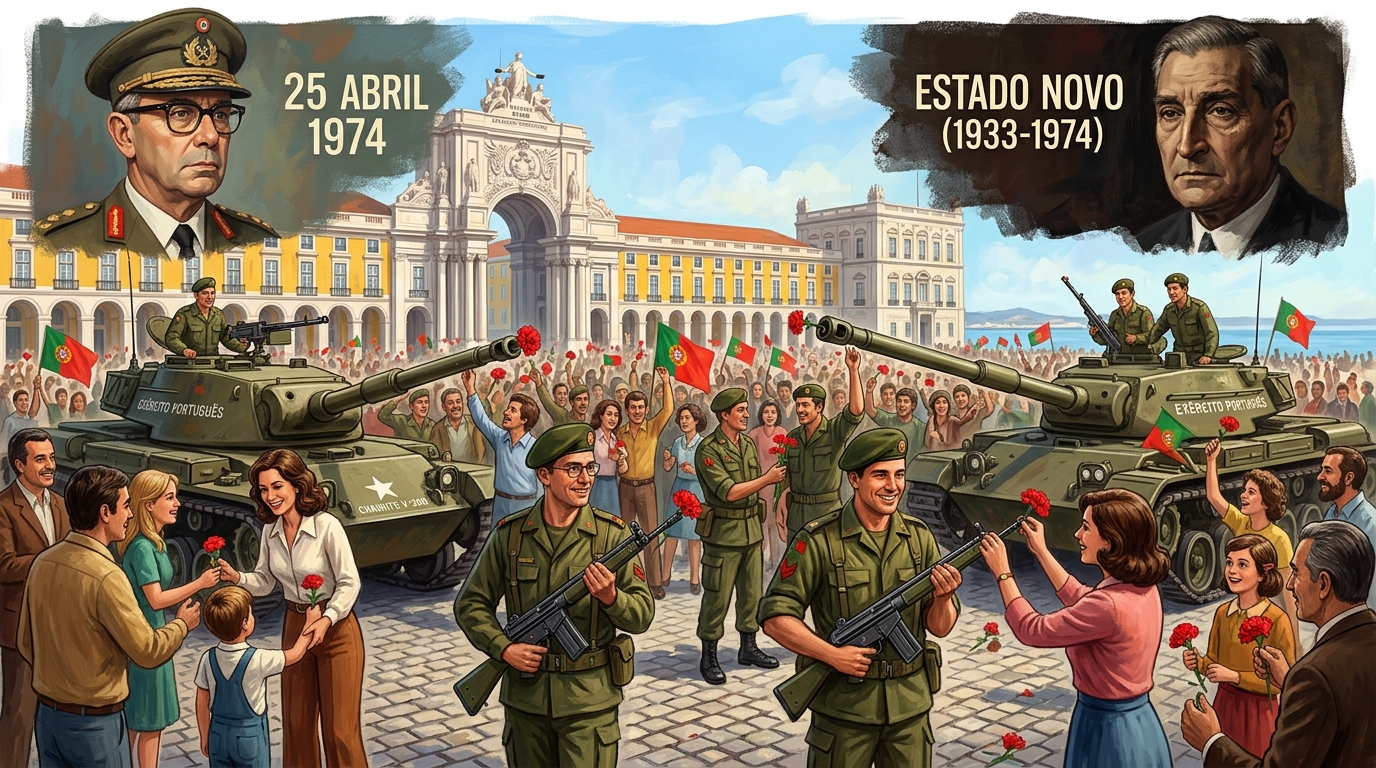
- The coup of April 25, 1974, organized by the clandestine Movimento das Forças Armadas (MFA), brought an end to 41 years of the authoritarian Estado Novo dictatorship.
- The primary catalyst for the revolution was the protracted and financially draining Portuguese Colonial War in Angola, Mozambique, and Guinea-Bissau.
- The transition transformed global geopolitics by triggering the immediate decolonization of Portugal's African empire and shifting the Cold War balance in Southern Africa.
On April 25, 1974, a nearly bloodless military coup in Lisbon permanently dismantled Europe’s longest-surviving right-wing dictatorship: the Estado Novo (New State). This event, known globally as the Carnation Revolution (Revolução dos Cravos), did not merely alter the domestic landscape of Portugal; it fundamentally reordered the geopolitical dynamics of Southern Africa and marked the beginning of what political scientist Samuel P. Huntington termed the "Third Wave" of global democratization. This detailed analysis explores the structural causes, tactical progression, and far-reaching global consequences of this historic transition.
Historical Context and Origins
To understand the sudden collapse of the Portuguese regime in 1974, one must examine the institutional framework of the Estado Novo, established by António de Oliveira Salazar in 1933. Salazar’s regime was characterized by authoritarianism, corporatism, state-enforced Catholicism, and a fierce commitment to preserving Portugal's colonial empire (termed "pluricontinentalism").1 Through the use of the ruthless secret police, the PIDE (later renamed DGS), censorship, and political imprisonment, the regime maintained an iron grip on domestic dissent for decades.
The Colonial War: A Structural Catalyst
By the early 1960s, as British, French, and Belgian empires rapidly decolonized, Portugal chose a diametrically opposed path. Salazar insisted that the overseas territories in Africa—primarily Angola, Mozambique, and Portuguese Guinea (now Guinea-Bissau)—were not colonies but rather "overseas provinces" integral to the Portuguese nation.
This refusal to decolonize triggered the Portuguese Colonial War (Guerra Ultramarina) in 1961. For thirteen years, Portugal fought simultaneous counter-insurgency campaigns against nationalist liberation movements, including:
- The MPLA, FNLA, and UNITA in Angola.
- The FRELIMO in Mozambique.
- The PAIGC in Guinea-Bissau.
By the early 1970s, the human and economic toll of these wars had become unsustainable. Nearly 40% of Portugal's national budget was swallowed by military spending.2 Conscription was mandatory for young men, leading to massive emigration—often illegal—as hundreds of thousands fled to France, Germany, and the Americas to escape the draft.
The Marcelist Spring That Never Was
When Salazar suffered a debilitating stroke in 1968, he was succeeded by Marcello Caetano. Caetano initially promised mild liberalization—a period known as the Primavera Marcelista (Marcelist Spring). However, pressured by hardline elements within the regime's military and political elite (the ultras), Caetano backtracked. He refused to abandon the colonial wars, sealing the fate of the regime as political avenues for peaceful reform closed.
The Rise of the MFA
The immediate precursor to the coup was not a popular uprising, but deep-seated professional and political discontent within the military. In 1973, the government issued Decree-Law 353/73, a measure designed to address the shortage of junior officers by allowing conscripted militia officers with short training periods to enter the permanent officer corps at ranks equal to academy graduates.
This deeply offended career military academy graduates, who saw their prestige and career paths compromised. What began as a professional protest quickly morphed into a highly politicized, clandestine movement: the Movimento das Forças Armadas (MFA) or Movement of the Armed Forces. The MFA rapidly realized that professional grievances could not be solved without addressing the root cause: the endless, unwinnable colonial wars and the dictatorship itself.
Timeline of Events and Key Moments
The execution of the coup on April 25, 1974, was a masterpiece of military logistics and tactical communication, coordinated by a young strategist, Major Otelo Saraiva de Carvalho.
| Time | Event |
|---|---|
| April 24, 22:55 | "E Depois do Adeus" broadcast (First signal to mobilize) |
| April 25, 00:20 | "Grândola, Vila Morena" broadcast (Confirmation signal) |
| April 25, 03:00 | MFA units occupy strategic points in Lisbon |
| April 25, 09:00 | Citizens gather in Lisbon; Celeste Caeiro distributes carnations |
| April 25, 12:00 | Forces led by Salgueiro Maia surround Quartel do Carmo |
| April 25, 18:00 | Marcello Caetano surrenders to General António de Spínola |
The Audio Signals of Revolution
Because the conspirators needed a secure way to alert units across the country to begin the operation, they turned to commercial radio broadcasts. Two specific songs were chosen as coded signals:
- April 24, 10:55 PM: The song "E Depois do Adeus" ("And After the Farewell") by Paulo de Carvalho was broadcast on Emissores Associados de Lisboa. This was the preparatory signal, telling officers to prepare their units and equipment.
- April 25, 12:20 AM: The highly symbolic, left-wing folk song "Grândola, Vila Morena" ("Grândola, Your Swarthy Town") by Zeca Afonso (which had been banned by the regime's censors) was played on Rádio Renascença. This was the definitive "go" signal for the military operations to commence.
"Grândola, vila morena / Terra da fraternidade / O povo é quem mais ordena / Dentro de ti, ó cidade." — Zeca Afonso, the song that launched a revolution.
The Occupation of Lisbon
By the early hours of April 25, military columns from various parts of the country marched on Lisbon. The MFA units quickly occupied vital strategic targets, including state television (RTP) and radio stations, international airports, the Ministry of Defense, and the Bank of Portugal.
A pivotal confrontation occurred at the Terreiro do Paço (Praca do Comércio), where armored units under the command of Captain Salgueiro Maia confronted loyalist forces. Through sheer charisma, tactical resolve, and the refusal of loyalist soldiers to fire on their comrades, Maia successfully persuaded the regime's armored units to defect to the rebel cause.
QUARTEL DO CARMO
- Factions
- Context
The Siege of Carmo and the Fall of Caetano
Primeiro-Ministro Marcello Caetano took refuge in the headquarters of the Republican National Guard (Guartel do Carmo). Salgueiro Maia’s forces surrounded the building. Though the MFA had explicitly urged citizens to stay in their homes for their own safety, thousands of Lisbon's residents flooded the streets to support the military rebels.
Recognizing that his position was completely untenable, Caetano refused to surrender to a lower-ranking officer like Maia, fearing that power would "fall into the streets." Instead, he demanded to hand over the government to a general officer who had not actively participated in the operational coup but was respected by both sides: General António de Spínola.3
At 6:00 PM on April 25, Caetano formally surrendered to Spínola. He and other senior members of the Estado Novo regime were flown to Madeira and subsequently exiled to Brazil, bringing a peaceful end to more than four decades of authoritarian rule.
Geopolitical Consequences and Aftermath
The fall of the Estado Novo immediately triggered a cascade of geopolitical shifts that transformed three continents.
Sudden and Chaotic Decolonization
The immediate goal of the MFA was the cessation of the colonial wars. This led to a rapid and often chaotic decolonization process in Africa. Within less than two years, Portugal withdrew its forces, leading to the independence of:
- Guinea-Bissau (formally recognized in September 1974)
- Mozambique (June 1975)
- Cape Verde (July 1975)
- São Tomé and Príncipe (July 1975)
- Angola (November 1975)
This sudden power vacuum had devastating geopolitical consequences, particularly in Angola and Mozambique. In Angola, the departure of the Portuguese army accelerated a brutal civil war between the Soviet-backed MPLA, the US-and-Zaire-backed FNLA, and the South African-supported UNITA. This conflict became one of the most intense proxy battlegrounds of the late Cold War, attracting thousands of Cuban combat troops and direct South African military intervention.4
The domestic transition: "PREC" and the threat of Communism
Domestically, Portugal entered a highly volatile transition period known as the Processo Revolucionário em Curso (PREC—Ongoing Revolutionary Process) between 1974 and 1975. The MFA was deeply divided between moderate democratic socialists, led by figures like Mário Soares, and radical pro-communist factions allied with the Portuguese Communist Party (PCP) under Álvaro Cunhal and Prime Minister Vasco Gonçalves.
For several months, Western powers, particularly the United States and NATO, watched with extreme anxiety as Portugal—a founding member of NATO—appeared on the verge of becoming the first Soviet-aligned communist state in Western Europe. It was only after a failed left-wing military coup attempt on November 25, 1975, followed by a successful counter-mobilization by moderate military officers (led by António Ramalho Eanes), that Portugal stabilized its path toward a Western-style pluralist democracy.
| Year | Key Political Event in Portugal | Geopolitical Impact |
|---|---|---|
| 1974 | April 25 Coup / Fall of Estado Novo | Collapse of the colonial empire begins |
| 1974 | Independence of Guinea-Bissau | First African colony officially recognized |
| 1975 | PREC / Radicalization Period | NATO worries about a communist Portugal |
| 1975 | Independence of Angola & Mozambique | Marxist governments take power; Civil Wars ignite |
| 1976 | First Democratic Constitution | Portugal aligns firmly with Western Europe |
| 1986 | Accession to European Economic Community | Integration into the European project cemented |
Analysis of Key Actors and Decisive Actions
The success and unique character of the Carnation Revolution were dictated by the friction and cooperation among a few key historical figures:
António de Oliveira Salazar: The Architect of Isolation
Though he passed away in 1970, Salazar’s ghost haunted the events of 1974. His economic policy of autarky and his obsessive focus on the preservation of the colonies left Portugal economically underdeveloped, with high illiteracy rates and a crumbling infrastructure compared to the rest of Western Europe. By tying national identity so deeply to the preservation of the "Overseas Provinces," Salazar created an ideological trap from which his successor, Marcello Caetano, could not escape without destroying the regime's core legitimacy.
General António de Spínola: The Conservative Reformer
Spínola, a highly decorated officer who had served as the Governor-General of Portuguese Guinea, became an intellectual catalyst for the revolution when he published his groundbreaking book, Portugal e o Futuro (Portugal and the Future), in February 1974.
"To want to win a subversion war by means of a military solution is to accept, beforehand, a defeat... This is the core issue of our national survival." — António de Spínola, 'Portugal e o Futuro' (1974)[^5]
Spínola argued that a military victory in Africa was impossible and urged a political, federalist solution. This public dissent from a top-tier general shattered the regime’s facade of unity. However, Spínola’s vision was conservative; he favored a gradual transition to a federation of Portuguese-speaking states, whereas the younger captains of the MFA demanded immediate, unconditional independence for the colonies. This ideological rift would later lead to Spínola's resignation and his involvement in a failed counter-coup in March 1975.
Captain Salgueiro Maia: The Exemplar of Chivalry
Salgueiro Maia emerged as the operational hero of April 25. Commanding the armored column from Santarém, his calm leadership, strategic patience, and refusal to escalate conflicts prevented unnecessary bloodshed. Maia’s conduct exemplified the peaceful ideals of the revolution. Unlike many of his peers, he refused political office or personal advancement after the transition, choosing instead to remain a dedicated military officer.
Trivia and Lesser-Known Facts
- Celeste Caeiro’s Carnations: The red carnations that gave the revolution its name were not a planned political symbol. Celeste Caeiro, a worker at a newly opened self-service restaurant in Lisbon, was carrying a bunch of red and white carnations meant for an anniversary celebration that had been cancelled due to the military movement. As she walked through the streets, a soldier asked her for a cigarette. Having none, she offered him a carnation instead. He placed it in the muzzle of his rifle, and other soldiers quickly copied the gesture, creating one of the most enduring symbols of peaceful political transition in modern history.
- The Prime Minister in the Dark: When António de Oliveira Salazar suffered a stroke in 1968, his ministers replaced him with Marcello Caetano. However, because doctors feared the shock would kill him, nobody told the aging dictator that he had been replaced. For the remaining two years of his life, Salazar lived in a mock reality, holding dummy cabinet meetings and signing useless decrees while Caetano ran the country.
- The CIA’s Worst Nightmare: During the turbulent PREC period of 1975, US Secretary of State Henry Kissinger believed that Portugal was lost to the Soviet bloc. He famously told the Portuguese socialist leader Mário Soares that he was the "Kerensky" of Portugal, destined to be swept away by communist radicals. Kissinger’s pessimism was countered by the US Ambassador to Portugal, Frank Carlucci, who successfully argued that supporting moderate left-wing elements (rather than organizing a right-wing coup) was the key to keeping Portugal within the Western democratic fold.
References and Literature
- Maxwell, Kenneth. The Making of Portuguese Democracy. Cambridge University Press, 1995. - A definitive academic analysis of the transition from authoritarianism to democracy in Portugal.
- Pinto, António Costa. Salazar's Dictatorship and European Fascism. Social Science Monographs, 1995. - Comprehensive exploration of the institutional frameworks of the Estado Novo.
- MacQueen, Norrie. The Decolonization of Portuguese Africa: Metropolitan Revolution and the Dissolution of Empire. Longman, 1997. - A detailed study detailing how the events in Lisbon reshaped African geopolitics.
- The Carnation Revolution Historical Archive on Wikipedia - Public-access collaborative encyclopedia detailing military orders of battle and timelines of April 25.
---
Footnotes & Explanations
- António Costa Pinto, Salazar's Dictatorship and European Fascism (Social Science Monographs, 1995), pp. 45–62. ↩
- Kenneth Maxwell, The Making of Portuguese Democracy (Cambridge University Press, 1995), p. 34. ↩
- Norrie MacQueen, The Decolonization of Portuguese Africa (Longman, 1997), pp. 88–91. ↩
- Piero Gleijeses, Conflicting Missions: Havana, Washington, and Pretoria, 1959-1976 (University of North Carolina Press, 2002), pp. 230–272. ↩
- António de Spínola, Portugal e o Futuro (Arcádia, 1974), p. 112. ↩