Key Takeaways
- The Suez Crisis represented the definitive transition from a multipolar colonial order to a bipolar Cold War hierarchy, demonstrating the waning influence of traditional European powers.
- United States opposition to the intervention, driven by fears of Soviet encroachment and a commitment to international law, starkly demonstrated that European powers could no longer act independently of American strategic and financial interests.
- Nasser’s successful defiance of Britain and France, despite military setbacks, turned him into a towering pan-Arab icon and a symbol of successful anti-colonial resistance, emboldening movements across the Global South.
- The crisis led to the establishment of the first large-scale UN peacekeeping force (UNEF), setting a precedent for future international conflict resolution.
- It severely strained the 'Special Relationship' between the UK and US, contributed to French withdrawal from NATO's integrated military command, and allowed the Soviet Union to significantly expand its influence in the Middle East.
Historical Context and Origins
The Suez Crisis of 1956, often referred to as the Second Arab-Israeli War or the Tripartite Aggression, was far more than a localized dispute over a vital waterway; it was a watershed moment that dramatically redefined the geopolitical landscape of the post-World War II era. It served as the crucible in which the nascent Cold War hierarchy was forged, irrevocably accelerating the decline of European colonial empires and elevating the United States and the Soviet Union as the undisputed global superpowers.
By the mid-20th century, the Suez Canal, connecting the Mediterranean and Red Seas, was an indispensable artery of global commerce and strategic projection. For Britain, in particular, it was the "jugular vein" of its dwindling empire, facilitating the transit of oil from the Persian Gulf to the factories and homes of Western Europe, and serving as a crucial military link to remaining colonial possessions and Commonwealth nations in Asia and Africa. Control over the canal symbolized continued British power and influence on the world stage, despite the economic devastation of two world wars.
The crisis found its roots in the surging tide of Arab nationalism and anti-colonial sentiment that swept across the Middle East and North Africa after World War II. In 1952, the Free Officers Movement, a clandestine group of young nationalist military officers led by the charismatic Gamal Abdel Nasser, overthrew the corrupt, pro-British monarchy of King Farouk in Egypt. Nasser, a compelling orator and shrewd political operator, quickly consolidated power, articulating a vision for a modernized, independent, and sovereign Egypt free from foreign interference. His ideology of Pan-Arabism aimed to unite the Arab world under a single, powerful banner, challenging both the lingering vestiges of European colonialism and the burgeoning influence of the nascent state of Israel.
A cornerstone of Nasser's ambitious modernization program was the construction of the Aswan High Dam, a monumental engineering project designed to control the Nile's annual flooding, generate vast amounts of hydroelectric power, and expand agricultural land. Seeking financing for this colossal undertaking, Nasser initially turned to the United States and the World Bank. However, his independent foreign policy, which included forging closer ties with the Non-Aligned Movement and, critically, an arms deal with the Soviet bloc (via Czechoslovakia) in September 1955, began to alarm Western powers. The arms deal, valued at hundreds of millions of dollars, signaled a significant shift in the regional balance of power and a direct challenge to Western arms monopolies. Convinced that Nasser was drifting dangerously into the Soviet orbit and unwilling to finance a project that would empower a perceived adversary, U.S. Secretary of State John Foster Dulles abruptly withdrew the American offer of financing for the Aswan Dam on July 19, 1956. The World Bank swiftly followed suit.
Nasser, profoundly humiliated and angered by what he perceived as an attempt to undermine Egyptian sovereignty, retaliated with a dramatic and defiant move. On July 26, 1956, in a nationally broadcast speech in Alexandria, he announced the nationalization of the Suez Canal Company, declaring that its tolls would now fund the Aswan Dam. While the Suez Canal Company was technically an Egyptian corporation, it was largely owned by British and French shareholders, with Britain holding the largest stake (44% purchased by Benjamin Disraeli in 1875). Nasser's move was a direct assertion of sovereignty, a popular nationalist triumph at home, and an act of audacious defiance on the international stage.
For British Prime Minister Anthony Eden, a veteran diplomat and staunch opponent of appeasement, Nasser's nationalization was an intolerable challenge to the existing international order, reminiscent of Hitler's reoccupation of the Rhineland or Mussolini's aggression in Ethiopia. He viewed Nasser as a dangerous dictator whose actions threatened vital British economic and strategic interests, particularly the flow of Middle Eastern oil. Simultaneously, France, under Prime Minister Guy Mollet, shared Eden's outrage. France was deeply embroiled in a brutal colonial war in Algeria, and Nasser's vocal support for the Algerian National Liberation Front (FLN), including providing arms and propaganda, was seen as a direct threat to French colonial prestige and security. Paris, therefore, sought Nasser's removal to stabilize its North African interests and reassert its waning influence. Israel, the third member of this uneasy triumvirate, had its own urgent security concerns. It faced incessant cross-border fedayeen (Palestinian commando) raids from Egyptian territory, and Nasser's blockade of the Straits of Tiran—Israel's sole maritime outlet to the Red Sea and East Africa—was a critical economic and military impediment. For Israeli Prime Minister David Ben-Gurion, the crisis presented a unique opportunity to pre-emptively strike against a powerful Arab adversary, eliminate the fedayeen threat, and secure vital navigation rights. These converging, yet distinct, motivations set the stage for a desperate, clandestine collaboration that would ultimately prove disastrous for the old colonial powers.
Historical Precedents & Context of Anglo-French Decline
The Suez Crisis did not emerge in a vacuum; it was the culmination of decades of imperial decline, economic exhaustion, and a profound psychological struggle for European powers to adapt to a rapidly changing global order.
Following World War II, both Britain and France were severely weakened. Their economies were shattered, their treasuries depleted, and their populations weary of conflict. Yet, psychologically, both nations struggled to shed their imperial identities. Britain, though granted independence to India and Pakistan in 1947, still maintained a vast global network of colonies and protectorates, underpinned by a belief in its "Great Power" status. France, similarly, clung desperately to its empire, suffering a humiliating defeat in Indochina at Dien Bien Phu in 1954 and battling a brutal insurgency in Algeria that threatened to tear the nation apart.
The post-war era also saw the undeniable rise of two new superpowers: the United States and the Soviet Union. The Marshall Plan had rebuilt Western Europe, but it also cemented American economic and political influence. NATO, while a vital security alliance, positioned the US as the ultimate guarantor of Western European defense, effectively subordinating British and French military independence. American opposition to colonialism, though often pragmatic rather than purely ideological, further chipped away at European imperial legitimacy. The US viewed decolonization as an inevitable process, and critically, feared that European attempts to cling to empire would push newly independent nations into the Soviet camp.
For Britain, the Suez Canal held an almost sacred significance. Generations of British strategists, from Palmerston to Churchill, had seen its control as essential to national security and global commerce. The 1936 Anglo-Egyptian Treaty had allowed Britain to maintain troops in the Canal Zone, ostensibly to defend the waterway. However, Nasser's rise and the nationalist fervor had led to increasing pressure for a full British withdrawal, which finally occurred in June 1956, just weeks before nationalization. This withdrawal was a bitter pill for many British conservatives, including Eden, who saw it as a retreat that emboldened Nasser. The fear was that losing control of Suez would effectively sever Britain's ties to its Commonwealth, undermine its economy (especially oil supplies), and reduce it to a second-rate power.
French perspectives were similarly rooted in an inability to accept imperial decline. The trauma of losing Indochina was fresh, and the war in Algeria was consuming vast resources and creating deep internal divisions. Nasser's support for the FLN was seen as an intolerable foreign interference and an existential threat to French North Africa. Prime Minister Guy Mollet, a socialist, nevertheless held firm to the belief that Algeria was an integral part of France and that Nasser represented a direct challenge to French sovereignty and prestige. The collaboration with Israel was, for France, also driven by a pragmatic desire to acquire advanced military technology and intelligence, solidifying a relationship that would endure for years.
Therefore, the Suez Crisis was not merely a reaction to Nasser's nationalization, but a desperate, last-ditch effort by two former colonial giants to reassert their historical dominance, preserve their remaining empires, and resist the inexorable tide of decolonization, all while trying to ignore the new realities of superpower hegemony.
Timeline of Events and Key Moments
The Suez Crisis escalated with alarming speed, transforming from a diplomatic impasse into a full-scale military conflict and then a global political firestorm. The following expanded timeline highlights the critical junctures:
| Date | Event | Significance |
|---|---|---|
| July 19, 1956 | U.S. and World Bank withdraw Aswan Dam financing. | Precipitated Nasser's retaliatory move, setting the stage for the crisis. |
| July 26, 1956 | Nasser nationalizes the Suez Canal Company. | Announced in a defiant speech, this act of sovereignty ignited the diplomatic and military crisis, challenging Anglo-French control. |
| August 16-23, 1956 | First London Conference on Suez. | 22 nations (excluding Egypt) met to discuss international control of the canal; Nasser rejected proposals, including American 'Suez Canal Users' Association' (SCUA). |
| September 19-21, 1956 | Second London Conference on Suez. | Further attempts to find a diplomatic solution failed as Egypt remained firm on nationalization. |
| October 5, 1956 | UN Security Council debates Suez. | Britain and France proposed a resolution affirming international control, but it was vetoed by the Soviet Union. |
| October 14, 1956 | Eden's Secret Visit to Paris. | British PM Anthony Eden meets with French PM Guy Mollet to confirm joint military action plans. |
| October 22-24, 1956 | The Sèvres Protocol signed in secret. | The definitive secret agreement between UK, France, and Israel outlining the coordinated military invasion, establishing the 'casus belli.' |
| October 29, 1956 | Israel invades the Sinai Peninsula (Operation Kadesh). | The pre-arranged 'provocation' began, with Israeli forces rapidly advancing into Egyptian territory towards the Suez Canal. |
| October 30, 1956 | Anglo-French Ultimatum to Egypt and Israel. | Britain and France issue a 12-hour ultimatum, demanding both sides withdraw from the Canal Zone and allow Anglo-French forces to occupy key positions. |
| October 31, 1956 | Anglo-French airstrikes begin (Operation Musketeer). | Following Egypt's inevitable refusal of the ultimatum, Anglo-French air forces launch bombing raids on Egyptian airfields, beginning the intervention under the guise of separating combatants. |
| November 1, 1956 | UN General Assembly calls for immediate ceasefire. | The US, furious at its allies' deception, leads efforts in the UN, circumventing Soviet vetoes in the Security Council. |
| November 5, 1956 | Anglo-French paratroop landings in Port Said. | The first phase of the amphibious invasion begins, securing initial bridgeheads. |
| November 6, 1956 | Anglo-French seaborne landings; Sterling Crisis and Ceasefire. | Main amphibious forces land. Simultaneously, severe U.S. financial pressure (threat to sell sterling reserves) forces a UK halt. Eden announces ceasefire effective midnight. |
| November 7, 1956 | UN Emergency Force (UNEF) authorized. | The UN General Assembly approves the creation of the first large-scale UN peacekeeping force, proposed by Canadian Lester B. Pearson, to monitor the ceasefire. |
| November 15, 1956 | First UNEF troops arrive in Egypt. | Marking the unprecedented deployment of an international peacekeeping force. |
| December 22, 1956 | Anglo-French forces complete withdrawal from Egypt. | Humiliating retreat, leaving the canal under Egyptian control, managed by UNEF. |
| January 6, 1957 | Israeli forces complete withdrawal from the Sinai. | Under intense international pressure, Israel withdraws, but secures guarantees on navigation rights. |
The Sèvres Protocol: A Conspiracy Unveiled
One of the most sordid and ethically compromised aspects of the Suez Crisis was the Sèvres Protocol, a secret agreement that laid bare the conspiratorial nature of the Anglo-French-Israeli intervention. Signed on October 24, 1956, at a villa in Sèvres, a suburb of Paris, this clandestine document meticulously orchestrated the impending war, transforming a series of grievances into a cynical and coordinated act of aggression designed to appear as a legitimate response to Egyptian actions.
The meeting at Sèvres involved key figures from the three nations:
- For Britain: Foreign Secretary Selwyn Lloyd, representing Prime Minister Anthony Eden.
- For France: Prime Minister Guy Mollet, Foreign Minister Christian Pineau, and Defense Minister Maurice Bourges-Maunoury.
- For Israel: Prime Minister David Ben-Gurion, Chief of Staff Moshe Dayan, and Director General of the Ministry of Defense Shimon Peres.
The protocol outlined a precise sequence of events:
- Israeli Attack: On October 29, 1956, Israel would launch a large-scale invasion of the Sinai Peninsula, advancing rapidly towards the Suez Canal. The ostensible casus belli would be to suppress Fedayeen raids.
- Anglo-French Ultimatum: On October 30, Britain and France would issue an ultimatum to both Egypt and Israel, demanding that they cease hostilities and withdraw their forces 10 miles (16 km) from the Suez Canal. They would claim this was necessary to protect the vital waterway from the conflict.
- Egyptian Refusal & Anglo-French Intervention: Given that Israeli forces would already be deep in the Sinai, Nasser would inevitably refuse to withdraw from what was Egyptian territory or allow foreign troops to occupy the Canal Zone. This refusal would then provide Britain and France with the pretext to launch their own military operation (Operation Musketeer), ostensibly to "separate the belligerents" and "safeguard the Canal," but in reality, to seize control of the canal and, implicitly, overthrow Nasser.
- Israeli Gains: In return for its role as the initial aggressor, Israel was promised a degree of freedom of action in the Sinai and implied assurances regarding its security and navigation rights, though the specifics of these benefits were to be clarified after the fact.
The Sèvres Protocol was a desperate gamble. Its architects believed that by presenting a fait accompli, the international community, particularly the United States, would be forced to accept their intervention as a necessary evil to restore stability and secure vital oil supplies. They misjudged Eisenhower's commitment to international law and his fierce opposition to actions that could destabilize the Middle East and push Arab nations towards the Soviet Union.
The secrecy of the protocol was paramount. Its exposure would confirm the intervention as a pre-meditated act of aggression, a breach of the UN Charter, and a deception of international public opinion. Indeed, when details of the protocol eventually leaked, particularly in France, it caused immense diplomatic embarrassment and stained the reputations of the governments involved. The "collusion," as it became known, fueled anti-colonial sentiment globally and further isolated Britain and France on the world stage, irrevocably undermining their moral authority. The Sèvres Protocol stands as a stark reminder of the lengths to which declining imperial powers would go to preserve their influence, even at the cost of international law and trust among allies.
Military Campaign: Tactics and Execution
The military campaign, codenamed Operation Kadesh for Israel and Operation Musketeer for the Anglo-French forces, was a complex, multi-stage operation that, from a purely tactical perspective, achieved its immediate military objectives but proved to be an unmitigated strategic catastrophe.
Operation Kadesh: The Israeli Advance
On October 29, 1956, the Israeli Defense Forces (IDF) launched their invasion of the Sinai Peninsula. The plan involved a rapid, three-pronged armored thrust, supported by paratroopers, designed to capture key strategic points and create the impression of a genuine threat to the Suez Canal.
- Paratrooper Drop: The 890th Paratroop Battalion, led by Ariel Sharon, was dropped near the Mitla Pass, deep inside the Sinai, to secure a crucial chokepoint. This audacious move was intended to draw Egyptian forces into battle.
- Armored Thrusts: Israeli armored brigades, commanded by figures like Haim Bar-Lev and Avraham Yoffe, swept across the desert, engaging Egyptian garrisons and outposts. The Israeli air force provided close air support, quickly establishing air superiority over the largely Soviet-equipped Egyptian air force.
- Objectives: Beyond creating the pretext for Anglo-French intervention, Israel aimed to destroy Egyptian military infrastructure in the Sinai, eliminate the Fedayeen bases, and secure navigation rights through the Straits of Tiran by capturing Sharm el-Sheikh.
The Israeli advance was remarkably swift and effective. Within a few days, despite stiff resistance in some areas, the IDF had captured most of the Sinai, including the Mitla Pass, and were within striking distance of the Canal Zone. Their military superiority and tactical execution were undeniable, inflicting heavy casualties and material losses on the Egyptian army.
Operation Musketeer: The Anglo-French Intervention
As planned in Sèvres, on October 30, Britain and France issued their ultimatum. Upon Egypt's refusal, Operation Musketeer commenced on October 31 with a massive air campaign designed to cripple the Egyptian air force and destroy key military installations.
- Air Campaign: British and French air forces, operating from bases in Cyprus and Malta, launched waves of bombing raids against Egyptian airfields, command centers, and industrial targets. This phase quickly achieved air superiority, effectively neutralizing Egypt's ability to resist the impending invasion.
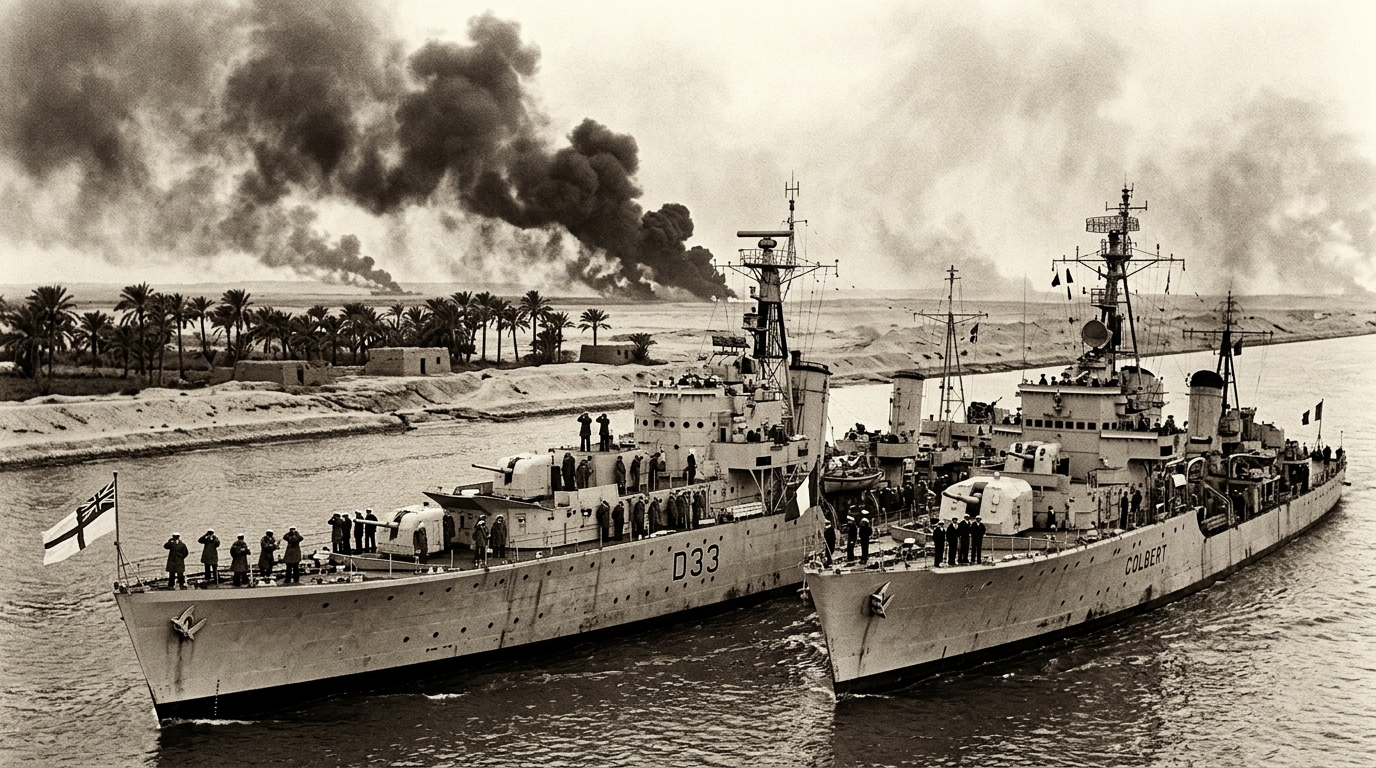
- Naval & Amphibious Buildup: A formidable Anglo-French invasion fleet, comprising aircraft carriers, battleships, cruisers, destroyers, and troop transports, converged on the Egyptian coast, particularly targeting Port Said at the northern entrance of the canal.
- Paratroop Landings (November 5): The ground invasion began with the elite 3rd Battalion of the British Parachute Regiment and elements of the French 2nd Colonial Parachute Regiment dropping into Port Said. Their objective was to secure key infrastructure and create a beachhead for the main amphibious assault. They faced fierce resistance from Egyptian forces and local militia, leading to intense street fighting.
- Amphibious Landings (November 6): The main amphibious assault force, led by British Royal Marines and French Foreign Legionnaires, landed at Port Said and Port Fouad. Supported by naval gunfire and close air support, they began to push south, aiming to secure the entire Canal Zone.
However, just as the Anglo-French forces were consolidating their positions and advancing, political developments forced an abrupt halt. On November 6, as British and French troops were fighting their way through Port Said, Prime Minister Eden announced a ceasefire, effective at midnight. The military operation, which was tactically successful in its limited objectives of seizing the northern part of the canal, was stopped dead in its tracks by overwhelming international pressure, primarily from the United States. This premature cessation left the Anglo-French forces in an awkward and vulnerable position, having achieved military gains but facing political defeat.
The military campaign highlighted several key points: the tactical prowess of the Israeli army, the significant air and naval capabilities still possessed by Britain and France, and critically, the severe limitations on using such power without the political and financial backing of the United States. While the Egyptians suffered a clear military defeat, Nasser's shrewd political maneuvering ultimately turned this into a profound diplomatic victory.
Geopolitical Consequences and Aftermath
The aftermath of the Suez Crisis fundamentally altered global politics, accelerating the decline of old empires and reshaping alliances. The military intervention was a tactical success for the tripartite forces, but it proved to be an unmitigated strategic catastrophe for Britain and France, and a complex mixture of gains and losses for Israel.
The Eclipse of Imperial Hegemony
The most immediate and profound consequence was the stark exposure of the limitations of British and French power. Despite successfully occupying the canal zone, London and Paris faced unprecedented diplomatic isolation. The United States, infuriated by the deception and concerned about Soviet encroachment, joined the Soviet Union in condemning the invasion. At the United Nations, a formidable coalition demanded an immediate ceasefire and withdrawal.
The economic weapon proved the most potent. The United States, under President Eisenhower, threatened to sell off its substantial holdings of the British pound, which would have triggered a catastrophic collapse of the UK economy and severely devalued sterling. With Britain's foreign exchange reserves plummeting rapidly and facing economic ruin, Prime Minister Eden had no choice but to back down. France, dependent on British logistical support for its own forces, was compelled to follow suit. This humiliating retreat laid bare the total financial and strategic dependence of the old European powers on the United States, effectively ending any pretense of independent "Great Power" status. It signaled the definitive end of gunboat diplomacy as a viable instrument of British and French foreign policy.
The Rise of Nasserism and Pan-Arabism
Paradoxically, despite the military defeat, Gamal Abdel Nasser emerged from the crisis as an undisputed hero and the symbolic leader of the Arab world. Having defied and seemingly "defeated" two former colonial powers, his standing among Arab masses soared. Nasserism, his brand of pan-Arab nationalism, secularism, and anti-imperialism, gained immense traction, inspiring nationalist movements across the Middle East and Africa. He became a beacon for post-colonial resistance, demonstrating that newly independent nations could challenge Western dominance. This emboldened anti-colonial struggles and contributed to the rapid acceleration of decolonization in the years that followed.
The UN’s New Role: Peacekeeping Pioneer
The Suez Crisis was a critical moment for the United Nations. With the UN Security Council paralyzed by Anglo-French and Soviet vetoes, the General Assembly, under the leadership of Canadian Secretary of State for External Affairs Lester B. Pearson, stepped into the breach. Pearson proposed the creation of an international emergency force to supervise the ceasefire and facilitate the withdrawal of foreign troops. This led to the establishment of the United Nations Emergency Force (UNEF), the first large-scale international peacekeeping mission. UNEF, composed of troops from neutral nations, successfully monitored the ceasefire, cleared the canal, and ensured the withdrawal of Anglo-French and Israeli forces. Pearson was awarded the Nobel Peace Prize in 1957 for his initiative, and the UNEF model became a blueprint for future UN peacekeeping operations, establishing a new mechanism for international conflict resolution.
Soviet Penetration into the Middle East
By championing Egypt and condemning the tripartite aggression, the Soviet Union solidified its influence in the Middle East. Moscow's threats of intervention, including thinly veiled hints of nuclear strikes against London and Paris, positioned the USSR as a defender of Arab sovereignty against Western imperialism. Though these threats were largely bluster, they resonated strongly in the region. The crisis provided the Soviets with a powerful propaganda victory and an opportunity to expand its strategic footprint, leading to increased arms deals and economic aid for Egypt and other Arab nations, shaping the Cold War dynamics in the region for decades to come.
Strain on the Western Alliance
The Suez Crisis severely strained the "Special Relationship" between the United States and the United Kingdom, built during World War II. Eisenhower felt personally betrayed by Eden's deception, leading to a profound loss of trust. While the relationship eventually recovered, Suez served as a stark reminder to Britain that its foreign policy could no longer diverge significantly from that of its powerful American ally.
For France, the experience was equally impactful. The humiliation cemented the conviction of figures like Charles de Gaulle that France could not rely on Anglo-Saxon allies for its security or national prestige. This conviction directly contributed to France's accelerated development of its independent nuclear deterrent, the Force de Frappe, and its eventual withdrawal from NATO's integrated military command structure in 1966, pursuing a more independent foreign policy.
Israel's Complex Outcome
For Israel, the outcome was mixed. Militarily, Operation Kadesh was a stunning success, demonstrating the IDF's prowess. However, Israel was forced to withdraw from the Sinai under intense US pressure, foregoing its territorial gains. Despite this, it secured tacit guarantees from the US regarding freedom of navigation through the Straits of Tiran, which remained open for shipping for the next decade. The crisis underscored Israel's strategic vulnerability and its increasing dependence on external security assurances, even as it strengthened its alliance with France. The lessons learned from Suez, particularly the need for a decisive pre-emptive strike and the dangers of relying on Western powers, profoundly influenced Israeli military doctrine leading up to the 1967 Six-Day War.
Analysis of Key Actors and Decisive Actions
The Suez Crisis was a drama played out by strong personalities, each making decisions that reverberated globally.
Gamal Abdel Nasser: The Opportunistic Nationalist
Nasser demonstrated an extraordinary ability to navigate the treacherous currents of the Cold War. Having come to power as a fervent Egyptian nationalist, his vision quickly expanded to encompass pan-Arabism, challenging both residual colonialism and nascent Israeli power. His decision to nationalize the Suez Canal was a calculated gamble, a direct response to the withdrawal of Aswan Dam financing, but also a bold assertion of sovereignty. He shrewdly played the US against the USSR, leveraging the Cold War rivalry to secure arms (the Czech arms deal) and, after the crisis, significant Soviet economic and military aid. His powerful, charismatic oratory and defiant stand against Britain and France, despite the military setback, transformed him into the primary symbol of post-colonial resistance and a hero across the Arab world and the Non-Aligned Movement. His actions redefined Arab nationalism, laying the groundwork for a generation of anti-Western sentiment.
Anthony Eden: The Prisoner of History
British Prime Minister Anthony Eden, a seasoned diplomat and a figure who had championed resistance against Fascism in the 1930s, fundamentally miscalculated the nature of his era. He viewed Nasser through the prism of appeasement, seeing him as a "new Hitler" whose aggression had to be confronted decisively. This historical analogy, coupled with a deep-seated belief in Britain's imperial prerogatives and the vital economic importance of the canal, clouded his judgment. His failure to consult President Eisenhower adequately before the intervention proved to be a fatal oversight. Eden, suffering from ill health and under immense domestic pressure from the "Suez Group" within his own party, failed to grasp that the era of "gunboat diplomacy" had been definitively replaced by a global reality governed by superpower dynamics, where even close allies could not act independently on such a scale. The crisis devastated his political career, leading to his resignation in January 1957.
Dwight D. Eisenhower: The Pragmatic Realist
President Dwight D. Eisenhower's reaction was guided by a profound understanding of Cold War geopolitics and a commitment to international law. He was personally offended by the deception of his closest allies but acted with cold, bureaucratic precision to collapse the intervention. Eisenhower's primary concern was that the Suez adventure would destabilize the Middle East, alienate the newly independent Arab nations, and drive them into the waiting arms of Moscow. He also strongly believed in upholding the principles of the UN Charter, fearing that allowing Britain and France to unilaterally invade would set a dangerous precedent that the Soviet Union could exploit in Eastern Europe (where Hungary was simultaneously being brutally suppressed). His strategic priority was the preservation of the Western Alliance's moral standing and the containment of Soviet influence, which he prioritized over the specific colonial interests of London and Paris. His firm, decisive financial pressure was the ultimate factor in halting the invasion.
Guy Mollet: The French Ideologue
French Prime Minister Guy Mollet, a socialist, was a key architect of the tripartite plan. Driven by the existential threat Nasser's support for the Algerian FLN posed to French colonial rule, and a desire to restore French prestige after the humiliation of Indochina, Mollet was arguably the most zealous proponent of intervention. He saw Nasser as a direct enemy and believed his removal was essential for France's survival as an imperial power. His government maintained close ties with Israel, viewing it as a strategic partner against Arab nationalism. The Suez debacle, while deeply humiliating, ultimately solidified in French leadership circles the necessity of an independent foreign policy, a doctrine later championed by Charles de Gaulle.
David Ben-Gurion: The Israeli Strategist
Israeli Prime Minister David Ben-Gurion seized the opportunity presented by Anglo-French desperation. Facing constant Fedayeen raids and a blockade of the Straits of Tiran, Ben-Gurion viewed Nasser's Egypt as an existential threat. The Sèvres Protocol offered a unique chance to pre-emptively strike against a formidable enemy, gain strategic depth in the Sinai, and secure vital shipping lanes, all under the protective, if cynical, umbrella of the European powers. Despite the forced withdrawal from Sinai, Ben-Gurion extracted valuable lessons on strategic alliances, military effectiveness, and the critical importance of US support, which would shape Israel's defense policy in the years leading up to the 1967 Six-Day War.
Lester B. Pearson: The Peacekeeping Architect
The Canadian Secretary of State for External Affairs, Lester B. Pearson, played a pivotal role in defusing the crisis through diplomatic means at the United Nations. Recognizing the paralysis in the Security Council, Pearson successfully steered the debate to the General Assembly, where he proposed the creation of an international emergency force to supervise the ceasefire and oversee the withdrawal of troops. His initiative led to the formation of UNEF, marking the birth of modern UN peacekeeping. Pearson's diplomatic ingenuity not only provided a face-saving solution for the withdrawing powers but also established a crucial precedent for multilateral conflict resolution, earning him the Nobel Peace Prize.
Domestic Reaction and Political Fallout
The Suez Crisis sent shockwaves through the domestic political landscapes of all the involved nations, revealing deep divisions and triggering significant governmental shifts.
United Kingdom: A Crisis of Conscience and Leadership
For Britain, the crisis was a national trauma. The initial intervention was met with a deeply divided public and political class. While many conservatives, particularly the "Suez Group" within Eden's own party, supported robust action to protect imperial interests, the Labour opposition, led by Hugh Gaitskell, vehemently condemned the invasion as a reckless act of aggression, a violation of international law, and a betrayal of Britain's moral standing. Public protests erupted, and there was widespread discomfort with the perceived "collusion" with Israel. The economic humiliation, coupled with the diplomatic isolation, was a profound blow to national pride. Prime Minister Anthony Eden, whose health was already failing, never recovered politically. Accusations of deception and poor judgment, alongside the profound national embarrassment, led to his resignation in January 1957, officially due to ill health, but effectively marking the end of his career. The crisis fundamentally altered the British self-perception, accelerating the decolonization process and ushering in an era of introspection about Britain's role in the world. The "never again" sentiment became deeply embedded in British foreign policy.
France: Frustration and a Path to Independence
In France, the reaction was initially more unified in support of intervention, particularly given Nasser's support for the Algerian rebels. Prime Minister Guy Mollet's socialist government, like Eden's, felt justified in confronting Nasser. However, the forced withdrawal, perceived as a betrayal by the Anglo-Saxons, generated immense frustration and a deep sense of humiliation. It solidified the conviction among many, especially future president Charles de Gaulle, that France could no longer rely on external allies for its core security and national interests. This sentiment directly fueled France's resolve to develop its own independent nuclear deterrent (the Force de Frappe) and pursue a more assertive, independent foreign policy, culminating in its withdrawal from NATO's integrated military command structure in 1966. The Suez debacle, therefore, inadvertently laid the groundwork for a more Gaullist, autonomous France on the global stage.
Egypt: Triumph Amidst Military Defeat
For Egypt, the crisis was a moment of immense national triumph, despite the military setbacks. Nasser's audacious nationalization and his steadfast defiance against superior Anglo-French military power, even in the face of bombing and invasion, resonated deeply with the Egyptian populace. He masterfully leveraged the political fallout, turning military defeat into a resounding moral and political victory. His popularity soared to unprecedented heights, cementing his position as the undisputed leader of Egypt and a pan-Arab hero. The crisis allowed him to consolidate his power domestically, suppress dissent, and steer Egypt firmly towards the non-aligned, and increasingly Soviet-leaning, bloc.
United States: Vindication and Strengthened Principles
In the United States, there was broad bipartisan consensus against the Anglo-French-Israeli intervention. President Eisenhower's firm stance was widely supported across the political spectrum. The crisis vindicated Eisenhower's foreign policy principles, particularly his commitment to upholding international law and preventing Soviet expansionism. It demonstrated the decisive power of US financial and diplomatic leverage, solidifying its role as the undisputed leader of the Western alliance and a global superpower. The crisis further highlighted the US's growing influence in the Middle East, as it stepped in to fill the vacuum left by the declining European powers, though this would later bring its own set of challenges.
Israel: Mixed Feelings and Long-Term Strategic Shifts
For Israel, the immediate domestic reaction was a mixture of pride in the military's swift victory and frustration over the forced withdrawal. The public celebrated the IDF's prowess in the Sinai, but the subsequent diplomatic isolation and the need to concede territorial gains under US pressure were sober reminders of Israel's vulnerability. However, the crisis also led to a tacit US guarantee of navigation rights through the Straits of Tiran, a crucial security gain. The experience solidified the perception within Israeli leadership that while military strength was paramount, diplomatic maneuvering and, increasingly, a strong relationship with the United States were equally vital for national security. It also deepened the strategic partnership with France in the short term, particularly in military cooperation, but ultimately pushed Israel closer to the US in the long run.
Trivia and Lesser-Known Facts
- The Soviet Nuclear Threat: During the height of the crisis, Soviet Premier Nikolai Bulganin sent letters to Britain, France, and Israel, hinting at the possibility of using "modern weapons" (implied nuclear strikes) against London and Paris. While largely considered a bluff, given the Soviet Union's relatively nascent nuclear arsenal compared to the US, these threats were taken seriously by the British Cabinet and contributed to the sense of urgency for de-escalation.
- The Hungarian Uprising: The Suez Crisis unfolded simultaneously with the Soviet suppression of the Hungarian Uprising (October-November 1956). Many historians argue that the Suez intervention diverted international attention from Hungary, potentially allowing the Soviets greater latitude to act brutally without significant international backlash. Eisenhower's staunch defense of the UN Charter during Suez was partly motivated by the fear of setting a precedent that the USSR could later use to legitimize its actions in Eastern Europe.
- Israel's Secret Gains: While Israel was forced to withdraw from the Sinai, they secured a secret guarantee from the US regarding freedom of navigation through the Straits of Tiran, enforced by UNEF. This access, critical for Israel's trade with East Africa and Asia, became a central point of contention in the lead-up to the 1967 Six-Day War when Nasser blockaded the Straits again.
- A Fractured Relationship for France: The Suez crisis created a lingering resentment in French leadership. Charles de Gaulle, then in political retirement but soon to return, drew profound conclusions. He believed that France could never rely on the United States for security or support in pursuing its national interests. This led directly to the acceleration of the French nuclear program, the Force de Frappe, and France’s eventual withdrawal from the NATO integrated military command structure in 1966, pursuing a foreign policy independent of both Washington and Moscow.
- The Canadian Flag Debate: Lester B. Pearson's role in the Suez Crisis and the creation of UNEF highlighted Canada's emerging role as a middle power and a leader in international diplomacy. The blue helmet of the UN peacekeepers, often a Canadian innovation, contributed to Canada's image as a "peacekeeping nation." The process of finding a distinct Canadian identity, separate from its colonial past, later included the adoption of the maple leaf flag in 1965, replacing the Red Ensign which featured the Union Jack.
- The Canal's Operational Recovery: Despite Anglo-French attempts to justify their intervention as necessary to keep the canal open, Egyptian forces deliberately scuttled 49 ships in the waterway, effectively blocking it for months. It took the UN and a multinational salvage operation, led by the US, to clear the canal, which reopened in April 1957. This demonstrated that the military intervention had, in the short term, precisely the opposite effect of its stated aim to secure the canal's passage.
- The Role of Oil: While often mentioned, the specific reliance on Middle Eastern oil was a critical driver. Britain imported 75% of its oil through the Suez Canal. The closure of the canal and the damage to pipelines during the crisis threatened an immediate energy crunch in Western Europe, adding another layer of urgency and panic to the British and French calculus.
References and Literature
- The Suez Crisis: A Chronology - An authoritative overview of the escalation and international response, providing key dates and events.
- Kyle, Keith (2011). Suez: Britain's End of Empire in the Middle East - Widely considered the definitive scholarly work on the British perspective of the crisis, offering in-depth analysis of Eden's motivations and the political fallout.
- Foreign Affairs: The Suez Crisis and the World Order - Provides academic analysis of the crisis's profound impact on international institutions, the development of UN peacekeeping, and global power dynamics.
- National Archives (UK): Cabinet Papers on the Suez Operation - Primary source documents offering invaluable insights into the secret deliberations, decision-making processes, and internal tensions within the Eden government.
- Louis, Wm. Roger; Owen, Roger (Eds.) (1989). Suez 1956: The Crisis and Its Consequences - A comprehensive collection of essays by leading historians, analyzing various national perspectives and the long-term impact of the crisis.
- Neustadt, Richard E. (1960). Presidential Power and the Modern Presidents: The Politics of Leadership from Roosevelt to Reagan - Offers a detailed account of President Eisenhower's handling of the crisis, highlighting his decision-making process and use of executive power.
- Peres, Shimon (1995). Battling for Peace: A Memoir - Provides an Israeli perspective on the events, including the Sèvres Protocol, from one of its key architects.