Key Takeaways
- The North Atlantic Treaty was signed on April 4, 1949, establishing a mutual defense pact between 12 founding nations of North America and Western Europe.
- The treaty represented a revolutionary shift in United States foreign policy, marking its first peacetime military alliance outside the Western Hemisphere.
- The Soviet blockade of Berlin and the consolidation of communist regimes in Eastern Europe served as the primary catalysts for Western military integration.
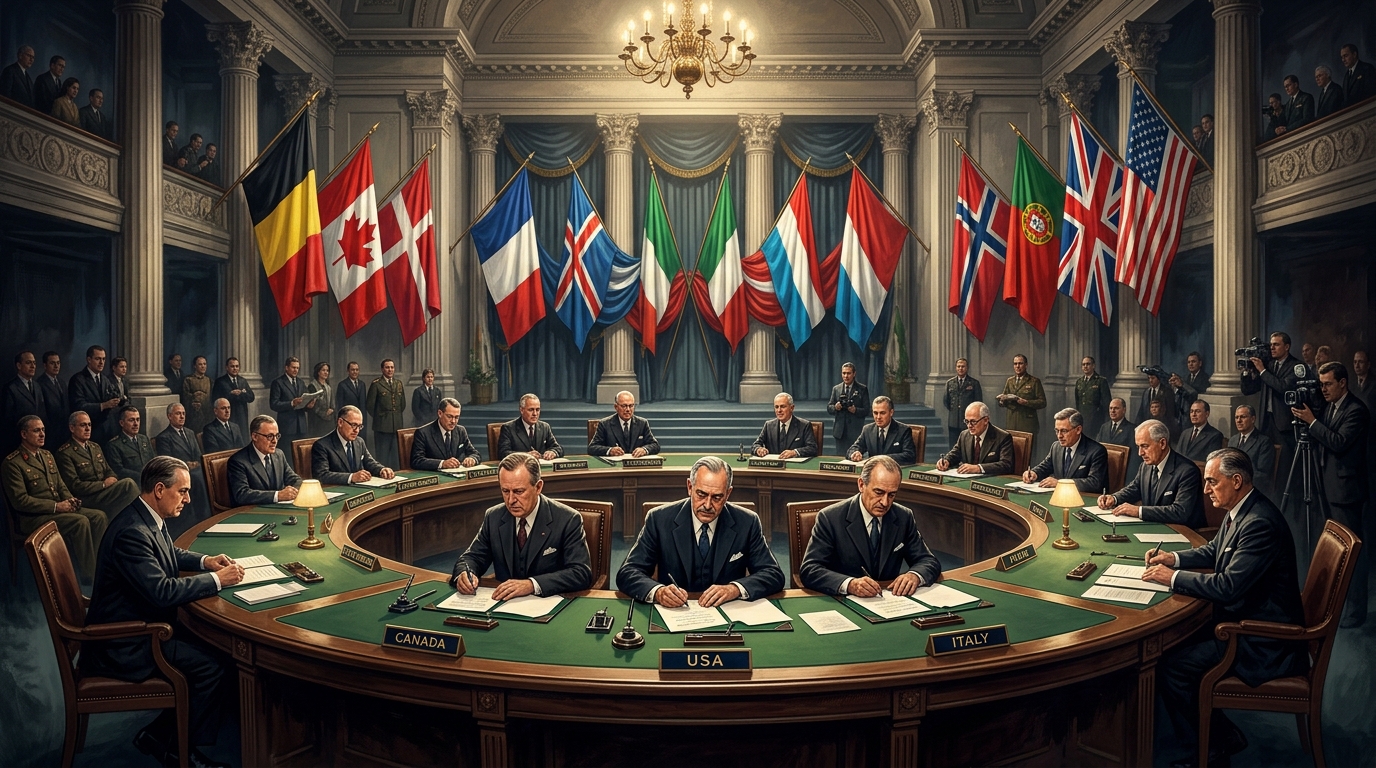
On April 4, 1949, representatives from twelve sovereign nations gathered in the Departmental Auditorium in Washington, D.C., to sign the North Atlantic Treaty. This diplomatic event marked the birth of the North Atlantic Treaty Organization (NATO), fundamentally reshaping the global geopolitical architecture. For the United States, the treaty represented an unprecedented departure from its historic foreign policy traditions, binding its security irreversibly to the fate of Western Europe. For Europe, still recovering from the physical and economic devastation of the Second World War, the alliance offered a vital security umbrella underwritten by American nuclear monopoly and economic might.
This article provides a comprehensive analysis of the diplomatic maneuvers, systemic pressures, and strategic calculations that culminated in the signing of the Washington Treaty, establishing collective defense as the foundational pillar of the Western world.
Historical Context and Origins
The origins of NATO lie in the rapid collapse of the wartime Grand Alliance that had defeated Nazi Germany. By 1947, the optimistic post-war vision of a cooperative international order overseen by the United Nations had shattered. In its place emerged a polarized international system defined by ideological rivalry, geopolitical competition, and mutual suspicion between the United States and the Soviet Union.
Several key factors drove Western policymakers toward the realization that a coordinated security framework was urgently required:
The Sovietization of Eastern Europe
Following the Yalta and Potsdam conferences, the Soviet Union systematically consolidated its control over the countries of Eastern Europe. Through the use of "salami tactics"—a process of gradual political elimination orchestrated by local communist parties under the supervision of the Soviet Red Army—coalition governments were dismantled in Poland, Hungary, Romania, Bulgaria, and Albania 1. The coup d'état in Czechoslovakia in February 1948, which replaced a democratic government with a hardline communist regime, sent shockwaves through Western capitals, demonstrating that even established European democracies were vulnerable to Soviet subversion.
Economic Exhaustion and the Marshall Plan
Western Europe in the late 1940s was economically crippled, politically unstable, and psychologically traumatized. Industrial production was stagnant, food shortages were widespread, and local communist parties in France and Italy were gaining significant electoral strength. Policymakers in Washington recognized that economic recovery was the first line of defense against communist expansion. This led to the launch of the European Recovery Program (the Marshall Plan) in 1947. However, economic aid alone was insufficient; European leaders argued that economic reconstruction could not succeed without a psychological sense of security, which only a formal American military commitment could provide.
The Western Security Dilemma (1947-1948)
| Security Concern | Addressed By |
|---|---|
| Economic Vulnerability | The Marshall Plan |
| Military Instability | The Brussels Treaty |
| Transatlantic Gap | The Washington Treaty |
The European Initiative: The Brussels Treaty
Before committing to European defense, the United States required evidence that European nations were willing to cooperate and defend themselves. British Foreign Secretary Ernest Bevin spearheaded this effort. In March 1948, the United Kingdom, France, Belgium, the Netherlands, and Luxembourg signed the Brussels Treaty, establishing the Western Union 2. This mutual defense agreement demonstrated European initiative and resolve, satisfying a crucial political condition for American participation in transatlantic security negotiations.
The Berlin Blockade
The ultimate catalyst for military integration was the Berlin Blockade, which began in June 1948. In response to currency reform in the Western occupation zones of Germany, Joseph Stalin cut off all highway, rail, and water access to West Berlin. The Western powers responded with a massive, year-long airlift to keep the city supplied. The Berlin crisis brought the United States and the Soviet Union to the brink of direct military conflict, transforming the abstract threat of Soviet aggression into an immediate, tangible reality.
Timeline of Events and Key Moments
The path to the North Atlantic Treaty involved a series of delicate legislative, diplomatic, and military negotiations between 1947 and 1949:
- March 12, 1947: President Harry S. Truman delivers a speech to Congress, establishing the Truman Doctrine, which commits the United States to supporting "free peoples who are resisting attempted subjugation by armed minorities or by outside pressures" [[^3]].
- March 17, 1948: The Brussels Treaty is signed, establishing the Western Union and demonstrating a commitment to European self-defense.
- June 11, 1948: The United States Senate passes the Vandenberg Resolution (Senate Resolution 239) by an overwhelming vote of 64 to 4. Drafted by Republican Senator Arthur Vandenberg, the resolution advises the President to pursue U.S. association with regional collective security arrangements within the framework of the UN Charter, effectively granting legislative permission to depart from peacetime isolationism.
- July 6, 1948: The Washington Exploratory Talks on Security begin at the State Department. These highly secretive meetings bring together diplomats from the United States, Canada, and the Brussels Treaty powers to hammer out the structure of a transatlantic alliance.
- December 10, 1948: Negotiations expand to include other strategic nations: Denmark, Iceland, Italy, Norway, and Portugal are invited to join the talks to secure vital maritime routes, airbases, and territory in the North Atlantic and Mediterranean.
- April 4, 1949: The North Atlantic Treaty is officially signed in Washington, D.C., by twelve founding nations: Belgium, Canada, Denmark, France, Iceland, Italy, Luxembourg, the Netherlands, Norway, Portugal, the United Kingdom, and the United States.
- August 24, 1949: Following ratification by the respective parliaments of all twelve signatory states, the North Atlantic Treaty officially enters into force.
- March 1948: Brussels Treaty
- June 1948: Vandenberg Resolution
- July 1948: Washington Exploratory Talks
- April 1949: Signing of the Washington Treaty
Geopolitical Consequences and Aftermath
The formation of NATO profoundly altered the international system, leaving a legacy that continues to define contemporary global politics.
The Institutionalization of the Cold War
The signing of the treaty permanently codified the division of Europe into two opposing, militarized blocs. The Soviet Union viewed NATO not as a defensive alliance, but as an aggressive, capitalist encirclement strategy orchestrated by Washington. In response to West Germany's accession to NATO in May 1955, the Soviet Union formalized its own eastern military alliance, the Warsaw Pact, cementing the bipolar security architecture of the Cold War.
The Transformation of American Foreign Policy
Historically, the United States had adhered to the foreign policy advice laid out in George Washington’s 1796 Farewell Address, which warned against entering into "permanent alliances" with foreign nations. The North Atlantic Treaty shattered this isolationist paradigm. By committing to the defense of Europe in peacetime, the United States took on the role of the primary guardian of Western democratic liberalism, establishing a permanent military presence in Europe that remains intact today 4.
The Militarization of the Alliance
Interestingly, the initial treaty signed in 1949 did not create the integrated, highly structured military command that we associate with NATO today; it was primarily a political commitment to mutual assistance. It was the outbreak of the Korean War in June 1950 that transformed NATO from a "paper treaty" into a functional, integrated military organization. Fearing that the communist invasion of South Korea was a precursor to a Soviet assault on Western Europe, NATO leaders established an integrated military command structure under a Supreme Allied Commander Europe (SACEUR). General Dwight D. Eisenhower was appointed as the first SACEUR in December 1950.
"The purpose of NATO was to keep the Soviet Union out, the Americans in, and the Germans down." — Lord Ismay, NATO's first Secretary General [[^5]]
Analysis of Key Actors and Decisive Actions
The successful negotiation of the Washington Treaty required navigating intense domestic political skepticism, historical European rivalries, and competing strategic interests. Several key personalities and nations played decisive roles in shaping the final text:
| Country | Key Personality | Primary Strategic Objectives | Major Contribution / Impact |
|---|---|---|---|
| United States | Harry S. Truman | Contain Soviet expansion; avoid return to isolationism; protect U.S. constitutional war powers. | Championed the Truman Doctrine; secured the bipartisan support of Senator Arthur Vandenberg to pass the Vandenberg Resolution. |
| United Kingdom | Ernest Bevin | Anchor American military power to Europe; build a Western European security coalition. | Engineered the Brussels Treaty to prove European defense viability; acted as the prime diplomatic catalyst for the transatlantic link. |
| France | Georges Bidault / Robert Schuman | Secure guarantees against potential future German aggression; obtain American protection against the Soviet Union. | Insisted on the inclusion of Algeria within NATO's geographic scope; negotiated security guarantees on Germany. |
| Canada | Lester B. Pearson | Ensure the alliance was not solely military; promote broader political and economic cooperation. | Drafted and fought for Article 2 (the "Canadian Article") to promote non-military, democratic values. |
Harry S. Truman: The Architect of Containment
President Harry S. Truman played a pivotal role in redefining the American global posture. Recognizing that the destruction of Europe would leave the United States isolated in a hostile world, Truman worked tirelessly to build a domestic bipartisan consensus. He gave Senator Arthur Vandenberg, a Republican, a major role in drafting the treaty parameters, ensuring that the final agreement would pass the Republican-controlled Senate without the disastrous partisan divisions that had sunk Woodrow Wilson’s League of Nations in 1919.
Ernest Bevin: The Master Diplomat
British Foreign Secretary Ernest Bevin was perhaps the most influential figure in initiating the treaty negotiations. Bevin recognized that Great Britain, exhausted by war and facing the rapid dissolution of its empire, could no longer maintain the European balance of power alone. His strategy was to create a Western European defense organization (the Brussels Treaty) that would serve as a "lure" to bring the United States into a formal, binding treaty. Bevin’s pragmatic approach successfully bridged the gap between American hesitation and European desperation.
The Debate over Article 5 and U.S. Sovereignty
The most contentious element of the treaty negotiations was Article 5, which defined the nature of the collective defense commitment. The European powers, particularly France, wanted an automatic commitment, requiring all members to go to war immediately if one was attacked.
However, U.S. State Department negotiators, led by Secretary of State Dean Acheson, knew that the U.S. Senate would reject any treaty that infringed upon Congress’s constitutional authority to declare war 6. To resolve this conflict, the negotiators drafted a compromise:
"The Parties agree that an armed attack against one or more of them in Europe or North America shall be considered an attack against them all and consequently they agree that, if such an armed attack occurs, each of them... will assist the Party or Parties so attacked by taking forthwith, individually and in concert with the other Parties, such action as it deems necessary, including the use of armed force..."
This crucial phrase—“such action as it deems necessary”—allowed the United States to fulfill its political commitment to collective defense while preserving its constitutional sovereignty and legislative independence.
Trivia and Lesser-Known Facts
- The Irony of the Soundtrack: During the formal treaty signing ceremony on April 4, 1949, the United States Marine Band played several musical selections. Among them were two songs from George Gershwin's opera Porgy and Bess: "It Ain't Necessarily So" and "I've Got Plenty o' Nuttin'". Diplomatic historians have often noted the unintended, humorous irony of these titles playing as leaders signed a historic pact committing their nations to mutual defense.
- The Battle for Article 2: Article 2 of the treaty, which encourages members to promote "conditions of stability and well-being" and strengthen their free institutions, is known as the "Canadian Article." Canadian Under-Secretary of State for External Affairs Lester B. Pearson strongly advocated for its inclusion, despite fierce resistance from American and British negotiators who wanted NATO to remain a strictly military pact. Pearson argued that the alliance needed a moral and economic foundation to appeal to the democratic values of the public.
- Iceland’s Unique Status: Iceland was a founding member of NATO in 1949, yet it was the only member state that did not possess—and has never possessed—a standing military force. Iceland joined on the strict condition that it would not be required to establish an army, offering instead its strategically vital geographic location in the GIUK (Greenland-Iceland-United Kingdom) gap for naval and air surveillance.
- The Secret Negotiations: The preliminary meetings in Washington were so secretive that the participants did not use official State Department communication channels. Fearing Soviet espionage (which was highly active at the time, as evidenced by the later exposure of Donald Maclean, a British diplomat involved in early Anglo-American planning), drafts of the treaty were often hand-delivered by trusted couriers directly to negotiators' private residences.
References and Literature
- The North Atlantic Treaty, 1949 (Official Text) - The official founding document of the North Atlantic Treaty Organization, signed in Washington, D.C.
- The Department of State Office of the Historian: The North Atlantic Treaty Organization, 1949 - A comprehensive academic review of the diplomatic negotiations and legislative maneuvers behind the alliance.
- Kaplan, Lawrence S. (1984). The United States and NATO: The Formative Years. University Press of Kentucky. - A seminal scholarly analysis focusing on the U.S. transition from isolationism to transatlantic commitment.
- Gaddis, John Lewis (2005). The Cold War: A New History. Penguin Press. - An authoritative history of the geopolitical division of the world, detailing how NATO fit into the broader American strategy of containment.
---
Footnotes & Explanations
- Gaddis, John Lewis. The Cold War: A New History. Penguin Press, 2005, pp. 31-35. ↩
- Treaty of Economic, Social and Cultural Collaboration and Collective Self-Defence (Brussels Treaty), March 17, 1948. ↩
- Harry S. Truman, Address to a Joint Session of Congress, March 12, 1947. ↩
- Kaplan, Lawrence S. The United States and NATO: The Formative Years. University Press of Kentucky, 1984, pp. 11-14. ↩
- This famous aphorism, attributed to Hastings Ismay, 1st Baron Ismay, highlights the triple strategic purpose of the alliance: containing the Soviets, securing the U.S. presence, and preventing a resurgence of German militarism. ↩
- Acheson, Dean. Present at the Creation: My Years in the State Department. W. W. Norton & Company, 1969, pp. 277-280. ↩