Key Takeaways
- The 1992 independence referendum served as the critical catalyst, systematically fragmenting Bosnia and Herzegovina along ethno-national lines.
- Sarajevo’s 1,425-day siege stands as the longest siege of a capital city in modern military history, becoming a symbol of urbicide and civilian suffering.
- The conflict underscored the profound failure of post-Cold War European security mechanisms and international diplomacy to prevent widespread ethno-nationalist violence and genocide.
- The Dayton Agreement, while ending hostilities, codified a complex, often dysfunctional, ethno-territorial political structure that continues to shape Bosnia's trajectory.
Historical Context and Origins
The disintegration of the Socialist Federal Republic of Yugoslavia (SFRY) was not an abrupt explosion but a cascading collapse of constitutional, economic, and ideological pillars that had held together a diverse mosaic of nations for over four decades. Following the death of Marshal Josip Broz Tito in 1980, the rotating presidency, designed to balance the interests of the six constituent republics and two autonomous provinces, struggled to maintain equilibrium. Tito’s carefully cultivated policy of "Brotherhood and Unity" (Bratstvo i jedinstvo) had successfully suppressed underlying ethno-nationalist tensions, but it also masked deep-seated historical grievances and uneven economic development. The economic stagnation of the 1980s, marked by rampant inflation, rising unemployment, and a burgeoning foreign debt, eroded the social contract and provided fertile ground for the resurgence of nationalism.
By the late 1980s, the rise of Slobodan Milosevic in Serbia heralded a seismic shift toward an exclusionary, expansionist Serbian nationalism. Milosevic skillfully exploited the grievances of Serbs in Kosovo, where he delivered his electrifying Gazimestan speech in 1987, framing Serbs as victims and promising to restore Serbian dignity. This move, followed by the abolition of the autonomy of Kosovo and Vojvodina in 1989, concentrated power in Belgrade and inevitably triggered reactive nationalist movements in Slovenia, Croatia, and Bosnia and Herzegovina, effectively unraveling the Yugoslav federation.
Bosnia and Herzegovina occupied a uniquely precarious position within the SFRY, often described as "Yugoslavia in miniature" due to its highly mixed demographic composition of Bosniaks (Muslims), Serbs (Orthodox Christians), and Croats (Catholic Christians). Unlike Slovenia and Croatia, which had clearer national majorities, Bosnia's population was intertwined, with significant minorities of each group scattered across its territory. While Tito had successfully fostered a multi-ethnic identity, the economic hardships of the 1980s allowed historical grievances, particularly those dating back to the brutal inter-ethnic conflicts of World War II (when the Ustasha regime in the Independent State of Croatia committed atrocities against Serbs, Jews, and Roma, while Chetnik forces retaliated against Bosniaks and Croats), to resurface and be manipulated by emerging nationalist leaders.
As Slovenia and Croatia declared independence in 1991, following short but decisive wars, Bosnia found itself trapped in an agonizing dilemma. Alija Izetbegovic, the erudite leader of the Party of Democratic Action (SDA) and a key proponent of Bosnian sovereignty, recognized that if Yugoslavia ceased to exist, Bosnia could not remain within a Serb-dominated rump state without losing its multi-ethnic character and, effectively, its independence. His vision was for a civic, multi-ethnic republic, a continuation of Bosnia's historical pluralism. Conversely, Radovan Karadzic and the Serbian Democratic Party (SDS), overtly backed by Milosevic's regime in Belgrade, vehemently warned that Bosnian independence would lead to the annihilation of the Bosnian Serb population, invoking the traumatic specter of the Independent State of Croatia (NDH) from the 1940s. This narrative of historical victimhood and existential threat became the cornerstone of the Bosnian Serb mobilization, justifying the creation of a separate Serb entity within Bosnia and, ultimately, armed secession. The stage was set for a conflict over Bosnia's very existence, fueled by irredentist claims and fear.
Historical Precedents and the 'Serbian Question'
To fully grasp the origins of the Bosnian War, it is essential to delve into the deeper historical currents that shaped the region and informed the nationalist narratives of the late 20th century. The idea of a "Greater Serbia," aiming to unite all Serbs in one state, was not new; it had roots in 19th-century nationalism and resurfaced forcefully with the collapse of Ottoman and Austro-Hungarian empires. This ambition was often in direct conflict with the aspirations of other South Slav nations.
In the context of the dissolving Yugoslavia, the "Serbian Question" in Bosnia was particularly complex. Bosnian Serbs constituted approximately 31% of Bosnia's population, making them the second-largest ethnic group, but they were geographically dispersed, often forming majorities in specific regions but rarely in contiguous swathes that could be easily carved out. This demographic reality made any notion of a "Greater Serbia" that included Bosnian Serb-populated areas inherently problematic and violent, as it would necessitate the expulsion or subjugation of large non-Serb populations.
The legacy of World War II cast a long and dark shadow. The brutal inter-ethnic violence, particularly the massacres committed by the Ustasha regime against Serbs and other minorities, was meticulously preserved and amplified in Serb nationalist discourse. For Radovan Karadzic and his ideologues, the independence of Bosnia, especially under a Bosniak leader like Izetbegovic, was framed as a direct continuity of the WWII threat. This fear, often exaggerated and distorted, served as a powerful mobilization tool, convincing many Bosnian Serbs that their very survival depended on resisting Bosnian independence and aligning with Serbia.
Furthermore, the Ottoman legacy, where Bosniaks had converted to Islam and formed an elite, was also twisted into a narrative of historical grievance by Serb nationalists, portraying Bosniaks as historical oppressors or collaborators with foreign powers. This deep historical revisionism was critical in demonizing the Bosniak population and justifying subsequent actions, including ethnic cleansing. The idea was to create an ethnically pure "Republika Srpska" connected to Serbia, ignoring centuries of shared life and intermarriage. The failure of Tito's "Brotherhood and Unity" to truly reconcile these historical traumas meant that once the ideological lid of communism was lifted, these deep-seated grievances erupted with devastating force, manipulated by political entrepreneurs like Milosevic and Karadzic who understood the power of collective memory and fear.
Timeline of Events and Key Moments Leading to the Siege
The transition from political deadlock to total war in Bosnia was marked by several critical junctures, escalating rapidly in late 1991 and early 1992.
| Date |
| March 1992 |
January 1992: Arbitration Commission's Recommendation
The EC's Arbitration Commission (Badinter Commission) concluded that Bosnia-Herzegovina met the criteria for recognition as an independent state, if its population so desired. This legal opinion provided significant international legitimacy for the independence referendum.
March 1992: Independence Referendum
The most pivotal moment occurred on February 29 and March 1, 1992, when Bosnia and Herzegovina held its independence referendum. Boycotted by most Bosnian Serbs, the turnout was around 63%, with 99.7% voting for independence. This democratic exercise, though internationally sanctioned, was seen by Bosnian Serb leaders as a declaration of war, threatening their existence within a state where they would be a minority. Immediately following the referendum, Serbian militant factions began erecting barricades in Sarajevo, blocking major intersections and vital supply routes, effectively initiating the siege.
April 5, 1992: Suada Dilberović's Death and Initial Shelling
On April 5, amidst widespread peace protests in Sarajevo, Serbian snipers fired into the crowd, killing Suada Dilberović and Olga Sučić, two young women who are widely considered the first casualties of the siege. This tragic event galvanized the city's inhabitants but also marked the definitive end of peaceful protest and the beginning of open conflict. On the same day, Serbian forces began their systematic shelling of Sarajevo from positions in the surrounding hills, effectively initiating the longest siege of a capital city in modern history.
April 6, 1992: International Recognition
On April 6, the European Community officially recognized Bosnia and Herzegovina as an independent state, followed swiftly by the United States the next day. While intended to solidify Bosnia's sovereignty and deter aggression, this recognition instead inflamed Bosnian Serb and Serbian nationalist sentiments, who viewed it as an illegitimate act designed to dismember Yugoslavia and marginalize Serbs. The international recognition paradoxically intensified the conflict, as it provided a clear casus belli for the Bosnian Serb leadership to formalize their military operations.
May 1992: JNA Withdrawal and VRS Formation
Throughout May 1992, the Yugoslav People's Army (JNA), which had been heavily involved in supporting Bosnian Serb militias, formally withdrew from Bosnia and Herzegovina. However, this "withdrawal" was largely a strategic maneuver. A vast amount of its heavy weaponry, including tanks, artillery, and ammunition, was systematically transferred to the newly formed Army of Republika Srpska (VRS), commanded by General Ratko Mladić. Many JNA officers of Serbian ethnicity also transferred directly into the VRS. This ensured that the Bosnian Serb forces were exceptionally well-equipped and trained, far superior to the nascent and poorly armed Army of the Republic of Bosnia and Herzegovina (ARBiH), which was additionally hampered by an international arms embargo. The encirclement of Sarajevo was completed, and the relentless shelling and sniping became a horrific daily reality for its citizens, commencing a 1,425-day ordeal.
Geopolitical Consequences and Aftermath
The Bosnian War transformed the geopolitical architecture of post-Cold War Europe, leaving an indelible mark on international relations and humanitarian law. It exposed the stark limitations of existing security mechanisms and proved that the optimistic "End of History" thesis—the notion that liberal democracy had triumphed globally, ensuring peace—was profoundly premature. The conflict served as a brutal reminder of the enduring power of ethno-nationalism and the fragility of peace in transitional states.
- Failure of Humanitarian Intervention and the UNPROFOR Mandate: The crisis forced the United Nations to deploy the UN Protection Force (UNPROFOR) in Bosnia. Initially tasked with securing humanitarian aid convoys, UNPROFOR's mandate was incrementally expanded to include "safe areas" (such as Srebrenica, Žepa, Goražde, Bihać, and Sarajevo). However, these safe areas were never adequately protected or enforced, becoming thinly veiled refugee camps vulnerable to attack. The Srebrenica genocide in July 1995, where over 8,000 Bosniak men and boys were systematically murdered by VRS forces despite the presence of Dutch UN peacekeepers, stands as a devastating testament to the failure of the "safe area" concept and the broader limitations of UN peacekeeping without a robust enforcement mandate and the political will of major powers to back it with decisive force. The UNPROFOR mission was widely criticized for its inability to prevent atrocities, its perceived neutrality which often favored the aggressors, and its operational constraints, including the "dual key" system requiring both UN and NATO approval for air strikes.
- The Dayton Agreement and Institutionalized Division: Signed in Dayton, Ohio, in November 1995 (and formally in Paris in December), the accords ended the fighting but institutionalized ethnic division through a highly complex and often dysfunctional constitutional framework. Bosnia and Herzegovina was established as a single, sovereign state but split into two largely autonomous entities: the Federation of Bosnia and Herzegovina (predominantly Bosniak and Croat) and the Republika Srpska (predominantly Serb). A weak central government was created, featuring a tripartite presidency, a bicameral parliament, and extensive veto powers for each constituent people. This structure, while ending the immediate bloodshed, essentially froze the ethno-territorial gains of the war and perpetuated deep divisions, often hindering effective governance, economic development, and genuine reconciliation. The agreement is frequently described as a "frozen conflict" where political actors continue to utilize the rhetoric of 1992 to maintain power and obstruct progress towards a unified, functional state.
- Establishment of International Criminal Justice: The conflict led to the urgent establishment of the International Criminal Tribunal for the former Yugoslavia (ICTY) in The Hague in 1993, by UN Security Council Resolution 827. The ICTY prosecuted individuals responsible for war crimes, crimes against humanity, and genocide committed during the wars in Yugoslavia. It brought to justice key political and military leaders, including Slobodan Milosevic (who died during trial), Radovan Karadzic, and Ratko Mladić, who were convicted of genocide, war crimes, and crimes against humanity. The ICTY set a crucial precedent for international law, demonstrating that heads of state and military commanders could be held individually accountable for atrocities, thus contributing significantly to the development of modern international criminal justice and the principle of universal jurisdiction. Its legacy remains contentious in some parts of the former Yugoslavia, but its impact on documenting the truth and seeking justice for victims is undeniable.
The legacy of the 1992 outbreak and the subsequent war continues to shape Bosnia and Herzegovina. The state apparatus remains deeply paralyzed by the constitutional structures established at Dayton, frequently leading to political stalemates and preventing genuine state-building and economic reform. The wounds of war, marked by displacement, missing persons, and pervasive mistrust, are far from healed, making the path to true reconciliation long and arduous.
Analysis of Key Actors and Decisive Actions
The Bosnian conflict was profoundly shaped by the strategic interplay between three primary figures, whose decisions and ideologies irrevocably altered the Balkans and led to immense human suffering.
Alija Izetbegovic: The Dilemma of Statehood
As the President of the Republic of Bosnia and Herzegovina and leader of the Party of Democratic Action (SDA), Alija Izetbegovic faced an unenviable task. A devout Muslim intellectual and former dissident, he was thrust into leadership at a time of existential crisis. He viewed the independence referendum as an existential necessity, believing that remaining in a Serb-dominated Yugoslavia would lead to Bosnia's ultimate demise as a multi-ethnic entity. His critics often argue that he underestimated the willingness of Belgrade and the Bosnian Serbs to use overwhelming force, or that he was too slow to prepare Bosnia's defenses. However, his proponents maintain that he had no viable alternative to independence once Slovenia and Croatia had departed, and that Bosnia's desire for sovereignty was legitimate and democratic.
Izetbegovic's leadership was defined by a desperate attempt to gain international support for a nascent state that possessed almost no standing army, facing a well-equipped JNA-backed Bosnian Serb force. He struggled to maintain a multi-ethnic front within Bosnia, balancing the demands of Bosniak nationalism with the need to retain Croat and loyal Serb support. The international arms embargo imposed on all sides further crippled his government, leaving the nascent Army of the Republic of Bosnia and Herzegovina (ARBiH) severely outmatched, leading to heavy reliance on foreign aid and, at times, unsavory alliances. His diplomatic efforts were constant, often negotiating from a position of profound weakness, trying to prevent the complete dismemberment of his country.
Radovan Karadzic: The Architect of Secession
Radovan Karadzic, a psychiatrist by profession and leader of the Serbian Democratic Party (SDS), functioned as the ideological and political engine for the Bosnian Serb cause. Drawing heavily on the "Greater Serbia" narrative propagated by Belgrade, Karadzic tirelessly advocated for the secession of Bosnian Serb-populated territories and their eventual merger with Serbia. By forming the "Republika Srpska" (Serb Republic) in early 1992 and establishing a parallel government and assembly, he created a de facto state apparatus that allowed him to command military units, ostensibly under the guise of "self-defense" against an independent Bosnia.
Karadzic's strategy relied heavily on stoking fear of genocide among Bosnian Serbs, a powerful mobilization tool that ensured total support from his constituency, even as it demonized Bosniaks and Croats. He openly threatened war if Bosnia declared independence and, once conflict began, authorized military actions, including the siege and shelling of Sarajevo, that amounted to systematic ethnic cleansing aimed at creating ethnically homogenous territories. His political rhetoric was consistently uncompromising, rejecting any notion of a unitary, multi-ethnic Bosnia. He was later indicted and convicted by the ICTY for genocide, war crimes, and crimes against humanity, specifically for the campaign of sniping and shelling in Sarajevo and the Srebrenica genocide.
Slobodan Milosevic: The Master Strategist
Though he operated from Belgrade as President of Serbia, Slobodan Milosevic was undeniably the master strategist who provided the logistical, financial, and military framework for the war in Bosnia. His objective was the consolidation of a "Serb world" that could survive the collapse of the SFRY, whether through a rump Yugoslavia or a de facto Greater Serbia. Milosevic skillfully played a complex double game: negotiating peace at international summits and presenting himself as a peacemaker to the international community, while simultaneously orchestrating and fueling the military efforts of the Bosnian Serbs through the Yugoslav People's Army (JNA).
The JNA, by 1992, had been thoroughly "Serbianized" and largely functioned as an extension of Belgrade's will. Before its "withdrawal" from Bosnia in May 1992, the JNA transferred massive amounts of heavy weaponry, ammunition, and personnel to the newly formed VRS, providing them with a decisive military advantage. Milosevic ensured a constant flow of funding, intelligence, and paramilitary support to Karadzic's forces, maintaining plausible deniability by claiming the Bosnian Serb forces were independent. This strategic deception allowed him to evade direct international condemnation for a period, even as he was the ultimate orchestrator of the aggression. He was later indicted by the ICTY for war crimes, crimes against humanity, and genocide for his role in the wars in Croatia, Bosnia, and Kosovo, though his trial ended without a verdict due to his death in 2006.
"The war in Bosnia was not a spontaneous uprising of neighbors against neighbors, but a carefully orchestrated campaign of territorial expansion fueled by state-level support from Belgrade, executed through a proxy force that meticulously employed ethnic cleansing as a strategic tool." — Academic assessment of the conflict's origins and execution, emphasizing external influence and systematic violence.
International Response and Intervention Failures
The international community's response to the escalating crisis in Bosnia, particularly in 1992, was characterized by hesitation, division, and ultimately, a tragic failure to prevent widespread atrocities. The initial European Community (EC) reaction was one of bewilderment and impotence. Having grappled unsuccessfully with the secession of Slovenia and Croatia, the EC was deeply divided on how to address the much more complex situation in Bosnia. Germany pushed for early recognition of Bosnian independence, while France and the UK were more cautious, fearing it would exacerbate tensions and lead to wider conflict. This disunity prevented a coherent and decisive diplomatic front.
The United States, under President George H.W. Bush, initially adopted a hands-off approach, viewing the conflict as a European problem and hesitant to become entangled in what was perceived as a complex "ethnic quarrel" after the end of the Cold War. There was a strong desire to avoid "another Vietnam" and a lack of clear strategic interest, leading to a policy of non-intervention that proved catastrophic for Bosnia.
The UN Protection Force (UNPROFOR) was deployed, but its mandate was critically flawed. It was primarily a humanitarian mission, tasked with delivering aid and monitoring ceasefires, not with enforcing peace or protecting civilians by force. Critically, the international community imposed an arms embargo on all warring factions in 1991, which disproportionately harmed the Bosnian government forces (ARBiH). The Bosnian Serbs inherited vast stockpiles of JNA weaponry, while the nascent Bosnian army was left poorly equipped to defend its territory and population, effectively leveling the playing field in favor of the aggressors.
Key failures include:
- Lack of Political Will: Major powers lacked the unified political will to intervene militarily early on, preferring diplomatic solutions that consistently failed to deter Serbian aggression.
- "Dual Key" System: The requirement for both UN and NATO approval for air strikes meant that vital military actions were often delayed or vetoed by UN commanders on the ground, who prioritized peacekeeper safety over civilian protection. This made UNPROFOR a "humanitarian fig leaf" that could not enforce its own safe areas.
- Consequences of the Arms Embargo: The embargo, intended to prevent escalation, instead created a severe imbalance of power, leaving the Bosniak-led government vulnerable and allowing the Bosnian Serb forces to consolidate their gains.
- Media and Public Pressure: While images of the siege of Sarajevo, concentration camps, and ethnic cleansing gradually awakened international public opinion, it took years for this pressure to translate into effective policy change. The "CNN effect" was present, but it was insufficient to overcome political inertia.
It was not until the horrors of the Srebrenica genocide and the second Markale massacre in Sarajevo in 1995 that NATO, with stronger US backing under the Clinton administration, launched Operation Deliberate Force, a sustained air campaign against Bosnian Serb military targets. This, combined with a Croatian-Bosniak military offensive, finally compelled the Bosnian Serbs to the negotiating table, leading to the Dayton Agreement. The delayed and inadequate international response remains a somber lesson in the dangers of inaction in the face of widespread human rights abuses and potential genocide.
The Brutality of the Siege: Urbicide and Civilian Life
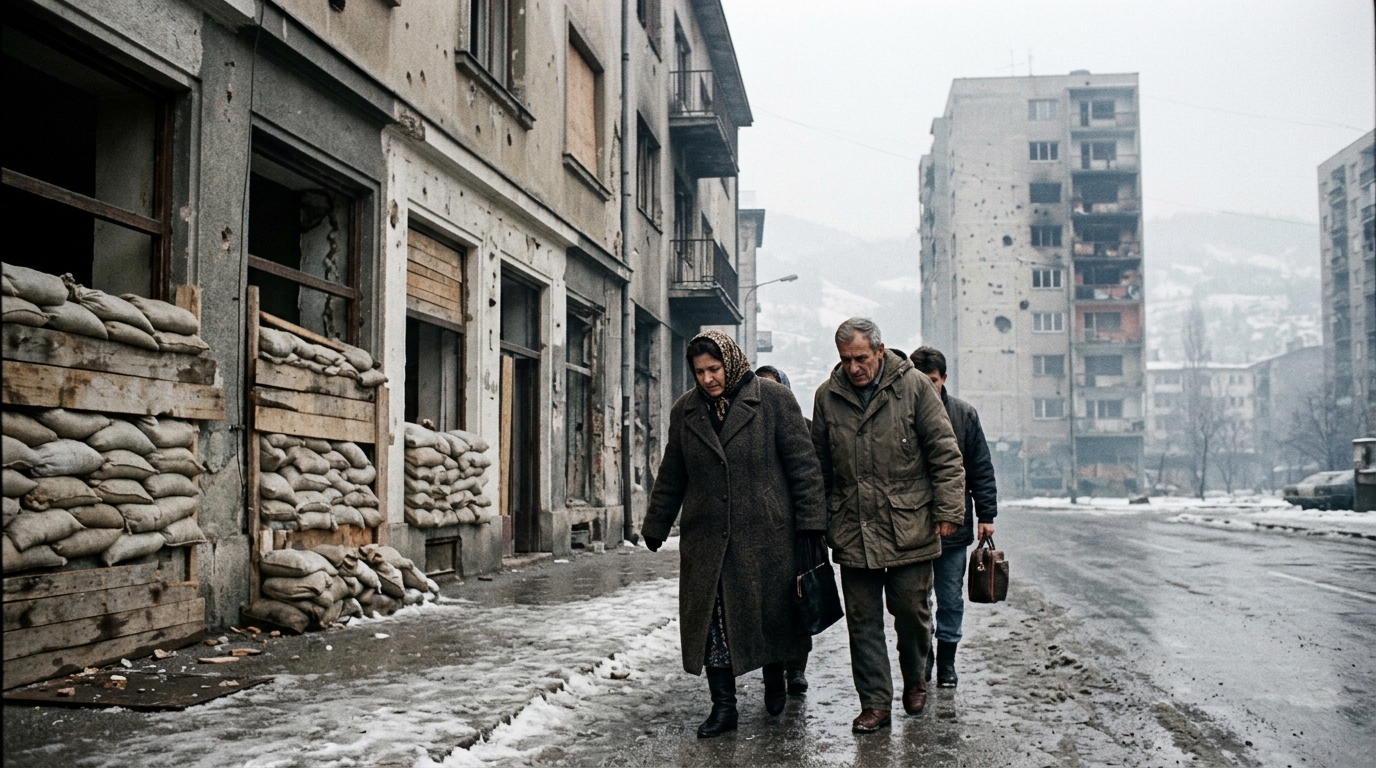
The Siege of Sarajevo, lasting 1,425 days from April 1992 to February 1996, was not merely a military encirclement; it was a deliberate campaign of urbicide—the killing of a city—and a sustained assault on its multi-ethnic fabric and civilian population. Positioned in a valley surrounded by hills, Sarajevo was inherently vulnerable, and Bosnian Serb forces, primarily the VRS, exploited this geographical advantage to devastating effect.
From their strategic positions in the surrounding mountains (Trebević, Igman, Bjelašnica, Jahorina), VRS artillery, tanks, and mortars rained down an average of 329 shells per day on the city. On July 22, 1993, a record 3,777 shells were fired in a single day. This indiscriminate shelling targeted residential areas, hospitals, markets, schools, and cultural institutions, turning Sarajevo into a shattered landscape. The systematic destruction included the Bosnian National and University Library, an architectural marvel housing centuries of invaluable historical manuscripts and books, which was deliberately shelled and burned in August 1992, destroying much of Bosnia's cultural heritage.
Life under siege was an unimaginable ordeal:
- Sniper Alley: The main thoroughfare of Sarajevo, Zmaja od Bosne, became infamously known as "Sniper Alley." VRS snipers, positioned in high-rise buildings and hills, targeted civilians—men, women, and children—as they ran between buildings, collected water, or simply walked down the street. Signs reading "Pazi Snajper!" (Beware Sniper!) became a common sight, and residents developed elaborate strategies of concealment, sprinting across open spaces, or using makeshift barricades.
- Water, Food, and Energy Shortages: The siege cut off virtually all essential utilities. Electricity was scarce and unreliable, water often had to be collected from communal taps under sniper fire, and food was dependent on risky humanitarian aid convoys, often extorted or blocked by besieging forces. Citizens resorted to chopping down trees in parks for firewood, foraging for food, and digging wells.
- Psychological Warfare: The constant threat of shelling and sniping was designed not only to inflict casualties but also to terrorize and demoralize the population, forcing them to abandon the city and facilitate ethnic cleansing. The Markale massacres, where mortar shells struck a crowded market in February 1994 and August 1995, killing dozens of civilians, were stark examples of this indiscriminate terror. These events, widely broadcast internationally, were critical in turning global public opinion.
- Cultural Resilience: Despite the relentless attacks, Sarajevans exhibited extraordinary resilience and defiance. The Sarajevo Philharmonic Orchestra continued to perform in damaged halls, often in candlelight. The Sarajevo Film Festival was founded amidst the war, a powerful statement that culture and spirit could not be destroyed by bullets and bombs. People held weddings, opened makeshift businesses, and maintained a semblance of normal life, a testament to the human will to survive and resist.
- Medical Crisis: Hospitals operated under extreme conditions, lacking basic medicines, equipment, and often electricity. Surgeons performed operations by candlelight, and casualties from shelling and sniper fire overwhelmed the limited medical infrastructure.
The Siege of Sarajevo resulted in the deaths of over 13,952 people, including 5,434 civilians, with many more wounded. It was a stark demonstration of how modern warfare could be waged against a civilian population, deliberately creating an environment of fear and deprivation to achieve political ends. The city became a symbol of resistance against aggression and a tragic monument to the cost of ethnic hatred and international indifference.
Trivia and Lesser-Known Facts
The Bosnian War, and particularly the Siege of Sarajevo, generated countless stories of horror, heroism, and humanity that often go untold in broader historical narratives.
- The Tunnel of Hope: To sustain the city, citizens, with the help of the Bosnian army, secretly dug an 800-meter-long (2,600 ft) tunnel under the Sarajevo Airport runway, which was controlled by UNPROFOR. Completed in mid-1993, this "Tunnel of Hope" (Tunel spasa) became the city's only physical link to the outside world, allowing for the smuggling of food, medical supplies, weapons, and fuel, as well as the movement of people in and out of the besieged city. It was crucial for Sarajevo's survival.
- Cultural Resistance: Despite the constant shelling and deprivation, the artistic and cultural spirit of Sarajevo flourished as an act of defiance. The Sarajevo Philharmonic Orchestra continued to perform, often in bombed-out venues. The Sarajevo Film Festival was born in 1995, mid-war, evolving into one of Europe's premier film events. Artists, musicians, and actors used their craft to resist dehumanization and maintain a sense of normalcy and hope.
- International Participation: The war saw the arrival of thousands of mujahideen (Islamic holy warriors) fighters from various Arab and Muslim countries, creating a complex and controversial narrative regarding the influence of international Islamist networks. While some provided much-needed military assistance to the Bosnian army, their presence later became a point of contention and scrutiny in the context of global anti-terrorism policies and complicated Bosnia's international image.
- The Sarajevo Roses: The city's streets are still marked by "Sarajevo Roses," concrete scars left by mortar shell explosions that have been filled with red resin. These serve as poignant memorials to the civilian victims who died at those exact spots, a physical reminder of the brutal siege.
- Romeo and Juliet in Sarajevo: The tragic story of Admira Ismić (Bosniak) and Boško Brkić (Serb), a young couple who were shot and killed by snipers in May 1993 while attempting to flee the city, became a powerful symbol of the senseless human cost of the conflict. Their story, dubbed "Romeo and Juliet in Sarajevo," highlighted the personal tragedies behind the geopolitical conflict.
- Olympic Spirit Under Siege: Sarajevo had proudly hosted the 1984 Winter Olympics. The iconic Olympic bobsled track on Mount Trebević, which once symbolized unity and international sport, was heavily damaged and used as an artillery position by Bosnian Serb forces during the siege, a bitter irony.
The Bosnian war of 1992-1995 remains a profound case study in the dangers of unchecked ethno-nationalist mobilization, the catastrophic consequences of international inaction, and the brutal reality of urban warfare in a post-Cold War world. It stands as a stark reminder that international stability is not a static condition but a fragile construct requiring constant, proactive diplomacy and a robust commitment to human rights and intervention when necessary.
References and Literature
- ICTY Case Law and Archive - Comprehensive records of the trials, judgments, and testimonies regarding the events in Sarajevo and the wider Bosnian conflict, offering invaluable primary and secondary source material for understanding the legal and historical aspects of the war.
- The Death of Yugoslavia (BBC Documentary Series) - A seminal six-part documentary series based on extensive interviews with key political and military figures, including Milosevic, Izetbegovic, and Tudjman, providing essential insights into the conflict's origins and execution.
- Honig, J.W. & Both, N. (1996) "Srebrenica: Record of a War Crime" - An in-depth analysis of the failures of the international community, particularly UNPROFOR, during the war, focusing on the context and events leading to the Srebrenica genocide.
- Foreign Affairs: The Tragedy of Bosnia - Features critical contemporary and retrospective analyses of the geopolitical implications of the 1992 independence declaration, international policy debates, and the long-term consequences of the conflict.
- Daalder, Ivo H. (2000) "Getting to Dayton: The Making of America's Peace Policy Toward Bosnia." Brookings Institution Press. - Provides a detailed account of the diplomatic efforts and policy shifts that led to the Dayton Agreement.
- Rieff, David. (1995) "Slaughterhouse: Bosnia and the Failure of the West." Simon & Schuster. - A powerful and searing critique of the international community's failure to intervene effectively in Bosnia, written by a journalist who spent considerable time in the besieged city.
- Gutman, Roy. (1993) "A Witness to Genocide." Macmillan. - An early and crucial journalistic account documenting the first reports of concentration camps and ethnic cleansing in Bosnia.
- Malcolm, Noel. (1994) "Bosnia: A Short History." New York University Press. - A comprehensive historical overview of Bosnia, essential for understanding the deep historical roots of the conflict.
Footnotes & Explanations
- Referring to the collapse of the Communist party structures and the breakdown of federal institutions in Yugoslavia. ↩
- Referring to the specific demographic shifts and ethno-territorial ambitions that made partition technically difficult but politically inevitable to extremist factions seeking homogenous states. ↩