Key Takeaways
- The Somalia intervention marked the transition from humanitarian aid to nation-building, exposing the limitations of military force in stateless environments.
- The Battle of Mogadishu served as a profound psychological shock to the American public, causing a rapid withdrawal and a legacy of caution in subsequent foreign engagements.
- The shift in mission scope from UN Resolution 794 to the neutralization of Mohamed Farrah Aidid created a fatal disconnect between tactical military objectives and broader political strategy.
Historical Context and Origins
Somalia's journey to the brink of collapse in the early 1990s was a complex tapestry woven from post-colonial state-building failures, Cold War proxy politics, and deep-seated clan dynamics. For decades, the nation had been governed by Siad Barre, who seized power in a military coup in 1969. Barre initially pursued a socialist agenda, relying on Soviet support, but later shifted allegiances to the United States during the Cold War, primarily due to the Ogaden War with Ethiopia. This geopolitical opportunism allowed Barre to maintain a fragile grip on power, often by exacerbating clan divisions and centralizing authority in a highly personalized manner.
When the Cold War ended, Somalia lost its strategic significance to both superpowers, and external aid dwindled. Barre's regime, devoid of external patronage and facing internal resistance from clan-based rebel groups, crumbled in January 1991. What followed was not a transition to a new government but an implosion into a brutal civil war. Rival clan militias, primarily led by Mohamed Farrah Aidid (representing the Hawiye clan's Habar Gidr sub-clan) and Ali Mahdi Mohamed (representing the Hawiye clan's Abgal sub-clan), battled fiercely for control of the capital, Mogadishu, and other key territories.
The ensuing conflict devastated the country's infrastructure, leading to a catastrophic famine by 1992. An estimated 300,000 Somalis perished from starvation and conflict, with many more displaced. Graphic images of emaciated children and besieged aid convoys flooded international media, prompting a global outcry. This humanitarian catastrophe, exacerbated by the inability of international aid organizations to safely deliver food and medical supplies due to widespread looting and attacks by warring factions, spurred the United Nations to action.
In December 1992, outgoing President George H.W. Bush, motivated by humanitarian concerns and the "CNN effect" of persistent media coverage, launched Operation Restore Hope. This mission, authorized by UN Security Council Resolution 794, was explicitly humanitarian. It deployed a US-led multinational force (UNITAF - Unified Task Force) to secure ports, airfields, and road networks, thereby ensuring the safe passage and distribution of humanitarian aid. The mission was a remarkable initial success; the sheer presence and firepower of heavily armed US Marines and other coalition forces significantly reduced banditry and warlord interference, allowing food to reach the starving population. Mass starvation was largely alleviated within months, hailed as a testament to the potential of humanitarian intervention.
However, the intervention carried inherent risks and ambiguities. The underlying political vacuum remained unaddressed. While UNITAF secured the environment, it did not disarm the warring factions, nor was it mandated to build a new government. This distinction became critical with the transition from UNITAF to the second United Nations Operation in Somalia (UNOSOM II) in May 1993. UNOSOM II, under UN Resolution 814, inherited a much broader and more ambitious mandate. Its objectives expanded beyond merely securing humanitarian aid to include nationwide disarmament, rebuilding the Somali police force, fostering political reconciliation, and ultimately, building a stable state. This pivot from pure humanitarian relief to comprehensive nation-building and active pacification fundamentally altered the nature of the mission, laying the groundwork for direct confrontation with the warlords who viewed these efforts as a direct challenge to their power. The most formidable of these was Mohamed Farrah Aidid and his Somali National Alliance (SNA). This shift, often termed "mission creep," transformed the international presence from a benevolent protector to a perceived occupier, fundamentally altering the calculus of all involved parties.
Timeline of Events and Key Moments
The trajectory of the US intervention in Somalia, particularly the shift from humanitarian efforts to direct military engagement, can be charted through a series of critical events in 1993.
| Date | Event | Significance |
|---|---|---|
| January 1991 | Collapse of Siad Barre regime | Somalia descends into civil war and state collapse. |
| December 9, 1992 | Operation Restore Hope (UNITAF) begins | US-led multinational force deploys to secure humanitarian aid; initial success in alleviating famine. |
| May 4, 1993 | UNOSOM II officially takes over | Shift from humanitarian security to nation-building and disarmament; mandate expands under UN Resolution 814. |
| June 5, 1993 | SNA ambush of Pakistani peacekeepers | 24 Pakistani soldiers killed; UN Security Council passes Resolution 837, authorizing "all necessary measures" to bring those responsible to justice, specifically naming Aidid. |
| June 12-17, 1993 | US/UN retaliatory raids against Aidid's forces | Beginning of direct combat operations against the SNA; UN puts a $25,000 bounty on Aidid's head. |
| August 22, 1993 | Arrival of Task Force Ranger | Elite US special operations units deployed to capture Aidid and his lieutenants. |
| September 9, 1993 | Battle of the Abdi House | Task Force Ranger raid captures SNA financiers; intense firefight ensues, showing SNA's urban combat capabilities. |
| September 25, 1993 | Shootdown of a Pakistani Black Hawk helicopter | Precursor to the October battle, demonstrating SNA's anti-aircraft capabilities. |
| October 3-4, 1993 | The Battle of Mogadishu (Operation Gothic Serpent) | Two US Black Hawk helicopters shot down, leading to an 18-hour intense urban firefight and significant US casualties. |
| October 6, 1993 | President Clinton's address | Announcing the immediate increase of US forces and an ultimate withdrawal by March 31, 1994. |
| November 16, 1993 | UN Resolution 885 | Suspending the warrant for Aidid's arrest and emphasizing political reconciliation. |
| March 2, 1994 | Operation United Shield | Final departure of US and other Western forces from Somalia. |
| March 31, 1994 | Complete US withdrawal | End of US military involvement in Somalia, though UNOSOM II continued for another year. |
The Battle of Mogadishu (October 3-4, 1993)
The raid on October 3, 1993, codenamed Operation Gothic Serpent, was designed as a quick snatch-and-grab operation. Its objective was to capture two key lieutenants of Mohamed Farrah Aidid—Omar Salad Elmi and Abdi Hassan Awale Qeybdiid—during a meeting at the Olympic Hotel in the Bakaara Market district of Mogadishu, a stronghold of Aidid's Habar Gidr clan. The mission involved approximately 160 elite US Army Special Operations forces from Task Force Ranger, a joint unit comprising elements of the 1st Special Forces Operational Detachment-Delta (Delta Force), the 75th Ranger Regiment, and the 160th Special Operations Aviation Regiment (SOAR) "Night Stalkers."
The operation began at 15:42 local time. Four MH-60 Black Hawk helicopters provided air assault insertion, while four MH-6 Little Bird helicopters provided close air support and reconnaissance. A convoy of nine Humvees and three trucks was meant to provide ground exfiltration. Initially, the raid proceeded smoothly, with the Delta operators quickly securing the target building and apprehending the targets and several other high-value individuals.
However, the situation rapidly deteriorated. As the ground convoy prepared to extract the prisoners and the Delta assault team, a critical error occurred: Ranger PFC Todd Blackburn missed a rope during fast-rope insertion and fell 70 feet, sustaining severe injuries. This immediately diverted resources, including a medical evacuation team and a Humvee, to secure and evacuate him, delaying the convoy's departure.
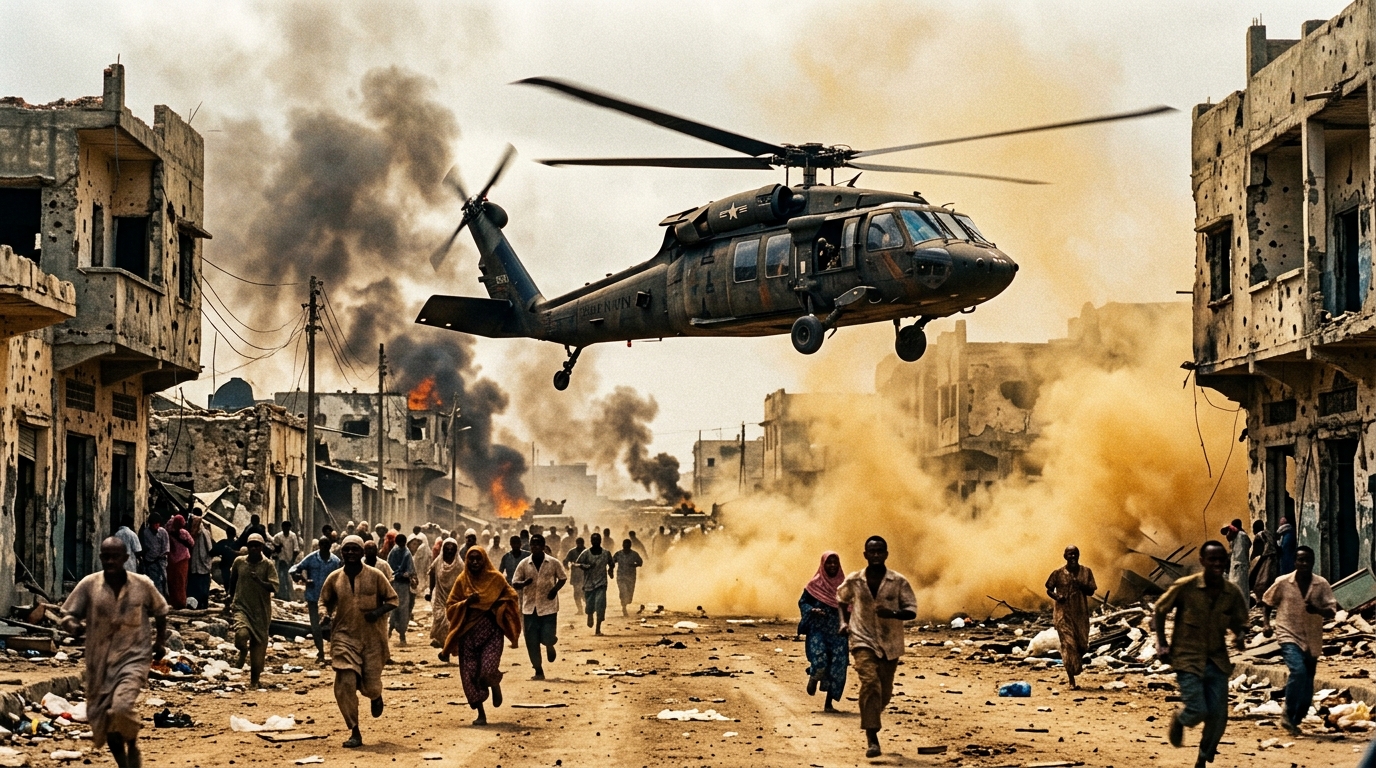
At 16:20, disaster struck. An RPG-7 rocket-propelled grenade, a relatively simple and inexpensive weapon, hit the tail rotor of Black Hawk Super 61, piloted by Chief Warrant Officer Cliff Wolcott, causing it to crash in a heavily populated and hostile section of the city. This single event transformed a planned 30-minute raid into an 18-hour urban nightmare. Immediately, a Ranger chalk was fast-roped to secure the crash site, while the remaining ground convoy attempted to reach the downed helicopter. However, the streets of Mogadishu quickly became a labyrinthine battlefield. Aidid's militia, utilizing their intimate knowledge of the urban terrain, quickly mobilized, erecting roadblocks and deploying hundreds of fighters, often mixed with civilians, against the US forces.
Approximately an hour later, at 17:40, a second Black Hawk, Super 64, piloted by Chief Warrant Officer Michael Durant, was shot down by another RPG-7. This second crash further complicated the rescue efforts, stretching already limited resources. Delta Force snipers MSG Gary Gordon and SFC Randy Shughart, realizing the desperate situation of Durant and his crew, volunteered to be inserted onto the crash site to protect the downed pilot. They fought heroically, expending all their ammunition, before being overwhelmed and killed. Durant was captured, the sole survivor of Super 64's crew. Both Gordon and Shughart were posthumously awarded the Medal of Honor for their extraordinary valor, the first awarded since the Vietnam War.
The ground forces, now pinned down at the first crash site and attempting to reach the second, found themselves embroiled in a desperate, prolonged urban firefight. The lack of adequate armored vehicles in the initial force composition proved to be a fatal flaw. While Humvees offered some protection, they were vulnerable to RPGs and heavy machine gun fire, and their lack of heavy armament made suppressing the overwhelming numbers of Somali militia difficult. Attempts by the ground convoy to reach the crash sites were repelled by intense resistance, inflicting heavy casualties.
As darkness fell, the situation grew more dire. US forces, now scattered and encircled, prepared for a long night of fighting. The AC-130 Specter gunships provided crucial overhead fire support, its sophisticated night vision allowing it to engage targets unseen by ground forces. However, it could not deter the relentless human wave attacks of the Somali militia. A crucial relief convoy, consisting of Malaysian and Pakistani UN peacekeepers and additional US forces, including armored personnel carriers (APCs) and tanks, was painstakingly organized. Led by US Army Major General William F. Garrison, the commander of Task Force Ranger, and under heavy fire, this "Daylight Convoy" finally reached the pinned-down US soldiers in the early hours of October 4.
The extraction from the city, famously dubbed "the Mogadishu Mile," saw US Rangers and Delta operators running alongside the armored vehicles, under continuous fire, to reach the relative safety of the Pakistani stadium. The battle finally ended around dawn on October 4. The cost was significant: 18 US soldiers killed and 73 wounded, with one pilot (Durant) captured. On the Somali side, casualty estimates varied widely, from several hundred to over a thousand killed, including combatants and non-combatants, and many more wounded. The battle showcased the tactical brilliance and bravery of the US special forces, but also the limitations of high-tech military power against a determined, numerous, and urban-savvy adversary.
Intelligence and Operational Challenges
The Battle of Mogadishu and the broader US intervention were plagued by significant intelligence and operational challenges that contributed to the mission's ultimate difficulties and tactical setbacks.
Foremost among these was a profound lack of understanding of the complex socio-political landscape of Somalia. US intelligence agencies, accustomed to Cold War-era state actors, struggled to comprehend the intricate clan-based power structures, the fluidity of allegiances, and the motivations of non-state actors like Aidid. Intelligence regarding Aidid's network, his command and control structure, and his militia's capabilities was often fragmented, outdated, or inaccurate. There was an underestimation of Aidid's ability to rapidly mobilize and motivate the local population, including women and children, to resist foreign forces, framing the UN and US as invaders rather than liberators.
Operational constraints further hampered effectiveness. Task Force Ranger was initially denied essential assets that could have mitigated risks. The most critical was the repeated denial of heavy armored vehicles, specifically M1 Abrams tanks or M2 Bradley Fighting Vehicles, which General Garrison requested to provide protection and firepower in Mogadishu's urban environment. These requests were denied by higher command, driven by political sensitivities and a desire to maintain a "light footprint" that would not be perceived as an overwhelming invasion force. This decision proved catastrophic during the Battle of Mogadishu, as the lightly armored Humvees were ill-equipped to withstand sustained urban combat against RPGs and small arms fire, and their mobility was easily hampered by improvised roadblocks.
Additionally, rules of engagement (ROE) for UNOSOM II were complex and at times restrictive, creating confusion and hesitation among forces on the ground. While the US forces under Task Force Ranger operated under more aggressive ROE focused on capturing high-value targets, they were still constrained by broader UN political directives, which often prioritized de-escalation and humanitarian objectives. The reluctance to engage in widespread disarmament initially allowed warlords to retain their arms, laying the groundwork for future confrontations.
Intelligence gathering within Mogadishu itself was also problematic. The urban environment, with its dense population and narrow, winding streets, made traditional surveillance difficult. Human intelligence was scarce and unreliable due to the clan divisions and fear of retribution. Attempts to use sophisticated signals intelligence were often ineffective against a low-tech enemy communicating through runners and basic radios. Furthermore, the reliance on high-tech aerial platforms, while offering a broad overview, often lacked the granular detail needed to predict localized ambushes or identify specific targets amidst a crowded populace.
The combination of these factors — a cultural intelligence deficit, politically-driven operational restrictions, and tactical intelligence gaps — created a volatile environment where superior technology and training were ultimately insufficient to overcome the challenges posed by a determined and adaptable adversary deeply embedded within the urban landscape.
Geopolitical Consequences and Aftermath
The fallout from Mogadishu was immediate and profound, reverberating through domestic US politics and international foreign policy for decades. Domestically, the Clinton administration faced a firestorm in Congress and public outcry. The televised images of dead American soldiers being dragged through the streets of Mogadishu and the capture of Chief Warrant Officer Michael Durant sent a shockwave across the nation. Questions mounted regarding the mission's purpose, its escalating costs in blood and treasure, and the perceived "mission creep" from humanitarian aid to active combat. Republicans, alongside a growing chorus of Democrats, demanded an immediate explanation for the shift and a rapid withdrawal. President Clinton, facing immense pressure, addressed the nation on October 7, 1993, reaffirming the US commitment to humanitarian goals but announcing a firm deadline for troop withdrawal by March 31, 1994. An additional 1,700 Marines and armored equipment were deployed temporarily to secure the withdrawal.
Internationally, the incident became a seminal case study in the risks of asymmetric warfare and the complexities of post-Cold War interventions. It starkly demonstrated that state-of-the-art military technology, while powerful, could be negated by an agile, determined insurgent force using low-tech weaponry (like the RPG-7) and leveraging deep knowledge of the terrain and local population. The graphic nature of the battle amplified concerns about "casualties tolerance" in Western democracies, particularly for missions lacking a direct, existential national security threat.
The most significant and lasting legacy on US foreign policy was the development of Presidential Decision Directive 25 (PDD-25), issued in May 1994. This directive, a direct response to the Somalia experience, established stringent criteria for US participation in future UN-led peacekeeping operations. It mandated:
- Clear and achievable objectives with a defined end-state.
- A reasonable prospect of success.
- A clear UN mandate.
- The willingness of other nations to contribute.
- Crucially, a demonstration that US involvement served a vital national interest.
PDD-25 effectively raised the bar for US intervention, leading to a long-term US reluctance to commit to large-scale humanitarian interventions in regional conflicts throughout the 1990s. This policy had tragic consequences in subsequent crises, most notably during the Rwandan Genocide in 1994. The international community, still reeling from Mogadishu, hesitated to act decisively, withdrawing UN peacekeepers as the genocide escalated, contributing to the deaths of an estimated 800,000 people. Many scholars and policymakers argue that the "shadow of Somalia" paralyzed international action in Rwanda.
The event also fueled debates about the "Powell Doctrine," named after then-Chairman of the Joint Chiefs of Staff Colin Powell, which advocated for overwhelming force, clear objectives, and a defined exit strategy before military engagement. Somalia became a textbook example of what could go wrong when these principles were not fully adhered to, particularly concerning the use of limited force for nation-building goals. The "Mogadishu Line" became shorthand for the political threshold of casualties a Western nation could tolerate in non-vital interventions.
The Battle of Mogadishu did not end the UNOSOM II mission immediately, but it irrevocably altered its trajectory. The UN shifted from aggressively pursuing Aidid to focusing on political reconciliation. Most Western forces, including the US, completed their withdrawal by March 1994, leaving behind a reduced UN force that eventually departed in March 1995. The intervention's failure to establish a stable government ultimately contributed to Somalia's continued status as a 'failed state' for decades, becoming a haven for piracy and later, extremist groups.
Analysis of Key Actors and Decisive Actions
The Somalia intervention and its tragic turning point were shaped by the interplay of several key actors, each with their own objectives, limitations, and miscalculations.
Mohamed Farrah Aidid emerged as the primary antagonist from the Western perspective, yet his actions from a Somali viewpoint were largely those of a warlord protecting his sphere of influence and clan interests against perceived foreign occupation. Aidid was a former general in Siad Barre's army, with a deep understanding of military strategy and, crucially, Somali clan politics. He shrewdly exploited the cultural and informational gaps of the intervening forces. Aidid understood that his relatively weaker conventional military power could be offset by asymmetric tactics: using the dense urban environment of Mogadishu to his advantage, blurring the lines between combatants and civilians, and leveraging the clan loyalty of the Habar Gidr. He effectively framed the UN and US intervention not as humanitarian aid but as an attempt to disarm and subjugate his clan, thereby galvanizing popular support against the international forces. His fighters, often lightly armed but highly motivated and intimately familiar with the labyrinthine streets, employed effective tactics such as ambushes, hit-and-run attacks, and the devastating use of RPG-7s against helicopters. Furthermore, Aidid's capture and subsequent release of Chief Warrant Officer Michael Durant, coupled with the brutal images of American bodies, demonstrated a sophisticated understanding of information warfare, directly influencing international public opinion and pressuring the US to withdraw.
President Bill Clinton found himself in a precarious position, having inherited Operation Restore Hope from the Bush administration. While the initial humanitarian success was clear, the transition to UNOSOM II's nation-building mandate occurred on his watch. Clinton, and his advisors, were initially enthusiastic about multilateralism and humanitarian intervention in the post-Cold War era. However, the unexpected and brutal casualties in Mogadishu represented a profound shock to his administration. He faced intense pressure from Congress and a horrified American public who had little understanding of why American soldiers were dying in a distant African civil war after the humanitarian crisis had been ostensibly resolved. Clinton’s subsequent decision to set a withdrawal deadline and issue PDD-25 reflected a dramatic shift in his foreign policy approach, prioritizing the protection of American lives and defining national interests more narrowly. The events of Mogadishu undoubtedly tempered his willingness to engage militarily in subsequent humanitarian crises, a policy that would face harsh scrutiny during the Rwandan Genocide.
UN Secretary-General Boutros Boutros-Ghali, a former Egyptian Foreign Minister, played a significant but controversial role. He was a vocal advocate for robust UN peacekeeping and nation-building in Somalia. Following the June 5 ambush of Pakistani peacekeepers, it was Boutros-Ghali who aggressively pushed for a strong UN response, declaring Aidid an outlaw and placing a bounty on his head. This decision, while understandable in the context of protecting UN forces, dramatically escalated the conflict and personalized it, shifting the mission from peace enforcement to "manhunting." His assertive stance, however, often clashed with the more cautious approach of the US, particularly as casualties mounted, creating friction between the UN and its most powerful member state.
Major General William F. Garrison, the commander of Task Force Ranger, faced immense operational challenges. Leading an elite special operations force designed for surgical strikes, he found himself in a prolonged urban battle where his assets were ill-suited for sustained ground combat against a numerous and entrenched enemy. His requests for armored support were denied by higher authorities, a decision that haunted the operation. Despite these limitations, Garrison's leadership in orchestrating the complex and dangerous relief effort during the "Mogadishu Mile" was critical in preventing even greater loss of life. His tactical decisions during the raid itself were based on the best available intelligence at the time, but the unpredictability of urban warfare and the enemy's resilience ultimately created an uncontrollable situation.
The collective actions and decisions of these figures, within a complex and rapidly evolving environment, converged to produce one of the most defining moments in post-Cold War international relations, forcing a re-evaluation of interventionist policies and the limits of military power.
Legacy and Historiographical Debates
The US intervention in Somalia and the Battle of Mogadishu left an indelible mark on military doctrine, foreign policy, and the global perception of humanitarian intervention. Its legacy continues to be debated by historians, policymakers, and military strategists, offering multiple interpretations of its successes, failures, and enduring lessons.
One of the central debates revolves around the concept of "mission creep." Was the expansion of UNOSOM II's mandate from humanitarian aid to disarmament and nation-building an inevitable and necessary evolution, or a fatal overreach that doomed the mission? Proponents of the expanded mandate argue that simply feeding the starving without addressing the root causes of conflict — the warring factions and the absence of a functional state — would have been a temporary fix, leading to a resurgence of violence once international forces departed. They contend that sustainable peace required political stabilization. Critics, however, argue that the UN and US lacked the capacity, cultural understanding, and political will for such an ambitious undertaking. The abrupt shift from neutrality to active engagement in a civil conflict alienated the very population the mission was intended to help, turning former beneficiaries into adversaries.
Another significant historiographical debate centers on the role of media and public opinion. The "CNN effect" is often cited as both a catalyst for intervention (mobilizing international will for Operation Restore Hope) and a constraint on sustained engagement (forcing withdrawal after the graphic images of US casualties). Some argue that the media, in its pursuit of compelling narratives, oversimplified the conflict and inadvertently swayed public and political opinion disproportionately. Others maintain that the media played a vital democratic function by exposing the human cost of intervention and holding leaders accountable, albeit in a brutal fashion. This interplay between media coverage, public perception, and policy-making remains a complex and contested area of study.
The Battle of Mogadishu also profoundly impacted military strategy and procurement. The effectiveness of the RPG-7 against Black Hawk helicopters led to re-evaluations of helicopter vulnerability and protective measures. The difficulties faced by light infantry in urban combat without armored support spurred greater emphasis on urban warfare training, combined arms tactics, and the integration of armor and air support in complex operational environments. The value of robust intelligence gathering, cultural awareness, and clear rules of engagement became paramount in military planning.
Furthermore, the long-term impact on Somalia itself is a subject of ongoing discussion. The withdrawal of international forces left a power vacuum that was eventually filled by various warlords, followed by extremist groups like Al-Shabaab. Some argue that the intervention, by disrupting a fragile balance of power, inadvertently prolonged Somalia's instability. Others contend that Somalia's trajectory was already set by decades of internal conflict and that the international community's efforts, however flawed, provided a temporary reprieve from widespread death. The perception of foreign intervention in Somalia continues to shape local political dynamics and anti-Western sentiment.
Finally, the ethical dimension of intervention is a persistent legacy. The high Somali casualty count, often overlooked in Western narratives focusing on US losses, raises questions about the disproportionate impact of modern warfare on civilian populations in asymmetric conflicts. It also fuels debates about the 'responsibility to protect' (R2P) doctrine, which emerged later, and the inherent tension between state sovereignty and humanitarian imperative. Mogadishu stands as a cautionary tale, demonstrating the profound complexities and unintended consequences of attempting to impose order from the outside, even with the noblest of intentions. The legacy is thus not one of simple victory or defeat, but of a complex, multifaceted event that continues to inform global approaches to conflict, humanitarianism, and the use of force.
Trivia and Lesser-Known Facts
- Casualty Disparity and Perception: While 18 US soldiers lost their lives during the main battle (with another dying shortly after from wounds), estimates for Somali casualties range dramatically from 300 to over 1,000, including combatants and non-combatants caught in the intense crossfire. This significant disparity often shapes divergent narratives of the event, with the US focus on its own losses and the Somali perspective highlighting the devastating impact on their population.
- The "Black Hawk" Legacy: The gripping non-fiction book Black Hawk Down: A Story of Modern War by Mark Bowden brought the event into the public consciousness, meticulously detailing the tactical and human elements of the battle. It was later adapted into a critically acclaimed major motion picture directed by Ridley Scott in 2001, which, despite some historical liberties, powerfully depicted the chaos and heroism of the soldiers involved.
- The Role of Technology in Urban Combat: The battle saw an early and intense major use of advanced night-vision technology in a sustained urban fight. While it provided US forces with a temporary tactical advantage during the night, allowing them to engage unseen enemies, it couldn't fully compensate for the lack of heavy armor or the sheer numerical superiority of the Somali militia, who were intimately familiar with the terrain.
- The Media’s Unprecedented Role: The imagery of a captured US pilot (Michael Durant) and the desecration of a soldier's body (SFC Randall Shughart's remains were reportedly dragged through the streets) were pivotal moments in the history of "CNN-driven foreign policy." The 24-hour news cycle, still relatively new, broadcast these images globally, instantly galvanizing public outrage and directly influencing the Clinton administration's decision-making, demonstrating the growing power of media to dictate, rather than merely report on, the pace of diplomatic and military action.
- The Humanitarian Mission's Initial Success: It's often overshadowed by the battle, but Operation Restore Hope (UNITAF) was remarkably successful in its primary, initial phase. By early 1993, the intervention had largely secured food supply lines and mitigated the mass starvation that had claimed hundreds of thousands of lives. The operation is still considered a textbook example of effective humanitarian intervention, before its mission expanded.
- Aidid's Survival and Aftermath: Despite the intense manhunt, Mohamed Farrah Aidid was never captured by US forces. He later declared himself president of Somalia in 1995 but was not internationally recognized. He died in August 1996 from wounds sustained in inter-clan fighting, nearly three years after the Battle of Mogadishu. His death did not, however, lead to immediate stability or the formation of a strong central government in Somalia.
- Medal of Honor Recipients: Delta Force snipers MSG Gary Gordon and SFC Randy Shughart were posthumously awarded the Medal of Honor, the highest US military decoration, for their extraordinary heroism in defending the second Black Hawk crash site and its pilot, Michael Durant. They were the first recipients of the Medal of Honor since the Vietnam War.
References and Literature
- Black Hawk Down: A Story of Modern War - A seminal investigative account by Mark Bowden regarding the tactical and human elements of the battle.
- The Somalia Intervention: A Case Study in Policy Failure - A scholarly analysis published in Foreign Affairs examining the collapse of the humanitarian mandate.
- Presidential Decision Directive 25 - The official archive of the Clinton administration’s policy change regarding UN-led peacekeeping operations.
- Somalia: The Missed Opportunities - Research from the United States Institute of Peace documenting the diplomatic breakdown between the UN and Somali clans.
- Allard, Kenneth. Somalia Operations: Lessons Learned. National Defense University Press, 1995. - A comprehensive official military analysis of the operation.
- Stevenson, Jonathan. Losing the Edge: The Clinton Administration and the US Military in Somalia, Rwanda, and Haiti. Harvard University Press, 2005. - Examines the broader context of Clinton's foreign policy decisions in the 1990s.
Footnotes & Explanations
- UN Resolution 794 authorized the use of "all necessary means" to establish a secure environment for humanitarian relief. ↩
- The transition to UNOSOM II marked the start of active political confrontation with the SNA, moving beyond strictly humanitarian objectives. ↩
- PDD-25 remains a foundational document for US military doctrine regarding foreign interventions in civil conflicts, emphasizing caution and clear national interest. ↩