Key Takeaways
- The withdrawal marked the formal conclusion of the longest war in American history, initiated in the aftermath of the September 11 attacks, costing over $2 trillion and countless lives.
- The rapid collapse of the Afghan National Defense and Security Forces (ANDSF) highlighted deep-seated systemic failures, including corruption, over-reliance on U.S. support, and a critical loss of morale and legitimacy.
- The Taliban's swift return to power fundamentally altered the regional geopolitical landscape, compelling a re-evaluation of U.S. counterterrorism strategies and raising significant humanitarian and human rights concerns.
- The withdrawal's chaotic execution revealed intelligence failures, strategic miscalculations, and left a lasting impact on international perceptions of U.S. reliability and global leadership.
Historical Context and Origins: The "Forever War" and Its Deep Roots
The conflict in Afghanistan, often labeled "The Forever War," did not begin solely with the events of October 2001. Its origins are deeply interwoven with Afghanistan's turbulent 20th-century history, particularly the Soviet invasion in 1979 and the subsequent proxy war, which saw the United States arming Mujahideen factions. This period gave rise to powerful, often religiously conservative, warlords and the eventual emergence of the Taliban in the mid-1990s from the chaos of civil war. The Taliban, initially welcomed by many Afghans weary of militia rule, quickly imposed a strict interpretation of Islamic law and provided sanctuary to Osama bin Laden and Al-Qaeda.
Following the devastating September 11, 2001, terrorist attacks on the World Trade Center and the Pentagon, which Al-Qaeda claimed responsibility for, the United States, under President George W. Bush, launched Operation Enduring Freedom. The initial, clearly defined goal was to dismantle Al-Qaeda's operational capabilities and depose the Taliban regime for harboring bin Laden. This objective was rapidly achieved; the Taliban regime collapsed within weeks, and an interim government, followed by the Bonn Agreement in December 2001, laid the groundwork for a new Afghan state.
However, the mission soon morphed. With the primary military objectives seemingly met, the focus broadened significantly to an ambitious—and ultimately ill-fated—project of state-building, democratic institutionalization, and nationwide security sector reform. Billions of dollars were poured into building a Western-style democracy, establishing new institutions, and training the Afghan National Army (ANA) and police force. This expansive vision often clashed with Afghanistan's complex tribal loyalties, pervasive corruption, and deeply rooted socio-political structures. The U.S. and its NATO allies found themselves embroiled in a protracted counter-insurgency against a resurgent Taliban, which leveraged local grievances, ethnic fragmentation, and support networks across the border in Pakistan.
Over two decades, successive U.S. administrations struggled to define victory. The Bush administration shifted focus to Iraq, allowing the Afghan insurgency to regain strength. The Obama administration launched a "surge" of troops in 2009, aiming to degrade the Taliban, build Afghan capacity, and enable a responsible drawdown. While temporary tactical gains were made, the fundamental challenges of governance, corruption, and the Taliban's resilience persisted. By the late 2010s, the U.S. public and political establishment reached a palpable point of war fatigue. The strategic landscape had fundamentally shifted from actively fighting an insurgency to propping up a government in Kabul that struggled with endemic corruption, ethnic fragmentation, internal administrative paralysis, and a growing disconnect from its own rural population.
The turning point came with the Trump administration, which openly questioned the utility of continued military presence and initiated direct talks with the Taliban in 2018. This move, spearheaded by Special Representative Zalmay Khalilzad, was highly controversial. Notably, the internationally recognized Afghan government under President Ashraf Ghani was largely excluded from these negotiations. This exclusion severely undermined Ghani’s authority and legitimacy, signaling to regional power brokers, the Afghan populace, and crucially, the Taliban, that a U.S. exit was inevitable and that the Afghan government’s future was increasingly tenuous. The Doha Agreement, signed in February 2020, formalized this commitment, setting a timeline for complete U.S. troop withdrawal, conditional on the Taliban's counterterrorism guarantees and engagement in intra-Afghan peace talks. However, the intra-Afghan talks made little substantive progress, leaving the political future of Afghanistan dangerously unresolved.
Timeline of Events and Key Moments
The transition from a seemingly indefinite presence-based strategy to a total, precipitous withdrawal was marked by several critical junctures, each revealing the accelerating pace of the U.S. disengagement and the corresponding collapse of the Afghan state.
| Date | Event | Significance |
|---|---|---|
| Oct 7, 2001 | Operation Enduring Freedom begins | U.S. and UK forces launch air strikes, marking the start of the war. |
| Dec 5, 2001 | Bonn Agreement signed | Establishes interim Afghan government, setting path for new constitution and elections. |
| Dec 2004 | Hamid Karzai elected President | First democratically elected president of Afghanistan. |
| Feb 17, 2009 | Obama announces troop surge | U.S. military presence reaches peak of over 100,000 troops by 2010. |
| May 2, 2011 | Osama bin Laden killed | U.S. Special Forces kill Al-Qaeda leader in Pakistan, fulfilling a key initial objective. |
| Dec 28, 2014 | NATO ends combat mission | "Operation Resolute Support" begins, focusing on training and advising Afghan forces. |
| Sep 2018 | U.S. begins direct talks with Taliban | Trump administration bypasses Afghan government to negotiate withdrawal. |
| Feb 29, 2020 | Doha Agreement signed | The U.S. commits to a full withdrawal by May 1, 2021, contingent on Taliban counterterrorism assurances and intra-Afghan dialogue. |
| Jan 15, 2021 | Trump administration reduces troop levels | U.S. troops in Afghanistan fall to 2,500, the lowest since 2001. |
| Apr 14, 2021 | Biden’s Withdrawal Announcement | President Biden delays the Trump-era deadline but sets a firm final withdrawal date of September 11, 2021, later moved to August 31. |
| May 1, 2021 | Official start of final U.S. withdrawal | Remaining U.S. forces begin departure; Taliban intensify offensive operations. |
| Jul 2, 2021 | Bagram Airfield evacuated | U.S. forces quietly abandon the crucial strategic base without informing Afghan commanders, a major symbolic and operational blow. |
| Aug 6, 2021 | Fall of Zaranj | Zaranj, capital of Nimruz province, becomes the first provincial capital to fall to the Taliban since the withdrawal began, marking the start of the rapid domino effect. |
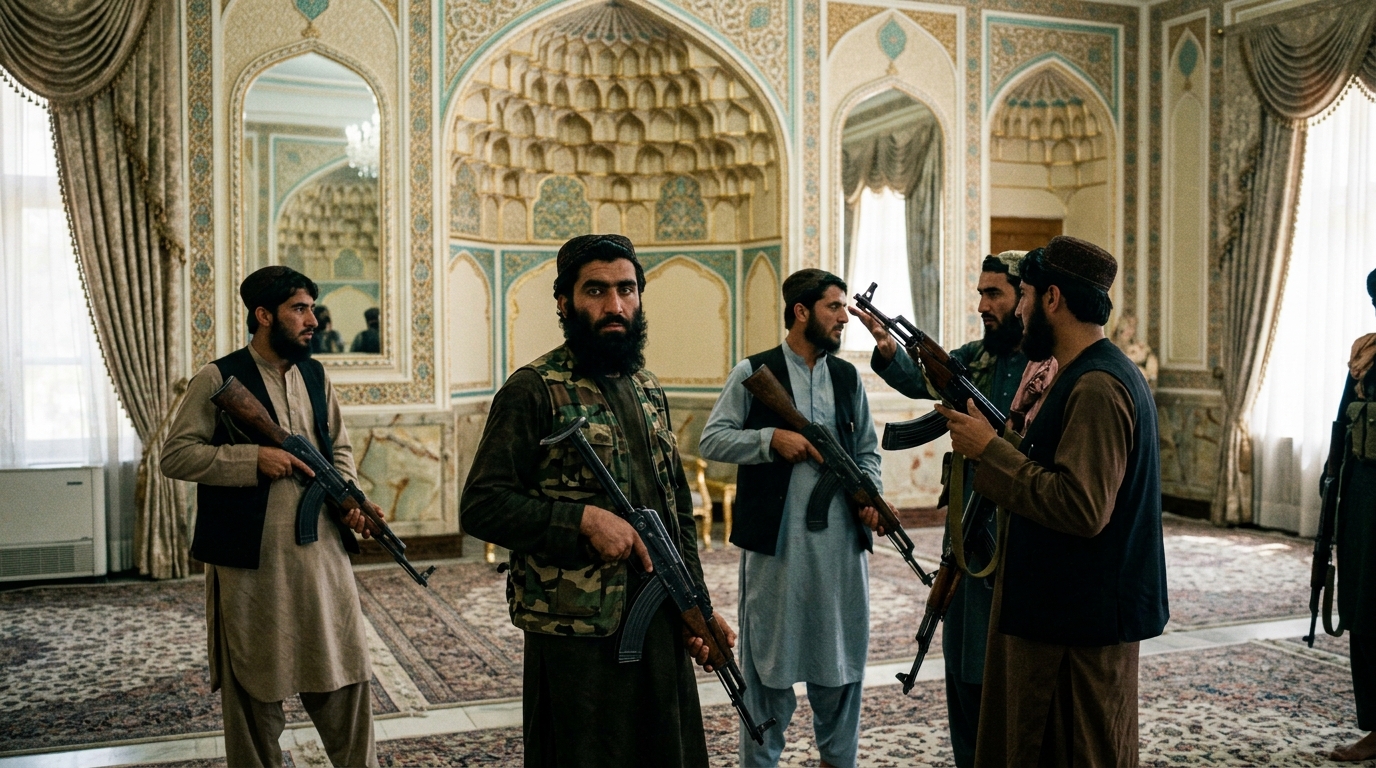
| Aug 15, 2021 | Fall of Kabul | President Ashraf Ghani flees the country; Taliban fighters enter the capital largely unopposed, seizing control of the presidential palace. |
| Aug 16-30, 2021 | Chaotic Kabul Airport Evacuation | Tens of thousands of Afghans and foreign nationals are evacuated amidst desperate scenes and security threats, including a deadly ISIS-K attack. |
| Aug 30, 2021 | Final U.S. Flight | Major General Chris Donahue boards the last C-17 military transport plane from Kabul, formally ending the 20-year U.S. military presence in Afghanistan. |
The Collapse of the Republic: A Domino Effect
The speed of the Taliban’s advance during the summer of 2021 caught international intelligence agencies, and indeed many within the Taliban itself, off guard. From May to August, a meticulously planned and executed Taliban offensive exploited the systemic weaknesses of the Afghan National Defense and Security Forces (ANDSF). As U.S. forces drew down, particularly after the abandonment of Bagram Airfield, the ANDSF—long dependent on American logistical support, intelligence, and crucial air power—began to disintegrate.
The collapse was not merely military; it was psychological and political. Local commanders often negotiated surrenders rather than fighting, spurred by promises of amnesty or fear of retribution. The widespread corruption within the ANDSF, where "ghost soldiers" inflated payrolls and supplies were routinely diverted, meant that many units were underpaid, poorly equipped, and lacked fundamental morale. Without U.S. air support to counter Taliban advances and the logistical backbone provided by contractors, ANDSF units were isolated and outmaneuvered. The perception of abandonment by their primary foreign backer, coupled with President Ghani's increasingly isolated leadership and perceived illegitimacy, created a cascade effect. Provincial capitals fell one after another, often with minimal resistance, culminating on August 15, when the Taliban entered Kabul without firing a shot, effectively ending the 20-year experiment in Western-style governance. President Ghani's sudden flight from the country that day further cemented the perception of a government that had lost its will to fight, leaving a power vacuum the Taliban readily filled.
Geopolitical Consequences and Aftermath
The withdrawal produced a seismic shift in regional power dynamics, reshaping alliances, igniting new concerns, and challenging existing geopolitical paradigms. The sudden vacuum left by the United States prompted immediate maneuvering from a diverse array of neighboring actors and global powers.
- Regional Hegemony and Pakistan's Predicament: Pakistan, historically a complex and often contradictory partner in the "War on Terror," found itself in a precarious position. Long suspected of providing sanctuary and strategic depth to elements of the Taliban, Islamabad initially viewed the Taliban's return as a strategic victory, a reassertion of its influence in a neighboring state. However, this has been tempered by significant risks of blowback. The Tehrik-i-Taliban Pakistan (TTP), or Pakistani Taliban, emboldened by their Afghan counterparts' success, intensified their insurgency within Pakistan, leading to increased instability along the Durand Line. Pakistan faces the challenge of managing a potentially volatile border, the influx of refugees, and the delicate balance between engaging with the new Taliban regime and addressing international concerns about terrorism.
- Great Power Competition: Russia and China's Strategic Engagement: Both Russia and China, traditionally wary of Islamic militancy bleeding into their respective spheres of influence in Central Asia, moved swiftly to engage diplomatically with the new regime. Their primary focus has been regional stability, counterterrorism, and economic opportunities, rather than human rights or democratic principles.
- Counterterrorism Re-evaluation and the "Over-the-Horizon" Strategy: The U.S. lost its permanent military and intelligence footprint in the heart of Eurasia, a critical base for counterterrorism operations. The current "over-the-horizon" strategy relies on intelligence gathering and drone strikes launched from outside the country. While the killing of Ayman al-Zawahiri in Kabul in July 2022 demonstrated some capability, security analysts argue that this method is significantly less effective than a localized presence with on-the-ground intelligence networks. The withdrawal raised concerns about the potential for Afghanistan to once again become a haven for international terrorist groups, challenging U.S. counterterrorism objectives globally and raising questions about the long-term security implications for the American homeland.
- Impact on Regional Actors: India, Iran, and Central Asia:
- Erosion of U.S. Credibility and Alliance Management: The chaotic nature of the withdrawal and the swift collapse of the Afghan government sent ripples through Washington's allied nations. Critics argued that it damaged U.S. credibility, raising questions about Washington's reliability as a partner and its commitment to protracted state-building efforts. For NATO allies who had invested heavily in the Afghanistan mission, the unilateral nature and abruptness of the withdrawal were particularly jarring, prompting broader debates about the future of transatlantic security cooperation and the efficacy of joint military interventions.
Analysis of Key Actors and Decisive Actions
The final act of the Afghanistan War was shaped by the decisions and actions, or inactions, of several pivotal figures, whose legacies will be inextricably linked to the events of 2021.
Joe Biden: The Pragmatic Pivot to an Impatient Exit
President Joe Biden’s decision to follow through with, and indeed expedite, the withdrawal initiated by his predecessor, Donald Trump, was grounded in a long-held conviction that the war had become a "strategic distraction." For decades, Biden had expressed skepticism about large-scale nation-building efforts, advocating for a more focused counterterrorism approach. His administration argued that the U.S. presence, increasingly devoid of a clear strategic purpose beyond preventing the government's collapse, was no longer vital to protecting the American homeland and consumed resources better directed towards emerging geopolitical challenges, particularly great power competition with China and Russia.
Biden inherited the Doha Agreement and, despite the Taliban's failure to fully adhere to its spirit regarding intra-Afghan talks, he ultimately chose to prioritize the commitment to withdraw over attempting to renegotiate or extend the presence. He emphasized that the U.S. had achieved its core counterterrorism objectives related to 9/11 and that a continued military presence could not guarantee a different outcome for Afghanistan's internal political struggles. As he stated in April 2021, "I am the fourth American president to preside over American troop presence in Afghanistan. Two Republicans, two Democrats. I will not pass this responsibility to a fifth." This framing underscored his belief that the war was unwinnable in conventional terms and that the cost-benefit analysis no longer justified continued engagement.
However, the execution of the withdrawal and the subsequent optics of the evacuation, particularly the harrowing scenes at Kabul International Airport, severely damaged the administration’s domestic approval ratings and invited fierce international criticism regarding operational planning and foresight. The rapid collapse and the humanitarian crisis that unfolded overshadowed the strategic rationale for ending the war, painting a picture of chaos and unpreparedness. Critics argued that the Biden administration had underestimated the speed of the Taliban's advance and failed to adequately plan for the safety of Afghan allies, leaving thousands vulnerable.
Ashraf Ghani: The Failed Architect of a Fragile State
President Ashraf Ghani’s leadership was characterized by a reliance on an intellectual, top-down governance model that struggled to connect with and gain the loyalty of Afghanistan's diverse and often rural populations. An accomplished academic and former World Bank official, Ghani approached governance with a technocratic vision, aiming to centralize power and implement sweeping reforms. However, this often alienated powerful regional figures, exacerbated ethnic divisions, and failed to address the deeply entrenched corruption that plagued every level of government and the security forces.
His government was perceived by many Afghans as distant, ineffective, and fundamentally corrupt. Ghani’s insistence on centralizing command structures for the ANDSF, often overriding experienced generals, further weakened the military's coherence and effectiveness. His exclusion from the U.S.-Taliban Doha negotiations critically undermined his authority, signaling that his government was not a full partner in its own country's future. As the Taliban gained momentum in 2021, Ghani’s public statements often projected defiance, but behind the scenes, his administration was crumbling. His abrupt departure on August 15, purportedly to prevent bloodshed but without notifying his cabinet or security chiefs, effectively collapsed the state apparatus overnight, leaving his security forces without a unified command structure and extinguishing any remaining hope of organized resistance. His flight was widely viewed as a betrayal, cementing his legacy as the leader who presided over the swift, ignominious end of the Afghan Republic.
The Taliban: Patience, Propaganda, and Proxy Power
The Taliban's decisive victory in 2021 was a testament to their long-term strategy, unwavering ideological commitment, and a shrewd understanding of Afghanistan's political landscape. Despite being outgunned and outmanned by Western-backed forces for two decades, their insurgency never truly abated. Their strategy revolved around several key pillars:
- Resilience and Sanctuary: Sustained by cross-border sanctuaries in Pakistan and drawing on a consistent recruitment pool from disaffected rural populations.
- Propaganda and Psychological Warfare: Portraying the Afghan government as a corrupt, foreign-backed puppet regime and themselves as liberators from occupation.
- Local Governance: Even while fighting, the Taliban often provided more effective, albeit brutal, local governance and justice in areas they controlled than the distant and corrupt Kabul government.
- Exploiting U.S. Withdrawal: They capitalized on the U.S.'s clear intent to withdraw, using the Doha Agreement as a legitimizing document and a psychological weapon against the ANDSF. They launched a highly effective hearts-and-minds campaign coupled with targeted military pressure, frequently negotiating local surrenders rather than engaging in costly battles. Their swift advance demonstrated not just military prowess, but also a profound weakness in the opposing forces and a widespread disillusionment with the Afghan Republic.
New Section 1: Intelligence Failures and Strategic Miscalculations
The rapidity of the Afghan government's collapse and the Taliban's triumphant return caught much of the international community, including top U.S. intelligence agencies, off guard. Despite two decades of extensive intelligence gathering and military presence, there was a profound disconnect between on-the-ground realities and the assessments informing policy decisions.
Underestimation of Taliban Strength and ANDSF Weakness: For years, U.S. intelligence reports and public statements often presented an overly optimistic view of the Afghan National Defense and Security Forces (ANDSF) capabilities. Billions of dollars were spent on training and equipping the ANDSF, with pronouncements that they were "ready to take the lead." However, internal government documents, such as those later revealed in "The Afghanistan Papers," painted a far bleaker picture, detailing systemic issues:
- "Ghost Soldiers" and Corruption: Widespread corruption meant that troop numbers were inflated, allowing commanders to siphon off salaries and resources. This created a facade of strength that crumbled under pressure.
- Logistical Dependence: The ANDSF was critically dependent on U.S. and contractor support for air power, intelligence, maintenance, and logistics – capabilities they never fully internalized. Once this support dwindled, their operational capacity evaporated.
- Morale and Legitimacy: Poor leadership, endemic corruption, and a perception that the government lacked legitimacy eroded troop morale. When the U.S. withdrawal was announced, many soldiers felt abandoned and saw no reason to fight for a government perceived as failing and a cause they no longer believed in.
Misreading the Taliban's Strategy and Resilience: Intelligence agencies failed to fully grasp the Taliban's strategic patience and their deep roots within certain segments of Afghan society. The Taliban were not merely a terrorist group; they were a resilient insurgent force with a sophisticated political and military command structure. They effectively exploited local grievances, tribal rivalties, and the desire for stability, even if under harsh rule, over the corrupt and chaotic alternative offered by Kabul. The Doha Agreement, intended to usher in peace talks, instead provided the Taliban with a clear timeline for U.S. withdrawal, which they shrewdly interpreted as a green light for a final offensive.
The "Withdrawal Paradox": The very act of announcing a withdrawal created a self-fulfilling prophecy of collapse. Once the U.S. commitment to staying was removed, the incentives for Afghan forces to fight and for political leaders to compromise vanished. Intelligence agencies struggled to accurately predict the speed of this psychological and institutional breakdown, often adhering to models that projected a slower, more contested transition. The consensus among many analysts was that Kabul would fall in months, not days or weeks. This severe underestimation had direct consequences for the evacuation planning, leading to the chaotic and dangerous scenes at Kabul's airport.
Policy vs. Intelligence: There were also debates about whether intelligence warnings were heeded. Some argue that intelligence estimates were indeed pessimistic, but political leaders, determined to end the "forever war," chose to prioritize the withdrawal timeline over worst-case scenarios. This reflects a broader challenge in national security decision-making: the interplay between intelligence assessments and political imperatives, where the desire for a particular outcome can sometimes influence the interpretation of available information. The failures in Afghanistan represent a significant case study in the limitations of intelligence, the complexities of nation-building, and the catastrophic consequences of strategic miscalculation.
New Section 2: Socio-Economic Aftermath and Humanitarian Crisis
The 2021 withdrawal not only plunged Afghanistan into political uncertainty but also triggered a profound socio-economic collapse and a severe humanitarian crisis, disproportionately affecting its most vulnerable populations.
Economic Freefall and Sanctions: Following the Taliban's takeover, international financial institutions, including the World Bank and the International Monetary Fund (IMF), immediately froze aid to Afghanistan. The United States also froze approximately $7 billion in Afghan central bank assets held in the U.S., a move intended to deny funds to the Taliban regime but which simultaneously crippled the country's already fragile economy. Afghanistan, highly dependent on foreign aid (which constituted around 75% of its public spending), faced an immediate liquidity crisis. The value of the Afghani currency plummeted, inflation soared, and the banking system largely ceased to function. This led to:
- Widespread Poverty and Starvation: Millions of Afghans, already struggling with drought and decades of conflict, were pushed to the brink of starvation. The UN estimated that over half the population faced acute food insecurity, with rates of malnutrition skyrocketing among children.
- Mass Unemployment: With businesses closing and public services collapsing due to lack of funds, unemployment surged. Many educated professionals, fearing Taliban rule, fled the country, leading to a significant "brain drain."
- Opium Trade: The economic collapse also risks driving more Afghans into illicit activities, including the cultivation and trade of opium, potentially exacerbating regional drug trafficking problems despite Taliban pledges to eradicate it.
Humanitarian Crisis and Displacement: The rapid change in governance and economic hardship exacerbated a pre-existing humanitarian crisis.
- Internal Displacement: The Taliban's offensive and the ensuing chaos led to further internal displacement, with hundreds of thousands of Afghans fleeing their homes in search of safety, adding to the millions already displaced by conflict.
- Refugee Crisis: Neighboring countries, particularly Pakistan and Iran, braced for a potential influx of refugees, while thousands sought asylum in Western nations, often through perilous journeys.
- Limited Aid Access: While international humanitarian aid continued to flow, its delivery was hampered by logistical challenges, security concerns, and the complexities of operating under a non-recognized Taliban regime. NGOs struggled to navigate Taliban decrees, funding restrictions, and the imperative to deliver aid impartially.
Human Rights Reversal, Especially for Women and Girls: Perhaps the most devastating impact has been the systematic rollback of human rights, particularly for women and girls. Two decades of progress, however imperfect, in education, healthcare, and political participation were swiftly undone:
- Education: Girls beyond primary school were barred from attending secondary schools and universities, effectively ending their formal education.
- Employment: Women were largely confined to their homes, losing jobs in government and many private sectors. Strict dress codes and movement restrictions (requiring a male chaperone for long journeys) were reimposed.
- Public Life: Women were largely erased from public life, denied political participation, and removed from positions of authority.
- Suppression of Dissent: The Taliban regime quickly suppressed any form of dissent, restricting media freedom, arbitrarily detaining activists, and quashing protests. Ethnic and religious minorities, such as the Hazaras, also faced renewed threats and discrimination.
The international community, while committed to providing humanitarian assistance, faces a profound dilemma: how to alleviate the suffering of the Afghan people without legitimizing or directly funding a regime that systematically violates human rights. The freezing of assets, intended as leverage, has inadvertently exacerbated the humanitarian catastrophe, leaving millions in a desperate state and highlighting the complex ethical challenges of post-conflict engagement.
Trivia and Lesser-Known Facts
- The "Ghost Soldiers" and Systemic Corruption: For years, the U.S. military struggled with the phenomenon of "ghost soldiers"—names on the payroll of the Afghan army that did not exist. This pervasive corruption, often implicating high-ranking Afghan officials, artificially inflated troop numbers, siphoned off funding, and masked the true weakness of the ANDSF, a critical factor in its rapid collapse. Estimates suggested that up to one-third of the official troop count could have been fictitious.
- The Abandoned Fleet and Arsenal: The U.S. withdrawal left behind an estimated $7 billion in military hardware, including advanced aircraft (like Black Hawk helicopters, though many were demilitarized or rendered inoperable), armored vehicles (such as Humvees), artillery, and sophisticated communication systems. The Taliban immediately integrated much of this arsenal into their own forces, significantly upgrading their capabilities and projecting a stronger image.
- The Lasting Toll in Lives and Treasure: While the U.S. spent over $2 trillion on the war effort, the cost in human life was staggering. Beyond the 2,400+ U.S. service members and 1,100+ NATO coalition personnel killed, estimates range from 176,000 to 212,000 Afghan casualties, encompassing both civilian and combatant deaths. This figure includes Afghan national security forces, Taliban fighters, and an immense toll on the civilian population from direct conflict, terrorism, and indirect causes such as disease and lack of access to resources.
- The Doha Agreement's Secret Annexes: While the main text of the Doha Agreement was public, reports emerged of secret annexes or understandings between the U.S. and the Taliban. These unreleased details reportedly included specific counterterrorism assurances and conditions that were never fully transparent, leading to later disputes and accusations of non-compliance.
- Bagram Airfield's Silent Departure: The U.S. forces’ departure from Bagram Airfield, the largest military base in Afghanistan and a critical logistical hub, occurred in the dead of night on July 2, 2021, without prior notification to Afghan officials. Afghan forces were left to discover the abandonment hours later, finding thousands of prisoners, including Taliban fighters, released and looters already ransacking the base. This abrupt exit severely undermined Afghan morale and readiness, symbolizing the disengagement more starkly than any other event.
References and Literature
- The Afghanistan Papers: A Secret History of the War (Craig Whitlock) - An exhaustive investigative report based on thousands of internal government documents that reveal how the war effort was characterized by deception, strategic failure, and a consistent public misrepresentation of progress.
- Foreign Affairs: The Afghanistan Withdrawal (Special Collection) - A comprehensive repository of policy analysis, expert commentary, and historical perspectives regarding the long-term impacts of the 2021 withdrawal on U.S. national security, international relations, and regional stability.
- Congressional Research Service: Afghanistan (2001-2021) - Official, non-partisan reporting detailing the funding, military strategy, legislative history, and oversight of the U.S. presence in Afghanistan, providing a detailed public record for policymakers.
- U.S. Department of State: The Doha Agreement - The primary text and associated public statements regarding the peace agreement between the United States and the Taliban that served as the foundational document for the 2021 withdrawal.
- The Longest War: The Enduring Conflict in Afghanistan and Its Global Implications (Rajiv Chandrasekaran) - A detailed journalistic account of the war, offering insights into military operations, political challenges, and the human cost of the conflict.
- No Good Men Among the Living: America, the Taliban, and the War Through Afghan Eyes (Anand Gopal) - Provides a powerful ground-level perspective of the conflict through the experiences of ordinary Afghans, revealing the complexities and ironies of the war.
Footnotes & Explanations
- The "Forever War" is defined here as the conflict spanning 2001 to 2021, emphasizing the continuous U.S. military engagement and nation-building efforts. ↩
- Operational failure refers specifically to the inability of the ANDSF to sustain security and governmental control independently following the withdrawal of U.S. logistical, air, and intelligence support. ↩