Key Takeaways
- The invasion was a direct response to the 9/11 attacks, marking the beginning of the Global War on Terror.
- The synergy between U.S. air power and the Northern Alliance demonstrated a 'light footprint' model of modern warfare, achieving rapid initial military success.
- The rapid military success masked the profound difficulty of the subsequent nation-building and stabilization efforts, contributing to a prolonged insurgency.
- Critical intelligence failures, particularly at Tora Bora, allowed key al-Qaeda leadership to escape, prolonging the hunt for Osama bin Laden.
- The diversion of U.S. resources and attention to the Iraq War significantly impacted the long-term viability of the Afghan state and counter-insurgency efforts.
Historical Context and Origins
The geopolitical landscape of the early 21st century was irrevocably altered on September 11, 2001. The devastating terrorist attacks on the World Trade Center in New York City and the Pentagon in Arlington, Virginia, along with the thwarted attack aboard United Airlines Flight 93, orchestrated by the transnational Sunni Islamist terrorist organization al-Qaeda under the leadership of Osama bin Laden, catalyzed a profound shift in U.S. foreign policy. This event marked the formal beginning of the Global War on Terror, defining two decades of American strategic priorities and military engagements.
Afghanistan, a nation with a complex history of foreign intervention and internal strife, served as the crucible for this new era. Following the Soviet withdrawal in 1989 and the subsequent collapse of the pro-Soviet regime in 1992, Afghanistan plunged into a brutal civil war. Various Mujahideen factions, initially united against the Soviets, turned on each other, tearing the country apart. It was from this chaos that the Taliban (meaning "students" or "seekers") emerged in the mid-1990s. A predominantly Pashtun, fundamentalist Islamist movement, the Taliban promised to restore order and implement a strict interpretation of Sharia law. By 1996, they had captured Kabul and established the Islamic Emirate of Afghanistan, imposing a draconian social order that repressed women's rights, banned music and television, and enforced public executions.
The Taliban's rise was significantly aided by Pakistan, which sought a friendly regime in Afghanistan to secure its western border and gain strategic depth against India. Crucially, the Taliban granted sanctuary to al-Qaeda and its leader, Osama bin Laden. This decision was rooted in a complex web of ideological affinity, historical camaraderie forged during the anti-Soviet jihad, and pragmatic alliance. Bin Laden had established training camps in Afghanistan and used the country as a base to plan and execute global terrorist attacks against American interests, including the 1998 embassy bombings in Kenya and Tanzania and the 2000 attack on the USS Cole.
Despite increasing international pressure through the United Nations Security Council resolutions (e.g., UNSCR 1267 and 1333) and direct warnings from Washington, the Taliban regime defiantly refused to hand over bin Laden or dismantle the al-Qaeda training camps operating within their borders. They cited tribal customs of hospitality (Pashtunwali) and Islamic solidarity, fundamentally misjudging the resolve of the United States after the 9/11 attacks. President George W. Bush delivered an unequivocal ultimatum to the Taliban, stating, "They will hand over the terrorists, or they will share in their fate." When the regime remained defiant, the United States, supported by a nascent international coalition, initiated Operation Enduring Freedom on October 7, 2001, just 26 days after the 9/11 attacks. This marked a profound departure from post-Cold War U.S. foreign policy, embracing a doctrine of preemptive action against states harboring terrorist threats, rather than merely responding to attacks.
Timeline of Events and Key Moments
The invasion was characterized by a rapid, high-tech air campaign paired with local proxy forces, a strategy that would become a hallmark of 21st-century American military doctrine.
| Date | Event |
|---|---|
| Sep 11, 2001 | Al-Qaeda terrorists hijack four commercial airliners, crashing two into the World Trade Center towers, one into the Pentagon, and one in a field in Pennsylvania, killing nearly 3,000 people. |
| Sep 20, 2001 | President George W. Bush issues an ultimatum to the Taliban: "Deliver to the United States all the leaders of al-Qaeda who hide in your land," and "release all foreign nationals, including American citizens, unjustly imprisoned in your land." |
| Oct 7, 2001 | Initiation of airstrikes against Taliban and al-Qaeda targets in Afghanistan. Code-named Operation Enduring Freedom, this marked the beginning of military intervention. The strikes targeted air defenses, command and control nodes, and al-Qaeda training facilities. |
| Oct 19, 2001 | First official U.S. Special Forces (Green Berets) teams (ODA 595 and others) drop into Afghanistan, linking up with Northern Alliance commanders to coordinate ground operations and precision air support. These small teams were critical to the "light footprint" strategy. |
| Nov 9, 2001 | The Northern Alliance, with crucial U.S. air support, captures Mazar-i-Sharif, a crucial strategic city in the north. This victory opened supply routes from Uzbekistan and shattered the myth of the Taliban's invincibility, signaling a rapid collapse. |
| Nov 13, 2001 | Taliban forces abandon Kabul, allowing the Northern Alliance to enter unopposed. The rapid fall of the capital surprised many, as the U.S. had advised the Northern Alliance to halt their advance outside the city to avoid exacerbating ethnic tensions. |
| Nov 25, 2001 | The Qala-i-Jangi prison uprising occurs near Mazar-i-Sharif. Hundreds of captured Taliban and al-Qaeda fighters revolt, leading to a brutal siege and intense fighting involving U.S. Special Forces and Northern Alliance troops. It underscored the fanatical resistance of some elements. |
| Dec 5, 2001 | The Bonn Agreement is signed in Germany, paving the way for a post-Taliban interim government. It outlined a roadmap for a new constitution and democratic elections, aiming to stabilize the country politically. |
| Dec 7, 2001 | The fall of Kandahar, the spiritual birthplace and last major stronghold of the Taliban, marks the final collapse of the Taliban’s organized leadership and overt control over significant Afghan territory. Mullah Omar, the Taliban leader, flees. |
| Dec 22, 2001 | Hamid Karzai is sworn in as the leader of the Afghan Interim Authority in Kabul, symbolizing the formal transition of power and the international community's effort to establish a new, legitimate government. |
| Dec 3-17, 2001 | Battle of Tora Bora. U.S. and Afghan forces surround al-Qaeda's mountain stronghold, believed to harbor Osama bin Laden. A critical failure to deploy sufficient U.S. ground troops to seal escape routes allows bin Laden and other senior al-Qaeda leaders to slip away into Pakistan. |
The "Light Footprint" Strategy
Unlike traditional invasions involving massive infantry deployments, the 2001 invasion utilized a "light footprint." This strategy, championed by then-Secretary of Defense Donald Rumsfeld, aimed to leverage technological superiority and local partnerships to achieve objectives with minimal U.S. ground forces. U.S. Central Command (CENTCOM) relied on heavy precision bombardment from B-52s, B-1s, and carrier-based aircraft, using Joint Direct Attack Munitions (JDAMs) against static Taliban defensive lines and al-Qaeda training camps. These strikes were often guided by small teams of CIA operatives and Special Forces (often Green Berets and Delta Force) embedded with the Northern Alliance.
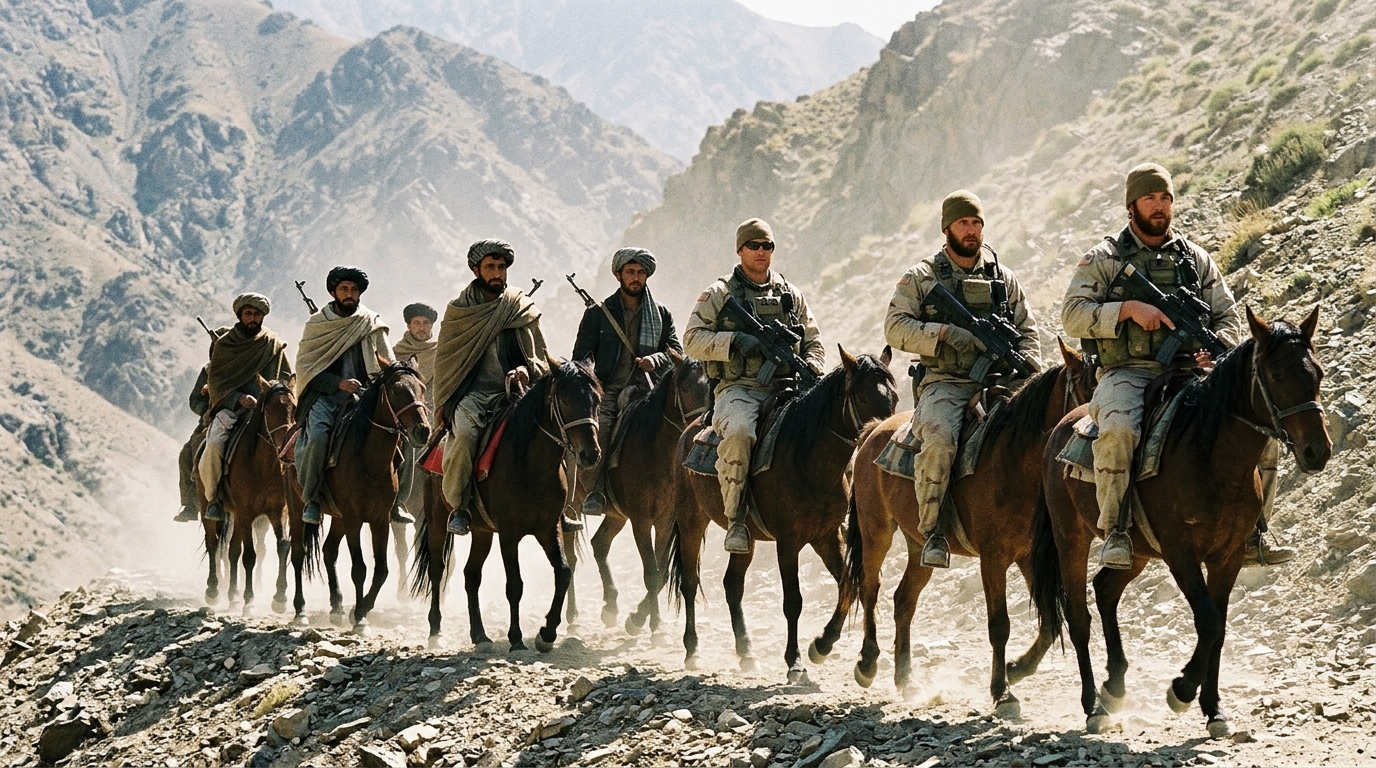
These highly skilled operators, sometimes nicknamed "The Horse Soldiers" for their use of equestrian transport in the rugged terrain, served as crucial liaisons. They provided real-time intelligence, identified targets, and called in pinpoint air support using laser designators and satellite communications. This synergy between overwhelming American air power and the indigenous fighting capabilities of the Northern Alliance proved devastatingly effective against the conventional, though poorly equipped, Taliban forces. The strategy allowed for swift territorial gains and the rapid disintegration of the Taliban's military structure, avoiding the impression of a large-scale occupation and minimizing American casualties. However, it also carried inherent risks, particularly in the subsequent phases of nation-building and counterinsurgency, as the absence of a robust ground presence meant less control over liberated areas and limited ability to pursue and eliminate fleeing enemy combatants effectively.
Geopolitical Consequences and Aftermath
The swift collapse of the Taliban regime brought an immediate, if fragile, transition. The Bonn Agreement, while successful in installing a new interim government under Hamid Karzai, failed to fully address the intricate tribal, ethnic, and political power dynamics of the country. Critically, it largely excluded significant Pashtun elements, many of whom had supported the Taliban or simply felt marginalized by the new, largely Northern Alliance-dominated power structure. By focusing on a centralized executive branch led by a Western-educated Pashtun figurehead, the international community inadvertently alienated southern Pashtun tribes, many of whom felt excluded from the new political order and saw the new government as an imposition by foreign powers and their former civil war adversaries. This created fertile ground for discontent and a future insurgency.
Furthermore, the focus of the United States shifted rapidly toward the 2003 invasion of Iraq. This diversion of resources, attention, and military assets — including Special Forces, intelligence analysts, and advanced military equipment — is widely cited by geopolitical analysts as a critical turning point. It allowed the Taliban and remnants of al-Qaeda to regroup and rebuild in the porous border regions of Pakistan, particularly within the Federally Administered Tribal Areas (FATA), where they found sanctuary and rebuilt their organizational capacity. This strategic error transformed what could have been a contained counter-terrorism operation into a protracted counterinsurgency, eventually leading to the war for another two decades. The lack of sustained focus also hindered early nation-building efforts, exacerbating issues of corruption, weak governance, and a nascent security sector that struggled to assert control beyond Kabul.
The invasion also had broader implications for international law and sovereignty. The Bush Doctrine, articulated in response to 9/11, asserted a right to preemptive action against states harboring terrorists, re-shaping the post-Cold War international order. This doctrine, while securing initial domestic and international support for the invasion of Afghanistan, generated significant controversy regarding its application in Iraq and its long-term implications for global stability and the United Nations system.
Intelligence, Operational Flaws, and the Seeds of Insurgency
While Operation Enduring Freedom achieved its immediate military objective of dislodging the Taliban and dismantling al-Qaeda's visible infrastructure, the rapid success masked profound operational and intelligence challenges that would haunt the subsequent two decades.
Pre-9/11 Intelligence Landscape
Prior to 9/11, intelligence agencies faced significant hurdles in understanding the true scope of al-Qaeda's capabilities and the depth of the Taliban's commitment to harboring them. Despite warnings from various analysts about bin Laden's growing network and intentions, the intelligence community suffered from fragmented information sharing, a focus on traditional state actors, and an underestimation of the non-state terrorist threat. This made precise targeting and effective pre-emption difficult.
The Tora Bora Escape and its Ramifications
The most glaring intelligence and operational failure of the initial invasion occurred in December 2001 at the Battle of Tora Bora. U.S. intelligence indicated that Osama bin Laden and a significant portion of al-Qaeda's leadership were cornered in the heavily fortified cave complex in eastern Afghanistan, near the Pakistani border. However, several critical missteps allowed them to escape.
- Insufficient Ground Forces: The "light footprint" strategy, while effective for rapid regime change, meant that there. were not enough U.S. ground troops available to fully cordon off the expansive and rugged Tora Bora region. Instead, the U.S. relied heavily on Afghan militias, many of whom had their own agendas and allegiances, and who were less capable of maintaining a watertight perimeter.
- Reliance on Afghan Proxies: While valuable in combat, the Afghan militias were not always reliable for sustained blocking positions. Reports suggest that some local commanders may have accepted bribes to allow al-Qaeda fighters, including possibly bin Laden, to escape into Pakistan.
- Intelligence Gaps: There were persistent debates about the exact location of bin Laden within the complex and the most effective means to trap him. Misinformation or a lack of precise intelligence on escape routes exacerbated the challenge.
- Strategic Priorities: Some analysts argue that the intense focus on airstrikes, coupled with the reluctance to deploy a large conventional ground force, prioritized minimizing U.S. casualties over the singular objective of capturing bin Laden.
The failure to capture or kill bin Laden at Tora Bora was a monumental blow, allowing the al-Qaeda leader to remain at large for another decade. His survival enabled him to continue influencing and inspiring global jihadist movements from the shadows, ensuring that the counter-terrorism effort would be prolonged and complex. It also fueled the narrative among jihadists that their leaders were elusive and resilient, despite American military might.
Early Signs of Insurgency
The rapid military victory also created new vulnerabilities. The "light footprint" meant that large swathes of the country were "liberated" but not secured or effectively governed. This created a power vacuum in many rural areas, allowing disillusioned Taliban remnants and al-Qaeda sympathizers to gradually regroup. The exclusion of many Pashtun elements from the Bonn process also meant that a significant segment of the population felt unrepresented and disenfranchised, making them susceptible to the re-emerging Taliban's rhetoric of resistance against foreign occupation and a corrupt, imposed government. The seeds of the enduring insurgency were sown in these early months, as the initial focus on military victory overlooked the critical need for comprehensive security and legitimate governance across the entire country.
Socio-Economic Aftermath and the Nation-Building Quandary
The aftermath of the 2001 invasion ushered in a period of intense, yet ultimately faltering, nation-building efforts. The international community, led by the U.S., embarked on an ambitious project to transform Afghanistan into a stable, democratic state. However, this endeavor faced immense socio-economic and cultural hurdles.
Humanitarian Crisis and Reconstruction Challenges
The decades of war—first against the Soviets, then the civil war, and finally the U.S. invasion—had left Afghanistan in a state of profound humanitarian crisis. Millions were refugees in neighboring countries or internally displaced. Infrastructure was decimated, access to healthcare and education was minimal, and food insecurity was widespread. Initial reconstruction efforts focused on immediate relief, road building, and establishing basic public services. Billions of dollars in international aid flowed into the country, but this often overwhelmed the nascent Afghan administrative capacity and was frequently diverted by corruption or mismanaged due to a lack of oversight.
The Opium Economy and Corruption
One of the most intractable challenges was the resurgence of Afghanistan's illicit opium economy. The Taliban had largely suppressed poppy cultivation in the late 1990s, but with their fall, farmers quickly reverted to growing the lucrative crop as a means of survival. Opium and heroin production surged, becoming a primary source of funding for the re-emerging insurgency and a driver of corruption within the fledgling Afghan government and security forces. Efforts to eradicate poppy fields often alienated rural populations, driving them further into the arms of the Taliban who offered protection and a share of the profits.
Establishing Rule of Law and Governance
Building a robust and legitimate system of governance and rule of law proved extraordinarily difficult. The Afghan state had historically been weak outside of Kabul, with tribal and regional strongmen (warlords) wielding significant power. The Bonn Agreement's emphasis on a centralized government, while well-intentioned, often struggled to impose its writ over these deeply entrenched local power structures. Justice was often dispensed through traditional jirgas (councils) or by local warlords, rather than through a formal, transparent legal system. Corruption became endemic at all levels of government, eroding public trust and undermining the legitimacy of the new democratic institutions. International efforts to train and equip the Afghan National Army (ANA) and Afghan National Police (ANP) were hampered by illiteracy, desertion, corruption, and the difficulty of building a national identity in a country with strong ethnic and tribal loyalties.
Cultural Barriers and Social Change
The ambition to introduce Western-style democratic institutions and promote social change, particularly regarding women's rights and education, encountered significant cultural resistance in many conservative, rural areas. While women and girls gained unprecedented access to education and public life in urban centers, these gains were fragile and often viewed with suspicion by traditional communities. The stark contrast between urban and rural Afghanistan grew, further fragmenting the national identity and providing a narrative for the Taliban to exploit. The slow pace of economic development, persistent insecurity, and the perception of a foreign-imposed system ultimately fueled popular disillusionment, leaving the new Afghan state vulnerable to the persistent insurgency. The socio-economic aftermath was thus a complex tapestry of modest progress intertwined with profound setbacks, underscoring the immense difficulty of large-scale nation-building in a war-torn, ethnically diverse country with a history of external interference.
Analysis of Key Actors and Decisive Actions
The initial phase of Operation Enduring Freedom was shaped by the decisions and actions of several pivotal figures:
- George W. Bush: As the President following the 9/11 attacks, Bush's decisive rhetoric and commitment to a global war on terror fundamentally redefined U.S. foreign policy. His administration articulated the Bush Doctrine, allowing for unilateral preemptive strikes against regimes harboring threats. This doctrine was a significant departure from post-Cold War diplomatic norms, emphasizing the U.S.'s right to act in self-defense against non-state actors and their state sponsors. His leadership galvanized international support for the initial invasion, but the subsequent pivot to Iraq diverted critical resources and attention, shaping the long-term trajectory of the Afghan conflict.
- Osama bin Laden: The architect of 9/11 and leader of al-Qaeda, bin Laden's decision to launch the attacks and his subsequent refusal to leave Afghanistan fundamentally miscalculated the U.S. response. He believed the U.S. would react with limited retaliatory strikes, rather than a full-scale invasion aimed at regime change. His ability to evade capture at Tora Bora allowed him to remain a potent symbolic figure, continuing to issue directives and inspire extremist groups for years, profoundly altering his ability to direct global operations but sustaining the ideological struggle.
- Hamid Karzai: Chosen as the leader of the Afghan Interim Authority and later elected president, Karzai was a Western-educated Pashtun figurehead intended to bridge the gap between traditional Afghan society and the international community. His ability to navigate the competing demands of regional warlords, international donors, and rural tribes defined the central paradox of Afghan politics throughout the 2000s. While he provided a semblance of national leadership, his government struggled with corruption, a lack of widespread legitimacy, and an inability to project power beyond Kabul, frequently relying on foreign military support.
- Donald Rumsfeld: As U.S. Secretary of Defense, Rumsfeld was the primary proponent of the "light footprint" strategy. His vision of a technologically advanced, agile military capable of achieving objectives with minimal ground forces shaped the initial success of Operation Enduring Freedom. However, his insistence on a smaller force, while militarily efficient for regime change, is retrospectively criticized for failing to account for the requirements of stabilization, counterinsurgency, and nation-building in the longer term.
- General Tommy Franks: As Commander of U.S. Central Command (CENTCOM), Franks was the operational leader of Operation Enduring Freedom. His command oversaw the successful execution of the "light footprint" strategy, coordinating air power with Special Forces and local Afghan militias. However, he also faced criticism for the limited resources allocated to the Tora Bora operation and for not deploying additional U.S. ground forces to seal off escape routes for al-Qaeda leadership.
- Northern Alliance Commanders: Figures like General Abdul Rashid Dostum (Uzbek), Mohammad Fahim Khan (Tajik), and Ismail Khan (Tajik) were critical ground partners. These warlords, seasoned from years of fighting the Soviets and the Taliban, provided the necessary indigenous forces and local knowledge. While instrumental in the rapid fall of the Taliban, their inclusion in the new government also perpetuated a system of localized power centers, often at odds with the central government, complicating efforts to build a unified national army and legitimate governance.
"We are a peaceful nation. Yet, as we have learned, so suddenly and so tragically, there can be no peace in a world of sudden terror." — George W. Bush, address to Congress, September 20, 2001. This statement articulated the dramatic shift in American policy from post-Cold War disengagement to an assertive posture against global terrorism.
Trivia and Lesser-Known Facts
- The Horse Soldiers' Legacy: The U.S. Special Forces Operational Detachment Alpha (ODA) 595, operating in northern Afghanistan, gained renown for fighting alongside Northern Alliance cavalry units. Their adaptability to fighting on horseback across the rugged Hindu Kush mountains became the subject of books and films, illustrating the unique challenges and ingenuity required in the early phase of the conflict.
- Initial JDAM Use: The invasion was one of the first conflicts where the Joint Direct Attack Munition (JDAM) was used extensively. These precision-guided kits transformed "dumb" bombs into highly accurate, all-weather munitions, radically altering the effectiveness of air power and enabling the "light footprint" strategy.
- Pakistan's Double Game: From the outset, Pakistan played a complex and often contradictory role. While publicly aligning with the U.S. in the War on Terror, elements within its Inter-Services Intelligence (ISI) maintained ties with the Taliban, providing sanctuary and support to leaders and fighters in the border regions. This "double game" significantly hindered counter-insurgency efforts for years.
- The First Drone Kill: While Predator drones were used for reconnaissance prior to 2001, the invasion of Afghanistan saw the first successful use of an armed Predator drone. On October 7, 2001, a Predator armed with Hellfire missiles destroyed a Taliban vehicle, marking a pivotal moment in the evolution of remote-controlled warfare and setting a precedent for drone usage in future conflicts.
- Kandahar Airport's Strategic Importance: After its capture, Kandahar Airport became a crucial hub for coalition forces. Its vast runways and facilities, initially built with Soviet assistance, allowed for rapid deployment of troops and materiel, becoming central to the logistics of the Southern Front and future counter-insurgency operations.
- Cultural Advisers: Beyond military and intelligence personnel, the U.S. deployed cultural and tribal affairs advisers to better understand Afghanistan's complex social fabric. Despite these efforts, the sheer depth of tribal loyalties and regional animosities often proved difficult to navigate, underscoring the challenge of external intervention in a deeply traditional society.
References and Literature
- The Looming Tower: Al-Qaeda and the Road to 9/11 - Lawrence Wright's Pulitzer Prize-winning investigation into the origins of al-Qaeda and the events leading to the September 11th attacks and the subsequent invasion.
- Ghost Wars: The Secret History of the CIA, Afghanistan, and Bin Laden, from the Soviet Invasion to September 10, 2001 - Steve Coll provides a definitive and meticulously researched chronicle of the CIA’s deep involvement in Afghanistan, detailing the complex interplay of actors from the Soviet era to the eve of the 2001 invasion.
- The Afghanistan Papers: A Secret History of the War - An investigative series by The Washington Post, based on confidential government documents, offering a stark assessment of policy failures and the consistent misrepresentation of progress during the two-decade engagement.
- Bush at War - Bob Woodward's inside account of President George W. Bush's national security team's decision-making in the immediate aftermath of 9/11 and the planning of the Afghanistan invasion.
- Horse Soldiers: The Extraordinary Story of a Band of US Special Forces Who Rode to Victory in Afghanistan - Doug Stanton's gripping narrative of the U.S. Special Forces teams who worked alongside the Northern Alliance, detailing their unique tactics and immediate impact.
- Operation Enduring Freedom - U.S. Department of Defense Archive - Official military history, press briefings, and strategic objectives regarding the execution and phases of the 2001 campaign.
- Foreign Affairs: The Future of Afghanistan - A collection of articles offering in-depth analysis of the political, economic, and security challenges faced by Afghanistan post-2001, and the long-term consequences of the international intervention.