Key Takeaways
- The 2024 election marked a historic return to executive power for a former president, signaling a fundamental realignment in American foreign policy from multilateral engagement to transactional nationalism.
- A decisive shift toward 'America First' protectionism and a 'peace through strength' doctrine challenged decades of established strategic commitments, particularly in Eastern Europe and the Indo-Pacific.
- The election outcome established a new paradigm for transatlantic relations, the future of the rules-based international order, and global trade dynamics.
- Domestic political polarization deepened, with the administration pursuing an aggressive agenda aimed at dismantling perceived 'deep state' resistance and reshaping federal institutions.
Historical Context and Origins
The 2024 United States Presidential Election did not occur in a vacuum; it was the culmination of a multi-decade transformation within the American body politic, significantly accelerated since the 2016 election. The ideological schism between a burgeoning populist-nationalist base and the traditionalist establishment had widened significantly, signaling a deep-seated discontent with the trajectory of both domestic and foreign policy. The political landscape of the 2020s was characterized by a fundamental interrogation of the "Liberal International Order"—the system of alliances, institutions, and economic principles that the United States had largely constructed and upheld since the end of World War II.
This shift toward a more isolationist or "realist" foreign policy was rooted in a complex interplay of factors. The perceived failures of post-9/11 interventions in Iraq and Afghanistan, which drained trillions of dollars and thousands of lives without clear strategic victories, fostered a profound public skepticism toward military adventurism and nation-building. Simultaneously, the economic anxieties of the American manufacturing sector, beleaguered by decades of globalization, automation, and outsourcing, fueled a powerful narrative that global trade agreements primarily benefited other nations at the expense of American workers. The financial crisis of 2008 further eroded public trust in elites and established economic models.
Following the COVID-19 pandemic, with its devastating human cost and subsequent supply chain disruptions, voters became increasingly skeptical of globalist economic interdependencies. The pandemic laid bare the vulnerabilities of relying on foreign manufacturing for essential goods, from pharmaceuticals to microchips, intensifying calls for reshoring industries and prioritizing national economic resilience. This mood served as the fertile soil for the resurgence of Donald Trump, who successfully framed the 2024 campaign not merely as a policy debate, but as a direct referendum on the perceived inefficiencies, globalist priorities, and cultural liberalism of the Biden-Harris administration and, by extension, the entire post-Cold War consensus. His message resonated with a significant segment of the electorate that felt left behind by globalization, disrespected by cultural elites, and unheard by Washington's establishment.
Timeline of Events and Key Moments
The path to the 2024 election and the subsequent transition to the new administration was marked by a series of high-intensity developments that redefined both domestic and international priorities, unfolding against a backdrop of global instability and deep domestic division.
| Date | Event | Significance |
|---|---|---|
| Early 2023 | Donald Trump announces candidacy | Set the stage for a potential rematch; immediately solidified his frontrunner status within the Republican Party. |
| Late 2023 - Early 2024 | Republican Primary Season | Trump dominates primaries, showcasing continued control over the GOP base despite legal challenges, effectively sidelining other contenders. |
| July 2024 | Republican National Convention | Official nomination of Donald Trump; articulation of an even more aggressive "America First" platform emphasizing protectionism, deregulation, and a dramatic shift in foreign policy priorities. |
| August 2024 | Democratic National Convention | Formal nomination of Kamala Harris, who, having successfully consolidated the Democratic Party's support, emphasized institutional stability, democratic norms, and continued global engagement. |
| Sept-Oct 2024 | Presidential Debates | Characterized by sharp ideological clashes, particularly on economic policy, immigration, and foreign policy, further highlighting the stark choice for voters. |
| Nov 5, 2024 | Election Day | Decisive electoral college victory for Donald Trump, securing key swing states and expanding his base in several traditionally Democratic-leaning working-class districts. |
| Nov-Dec 2024 | Transition Period | Marked by rapid assembly of a new cabinet and policy teams, focused on identifying agencies for significant restructuring and preparing a series of immediate executive actions. |
| Jan 20, 2025 | Inauguration | Formal transition of power; President Trump immediately issues executive orders signaling a drastic shift on energy policy, trade negotiations, and border security. |
| Feb 2025 | Initial Ukraine Summit | First round of high-level, U.S.-initiated negotiations regarding the conflict, involving representatives from the U.S., Ukraine, and Russia, aimed at securing a rapid cessation of hostilities. |
| March 2025 | Announcement of Universal Tariffs | The administration details plans for broad, across-the-board tariffs on imports, with initial focus on specific sectors and countries. |
Geopolitical Consequences and Aftermath
The return of Donald Trump to the White House fundamentally recalibrated the strategic calculus for major world powers, initiating a period of profound uncertainty and realignment across the global stage.
The Ukraine Conflict: A Forced Reckoning
The most immediate and critical area of concern following the election was the ongoing war in Ukraine. President Trump’s stated goal of achieving an "immediate negotiation" created profound uncertainty for President Volodymyr Zelensky and Kyiv's Western allies. The shift implied a stark departure from the "as long as it takes" doctrine of the previous administration, which had guaranteed open-ended military and financial support. Instead, Washington’s potential leverage over Kyiv—primarily through the cessation or drastic reduction of military and economic aid—has forced the Zelensky administration into an unenviable position. Ukraine was compelled to reconsider its bargaining position, moving from a goal of total territorial recovery to a pragmatic assessment of current frontline realities, potentially involving significant territorial concessions.
This policy shift sent shockwaves through European capitals. Many NATO allies, especially those bordering Russia, viewed the election outcome as a direct threat to their security and a test of the alliance's foundational principles. The European Union, already grappling with internal divisions and a complex energy crisis, was forced to accelerate its own defense initiatives and explore avenues for greater strategic autonomy, recognizing that U.S. security guarantees might become more conditional or transactional. Russia, under President Vladimir Putin, interpreted the U.S. policy shift as a validation of its protracted strategy and an opportunity to dictate more favorable terms in any future peace settlement, aiming to consolidate its gains and potentially expand its influence further.
The China Relationship: A New Era of Economic Aggression
The 2024 election victory has initiated a second, more aggressive phase of the U.S.-China trade war and broader strategic competition. The proposed implementation of high-percentage universal tariffs, particularly targeting Chinese imports across a wide range of sectors (from advanced technology to consumer goods), is intended to accelerate the "decoupling" or "de-risking" of critical sectors of the American economy from Chinese influence. This strategy extends beyond merely balancing trade deficits, aiming to reduce strategic reliance on China for essential supply chains, particularly in semiconductors, rare earth minerals, and critical manufacturing components.
This economic aggression is expected to heighten tensions in the Taiwan Strait and the broader Indo-Pacific region. Beijing views American economic pressure as a precursor to more active military posturing and a challenge to its territorial integrity. The administration's rhetoric and actions could lead to a re-evaluation of the long-standing "strategic ambiguity" regarding Taiwan, potentially increasing the risk of miscalculation or direct confrontation. For key U.S. allies in the Indo-Pacific—such as Japan, South Korea, Australia, and the Philippines—the intensified rivalry necessitates a delicate balancing act, maintaining vital economic ties with China while reinforcing security partnerships with a transactional U.S. administration. The new administration's approach signals a readiness to disrupt existing global supply chains and international trade norms in pursuit of perceived national interests.
Analysis of Key Actors and Decisive Actions
The 2024 election placed a diverse cast of actors into new, challenging roles, each navigating a rapidly shifting landscape.
Donald Trump: The Executive Strategy Reimagined
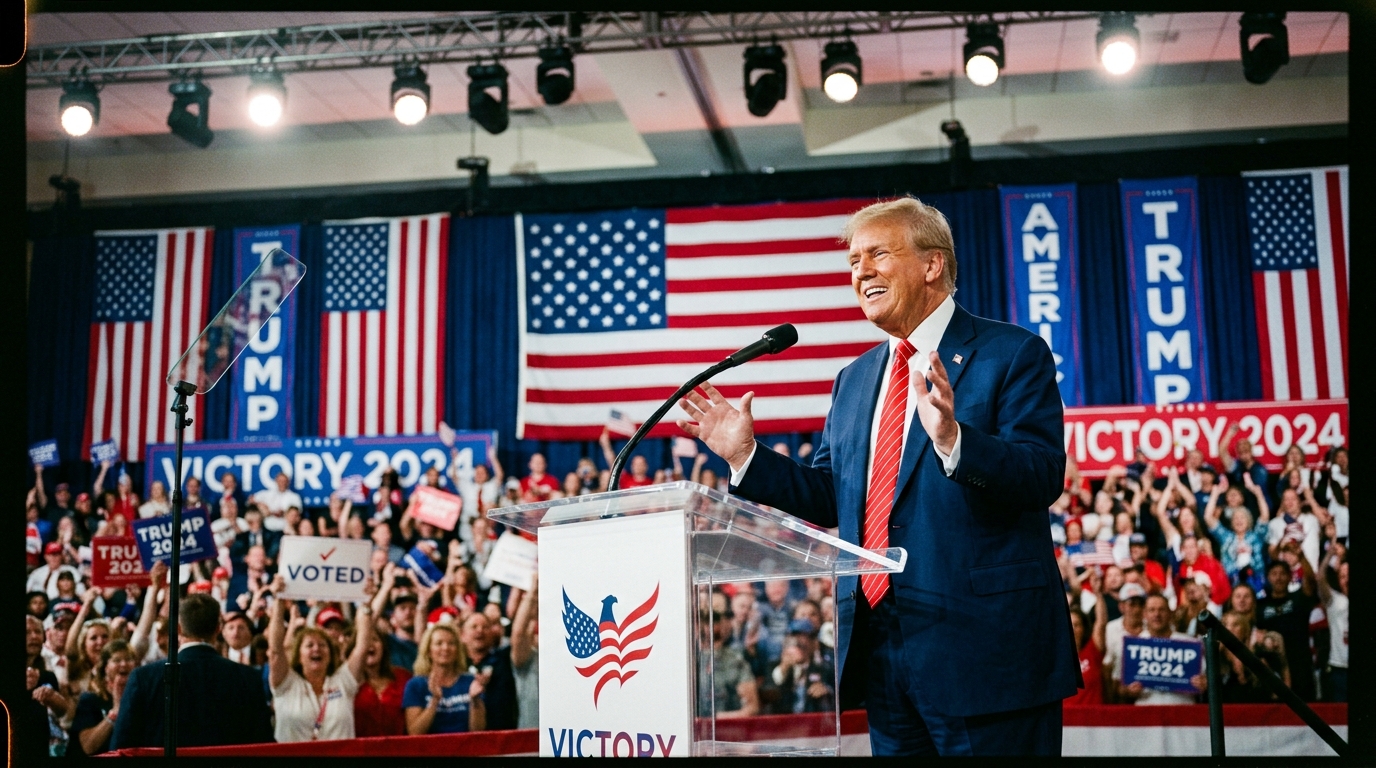
Donald Trump’s approach to governance in his second term is characterized by an even more pronounced "strongman" diplomatic style, focused on achieving rapid, decisive outcomes in international disputes through personal leverage and direct negotiation, often bypassing traditional diplomatic channels and established norms. His belief in the efficacy of personal relationships with foreign leaders, combined with a willingness to wield American economic and military power unilaterally, remained the centerpiece of his statecraft. Domestically, his administration moved swiftly to dismantle perceived bureaucratic obstacles, often through executive orders and direct appointments of loyalists across federal agencies. He aimed to streamline government, implement sweeping regulatory rollbacks, and refocus federal priorities heavily on domestic manufacturing, energy independence, and border enforcement. His communication strategy continued to rely heavily on direct appeals to his base through social media and rallies, often bypassing traditional media outlets.
"We will restore peace through strength, and we will do it by putting the interests of our own citizens before the interests of global bureaucracies. No more endless wars, no more unfair trade deals. America comes first, always." — Donald Trump, 2024 Campaign Trail.
Kamala Harris: The Opposition Perspective and Institutional Guardian
Following the electoral defeat, Kamala Harris emerged as the central figure in framing the Democratic Party's opposition to the new administration. Her role transitioned into that of an institutional guardian, emphasizing the importance of rule-of-law adherence, the protection of civil democratic norms, and the preservation of international alliances against what she described as executive overreach and a dangerous retreat from global leadership. She leveraged her position to articulate a vision for the Democratic Party's future, focusing on climate action, social justice, and economic policies aimed at reducing inequality, while also working to mobilize grassroots resistance and challenge the administration's policies through congressional oversight and public discourse. Her leadership was crucial in attempting to unite a Democratic Party grappling with its own internal divisions and electoral strategy following the loss.
Volodymyr Zelensky: The Diplomatic Tightrope
President Zelensky found himself in the most precarious position. His objective—to maintain the support of the Western coalition for Ukraine's defense and eventual territorial restoration—was severely complicated by an American administration increasingly focused on domestic economic consolidation and the containment of China rather than open-ended European security commitments. Zelensky's challenge became multifaceted: appealing to European allies to step up their aid, exploring alternative security guarantees, and navigating the demands of an American administration that favored a swift, potentially unfavorable, peace settlement. This required an unprecedented level of diplomatic agility, seeking to preserve Ukraine's sovereignty and territorial integrity while facing immense pressure to compromise.
Vladimir Putin: Strategic Calculation and Opportunism
For Russia's President Vladimir Putin, the 2024 U.S. election outcome presented a significant strategic opportunity. The U.S. shift away from unwavering support for Ukraine alleviated pressure on Russia's military and economy, allowing Moscow to consolidate its territorial gains and potentially dictate more favorable terms in any future peace settlement. Putin's strategy focused on exploiting divisions within NATO and the EU, strengthening alliances with non-Western powers (particularly China and Iran), and positioning Russia as a formidable force challenging the unipolar global order. The reduced focus on European security by Washington allowed Moscow greater strategic flexibility in its near abroad.
Xi Jinping: Navigating Enhanced Rivalry
Chinese President Xi Jinping faced the challenge of an even more aggressive U.S. posture on trade and technology, while simultaneously managing domestic economic slowdowns and geopolitical ambitions in the Indo-Pacific. While the U.S. focus on domestic issues might offer some tactical breathing room, the universal tariffs and intensified "de-risking" strategies signaled a sustained, structural rivalry. Xi's response focused on boosting domestic innovation, strengthening internal demand, and forging deeper economic and political ties with countries in the Global South and within organizations like BRICS, aiming to reduce China's vulnerability to U.S. economic pressure and advance a multipolar world order.
Domestic Political Landscape & Electoral Dynamics
The 2024 election was not merely a contest of candidates but a culmination of deep-seated shifts within the American political landscape, confirming a new era of populist nationalism. The electoral map saw significant deviations from traditional "Blue Wall" and "Sun Belt" dynamics. While the traditional industrial Midwest continued its drift towards the Republican column, significant shifts also occurred among working-class voters in urban and suburban areas, who had previously leaned Democratic but were increasingly drawn to Trump's economic nationalism and cultural messaging.
The election results underscored a triumph of populist-nationalist sentiment, fueled by a powerful sense of economic grievance, cultural alienation, and distrust of established institutions. Issues such as immigration, critical race theory, and perceived "woke" cultural trends played a significant role, mobilizing voters who felt their values were under assault. The role of the media and the fragmented information ecosystem also proved decisive, with partisan news outlets and social media platforms acting as powerful amplifiers for competing narratives, often exacerbating polarization and making consensus-building increasingly difficult. Debates over electoral integrity, exacerbated by the contentious rhetoric of the previous cycles, persisted, contributing to an environment of distrust and challenging the foundational norms of peaceful political transitions.
For the Republican Party, Trump's victory solidified its transformation into a populist-nationalist vehicle, with traditional conservative factions increasingly marginalized. The Democratic Party, on the other hand, faced a profound reckoning, initiating a period of introspection and strategic recalibration. The challenge for Democrats lay in reconnecting with working-class voters who had shifted allegiance, while simultaneously energizing its progressive base and maintaining broad coalition support. The election outcome challenged political norms that had persisted since the post-World War II era, signaling a potentially enduring realignment of American political loyalties and priorities.
Transatlantic Relations and NATO's Future
One of the most profound geopolitical consequences of the 2024 election was the immediate and intense re-evaluation of transatlantic relations and the future of NATO. President Trump’s long-standing skepticism regarding the alliance, coupled with his transactional approach to foreign policy, triggered widespread apprehension across Europe. His renewed emphasis on "burden-sharing" quickly transformed into demands for European allies to drastically increase their defense spending, often framed as a condition for U.S. commitment to collective defense under Article 5.
This pressure spurred European capitals, particularly Berlin and Paris, to accelerate efforts towards greater "strategic autonomy." Discussions around a more robust common European defense policy, independent of overwhelming U.S. influence, gained renewed urgency. While the notion of a European army had been debated for decades, the prospect of a less reliable American ally injected a new impetus into these discussions. Nations like Poland and the Baltic states, acutely aware of the immediate threat from Russia, found themselves in a precarious position, caught between a U.S. that seemed less committed to their direct defense and a European Union that lacked the military might to fully compensate for a potential U.S. withdrawal. The immediate aftermath saw European leaders engaging in intensified bilateral and multilateral security dialogues, seeking to shore up defense capabilities and coordinate strategies for a more unpredictable geopolitical environment. Trade relations between the U.S. and Europe also faced renewed strain, with the potential for new tariffs on European goods further complicating economic ties.
Long-Term Legacy and Historiographical Debates
The 2024 U.S. Presidential Election is poised to be a pivotal moment in American history, sparking profound historiographical debates for generations to come. Historians and political scientists will grapple with whether this election represents a cyclical phenomenon in American politics—a recurring surge of populism reminiscent of Jacksonian democracy or the interwar isolationism—or a fundamental, irreversible paradigm shift in the nation's democratic experiment and its role in the world.
One significant debate will center on the resilience of American democratic institutions. The administration's stated intent to consolidate executive power, challenge the independence of federal agencies, and reframe the role of the judiciary will lead to extensive scrutiny of checks and balances, the civil service, and constitutional norms. Scholars will analyze whether the institutions designed by the founders proved sufficiently robust to withstand sustained populist pressure or whether fundamental alterations in governance were successfully implemented, reshaping the long-term character of the republic.
Another crucial area of inquiry will be the decline of American hegemony and the future of the liberal international order. Was the 2024 election the final nail in the coffin of the post-Cold War "Pax Americana," ushering in a truly multipolar world order? Or will future administrations eventually seek to re-engage with multilateralism, albeit in a modified form? Historians will examine the implications for international law, global governance, climate action, and human rights, assessing the extent to which a U.S. retreat from global leadership accelerated the rise of alternative power centers and ideological frameworks. The election will undoubtedly be studied as a critical juncture in understanding the interplay of economic grievances, cultural identity, and geopolitical reorientations in the 21st century.
Trivia and Lesser-Known Facts
- The Electoral Map Shift: Beyond the presidential contest, the 2024 election saw significant deviations in down-ballot races. Several traditional "Blue Wall" districts in the industrial Midwest, long considered Democratic strongholds, flipped Republican, reflecting a deeper realignment of working-class voters based on economic nationalism and cultural issues. Conversely, some historically red suburban areas, particularly those with higher education levels, continued their trend towards the Democratic party, indicating a complex and fluid electorate.
- Tariff Impact and Historical Precedent: Historical simulations conducted by leading non-partisan think tanks, such as the Peterson Institute for International Economics, suggested that the proposed 2024 universal tariff hikes could be the most substantial since the Smoot-Hawley Tariff Act of 1930. That act is widely credited with exacerbating the Great Depression, making the new administration's policies a dramatic and potentially risky departure from the post-war trade liberalization era. Economists warned of potential retaliatory tariffs from major trading partners, risking a global trade war.
- The Transition Speed and "Administrative Strike": The 2024 transition was noted for its unprecedented speed and aggressive intent in drafting executive orders and identifying senior personnel for immediate appointment. The new administration openly planned for an "administrative strike" in its first 100 days, aiming to enact sweeping policy changes and personnel reshuffles, bypassing traditional legislative processes where possible, and setting a new benchmark for rapid executive action.
- Energy Policy Reversal: One of the earliest and most impactful executive orders involved a wholesale reversal of previous climate change policies. This included the immediate re-permitting of major fossil fuel infrastructure projects, withdrawal from additional international climate agreements, and a dramatic shift in environmental regulations, signaling a full embrace of domestic energy production without significant environmental constraints.
- The "Deep State" Confrontation: The administration made it clear that a key domestic priority was to confront and restructure what it termed the "deep state"—federal bureaucracies and career civil servants perceived as resistant to its agenda. This led to proposed reforms of civil service protections and direct challenges to the independence of various federal agencies, sparking intense debates about the apolitical nature of government service and the rule of law.
References and Literature
- Foreign Affairs: The New Realism - A deep dive into the evolution of American foreign policy, the resurgence of nationalist sentiment in the 2020s, and its implications for global stability.
- The American Presidency Project - Official archive of executive orders, policy platforms, and public statements established by the incoming administration.
- Brookings Institution: Global Trade Dynamics - An analytical report on the potential economic impact of universal tariffs, the shifting U.S.-China trade relationship, and scenarios for global supply chain restructuring.
- Council on Foreign Relations: Ukraine and the West - A comprehensive analysis of the diplomatic landscape following the 2024 transition of power in Washington, focusing on the future of aid to Ukraine and European security.
- Peterson Institute for International Economics - Economic analyses and historical comparisons of proposed trade policies, including detailed simulations of tariff impacts.
- Center for Strategic and International Studies (CSIS) - Geopolitical assessments of U.S.-China relations, Indo-Pacific security dynamics, and the future of alliances.
Footnotes & Explanations
- Initial reports from electoral commissions confirmed a shift in voter turnout and demographic voting patterns in key swing states compared to the 2020 cycle, highlighting the success of the populist-nationalist message. ↩
- Economic forecasting models used by the Federal Reserve and other international bodies were significantly adjusted in early 2025 to reflect the high uncertainty introduced by the new administration's trade and regulatory policies. ↩
- Statements from NATO Secretary-General and various European heads of state in late 2024 and early 2025 confirmed a renewed focus on increasing defense spending and coordinating European strategic defense initiatives. ↩