Key Takeaways
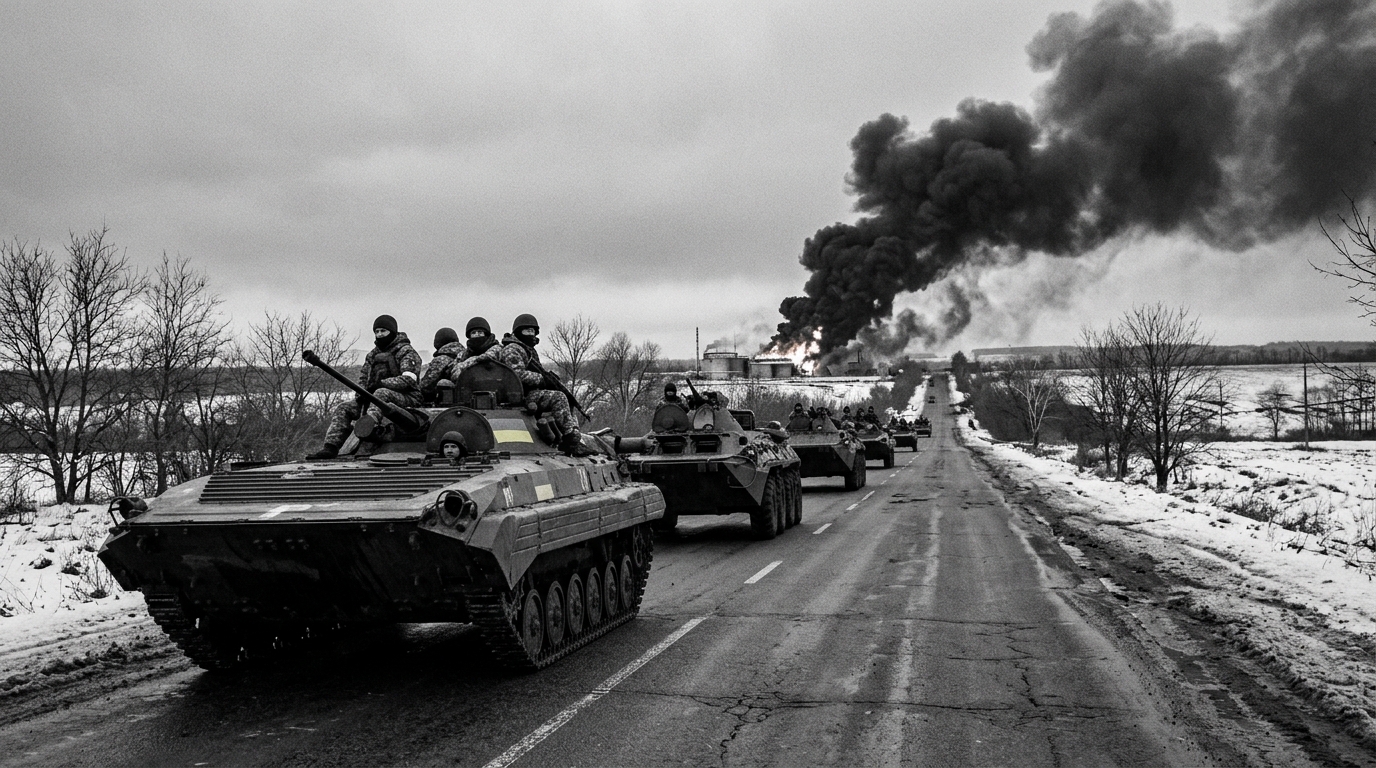
- The invasion marked the largest conventional military mobilization in Europe since the conclusion of the Second World War, shattering decades of post-Cold War assumptions about continental security.
- The failure of the initial Russian 'decapitation' strategy, aimed at swiftly capturing Kyiv and installing a pro-Kremlin government, shifted the conflict into a protracted and brutal war of attrition with cascading global economic and humanitarian repercussions.
- The transatlantic alliance, led by the United States, responded with an unprecedented, unified package of economic warfare, robust intelligence sharing, and direct lethal military aid to Kyiv, fundamentally altering post-Cold War security architectures and strengthening NATO's resolve and membership.
- The conflict underscored the resilience of Ukrainian national identity and statehood, challenging long-held Russian narratives, and catalyzed a significant re-evaluation of energy dependencies and defense policies across Europe.
Historical Context and Origins
The roots of the 2022 invasion are deep, intertwined with the complex, often contentious history of Slavic peoples, the collapse of the Soviet Union in 1991, and the subsequent divergent political trajectories of the Russian Federation and newly independent Ukraine. For years, President Vladimir Putin characterized the fall of the Soviet Union as the "greatest geopolitical catastrophe of the 20th century," a sentiment that deeply informed his worldview and foreign policy. He consistently viewed Ukraine’s westward integration—particularly its aspirations toward NATO and the European Union—not merely as a sovereign choice but as an encroaching security threat, directly challenging Russia's perceived sphere of influence and historical claims. This perception was exacerbated by a deeply rooted Russian historical narrative that often denies Ukrainian distinctiveness, viewing it as an integral part of a wider 'Russian world' (Russkiy Mir).
The path to confrontation was paved with several key events. The 2004 Orange Revolution in Ukraine, which saw mass protests against a fraudulent presidential election and ultimately led to a pro-Western government, was viewed with deep suspicion by the Kremlin, interpreted as a Western-backed color revolution. The 2008 NATO Bucharest Summit, where an aspirational pathway for Ukraine and Georgia to join the alliance was articulated, further solidified Putin's conviction that NATO expansion was an existential threat, despite the absence of concrete timelines. Russia's swift military intervention in Georgia later that year underscored its readiness to use force to defend its perceived regional prerogatives.
The crisis intensified significantly following the 2014 Euromaidan Revolution in Ukraine, a culmination of months of widespread protests against the pro-Russian President Viktor Yanukovych's decision to pivot away from a planned association agreement with the European Union. Yanukovych's ouster triggered an immediate and aggressive Russian response: the clandestine seizure and subsequent annexation of Crimea in March 2014, violating international law and the 1994 Budapest Memorandum (where Russia, along with the U.S. and UK, guaranteed Ukraine's territorial integrity in exchange for its relinquishing nuclear weapons). Concurrently, Russia instigated and supported a separatist insurgency in the Donbas region of eastern Ukraine, leading to an undeclared, low-intensity war.
Despite the Minsk agreements (Minsk I in September 2014 and Minsk II in February 2015)—brokered by France and Germany and designed to bring a ceasefire and political settlement to eastern Ukraine—the conflict remained a "frozen war" for eight years, claiming over 13,000 lives. Russia consistently denied its direct military involvement, framing the conflict as a Ukrainian civil war, even as evidence mounted of regular Russian army units and weaponry operating in the Donbas. The agreements themselves became a diplomatic quagmire, with differing interpretations over sequencing and implementation, primarily regarding Ukraine's demand for full control over its border before granting autonomy to the separatist regions, and Russia's insistence on political concessions first.
By late 2021, Moscow began to escalate its demands, issuing sweeping security ultimatums to the United States and NATO. These demands, unprecedented in their scope, included an ironclad, legally binding guarantee that Ukraine would never join the alliance, a rollback of NATO military infrastructure in Eastern Europe to 1997 levels, and an end to all NATO military cooperation with former Soviet states. When these demands, widely seen as non-starters and an attempt to dictate the sovereign choices of independent nations, were rejected by Western powers, Russia commenced a massive military buildup, amassing over 150,000 troops on Ukraine’s borders by early 2022, signaling a clear intent for a large-scale offensive. Diplomatic efforts by various European leaders, including French President Emmanuel Macron and German Chancellor Olaf Scholz, proved fruitless in dissuading Putin from his chosen course.
Historical Precedents and Strategic Culture
Understanding the 2022 invasion requires examining both historical precedents and the distinct strategic cultures of Russia and Ukraine. Russia's actions draw heavily from a historical playbook that emphasizes spheres of influence, military power projection, and a deep-seated suspicion of Western encroachment. From the Tsarist expansion across Eurasia to the Soviet interventions in Hungary (1956) and Czechoslovakia (1968), and more recently, in Georgia (2008) and Crimea (2014), the Kremlin has consistently demonstrated a willingness to use overwhelming force to maintain control or influence over neighboring states perceived as vital to its security. The 2022 invasion was, in many ways, an extension of this historical pattern, albeit on an unprecedented scale for post-Cold War Europe. Putin's own revisionist historical essays, particularly his July 2021 article "On the Historical Unity of Russians and Ukrainians," laid the ideological groundwork, denying Ukraine's distinct statehood and asserting its essential subservience to Russia.
Russian strategic culture, deeply influenced by its vast geography and a history of invasions, tends towards maximalist security demands, a preference for military solutions, and a centralized, top-down command structure. Its military doctrine often emphasizes mass, deception (maskirovka), and a high tolerance for casualties. The initial invasion plan for Ukraine reflected this: a rapid, multi-pronged assault aimed at decapitating the government, leveraging special forces (VDV airborne troops) for key objectives like Hostomel Airport, and relying on armored thrusts to quickly encircle major cities. This "blitzkrieg" approach was predicated on assumptions of minimal Ukrainian resistance and a swift collapse of state authority.
In contrast, Ukraine's strategic culture has evolved significantly since 2014. Previously, its military doctrine was largely post-Soviet, underfunded, and often politically compromised. However, eight years of conflict in the Donbas, coupled with extensive training and support from Western nations (including the U.S., UK, Canada, and Poland), fostered a more adaptive, resilient, and Western-leaning military. This post-2014 reform emphasized decentralized command, tactical flexibility, and the integration of modern intelligence and anti-armor/anti-air systems. The Ukrainian concept of total defense, involving not just regular armed forces but also territorial defense units and a highly motivated civilian population, became a cornerstone of their resistance. This evolution allowed Ukraine to effectively counter Russia's superior numbers and firepower, particularly in the initial phases of the invasion, by leveraging urban terrain, superior local intelligence, and a strong sense of national purpose. The difference in motivation and adaptability proved crucial, exposing the rigidity and corruption within the Russian military apparatus.
Timeline of Events and Key Moments
The escalation reached its zenith in February 2022, following months of intense diplomatic posturing and military buildup. On February 21, Vladimir Putin delivered a lengthy, historically revisionist address, followed by his recognition of the self-proclaimed Donetsk and Luhansk People's Republics as independent states, effectively tearing up the Minsk agreements. On February 24, at approximately 5:00 AM local time, he announced a "special military operation" on national television, citing the need for "demilitarization" and "denazification" of Ukraine, a pretext widely condemned as baseless by international bodies and governments. Moments later, explosions were heard across Ukraine, signaling the start of the full-scale invasion.
The initial phase of the invasion involved simultaneous attacks from multiple axes:
- Northern Front: Aiming directly at Kyiv from Belarus and Russia, with key objectives including the capture of Hostomel Airport to facilitate an air bridge.
- Northeastern Front: Targeting cities like Kharkiv and Sumy.
- Eastern Front: Expanding the existing conflict zone in Donbas.
- Southern Front: Launching from Crimea, targeting Kherson, Melitopol, and Mariupol, with the strategic goal of creating a land bridge to Crimea and controlling Ukraine's Black Sea coast.
| Phase | Date Range | Key Objectives & Events | Strategic Significance |
|---|---|---|---|
| Initial Invasion: The Blitzkrieg Attempt | Feb 24–28, 2022 | Russian forces strike deep into Ukraine from the north, east, and south. Airborne assaults target key infrastructure, notably Hostomel Airport. Simultaneous missile strikes hit military targets and major cities across the country. | Russia's attempt at a swift 'decapitation strike' and regime change, aiming to paralyze Ukraine's government and military command structure within days. |
| Battle for Kyiv: Ukrainian Resilience | Feb–March 2022 | Intense fighting around the capital, Kyiv, and surrounding towns (Bucha, Irpin, Hostomel). Ukrainian forces, supported by Western anti-tank weapons and civilian volunteers, halt and inflict heavy losses on Russian armored columns. | The decisive defense of Kyiv, particularly the successful holding of Hostomel Airport and the prolonged resistance, thwarted Russia's primary strategic objective and fundamentally altered the war's trajectory. President Zelensky's resolve galvanized national and international support. |
| Russian Retreat & Eastern Focus | March–April 2022 | Following heavy losses and logistical failures, Russian troops abandon their northern axes (Kyiv, Chernihiv, Sumy) and announce a "regrouping" to focus on the "liberation of Donbas." Evidence of war crimes (Bucha massacre) emerges. | Signified a major strategic defeat for Russia, forcing a shift from a multi-front offensive to a concentrated, albeit still large-scale, assault on eastern and southern Ukraine. Exposed Russian military deficiencies and brutality. |
| War of Attrition & Southern Seizures | May 2022–Present | A shift toward long-range artillery duels, localized offensives, and fortified positions in the east (Donbas) and south. Russia consolidates control over southern territories, including Mariupol after a protracted siege. | Marked the beginning of a prolonged, grinding conflict focused on territorial gains through overwhelming firepower, particularly in Donbas, and securing the land bridge to Crimea. International military aid becomes crucial for Ukraine's defense. |
The defense of Kyiv stands as the most critical moment of the opening phase. Contrary to widespread intelligence estimates, including those from Western services, suggesting the capital would fall within 72 hours, Ukrainian forces mounted a tenacious defense. They utilized urban terrain to their advantage, employing hit-and-run tactics against Russian convoys, and effectively deployed anti-tank weaponry like the US-supplied Javelin and the UK-supplied NLAW. Sophisticated intelligence sharing from Western allies allowed Ukraine to anticipate Russian movements. Critically, a highly motivated civilian defense force, mobilized within hours, bolstered the regular army, turning Kyiv into a formidable fortress. The Battle of Hostomel, where Ukrainian airborne and special forces fought fiercely to prevent Russia from establishing an air bridge to land heavy equipment, was particularly pivotal, buying crucial time for Kyiv's defenses to solidify.
"The fight is here; I need ammunition, not a ride." — President Volodymyr Zelensky, rejecting U.S. offers of evacuation during the early hours of the invasion, a statement that resonated globally and became an enduring symbol of Ukrainian defiance.
Geopolitical Consequences and Aftermath
The 2022 invasion fundamentally redrew the geopolitical map of Europe and beyond, forcing a total recalculation of longstanding policies on energy dependence, military spending, and international alliances. Germany, a nation historically hesitant to project military power and deeply intertwined with Russian energy, announced a Zeitenwende (turning point or epochal shift). This landmark policy reversal included a commitment to spend €100 billion on modernizing its armed forces, sending lethal weapons to a conflict zone for the first time since World War II, and accelerating its transition away from Russian fossil fuels. This shift rippled across Europe, leading to increased defense budgets and a renewed focus on collective security.
Simultaneously, the global economic order faced unprecedented disruption. The coordinated sanctions regime imposed by the United States, EU, UK, Canada, Australia, and other allies turned Russia into the most sanctioned nation on Earth. These measures included freezing Russian Central Bank assets (estimated at over $300 billion), disconnecting major Russian banks from the SWIFT international payment system, banning imports of Russian oil and gas (by some nations), and targeting oligarchs and key Russian industries. While these sanctions did not immediately cripple the Russian economy, they forced a significant "pivot to the East," as Russia moved to strengthen economic and diplomatic ties with China, India, and Iran, seeking alternative markets and financial systems. The sanctions also spurred global inflation, particularly in energy and food prices, as Ukraine and Russia are major exporters of grain and fertilizers, exacerbating a looming global food crisis.
Furthermore, the war shattered the policy of neutrality for several European nations, most notably Finland and Sweden. Observing the brutal reality of being outside the NATO security umbrella, both nations, after decades of non-alignment, formally applied for and were granted membership in NATO. This expansion, effectively turning the Baltic Sea into a "NATO lake," represented a significant strategic defeat for Putin, who had cited NATO expansion as a primary justification for his invasion. The alliance itself, previously debated as "brain-dead" by some, experienced a powerful revitalization, demonstrating renewed purpose and unity in the face of a direct threat to European security.
The invasion also had profound implications for international law and institutions. The International Criminal Court (ICC) opened an investigation into alleged war crimes and crimes against humanity in Ukraine, eventually issuing an arrest warrant for Vladimir Putin in March 2023, for the unlawful deportation of Ukrainian children. The United Nations General Assembly repeatedly condemned Russia's aggression, demanding its withdrawal, though the Security Council remained paralyzed by Russia's veto power. This highlighted the limitations of existing global governance structures in preventing or resolving conflicts involving permanent members.
Analysis of Key Actors and Decisive Actions
The Kremlin's Calculus and Catastrophe
Vladimir Putin operated under a profoundly flawed assumption: that Ukraine lacked a cohesive national identity distinct from Russia, that its government was illegitimate and corrupt, and that its population would either welcome Russian forces as liberators or offer minimal resistance. This intelligence failure, stemming from a closed decision-making circle, a culture of sycophancy, and a dismissal of independent analysis, proved catastrophic. The rigid, top-down command structure of the Russian military, combined with pervasive corruption that hollowed out its logistical capabilities and maintenance, led to a tactical disaster in the opening phase of the war. Russian forces demonstrated poor combined arms coordination, inadequate training for urban warfare, and severe morale issues, contrasting sharply with their initial reputation as a modernized fighting force. The reliance on vertical decision-making meant that mid-level commanders lacked the autonomy to adapt to rapidly changing battlefield conditions, further hampering their advance.
The Ukrainian Resistance and Zelensky's Leadership
President Volodymyr Zelensky’s transformation from a former television actor into a resolute wartime leader was instrumental in maintaining national morale, rallying domestic support, and securing unprecedented international assistance. His decision to remain in Kyiv despite the imminent threat of assassination by Russian special forces allowed the government to continue functioning, provided a clear, charismatic focal point for national resistance, and offered a powerful counter-narrative to Russian propaganda. Zelensky's masterful use of social media and direct addresses to parliaments worldwide kept Ukraine's plight at the forefront of global attention, effectively bypassing traditional diplomatic channels to appeal directly to publics and leaders. The Ukrainian Armed Forces, forged in the crucible of the Donbas conflict, demonstrated remarkable adaptability, high morale, and innovative use of Western military aid. Their effective decentralized command, combined with the fierce determination of territorial defense forces and ordinary citizens, turned every street and building into a potential stronghold, effectively blunting Russia's numerical superiority.
The United States and NATO's Coordinated Response
Under President Joe Biden, the United States served as the logistical, intelligence, and diplomatic backbone of the Ukrainian defense effort. The Biden administration, learning lessons from the perceived hesitancy of 2014, pursued a strategy of robust pre-invasion intelligence sharing with allies and public warnings about Russia's intentions. Once the invasion began, the U.S. orchestrated a global coalition to provide advanced weapon systems, intelligence, and financial aid to Ukraine. This included M142 High Mobility Artillery Rocket Systems (HIMARS), Patriot air defense batteries, Bradley Fighting Vehicles, and long-range cruise missiles, significantly enhancing Ukraine's ability to strike Russian targets, defend its airspace, and conduct complex offensive operations. The coordination within NATO, despite initial German reluctance, proved remarkably effective. The alliance reinforced its eastern flank, deployed thousands of additional troops, and conducted joint exercises, signaling a strong deterrent message to Moscow. The comprehensive sanctions regime, targeting Russia's financial institutions, energy sector, and technology access, was a direct result of this coordinated transatlantic effort, aiming to cripple Russia's ability to finance and sustain its war machine in the long term.
Socio-Economic and Humanitarian Catastrophe
The 2022 invasion unleashed a humanitarian catastrophe and inflicted staggering socio-economic damage, both within Ukraine and globally. Within weeks, millions of Ukrainians were forced to flee their homes, triggering Europe's largest refugee crisis since World War II. By late 2022, over 7.9 million Ukrainians had sought refuge across Europe, primarily in Poland, Germany, and other neighboring countries, while an estimated 6.5 million were internally displaced. This massive displacement strained the resources of host nations and created immense social challenges, including ensuring access to housing, education, and healthcare for vulnerable populations, particularly women and children. The resilience and generosity of European communities in responding to this crisis were noteworthy, yet the long-term integration of millions of displaced persons remains a significant challenge.
The scale of destruction within Ukraine is immense. Major cities like Mariupol, Bakhmut, and Avdiivka were reduced to rubble. Critical infrastructure, including energy grids, bridges, railways, hospitals, and residential buildings, became deliberate targets of Russian attacks, particularly in the autumn and winter of 2022-2023, designed to break civilian morale and weaponize winter. Estimates for Ukraine's post-war reconstruction run into the hundreds of billions of dollars, a burden that will require substantial international assistance. The agricultural sector, a vital component of Ukraine's economy and a major global food supplier, was severely disrupted, with fertile lands mined, equipment destroyed, and shipping routes blocked.
Beyond the immediate conflict zone, the war sent shockwaves through the global economy. Russia and Ukraine are major exporters of agricultural commodities (wheat, corn, sunflower oil) and fertilizers. The blockade of Ukrainian Black Sea ports by Russia, initially preventing millions of tons of grain from reaching international markets, exacerbated food insecurity in developing nations, particularly in Africa and the Middle East. While the UN-brokered Black Sea Grain Initiative (July 2022) offered some relief, its future remained precarious. The weaponization of energy by Russia, through drastic cuts in natural gas supplies to Europe, triggered an energy crisis, sending gas and electricity prices skyrocketing and accelerating Europe's transition to alternative energy sources. Inflation became a significant concern for economies worldwide, fueled by higher energy, food, and commodity prices, further complicated by existing supply chain issues stemming from the COVID-19 pandemic. The humanitarian impact also extends to documented allegations of war crimes, including summary executions, torture, sexual violence, and the forced deportation of Ukrainian children to Russia. These actions have prompted international investigations and calls for accountability, elevating the conflict beyond a conventional military engagement to one with profound moral and legal dimensions.
Trivia and Lesser-Known Facts
- Ghost of Kyiv: Early in the conflict, rumors circulated widely regarding an anonymous Ukrainian pilot, dubbed the "Ghost of Kyiv," who allegedly downed multiple Russian aircraft in the first 30 hours of the invasion. While later confirmed by Ukrainian authorities to be a morale-boosting legend representing the collective efforts of the Ukrainian Air Force rather than a single individual, it became a powerful symbol of Ukrainian bravery and air defense prowess during a critical period of intense information warfare.
- The Sunflower Symbol: A viral video of a Ukrainian woman confronting an armed Russian soldier, offering him sunflower seeds and telling him to put them in his pockets so "sunflowers will grow when you die on Ukrainian land," became a global emblem of non-violent resistance, defiance, and the deeply personal nature of the conflict for ordinary Ukrainians. The sunflower, Ukraine's national flower, took on a new, poignant significance.
- The Sinking of the Moskva: On April 14, 2022, the Moskva, the flagship of Russia’s Black Sea Fleet and a potent symbol of Russian naval power, was struck by Ukrainian Neptune anti-ship missiles and subsequently sank. This event marked the largest loss of a warship in combat since the Falklands War and represented a significant psychological and operational victory for Ukraine, severely degrading Russia's Black Sea fleet capabilities and forcing a re-evaluation of its naval posture.
- Snake Island Defiance: In the opening hours of the invasion, a small Ukrainian garrison on Snake Island (Zmiinyi Island) in the Black Sea famously refused a Russian warship's demand to surrender, responding with the iconic phrase, "Russian warship, go fuck yourself." Though the defenders were initially captured, the phrase became a rallying cry for Ukrainian resistance and was later immortalized on a Ukrainian postage stamp.
- Starlink's Role: SpaceX's Starlink satellite internet service, rapidly deployed to Ukraine at the request of the government, played a crucial role in maintaining critical communications for both military and civilian purposes amidst Russian efforts to disrupt traditional internet and cellular networks. This highlighted the increasing importance of space-based capabilities in modern warfare and disaster response.
References and Literature
- Council on Foreign Relations: The Conflict in Ukraine - A detailed ongoing monitor of the conflict's progression, key policy shifts, and a comprehensive overview of the humanitarian and geopolitical impacts.
- Institute for the Study of War (ISW) - Provides daily, mapping-intensive analysis of Russian and Ukrainian troop movements, territorial control, and assessments of strategic developments, widely cited by policymakers and analysts.
- Foreign Affairs: The War of the World - A repository of academic essays and expert analyses examining the broader impact of the invasion on the liberal international order, global power dynamics, and international relations theory.
- The Return of Great Power Politics by Michael J. Mazarr - A foundational text for understanding the strategic environment that led to the conflict, particularly the re-emergence of state-on-state competition and the erosion of post-Cold War norms.
- United Nations Office for the Coordination of Humanitarian Affairs (OCHA) - Provides comprehensive data and reports on the humanitarian situation, displacement figures, and aid operations in Ukraine and neighboring countries.
- Putin's People: How the KGB Took Back Russia and Then Took on the West by Catherine Belton - Offers critical insights into the internal dynamics of the Kremlin, the rise of the siloviki, and the ideological underpinnings of Putin's foreign policy, providing crucial context for understanding his motivations.
Footnotes & Explanations
- Initial invasion logistics failure, as documented by satellite surveillance analysis and reports from organizations like the Royal United Services Institute (RUSI). ↩
- Economic impact data sourced from the IMF's 2022 and 2023 World Economic Outlook reports, along with World Bank assessments of reconstruction needs for Ukraine. ↩
- Ukrainian refugee statistics provided by the UNHCR, the UN Refugee Agency, updated periodically. ↩