Key Takeaways
- The 2025 peace initiatives signal a critical pivot from open-ended conflict to structured geopolitical bargaining, increasingly involving multi-polar interests and challenging established international norms.
- The 'freeze-and-monitor' approach suggests a pragmatic, albeit controversial, transition toward a Korean-style armistice, heavily contingent on complex Western security guarantees and a new definition of sovereignty.
- China’s increased involvement in 2025 indicates a strategic move to position itself as a primary arbiter of non-Western security frameworks, aiming to recalibrate global power dynamics and economic pathways.
Historical Context and Origins
By early 2025, the full-scale kinetic operations in Ukraine had entered their fourth grueling year, a period marked by profound strategic exhaustion on all sides. The initial optimism for decisive breakthroughs, particularly following the major offensives of 2022–2023, had largely evaporated, replaced by a grim recognition that military superiority alone could not secure outright political capitulation. The strategic landscape had fundamentally transformed from one of maneuver warfare to a grinding "war of attrition," which by this point had reached its absolute upper threshold, inflicting immense human, material, and economic costs.
The genesis of the 2025 peace initiatives can be traced directly to the comprehensive failure of the 2024 offensives. Both the Ukrainian and Russian forces had attempted to achieve significant territorial gains—Ukraine aiming to sever the land bridge to Crimea and reclaim significant portions of its occupied south and east, while Russia sought to consolidate its grip on the Donbas and push further into strategic Ukrainian territory. However, these operations proved prohibitively costly, yielding minimal strategic advantage. Reinforced defensive lines, the pervasive threat of drones and long-range artillery, and the sheer scale of mobilization required rendered large-scale advances unsustainable. The 2024 campaigns depleted reserves, both human and material, on an unprecedented scale, pushing the combatants towards a critical juncture where the cost of continuing total war began to outweigh any conceivable gains.
This historical moment bore striking resemblances to the later stages of the Korean War (1950-1953), where after two years of seesaw battles, the conflict devolved into a static, brutal stalemate along a fortified front line. The realization dawned on all parties that military force, while capable of preventing defeat, was incapable of delivering victory. Diplomacy, however unpalatable, became the only viable pathway to de-escalation. The 2025 context was further complicated by several critical exogenous factors: a significant shift in the American executive branch, which recalibrated Washington’s geopolitical priorities; mounting, systemic economic pressures within the Russian Federation, exacerbated by prolonged sanctions and war spending; and the profound, almost debilitating, fatigue within Ukraine’s mobilization infrastructure and its civilian population. These combined forces converged to create a unique, albeit reluctant, window for diplomatic engagement.
Historical Precedents and the Logic of Frozen Conflicts
The concept of a "frozen conflict" – a state of suspended animation where active hostilities cease but a comprehensive political settlement remains elusive, leading to de facto borders and unresolved sovereignty issues – gained significant traction in the 2025 discussions. Ukraine’s evolving situation mirrored a pattern observed in several post-Cold War conflicts, providing a complex tapestry of precedents, both cautionary and illustrative.
One of the most frequently cited parallels was the division of Korea along the 38th parallel. The 1953 Armistice Agreement established a Demilitarized Zone (DMZ) but crucially, did not result in a peace treaty, leaving the Korean Peninsula technically still at war. This model highlighted the potential for an indefinite halt to kinetic warfare, yet simultaneously underscored the enduring political tension, the militarization of the buffer zone, and the persistence of ideological confrontation. The lesson drawn was that a 'freeze' could avert immediate bloodshed but might postpone genuine resolution for generations.
Other significant examples included the frozen conflicts in the post-Soviet space:
- Transnistria (Moldova): A narrow strip of land along the Ukrainian border that declared independence from Moldova in 1990, backed by Russian forces. Decades later, it remains a de facto independent entity, with Russian "peacekeepers" maintaining the status quo. This illustrated how a frozen conflict could become a persistent leverage point for external powers.
- Abkhazia and South Ossetia (Georgia): These regions, after conflicts in the early 1990s and again in 2008, gained de facto independence with extensive Russian military and economic support, eventually recognized by Russia as independent states. Here, a frozen conflict escalated to overt recognition by a major power, fundamentally altering international legal norms.
- Nagorno-Karabakh (Azerbaijan/Armenia): A decades-long frozen conflict that demonstrated its inherent instability. Periods of relative calm were punctuated by renewed intense fighting (notably in 2020 and 2023) that ultimately shattered the status quo and led to the reintegration of the territory into Azerbaijan. This served as a stark warning that frozen conflicts are inherently precarious and can re-ignite with devastating speed.
- Cyprus: Divided since the 1974 Turkish invasion, with a UN-patrolled Green Line separating the internationally recognized Republic of Cyprus from the Turkish Republic of Northern Cyprus (recognized only by Turkey). This highlighted the potential for a long-term, internationally monitored buffer zone, but also the deep-seated political and ethnic divisions that can resist resolution for decades.
The "logic" driving states to accept a frozen conflict, despite its inherent injustices and instability, often stems from a pragmatic assessment: avoiding worse outcomes. For the weaker party (Ukraine in this context), it could mean preventing national collapse, conserving dwindling resources, and preserving a core state, even if territorially diminished. For the stronger party (Russia), it could mean consolidating gains, avoiding further costly military campaigns, and using the unresolved status as a permanent leverage point against its adversary's aspirations for full integration with Western blocs. Both sides might also harbor hopes that future geopolitical shifts or internal developments within the opposing state could eventually lead to a more favorable resolution. This logic, while politically unsatisfying, often becomes militarily unavoidable, forcing a reluctant turn towards pragmatic, albeit temporary, solutions. The challenge for international law, however, is immense, as these situations often violate established principles of territorial integrity and national sovereignty, raising profound questions about the future of the rules-based international order.
Timeline of Events and Key Moments
The trajectory of diplomatic efforts throughout the first half of 2025 was characterized by a delicate dance of forced interactions, strategic signaling, and a profound shift in international power dynamics.
| Date | Event | Significance |
|---|---|---|
| January 2025 | Inauguration of Donald Trump | Immediate shift in U.S. policy towards a "freeze" mandate, prioritizing a rapid cessation of hostilities over outright Ukrainian victory. |
| February 2025 | Beijing Peace Summit | China formally presents a 12-point security architecture proposal, positioning itself as a key global mediator and challenging Western-centric frameworks. |
| March 2025 | Kyiv-Moscow Backchannel | Informal talks regarding the establishment of a buffer zone, indicating a reluctant acknowledgment from both sides of the necessity of de-escalation. |
| April 2025 | The 'Line of Contact' Proposal | Discussion of an 800km demilitarized zone monitored by third parties, outlining the technical challenges and political obstacles of such a zone. |
| May 2025 | NATO Summit Preparations | Intense debate on "security guarantees" for Ukraine short of full membership, revealing divisions within the alliance and the difficulty of defining future commitments. |
January 2025: Inauguration of Donald Trump and the Policy Shift The return of Donald Trump to the White House marked an immediate and dramatic pivot in U.S. foreign policy. During his campaign, Trump had frequently articulated a desire to end the conflict swiftly, often suggesting a "deal" could be struck within 24 hours. Upon his inauguration, this rhetoric translated into a clear mandate for his administration: to prioritize a rapid "freeze" of the conflict, irrespective of existing territorial lines, over the previous administration's goal of supporting Ukraine's full territorial integrity. This shift profoundly impacted Kyiv’s strategic calculus, as the implicit promise of open-ended military and financial support, which had underpinned Ukraine's resilience, began to erode. European allies, already grappling with aid fatigue and internal economic pressures, were compelled to re-evaluate their own commitments, leading to increased calls for a more independent European security posture.
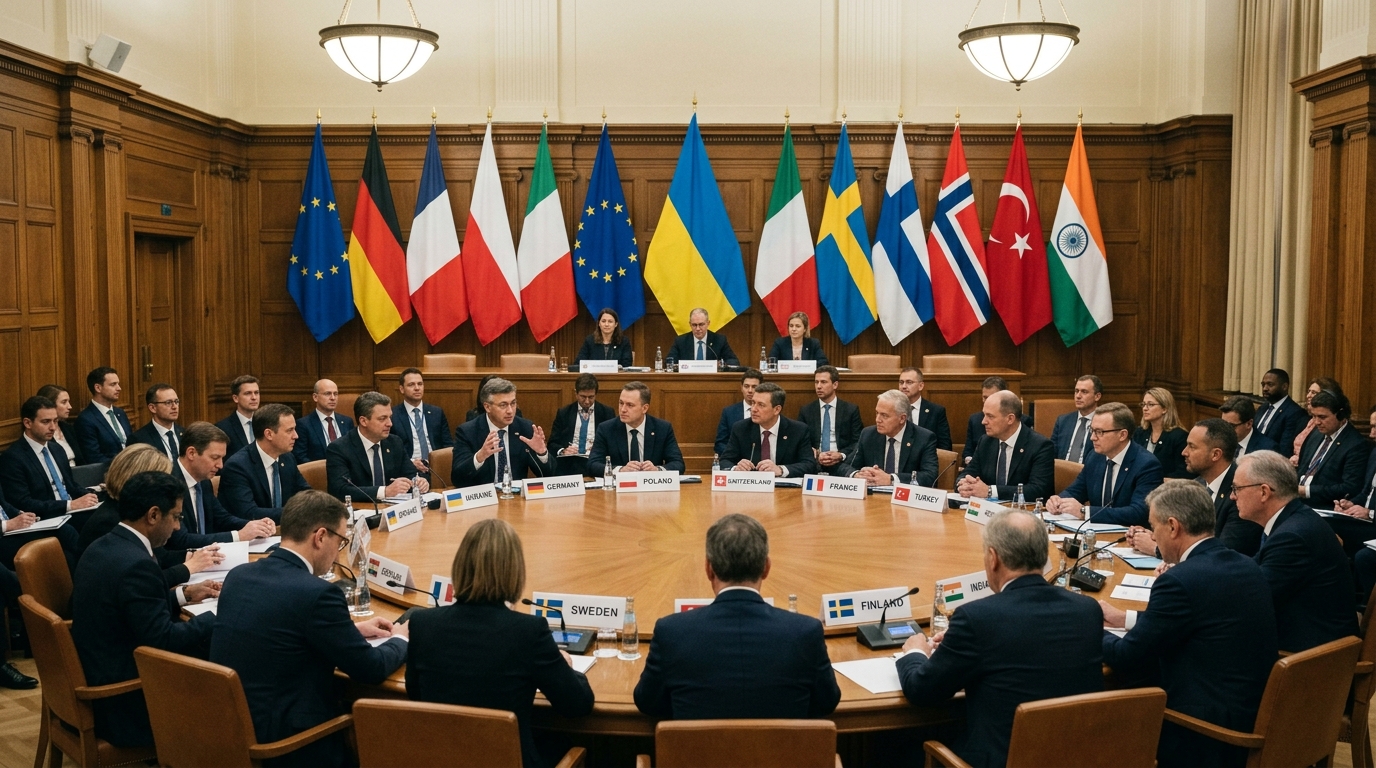
February 2025: Beijing Peace Summit and China's 12-Point Proposal Responding to global pressure and its own strategic interests, China convened a high-profile peace summit in Beijing. At this gathering, Beijing formally unveiled a comprehensive 12-point security architecture proposal, building upon earlier, vaguer declarations. Key tenets included an immediate ceasefire, the establishment of demilitarized zones, respect for national sovereignty (while ambiguously defining which national borders), rejection of unilateral sanctions, and a framework for post-war reconstruction led by non-Western powers. While cautiously welcomed by some Global South nations, Western capitals viewed the proposal with skepticism, perceiving it as overtly pro-Russian in its emphasis on "legitimate security concerns" and lacking robust enforcement mechanisms for territorial integrity. Nevertheless, the summit solidified China's position as a significant, albeit self-interested, player in global mediation, directly challenging the traditional Western-led diplomatic frameworks.
March 2025: Kyiv-Moscow Backchannel Engagements Amidst the public diplomatic overtures, a crucial and largely unrecorded backchannel opened between Kyiv and Moscow. Facilitated by discreet intermediaries, possibly through non-aligned states in the Gulf or Central Asia, these informal talks focused predominantly on the technical and logistical challenges of establishing a buffer zone. Discussions included the potential width and depth of such a zone, methods of withdrawal, and initial concepts for third-party monitoring. These discussions, though fraught with mistrust and limited in scope, represented a reluctant acknowledgement from both belligerents that direct communication was becoming necessary to prevent further catastrophic escalation and manage the practicalities of any future de-escalation. Specific sticking points included the precise demarcation of the buffer zone, the composition and mandate of monitoring forces, and guarantees against surprise attacks during any phased withdrawal.
April 2025: The 'Line of Contact' Proposal Following the preliminary backchannel discussions, a more concrete initiative emerged: the "Line of Contact" proposal. This ambitious plan envisioned an 800-kilometer demilitarized zone stretching along the existing front lines, from the Dnipro River to the Luhansk region. The proposal, reportedly spearheaded by a consortium of neutral European and Asian nations, aimed to create a robust physical separation between the warring parties. However, its implementation faced immense technical and political hurdles. Key challenges included: defining the exact boundaries, given the complex and often fluid nature of the front; establishing a credible, sufficiently resourced, and genuinely neutral third-party monitoring force with a mandate to enforce compliance; and ensuring the safe evacuation and resettlement of civilian populations within the proposed zone. The historical precedent of the Korean DMZ, a heavily fortified and deadly frontier, underscored the difficulty of creating a truly demilitarized and peaceful buffer.
May 2025: NATO Summit Preparations and Security Guarantees As the prospects of a ceasefire grew, the focus shifted to Ukraine's long-term security. Preparations for the annual NATO Summit became dominated by intense debates over the nature of "security guarantees" for Ukraine. The previous consensus on eventual full membership had shattered under the weight of the war and the U.S. policy shift. Instead, discussions revolved around alternatives: enhanced military assistance packages, bilateral defense treaties with individual NATO members, or a "layered defense" strategy involving robust air defenses and advanced weaponry without the Article 5 collective defense clause. Divisions within NATO became starkly apparent, with Eastern European members advocating for stronger, immediate commitments, while some Western European nations and the U.S. expressed caution about any arrangement that could be perceived as dragging NATO directly into the conflict. This internal friction highlighted the existential challenge for NATO: how to protect European security without further provoking Russia or undermining the alliance's own cohesion.
Geopolitical Consequences and Aftermath
The potential freezing of the front lines in 2025 represents a profound departure from the "rules-based international order" that Western powers had vigorously promoted in the early 2020s. By implicitly conceding that territorial integrity, a cornerstone of post-WWII international law, could not be restored solely through military force, the international community faced a deep crisis of legitimacy and a recalibration of geopolitical norms. The consequences of this emerging status quo were far-reaching and complex.
Consequences of the 2025 status quo:
- European Strategic Autonomy: The realization that the U.S. was prioritizing internal stability and transactional diplomacy over open-ended European collective security accelerated calls for an independent, robust EU defense pillar. This manifested in increased discussions within Brussels about common defense procurement, joint military exercises, and the potential for an autonomous European command structure, largely championed by France and Germany. The aim was to reduce reliance on the U.S. security umbrella, particularly in the face of a more assertive and unpredictable Russia, and to establish the EU as a truly independent geopolitical actor capable of managing its own neighborhood security without external guarantees. However, this aspiration was met with significant practical challenges, including disparate national defense budgets, differing strategic priorities among member states, and the sheer scale of investment required to build capabilities equivalent to NATO's.
- The Russian Integration Model: A frozen conflict provided Russia with a crucial opportunity to cement its administrative, political, and economic control over the occupied territories. This involved a process of "passportization," issuing Russian passports to Ukrainian citizens, integrating local economies into the Russian system, implementing Russian curricula in schools, and actively suppressing Ukrainian cultural identity. This strategy effectively created an "irredentist wall" along the new de facto borders, making future reintegration of these territories into Ukraine an exponentially more difficult, if not impossible, prospect. This consolidation also had implications for Russia's broader foreign policy, showcasing a willingness to challenge international norms and creating a precedent for future interventions in its perceived sphere of influence, potentially emboldening similar actions in Moldova (Transnistria) or Central Asia.
- Ukraino-Centric Realignment: Ukraine was forced to undergo a painful but necessary strategic pivot. From an offensive-oriented military state driven by the goal of total liberation, it had to adapt to a "Fortress Ukraine" model. This involved prioritizing defensive depth, investing heavily in advanced air defense systems, anti-tank capabilities, and robust border fortifications along the new contact line. The focus shifted from territorial reconquest to long-term domestic security, economic resilience, and the protection of its remaining sovereign territory. This realignment also entailed significant internal challenges: managing the trauma of war, integrating millions of internally displaced persons, addressing widespread infrastructure damage, and mitigating the political fallout of having to accept a truncated nation-state. The "Fortress Ukraine" model emphasized self-reliance, domestic arms production, and a strong national identity forged in resistance, even as it grappled with the implications of a smaller, more defensively oriented state.
- Erosion of International Norms and Institutions: Beyond the immediate belligerents, the 2025 developments cast a long shadow over the efficacy of international law and multilateral institutions. The inability of the United Nations Security Council to decisively act, due to Russia's veto power, further highlighted its structural limitations. The principle of territorial integrity, upheld as sacrosanct since the Helsinki Accords, was visibly undermined. This erosion risked creating a more anarchic international system where great powers might feel emboldened to alter borders by force, setting a dangerous precedent for conflicts globally and weakening the very foundations of international stability.
Analysis of Key Actors and Decisive Actions
The diplomatic and military landscape of 2025 was shaped by the distinct strategies and internal pressures faced by its principal actors. Each leader navigated a treacherous path, balancing national interests with geopolitical realities.
Donald Trump and the Transactional Peace
The Trump administration's approach in 2025 was unapologetically transactional, rooted in the "Peace through Strength" rhetoric, reinterpreted as a pragmatic, cost-benefit analysis. Trump's core strategy involved conditioning further American military and financial aid on the immediate cessation of hostilities and a willingness to negotiate a "deal." This was designed as a dual pressure tactic: to force Volodymyr Zelensky to the negotiating table by removing the previous administration's safety net of open-ended support, while simultaneously pressuring Vladimir Putin with the implicit threat of renewed, escalatory military aid to Ukraine if a viable agreement was refused. The internal memorandum from a Senior White House Advisor, "The time for endless funding has passed; it is time for a durable, localized arrangement that preserves sovereignty without hemorrhaging American capital," encapsulated this shift. For Trump, the conflict was an American financial burden that needed to be resolved to re-focus on domestic priorities and competition with China. His administration was willing to countenance outcomes previously deemed unacceptable by Western allies, prioritizing a quick resolution over strict adherence to international legal norms, alienating some European partners but appealing to a domestic constituency weary of foreign entanglements.
Vladimir Putin: Consolidation over Conquest
For the Kremlin, 2025 marked a strategic recalibration. The initial grand ambitions of rapid conquest and regime change in Ukraine had proven prohibitively expensive in terms of human lives, military materiel, and economic sanctions. Therefore, Putin’s primary objective in 2025 was not further territorial expansion, but rather the legalization of the status quo—the de facto administrative and territorial control Russia had established over Ukrainian regions since 2014 and intensified since 2022. Putin’s diplomatic efforts aimed to secure a "Neutrality Charter" that would constitutionally bar Ukraine from joining NATO, effectively achieving the strategic security objectives of his 2021 pre-invasion demands through diplomacy rather than continuous, costly combat. This Charter would likely include limitations on Ukraine's military size and capabilities, and possibly guarantees regarding language rights for Russian speakers. Domestically, Putin sought to present the cessation of hostilities as a victory, legitimizing the territorial gains and positioning himself as the protector of Russian historical lands, despite the immense toll the war had taken on Russia’s economy and demographics. The consolidation of occupied territories into the Russian Federation, through referendums and administrative integration, was a crucial part of this legalization strategy.
Volodymyr Zelensky: The Burden of Realism
President Zelensky faced arguably the most complex and agonizing challenge. Having rallied his nation around the promise of restoring Ukraine’s 1991 borders and defending its sovereignty at all costs, the 2025 initiatives required a painful pivot toward "pragmatic territorial preservation." This shift, forced by the changing international landscape and the unsustainable costs of continued total war, carried immense political risk. Zelensky had to manage profound domestic expectations, navigating the profound psychological impact of potential territorial concessions on a populace that had sacrificed so much. The threat of an internal fracture within the Ukrainian government and society was palpable, caught between factions advocating for total war until victory and those recognizing the grim necessity of a ceasefire to prevent national collapse. His leadership was tested in its ability to articulate a new vision for Ukraine – one of resilient defense and reconstruction within a potentially smaller, but secure, sovereign state. The political tightrope involved justifying the compromises to a traumatized and often radicalized populace, potentially through referendums or a national dialogue on the future of occupied territories.
The Role of China
China’s emergence as a visible broker for the "Global South" in 2025 was a calculated geopolitical maneuver. By presenting a neutral, albeit subtly pro-Russian-leaning, diplomatic framework, Beijing strategically positioned itself to lead post-war reconstruction efforts and exert influence in a new European security order. This was a multi-pronged strategic play:
- Economic Stabilization: To stabilize crucial European trade routes and ensure the continuity of its Belt and Road Initiative, which had been disrupted by the conflict.
- Geopolitical Influence: To challenge the U.S.-led "rules-based order" and solidify its "Global South" leadership credentials, demonstrating a multipolar alternative to Western-centric diplomacy.
- Strategic Opportunities: To lock in economic partnerships in a post-war Ukraine (or a partitioned one), potentially bypassing Western sanctions regimes and extending its economic reach.
Beijing's peace plan was often criticized for its ambiguity on territorial integrity and its emphasis on "legitimate security concerns" (a veiled reference to NATO expansion), but it allowed China to project an image of a responsible global power while advancing its own long-term strategic interests in reshaping the global power balance.
Intelligence and Information Warfare in the 2025 Landscape
The landscape of 2025 peace initiatives was deeply influenced, and at times manipulated, by the ongoing intelligence and information warfare campaigns waged by all involved parties. Intelligence assessments, often contradictory or incomplete, profoundly shaped the diplomatic maneuvers and military postures.
Intelligence Assessments and Decision-Making:
- Western Intelligence (CIA, MI6, BND): Intelligence agencies provided continuous assessments on Russian capabilities, the impact of sanctions, internal Kremlin dynamics, and the sustainability of Ukrainian resistance. These reports often highlighted the growing attrition on both sides, informing Western leaders that a decisive military victory for Ukraine was increasingly unlikely without unprecedented and potentially escalatory commitments. Assessments of Russian troop morale, equipment depletion, and the effectiveness of Western military aid were crucial in shaping the U.S. and NATO's policy shifts towards a "freeze."
- Russian Intelligence (SVR, GRU): The Kremlin relied on its intelligence services to gauge Western resolve, the extent of European disunity, and the internal political stability of Ukraine. Reports likely emphasized Western aid fatigue, the strains on Ukrainian mobilization, and the perceived vulnerability of Kyiv to external pressure. These assessments likely contributed to Putin's confidence that a diplomatic "freeze" could cement Russia's territorial gains without further debilitating military action.
- Ukrainian Intelligence (GUR, SBU): Ukrainian intelligence focused on identifying Russian vulnerabilities, potential breakthrough points, and the impact of sanctions. However, by 2025, their assessments increasingly acknowledged the severe human and material costs of continued high-intensity warfare, feeding into President Zelensky's painful "burden of realism." Intelligence failures, such as underestimating the depth of Russian fortifications or overestimating the speed of Western arms delivery, had contributed to the disappointing outcomes of the 2024 offensives.
The Role of Information Warfare: Beyond traditional intelligence, information warfare remained a critical battleground. Both Russia and Ukraine engaged in sophisticated campaigns to shape narratives, both domestically and internationally.
- Russian Narratives: Moscow consistently pushed the narrative of NATO aggression, the necessity of "denazification," and the protection of Russian speakers. Domestically, state media amplified themes of heroic resistance against a Western proxy war, preparing the population for potential territorial concessions as a "victory" against existential threats. Internationally, they sought to sow discord within NATO and depict Ukraine as a failing state incapable of independent existence.
- Ukrainian Narratives: Kyiv maintained its focus on national sovereignty, territorial integrity, and the defense of democratic values against imperial aggression. The challenge in 2025 was adapting this narrative to explain the shift towards pragmatic compromise, balancing the need for national unity with the difficult realities of a protracted conflict. This involved carefully framing potential concessions as a necessary step to preserve the nation, rather than a surrender of principles.
- Third-Party Influence: China, in its mediating role, used its state media and diplomatic channels to promote a narrative of neutrality and responsible global leadership, implicitly criticizing Western "hegemony" and advocating for a new, multipolar security architecture.
The Trust Deficit and Verification Challenges: A profound "trust deficit" between Kyiv and Moscow, deeply rooted in historical grievances and recent betrayals (such as the violation of the Budapest Memorandum and the Minsk Agreements), made any peace initiative inherently precarious. Intelligence agencies played a crucial role in attempts to verify information and monitor compliance, particularly concerning proposed demilitarized zones. However, the lack of genuine trust meant that any monitoring mechanism would need to be exceptionally robust, transparent, and internationally mandated, a significant challenge given the existing geopolitical fault lines. The ongoing cyber warfare and digital espionage further complicated verification efforts, as both sides sought to exploit vulnerabilities and sow disinformation.
Trivia and Lesser-Known Facts
- The "Track 1.5" Diplomacy: In early 2025, a series of highly secretive "Track 1.5" diplomatic meetings took place, primarily in neutral Gulf states such as Oman and the UAE. These weren't formal government-to-government talks (Track 1) but involved mid-level military intelligence officers and retired senior military figures from both Kyiv and Moscow, sometimes facilitated by discreet academic or non-governmental intermediaries. Their agenda was strictly limited to technical, non-political issues, such as mine-clearing protocols along specific front sectors, the mechanics of potential prisoner exchanges beyond high-profile swaps, and protocols for identifying and repatriating fallen soldiers. These focused, pragmatic discussions aimed to build minimal operational trust for future de-escalation, bypassing the political deadlock at higher levels.
- Digital Sovereignty and Starlink: A critical, often overlooked element of the 2025 negotiations involved the future of satellite communications infrastructure, particularly Elon Musk’s Starlink. Both sides raised concerns about "digital sovereignty," with Russia demanding guaranteed non-interference in its communication spheres and access for its proxies in occupied territories, while Ukraine sought assurances of uninterrupted service and protection against jamming or targeting. Informal discussions explored the possibility of creating "neutral digital corridors" or zones where satellite internet access would be managed by a third-party consortium or subjected to strict international oversight, effectively treating digital infrastructure as a potential de-escalation mechanism rather than a weapon of war.
- Energy Infrastructure as a "Grid-for-Peace" Agreement: Deep within the secret, implicit part of the peace talks lay the concept of a "grid-for-peace" agreement. This involved leveraging cross-border energy dependencies as a de-escalation mechanism. Prior to the full-scale invasion, Ukraine had relied on Russian-sourced nuclear fuel and some electricity transfers, while Russia utilized Ukrainian pipelines for gas transit to Europe. The 2025 proposal explored a mutual restoration of critical energy infrastructure links, particularly in regions devastated by shelling, under international monitoring. The idea was that shared reliance on an intact energy grid would create a disincentive for renewed hostilities, as damaging these assets would harm both sides. Specific discussions focused on the Zaporizhzhia Nuclear Power Plant and its connection to Ukraine's national grid, proposing its full demilitarization and operation under UN or IAEA oversight, with guarantees of power supply to both Ukrainian and Russian-controlled territories.
- The Odessa Port Question: Although not prominently featured in public discourse, the future of the Odessa port and the broader Black Sea access became a silent yet pivotal point of contention. While Russia had largely failed to seize Odessa, its continued naval blockade and missile strikes significantly hampered Ukrainian grain exports and overall economic viability. Informal proposals circulating in diplomatic circles suggested a possible "internationalized zone" for Odessa's port, granting special status under a multilateral guarantee to ensure safe passage for commercial shipping, perhaps mirroring historical arrangements for strategic waterways or the Bosporus Straits. However, both Kyiv and Moscow viewed any such proposal with deep suspicion, fearing it would compromise their respective sovereign claims and strategic interests in the Black Sea.
References and Literature
- Foreign Affairs: The Future of European Security - A comprehensive analysis published in early 2025, exploring how existing European security architectures were shifting, particularly in response to U.S. policy changes and the emergence of regionalized buffer states or zones. The articles often debated the efficacy of "strategic autonomy" versus continued NATO reliance.
- Council on Foreign Relations: The Korean Model in Ukraine - An academic comparison frequently referenced by policymakers, drawing parallels between the 1953 Korean armistice and the proposed Ukrainian peace initiatives, analyzing the long-term implications of frozen conflicts and the challenges of international monitoring.
- UN Archive: 2025 Diplomatic Missions - Official transcripts and reports from various United Nations security council sessions and special envoy missions concerning the proposed demilitarized zones, humanitarian corridors, and the legal complexities surrounding any non-consensual territorial changes.
- Carnegie Endowment for International Peace: China's Role in a Multipolar World - A series of analytical pieces examining Beijing's evolving foreign policy doctrine, its "Global South" strategy, and its increasing assertiveness in mediating international conflicts, specifically highlighting its 2025 peace proposals for Ukraine.
- International Crisis Group: Managing Frozen Conflicts - In-depth reports providing historical context and best practices for managing and potentially resolving frozen conflicts, offering crucial insights into the mechanisms of de-escalation and the prevention of renewed hostilities.
Footnotes & Explanations
- Denotes the transition from high-intensity conflict to protracted low-intensity post-conflict management, emphasizing resource depletion and shifting political objectives. ↩
- Refers to the intense internal political friction in Kyiv regarding constitutional changes and potential territorial concessions required for any form of security guarantees, highlighting the profound challenge to national unity. ↩